When Black Holes Can Wear Pants
Pith reviewed 2026-06-25 22:54 UTC · model grok-4.3
The pith
Black hole fragmentation into multiple horizons is forbidden by the area law and kinematics in classical four-dimensional general relativity but can become entropically favored in higher dimensions, under superradiance, or in modified gravi
A machine-rendered reading of the paper's core claim, the machinery that carries it, and where it could break.
Core claim
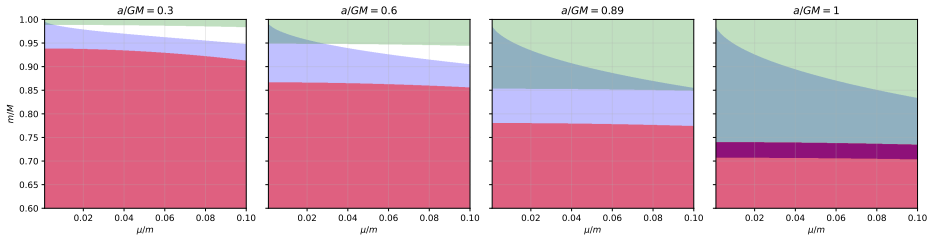
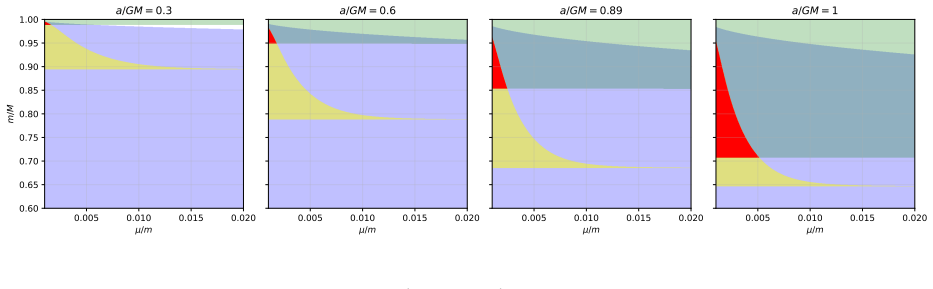
In classical general relativity the Bekenstein-Hawking area law forbids black hole fragmentation for Schwarzschild black holes, and kinematic constraints prevent it for Kerr black holes except possibly near-extremal cases; fragmentation can be entropically favored in higher-dimensional, superradiant, or modified-gravity scenarios but still depends on initial kinematics.
What carries the argument
black hole fragmentation, the splitting of one horizon into multiple horizons whose total area and entropy are compared against the initial state
If this is right
- Emission of small fragments can increase total entropy when the entropy-mass relation is altered by extra dimensions or modified gravity.
- Kinematic constraints still limit which initial black hole states can actually fragment even when entropy favors the process.
- Primordial black holes in higher-dimensional or modified-gravity cosmologies could evolve by shedding smaller black holes.
- Black hole mergers could end with multiple remnants instead of a single final black hole if the post-merger state satisfies the fragmentation conditions.
Where Pith is reading between the lines
- Gravitational-wave signals from mergers might carry signatures of temporary multi-horizon states if fragmentation occurs.
- The same entropy-versus-kinematics logic could be applied to test specific modified-gravity models against future black-hole observations.
- Near-extremal astrophysical black holes become the most interesting targets for searching fragmentation effects.
Load-bearing premise
Entropic favorability or the presence of an instability is sufficient to overcome kinematic barriers and produce actual fragmentation rather than merely permitting it in principle.
What would settle it
A numerical simulation of a near-extremal Kerr black hole or a higher-dimensional black hole that shows an instability causing the horizon to split into two separate horizons within finite time.
Figures




read the original abstract
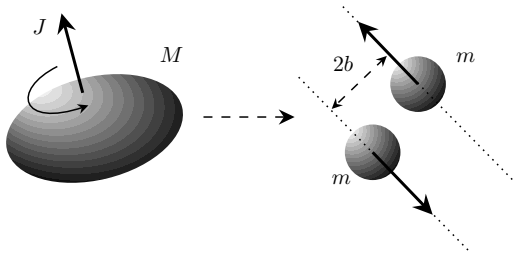
We investigate the conditions under which black hole fragmentation, the splitting of a black hole horizon into multiple smaller ones, may occur. The simplest realization is that of a single black hole horizon splitting into two, giving rise to the eponymous pants topology. In classical general relativity, the Bekenstein-Hawking area law forbids such processes for Schwarzschild black holes. For spinning Kerr black holes, purely kinematic analyses impose constraints that prevent fragmentation, even in regimes where entropy considerations might allow it, except possibly in near-extremal cases. We then hunt for scenarios where black holes can wear pants: from the well-known Gregory-Laflamme instability in higher dimensions, to the potential effect of superradiant instabilities in non-axisymmetric radiation trapping, to finally gravitational models that modify the relations between entropy and/or horizon radius and the black hole mass in four dimensions. In all such cases, emission of small fragments can be entropically favored, however its occurrence still depends on the kinematic configuration of the initial state. Our analysis clarifies the theoretical landscape where black holes may fragment, which is particularly relevant for primordial black holes and catastrophic events such as black hole mergers.
Editorial analysis
A structured set of objections, weighed in public.
Referee Report
Summary. The manuscript investigates conditions under which black hole fragmentation (splitting of a horizon into multiple smaller ones, yielding pants topology) may occur. It states that the Bekenstein-Hawking area law forbids fragmentation for Schwarzschild black holes in classical GR, while kinematic constraints prevent it for Kerr black holes except possibly near-extremal cases. The paper then examines scenarios where small-fragment emission can be entropically favored, including the Gregory-Laflamme instability in higher dimensions, superradiant instabilities, and modified-gravity models altering entropy-mass or horizon-radius relations in four dimensions. In all such cases, actual occurrence still depends on the kinematic configuration of the initial state. The analysis is framed as clarifying the theoretical landscape, with relevance to primordial black holes and mergers.
Significance. If the analysis holds, the work provides a useful map of the regimes where fragmentation is classically forbidden versus those where it becomes entropically allowed, while correctly emphasizing that entropic favorability alone does not guarantee dynamical realization. The explicit hedging regarding kinematic dependence is a strength that keeps the claims proportionate. No machine-checked proofs or reproducible code are mentioned, but the grounding in standard GR tools (area law, superradiance, Gregory-Laflamme) and the focus on falsifiable kinematic conditions add value to the literature on black-hole instabilities and modified gravity.
minor comments (1)
- [Abstract] The abstract refers to 'non-axisymmetric radiation trapping' without a brief parenthetical definition or reference; a short clarification would aid readers unfamiliar with the specific superradiant mechanism.
Simulated Author's Rebuttal
We thank the referee for their positive assessment of the manuscript, including the recognition that the analysis provides a useful map of regimes where fragmentation is forbidden versus entropically allowed, while correctly emphasizing kinematic dependence. We are pleased that the referee recommends acceptance.
Circularity Check
No significant circularity
full rationale
The paper presents an analysis of black hole fragmentation conditions based on the standard Bekenstein-Hawking area law, kinematic constraints in GR, and known instabilities or modifications in other scenarios. No equations, derivations, or claims reduce by construction to fitted inputs, self-definitions, or self-citation chains. The central statements remain hedged on kinematic dependence and cite external established results without load-bearing self-references or renaming of known patterns as new derivations. The derivation chain is self-contained against external benchmarks.
Axiom & Free-Parameter Ledger
Reference graph
Works this paper leans on
-
[1]
Schwarzschild black holes 7 2.2
General Relativity constraints on Black Hole pants, a brief summary 6 2.1. Schwarzschild black holes 7 2.2. Kerr black holes 7 2.3. Higher dimensions 13 2.3.1. Induced metric of ad-dimensional black hole on a 4-dimensional brane 17
-
[2]
Effective fragmentation from superradiance instability? 19
-
[3]
Modified gravity: higher curvature corrections 21 4.2
Black holes do wear pants beyond GR 21 4.1. Modified gravity: higher curvature corrections 21 4.2. Modified gravity: General deformations 24 4.3. Bumpy horizons 27
-
[4]
Conclusion 28 Acknowledgments 30 References 30 2
-
[5]
wear pants
INTRODUCTION Answering the question whether a black hole can“wear pants”, that is, whether a single horizon can evolve into a configuration that effectively resembles multiple black holes, is a probe of the interplay between dynamics, thermodynamics, and global structure in gravity. The simplest illustration of this process would be a single black hole ho...
-
[6]
gravitational potential
GENERAL RELATIVITY CONSTRAINTS ON BLACK HOLE PANTS, A BRIEF SUMMARY We will first critically analyze why common lore says that black hole fragmentation is forbidden in GR by the second law of black hole thermodynamics. This law has a crucial assumption: the absence of matter violating the Null Energy Condition. This condition, however, is invalidated in m...
-
[7]
For the same reason, the area law also implies the possibility of superradiant scattering [ 13], namely the amplification of waves interacting with a rotating black hole
EFFECTIVE FRAGMENTATION FROM SUPERRADIANCE INSTABILITY? While analyzing the (im)possibility of fragmentation for a Kerr black hole in four dimen- sions, we saw how the area law allows for the extraction of rotational energy from it. For the same reason, the area law also implies the possibility of superradiant scattering [ 13], namely the amplification of...
-
[8]
We will now explore how classical deviations from GR can also modify the area law, entropically favoring black hole fragmentation
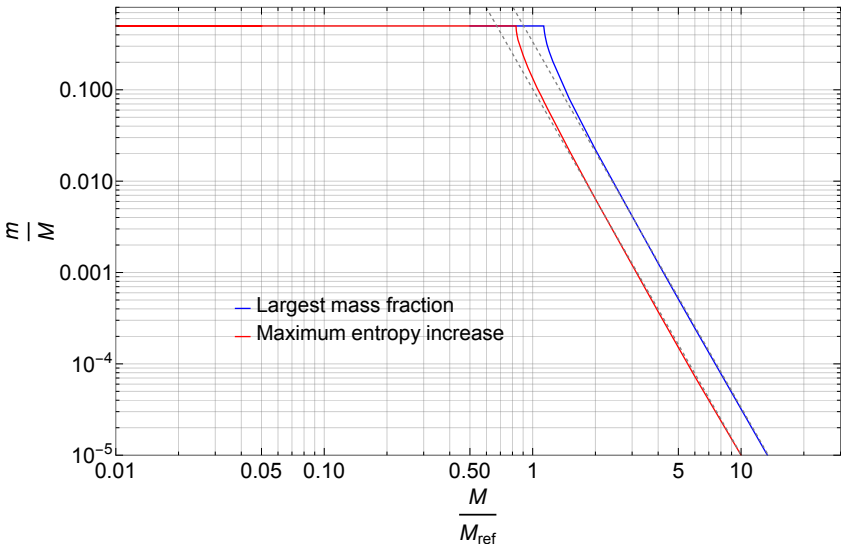
BLACK HOLES DO WEAR PANTS BEYOND GR We know that the area law is violated when we take into account semi-classical or quantum effects, an example of this is the Hawking evaporation itself [ 21]. We will now explore how classical deviations from GR can also modify the area law, entropically favoring black hole fragmentation. The first case consists in a cl...
-
[9]
28 Within four-dimensional GR, the absence of fragmentation is robust for Schwarzschild black holes due to the Bekenstein–Hawking entropy
CONCLUSION In this work we have systematically investigated the conditions under which black hole fragmentation may occur, mapping the boundary between what is forbidden, what is merely unlikely, and what becomes possible once the standard assumptions are relaxed. 28 Within four-dimensional GR, the absence of fragmentation is robust for Schwarzschild blac...
2025
-
[10]
Hawking,Gravitational radiation from colliding black holes,Phys
S.W. Hawking,Gravitational radiation from colliding black holes,Phys. Rev. Lett.26(1971) 1344
1971
-
[11]
LIGO Scientific, Virgo, KAGRAcollaboration,GW250114: Testing Hawking’s Area Law and the Kerr Nature of Black Holes,Phys. Rev. Lett.135(2025) 111403 [2509.08054]
Pith/arXiv arXiv 2025
-
[12]
S.-P. Tang, H.-T. Wang, Y.-J. Li and Y.-Z. Fan,Verification of the black hole area law with GW230814,Sci. Bull.71(2026) 83 [2509.03480]
arXiv 2026
-
[13]
Whiting,Mode Stability of the Kerr Black Hole,J
B.F. Whiting,Mode Stability of the Kerr Black Hole,J. Math. Phys.30(1989) 1301
1989
- [14]
-
[15]
R.M. Wald,General Relativity, Chicago Univ. Pr., Chicago, USA (1984), 10.7208/chicago/9780226870373.001.0001
-
[16]
G. Cacciapaglia, S. Hohenegger and F. Sannino,Looking for black hole morsels in astrophysical mergers via Hawking radiation,Nucl. Phys. B1018(2025) 117021 [ 2405.12880]
arXiv 2025
-
[17]
R. Gregory and R. Laflamme,Black strings and p-branes are unstable,Phys. Rev. Lett.70 (1993) 2837 [hep-th/9301052]
Pith/arXiv arXiv 1993
-
[18]
Myers and M.J
R.C. Myers and M.J. Perry,Black Holes in Higher Dimensional Space-Times,Annals Phys. 172(1986) 304. 30
1986
-
[19]
R. Emparan and R.C. Myers,Instability of ultra-spinning black holes,JHEP09(2003) 025 [hep-th/0308056]
Pith/arXiv arXiv 2003
-
[20]
R. Emparan, R. Suzuki and K. Tanabe,Instability of rotating black holes: large D analysis, JHEP06(2014) 106 [1402.6215]
arXiv 2014
-
[21]
L. Lehner and F. Pretorius,Black Strings, Low Viscosity Fluids, and Violation of Cosmic Censorship,Phys. Rev. Lett.105(2010) 101102 [1006.5960]
Pith/arXiv arXiv 2010
-
[22]
Press and S.A
W.H. Press and S.A. Teukolsky,Floating Orbits, Superradiant Scattering and the Black-hole Bomb,Nature238(1972) 211
1972
-
[23]
J.P. Conlon and C.A.R. Herdeiro,Can black hole superradiance be induced by galactic plasmas?,Phys. Lett. B780(2018) 169 [1701.02034]
Pith/arXiv arXiv 2018
-
[24]
P. Bueno and P.A. Cano,Four-dimensional black holes in Einsteinian cubic gravity,Phys. Rev. D94(2016) 124051 [1610.08019]
Pith/arXiv arXiv 2016
-
[25]
P. Bueno and P.A. Cano,Universal black hole stability in four dimensions,Phys. Rev. D96 (2017) 024034 [1704.02967]
Pith/arXiv arXiv 2017
-
[26]
F. Canfora, A. Gomberoff, C. Henr´ ıquez-Baez and A. Vera,Exact black holes and black branes with bumpy horizons supported by superfluid pions,2601.22914
-
[27]
Bekenstein,Black holes and the second law,Lett
J.D. Bekenstein,Black holes and the second law,Lett. Nuovo Cim.4(1972) 737
1972
-
[28]
Bekenstein,Black holes and entropy,Phys
J.D. Bekenstein,Black holes and entropy,Phys. Rev. D7(1973) 2333
1973
-
[29]
Hawking,Black hole explosions,Nature248(1974) 30
S.W. Hawking,Black hole explosions,Nature248(1974) 30
1974
-
[30]
Hawking,Particle Creation by Black Holes,Commun
S.W. Hawking,Particle Creation by Black Holes,Commun. Math. Phys.43(1975) 199
1975
-
[31]
Horowitz and A
G.T. Horowitz and A. Strominger,Black strings and P-branes,Nucl. Phys. B360(1991) 197
1991
-
[32]
T. Andrade, R. Emparan, A. Jansen, D. Licht, R. Luna and R. Suzuki,Entropy production and entropic attractors in black hole fusion and fission,JHEP08(2020) 098 [2005.14498]
arXiv 2020
-
[33]
G.T. Horowitz and E.J. Martinec,Comments on black holes in matrix theory,Phys. Rev. D 57(1998) 4935 [hep-th/9710217]
Pith/arXiv arXiv 1998
-
[34]
T. Andrade, R. Emparan, D. Licht and R. Luna,Black hole collisions, instabilities, and cosmic censorship violation at largeD,JHEP09(2019) 099 [1908.03424]
arXiv 2019
-
[35]
Tangherlini,Schwarzschild field in n dimensions and the dimensionality of space problem, Nuovo Cim.27(1963) 636
F.R. Tangherlini,Schwarzschild field in n dimensions and the dimensionality of space problem, Nuovo Cim.27(1963) 636
1963
-
[36]
Zeldovich,Generation of Waves by a Rotating Body,Soviet Journal of Experimental and Theoretical Physics Letters14(1971) 180
Y.B. Zeldovich,Generation of Waves by a Rotating Body,Soviet Journal of Experimental and Theoretical Physics Letters14(1971) 180. 31
1971
-
[37]
Penrose and R.M
R. Penrose and R.M. Floyd,Extraction of rotational energy from a black hole,Nature229 (1971) 177
1971
-
[38]
R. Brito, V. Cardoso and P. Pani,Black holes as particle detectors: evolution of superradiant instabilities,Class. Quant. Grav.32(2015) 134001 [1411.0686]
Pith/arXiv arXiv 2015
-
[39]
R. Brito, V. Cardoso and P. Pani,Superradiance: New Frontiers in Black Hole Physics,Lect. Notes Phys.906(2015) pp.1 [1501.06570]
Pith/arXiv arXiv 2015
-
[40]
Lode and C
A.U.J. Lode and C. Bruder,Fragmented superradiance of a bose-einstein condensate in an optical cavity,Phys. Rev. Lett.118(2017) 013603
2017
-
[41]
A. Dima and E. Barausse,Numerical investigation of plasma-driven superradiant instabilities, Class. Quant. Grav.37(2020) 175006 [2001.11484]
arXiv 2020
-
[42]
G. Lingetti, E. Cannizzaro and P. Pani,Superradiant instabilities by accretion disks in scalar-tensor theories,Phys. Rev. D106(2022) 024007 [2204.09335]
arXiv 2022
-
[43]
G. Lambiase, T.K. Poddar and L. Visinelli,Impact of the cosmic neutrino background on black hole superradiance,Phys. Rev. D112(2025) 016010 [2503.02940]
arXiv 2025
-
[44]
V. Cardoso, W.-D. Guo, C.F.B. Macedo and P. Pani,The tune of the Universe: the role of plasma in tests of strong-field gravity,Mon. Not. Roy. Astron. Soc.503(2021) 563 [2009.07287]
arXiv 2021
-
[45]
E. Cannizzaro, F. Corelli and P. Pani,Nonlinear photon-plasma interaction and the black hole superradiant instability,Phys. Rev. D109(2024) 023007 [2306.12490]
arXiv 2024
-
[46]
A. Held and J. Zhang,Instability of spherically symmetric black holes in quadratic gravity, Phys. Rev. D107(2023) 064060 [2209.01867]
arXiv 2023
-
[47]
H. L¨ u, A. Perkins, C.N. Pope and K.S. Stelle,Lichnerowicz Modes and Black Hole Families in Ricci Quadratic Gravity,Phys. Rev. D96(2017) 046006 [1704.05493]
Pith/arXiv arXiv 2017
-
[48]
R. Brito, V. Cardoso and P. Pani,Massive spin-2 fields on black hole spacetimes: Instability of the Schwarzschild and Kerr solutions and bounds on the graviton mass,Phys. Rev. D88 (2013) 023514 [1304.6725]
Pith/arXiv arXiv 2013
-
[49]
P. Bueno, P.A. Cano and R.A. Hennigar,Regular black holes from pure gravity,Phys. Lett. B 861(2025) 139260 [2403.04827]
arXiv 2025
-
[50]
P.A. Cano, L. Capuano, N. Franchini, S. Maenaut and S.H. V¨ olkel,Higher-derivative corrections to the Kerr quasinormal mode spectrum,Phys. Rev. D110(2024) 124057 [2409.04517]. 32
arXiv 2024
-
[51]
P.A. Cano, K. Fransen and T. Hertog,Ringing of rotating black holes in higher-derivative gravity,Phys. Rev. D102(2020) 044047 [2005.03671]
arXiv 2020
-
[52]
A. Hussain and A. Zimmerman,Approach to computing spectral shifts for black holes beyond Kerr,Phys. Rev. D106(2022) 104018 [2206.10653]
arXiv 2022
- [53]
- [54]
-
[55]
A. Simpson and M. Visser,Black-bounce to traversable wormhole,1812.07114
-
[57]
E. Ayon-Beato and A. Garcia,Regular black hole in general relativity coupled to nonlinear electrodynamics,Phys. Rev. Lett.80(1998) 5056 [gr-qc/9911046]
Pith/arXiv arXiv 1998
-
[58]
Bardeen,Non-singular general relativistic gravitational collapse, inProceedings of the International Conference GR5, (Tblisi, U.S.S.R.), 1968
J.M. Bardeen,Non-singular general relativistic gravitational collapse, inProceedings of the International Conference GR5, (Tblisi, U.S.S.R.), 1968
1968
-
[59]
Hayward,Formation and evaporation of non-singular black holes,Phys
S.A. Hayward,Formation and evaporation of non-singular black holes,Phys. Rev. Lett.96 (2006) 031103 [gr-qc/0506126]
Pith/arXiv arXiv 2006
-
[60]
Dymnikova,Vacuum nonsingular black hole,Gen
I. Dymnikova,Vacuum nonsingular black hole,Gen. Relativ. Gravit.24(1992) 235
1992
-
[61]
Z.-Y. Fan and X. Wang,Construction of regular black holes in general relativity,Phys. Rev. D 94(2016) 124027 [1610.02636]
Pith/arXiv arXiv 2016
-
[62]
E. Binetti, M. Del Piano, S. Hohenegger, F. Pezzella and F. Sannino,Effective theory of quantum black holes,Phys. Rev. D106(2022) 046006 [2203.13515]
arXiv 2022
-
[63]
M. Del Piano, S. Hohenegger and F. Sannino,Quantum black hole physics from the event horizon,Phys. Rev. D109(2024) 024045 [2307.13489]
arXiv 2024
-
[64]
M. Del Piano, S. Hohenegger and F. Sannino,Effective metric descriptions of quantum black holes,Eur. Phys. J. C84(2024) 1273 [2403.12679]
arXiv 2024
-
[65]
M. Del Piano, C. De Simone, M. Damia Paciarini, V. De Falco, M. Myszkowski, F. Sannino et al.,Toward a unified view of agnostic parametrizations for deformed black holes,Phys. Rev. D113(2026) 064010 [2510.14707]. 33
arXiv 2026
-
[66]
Carlip,Logarithmic corrections to black hole entropy from the Cardy formula,Class
S. Carlip,Logarithmic corrections to black hole entropy from the Cardy formula,Class. Quant. Grav.17(2000) 4175 [gr-qc/0005017]
Pith/arXiv arXiv 2000
-
[67]
N.A. Collins and S.A. Hughes,Towards a formalism for mapping the space-times of massive compact objects: Bumpy black holes and their orbits,Phys. Rev. D69(2004) 124022 [gr-qc/0402063]
Pith/arXiv arXiv 2004
-
[68]
Novikov and V.S
I.D. Novikov and V.S. Manko,Generalizations of the Kerr and Kerr-Newman metrics possessing an arbitrary set of mass-multipole moments,Class. Quant. Grav.9(1992) 2477
1992
-
[69]
T. Johannsen and D. Psaltis,A Metric for Rapidly Spinning Black Holes Suitable for Strong-Field Tests of the No-Hair Theorem,Phys. Rev. D83(2011) 124015 [1105.3191]
Pith/arXiv arXiv 2011
-
[70]
S. Vigeland, N. Yunes and L. Stein,Bumpy Black Holes in Alternate Theories of Gravity, Phys. Rev. D83(2011) 104027 [1102.3706]
Pith/arXiv arXiv 2011
-
[71]
R. Emparan, P. Figueras and M. Martinez,Bumpy black holes,JHEP12(2014) 072 [1410.4764]
Pith/arXiv arXiv 2014
-
[72]
S. Dubovsky, P. Tinyakov and M. Zaldarriaga,Bumpy black holes from spontaneous Lorentz violation,JHEP11(2007) 083 [0706.0288]
Pith/arXiv arXiv 2007
-
[73]
Suh,Baryonic spindles from conifolds,JHEP02(2025) 181 [2304.03308]
M. Suh,Baryonic spindles from conifolds,JHEP02(2025) 181 [2304.03308]
arXiv 2025
-
[74]
K. Hristov and M. Suh,Spindle black holes in AdS 4× SE7,JHEP10(2023) 141 [ 2307.10378]
arXiv 2023
-
[75]
N. Farhangkhah and M.H. Dehghani,Lovelock black holes with nonmaximally symmetric horizons,Phys. Rev. D90(2014) 044014 [1409.1410]. 34
Pith/arXiv arXiv 2014
discussion (0)
Sign in with ORCID, Apple, or X to comment. Anyone can read and Pith papers without signing in.