Preparing multi-qudit states in a definite-weight subspace
Pith reviewed 2026-06-25 23:33 UTC · model grok-4.3
The pith
A deterministic algorithm prepares arbitrary multi-qudit states in a definite-weight subspace by ordering basis states according to a Gray code for multiset permutations.
A machine-rendered reading of the paper's core claim, the machinery that carries it, and where it could break.
Core claim
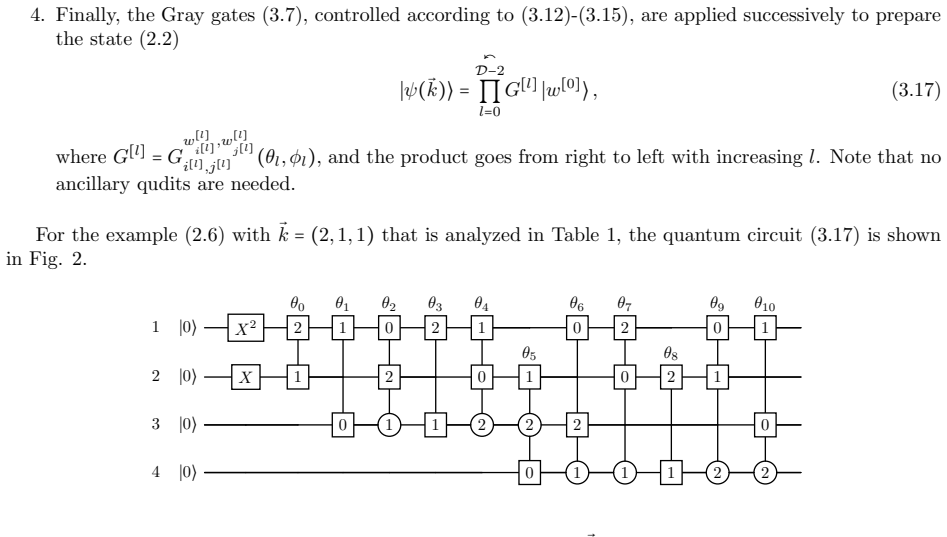
By ordering the computational basis states according to a Gray code for multiset permutations, the state-preparation task is reduced to performing a sequence of controlled 2-qudit Gray rotations. This yields a deterministic algorithm for arbitrary multi-qudit states in a definite-weight subspace, which is used to prepare Bethe states of the SU(3)-invariant Heisenberg Hamiltonian and SU(d) Dicke states.
What carries the argument
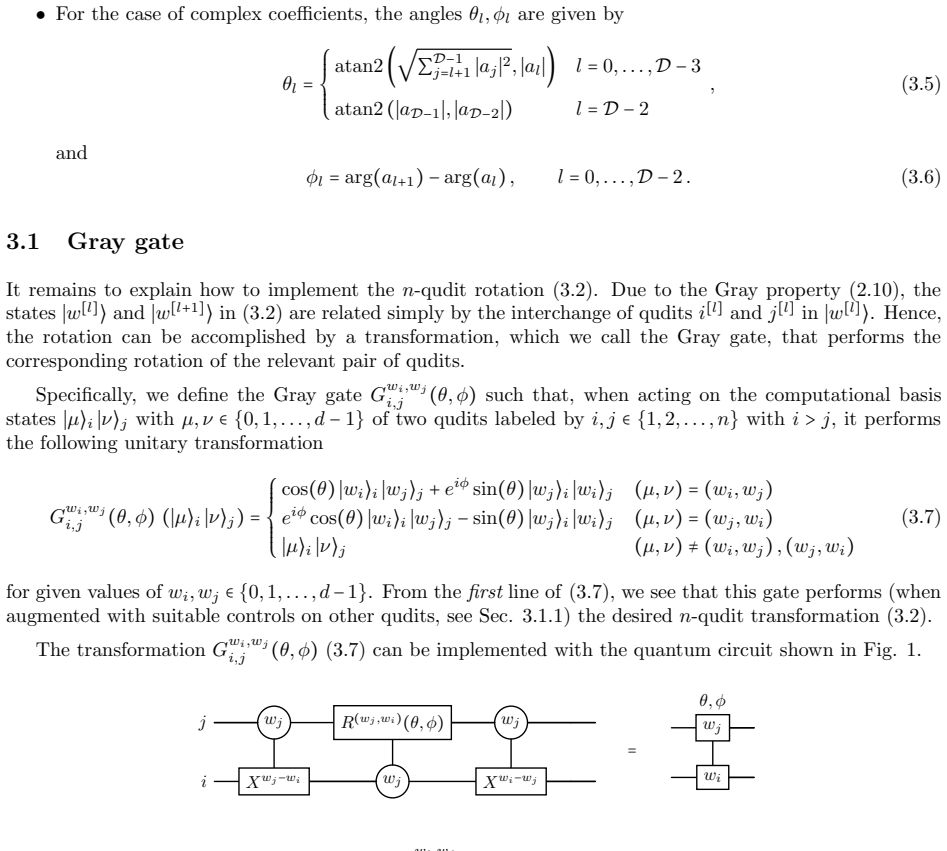
Gray code for multiset permutations that orders the basis states so successive states differ by a single controlled 2-qudit Gray rotation.
If this is right
- Exact, deterministic preparation of nested Bethe-ansatz eigenstates for the SU(3) Heisenberg model becomes possible on qudit hardware.
- SU(d) Dicke states and their q-deformations can be prepared exactly inside the fixed-weight subspace.
- Any state in a definite-weight subspace reduces to a deterministic sequence of pairwise controlled rotations.
- The method supplies a concrete gate decomposition for preparing symmetric multi-qudit states without measurement or post-selection.
Where Pith is reading between the lines
- Hardware that supports efficient controlled 2-qudit rotations could run these preparations with linear depth in the number of basis states.
- The Gray-code ordering may extend to other symmetric subspaces, such as fixed total angular momentum, by constructing analogous permutation Gray codes.
- The construction supplies a systematic route to prepare initial states for quantum simulations of integrable spin chains with higher symmetry.
- If the rotations are native, the algorithm avoids the exponential overhead typical of unstructured state preparation in large Hilbert spaces.
Load-bearing premise
The controlled 2-qudit Gray rotations can be implemented as native or efficiently decomposable gates without extra overhead that would break the deterministic character of the procedure.
What would settle it
Implement the algorithm for a small number of qudits, apply the sequence of controlled rotations, and measure whether the resulting state matches the target definite-weight state to machine precision or whether the total gate count exceeds the length of the Gray-code sequence.
Figures


read the original abstract
We formulate a deterministic algorithm for preparing arbitrary multi-qudit states in a definite-weight subspace. By ordering the corresponding computational basis states according to a Gray code for multiset permutations, the state-preparation task is reduced to performing a sequence of controlled 2-qudit Gray rotations. We use this algorithm to prepare exact eigenstates of the SU(3)-invariant Heisenberg Hamiltonian, whose Bethe ansatz is nested. In particular, we describe the preparation of the Bethe states, which are SU(3) highest-weight states, as well as their lower-weight descendants. We also consider the preparation of $SU(d)$ Dicke states and their q-deformations.
Editorial analysis
A structured set of objections, weighed in public.
Referee Report
Summary. The manuscript formulates a deterministic algorithm for preparing arbitrary multi-qudit states in a definite-weight subspace. By ordering the corresponding computational basis states according to a Gray code for multiset permutations, the state-preparation task is reduced to performing a sequence of controlled 2-qudit Gray rotations. The algorithm is applied to prepare exact eigenstates of the SU(3)-invariant Heisenberg Hamiltonian (Bethe states as SU(3) highest-weight states and their lower-weight descendants) as well as SU(d) Dicke states and their q-deformations.
Significance. If the central reduction holds, the work supplies a constructive, deterministic procedure for preparing states in definite-weight subspaces of qudit systems. This is relevant for quantum simulation of higher-spin or SU(d)-symmetric models. The combinatorial Gray-code ordering provides a systematic, non-variational route to state preparation and is explicitly credited as the key technical step. The applications to nested Bethe ansatz states and q-deformed Dicke states illustrate concrete utility for integrable models.
minor comments (2)
- [Algorithm description section] The manuscript would benefit from an explicit small-scale example (e.g., two qutrits, weight 1) showing the multiset-permutation Gray code ordering, the resulting sequence of controlled rotations, and the final circuit depth.
- [Notation and definitions] Notation for the controlled 2-qudit Gray rotation operator should be defined once with an explicit matrix or action on basis states to avoid ambiguity when the control is in a superposition.
Simulated Author's Rebuttal
We thank the referee for their positive assessment of the manuscript, accurate summary of its contributions, and recommendation for minor revision. No major comments were raised in the report.
Circularity Check
No significant circularity identified
full rationale
The paper formulates a deterministic algorithm that orders definite-weight computational basis states according to a Gray code for multiset permutations and reduces preparation to a sequence of controlled 2-qudit Gray rotations. This is presented as a direct constructive procedure grounded in standard combinatorial ordering, with no fitted parameters renamed as predictions, no self-definitional steps, and no load-bearing self-citations that reduce the central claim to its own inputs. The extensions to Bethe states, SU(d) Dicke states, and q-deformations follow identically from the same ordering without introducing circular reductions or uniqueness theorems imported from prior work by the authors.
Axiom & Free-Parameter Ledger
Reference graph
Works this paper leans on
-
[1]
M. A. Nielsen and I. L. Chuang,Quantum computation and quantum information. Cambridge University Press, 2019
2019
-
[2]
On the theory of metals. 1. Eigenvalues and eigenfunctions for the linear atomic chain,
H. Bethe, “On the theory of metals. 1. Eigenvalues and eigenfunctions for the linear atomic chain,”Z. Phys.71(1931) 205–226
1931
-
[3]
Linear Antiferromagnetic Chain with Anisotropic Coupling,
R. Orbach, “Linear Antiferromagnetic Chain with Anisotropic Coupling,”Phys. Rev.112(1958) 309–316
1958
-
[4]
How algebraic Bethe ansatz works for integrable models,
L. D. Faddeev, “How algebraic Bethe ansatz works for integrable models,” inSym´ etries Quantiques (Les Houches Summer School Proceedings vol 64), A. Connes, K. Gawedzki, and J. Zinn-Justin, eds., pp. 149–219. North Holland, 1998.arXiv:hep-th/9605187 [hep-th]
Pith/arXiv arXiv 1998
-
[5]
Preparing Bethe Ansatz Eigenstates on a Quantum Computer,
J. S. Van Dyke, G. S. Barron, N. J. Mayhall, E. Barnes, and S. E. Economou, “Preparing Bethe Ansatz Eigenstates on a Quantum Computer,”PRX Quantum2(2021) 040329,arXiv:2103.13388 [quant-ph]
arXiv 2021
-
[6]
Preparing exact eigenstates of the open XXZ chain on a quantum computer,
J. S. Van Dyke, E. Barnes, S. E. Economou, and R. I. Nepomechie, “Preparing exact eigenstates of the open XXZ chain on a quantum computer,”J. Phys. A55no. 5, (2022) 055301,arXiv:2109.05607 [quant-ph]
arXiv 2022
-
[7]
Bethe states on a quantum computer: success probability and correlation functions,
W. Li, M. Okyay, and R. I. Nepomechie, “Bethe states on a quantum computer: success probability and correlation functions,”J. Phys. A55no. 35, (2022) 355305,arXiv:2201.03021 [quant-ph]
arXiv 2022
-
[8]
A. Sopena, M. H. Gordon, D. Garc´ ıa-Mart´ ın, G. Sierra, and E. L´ opez, “Algebraic Bethe Circuits,” Quantum6(2022) 796,arXiv:2202.04673 [quant-ph]
arXiv 2022
-
[9]
The Bethe Ansatz as a Quantum Circuit,
R. Ruiz, A. Sopena, M. H. Gordon, G. Sierra, and E. L´ opez, “The Bethe Ansatz as a Quantum Circuit,”Quantum8(2024) 1356,arXiv:2309.14430 [quant-ph]
arXiv 2024
-
[10]
Deterministic Bethe state preparation,
D. Raveh and R. I. Nepomechie, “Deterministic Bethe state preparation,”Quantum8(2024) 1510, arXiv:2403.03283 [quant-ph]. 15
arXiv 2024
-
[11]
Bethe Ansatz, quantum circuits, and the F-basis,
R. Ruiz, A. Sopena, E. L´ opez, G. Sierra, and B. Pozsgay, “Bethe Ansatz, quantum circuits, and the F-basis,”SciPost Phys.18no. 6, (2025) 187,arXiv:2411.02519 [quant-ph]
arXiv 2025
-
[12]
Fractal decompositions and tensor network representations of Bethe wavefunctions,
S. Sahu and G. Vidal, “Fractal decompositions and tensor network representations of Bethe wavefunctions,”SciPost Phys. Core8(2025) 067,arXiv:2412.00923 [quant-ph]
arXiv 2025
-
[13]
H. Yeo, H. E. Kim, I. Sohn, and K. Jeong, “Reducing circuit depth in quantum state preparation for quantum simulation using measurements and feedforward,”Phys. Rev. Applied23no. 5, (2025) 054066,arXiv:2501.02929 [quant-ph]
arXiv 2025
-
[14]
Quantum encoder for fixed-Hamming-weight subspaces,
R. M. S. Farias, T. O. Maciel, G. Camilo, R. Lin, S. Ramos-Calderer, and L. Aolita, “Quantum encoder for fixed-Hamming-weight subspaces,”Phys. Rev. Applied23no. 4, (2025) 044014, arXiv:2405.20408 [quant-ph]
arXiv 2025
-
[15]
Toward optimal circuit size for sparse quantum state preparation,
R. Mao, G. Tian, and X. Sun, “Toward optimal circuit size for sparse quantum state preparation,” Phys. Rev. A110no. 3, (2024) 032439,arXiv:2404.05147 [quant-ph]
arXiv 2024
-
[16]
Preparation of Hamming-Weight-Preserving Quantum States with Log-Depth Quantum Circuits,
Y. Li, G. Tian, X. He, and X. Sun, “Preparation of Hamming-Weight-Preserving Quantum States with Log-Depth Quantum Circuits,”arXiv:2508.14470 [quant-ph]
-
[17]
Optimal Circuit Size for Fixed-Hamming-Weight Quantum States Preparation,
J. Luo and L. Li, “Optimal Circuit Size for Fixed-Hamming-Weight Quantum States Preparation,” arXiv:2508.17197 [quant-ph]
-
[18]
Even,Algorithmic Combinatorics
S. Even,Algorithmic Combinatorics. Macmillan, 1973
1973
-
[19]
H. S. Wilf,Combinatorial algorithms:an update. SIAM, 1989
1989
-
[20]
A survey of combinatorial Gray codes,
C. Savage, “A survey of combinatorial Gray codes,”SIAM Rev.39(1997) 605–629
1997
-
[21]
Combinatorial Gray codes—an updated survey,
T. M¨ utze, “Combinatorial Gray codes—an updated survey,”Elect. J. Combinatorics(2012) DS26–Sep,arXiv:2202.01280 [math.CO]
arXiv 2012
-
[22]
Model factorized S matrix and an integrable Heisenberg chain with spin 1,
A. B. Zamolodchikov and V. A. Fateev, “Model factorized S matrix and an integrable Heisenberg chain with spin 1,”Sov. J. Nucl. Phys.32(1980) 298–303
1980
-
[23]
Yang-Baxter Equation and Representation Theory. 1.,
P. P. Kulish, N. Yu. Reshetikhin, and E. K. Sklyanin, “Yang-Baxter Equation and Representation Theory. 1.,”Lett. Math. Phys.5(1981) 393–403
1981
-
[24]
Quantum spectral transform method. Recent developments,
P. P. Kulish and E. K. Sklyanin, “Quantum spectral transform method. Recent developments,”Lect. Notes Phys.151(1982) 61–119
1982
-
[25]
Exact solution of the isotropic Heisenberg chain with arbitary spins: thermodynamics of the model,
H. M. Babujian, “Exact solution of the isotropic Heisenberg chain with arbitary spins: thermodynamics of the model,”Nucl. Phys. B215(1983) 317–336
1983
-
[26]
Bethe ans¨ atze for 19-vertex models,
A. Lima-Santos, “Bethe ans¨ atze for 19-vertex models,”J. Phy. A32no. 10, (1999) 1819–1839, arXiv:hep-th/9807219 [hep-th]
Pith/arXiv arXiv 1999
-
[27]
Coordinate Bethe Ansatz for Spin s XXX Model,
N. Cramp´ e, E. Ragoucy, and L. Alonzi, “Coordinate Bethe Ansatz for Spin s XXX Model,”SIGMA7 (2011) 006,arXiv:1009.0408 [math-ph]
Pith/arXiv arXiv 2011
-
[28]
Spin-s U(1)-eigenstate preparation,
N. Z. Harofteh and R. I. Nepomechie, “Spin-s U(1)-eigenstate preparation,”Annalen der Physik (2026), in press,arXiv:2601.14513 [quant-ph]
arXiv 2026
-
[29]
Loop-free sequencing of bounded integer compositions,
T. R. Walsh, “Loop-free sequencing of bounded integer compositions,”J. Comb. Math. Comb. Comp. 33(2000) 323–345
2000
-
[30]
Some exact results for the many body problems in one dimension with repulsive delta function interaction,
C.-N. Yang, “Some exact results for the many body problems in one dimension with repulsive delta function interaction,”Phys. Rev. Lett.19(1967) 1312–1314
1967
-
[31]
Factorized s Matrices in Two-Dimensions as the Exact Solutions of Certain Relativistic Quantum Field Models,
A. B. Zamolodchikov and A. B. Zamolodchikov, “Factorized s Matrices in Two-Dimensions as the Exact Solutions of Certain Relativistic Quantum Field Models,”Annals Phys.120(1979) 253–291. 16
1979
-
[32]
Quantum R matrix for the generalized Toda system,
M. Jimbo, “Quantum R matrix for the generalized Toda system,”Commun. Math. Phys.102(1986) 537–547
1986
-
[33]
Integrable quantum systems and classical Lie algebras,
V. V. Bazhanov, “Integrable quantum systems and classical Lie algebras,”Commun. Math. Phys.113 (1987) 471–503
1987
-
[34]
A General Model for Multicomponent Quantum Systems,
B. Sutherland, “A General Model for Multicomponent Quantum Systems,”Phys. Rev. B12(1975) 3795–3805
1975
-
[35]
Gaudin,La fonction d’onde de Bethe
M. Gaudin,La fonction d’onde de Bethe. Masson, 1983. English translation by J.-S. Caux,The Bethe wavefunction, CUP, 2014
1983
-
[36]
Generating permutations of a bag by interchanges,
C. W. Ko and F. Ruskey, “Generating permutations of a bag by interchanges,”Inf. Proc. Lett.41 (1992) 263–269
1992
-
[37]
Geometric measure of entanglement and applications to bipartite and multipartite quantum states,
T.-C. Wei and P. M. Goldbart, “Geometric measure of entanglement and applications to bipartite and multipartite quantum states,”Phys. Rev. A68no. 4, (2003) 042307,arXiv:quant-ph/0307219 [quant-ph]
Pith/arXiv arXiv 2003
-
[38]
Entangling power of permutation-invariant quantum states,
V. Popkov, M. Salerno, and G. Sch¨ utz, “Entangling power of permutation-invariant quantum states,” Phys. Rev. A72no. 3, (2005) 032327,arXiv:quant-ph/0506209 [quant-ph]
Pith/arXiv arXiv 2005
-
[39]
Entanglement of multiparty-stabilizer, symmetric, and antisymmetric states,
M. Hayashi, D. Markham, M. Murao, M. Owari, and S. Virmani, “Entanglement of multiparty-stabilizer, symmetric, and antisymmetric states,”Phys. Rev. A77no. 1, (2008) 012104, arXiv:0710.1056 [quant-ph]
Pith/arXiv arXiv 2008
-
[40]
Relative entropy of entanglement for certain multipartite mixed states,
T.-C. Wei, “Relative entropy of entanglement for certain multipartite mixed states,”Phys. Rev. A78 (2008) 012327,arXiv:0805.1090 [quant-ph]
Pith/arXiv arXiv 2008
-
[41]
Additivity and non-additivity of multipartite entanglement measures,
H. Zhu, L. Chen, and M. Hayashi, “Additivity and non-additivity of multipartite entanglement measures,”New J. Phys.12no. 8, (Aug., 2010) 083002,arXiv:1002.2511 [quant-ph]
Pith/arXiv arXiv 2010
-
[42]
Generalized isotropic Lipkin–Meshkov–Glick models: ground state entanglement and quantum entropies,
J. A. Carrasco, F. Finkel, A. Gonz´ alez-L´ opez, M. A. Rodr´ ıguez, and P. Tempesta, “Generalized isotropic Lipkin–Meshkov–Glick models: ground state entanglement and quantum entropies,”J. Stat. Mech.1603no. 3, (2016) 033114,arXiv:1511.09346 [quant-ph]
Pith/arXiv arXiv 2016
-
[43]
Entanglement entropy in quasi-symmetric multi-qubit states,
Z.-H. Li and A.-M. Wang, “Entanglement entropy in quasi-symmetric multi-qubit states,”Int. J. Quant. Inf.13no. 02, (2015) 1550007,arXiv:1310.3089 [quant-ph]
Pith/arXiv arXiv 2015
-
[44]
D. Raveh and R. I. Nepomechie, “q-analog qudit Dicke states,”J. Phys. A57(2024) 065302, arXiv:2308.08392 [quant-ph]
arXiv 2024
-
[45]
https://doi.org/10.5281/zenodo.4023103
Quantum AI team and collaborators, “qsim,” Sep, 2020. https://doi.org/10.5281/zenodo.4023103. [46]https://github.com/nepomechie/qudit-definite-weight-states
-
[46]
Qudits and high-dimensional quantum computing,
Y. Wang, Z. Hu, B. C. Sanders, and S. Kais, “Qudits and high-dimensional quantum computing,” Front. Phys.8(2020) 479,arXiv:2008.00959 [quant-ph]
arXiv 2020
-
[47]
Qudit Dicke state preparation,
R. I. Nepomechie and D. Raveh, “Qudit Dicke state preparation,”Quantum Inf. Comp.24(2024) 0037–0056,arXiv:2301.04989 [quant-ph]
arXiv 2024
-
[48]
Dicke states as matrix product states,
D. Raveh and R. I. Nepomechie, “Dicke states as matrix product states,”Phys. Rev. A110no. 5, (2024) 052438,arXiv:2408.04729 [quant-ph]
arXiv 2024
-
[49]
Low-depth quantum symmetrization,
Z. Liu, A. M. Childs, and D. Gottesman, “Low-depth quantum symmetrization,”arXiv:2411.04019 [quant-ph]
-
[50]
Simple ways of preparing qudit Dicke states,
N. B. Kerzner, F. Galeazzi, and R. I. Nepomechie, “Simple ways of preparing qudit Dicke states,” Quant. Inf. Comp.25(2025) 668–686,arXiv:2507.13308 [quant-ph]. 17
arXiv 2025
-
[51]
J. Katriel, B. Abdesselam, and A. Chakrabarti, “The fundamental invariant of the Hecke algebra Hn(q) characterizes the representations of H n(q), Sn, SUq(N), and SU(N),”J. Math. Phys.36no. 9, (1995) 5139–5158,arXiv:q-alg/9501021 [math.QA]
Pith/arXiv arXiv 1995
-
[52]
Murphy elements from the double-row transfer matrix,
A. Doikou, “Murphy elements from the double-row transfer matrix,”J. Stat. Mech.2009no. 3, (2009) L03003,arXiv:0812.0898 [math-ph]
Pith/arXiv arXiv 2009
-
[53]
A. A. Ovchinnikov, “Coordinate space wave function from the Algebraic Bethe Ansatz for the inhomogeneous six-vertex model,”Phys. Lett. A374(2010) 1311–1314,arXiv:1001.2672 [math-ph]
Pith/arXiv arXiv 2010
-
[54]
Fast analytic solver of rational Bethe equations,
C. Marboe and D. Volin, “Fast analytic solver of rational Bethe equations,”J. Phys. A50no. 20, (2017) 204002,arXiv:1608.06504 [math-ph]
Pith/arXiv arXiv 2017
-
[55]
Generalized Heisenberg ferromagnet and the Gross-Neveu model,
P. P. Kulish and N. Y. Reshetikhin, “Generalized Heisenberg ferromagnet and the Gross-Neveu model,”Sov. Phys. JETP53(1981) 108–114
1981
-
[56]
Ansatz de Bethe et chaˆ ınes de spins
L. Alonzi, “Ansatz de Bethe et chaˆ ınes de spins.” supervisors: E. Ragoucy and N. Cramp´ e, 2010
2010
-
[57]
B. C. Hall,Lie Groups, Lie Algebras, and Representations: An Elementary Introduction. Graduate Texts in Mathematics, volume 222. Springer, 2 ed., 2015. 18
2015
discussion (0)
Sign in with ORCID, Apple, or X to comment. Anyone can read and Pith papers without signing in.