REVIEW 2 major objections 5 minor 48 references
DDStereo: Efficient Dual Decoder Transformers for Stereo 3D Road Anomaly Detection
T0 review · 2 major / 5 minor · reviewed 2026-07-12 · grok-4.5
Pith's one-line read A dual-decoder stereo transformer detects known and unknown 3D road obstacles in real time by coupling disparity-based foreground localization with shared object queries.
desk verdict Solid real-time stereo open-set detector with a clean dual-decoder + shared-query design; the alignment claim is the softest part but the numbers and ablations still hold up. read the letter →
The pith
A machine-rendered reading of the paper's core claim, the machinery that carries it, and where it could break.
The reading
What carries the argument
Shared object-level queries that condition both the disparity-based foreground decoder and the visual 3D decoder, plus the MNPF residual (foreground probability minus maximum known-class probability) that turns their agreement into an open-set score without NMS or anchor matching.
What would settle it
Train and evaluate the identical architecture with independent (non-shared) queries on KITTI-AR-OoD; if the open-set AP3D does not drop by the ~27 points reported in the ablation, the shared-query alignment claim fails.
Extended reading notes
Core claim
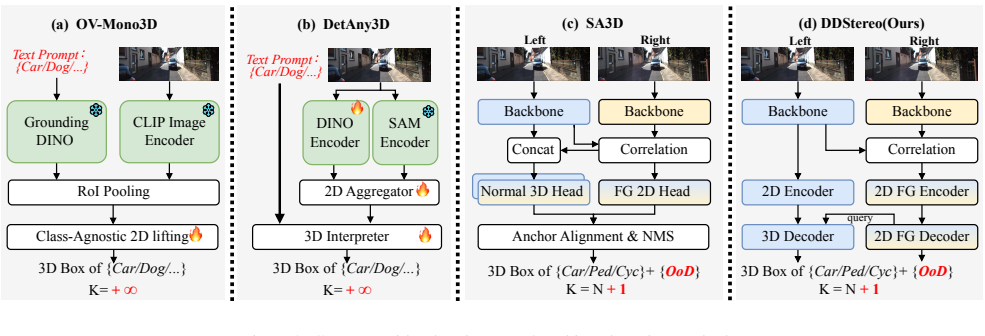
DDStereo is the first end-to-end Transformer stereo 3D detector that delivers real-time open-set inference: a disparity-driven binary foreground decoder and a left-image 3D-attribute decoder, kept in spatial register by shared object queries, jointly produce both known-class 3D boxes and a reliable object-level anomaly score, reaching state-of-the-art moderate/hard KITTI accuracy while running at monocular latency.
Load-bearing premise
Disparity features alone are category-agnostic enough for reliable binary foreground boxes, and shared queries keep those boxes spatially registered with the class-specific 3D predictions so that a simple residual score correctly flags anomalies.
Editorial extensions
If this is right
- Stereo 3D detection can match monocular frame rates while retaining higher accuracy on moderate and hard cases.
- Open-set road-anomaly detection no longer requires text prompts, point clicks, or dense NMS pipelines.
- A compact correlation-volume front-end plus dual lightweight decoders is sufficient for real-time stereo perception.
- Object-level anomaly scoring from foreground-minus-max-known residual can replace pixel-level OoD maps for driving safety.
- Limited synthetic extra data still yields large open-set gains, lowering the barrier to robust deployment.
Reading between the lines
- The same shared-query dual-decoder pattern could be dropped onto multi-view or surround-camera rigs without redesigning the fusion stage.
- Because the foreground branch is driven only by geometry, it may remain stable under domain shifts that destroy texture (night, rain, novel paint schemes).
- If the residual score proves brittle on rare true-background objects that look obstacle-like, a small calibrated threshold network on top of MNPF would be a natural next fix.
- The architecture suggests that open-set 3D perception can be treated as an alignment problem between two task-specialized heads rather than a single multi-task head.
Editorial analysis
A structured set of objections, weighed in public.
Referee Report
Summary. The paper introduces DDStereo, a dual-decoder stereo Transformer for real-time open-set 3D road anomaly detection. It decouples binary foreground localization (via multi-scale correlation volumes on disparity features) from multi-class 3D attribute regression (on left-image features), using shared object queries for cross-branch alignment and an MNPF residual score (foreground probability minus max known-class sigmoid score) for OoD decisions. Depth is obtained by sampling a lightweight U-Net depth map at projected centers. Evaluations claim SOTA closed-set AP3D on KITTI moderate/hard Car (43.97/36.16) and open-set results on KITTI-AR-OoD (e.g., 78.09 AP_OoD 3D under R40), with 23.5 ms inference matching monocular baselines, supported by ablations on queries, decoder design, depth sampling, and scoring.
Significance. If the empirical claims hold, the work is significant for autonomous driving perception: it is the first end-to-end Transformer stereo detector to deliver real-time open-set 3D performance without text prompts or NMS, closing the accuracy-speed gap versus monocular methods while outperforming prior stereo baselines (YOLOStereo3D, DSC3D, S3AD) on both closed- and open-set protocols. Strengths include official KITTI test-server numbers, matching prior train/val splits, systematic ablations (Tables 6–10), public code/models, and a compact design (19.6 M params, 62.65 GFLOPs). The dual-decoder + shared-query + MNPF formulation offers a practical, prompt-free alternative to open-vocabulary lifting methods.
major comments (2)
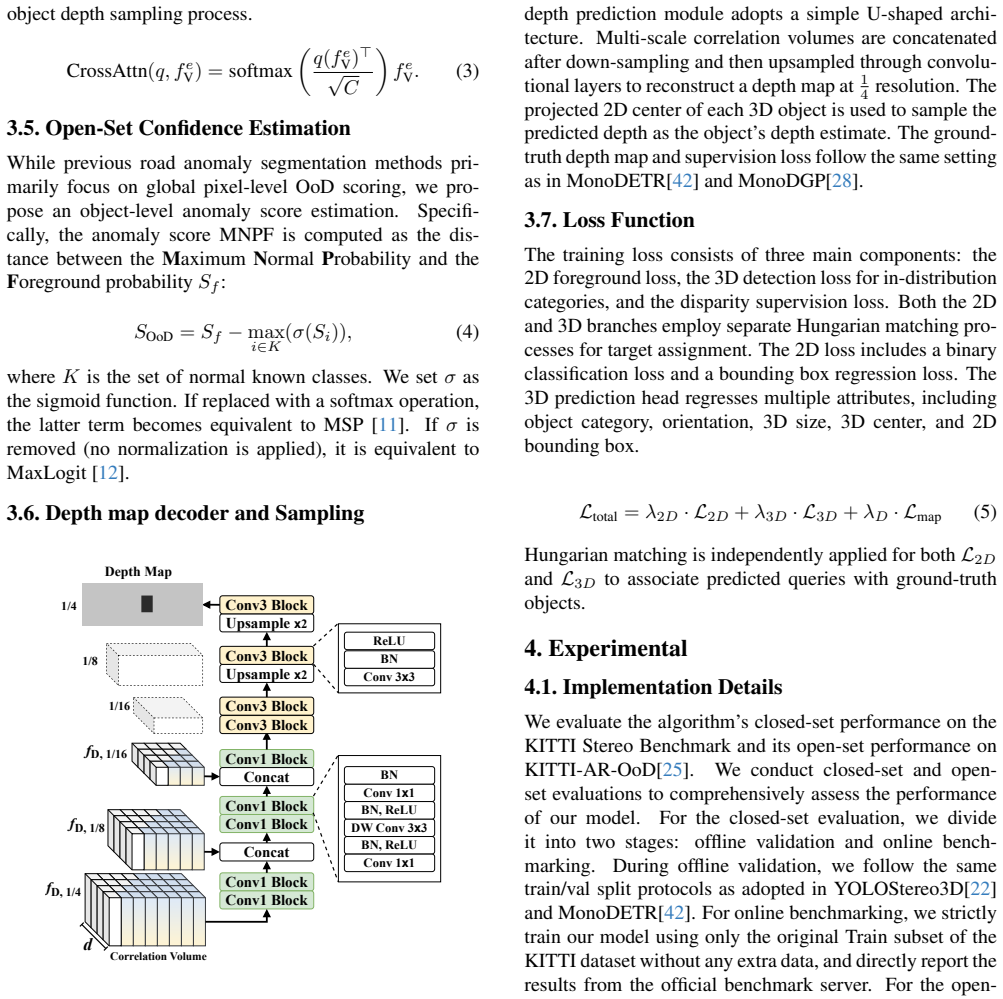
- [§§3.3–3.5, 3.7, Tables 6–7] §§3.3–3.5 and 3.7 (Eq. 4, shared queries q, independent Hungarian matchings for L2D and L3D): The central open-set claim rests on the premise that shared queries plus MNPF produce correctly paired FG/3D boxes without extra matching. Independent bipartite matchings do not enforce that a query matched to an OoD instance in the FG branch receives consistent 3D supervision or that the two heads’ 2D boxes align. Tables 6–7 show large AP_OoD drops for independent queries, yet the paper never reports per-query 2D-box IoU between heads, FG recall stratified by textureless/ambiguous geometry, or failure cases. Without this, the reliability of MNPF (and thus the “first real-time open-set Transformer stereo” claim) remains incompletely validated even if closed-set Car AP holds.
- [§3.2–3.3, Fig. 6, Supp. Figs. 7–11] §3.2–3.3 and abstract/intro claim that “disparity-aware features are largely independent of texture patterns” enabling category-agnostic foreground: This is load-bearing for open-set generalization, yet no quantitative support is given (e.g., FG AP on textureless OoD subsets of KITTI-AR-OoD, or comparison of FG decoder features vs. RGB). Supplementary visualizations show scale errors and one background-missed object; if the premise fails for a non-negligible fraction of real obstacles, both open-set numbers and the real-time SOTA claim are overstated.
minor comments (5)
- [Abstract] Abstract: incomplete sentence “demonstrate that DDStereo not only achieves state-of-the-art accuracy under open-set and closed-set protocols. Our method delivers…” — fix grammar and parallelism.
- [Fig. 1, Table 1] Fig. 1 caption and Table 1: clarify that Easy/Mod/Hard are official KITTI difficulty splits and that Hard includes Easy+Mod; the claim that Hard better reflects average accuracy is reasonable but should be stated once.
- [§4.1, Table 3] §4.1 and Table 3: confidence threshold 0.25 and R11/R40 are taken from S3AD; briefly restate the exact evaluation protocol (IoU thresholds, whether OoD is treated as single class) for self-containment.
- [§3] Notation: f_D, f_V, q, M_obj, S_f, MNPF appear without a single consolidated symbol table; add one or ensure first-use definitions are complete.
- [Supplementary] Supp. Tables 11–12 and Figs. 7–11 are useful; consider moving one key alignment or failure-mode analysis into the main paper to address the shared-query concern.
Circularity Check
Empirical architecture paper with external KITTI numbers and ablations; only minor self-citation for the authors' prior OoD benchmark/baseline, not a definitional loop.
-
self citation load bearing
[Sec. 2.2, Sec. 4.1, Table 3 (and abstract claim of open-set SOTA)]
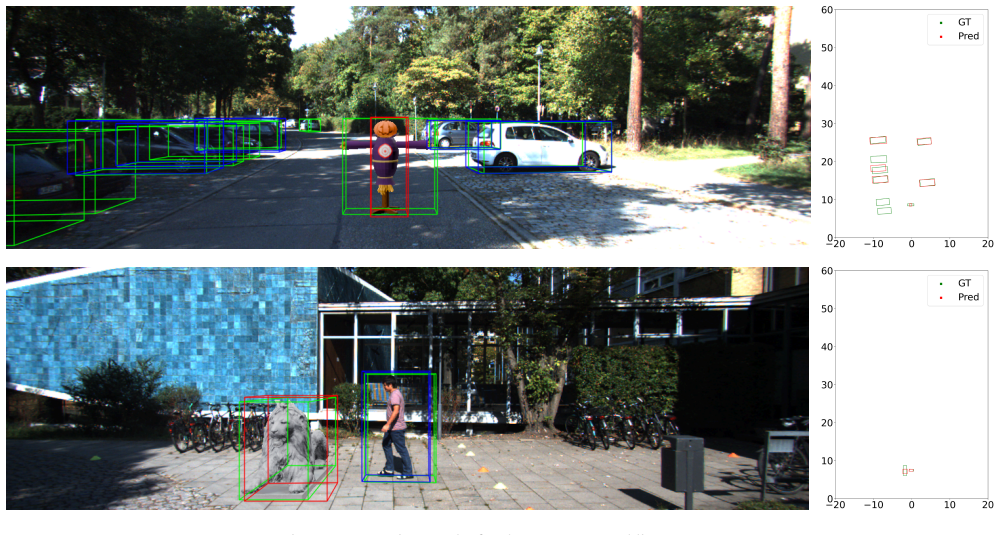
"S3AD [25] is the first method to introduce open-set 3D object detection based on stereo vision, along with the release of the KITTI-AR-OoD benchmark... For the open-set evaluation, we follow the setup defined in S3AD[25]."
The open-set protocol, the 'OoD' label definition, and the primary baseline numbers all come from the authors' own prior arXiv paper. This is ordinary dataset introduction rather than a load-bearing uniqueness theorem or a tautological redefinition of the architecture's outputs; closed-set KITTI results and the dual-decoder design remain independent. Flagged only as minor self-citation, not as a circular derivation.
full rationale
DDStereo proposes a dual-decoder Transformer architecture (shared object queries, disparity-only FG branch, MNPF residual scoring, center-sampled depth) and reports measured AP/runtime on the public KITTI closed-set benchmark plus the authors' prior KITTI-AR-OoD open-set set. The claimed SOTA and real-time numbers are empirical outcomes of training and evaluation, not algebraic identities or fitted parameters renamed as predictions. Shared-query alignment and MNPF are design choices whose benefit is shown by ablation tables (independent queries drop AP_OoD ~27 points; dual decoder and grid sampling also help); they do not redefine the evaluation metrics by construction. The sole self-citation of note is to S3AD (same authors) for the OoD dataset definition and the previous baseline; this is ordinary for introducing a new protocol and does not force the architecture or the closed-set KITTI results. No uniqueness theorem, no ansatz smuggled via citation, and no self-definitional equations appear. Independent Hungarian matchings for the two heads are a potential correctness risk (as the skeptic notes) but are not circularity. Score 1 only for the non-load-bearing self-citation of the OoD benchmark; the paper is otherwise self-contained against external numbers.
Assumptions & free parameters
free parameters (4)
- learning rate and decay schedule =
0.0002 / 0.1@125,165
- maximum disparity steps per scale =
24,24,16,16
- loss weights λ2D, λ3D, λD
- confidence threshold for open-set eval =
0.25
assumptions (4)
- domain assumption Stereo disparity (correlation volume) supplies category-agnostic geometric cues sufficient for binary foreground localization.
- ad hoc to paper Shared object queries keep the two decoders spatially aligned so that MNPF residual is a valid anomaly score.
- domain assumption Hungarian matching independently for 2D and 3D branches yields consistent target assignment.
- domain assumption KITTI-AR-OoD synthetic augmentations are a valid proxy for real open-set road anomalies.
invented entities (3)
-
Dual-decoder stereo transformer with shared queries
-
MNPF anomaly score (Sf − max σ(Si))
-
Object-level depth map sampled at projected centers
Cite this review
Pith. "Pith review of DDStereo: Efficient Dual Decoder Transformers for Stereo 3D Road Anomaly Detection." pith.science (2026). https://pith.science/paper/IMFU7M76
@misc{pith2026260624805,
  author       = {Pith},
  title        = {Pith review of: DDStereo: Efficient Dual Decoder Transformers for Stereo 3D Road Anomaly Detection},
  year         = {2026},
  howpublished = {\url{https://pith.science/paper/IMFU7M76}},
  note         = {Machine review of arXiv:2606.24805}
}
read the original abstract
Stereo-based 3D obstacle perception for autonomous driving is currently constrained by an imbalanced triplet: deployment cost, detection accuracy, and open-set adaptability. While existing methods struggle to balance these three competing objectives, there is an urgent demand for high-precision, real-time algorithms capable of detecting arbitrary obstacles in the wild. In this paper, we present DDStereo, a novel Dual-Decoder Stereo Transformer that achieves a synergistic integration of 3D object detection and Out-of-Distribution (OoD) road anomaly detection. Leveraging the geometric priors of stereo disparity, our approach effectively couples 3D attribute regression with open-set foreground detection within a streamlined dual-branch decoder architecture. Conventional methods rely on complex feature-level fusion; DDStereo maintains execution efficiency by employing a decoupled decoding strategy and shared object-level queries to ensure cross-modal target alignment. Extensive evaluations of public benchmarks demonstrate that DDStereo not only achieves state-of-the-art accuracy under open-set and closed-set protocols. Our method delivers real-time performance comparable to monocular 3D detection baselines, providing a cost-effective solution for the perception of obstacles of the normal and OoD category. Code and models are available at https://github.com/shiyi-mu/DDStereo.
Figures


Figures from the paper (8 more)




Reference graph
Works this paper leans on
-
[1]
3dos: Towards 3d open set learning – benchmark- ing and understanding semantic novelty detection on point clouds.arXiv e-prints, 2022
Antonio Alliegro, Francesco Cappio Borlino, and Tatiana Tommasi. 3dos: Towards 3d open set learning – benchmark- ing and understanding semantic novelty detection on point clouds.arXiv e-prints, 2022. 3
2022
-
[2]
Coda: Col- laborative novel box discovery and cross-modal alignment for open-vocabulary 3d object detection.Advances in Neu- ral Information Processing Systems, 36, 2024
Yang Cao, Zeng Yihan, Hang Xu, and Dan Xu. Coda: Col- laborative novel box discovery and cross-modal alignment for open-vocabulary 3d object detection.Advances in Neu- ral Information Processing Systems, 36, 2024. 3
2024
-
[3]
Open-set 3d object detection
Jun Cen, Peng Yun, Junhao Cai, Michael Yu Wang, and Ming Liu. Open-set 3d object detection. In2021 International conference on 3D vision (3DV), pages 869–878. IEEE, 2021. 3
2021
-
[4]
Dsc3d: Deformable sampling constraints in stereo 3d ob- ject detection for autonomous driving.IEEE Transactions on Circuits and Systems for Video Technology, 35(3):2794– 2805, 2025
Jiawei Chen, Qi Song, Wenzhong Guo, and Rui Huang. Dsc3d: Deformable sampling constraints in stereo 3d ob- ject detection for autonomous driving.IEEE Transactions on Circuits and Systems for Video Technology, 35(3):2794– 2805, 2025. 3, 6, 7
2025
-
[5]
Yolo-world: Real-time open-vocabulary object detection
Tianheng Cheng, Lin Song, Yixiao Ge, Wenyu Liu, Xing- gang Wang, and Ying Shan. Yolo-world: Real-time open-vocabulary object detection. InProceedings of the IEEE/CVF Conference on Computer Vision and Pattern Recognition, pages 16901–16911, 2024. 3
2024
-
[6]
Generative region-language pretraining for open- ended object detection
Lin Chuang, Jiang Yi, Qu Lizhen, Yuan Zehuan, and Cai Jianfei. Generative region-language pretraining for open- ended object detection. InProceedings of IEEE Conference on Computer Vision and Pattern Recognition (CVPR), 2024. 3
2024
-
[7]
The overlooked elephant of object detection: Open set
Akshay Dhamija, Manuel Gunther, Jonathan Ventura, and Terrance Boult. The overlooked elephant of object detection: Open set. InProceedings of the IEEE/CVF winter conference on applications of computer vision, pages 1021–1030, 2020. 3
2020
-
[8]
Xiuye Gu, Tsung-Yi Lin, Weicheng Kuo, and Yin Cui. Open-vocabulary object detection via vision and language knowledge distillation.arXiv preprint arXiv:2104.13921,
Show all 48 references
-
[9]
Ow-detr: Open-world detection transformer
Akshita Gupta, Sanath Narayan, KJ Joseph, Salman Khan, Fahad Shahbaz Khan, and Mubarak Shah. Ow-detr: Open-world detection transformer. InProceedings of the IEEE/CVF conference on computer vision and pattern recognition, pages 9235–9244, 2022. 3
2022
-
[10]
Expanding low-density latent regions for open-set object detection
Jiaming Han, Yuqiang Ren, Jian Ding, Xingjia Pan, Ke Yan, and Gui-Song Xia. Expanding low-density latent regions for open-set object detection. InProceedings of the IEEE/CVF Conference on Computer Vision and Pattern Recognition, pages 9591–9600, 2022. 3
2022
-
[11]
A baseline for detect- ing misclassified and out-of-distribution examples in neural networks
Dan Hendrycks and Kevin Gimpel. A baseline for detect- ing misclassified and out-of-distribution examples in neural networks. InInternational Conference on Learning Repre- sentations, 2017. 5, 8
2017
-
[12]
Scaling out-of-distribution detection for real-world settings
Dan Hendrycks, Steven Basart, Mantas Mazeika, Andy Zou, Joseph Kwon, Mohammadreza Mostajabi, Jacob Steinhardt, and Dawn Song. Scaling out-of-distribution detection for real-world settings. InInternational Conference on Machine Learning, pages 8759–8773. PMLR, 2022. 5, 8
2022
-
[13]
Monodtr: Monocular 3d object detection with depth-aware transformer
Kuan-Chih Huang, Tsung-Han Wu, Hung-Ting Su, and Win- ston H Hsu. Monodtr: Monocular 3d object detection with depth-aware transformer. InProceedings of the IEEE/CVF conference on computer vision and pattern recognition, pages 4012–4021, 2022. 7
2022
-
[14]
Towards open world object de- tection
KJ Joseph, Salman Khan, Fahad Shahbaz Khan, and Vi- neeth N Balasubramanian. Towards open world object de- tection. InProceedings of the IEEE/CVF conference on computer vision and pattern recognition, pages 5830–5840,
-
[15]
Learning-based shape estimation with grid map patches for realtime 3d ob- ject detection for automated driving
Hendrik Konigshof and Christoph Stiller. Learning-based shape estimation with grid map patches for realtime 3d ob- ject detection for automated driving. In2020 IEEE 23rd In- ternational conference on intelligent transportation systems (ITSC), pages 1–6. IEEE, 2020. 3, 6, 7
2020
-
[16]
Realtime 3d object detection for automated driving using stereo vision and semantic information
Hendrik Konigshof, Niels Ole Salscheider, and Christoph Stiller. Realtime 3d object detection for automated driving using stereo vision and semantic information. In2019 IEEE Intelligent Transportation Systems Conference (ITSC), 2019. 3, 6, 7
2019
-
[17]
Stereo r- cnn based 3d object detection for autonomous driving
Peiliang Li, Xiaozhi Chen, and Shaojie Shen. Stereo r- cnn based 3d object detection for autonomous driving. In 2019 IEEE/CVF Conference on Computer Vision and Pat- tern Recognition (CVPR), 2019. 3, 6
2019
-
[18]
Rts3d: Real- time stereo 3d detection from 4d feature-consistency em- bedding space for autonomous driving
Peixuan Li, Shun Su, and Huaici Zhao. Rts3d: Real- time stereo 3d detection from 4d feature-consistency em- bedding space for autonomous driving. InProceedings of the AAAI Conference on Artificial Intelligence, pages 1930– 1939, 2021. 6
1930
-
[19]
Monojsg: Joint semantic and geometric cost volume for monocular 3d ob- ject detection
Qing Lian, Peiliang Li, and Xiaozhi Chen. Monojsg: Joint semantic and geometric cost volume for monocular 3d ob- ject detection. InProceedings of the IEEE/CVF Conference on Computer Vision and Pattern Recognition, pages 1070– 1079, 2022. 6
2022
-
[20]
Generative region-language pretraining for open-ended object detection
Chuang Lin, Yi Jiang, Lizhen Qu, Zehuan Yuan, and Jianfei Cai. Generative region-language pretraining for open-ended object detection. InProceedings of the IEEE/CVF Confer- ence on Computer Vision and Pattern Recognition, pages 13958–13968, 2024. 2
2024
-
[21]
Grounding dino: Marrying dino with grounded pre-training for open-set object detection.arXiv preprint arXiv:2303.05499, 2023
Shilong Liu, Zhaoyang Zeng, Tianhe Ren, Feng Li, Hao Zhang, Jie Yang, Qing Jiang, Chunyuan Li, Jianwei Yang, Hang Su, et al. Grounding dino: Marrying dino with grounded pre-training for open-set object detection.arXiv preprint arXiv:2303.05499, 2023. 3
2023 arXiv
-
[22]
Yolostereo3d: A step back to 2d for efficient stereo 3d detection
Yuxuan Liu, Lujia Wang, and Ming Liu. Yolostereo3d: A step back to 2d for efficient stereo 3d detection. In2021 IEEE International Conference on Robotics and Automation (ICRA), 2021. 3, 5, 6, 7, 1
2021
-
[23]
Open-vocabulary point-cloud object detection without 3d an- notation
Yuheng Lu, Chenfeng Xu, Xiaobao Wei, Xiaodong Xie, Masayoshi Tomizuka, Kurt Keutzer, and Shanghang Zhang. Open-vocabulary point-cloud object detection without 3d an- notation. InProceedings of the IEEE/CVF conference on computer vision and pattern recognition, pages 1190–1199,
-
[24]
Gupnet++: Geometry uncertainty propagation network for monocular 3d object detection.IEEE Transactions on Pat- tern Analysis and Machine Intelligence, 2024
Yan Lu, Xinzhu Ma, Lei Yang, Tianzhu Zhang, Yating Liu, Qi Chu, Tong He, Yonghui Li, and Wanli Ouyang. Gupnet++: Geometry uncertainty propagation network for monocular 3d object detection.IEEE Transactions on Pat- tern Analysis and Machine Intelligence, 2024. 6, 7
2024
-
[25]
Stereo-based 3d anomaly object detection for au- tonomous driving: A new dataset and baseline.arXiv preprint arXiv:2507.09214, 2025
Shiyi Mu, Zichong Gu, Hanqi Lyu, Yilin Gao, and Shugong Xu. Stereo-based 3d anomaly object detection for au- tonomous driving: A new dataset and baseline.arXiv preprint arXiv:2507.09214, 2025. 1, 2, 3, 5, 6, 7, 8
2025 arXiv
-
[26]
Side: Center-based stereo 3d detector with structure-aware in- stance depth estimation
Xidong Peng, Xinge Zhu, Tai Wang, and Yuexin Ma. Side: Center-based stereo 3d detector with structure-aware in- stance depth estimation. InProceedings of the IEEE/CVF winter conference on applications of computer vision, pages 119–128, 2022. 3, 6
2022
-
[27]
Pon, Jason Ku, Chengyao Li, and Steven L
Alex D. Pon, Jason Ku, Chengyao Li, and Steven L. Waslan- der. Object-centric stereo matching for 3d object detection. In2020 IEEE International Conference on Robotics and Au- tomation (ICRA), pages 8383–8389, 2020. 6, 7
2020
-
[28]
Mon- odgp: Monocular 3d object detection with decoupled-query and geometry-error priors
Fanqi Pu, Yifan Wang, Jiru Deng, and Wenming Yang. Mon- odgp: Monocular 3d object detection with decoupled-query and geometry-error priors. InProceedings of the Computer Vision and Pattern Recognition Conference, pages 6520– 6530, 2025. 4, 5, 6
2025
-
[29]
Triangulation learn- ing network: from monocular to stereo 3d object detection
Zengyi Qin, Jinglu Wang, and Yan Lu. Triangulation learn- ing network: from monocular to stereo 3d object detection. InProceedings of the IEEE/CVF conference on computer vi- sion and pattern recognition, pages 7615–7623, 2019. 3, 6
2019
-
[30]
Stereo centernet-based 3d object detection for autonomous driving
Yuguang Shi, Yu Guo, Zhenqiang Mi, and Xinjie Li. Stereo centernet-based 3d object detection for autonomous driving. Neurocomputing, 471:219–229, 2022. 6
2022
-
[31]
Transformer-based stereo-aware 3d object detection from binocular images.IEEE Transactions on Intelligent Trans- portation Systems, 25(12):19675–19687, 2024
Hanqing Sun, Yanwei Pang, Jiale Cao, Jin Xie, and Xuelong Li. Transformer-based stereo-aware 3d object detection from binocular images.IEEE Transactions on Intelligent Trans- portation Systems, 25(12):19675–19687, 2024. 3, 6
2024
-
[32]
An efficient 3d object detection method based on fast guided anchor stereo rcnn.Advanced Engineering Informatics, 57:102069, 2023
Chongben Tao, Chunlin Cao, Hanjing Cheng, Zhen Gao, Xizhao Luo, Zuofeng Zhang, and Sifa Zheng. An efficient 3d object detection method based on fast guided anchor stereo rcnn.Advanced Engineering Informatics, 57:102069, 2023. 6
2023
-
[33]
Ov-uni3detr: Towards unified open- vocabulary 3d object detection via cycle-modality propaga- tion.arXiv preprint arXiv:2403.19580, 2024
Zhenyu Wang, Yali Li, Taichi Liu, Hengshuang Zhao, and Shengjin Wang. Ov-uni3detr: Towards unified open- vocabulary 3d object detection via cycle-modality propaga- tion.arXiv preprint arXiv:2403.19580, 2024. 3
2024 arXiv
-
[34]
Cora: Adapting clip for open-vocabulary detection with region prompting and anchor pre-matching
Xiaoshi Wu, Feng Zhu, Rui Zhao, and Hongsheng Li. Cora: Adapting clip for open-vocabulary detection with region prompting and anchor pre-matching. InProceedings of the IEEE/CVF conference on computer vision and pattern recognition, pages 7031–7040, 2023. 3
2023
-
[35]
Ulip: Learning a unified representation of language, images, and point clouds for 3d understanding
Le Xue, Mingfei Gao, Chen Xing, Roberto Mart ´ın-Mart´ın, Jiajun Wu, Caiming Xiong, Ran Xu, Juan Carlos Niebles, and Silvio Savarese. Ulip: Learning a unified representation of language, images, and point clouds for 3d understanding. InProceedings of the IEEE/CVF conference on...
2023
-
[36]
Open vocabulary monocular 3d object detection
Jin Yao, Hao Gu, Xuweiyi Chen, Jiayun Wang, and Zezhou Cheng. Open vocabulary monocular 3d object detection. arXiv preprint arXiv:2411.16833, 2024. 1, 2, 7
2024
-
[37]
Detclip: Dictionary-enriched visual-concept paralleled pre- training for open-world detection.Advances in Neural Infor- mation Processing Systems, 35:9125–9138, 2022
Lewei Yao, Jianhua Han, Youpeng Wen, Xiaodan Liang, Dan Xu, Wei Zhang, Zhenguo Li, Chunjing Xu, and Hang Xu. Detclip: Dictionary-enriched visual-concept paralleled pre- training for open-world detection.Advances in Neural Infor- mation Processing Systems, 35:9125–9138, 2022. 3
2022
-
[38]
Detclipv2: Scal- able open-vocabulary object detection pre-training via word- region alignment
Lewei Yao, Jianhua Han, Xiaodan Liang, Dan Xu, Wei Zhang, Zhenguo Li, and Hang Xu. Detclipv2: Scal- able open-vocabulary object detection pre-training via word- region alignment. InProceedings of the IEEE/CVF Con- ference on Computer Vision and Pattern Recognition, pages 23497...
2023
-
[39]
Detclipv3: To- wards versatile generative open-vocabulary object detection
Lewei Yao, Renjie Pi, Jianhua Han, Xiaodan Liang, Hang Xu, Wei Zhang, Zhenguo Li, and Dan Xu. Detclipv3: To- wards versatile generative open-vocabulary object detection. InProceedings of the IEEE/CVF Conference on Computer Vision and Pattern Recognition, pages 27391–27401, 2024. 3
2024
-
[40]
Detect anything 3d in the wild.arXiv preprint arXiv:2504.07958, 2025
Hanxue Zhang, Haoran Jiang, Qingsong Yao, Yanan Sun, Renrui Zhang, Hao Zhao, Hongyang Li, Hongzi Zhu, and Zetong Yang. Detect anything 3d in the wild.arXiv preprint arXiv:2504.07958, 2025. 1, 2
2025
-
[41]
Pointclip: Point cloud understanding by clip
Renrui Zhang, Ziyu Guo, Wei Zhang, Kunchang Li, Xu- peng Miao, Bin Cui, Yu Qiao, Peng Gao, and Hongsheng Li. Pointclip: Point cloud understanding by clip. InProceedings of the IEEE/CVF conference on computer vision and pattern recognition, pages 8552–8562, 2022. 3
2022
-
[42]
Monodetr: Depth- guided transformer for monocular 3d object detection
Renrui Zhang, Han Qiu, Tai Wang, Ziyu Guo, Ziteng Cui, Yu Qiao, Hongsheng Li, and Peng Gao. Monodetr: Depth- guided transformer for monocular 3d object detection. In Proceedings of the IEEE/CVF International Conference on Computer Vision, pages 9155–9166, 2023. 4, 5, 6, 8, 1
2023
-
[43]
Objects are differ- ent: Flexible monocular 3d object detection
Yunpeng Zhang, Jiwen Lu, and Jie Zhou. Objects are differ- ent: Flexible monocular 3d object detection. InProceedings of the IEEE/CVF Conference on Computer Vision and Pat- tern Recognition, pages 3289–3298, 2021. 6, 7
2021
-
[44]
Real-time transformer-based open-vocabulary detection with efficient fusion head.arXiv preprint arXiv:2403.06892, 2024
Tiancheng Zhao, Peng Liu, Xuan He, Lu Zhang, and Kyu- song Lee. Real-time transformer-based open-vocabulary detection with efficient fusion head.arXiv preprint arXiv:2403.06892, 2024. 3
2024 arXiv
-
[45]
Object2scene: Putting objects in context for open- vocabulary 3d detection.arXiv preprint arXiv:2309.09456,
Chenming Zhu, Wenwei Zhang, Tai Wang, Xihui Liu, and Kai Chen. Object2scene: Putting objects in context for open- vocabulary 3d detection.arXiv preprint arXiv:2309.09456,
-
[46]
3 DDStereo: Efficient Dual Decoder Transformers for Stereo 3D Road Anomaly Detection Supplementary Material
-
[47]
In Table 11 and Table 12 we compare the impact of these auxiliary losses on both open-set and closed-set detection, reporting results at Mod difficulty
Ablation of depth map and disparity loss DDStereo continues the auxiliary-supervision paradigm of disparity-map and depth-map prediction introduced in YOLOStereo3D[22] and MonoDETR[42], and adopts the same loss functions. In Table 11 and Table 12 we compare the impact of these...
-
[48]
Figure 7 local- izes the scarecrow and lion statue, yet the scale estimates still exhibit noticeable error
Visualization Figures 7– 11 visualize open-set detections. Figure 7 local- izes the scarecrow and lion statue, yet the scale estimates still exhibit noticeable error. Figure 8 successfully detects the elephant and cougar. Figure 9 identifies the red and gray discarded metal ba...
Reviewed July 12, 2026 · model on record in the stance chip above.
Discussion (0). Sign in to comment.