REVIEW 4 minor 61 references
Anyon Exchange Phase from Antidot Interferometry
T0 review · 0 major / 4 minor · reviewed 2026-07-14 · grok-4.5
Pith's one-line read The anyon exchange phase itself can be read from transmission-phase plateaus across a single antidot resonance in a Fabry–Perot interferometer.
desk verdict Clean microscopic theory that turns the Kivelson-Murthy antidot idea into a readable plateau difference equal to the bare exchange phase heta=πν. read the letter →
The pith
A machine-rendered reading of the paper's core claim, the machinery that carries it, and where it could break.
The reading
What carries the argument
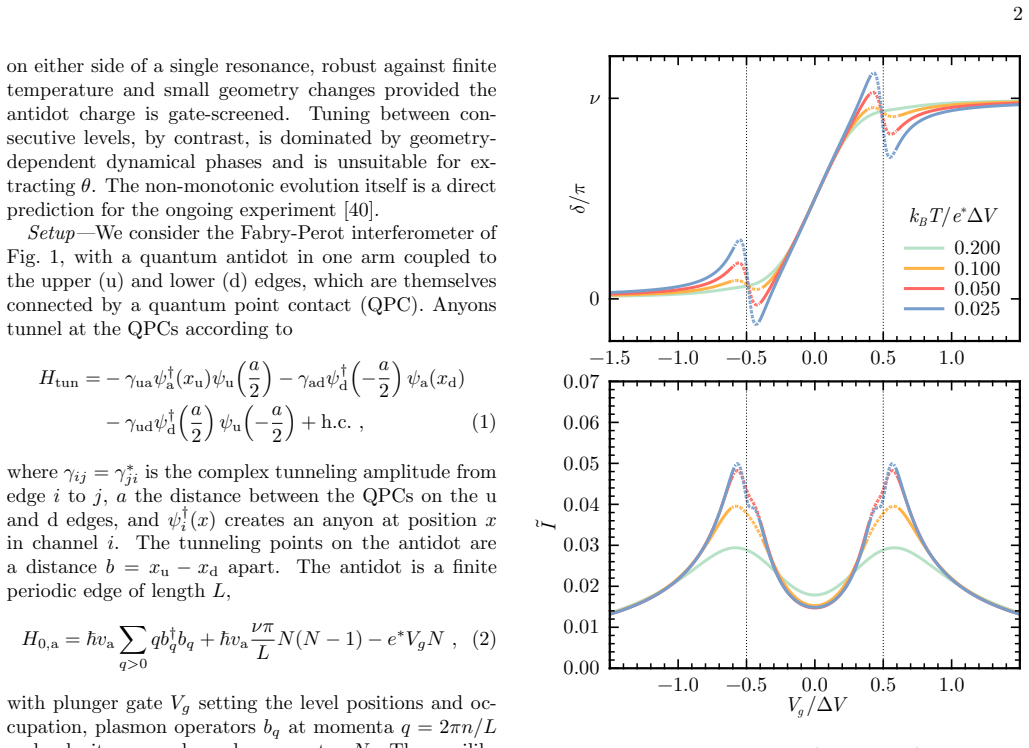
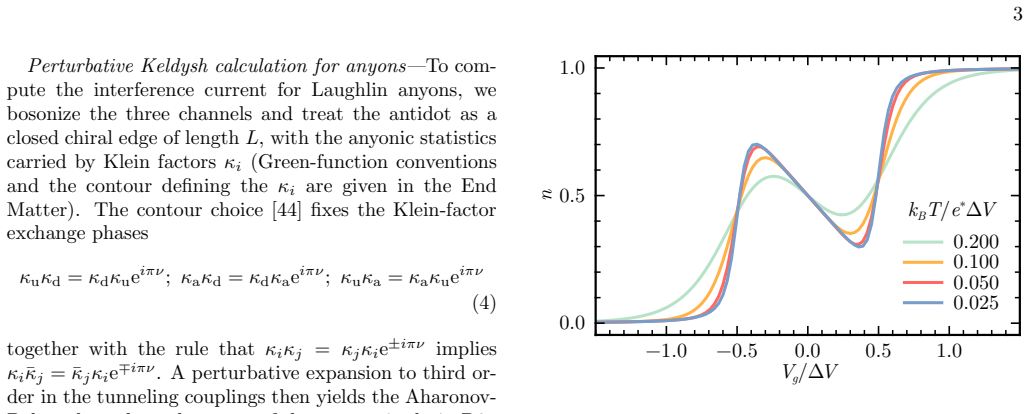
Third-order Keldysh expansion of the Aharonov–Bohm current through the antidot, with anyonic statistics carried by Klein factors and with the antidot Green function dressed by a non-equilibrium occupation n(Vg) and a self-energy that supplies level broadening Γ(ε) and shift Λ(ε). The plateau difference of the resulting transmission phase δ(Vg) isolates θ.
What would settle it
In a gate-screened antidot interferometer, measure the transmission phase while sweeping a single level through resonance: if the plateau difference is not πν (for filling ν) and the phase does not show the predicted non-monotonic swing near ±ΔV/2, the claim fails.
Extended reading notes
Core claim
For Laughlin anyons the difference between the transmission-phase plateaus on either side of a single, gate-screened antidot resonance equals the bare exchange phase θ = πν. A systematic non-equilibrium Keldysh calculation that includes the antidot’s occupation and anyonic level broadening produces a non-monotonic phase evolution near the lead chemical potentials, in clear contrast to the monotonic Breit–Wigner evolution of electrons.
Load-bearing premise
The antidot charge must be screened almost entirely by an external gate; if the quantum-Hall edges do the screening instead, an electrostatic phase exactly cancels the statistical phase one wants to measure.
Editorial analysis
A structured set of objections, weighed in public.
Referee Report
Summary. The manuscript develops a non-equilibrium Keldysh theory for a Fabry–Perot interferometer containing a quantum antidot in one arm, tuned through resonance by a plunger gate. For Laughlin anyons the transmission phase of the Aharonov–Bohm current evolves non-monotonically across a single resonance (in contrast to the monotonic 0 oπ Breit–Wigner evolution for electrons). The difference between the asymptotic phase plateaus equals the bare exchange phase θ=πν, provided the antidot charge is screened by an external gate and the level spacing exceeds the bias window. The calculation incorporates Klein factors, power-law edge densities of states, non-equilibrium antidot occupation, and self-energy level broadening, and recovers the electron T-matrix and the Chamon–Wen sequential-tunneling current as consistency checks.
Significance. If the result holds, the work supplies a concrete, experimentally accessible protocol for measuring the anyonic exchange phase itself rather than only the braiding phase 2θ. The non-monotonic phase evolution is a sharp, falsifiable prediction for ongoing antidot-interferometer experiments. Strengths include an internally consistent derivation from chiral Luttinger liquids and Klein factors (no hand-inserted statistics), explicit validity windows (r≪1), recovery of known limits, and a clear statement of the gate-screening prerequisite that isolates the statistical phase from electrostatic contributions.
minor comments (4)
- Fig. 2 caption and main-text discussion of the dashed-line regions (r>0.5) could more explicitly remind the reader that the plateau values used for readout of θ lie outside those regions, so the extraction remains quantitative.
- End Matter, Klein-factor contour: a short sentence clarifying that observables are independent of the precise origin choice would help readers less familiar with the Altland–Gefen–Rosenow construction.
- Supplemental Material A: the Friedel-sum-rule cancellation argument is clear, but a one-sentence estimate of the gate-screening fraction f achievable with a graphite back-gate (or similar) would strengthen the experimental outlook without altering the formal claim.
- Notation: the same symbol Γ is used both for the gamma function and for level broadening; a brief local redefinition or subscript would remove the minor ambiguity noted in the End Matter.
Circularity Check
No significant circularity: the exchange phase enters via standard Klein factors and is recovered as a derived plateau difference by explicit Keldysh calculation.
full rationale
The paper is a self-contained theoretical proposal. Anyonic statistics are introduced in the usual way through Klein-factor commutation relations (End Matter, Eq. (4) and the contour choice of Ref. [44]), which produce the factor e^{iπν} in the third-order Keldysh current (Eq. (5)) and in the resummed transmission amplitude (Eq. (10)). The T-matrix benchmark for electrons (Eq. (3)) shows how the corresponding fermionic factor cancels against the intermediate-state sign, leaving only the Breit-Wigner phase; for Laughlin anyons the fractional factor survives and appears as the difference between the transmission-phase plateaus on either side of a single resonance. Non-equilibrium occupation (Eq. (9)) and level broadening are obtained from a self-energy that is consistent with the sequential-tunneling result of Chamon & Wen; they are not fitted to the target observable. The gate-screening condition (Supp. Mat. A) is stated as a necessary experimental prerequisite, not as a hidden assumption that forces the result. There is no self-definitional loop, no parameter fitted to data and then re-predicted, and no load-bearing uniqueness theorem imported from the authors’ prior work. The derivation therefore stands as an independent calculation of a measurable signature of the input statistics.
Assumptions & free parameters
assumptions (4)
- domain assumption Fractional quantum Hall edges are chiral Luttinger liquids with tunneling density of states ∼ |ε|ν−1
- domain assumption Anyonic statistics are carried by Klein factors with exchange phases e^{iπν}
- ad hoc to paper Antidot charge is screened by an external gate so that the electrostatic phase does not cancel θ
- domain assumption Single-level approximation valid when level spacing ≫ bias and temperature
Cite this review
Pith. "Pith review of Anyon Exchange Phase from Antidot Interferometry." pith.science (2026). https://pith.science/paper/O6A3S7WG
@misc{pith2026260624831,
  author       = {Pith},
  title        = {Pith review of: Anyon Exchange Phase from Antidot Interferometry},
  year         = {2026},
  howpublished = {\url{https://pith.science/paper/O6A3S7WG}},
  note         = {Machine review of arXiv:2606.24831}
}
read the original abstract
Quasiparticles in fractional quantum Hall systems are anyons, carrying a fraction of the electron charge. Exchanging two of them gives rise to a fractional exchange phase. While the fractional charge and the braiding phase -- twice the exchange phase -- have been measured, the exchange phase itself has remained inaccessible. We study a quantum antidot embedded in a Fabry-Perot interferometer. Within a systematic non-equilibrium Keldysh treatment that consistently includes the occupation and level broadening of the antidot, we find that the transmission phase evolves non-monotonically when a gate voltage tunes the antidot through a resonance, in contrast to the monotonic evolution for electrons. The bare exchange phase can be extracted from the difference between the phase plateaus.
Figures

Figures from the paper (1 more)

Reference graph
Works this paper leans on
-
[1]
Leinaas and J
J. Leinaas and J. Myrheim, On the theory of identical particles, Il nuovo cimento37, 132 (1977)
1977
-
[2]
R. B. Laughlin, Anomalous quantum Hall effect: An in- compressible quantum fluid with fractionally charged ex- citations, Physical Review Letters50, 1395 (1983)
1983
-
[3]
B. I. Halperin, Statistics of quasiparticles and the hierar- chy of fractional quantized Hall states, Physical Review Letters52, 1583 (1984)
1984
-
[4]
Arovas, J
D. Arovas, J. R. Schrieffer, and F. Wilczek, Fractional statistics and the quantum Hall effect, Physical Review Letters53, 722 (1984)
1984
-
[5]
D. E. Feldman and B. I. Halperin, Fractional charge and fractional statistics in the quantum Hall effects, Reports on progress in physics. Physical Society (Great Britain) 84, 10.1088/1361-6633/ac03aa (2021)
-
[6]
C. L. Kane and M. P. Fisher, Nonequilibrium noise and fractional charge in the quantum Hall effect, Physical Re- view Letters72, 724 (1994)
1994
-
[7]
Reznikov, R
M. Reznikov, R. d. Picciotto, T. Griffiths, M. Heiblum, and V. Umansky, Observation of quasiparticles with one- fifth of an electron’s charge, Nature399, 238 (1999)
1999
-
[8]
Saminadayar, D
L. Saminadayar, D. C. Glattli, Y. Jin, and B. Etienne, Observation of the e/3 fractionally charged Laughlin quasiparticle, Physical Review Letters79, 2526 (1997)
1997
Show all 61 references
-
[9]
de Picciotto, M
R. de Picciotto, M. Reznikov, M. Heiblum, V. Uman- sky, G. Bunin, and D. Mahalu, Direct observation of a fractional charge, Nature389, 162 (1997)
1997
-
[10]
C. de C. Chamon, D. E. Freed, S. A. Kivelson, S. L. Sondhi, and X. G. Wen, Two point-contact interferom- eter for quantum Hall systems, Physical Review B55, 2331 (1997)
1997
-
[11]
B. I. Halperin, A. Stern, I. Neder, and B. Rosenow, Theory of the Fabry-P´ erot quantum Hall interferometer, Physical Review B83, 155440 (2011)
2011
-
[12]
Rosenow and A
B. Rosenow and A. Stern, Flux superperiods and period- icity transitions in quantum Hall interferometers, Physi- cal Review Letters124, 106805 (2020)
2020
-
[13]
Rosenow, I
B. Rosenow, I. P. Levkivskyi, and B. I. Halperin, Current correlations from a mesoscopic anyon collider, Physical Review Letters116, 156802 (2016)
2016
-
[14]
Thamm and B
M. Thamm and B. Rosenow, Effect of the soliton width on nonequilibrium exchange phases of anyons, Physical Review Letters132, 156501 (2024)
2024
-
[15]
Schiller, Y
N. Schiller, Y. Shapira, A. Stern, and Y. Oreg, Anyon statistics through conductance measurements of time- domain interferometry, Physical Review Letters131, 186601 (2023)
2023
-
[16]
C. Han, J. Park, Y. Gefen, and H.-S. Sim, Topological vacuum bubbles by anyon braiding, Nature communica- tions7, 11131 (2016)
2016
-
[17]
B. Lee, C. Han, and H.-S. Sim, Negative excess shot noise by anyon braiding, Physical Review Letters123, 016803 (2019)
2019
-
[18]
J.-Y. M. Lee, C. Han, and H.-S. Sim, Fractional mutual statistics on integer quantum Hall edges, Physical Review Letters125, 196802 (2020)
2020
-
[19]
Schiller, Y
N. Schiller, Y. Oreg, and K. Snizhko, Extracting the scal- ing dimension of quantum Hall quasiparticles from cur- rent correlations, Physical Review B105, 165150 (2022)
2022
-
[20]
Nakamura, S
J. Nakamura, S. Liang, G. C. Gardner, and M. J. Manfra, Direct observation of anyonic braiding statistics, Nature Physics16, 931 (2020)
2020
-
[21]
Nakamura, S
J. Nakamura, S. Liang, G. C. Gardner, and M. J. Manfra, Impact of bulk-edge coupling on observation of anyonic braiding statistics in quantum Hall interferometers, Na- ture Communications13, 344 (2022)
2022
-
[22]
Nakamura, S
J. Nakamura, S. Liang, G. C. Gardner, and M. J. Man- fra, Fabry-P´ erot interferometry at theν= 2/5 frac- tional quantum Hall state, Physical Review X13, 041012 (2023)
2023
-
[23]
Bartolomei, M
H. Bartolomei, M. Kumar, R. Bisognin, A. Marguerite, J.-M. Berroir, E. Bocquillon, B. Placais, A. Cavanna, Q. Dong, U. Gennser,et al., Fractional statistics in anyon 6 collisions, Science368, 173 (2020)
2020
-
[24]
J.-Y. M. Lee, C. Hong, T. Alkalay, N. Schiller, V. Uman- sky, M. Heiblum, Y. Oreg, and H.-S. Sim, Partitioning of diluted anyons reveals their braiding statistics, Nature 617, 277 (2023)
2023
-
[25]
Ruelle, E
M. Ruelle, E. Frigerio, J.-M. Berroir, B. Pla¸ cais, J. Rech, A. Cavanna, U. Gennser, Y. Jin, and G. F` eve, Comparing fractional quantum Hall Laughlin and Jain topological orders with the anyon collider, Physical Review X13, 011031 (2023)
2023
-
[26]
Glidic, O
P. Glidic, O. Maillet, A. Aassime, C. Piquard, A. Ca- vanna, U. Gennser, Y. Jin, A. Anthore, and F. Pierre, Cross-correlation investigation of anyon statistics in the ν= 1/3 and 2/5 fractional quantum Hall states, Physical Review X13, 011030 (2023)
2023
-
[27]
N. L. Samuelson, L. A. Cohen, W. Wang, S. Blanch, T. Taniguchi, K. Watanabe, M. P. Zaletel, and A. F. Young, Anyonic statistics and slow quasiparticle dynam- ics in a graphene fractional quantum Hall interferometer, arXiv preprint arXiv:2403.19628 (2024)
2024 arXiv
-
[28]
J. Kim, H. Dev, A. Shaer, R. Kumar, A. Ilin, A. Haug, S. Iskoz, K. Watanabe, T. Taniguchi, D. F. Mross, A. Stern, and Y. Ronen, Aharonov-Bohm interference in even-denominator fractional quantum Hall states, arXiv preprint arXiv:2412.19886 (2024)
2024
-
[29]
Werkmeister, J
T. Werkmeister, J. R. Ehrets, M. E. Wesson, D. H. Na- jafabadi, K. Watanabe, T. Taniguchi, B. I. Halperin, A. Yacoby, and P. Kim, Anyon braiding and telegraph noise in a graphene interferometer, Science (New York, N.Y.)388, 730 (2025)
2025
-
[30]
Read and S
N. Read and S. Das Sarma, Clarification of braiding statistics in Fabry–Perot interferometry, Nature Physics 20, 381 (2024)
2024
-
[31]
I. Safi, P. Devillard, and T. Martin, Partition noise and statistics in the fractional quantum Hall effect, Physical Review Letters86, 4628 (2001)
2001
-
[32]
E.-A. Kim, M. Lawler, S. Vishveshwara, and E. Fradkin, Signatures of fractional statistics in noise experiments in quantum Hall fluids, Physical Review Letters95, 176402 (2005)
2005
-
[33]
E.-A. Kim, M. J. Lawler, S. Vishveshwara, and E. Frad- kin, Measuring fractional charge and statistics in frac- tional quantum Hall fluids through noise experiments, Physical Review B74, 155324 (2006)
2006
-
[34]
Vishveshwara, Revisiting the Hanbury Brown-Twiss setup for fractional statistics, Physical Review Letters 91, 196803 (2003)
S. Vishveshwara, Revisiting the Hanbury Brown-Twiss setup for fractional statistics, Physical Review Letters 91, 196803 (2003)
2003
-
[35]
Campagnano, O
G. Campagnano, O. Zilberberg, I. V. Gornyi, D. E. Feldman, A. C. Potter, and Y. Gefen, Hanbury Brown- Twiss interference of anyons, Physical Review Letters 109, 106802 (2012)
2012
-
[36]
Campagnano, O
G. Campagnano, O. Zilberberg, I. V. Gornyi, and Y. Gefen, Hanbury Brown and Twiss correlations in quantum Hall systems, Physical Review B88, 235415 (2013)
2013
-
[37]
S. A. Kivelson and C. Murthy, Modified interferometer to measure anyonic braiding statistics, Phys. Rev. Lett. 135, 126605 (2025)
2025
-
[38]
Puster, M
F. Puster, M. Thamm, and B. Rosenow, Extracting the anyonic exchange phase from Hanbury Brown-Twiss cor- relations, arXiv:2603.13898 (2026)
2026
-
[39]
[55, 56]
See Supplemental Material for additional details, includ- ing Refs. [55, 56]
-
[40]
Ehrets, T
J. Ehrets, T. Werkmeister, C. E. Henzinger, M. Wes- son, D. H. Najafabadi, K. Watanabe, T. Taniguchi, B. Halperin, A. Yacoby, and P. Kim, Measuring the fun- damental exchange phase of anyons in a modified quan- tum Hall interferometer, Bulletin of the American Phys- ical Socie...
2025
-
[41]
Schuster, E
R. Schuster, E. Buks, M. Heiblum, D. Mahalu, V. Uman- sky, and H. Shtrikman, Phase measurement in a quantum dot via a double-slit interference experiment, Nature385, 417 (1997)
1997
-
[42]
K¨ onig and Y
J. K¨ onig and Y. Gefen, Coherence and partial coherence in interacting electron systems, Physical review letters 86, 3855 (2001)
2001
-
[43]
K¨ onig and Y
J. K¨ onig and Y. Gefen, Aharonov-Bohm interferome- try with interacting quantum dots: Spin configurations, asymmetric interference patterns, bias-voltage-induced Aharonov-Bohm oscillations, and symmetries of trans- port coefficients, Physical Review B65, 045316 (2002)
2002
-
[44]
Altland, Y
A. Altland, Y. Gefen, and B. Rosenow, Intermediate fixed point in a Luttinger liquid with elastic and dissipative backscattering, Physical Review B92, 085124 (2015)
2015
-
[45]
M. R. Geller and D. Loss, Aharonov-Bohm effect in the chiral Luttinger liquid, Physical Review B56, 9692 (1997)
1997
-
[46]
D. V. Averin and J. A. Nesteroff, Coulomb blockade of anyons in quantum antidots, Physical review letters99, 096801 (2007)
2007
-
[47]
Goldman and B
V. Goldman and B. Su, Resonant tunneling in the quan- tum Hall regime: measurement of fractional charge, Sci- ence267, 1010 (1995)
1995
-
[48]
Maasilta and V
I. Maasilta and V. Goldman, Energetics of quantum an- tidot states in the quantum Hall regime, Physical Review B57, R4273 (1998)
1998
-
[49]
Kataoka, C
M. Kataoka, C. Ford, G. Faini, D. Mailly, M. Sim- mons, D. Mace, C.-T. Liang, and D. Ritchie, Detection of Coulomb charging around an antidot in the quantum Hall regime, Physical review letters83, 160 (1999)
1999
-
[50]
C. L. Kane and M. P. Fisher, Transmission through barriers and resonant tunneling in an interacting one- dimensional electron gas, Physical Review B46, 15233 (1992)
1992
-
[52]
C. L. Kane, Telegraph noise and fractional statistics in the quantum Hall effect, Physical Review Letters90, 226802 (2003)
2003
-
[53]
C. d. C. Chamon and X. G. Wen, Resonant tunneling in the fractional quantum Hall regime, Physical review letters70, 2605 (1993)
1993
-
[54]
Jauho, N
A.-P. Jauho, N. S. Wingreen, and Y. Meir, Time- dependent transport in interacting and noninteracting resonant-tunneling systems, Physical Review B50, 5528 (1994)
1994
-
[55]
Rosenow and Y
B. Rosenow and Y. Gefen, Dephasing by a zero- temperature detector and the Friedel sum rule, Phys. Rev. Lett.108, 256805 (2012)
2012
-
[56]
Weisz, H
E. Weisz, H. K. Choi, M. Heiblum, Y. Gefen, V. Uman- sky, and D. Mahalu, Controlled dephasing of an electron interferometer with a path detector at equilibrium, Phys. Rev. Lett.109, 250401 (2012)
2012
-
[57]
Guyon, P
R. Guyon, P. Devillard, T. Martin, and I. Safi, Klein fac- tors in multiple fractional quantum Hall edge tunneling, Physical Review B65, 153304 (2002). 7 End Matter Details onT-matrix calculation—In the case of electrons, the calculation simplifies as we can introduce antidot ...
2002
-
[58]
Rosenow and Y
B. Rosenow and Y. Gefen, Dephasing by a zero- temperature detector and the Friedel sum rule, Phys. Rev. Lett. 108, 256805 (2012)
2012
-
[59]
Weisz, H
E. Weisz, H. K. Choi, M. Heiblum, Y. Gefen, V. Uman- sky, and D. Mahalu, Controlled dephasing of an electron interferometer with a path detector at equilibrium, Phys. Rev. Lett. 109, 250401 (2012)
2012
-
[60]
Jauho, N
A.-P. Jauho, N. S. Wingreen, and Y. Meir, Time- dependent transport in interacting and noninteracting resonant-tunneling systems, Physical Review B 50, 5528 (1994)
1994
-
[61]
Kane and M
C. Kane and M. P. Fisher, Edge-state transport, Perspec- tives in quantum Hall effects: Novel quantum liquids in low-dimensional semiconductor structures , 109 (1996)
1996
-
[62]
C. d. C. Chamon and X. G. Wen, Resonant tunneling in the fractional quantum Hall regime, Physical review let- ters 70, 2605 (1993)
1993
Reviewed July 14, 2026 · model on record in the stance chip above.
Discussion (0). Sign in to comment.