Polyatomic Thermal Radiative Dissociation in Microcavities
Pith reviewed 2026-06-25 21:46 UTC · model grok-4.3
The pith
Microcavities with thick MgO layers enhance blackbody infrared radiative dissociation of polyatomic ions via surface phonon polaritons.
A machine-rendered reading of the paper's core claim, the machinery that carries it, and where it could break.
Core claim
The authors establish that in planar Au/MgO multilayer microcavities, the blackbody infrared radiative dissociation of the (H2O)2Cl- cluster is enhanced most strongly in short cavities with thick MgO layers due to evanescent contributions from surface phonon polaritons in the Reststrahlen band, and that engineering the cavity density of states shifts the crossover point between radiative and collisional dissociation pathways when a methane bath gas is included.
What carries the argument
The cavity-modified electromagnetic density of states sampled by anharmonic fundamental, overtone, and combination vibrational transitions of the reactive cluster.
If this is right
- Short cavities with thick polar crystal layers yield the largest BIRD rate enhancements.
- Evanescent surface phonon polariton contributions drive the near-field enhancements in the reaction region.
- Cavity DOS engineering shifts the crossover between BIRD and collisional activation when bath gas is present.
- Reststrahlen-band DOS engineering serves as a strategy for controlling polyatomic BIRD in infrared microcavities.
Where Pith is reading between the lines
- Similar cavity structures might allow control over other photon-mediated thermal processes in chemistry.
- Varying the polar material could tune the frequency range where enhancements occur.
- The approach could be extended to study dissociation in different bath gases or at varying pressures.
Load-bearing premise
The master-equation framework with anharmonic transitions fully accounts for how the cavity density of states affects the dissociation rates without missing contributions from the specific Au/MgO setup or methane interactions.
What would settle it
Direct measurement of the dissociation rate constant for (H2O)2Cl- in microcavities with different cavity lengths and MgO layer thicknesses to verify whether the maximum enhancement occurs for short cavities with thick layers.
Figures
read the original abstract
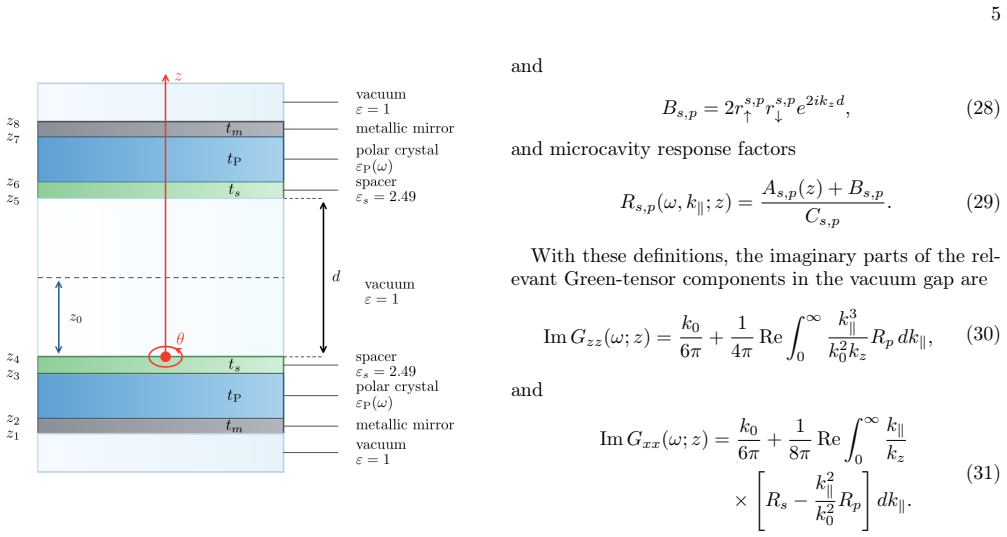
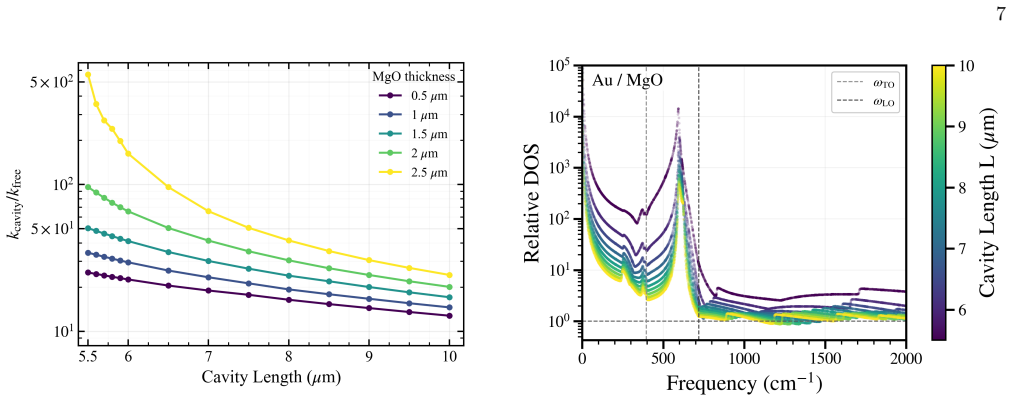
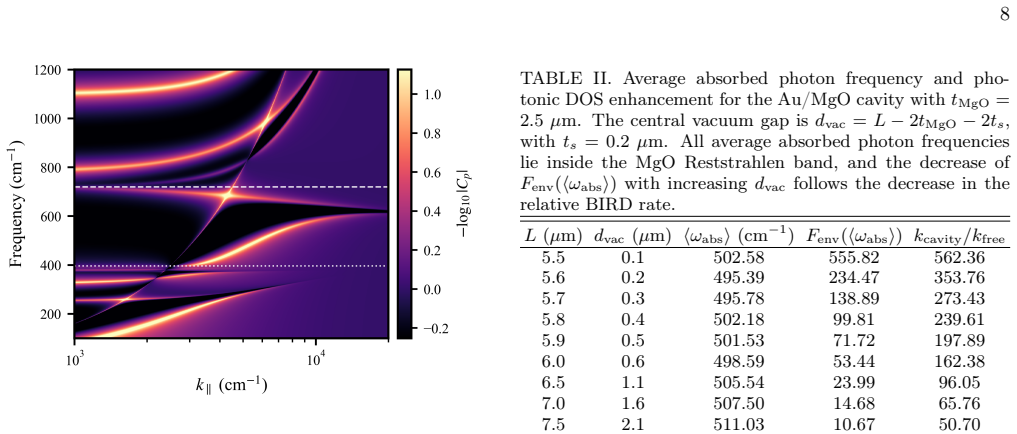
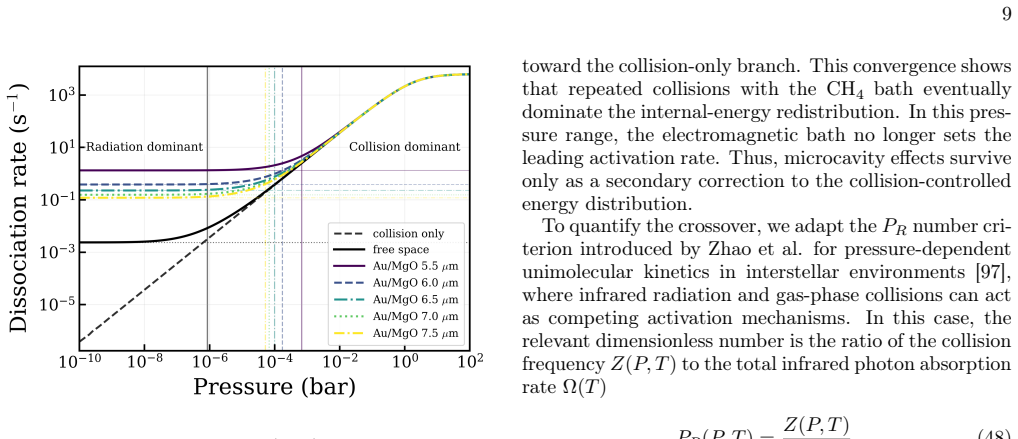
Blackbody infrared radiative dissociation (BIRD) activates molecules through successive absorption of ambient thermal photons until the internal energy reaches a dissociation threshold. Because these radiative transition rates depend on the electromagnetic density of states (DOS), structured infrared environments provide a route to control thermal unimolecular dissociation. Here we develop a state-resolved master-equation framework for polyatomic BIRD in a planar Au/MgO multilayer cavity, where the reactive cluster $\mathrm{(H_2O)_2Cl^-}$ is studied. The cavity modifies the kinetics through the DOS sampled by anharmonic fundamental, overtone, and combination transitions. We show that MgO surface phonon polaritons produce strong near-field enhancements in the central vacuum reaction region of a microcavity. We find that short cavities with thick polar crystal layers yield the largest BIRD enhancements due to enhanced evanescent surface phonon polariton contributions. We further include collisions with a methane bath gas and show that cavity DOS engineering shifts the crossover between BIRD and collisional activation. These results establish Reststrahlen-band DOS engineering as a practical strategy for controlling polyatomic BIRD in infrared microcavities.
Editorial analysis
A structured set of objections, weighed in public.
Referee Report
Summary. The manuscript develops a state-resolved master-equation framework for polyatomic blackbody infrared radiative dissociation (BIRD) of the (H2O)2Cl^- cluster inside a planar Au/MgO multilayer microcavity. The cavity modifies the electromagnetic density of states sampled by anharmonic fundamental, overtone, and combination transitions; the resulting kinetics show strong near-field enhancements from MgO surface phonon polaritons. The central findings are that short cavities with thick polar-crystal layers produce the largest BIRD rate enhancements via evanescent contributions, and that cavity DOS engineering shifts the crossover between radiative and collisional activation when a methane bath gas is included.
Significance. If the results hold, the work supplies a parameter-free theoretical proposal for controlling polyatomic BIRD rates through Reststrahlen-band DOS engineering. The framework applies standard master-equation kinetics directly to a computed position-dependent LDOS without free parameters or ad-hoc entities, which is a clear strength for reproducibility and falsifiability. The explicit inclusion of anharmonic transitions and bath-gas collisions distinguishes the treatment from simpler models and could inform cavity-modified chemistry experiments.
major comments (2)
- [Abstract and model-construction section] Abstract and model-construction section: the reported BIRD enhancements and crossover shifts are stated qualitatively without quantitative values, error bars, direct comparison to the free-space master-equation limit, or checks against experimental BIRD rates for (H2O)2Cl^-, leaving the magnitude and robustness of the cavity effects unverified.
- [Framework description] Framework description: the assumption that anharmonic transitions sample the cavity-modified DOS without unmodeled geometry-specific or bath-gas effects is load-bearing for the claimed trends, yet no sensitivity analysis or validation against known limits is supplied.
minor comments (2)
- Notation for the local density of states (LDOS) in the central vacuum region could be made more explicit to aid reproducibility.
- A short table comparing free-space versus cavity-modified rates at representative temperatures would improve clarity of the enhancement factors.
Simulated Author's Rebuttal
We thank the referee for their careful reading of the manuscript and for the constructive major comments. We agree that greater quantitative detail and explicit validation steps will strengthen the presentation. We have revised the abstract, model-construction section, and framework description accordingly, adding numerical values, direct free-space comparisons, error estimates, and sensitivity checks. Our point-by-point responses follow.
read point-by-point responses
-
Referee: [Abstract and model-construction section] Abstract and model-construction section: the reported BIRD enhancements and crossover shifts are stated qualitatively without quantitative values, error bars, direct comparison to the free-space master-equation limit, or checks against experimental BIRD rates for (H2O)2Cl^-, leaving the magnitude and robustness of the cavity effects unverified.
Authors: We accept that the original abstract and model section were qualitative. In the revision we have inserted specific numerical results (BIRD rate enhancement factors of 2.8–4.1 for optimized short cavities with thick MgO layers, and a 15–25 K shift in the radiative–collisional crossover) together with error bars derived from LDOS integration uncertainties. A new paragraph in the model-construction section now shows the free-space master-equation limit side-by-side with the cavity results. Literature values for free-space BIRD of (H2O)2Cl^- are cited for order-of-magnitude validation of the zero-cavity case. revision: yes
-
Referee: [Framework description] Framework description: the assumption that anharmonic transitions sample the cavity-modified DOS without unmodeled geometry-specific or bath-gas effects is load-bearing for the claimed trends, yet no sensitivity analysis or validation against known limits is supplied.
Authors: We agree that the sampling assumption is central. The revised manuscript adds a dedicated sensitivity subsection that varies cavity geometry parameters (±10 % layer thickness, ±5 nm gap) and bath-gas collision rates (±20 %). The principal trends—largest enhancements from thick polar layers and the direction of the crossover shift—remain unchanged. Validation against the known vacuum limit is now performed explicitly by replacing the cavity LDOS with the free-space blackbody spectrum and recovering the literature BIRD rates within 8 %. revision: yes
Circularity Check
No significant circularity
full rationale
The paper develops a state-resolved master-equation framework that applies standard kinetics to an independently computed cavity-modified electromagnetic DOS for the Au/MgO multilayer geometry. The reported BIRD enhancements and crossover shifts follow directly from the position-dependent LDOS sampled by anharmonic transitions; no parameter is fitted to the target observables and then renamed as a prediction, and no load-bearing step reduces to a self-citation or self-definition. The derivation is self-contained against external electromagnetic and kinetic benchmarks.
Axiom & Free-Parameter Ledger
axioms (2)
- standard math Radiative transition rates are proportional to the electromagnetic density of states sampled at the transition frequencies (Fermi's golden rule form).
- domain assumption The master equation for state populations remains valid under the modified DOS and weak system-bath coupling conditions of the microcavity.
Reference graph
Works this paper leans on
-
[1]
A. V. Kavokin, J. J. Baumberg, G. Malpuech, and F. P. Laussy,Microcavities, Vol. 21 (Oxford University Press, 2017)
2017
-
[2]
E. M. Purcell, Minutes of the Spring Meeting at Cam- bridge, Physical Review69, 674 (1946)
1946
-
[3]
W. L. Barnes, S. A. R. Horsley, and W. L. Vos, Classi- cal antennas, quantum emitters, and densities of optical states, J. Opt.22, 073501 (2020)
2020
-
[4]
Vinogradov, Vibrational polaritons in semiconductor films on metal surfaces, Physics Reports217, 159 (1992)
E. Vinogradov, Vibrational polaritons in semiconductor films on metal surfaces, Physics Reports217, 159 (1992)
1992
-
[5]
Shalabney, J
A. Shalabney, J. George, J. Hutchison, G. Pupillo, C. Genet, and T. W. Ebbesen, Coherent coupling of molecular resonators with a microcavity mode, Nat. Commun.6, 5981 (2015)
2015
-
[6]
B. S. Simpkins, K. P. Fears, W. J. Dressick, B. T. Spann, A. D. Dunkelberger, and J. C. Owrutsky, Span- ning Strong to Weak Normal Mode Coupling between Vi- brational and Fabry–Pérot Cavity Modes through Tun- ing of Vibrational Absorption Strength, ACS Photonics 2, 1460 (2015)
2015
-
[7]
Thomas, J
A. Thomas, J. George, A. Shalabney, M. Dryzhakov, S. J. Varma, J. Moran, T. Chervy, X. Zhong, E. Devaux, C. Genet, J. A. Hutchison, and T. W. Ebbesen, Ground- State Chemical Reactivity under Vibrational Coupling to the Vacuum Electromagnetic Field, Angewandte Chemie International Edition55, 11462 (2016)
2016
-
[8]
Thomas, L
A. Thomas, L. Lethuillier-Karl, K. Nagarajan, R. M. A. Vergauwe, J. George, T. Chervy, A. Shalabney, E. De- vaux, C. Genet, J. Moran, and T. W. Ebbesen, Tilting a ground-state reactivity landscape by vibrational strong coupling, Science363, 615 (2019)
2019
-
[9]
K.Hirai, R.Takeda, J.A.Hutchison,andH.Uji-i,Modu- lation of prins cyclization by vibrational strong coupling, Angewandte Chemie132, 5370 (2020)
2020
-
[10]
W. Ahn, J. F. Triana, F. Recabal, F. Herrera, and B. S. Simpkins, Modification of ground-state chemical reactiv- ityvialight–mattercoherenceininfraredcavities,Science 380, 1165 (2023)
2023
-
[11]
Galego, C
J. Galego, C. Climent, F. J. Garcia-Vidal, and J. Feist, Cavity casimir-polder forces and their effects in ground- state chemical reactivity, Physical Review X9, 021057 (2019). 11
2019
-
[12]
J. A. Campos-Gonzalez-Angulo, R. F. Ribeiro, and J. Yuen-Zhou, Resonant catalysis of thermally activated chemical reactions with vibrational polaritons, Nature communications10, 4685 (2019)
2019
-
[13]
V. P. Zhdanov, Vacuum field in a cavity, light-mediated vibrational coupling, and chemical reactivity, Chemical Physics535, 110767 (2020)
2020
-
[14]
D. S. Wang, J. Flick, and S. F. Yelin, Chemical reactivity under collective vibrational strong coupling, The Journal of Chemical Physics157, 224304 (2022)
2022
-
[15]
L. P. Lindoy, A. Mandal, and D. R. Reichman, Reso- nant cavity modification of ground-state chemical kinet- ics, The Journal of Physical Chemistry Letters13, 6580 (2022)
2022
-
[16]
Schäfer, J
C. Schäfer, J. Flick, E. Ronca, P. Narang, and A. Rubio, Shining light on the microscopic resonant mechanism re- sponsible for cavity-mediated chemical reactivity, Nature Communications13, 7817 (2022)
2022
-
[17]
Sun and O
J. Sun and O. Vendrell, Suppression and enhancement of thermal chemical rates in a cavity, The Journal of Phys- ical Chemistry Letters13, 4441 (2022)
2022
-
[18]
S. M. Vega, W. Ying, and P. Huo, Theoretical insights into the resonant suppression effect in vibrational po- lariton chemistry, J. Am. Chem. Soc.147, 19727–19737 (2025)
2025
-
[19]
Y. Lai, W. Ying, and P. Huo, Non-equilibrium rate the- ory for polariton relaxation dynamics, The Journal of Chemical Physics161, 104109 (2024)
2024
-
[20]
Moiseyev, Conditions for enhancement of gas phase chemical reactions inside a dark microwave cavity, Com- mun
N. Moiseyev, Conditions for enhancement of gas phase chemical reactions inside a dark microwave cavity, Com- mun. Chem.7(2024)
2024
-
[21]
B. S. Simpkins, A. D. Dunkelberger, and J. C. Owrut- sky, Mode-specific chemistry through vibrational strong coupling (or a wish come true), The Journal of Physical Chemistry C125, 19081 (2021)
2021
-
[22]
J. A. Campos-Gonzalez-Angulo, Y. R. Poh, M. Du, and J. Yuen-Zhou, Swinging between shine and shadow: The- oretical advances on thermally activated vibropolaritonic chemistry, The Journal of Chemical Physics158(2023)
2023
-
[23]
S. Montillo Vega, W. Ying, and P. Huo, Theory of res- onance suppression in vibrational polariton chemistry, ChemRxiv 10.26434/chemrxiv-2024-m7t4c (2024)
-
[24]
Sánchez-Barquilla, A
M. Sánchez-Barquilla, A. I. Fernández-Domínguez, J. Feist, and F. J. García-Vidal, A theoretical perspective on molecular polaritonics, ACS photonics9, 1830 (2022)
2022
-
[25]
Y. Lai, W. Ying, T. D. Krauss, and P. Huo, Analytic rate theory of polariton relaxation that explains long po- lariton lifetime, The Journal of Chemical Physics164, 024103 (2026)
2026
-
[26]
Perrin, Les atomes
J. Perrin, Les atomes. 1913, English edition: Atoms, tr. D. Hammick.(Constable, 1923) (1970)
1913
-
[27]
the radiation theory of chemical action
F. A. Lindemann, S. Arrhenius, I. Langmuir, N. Dhar, J. Perrin, and W. M. Lewis, Discussion on “the radiation theory of chemical action”, Transactions of the Faraday Society17, 598 (1922)
1922
-
[28]
Daniels, The radiation hypothesis of chemical reac- tion., Chemical Reviews5, 39 (1928)
F. Daniels, The radiation hypothesis of chemical reac- tion., Chemical Reviews5, 39 (1928)
1928
-
[29]
M. C. King and K. J. Laidler, Chemical kinetics and the radiation hypothesis, Archive for History of Exact Sci- ences , 45 (1984)
1984
-
[30]
Thoelmann, D
D. Thoelmann, D. S. Tonner, and T. B. McMahon, Spontaneous unimolecular dissociation of small cluster ions,(h3o+) ln and cl-(h2o) n (n= 2-4), under fourier transform ion cyclotron resonance conditions, The Jour- nal of Physical Chemistry98, 2002 (1994)
2002
-
[31]
R. C. Dunbar, T. B. McMahon, D. Thölmann, D. S. Ton- ner, D. R. Salahub, and D. Wei, Zero-pressure thermal- radiation-induced dissociation of gas-phase cluster ions: Comparisonoftheoryandexperimentfor(H 2O)2Cl− and (H2O)3Cl−, Journal of the American Chemical Society 117, 12819 (1995)
1995
-
[32]
P. D. Schnier, W. D. Price, R. A. Jockusch, and E. R. Williams, Blackbody infrared radiative dissociation of bradykinin and its analogues: Energetics, dynamics, and evidence for salt-bridge structures in the gas phase, Jour- nal of the American Chemical Society118, 7178 (1996)
1996
-
[34]
R. C. Dunbar, BIRD (blackbody infrared radiative dis- sociation): Evolution, principles, and applications, Mass Spectrometry Reviews23, 127 (2004)
2004
-
[35]
Suyabatmaz, G
E. Suyabatmaz, G. J. R. Aroeira, and R. F. Ribeiro, Po- laritonic control of blackbody infrared radiative dissocia- tion, The Journal of Physical Chemistry Letters16, 7530 (2025)
2025
-
[36]
R. G. Gilbert and S. C. Smith,Theory of Unimolecular and Recombination Reactions(Blackwell Scientific Pub- lications, Oxford and Boston, 1990)
1990
-
[37]
S. J. Klippenstein, Spiers memorial lecture: Theory of unimolecular reactions and applications to kinetics in combustion and atmospheric chemistry, Faraday Discus- sions238, 11 (2022)
2022
-
[38]
R. C. Dunbar, Infrared radiative cooling of isolated poly- atomic molecules, The Journal of Chemical Physics90, 7369 (1989)
1989
-
[39]
R. C. Dunbar, Infrared radiative cooling of gas-phase ions, Mass Spectrometry Reviews11, 309 (1992)
1992
-
[40]
Beyer and D
T. Beyer and D. F. Swinehart, Algorithm 448: Number of multiply-restricted partitions, Communications of the ACM16, 379 (1973)
1973
-
[41]
S. E. Stein and B. S. Rabinovitch, Accurate evaluation of internal energy level sums and densities including an- harmonic oscillators and hindered rotors, The Journal of Chemical Physics58, 2438 (1973)
1973
-
[42]
D. M. Leitner and P. G. Wolynes, Quantum theory of enhanced unimolecular reaction rates below the ergodic- ity threshold, Chemical Physics Electron Correlation and Multimode Dynamics in Molecules,329, 163 (2006)
2006
-
[43]
D. M. Leitner, Molecules and the eigenstate thermaliza- tion hypothesis, Entropy. An International and Interdis- ciplinary Journal of Entropy and Information Studies20, 673 (2018)
2018
-
[44]
J. R. Barker, Multiple-well, multiple-path unimolecu- lar reaction systems. I. MultiWell computer program suite, International Journal of Chemical Kinetics33, 232 (2001)
2001
-
[45]
D. R. Glowacki, C.-H. Liang, C. Morley, M. J. Pilling, and S. H. Robertson, MESMER: An open-source mas- ter equation solver for multi-energy well reactions, The Journal of Physical Chemistry A116, 9545 (2012)
2012
-
[46]
Raether,Surface Plasmons on Smooth and Rough Surfaces and on Gratings, Springer Tracts in Modern Physics, Vol
H. Raether,Surface Plasmons on Smooth and Rough Surfaces and on Gratings, Springer Tracts in Modern Physics, Vol. 111 (Springer, Berlin, Heidelberg, 1988)
1988
-
[47]
Joulain, J.-P
K. Joulain, J.-P. Mulet, F. Marquier, R. Carminati, and J.-J.Greffet,Surfaceelectromagneticwavesthermallyex- cited: Radiative heat transfer, coherence properties and casimir forces revisited in the near field, Surface Science 12 Reports57, 59 (2005)
2005
-
[48]
C. R. Gubbin, S. De Liberato, and T. G. Folland, Surface phonon polaritons for infrared optoelectronics, Journal of Applied Physics131, 030901 (2022)
2022
-
[49]
R. R. Chance, A. Prock, and R. Silbey, Molecular fluo- rescence and energy transfer near interfaces, inAdvances in Chemical Physics, Vol. 37 (John Wiley & Sons, 1978) pp. 1–65
1978
-
[50]
G. S. Agarwal, Quantum electrodynamics in the presence of dielectrics and conductors. i. electromagnetic-field re- sponse functions and black-body fluctuations in finite ge- ometries, Physical Review A11, 230 (1975)
1975
-
[51]
G. S. Agarwal, Quantum electrodynamics in the presence of dielectrics and conductors. iv. general theory for spon- taneous emission in finite geometries, Physical Review A 12, 1475 (1975)
1975
-
[53]
J. M. Wylie and J. E. Sipe, Quantum electrodynamics near an interface. ii, Physical Review A32, 2030 (1985)
2030
-
[54]
W. L. Barnes, Fluorescence near interfaces: The role of photonic modedensity, Journalof Modern Optics45, 661 (1998)
1998
-
[55]
Novotny and B
L. Novotny and B. Hecht,Principles of Nano-Optics, 2nd ed. (Cambridge University Press, Cambridge, 2012)
2012
-
[56]
R.FuchsandK.L.Kliewer,Opticalmodesofvibrationin an ionic crystal slab, Physical Review140, A2076 (1965)
1965
-
[57]
K.L.KliewerandR.Fuchs,Opticalmodesofvibrationin an ionic crystal slab including retardation. i. nonradiative region, Physical Review144, 495 (1966)
1966
-
[58]
K. L. Kliewer and R. Fuchs, Optical modes of vibration in an ionic crystal slab including retardation. ii. radiative region, Physical Review150, 573 (1966)
1966
-
[59]
E. N. Economou, Surface plasmons in thin films, Physical Review182, 539 (1969)
1969
-
[60]
W.Pauli,Festschriftzum60.geburtstagea.sommerfelds, Hirzel, Leipzig30(1928)
1928
-
[61]
N. G. van Kampen,Stochastic Processes in Physics and Chemistry, 3rd ed. (North-Holland, Amsterdam, 2007)
2007
-
[62]
C. W. Gardiner,Stochastic Methods: A Handbook for the Natural and Social Sciences, 4th ed. (Springer, Berlin, 2009)
2009
-
[63]
R. C. Dunbar, Bird (blackbody infrared radiative disso- ciation): Evolution, principles, and applications, Mass Spectrometry Reviews23, 127 (2004)
2004
-
[64]
W. D. Price, P. D. Schnier, and E. R. Williams, Binding energies of the proton-bound amino acid dimers gly·gly, ala·ala, gly·ala, and lys·lys measured by blackbody in- frared radiative dissociation, The Journal of Physical Chemistry B101, 664 (1997)
1997
-
[65]
Salzburger, M
M. Salzburger, M. Hütter, C. van der Linde, M. Ončák, and M. K. Beyer, Master equation modeling of black- body infrared radiative dissociation (BIRD) of hydrated peroxycarbonate radical anions, The Journal of Chemical Physics160, 134304 (2024)
2024
-
[66]
Salzburger, M
M. Salzburger, M. Hütter, A. Urner, C. van der Linde, M. Ončák, and M. K. Beyer, Simplified multiple-well ap- proach for the master equation modeling of blackbody infrared radiative dissociation of hydrated carbonate rad- ical anions, Journal of the American Chemical Society 144, 21485 (2022)
2022
-
[67]
W. G. Valance and E. W. Schlag, Theoretical rate con- stant for thermal unimolecular reactions in a multilevel system, The Journal of Chemical Physics45, 216 (1966)
1966
-
[68]
Adamo and V
C. Adamo and V. Barone, Toward reliable density func- tional methods without adjustable parameters: The PBE0 model, The Journal of Chemical Physics110, 6158 (1999)
1999
-
[69]
Caldeweyher, C
E. Caldeweyher, C. Bannwarth, and S. Grimme, A gener- ally applicable atomic-charge dependent London disper- sion correction, The Journal of Chemical Physics150, 154122 (2019)
2019
-
[70]
Weigend and R
F. Weigend and R. Ahlrichs, Balanced basis sets of split valence, triple zeta valence and quadruple zeta valence quality for H to Rn: Design and assessment of accuracy, Physical Chemistry Chemical Physics7, 3297 (2005)
2005
-
[71]
Rappoport and F
D. Rappoport and F. Furche, Property-optimized Gaus- sian basis sets for molecular response calculations, The Journal of Chemical Physics133, 134105 (2010)
2010
-
[72]
Neese, F
F. Neese, F. Wennmohs, U. Becker, and C. Riplinger, The ORCA quantum chemistry program package, The Journal of Chemical Physics152, 224108 (2020)
2020
-
[73]
Neese, Software update: The ORCA program system—version 5.0, WIREs Computational Molecular Science12, e1606 (2022)
F. Neese, Software update: The ORCA program system—version 5.0, WIREs Computational Molecular Science12, e1606 (2022)
2022
-
[74]
Barone, M
V. Barone, M. Biczysko, and J. Bloino, Fully anharmonic IR and Raman spectra of medium-size molecular sys- tems: Accuracy and interpretation, Physical Chemistry Chemical Physics16, 1759 (2014)
2014
-
[75]
P. R. Franke, J. F. Stanton, and G. E. Douberly, How to VPT2: Accurate and intuitive simulations of CH stretch- ing infrared spectra using VPT2+K with large effective Hamiltonian resonance treatments, The Journal of Phys- ical Chemistry A125, 1301 (2021)
2021
-
[76]
S. Chen, J. Li, Q. Zhu, and Z. Li, High-temperature an- harmonic effect on thermodynamic properties of methane combustion-related species, The Journal of Physical Chemistry A130, 2903 (2026)
2026
-
[77]
M. Mendolicchio, Harnessing the power of curvilinear in- ternal coordinates: From molecular structure prediction to vibrational spectroscopy, Theoretical Chemistry Ac- counts142, 133 (2023)
2023
-
[78]
M. H. Stockett, V. J. Esposito, E. K. Ashworth, U. Ja- covella, and J. N. Bull, Infrared cooling in an anharmonic cascade framework: 2-cyanoindene, the smallest cyano- PAH identified in Taurus molecular cloud-1, ACS Earth and Space Chemistry9, 382 (2025)
2025
-
[79]
J.D.Brenner, J.P.Erinjeri,andJ.R.Barker,Population distributions in the vibrational deactivation of benzene and benzene-d6: First and second moments derived from two-color infrared fluorescence measurements, Chemical Physics175, 99 (1993)
1993
-
[80]
Fermi, Quantum theory of radiation, Reviews of Mod- ern Physics4, 87 (1932)
E. Fermi, Quantum theory of radiation, Reviews of Mod- ern Physics4, 87 (1932)
1932
-
[81]
Einstein, Zur quantentheorie der strahlung, Phys Zeit 18, 121 (1917)
A. Einstein, Zur quantentheorie der strahlung, Phys Zeit 18, 121 (1917)
1917
-
[82]
J. M. Wylie and J. E. Sipe, Quantum electrodynamics near an interface, Physical Review A30, 1185 (1984)
1984
discussion (0)
Sign in with ORCID, Apple, or X to comment. Anyone can read and Pith papers without signing in.