Exploring Gravitational Wave Signatures Due to Primordial Non-gaussianity and Large Scale Structure Using SKAO
Pith reviewed 2026-06-25 22:58 UTC · model grok-4.3
The pith
Cross-correlating the gravitational wave background with large-scale structure tracers enhances signal detection for SKAO observations.
A machine-rendered reading of the paper's core claim, the machinery that carries it, and where it could break.
Core claim
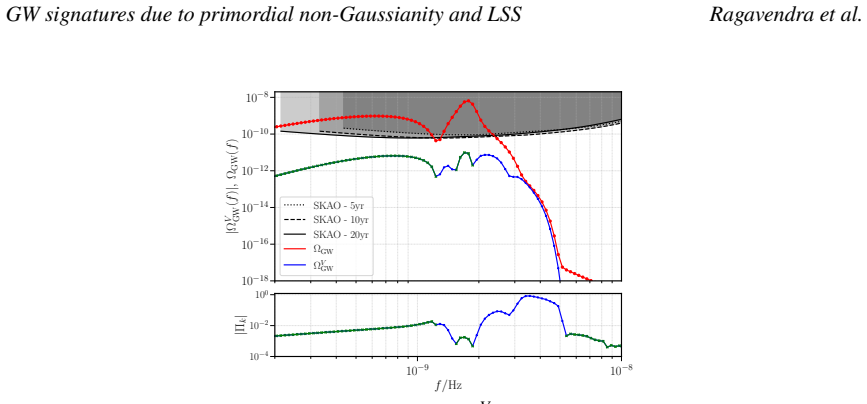
Scalar-induced gravitational waves carry unique features sensitive to primordial non-Gaussianity on small scales and can exhibit scale-dependent helicity from a parity-odd primordial trispectrum. The standard angular auto-correlation analysis of the stochastic gravitational wave background is limited by astrophysical shot noise. Cross-correlating the gravitational wave signal with large-scale structure tracers enhances the signal-to-noise ratio and isolates the astrophysical and cosmological components in the background.
What carries the argument
Cross-correlation between the stochastic gravitational wave background and large-scale structure tracers to mitigate shot noise and isolate components.
Load-bearing premise
Astrophysical shot noise dominates standard auto-correlation analyses of the gravitational wave background, and cross-correlations introduce no comparable new systematics.
What would settle it
A measurement showing whether the cross-correlation power spectrum with LSS tracers yields a significantly higher signal-to-noise ratio than the auto-correlation spectrum alone.
Figures

read the original abstract
This chapter explores theoretical and observational strategies to use the stochastic gravitational-wave background detectable by Square Kilometre Array Observatory (SKAO) as a probe of precision cosmology. We detail the critical phenomenon of scalar-induced gravitational waves, demonstrating their unique features and their sensitivity to primordial non-Gaussianity on scales much smaller than those probed by the cosmic microwave background and large-scale structure. We investigate the phenomenology of parity violation in the early Universe through the chirality imprinted in the stochastic gravitational-wave background, demonstrating that a parity-odd primordial trispectrum can generate a detectable scale-dependent helicity. On the observational side, we point out that the standard gravitational-wave angular auto-correlation analysis is significantly limited by astrophysical shot noise. We show that cross-correlating the gravitational wave signal with independent large-scale structure tracers enhances the signal-to-noise ratio and allows us to isolate the astrophysical and cosmological components in the background. These results can be achieved only thanks to the enhanced sensitivity of SKAO, extensive sky coverage, and high angular resolution, which together make such targets observationally feasible.
Editorial analysis
A structured set of objections, weighed in public.
Referee Report
Summary. The manuscript explores theoretical and observational strategies to use the stochastic gravitational-wave background (SGWB) detectable by SKAO as a probe of precision cosmology. It discusses scalar-induced GWs and their sensitivity to primordial non-Gaussianity on small scales, parity violation via chirality from a parity-odd primordial trispectrum, and proposes that cross-correlating the GW signal with independent LSS tracers enhances SNR while isolating astrophysical and cosmological components, enabled by SKAO's sensitivity, sky coverage, and angular resolution.
Significance. If the unshown calculations, error budgets, and quantitative forecasts hold, the work could provide new handles on small-scale primordial physics and component separation in SGWB analyses. The cross-correlation strategy addresses a known limitation of auto-correlation analyses, but its significance depends on validation that LSS tracers do not reintroduce comparable contamination.
major comments (1)
- [Abstract (final paragraph)] Abstract (final paragraph): the claim that cross-correlating with LSS tracers 'enhances the signal-to-noise ratio and allows us to isolate the astrophysical and cosmological components' rests on the assumption that these tracers introduce no systematics or selection biases comparable to astrophysical shot noise. No error budget or covariance analysis is referenced to support this isolation, making the central observational claim load-bearing but unsupported in the presented text.
Simulated Author's Rebuttal
We thank the referee for the careful and constructive review of our manuscript. The comment on the abstract is well taken, and we address it directly below. We will revise the manuscript to strengthen the presentation of the supporting analysis.
read point-by-point responses
-
Referee: [Abstract (final paragraph)] Abstract (final paragraph): the claim that cross-correlating with LSS tracers 'enhances the signal-to-noise ratio and allows us to isolate the astrophysical and cosmological components' rests on the assumption that these tracers introduce no systematics or selection biases comparable to astrophysical shot noise. No error budget or covariance analysis is referenced to support this isolation, making the central observational claim load-bearing but unsupported in the presented text.
Authors: We agree that the abstract statement would be stronger with explicit pointers to the supporting calculations. The full manuscript derives the cross-correlation SNR, presents the relevant covariance matrices, and discusses mitigation of LSS tracer systematics (including selection biases and shot noise) in Sections 3.2 and 4. To address the referee's concern, we will revise the abstract to reference these sections and add a concise statement on the error budget. We will also expand the main text to more explicitly compare residual LSS systematics against astrophysical shot noise. These changes will be incorporated in the revised version. revision: yes
Circularity Check
No significant circularity; claims rest on external literature and SKAO observational properties without self-referential reductions.
full rationale
The provided abstract and text outline strategies for scalar-induced GWs sensitive to primordial non-Gaussianity, parity violation via chirality, and cross-correlation with LSS tracers to mitigate shot noise. No equations, fitted parameters, or predictions are exhibited that reduce by construction to inputs. No self-citations are invoked as load-bearing uniqueness theorems or ansatze. The central claim about SNR enhancement via cross-correlation is presented as a consequence of SKAO sensitivity and coverage, independent of any internal definitions or prior author results within the paper itself. This is the standard case of a self-contained proposal against external benchmarks.
Axiom & Free-Parameter Ledger
Reference graph
Works this paper leans on
-
[1]
2019 , eprint=
Anticipated Performance of the Square Kilometre Array -- Phase 1 (SKA1) , author=. 2019 , eprint=
2019
-
[2]
2015 , publisher=
Advancing Astrophysics with the Square Kilometre Array (AASKA14) , author=. 2015 , publisher=
2015
-
[3]
and Pieroni, Mauro and Ricciardone, Angelo and Simakachorn, Peera
Figueroa, Daniel G. and Pieroni, Mauro and Ricciardone, Angelo and Simakachorn, Peera. Cosmological Background Interpretation of Pulsar Timing Array Data. Phys. Rev. Lett. 2024. doi:10.1103/PhysRevLett.132.171002. arXiv:2307.02399
-
[4]
Hunting for Primordial Non-Gaussianity in the Cosmic Microwave Background
Komatsu, Eiichiro. Hunting for Primordial Non-Gaussianity in the Cosmic Microwave Background. Class. Quant. Grav. 2010. doi:10.1088/0264-9381/27/12/124010. arXiv:1003.6097
-
[5]
Assembly bias in the local PNG halo bias and its implication for f _ NL constraints
Lazeyras, Titouan and Barreira, Alexandre and Schmidt, Fabian and Desjacques, Vincent. Assembly bias in the local PNG halo bias and its implication for f _ NL constraints. JCAP. 2023. doi:10.1088/1475-7516/2023/01/023. arXiv:2209.07251
-
[6]
Barreira, Alexandre. Can we actually constrain f _ NL using the scale-dependent bias effect? An illustration of the impact of galaxy bias uncertainties using the BOSS DR12 galaxy power spectrum. JCAP. 2022. doi:10.1088/1475-7516/2022/11/013. arXiv:2205.05673
-
[7]
The Shape of non-Gaussianities
Babich, Daniel and Creminelli, Paolo and Zaldarriaga, Matias. The Shape of non-Gaussianities. JCAP. 2004. doi:10.1088/1475-7516/2004/08/009. arXiv:astro-ph/0405356
-
[8]
Bartolo, N. and Komatsu, E. and Matarrese, Sabino and Riotto, A. Non-Gaussianity from inflation: Theory and observations. Phys. Rept. 2004. doi:10.1016/j.physrep.2004.08.022. arXiv:astro-ph/0406398
-
[9]
Akrami, Y. and others. Planck 2018 results. IX. Constraints on primordial non-Gaussianity. Astron. Astrophys. 2020. doi:10.1051/0004-6361/201935891. arXiv:1905.05697
-
[10]
Adshead, Peter and Lozanov, Kaloian D. and Weiner, Zachary J. Non-Gaussianity and the induced gravitational wave background. JCAP. 2021. doi:10.1088/1475-7516/2021/10/080. arXiv:2105.01659
-
[11]
Fully non-Gaussian Scalar-Induced Gravitational Waves
Perna, Gabriele and Testini, Chiara and Ricciardone, Angelo and Matarrese, Sabino. Fully non-Gaussian Scalar-Induced Gravitational Waves. JCAP. 2024. doi:10.1088/1475-7516/2024/05/086. arXiv:2403.06962
-
[12]
Aghanim, N. and others. Planck 2018 results. VI. Cosmological parameters. Astron. Astrophys. 2020. doi:10.1051/0004-6361/201833910. arXiv:1807.06209
-
[13]
Iovino, A. J. and Perna, G. and Riotto, A. and Veerm. Curbing PBHs with PTAs. JCAP. 2024. doi:10.1088/1475-7516/2024/10/050. arXiv:2406.20089
-
[14]
The effect of primordial non-Gaussianity on halo bias
Matarrese, Sabino and Verde, Licia. The effect of primordial non-Gaussianity on halo bias. Astrophys. J. Lett. 2008. doi:10.1086/587840. arXiv:0801.4826
-
[15]
Dalal, Neal and Dore, Olivier and Huterer, Dragan and Shirokov, Alexander. The imprints of primordial non-gaussianities on large-scale structure: scale dependent bias and abundance of virialized objects. Phys. Rev. D. 2008. doi:10.1103/PhysRevD.77.123514. arXiv:0710.4560
-
[16]
doi:10.1143/PTP.54.730 , reportnumber =
Tomita, Kenji , year = 1975, journal =. doi:10.1143/PTP.54.730 , reportnumber =
-
[17]
doi:10.1103/PhysRevLett.72.320 , eprint =
Matarrese, Sabino and Pantano, Ornella and Saez, Diego , year = 1994, journal =. doi:10.1103/PhysRevLett.72.320 , eprint =
-
[18]
doi:10.1016/S0550-3213(03)00550-9 , eprint =
Acquaviva, Viviana and Bartolo, Nicola and Matarrese, Sabino and Riotto, Antonio , year = 2003, journal =. doi:10.1016/S0550-3213(03)00550-9 , eprint =
-
[19]
doi:10.1103/PhysRevD.69.063002 , eprint =
Mollerach, Silvia and Harari, Diego and Matarrese, Sabino , year = 2004, journal =. doi:10.1103/PhysRevD.69.063002 , eprint =
-
[20]
and Clarkson, Chris and Wands, David , year = 2007, journal =
Ananda, Kishore N. and Clarkson, Chris and Wands, David , year = 2007, journal =. doi:10.1103/PhysRevD.75.123518 , eprint =
-
[21]
Guzzetti, M. C. and Bartolo, N. and Liguori, M. and Matarrese, S. Gravitational waves from inflation. Riv. Nuovo Cim. 2016. doi:10.1393/ncr/i2016-10127-1. arXiv:1605.01615
-
[22]
and Takahashi, Keitaro and Ichiki, Kiyotomo , year = 2007, journal =
Baumann, Daniel and Steinhardt, Paul J. and Takahashi, Keitaro and Ichiki, Kiyotomo , year = 2007, journal =. doi:10.1103/PhysRevD.76.084019 , eprint =
-
[23]
Science Case for the Einstein Telescope
Maggiore, Michele and others. Science Case for the Einstein Telescope. JCAP. 2020. doi:10.1088/1475-7516/2020/03/050. arXiv:1912.02622
-
[24]
Laser Interferometer Space Antenna
Amaro-Seoane, Pau and others. Laser Interferometer Space Antenna. 2017. arXiv:1702.00786
Pith/arXiv arXiv 2017
-
[26]
A Unified treatment of cosmological perturbations from super-horizon to small scales
Carbone, Carmelita and Matarrese, Sabino. A Unified treatment of cosmological perturbations from super-horizon to small scales. Phys. Rev. D. 2005. doi:10.1103/PhysRevD.71.043508. arXiv:astro-ph/0407611
-
[27]
Constraints on local primordial non-Gaussianity from large scale structure
Slosar, Anze and Hirata, Christopher and Seljak, Uros and Ho, Shirley and Padmanabhan, Nikhil. Constraints on local primordial non-Gaussianity from large scale structure. JCAP. 2008. doi:10.1088/1475-7516/2008/08/031. arXiv:0805.3580
-
[28]
Realistic consecutive galaxy mergers form eccentric pulsar timing array sources
Fastidio, Federica and Bortolas, Elisa and Gualandris, Alessia and Sesana, Alberto and Read, Justin and Dehnen, Walter. Realistic consecutive galaxy mergers form eccentric pulsar timing array sources. Astron. Astrophys. 2025. doi:10.1051/0004-6361/202556035. arXiv:2506.16539
-
[29]
arXiv , author =:2408.07741 , journal =
-
[30]
Astrophys. J. Lett. , number =. doi:10.3847/2041-8213/ace18a , eprint =
-
[31]
2024 , eprint=
Cross-Correlating the Universe: The Gravitational Wave Background and Large-Scale Structure , author=. 2024 , eprint=
2024
-
[32]
doi:10.1088/1475-7516/2018/09/039 , eprint =
JCAP , note =. doi:10.1088/1475-7516/2018/09/039 , eprint =
-
[33]
The NANOGrav 15 yr Data Set: Looking for Signs of Discreteness in the Gravitational-wave Background
Agazie, Gabriella and others. The NANOGrav 15 yr Data Set: Looking for Signs of Discreteness in the Gravitational-wave Background. Astrophys. J. 2025. doi:10.3847/1538-4357/ad93d5. arXiv:2404.07020
-
[34]
Bosi, M. and Bellomo, N. and Raccanelli, A. Constraining extended cosmologies with GW LSS cross-correlations. JCAP. 2023. doi:10.1088/1475-7516/2023/11/086. arXiv:2306.03031
-
[35]
Pol, Nihan and Taylor, Stephen R. and Romano, Joseph D. Forecasting Pulsar Timing Array Sensitivity to Anisotropy in the Stochastic Gravitational Wave Background. Astrophys. J. 2022. doi:10.3847/1538-4357/ac9836. arXiv:2206.09936
-
[36]
and van Haasteren, Rutger and Sesana, Alberto
Taylor, Stephen R. and van Haasteren, Rutger and Sesana, Alberto. From Bright Binaries To Bumpy Backgrounds: Mapping Realistic Gravitational Wave Skies With Pulsar-Timing Arrays. Phys. Rev. D. 2020. doi:10.1103/PhysRevD.102.084039. arXiv:2006.04810
-
[37]
Beyond the Background: Gravitational-wave Anisotropy and Continuous Waves from Supermassive Black Hole Binaries. , keywords =. doi:10.3847/1538-4357/ad2be8 , archivePrefix =. 2309.07227 , primaryClass =
-
[38]
and Arzoumanian, Zaven and Baker, Paul T
Agazie, Gabriella and Anumarlapudi, Akash and Archibald, Anne M. and Arzoumanian, Zaven and Baker, Paul T. and Bécsy, Bence and Blecha, Laura and Brazier, Adam and Brook, Paul R. and Burke-Spolaor, Sarah and Casey-Clyde, J. Andrew and Charisi, Maria and Chatterjee, Shami and Cohen, Tyler and Cordes, James M. and Cornish, Neil J. and Crawford, Fronefield a...
-
[39]
Phys. Rev. D , number =. doi:10.1103/PhysRevD.102.122005 , eprint =
-
[40]
Miles, Matthew T and Shannon, Ryan M and Reardon, Daniel J and Bailes, Matthew and Champion, David J and Geyer, Marisa and Gitika, Pratyasha and Grunthal, Kathrin and Keith, Michael J and Kramer, Michael and Kulkarni, Atharva D and Nathan, Rowina S and Parthasarathy, Aditya and Porayko, Nataliya K and Singha, Jaikhomba and Theureau, Gilles and Abbate, Fed...
-
[41]
Astrophys. J. , number =. doi:10.3847/1538-4357/ac01c5 , eprint =
-
[42]
2014 , eprint=
A Cosmic Census of Radio Pulsars with the SKA , author=. 2014 , eprint=
2014
-
[43]
Keane, E. F. and others. A Cosmic Census of Radio Pulsars with the SKA. PoS. 2015. doi:10.22323/1.215.0040. arXiv:1501.00056
-
[44]
The local nanohertz gravitational-wave landscape from supermassive black hole binaries. Nature Astronomy , keywords =. doi:10.1038/s41550-017-0299-6 , archivePrefix =. 1708.03491 , primaryClass =
-
[45]
doi:10.1088/1475-7516/2020/10/045 , eprint =
JCAP , note =. doi:10.1088/1475-7516/2020/10/045 , eprint =
-
[46]
Mon. Not. Roy. Astron. Soc. , note =. doi:10.1093/mnras/stx691 , eprint =
-
[47]
and Raccanelli, Alvise and Shiraishi, Maresuke
Dai, Liang and Kamionkowski, Marc and Kovetz, Ely D. and Raccanelli, Alvise and Shiraishi, Maresuke. Antisymmetric galaxy cross-correlations as a cosmological probe. Phys. Rev. D. 2016. doi:10.1103/PhysRevD.93.023507. arXiv:1507.05618
-
[48]
Beware of commonly used approximations
Bernal, Jos \'e Luis and Bellomo, Nicola and Raccanelli, Alvise and Verde, Licia. Beware of commonly used approximations. Part II. Estimating systematic biases in the best-fit parameters. JCAP. 2020. doi:10.1088/1475-7516/2020/10/017. arXiv:2005.09666
-
[49]
and Matarrese, Sabino and Raccanelli, Alvise and Regimbau, Tania and Sakellariadou, Mairi
Bertacca, Daniele and Ricciardone, Angelo and Bellomo, Nicola and Jenkins, Alexander C. and Matarrese, Sabino and Raccanelli, Alvise and Regimbau, Tania and Sakellariadou, Mairi. Projection effects on the observed angular spectrum of the astrophysical stochastic gravitational wave background. Phys. Rev. D. 2020. doi:10.1103/PhysRevD.101.103513. arXiv:1909.11627
-
[50]
Cosmological Measurements with General Relativistic Galaxy Correlations
Raccanelli, Alvise and Montanari, Francesco and Bertacca, Daniele and Dor \'e , Olivier and Durrer, Ruth. Cosmological Measurements with General Relativistic Galaxy Correlations. JCAP. 2016. doi:10.1088/1475-7516/2016/05/009. arXiv:1505.06179
-
[51]
Truant, Riccardo J. and Izquierdo-Villalba, David and Sesana, Alberto and Shaifullah, Golam Mohiuddin and Bonetti, Matteo. Resolving the nano-hertz gravitational wave sky: The detectability of eccentric binaries with PTA experiments. Astron. Astrophys. 2025. doi:10.1051/0004-6361/202451556. arXiv:2407.12078
-
[52]
Moreschi, Beatrice Eleonora and Valtolina, Serena and Sesana, Alberto and Shaifullah, Golam and Falxa, Mikel and Speri, Lorenzo and Izquierdo-Villalba, David and Chalumeau, Aurelien. Dissecting the nanoHz gravitational wave sky: frequency-correlated anisotropy induced by eccentric supermassive black hole binaries. 2025. doi:10.48550/arXiv.2506.14882. arXi...
-
[53]
Taylor, S. R. and Huerta, E. A. and Gair, J. R. and McWilliams, S. T. , year=. DETECTING ECCENTRIC SUPERMASSIVE BLACK HOLE BINARIES WITH PULSAR TIMING ARRAYS: RESOLVABLE SOURCE STRATEGIES , volume=. The Astrophysical Journal , publisher=. doi:10.3847/0004-637x/817/1/70 , number=
-
[54]
and Bécsy, Bence and Blecha, Laura and Blumer, Harsha and Brazier, Adam and Brook, Paul R
Agazie, Gabriella and Arzoumanian, Zaven and Baker, Paul T. and Bécsy, Bence and Blecha, Laura and Blumer, Harsha and Brazier, Adam and Brook, Paul R. and Burke-Spolaor, Sarah and Casey-Clyde, J. Andrew and Charisi, Maria and Chatterjee, Shami and Cheeseboro, Belinda D. and Cohen, Tyler and Cordes, James M. and Cornish, Neil J. and Crawford, Fronefield an...
-
[55]
Sah, Mohit Raj and Mukherjee, Suvodip and Saeedzadeh, Vida and Babul, Arif and Tremmel, Michael and Quinn, Thomas R , year=. Imprints of supermassive black hole evolution on the spectral and spatial anisotropy of nano-hertz stochastic gravitational-wave background , volume=. Monthly Notices of the Royal Astronomical Society , publisher=. doi:10.1093/mnras...
-
[56]
Sah, Mohit Raj and Mukherjee, Suvodip. The Route to Unveil the Cosmic Genealogy of Supermassive Black Hole Binaries Using Nanohertz Gravitational Waves and Galaxy Surveys. Astrophys. J. 2026. doi:10.3847/1538-4357/ae1742. arXiv:2504.05387
-
[57]
2023 , eprint=
Exploring the spectrum of stochastic gravitational-wave anisotropies with pulsar timing arrays , author=. 2023 , eprint=
2023
-
[58]
Libanore, S. and Artale, M. C. and Karagiannis, D. and Liguori, M. and Bartolo, N. and Bouffanais, Y. and Giacobbo, N. and Mapelli, M. and Matarrese, S. Gravitational Wave mergers as tracers of Large Scale Structures. JCAP. 2021. doi:10.1088/1475-7516/2021/02/035. arXiv:2007.06905
-
[59]
2024 , eprint=
The distribution of the gravitational-wave background from supermassive black holes , author=. 2024 , eprint=
2024
-
[60]
The NANOGrav 15 yr Dataset: Targeted Searches for Supermassive Black Hole Binaries
Agarwal, Nikita and others. The NANOGrav 15 yr Dataset: Targeted Searches for Supermassive Black Hole Binaries. Astrophys. J. Lett. 2026. doi:10.3847/2041-8213/ae3719. arXiv:2508.16534
-
[61]
and Kamionkowski, Marc and Jaffe, Andrew H
Hotinli, Selim C. and Kamionkowski, Marc and Jaffe, Andrew H. The search for anisotropy in the gravitational-wave background with pulsar-timing arrays. Open J. Astrophys. 2019. doi:10.21105/astro.1904.05348. arXiv:1904.05348
-
[62]
Grimm, Nastassia and Pijnenburg, Martin and Cusin, Giulia and Bonvin, Camille , year=. The impact of large-scale galaxy clustering on the variance of the Hellings-Downs correlation: numerical results , volume=. Journal of Cosmology and Astroparticle Physics , publisher=. doi:10.1088/1475-7516/2025/04/047 , number=
-
[63]
Variance of the Hellings-Downs correlation. , keywords =. doi:10.1103/PhysRevD.107.043018 , archivePrefix =. 2205.05637 , primaryClass =
-
[64]
Sesana, Alberto and Vecchio, Alberto and Colacino, Carlo Nicola. The stochastic gravitational-wave background from massive black hole binary systems: implications for observations with Pulsar Timing Arrays. Mon. Not. Roy. Astron. Soc. 2008. doi:10.1111/j.1365-2966.2008.13682.x. arXiv:0804.4476
-
[65]
Sesana, Alberto. Self consistent model for the evolution of eccentric massive black hole binaries in stellar environments: implications for gravitational wave observations. Astrophys. J. 2010. doi:10.1088/0004-637X/719/1/851. arXiv:1006.0730
-
[66]
The NANOGrav 15 yr Data Set: Evidence for a Gravitational-wave Background
Agazie, Gabriella and others. The NANOGrav 15 yr Data Set: Evidence for a Gravitational-wave Background. Astrophys. J. Lett. 2023. doi:10.3847/2041-8213/acdac6. arXiv:2306.16213
-
[67]
Ragavendra, H. V. and Bartolo, Nicola. Twisted echoes of an odd quartet: Scalar-induced gravitational waves as a probe of primordial parity-violation. 2025. doi:10.48550/arXiv.2507.02733. arXiv:2507.02733
-
[68]
Primordial gravity wave background anisotropies
Alba, Vasyl and Maldacena, Juan. Primordial gravity wave background anisotropies. JHEP. 2016. doi:10.1007/JHEP03(2016)115. arXiv:1512.01531
-
[69]
Anisotropies of Gravitational Wave Backgrounds: A Line Of Sight Approach
Contaldi, Carlo R. Anisotropies of Gravitational Wave Backgrounds: A Line Of Sight Approach. Phys. Lett. B. 2017. doi:10.1016/j.physletb.2017.05.020. arXiv:1609.08168
-
[70]
Large Nongaussianity in Axion Inflation
Barnaby, Neil and Peloso, Marco. Large Nongaussianity in Axion Inflation. Phys. Rev. Lett. 2011. doi:10.1103/PhysRevLett.106.181301. arXiv:1011.1500
-
[71]
Bartolo, N. and Bertacca, D. and Matarrese, S. and Peloso, M. and Ricciardone, A. and Riotto, A. and Tasinato, G. Anisotropies and non-Gaussianity of the Cosmological Gravitational Wave Background. Phys. Rev. D. 2019. doi:10.1103/PhysRevD.100.121501. arXiv:1908.00527
-
[72]
Characterizing the cosmological gravitational wave background: Anisotropies and non-Gaussianity
Bartolo, Nicola and Bertacca, Daniele and Matarrese, Sabino and Peloso, Marco and Ricciardone, Angelo and Riotto, Antonio and Tasinato, Gianmassimo. Characterizing the cosmological gravitational wave background: Anisotropies and non-Gaussianity. Phys. Rev. D. 2020. doi:10.1103/PhysRevD.102.023527. arXiv:1912.09433
-
[73]
Schulze, Florian and Valbusa Dall'Armi, Lorenzo and Lesgourgues, Julien and Ricciardone, Angelo and Bartolo, Nicola and Bertacca, Daniele and Fidler, Christian and Matarrese, Sabino. GW \_ CLASS: Cosmological Gravitational Wave Background in the cosmic linear anisotropy solving system. JCAP. 2023. doi:10.1088/1475-7516/2023/10/025. arXiv:2305.01602
-
[74]
The dipole of the astrophysical gravitational-wave background
Valbusa Dall'Armi, Lorenzo and Ricciardone, Angelo and Bertacca, Daniele. The dipole of the astrophysical gravitational-wave background. JCAP. 2022. doi:10.1088/1475-7516/2022/11/040. arXiv:2206.02747
-
[75]
Circular polarization of gravitational waves from early-Universe helical turbulence
Kahniashvili, Tina and Brandenburg, Axel and Gogoberidze, Grigol and Mandal, Sayan and Roper Pol, Alberto. Circular polarization of gravitational waves from early-Universe helical turbulence. Phys. Rev. Res. 2021. doi:10.1103/PhysRevResearch.3.013193. arXiv:2011.05556
-
[76]
Simulations of Helical Inflationary Magnetogenesis and Gravitational Waves
Brandenburg, Axel and He, Yutong and Sharma, Ramkishor. Simulations of Helical Inflationary Magnetogenesis and Gravitational Waves. Astrophys. J. 2021. doi:10.3847/1538-4357/ac20d9. arXiv:2107.12333
-
[77]
Gauge fields and inflation: Chiral gravitational waves, fluctuations, and the Lyth bound
Adshead, Peter and Martinec, Emil and Wyman, Mark. Gauge fields and inflation: Chiral gravitational waves, fluctuations, and the Lyth bound. Phys. Rev. D. 2013. doi:10.1103/PhysRevD.88.021302. arXiv:1301.2598
-
[78]
Chiral Primordial Gravitational Waves from a Lifshitz Point
Takahashi, Tomohiro and Soda, Jiro. Chiral Primordial Gravitational Waves from a Lifshitz Point. Phys. Rev. Lett. 2009. doi:10.1103/PhysRevLett.102.231301. arXiv:0904.0554
-
[79]
Gravitational Radiation in the Limit of High Frequency
Isaacson, Richard Allen. Gravitational Radiation in the Limit of High Frequency. 1967
1967
-
[80]
Valbusa Dall'Armi, Lorenzo and Mierna, Alina and Matarrese, Sabino and Ricciardone, Angelo. Adiabatic or Non-Adiabatic? Unraveling the Nature of Initial Conditions in the Cosmological Gravitational Wave Background. 2023. doi:10.48550/arXiv.2307.11043. arXiv:2307.11043
-
[81]
Inflationary initial conditions for the cosmological gravitational wave background
Valbusa Dall'Armi, Lorenzo and Mierna, Alina and Matarrese, Sabino and Ricciardone, Angelo. Inflationary initial conditions for the cosmological gravitational wave background. JCAP. 2024. doi:10.1088/1475-7516/2024/07/043. arXiv:2407.09405
discussion (0)
Sign in with ORCID, Apple, or X to comment. Anyone can read and Pith papers without signing in.