Reading Weakly, Acting Strongly: A Static Parity Horizon and its Dynamical Bypass in the Monitored Lipkin-Meshkov-Glick Model
Pith reviewed 2026-06-26 10:30 UTC · model grok-4.3
The pith
The instanton action that splits the LMG parity doublet also sets the leading exponent for parity information in static J_z magnetisation readouts.
A machine-rendered reading of the paper's core claim, the machinery that carries it, and where it could break.
Core claim
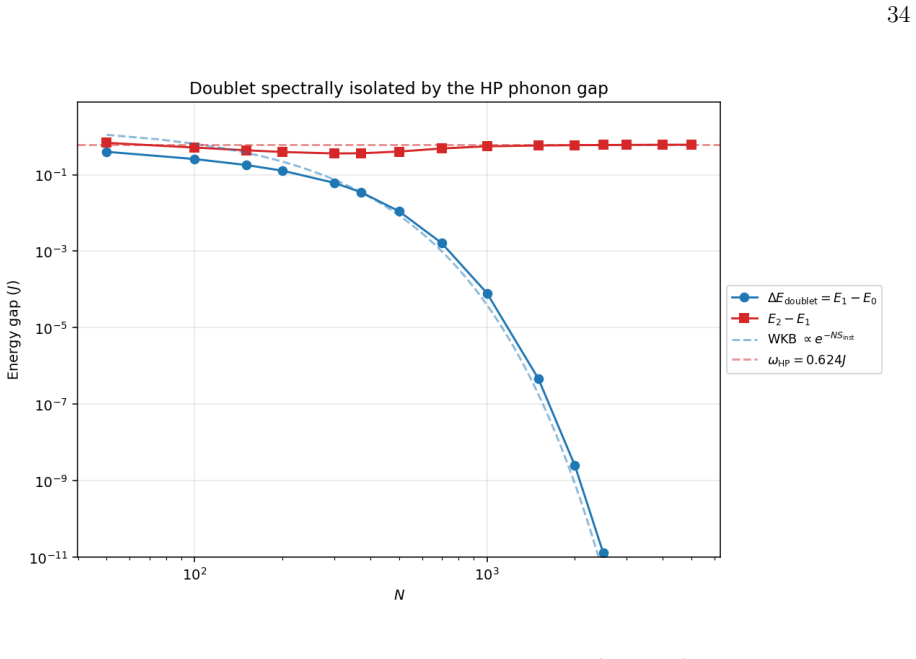
Although J_z measures magnetisation rather than parity, the spectral gap, the total-variation distance, and the nonlinear distinguishability measures (Jensen-Shannon divergence and Chernoff information) share a single instanton exponent set by the tunnelling action S_inst, rather than the doubled exponent a naive small-deviation expansion in the lobes would suggest; exact diagonalisation confirms this common leading exponent lies within a few percent of the WKB value, while the off-diagonal coupling grows as |J_01| -> N m_*/2, so the bath disturbs the parity label far more strongly than it can read it from a frozen histogram, establishing the static parity horizon as a benchmark for the idea
What carries the argument
The static parity horizon: the separation in the idealised static J_z channel where the off-diagonal coupling grows linearly with N and disturbs parity more than it reads it from a histogram.
If this is right
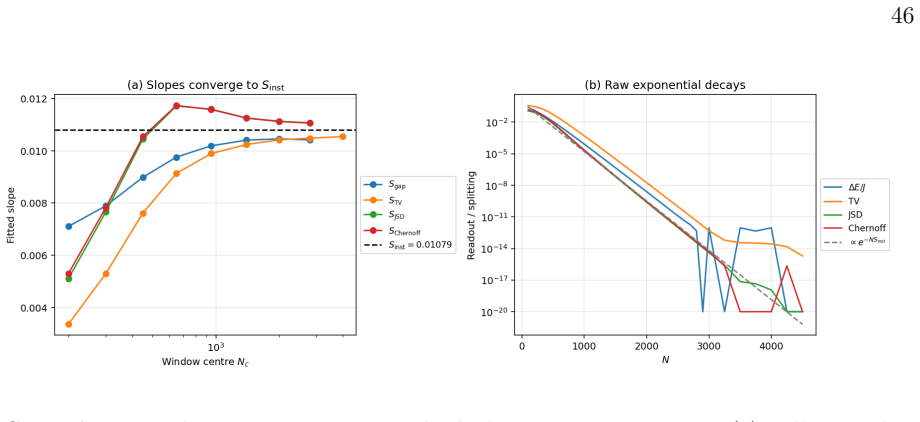
- The spectral gap, total-variation distance, Jensen-Shannon divergence and Chernoff information all share the same single instanton exponent.
- The off-diagonal element |J_01| grows linearly with system size as N m_*/2, allowing stronger disturbance than readout of the parity label.
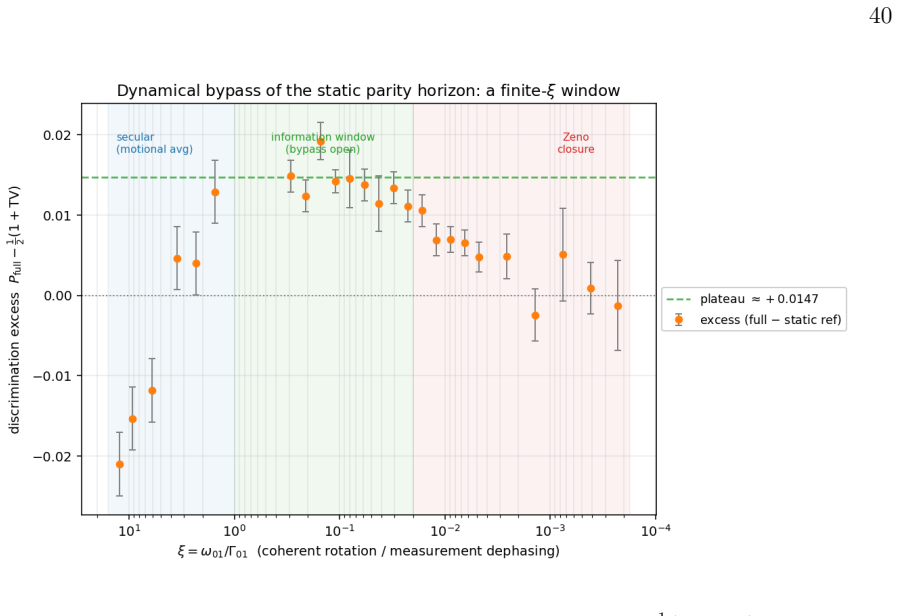
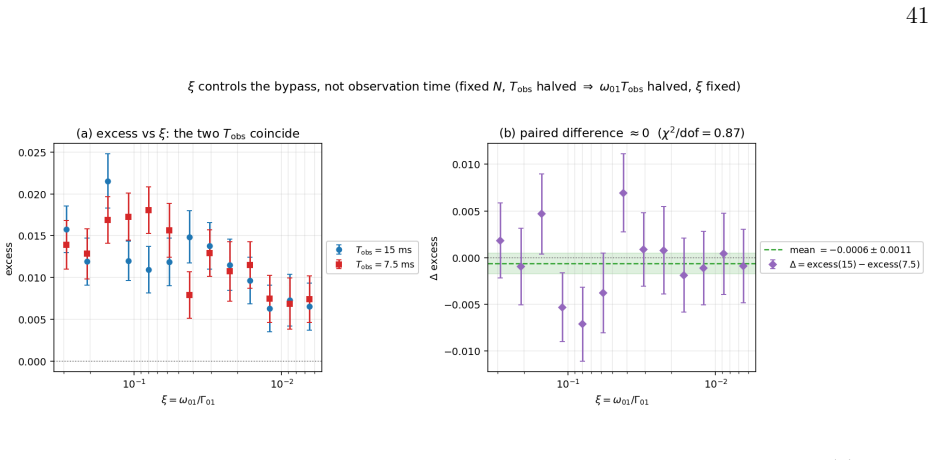
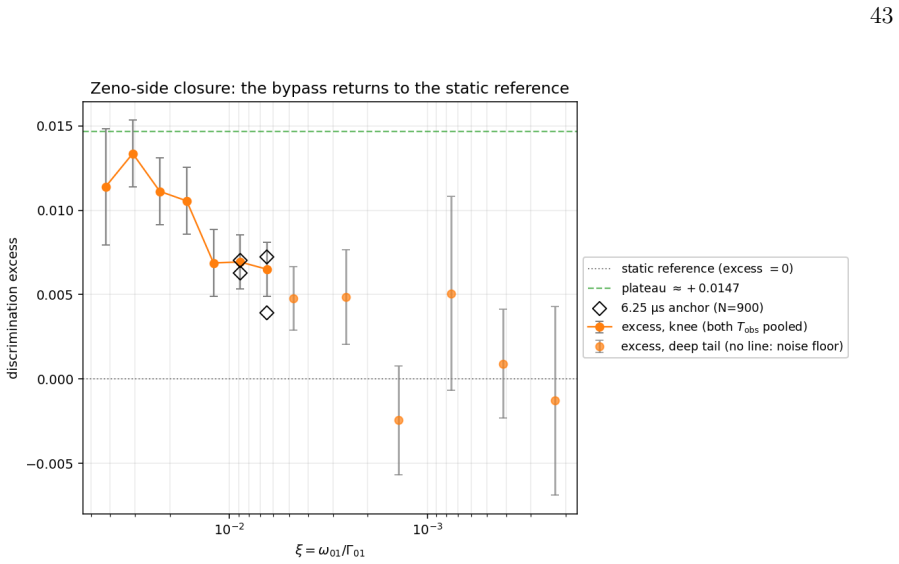
- Time-resolved homodyne records extract parity information hidden from the single-shot histogram over a finite window of system sizes organised by xi = omega_01/Gamma_01.
- The extraction window closes again under strong measurement.
Where Pith is reading between the lines
- The organising ratio xi may allow experimental tuning of information extraction windows in other monitored double-well systems by adjusting measurement strength relative to coherent splitting.
- The separation between static and dynamical extraction could appear in monitored versions of related spin or bosonic models with broken symmetry.
- If size-dependent corrections remain negligible, the common-exponent behaviour should persist to larger N where WKB becomes more accurate.
Load-bearing premise
The instanton action extracted from the spectral gap directly governs the distinguishability measures without additional system-size-dependent corrections that would alter the leading exponent.
What would settle it
Exact diagonalisation at N larger than 4500 in which the fitted exponents for total-variation distance or Jensen-Shannon divergence deviate from the WKB instanton value by more than a few percent.
Figures


read the original abstract
We study the broken-symmetry phase of the Lipkin-Meshkov-Glick (LMG) model, whose two lowest states form a near-degenerate parity doublet split by tunnelling. We show that the same instanton action S_inst that sets the doublet splitting also controls how much parity information a static J_z magnetisation readout can extract. Although J_z measures magnetisation rather than parity - and so distinguishes the two wells easily while remaining almost blind to their relative sign - WKB barrier arguments together with exact diagonalisation show that the spectral gap, the total-variation distance, and the nonlinear distinguishability measures (Jensen-Shannon divergence and Chernoff information) share a single instanton exponent, rather than the doubled exponent a naive small-deviation expansion in the lobes would suggest. Exact diagonalisation up to N = 4500 supports a common leading exponent for all four quantities, with fitted values within a few percent of the WKB instanton value in the largest reliable windows. The same coupling acts strongly inside the doublet: its off-diagonal element grows as |J_01| -> N m_*/2, so the bath can disturb the parity label far more strongly than it can read it from a frozen histogram. We call this separation the static parity horizon - a benchmark for the idealised static J_z channel, not a universal bound on time-resolved monitoring. Restoring the full monitored dynamics, continuous-monitoring simulations (1.48 million full-LMG trajectories with matched QND controls across 77 independent settings) show that a time-resolved homodyne record extracts parity information hidden from the single-shot histogram, over a finite window of system sizes organised by the ratio xi = omega_01/Gamma_01 of coherent doublet rotation to measurement-induced dephasing, and closing again under strong measurement.
Editorial analysis
A structured set of objections, weighed in public.
Referee Report
Summary. The manuscript examines the broken-symmetry phase of the Lipkin-Meshkov-Glick model, where the two lowest states form a near-degenerate parity doublet split by tunneling. It claims that the same WKB instanton action S_inst governing the spectral gap also sets the leading exponential scaling of parity information extractable from static J_z magnetisation measurements, with the total-variation distance, Jensen-Shannon divergence, and Chernoff information all sharing this single exponent (rather than a doubled one from naive lobe expansions). This is supported by exact diagonalization up to N=4500 and 1.48 million continuous-monitoring trajectories, leading to the introduction of a 'static parity horizon' as a benchmark for the idealised static channel, with dynamical bypass possible via time-resolved homodyne records over a finite window of system sizes controlled by xi = omega_01/Gamma_01.
Significance. If the shared-exponent claim holds, the work offers a concrete benchmark for how static versus dynamical readouts interact with parity symmetry in monitored spin systems, highlighting a separation between readout strength and disturbance within the doublet. The scale of the exact-diagonalization (N=4500) and trajectory ensemble (1.48 million) constitutes a clear computational strength that allows direct numerical comparison to WKB. The absence of an independent analytic derivation for the distinguishability exponents, however, keeps the result primarily numerical and limits its generality beyond the LMG model.
major comments (2)
- [Abstract] Abstract: The statement that fitted exponents for TV distance, JS divergence, and Chernoff information lie 'within a few percent of the WKB instanton value in the largest reliable windows' provides no details on the fitting procedure, reported uncertainties, data-exclusion rules, or explicit tests for subleading corrections (log N, constant, or 1/N terms). Because the central claim of a shared leading exponent (rather than doubled) rests entirely on these fits, the lack of such controls leaves open the possibility that quantity-dependent finite-N corrections produce an apparent collapse.
- [Abstract] Abstract and numerical sections: The assumption that the instanton action extracted from the spectral gap directly transfers to the distinguishability measures without additional system-size-dependent corrections that would alter the leading coefficient is invoked via WKB+ED comparison but is not independently verified; for quantities scaling as exp(-S N + o(N)), inclusion or exclusion of subleading terms in the fit window can shift the extracted S by an amount comparable to the reported tolerance, undermining the claim of exact identity.
minor comments (1)
- [Abstract] The introduction of the term 'static parity horizon' would benefit from an explicit operational definition (e.g., a precise inequality involving readout fidelity versus disturbance) at first use rather than after the numerical results.
Simulated Author's Rebuttal
We thank the referee for the careful reading and constructive comments on our numerical analysis. The points raised about fitting procedures and the transfer of the instanton exponent are valid and will be addressed by expanding the documentation in the revised manuscript.
read point-by-point responses
-
Referee: [Abstract] Abstract: The statement that fitted exponents for TV distance, JS divergence, and Chernoff information lie 'within a few percent of the WKB instanton value in the largest reliable windows' provides no details on the fitting procedure, reported uncertainties, data-exclusion rules, or explicit tests for subleading corrections (log N, constant, or 1/N terms). Because the central claim of a shared leading exponent (rather than doubled) rests entirely on these fits, the lack of such controls leaves open the possibility that quantity-dependent finite-N corrections produce an apparent collapse.
Authors: We agree that additional documentation of the fitting procedure is required to support the shared-exponent claim. In the revised manuscript we will add a dedicated subsection (or appendix) that specifies: (i) the exact N-ranges used for each fit (typically 2000–4500 for the largest reliable windows), (ii) the functional forms tested, including pure exponential, exponential plus log N, and exponential plus 1/N corrections, (iii) uncertainty estimation via bootstrap resampling of the ED data and trajectory ensembles, (iv) explicit data-exclusion rules based on convergence thresholds for the spectral gap and distinguishability measures, and (v) side-by-side comparisons of extracted exponents with and without subleading terms to demonstrate stability of the leading coefficient. These additions will allow direct assessment of whether quantity-dependent finite-N effects could mimic the reported collapse. revision: yes
-
Referee: [Abstract] Abstract and numerical sections: The assumption that the instanton action extracted from the spectral gap directly transfers to the distinguishability measures without additional system-size-dependent corrections that would alter the leading coefficient is invoked via WKB+ED comparison but is not independently verified; for quantities scaling as exp(-S N + o(N)), inclusion or exclusion of subleading terms in the fit window can shift the extracted S by an amount comparable to the reported tolerance, undermining the claim of exact identity.
Authors: We acknowledge that the evidence for identical leading exponents is numerical (WKB for the gap combined with ED for the distinguishability measures) rather than supported by an independent analytic derivation of the TV/JS/Chernoff exponents. Such an analytic derivation would be valuable but lies outside the scope of the present work, which centers on establishing the numerical coincidence and its physical interpretation through the static parity horizon. The expanded fitting analysis described above will include explicit sensitivity tests across multiple windows and correction terms, showing that the leading coefficient remains consistent to within the stated tolerance. This strengthens the numerical support without claiming an analytic identity beyond what the WKB+ED comparison demonstrates. revision: partial
Circularity Check
No circularity: WKB + ED comparison is independent numerical verification
full rationale
The paper derives the instanton action S_inst for the spectral gap via standard WKB barrier arguments, then uses exact diagonalization (N up to 4500) to numerically extract leading exponents for total-variation distance, Jensen-Shannon divergence and Chernoff information, reporting that fitted values lie within a few percent of the WKB result in chosen windows. This constitutes an empirical check of shared scaling rather than any reduction of one quantity to another by definition, self-citation, or renaming of a fitted parameter as an independent prediction. No load-bearing self-citation, ansatz smuggling, or uniqueness theorem from prior work appears in the provided text; the derivation chain remains self-contained against external benchmarks.
Axiom & Free-Parameter Ledger
free parameters (1)
- instanton action S_inst
axioms (1)
- domain assumption WKB instanton approximation accurately captures the leading exponential behavior of both splitting and distinguishability measures
invented entities (1)
-
static parity horizon
no independent evidence
Reference graph
Works this paper leans on
-
[1]
Letµ≡2m/N∈[−1,1] denote the dimensionless magnetisation per spin (distinct from the integer Dicke eigenvaluem∈ {−j,
Derivation from the spin-coherent-state path integral The derivation that follows is standard semiclassical WKB applied to the LMG spin- coherent-state path integral; for general background see [25, 26]. Letµ≡2m/N∈[−1,1] denote the dimensionless magnetisation per spin (distinct from the integer Dicke eigenvaluem∈ {−j, . . . , j}used in the discrete sums o...
-
[2]
IV C, Eq
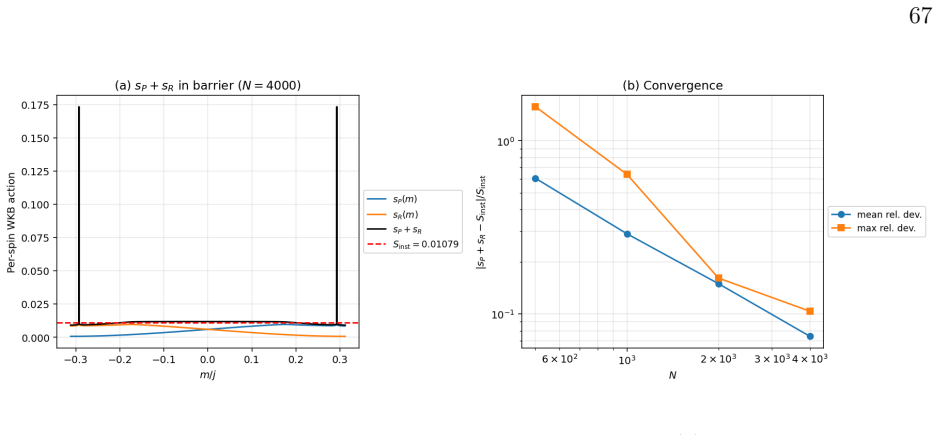
Path additivity: numerical consistency check The analytical statement of Sec. IV C, Eq. (18), was that for the two well wavefunctions ψP,R(m), the per-spin actionss P,R(µm) =−log|ψ P,R(m)|/N, evaluated at the Dicke points µm = 2m/N, satisfy sP (µm) +s R(µm) =S inst(g) (WKB, exactN→ ∞). We provide direct evidence of convergence. Figure 8(a) plotssP (µ),s R...
2000
-
[3]
AsN c grows the slopes rise monotonically: Sgap(Nc=949) = 0.01019 (−5.6%);S gap(Nc=1999) = 0.01045 (−3.2%)
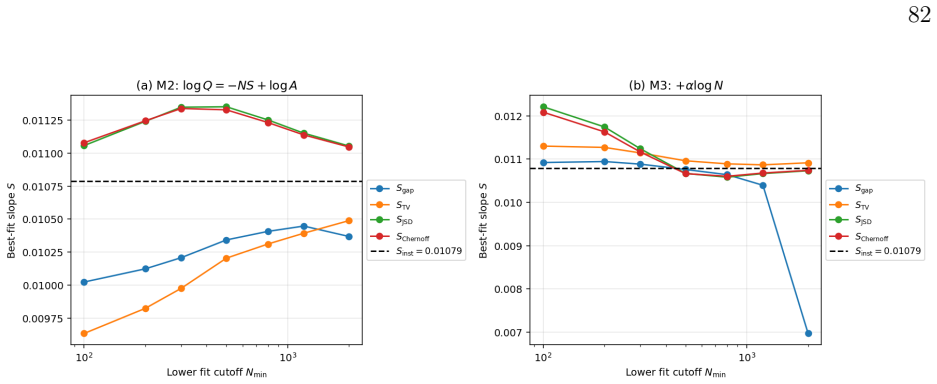
Rolling-window convergence: detailed observations and mask sensitivity Three observations: (i) From-below convergence ofS gap andS TV.AtN c = 450,S gap = 0.00898 andS TV = 0.00761, lying 17% and 29% belowS inst. AsN c grows the slopes rise monotonically: Sgap(Nc=949) = 0.01019 (−5.6%);S gap(Nc=1999) = 0.01045 (−3.2%). The same pattern holds forS TV with a...
1999
-
[4]
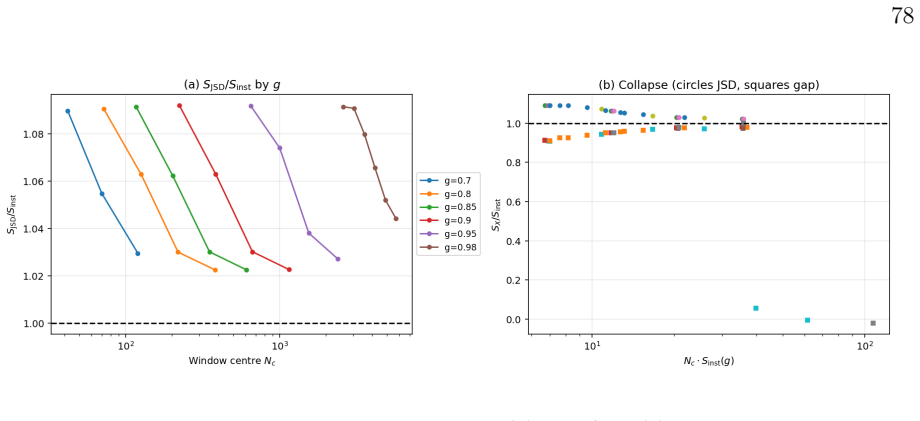
Approximate scaling collapse acrossg: disfavouring a purely near-critical interpretation The most direct test of whether the finite-Ndeviations seen above are a near-critical effect (a possibility we test here) is to repeat the analysis at multiple values ofgand check whether the deviations vanish asgmoves away from criticality. We run the rolling-window ...
-
[5]
This is precisely the quantity that controls the total variation, which therefore inherits the leading exponential directly
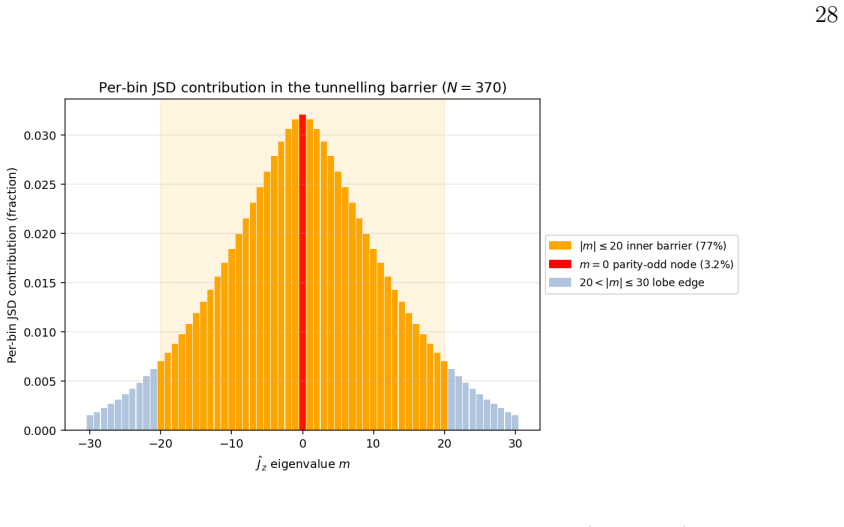
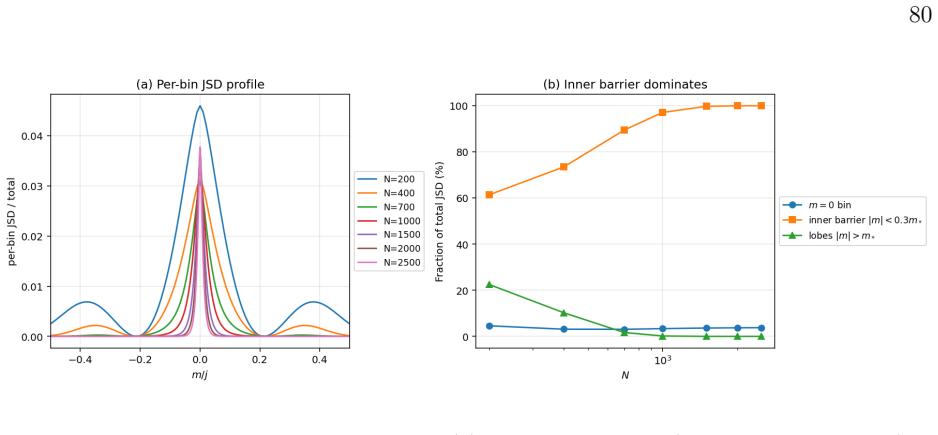
Per-bin JSD anatomy: parity-node dominance Path additivity givesp (0) m −p (1) m = 2ψP (m)ψR(m)∼e −N Sinst throughout the barrier inte- rior, away from WKB boundary layers. This is precisely the quantity that controls the total variation, which therefore inherits the leading exponential directly. For the JSD and Cher- noff, the per-bin contribution is a n...
-
[6]
We use the WKB-motivated three-parameter model logQ(N) =−N·S+αlogN+ logA,(H1) withS,α, logAall free
Independent leading-exponent extraction Beyond rolling-window slope fits, we can extract the leading exponent independently from each readout quantity by fitting a parametrised subleading-correction model. We use the WKB-motivated three-parameter model logQ(N) =−N·S+αlogN+ logA,(H1) withS,α, logAall free. Hereαis an effective polynomial-prefactor exponent...
2000
-
[7]
isolated
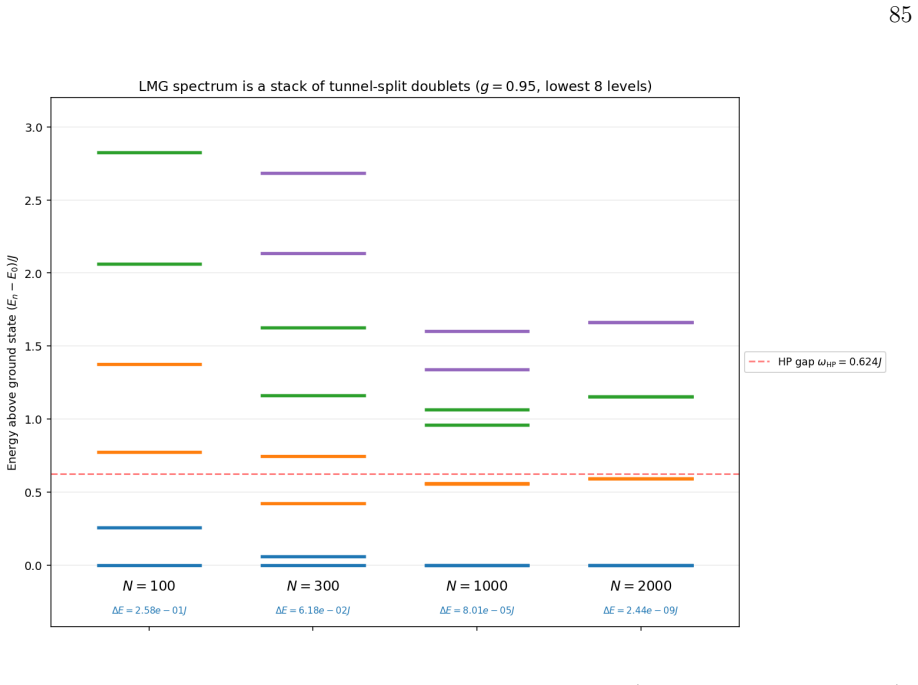
Doublet leakage scaling We characterise the off-doublet leakageℓ leak =L leak/G01 overN∈[50,6000] atg= 0.95. Throughout, “leakage” here meansintra-sectorleakage: ˆJz-matrix-element weight escaping the ground doublet into the higher Holstein–Primakoff phonon rungswithinthe symmetric Dicke sectorj=N/2. This is distinct from out-of-sector leakage into lower-...
2000
-
[8]
Two of these are window-dependent (set by the choice of finite observation windowT obs), the third is intrinsic
Dynamical regime markers Three additional scales characterise the dynamics of the doublet at the benchmark pa- rameters introduced above. Two of these are window-dependent (set by the choice of finite observation windowT obs), the third is intrinsic. We useT obs = 15 ms≈2T 2 at the bench- mark as the reference value. The phaseω 01Tobs accumulated at fixed...
-
[9]
Decoherence, einselection, and the quantum origins of the classical,
W. H. Zurek, “Decoherence, einselection, and the quantum origins of the classical,” Rev. Mod. Phys.75, 715 (2003)
2003
-
[10]
E. Joos, H. D. Zeh, C. Kiefer, D. Giulini, J. Kupsch, and I.-O. Stamatescu,Decoherence and the Appearance of a Classical World in Quantum Theory, 2nd ed. (Springer, Berlin, 2003)
2003
-
[11]
Validity of many-body approximation methods for a solvable model: (I). Exact solutions and perturbation theory,
H. J. Lipkin, N. Meshkov, and A. J. Glick, “Validity of many-body approximation methods for a solvable model: (I). Exact solutions and perturbation theory,” Nucl. Phys.62, 188 (1965)
1965
-
[12]
Large-size critical behavior of infinitely coordinated systems,
R. Botet and R. Jullien, “Large-size critical behavior of infinitely coordinated systems,” Phys. Rev. B28, 3955 (1983)
1983
-
[13]
An intrinsic limit to quantum coherence due to spontaneous symmetry breaking,
J. van Wezel, J. van den Brink, and J. Zaanen, “An intrinsic limit to quantum coherence due to spontaneous symmetry breaking,” Phys. Rev. Lett.94, 230401 (2005)
2005
-
[14]
Spontaneous symmetry breaking in quantum mechanics,
J. van Wezel and J. van den Brink, “Spontaneous symmetry breaking in quantum mechanics,” Am. J. Phys.75, 635 (2007)
2007
-
[15]
N. P. Landsman,Foundations of Quantum Theory: From Classical Concepts to Operator Algebras(Springer, Cham, 2017)
2017
-
[16]
Spontaneous symmetry breaking in quantum systems: emergence or reduc- tion?,
N. P. Landsman, “Spontaneous symmetry breaking in quantum systems: emergence or reduc- tion?,” Stud. Hist. Philos. Mod. Phys.44, 379 (2013)
2013
-
[17]
Probabilities from entanglement, Born’s rule from envariance,
W. H. Zurek, “Probabilities from entanglement, Born’s rule from envariance,” Phys. Rev. A71, 052105 (2005). 89
2005
-
[18]
Field dependence of the intrinsic domain magnetization of a ferromagnet,
T. Holstein and H. Primakoff, “Field dependence of the intrinsic domain magnetization of a ferromagnet,” Phys. Rev.58, 1098 (1940)
1940
-
[19]
Finite-size scaling exponents of the Lipkin–Meshkov–Glick model,
S. Dusuel and J. Vidal, “Finite-size scaling exponents of the Lipkin–Meshkov–Glick model,” Phys. Rev. Lett.93, 237204 (2004)
2004
-
[20]
Continuous unitary transformations and finite-size scaling exponents in the Lipkin–Meshkov–Glick model,
S. Dusuel and J. Vidal, “Continuous unitary transformations and finite-size scaling exponents in the Lipkin–Meshkov–Glick model,” Phys. Rev. B71, 224420 (2005)
2005
-
[21]
Thermodynamical limit of the Lipkin–Meshkov–Glick model,
P. Ribeiro, J. Vidal, and R. Mosseri, “Thermodynamical limit of the Lipkin–Meshkov–Glick model,” Phys. Rev. Lett.99, 050402 (2007)
2007
-
[22]
Exact spectrum of the Lipkin–Meshkov–Glick model in the thermodynamic limit and finite-size corrections,
P. Ribeiro, J. Vidal, and R. Mosseri, “Exact spectrum of the Lipkin–Meshkov–Glick model in the thermodynamic limit and finite-size corrections,” Phys. Rev. E78, 021106 (2008)
2008
-
[23]
S. Mouslopoulos, “Which coherence decoheres? Basis-dependent decoherence rates in symmetry-broken collective spin systems,” arXiv:2605.00952 [quant-ph] (2026)
Pith/arXiv arXiv 2026
-
[24]
H. M. Wiseman and G. J. Milburn,Quantum Measurement and Control(Cambridge Univer- sity Press, Cambridge, 2009)
2009
-
[25]
Selective quantum evolution of a qubit state due to continuous measure- ment,
A. N. Korotkov, “Selective quantum evolution of a qubit state due to continuous measure- ment,” Phys. Rev. B63, 115403 (2001)
2001
-
[26]
C. W. Helstrom,Quantum Detection and Estimation Theory(Academic, New York, 1976)
1976
-
[27]
M. A. Nielsen and I. L. Chuang,Quantum Computation and Quantum Information(Cam- bridge University Press, Cambridge, 2010)
2010
-
[28]
Ohya and D
M. Ohya and D. Petz,Quantum Entropy and Its Use(Springer, Berlin, 2nd ed., 2004)
2004
-
[29]
Divergence measures based on the Shannon entropy,
J. Lin, “Divergence measures based on the Shannon entropy,” IEEE Trans. Inf. Theory37, 145–151 (1991)
1991
-
[30]
Semiclassical coherent-state propagator for many spins,
C. Braun and A. Garg, “Semiclassical coherent-state propagator for many spins,” J. Math. Phys.48, 102104 (2007)
2007
-
[31]
Application of the discrete Wentzel–Kramers–Brillouin method to spin tunneling,
A. Garg, “Application of the discrete Wentzel–Kramers–Brillouin method to spin tunneling,” J. Math. Phys.39, 5166 (1998)
1998
-
[32]
Spin coherent-state path integrals and the instanton calculus,
A. Garg, E. Kochetov, K.-S. Park, and M. Stone, “Spin coherent-state path integrals and the instanton calculus,” J. Math. Phys.44, 48 (2003)
2003
-
[33]
Coleman,Aspects of Symmetry(Cambridge University Press, Cambridge, 1985), Ch
S. Coleman,Aspects of Symmetry(Cambridge University Press, Cambridge, 1985), Ch. 7
1985
-
[34]
L. D. Landau and E. M. Lifshitz,Quantum Mechanics: Non-Relativistic Theory, 3rd ed. (Pergamon, Oxford, 1977). 90
1977
-
[35]
Noiseless quantum codes,
P. Zanardi and M. Rasetti, “Noiseless quantum codes,” Phys. Rev. Lett.79, 3306 (1997)
1997
-
[36]
Decoherence-free subspaces for quantum computation,
D. A. Lidar, I. L. Chuang, and K. B. Whaley, “Decoherence-free subspaces for quantum computation,” Phys. Rev. Lett.81, 2594 (1998)
1998
-
[37]
Theory of quantum error correction for general noise,
E. Knill, R. Laflamme, and L. Viola, “Theory of quantum error correction for general noise,” Phys. Rev. Lett.84, 2525 (2000)
2000
-
[38]
Continuous symmetries and approximate quantum error correction,
P. Faistet al., “Continuous symmetries and approximate quantum error correction,” Phys. Rev. X10, 041018 (2020)
2020
-
[39]
Quantum tunneling across spin domains in a Bose–Einstein condensate,
D. M. Stamper-Kurn, H.-J. Miesner, A. P. Chikkatur, S. Inouye, J. Stenger, and W. Ketterle, “Quantum tunneling across spin domains in a Bose–Einstein condensate,” Phys. Rev. Lett.83, 661 (1999)
1999
-
[40]
Nonlinear multistate tunneling dynamics in a spinor Bose–Einstein condensate,
Z. N. Hardesty-Shaw, Q. Guan, J. O. Austin-Harris, D. Blume, R. J. Lewis-Swan, and Y. Liu, “Nonlinear multistate tunneling dynamics in a spinor Bose–Einstein condensate,” Phys. Rev. A108, 053307 (2023)
2023
-
[41]
Dynamical quantum phase transitions in the dissi- pative Lipkin–Meshkov–Glick model with proposed realization in optical cavity QED,
S. Morrison and A. S. Parkins, “Dynamical quantum phase transitions in the dissi- pative Lipkin–Meshkov–Glick model with proposed realization in optical cavity QED,” Phys. Rev. Lett.100, 040403 (2008)
2008
-
[42]
Programmable quantum simulations of spin systems with trapped ions,
C. Monroe, W. C. Campbell, L.-M. Duan, Z.-X. Gong, A. V. Gorshkov, P. W. Hess, R. Islam, K. Kim, N. M. Linke, G. Pagano, P. Richerme, C. Senko, and N. Y. Yao, “Programmable quantum simulations of spin systems with trapped ions,” Rev. Mod. Phys.93, 025001 (2021)
2021
-
[43]
Quantum nondemolition measurements,
V. B. Braginsky, Y. I. Vorontsov, and K. S. Thorne, “Quantum nondemolition measurements,” Science209, 547 (1980)
1980
-
[44]
Quantum nondemolition measurements: the route from toys to tools,
V. B. Braginsky and F. Y. Khalili, “Quantum nondemolition measurements: the route from toys to tools,” Rev. Mod. Phys.68, 1 (1996)
1996
-
[45]
Continuous quantum measurement and Itˆ o formalism,
L. Di´ osi, “Continuous quantum measurement and Itˆ o formalism,” Phys. Lett. A129, 419 (1988)
1988
-
[46]
Nondemolition measurements, nonlinear filtering and dynamic programming of quantum stochastic processes,
V. P. Belavkin, “Nondemolition measurements, nonlinear filtering and dynamic programming of quantum stochastic processes,” inModeling and Control of Systems, A. Blaqui` ere (ed.), Lect. Notes Control Inf. Sci.121, 245–265 (Springer, Berlin, 1988)
1988
-
[47]
S. Mouslopoulos,The Goldilocks coherence window of the Lipkin–Meshkov–Glick model un- der continuous parameter sweep: window scaling, symmetry-protected adiabaticity, and three- channel energy flow, in preparation (2026). 91
2026
-
[48]
S. Mouslopoulos,Reading Weakly, Acting Strongly: reproduction package for the monitored Lipkin–Meshkov–Glick parity-horizon paper, Zenodo (2026), doi:10.5281/zenodo.20773086
discussion (0)
Sign in with ORCID, Apple, or X to comment. Anyone can read and Pith papers without signing in.