Self-testing Quantum Supermaps
Pith reviewed 2026-06-25 23:20 UTC · model grok-4.3
The pith
Quantum supermaps can be identified device-independently up to local equivalences from measurement statistics alone.
A machine-rendered reading of the paper's core claim, the machinery that carries it, and where it could break.
Core claim
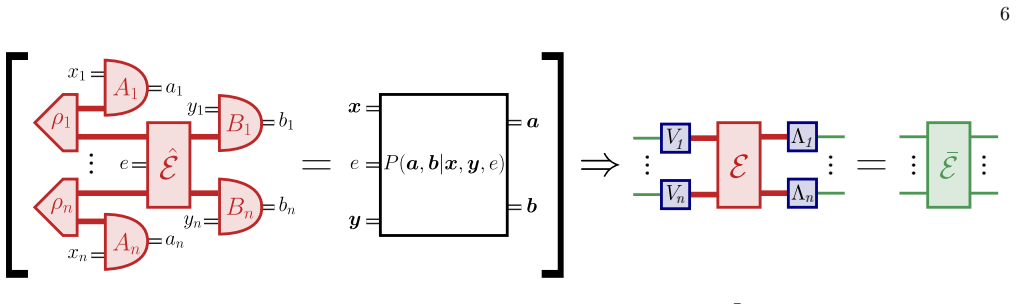
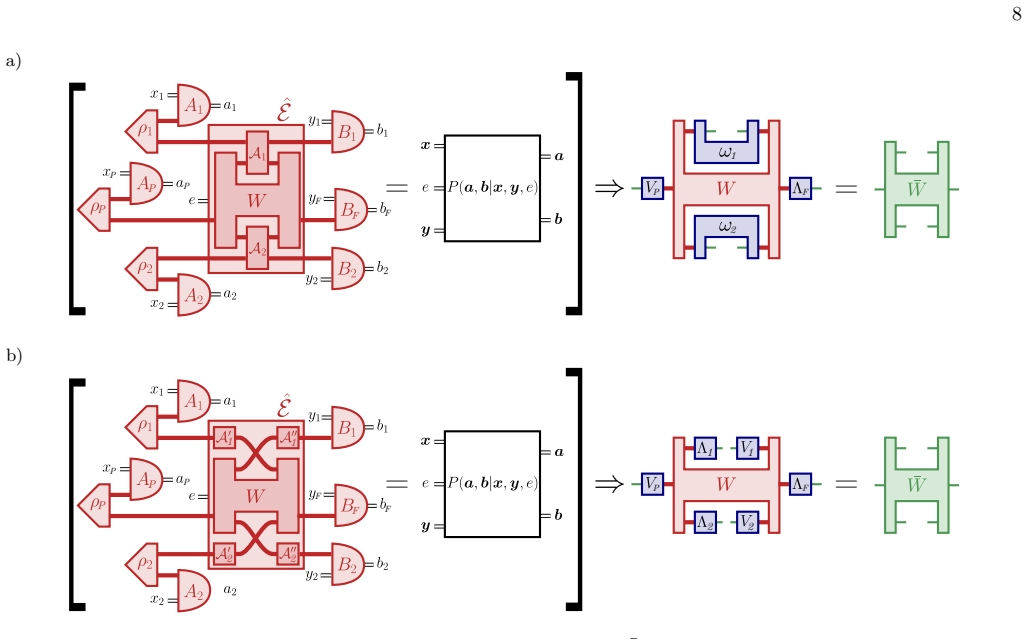
We show that quantum supermaps can be identified device-independently. Specifically, we obtain two levels of certification, depending on the network structure of the experiment: when each slot of the supermap accepts a single uncharacterized black box, identification up to local embedding combs is obtained; when several black boxes are inserted within each slot, identification up to local extracting and injecting maps is achieved. We illustrate our approach on four examples -- the identity comb, a bit-flip error-correcting comb, the comb describing Grover's algorithm, and the quantum switch -- providing in particular the first self-test of both a quantum algorithmic comb and a causally indef
What carries the argument
Device-independent self-testing of quantum supermaps using fixed network structure to distinguish identification up to local embedding combs versus up to local extracting and injecting maps.
If this is right
- The quantum switch can be certified as causally indefinite solely from statistics without assumptions on device internals.
- Grover's algorithm implemented as a comb becomes verifiable in a device-independent way.
- Error-correcting combs such as the bit-flip version can be identified up to the stated equivalences.
- Supermaps in general become subject to the same device-independent certification previously available for states and channels.
Where Pith is reading between the lines
- The approach may extend to certifying higher-order operations beyond supermaps if the slot structure remains known.
- It supplies a route to device-independent verification of quantum algorithms realized through comb structures.
- The distinction between the two certification levels could guide similar self-testing protocols in other quantum networks with known wiring.
Load-bearing premise
The experimental network structure, including whether one or multiple black boxes occupy each slot, is known and fixed in advance.
What would settle it
Measurement statistics that match those predicted for a target supermap such as the quantum switch, yet arise from a process that cannot be related to it by the allowed local maps, would falsify the identification claim.
Figures

read the original abstract
By certifying quantum operations from measurement statistics directly, without any assumption on the internal workings of the devices involved, self-testing enables a uniquely reliable identification of quantum objects. While such device-independent characterization has been shown to be possible for states, measurements and channels, it has so far not been extended to quantum supermaps -- operations that act on quantum channels themselves and can combine them in either a well-defined causal order or also, remarkably, in an indefinite causal order. Here we show that quantum supermaps can be identified device-independently. Specifically, we obtain two levels of certification, depending on the network structure of the experiment: when each slot of the supermap accepts a single uncharacterized black box, identification up to local embedding combs is obtained; when several black boxes are inserted within each slot, identification up to local extracting and injecting maps is achieved. We illustrate our approach on four examples -- the identity comb, a bit-flip error-correcting comb, the comb describing Grover's algorithm, and the quantum switch -- providing in particular the first self-test of both a quantum algorithmic comb and a causally indefinite quantum process. Notably, in the latter case, this provides a new way to certify causal indefiniteness in a device-independent manner.
Editorial analysis
A structured set of objections, weighed in public.
Referee Report
Summary. The paper claims to extend self-testing to quantum supermaps, enabling device-independent identification from measurement statistics. Two certification regimes are distinguished by experimental network structure: single uncharacterized black box per slot yields identification up to local embedding combs; multiple black boxes per slot yields identification up to local extracting and injecting maps. Concrete illustrations are given for the identity comb, a bit-flip error-correcting comb, the comb for Grover's algorithm, and the quantum switch (providing the first self-test of an algorithmic comb and of a causally indefinite process).
Significance. If the technical derivations hold, the result is significant: it supplies the first device-independent certification of quantum supermaps, including those with indefinite causal order, and thereby a new route to certifying causal indefiniteness without device assumptions. The concrete examples (especially the quantum switch) make the claim falsifiable and potentially useful for quantum information protocols that rely on supermaps.
major comments (2)
- [Abstract and §1] Abstract and §1: the two certification levels are applied only after the experimenter fixes and knows the slot occupancy (single vs. multiple black boxes per slot) and causal wiring. No device-independent procedure is supplied to certify this classical network structure from the observed statistics, so the device-independent guarantee remains conditional on an external assumption that is not derived from the data.
- [Abstract] The central claim of 'identification up to local embedding combs' (single-box case) and 'up to local extracting/injecting maps' (multi-box case) therefore inherits the same limitation; if the network structure itself cannot be certified, the self-testing statements are not fully device-independent.
minor comments (1)
- Notation for embedding combs and extracting/injecting maps should be introduced with an explicit diagram or equation reference in the main text to avoid ambiguity when comparing the two regimes.
Simulated Author's Rebuttal
We thank the referee for the positive evaluation of the significance of our results and for the detailed comments on the scope of device-independence. We respond to each major comment below.
read point-by-point responses
-
Referee: [Abstract and §1] Abstract and §1: the two certification levels are applied only after the experimenter fixes and knows the slot occupancy (single vs. multiple black boxes per slot) and causal wiring. No device-independent procedure is supplied to certify this classical network structure from the observed statistics, so the device-independent guarantee remains conditional on an external assumption that is not derived from the data.
Authors: We agree that the classical network structure—including slot occupancy (single versus multiple black boxes per slot) and causal wiring—is assumed known to the experimenter. This is standard in device-independent protocols, where the classical experimental configuration is fixed while the quantum devices remain uncharacterized. The self-testing statements certify the supermap conditional on this known structure. We will add explicit clarification of this assumption in the abstract and Section 1. revision: partial
-
Referee: [Abstract] The central claim of 'identification up to local embedding combs' (single-box case) and 'up to local extracting/injecting maps' (multi-box case) therefore inherits the same limitation; if the network structure itself cannot be certified, the self-testing statements are not fully device-independent.
Authors: The abstract claims are to be read in the context of a known network structure, consistent with the conventional interpretation of device-independence (e.g., Bell tests assume a known bipartite setup). We will revise the abstract and introduction to state this assumption explicitly, thereby preventing any overstatement of the device-independent guarantee. revision: partial
Circularity Check
No circularity: theoretical certification derived from standard quantum information assumptions without self-referential reduction
full rationale
The abstract and provided text present a derivation of device-independent identification of supermaps via two regimes (single vs. multiple black boxes per slot), leading to identification up to local embedding combs or extracting/injecting maps. No quoted equations, self-citations, or steps reduce the central claims to fitted inputs, self-definitions, or prior author work by construction. The network structure is stated as a known experimental input rather than a derived output, but this is an explicit assumption, not a circularity in the mathematical chain. The result is self-contained against external quantum information benchmarks.
Axiom & Free-Parameter Ledger
Reference graph
Works this paper leans on
-
[1]
M. D. and A. Yao, Self testing quantum apparatus, Quan- tum Info. Comput.4, 273 (2004)
2004
-
[2]
ˇSupi´ c and J
I. ˇSupi´ c and J. Bowles, Self-testing of quantum systems: a review, Quantum4, 337 (2020)
2020
-
[3]
J. F. Clauser, M. A. Horne, A. Shimony, and R. A. Holt, Proposed Experiment to Test Local Hidden-Variable Theories, Phys. Rev. Lett.23, 880 (1969). 16
1969
-
[4]
Kaniewski, J., Analytic and nearly optimal self-testing bounds for the Clauser-Horne-Shimony-Holt and Mermin inequalities, Phys. Rev. Lett.117, 070402 (2016)
2016
-
[5]
Coladangelo, K
A. Coladangelo, K. T. Goh, and V. Scarani, All pure bi- partite entangled states can be self-tested, Nature Com- mun.8, 15485 (2017)
2017
-
[6]
Balanz´ o-Juand´ o, A
M. Balanz´ o-Juand´ o, A. Coladangelo, R. Augusiak, A. Ac´ ın, and I. ˇSupi´ c, All pure multipartite entangled states of qubits can be self-tested, Nature Commun.17, 4463 (2026)
2026
-
[7]
R. Chen, L. Manˇ cinska, and J. Volˇ ciˇ c, All real projective measurements can be self-tested, Nature Phys.20, 1642 (2024)
2024
-
[8]
Storz, A
S. Storz, A. Kulikov, J. D. Sch¨ ar, V. Barizien, X. Val- carce, F. Berterotti` ere, N. Sangouard, J.-D. Bancal, and A. Wallraff, Complete Self-Testing of a System of Remote Superconducting Qubits, Phys. Rev. Lett.135, 030801 (2025)
2025
-
[9]
Magniez, D
F. Magniez, D. Mayers, M. Mosca, and H. Ollivier, Self- testing of quantum circuits, inAutomata, Languages and Programming, edited by M. Bugliesi, B. Preneel, V. Sas- sone, and I. Wegener (Springer Berlin Heidelberg, Berlin, Heidelberg, 2006) pp. 72–83
2006
-
[10]
Sekatski, J.-D
P. Sekatski, J.-D. Bancal, S. Wagner, and N. Sangouard, Certifying the building blocks of quantum computers from bell’s theorem, Phys. Rev. Lett.121, 180505 (2018)
2018
-
[11]
Wagner, J.-D
S. Wagner, J.-D. Bancal, N. Sangouard, and P. Sekatski, Device-independent characterization of quantum instru- ments, Quantum4, 243 (2020)
2020
-
[12]
Chiribella, G
G. Chiribella, G. M. D’Ariano, and P. Perinotti, Trans- forming quantum operations: Quantum supermaps, Eu- rophys. Lett.83, 30004 (2008)
2008
-
[13]
de Wolf, Quantum computing: Lecture notes (2023), arXiv:1907.09415 [quant-ph]
R. de Wolf, Quantum computing: Lecture notes (2023), arXiv:1907.09415 [quant-ph]
arXiv 2023
-
[14]
L. K. Grover, A fast quantum mechanical algorithm for database search, inProceedings of the Twenty-Eighth An- nual ACM Symposium on Theory of Computing, STOC ’96 (Association for Computing Machinery, New York, NY, USA, 1996) pp. 212–219
1996
-
[15]
Oreshkov, F
O. Oreshkov, F. Costa, and ˇC. Brukner, Quantum cor- relations with no causal order, Nature Commun.3, 1092 (2012)
2012
-
[16]
F. Costa, G. Rubino, C. Branciard, ˇC. Brukner, and M. T. Quintino, Indefinite quantum causality (2026), arXiv:2606.19438 [quant-ph]
Pith/arXiv arXiv 2026
-
[17]
Chiribella, G
G. Chiribella, G. M. D’Ariano, P. Perinotti, and B. Val- iron, Quantum computations without definite causal structure, Phys. Rev. A88, 022318 (2013)
2013
-
[18]
Ara´ ujo, F
M. Ara´ ujo, F. Costa, and ˇC. Brukner, Computational Advantage from Quantum-Controlled Ordering of Gates, Phys. Rev. Lett.113, 250402 (2014)
2014
-
[19]
A. A. Abbott, M. Mhalla, and P. Pocreau, Quantum query complexity of Boolean functions under indefinite causal order, Phys. Rev. Research6, L032020 (2024)
2024
-
[20]
P. A. Gu´ erin, A. Feix, M. Ara´ ujo, andˇC. Brukner, Expo- nential communication complexity advantage from quan- tum superposition of the direction of communication, Phys. Rev. Lett.117, 100502 (2016)
2016
-
[21]
Chiribella, G
G. Chiribella, G. M. D’Ariano, and P. Perinotti, Memory effects in quantum channel discrimination, Phys. Rev. Lett.101, 180501 (2008)
2008
-
[22]
Q. Liu, Z. Hu, H. Yuan, and Y. Yang, Optimal strategies of quantum metrology with a strict hierarchy, Phys. Rev. Lett.130, 070803 (2023)
2023
-
[23]
Bavaresco, P
J. Bavaresco, P. Lipka-Bartosik, P. Sekatski, and M. Mehboudi, Designing optimal protocols in Bayesian quantum parameter estimation with higher-order opera- tions, Phys. Rev. Research6, 023305 (2024)
2024
-
[24]
Taranto, S
P. Taranto, S. Milz, M. Murao, M. T. Quintino, and K. Modi, A guide to higher-order quantum operations, PRX Quantum (2026)
2026
-
[25]
Hossenfelder and T
S. Hossenfelder and T. Palmer, Rethinking superdeter- minism, Frontiers Phys.8, 139 (2020)
2020
-
[26]
Barizien, P
V. Barizien, P. Sekatski, and J.-D. Bancal, Custom Bell inequalities from formal sums of squares, Quantum8, 1333 (2024)
2024
-
[27]
Bancal, N
J.-D. Bancal, N. Sangouard, and P. Sekatski, Noise- Resistant Device-Independent Certification of Bell State Measurements, Phys. Rev. Lett.121, 250506 (2018)
2018
-
[28]
M. O. Renou, J. Kaniewski, and N. Brunner, Self-Testing Entangled Measurements in Quantum Networks, Phys. Rev. Lett.121, 250507 (2018)
2018
-
[29]
ˇSupi´ c, J
I. ˇSupi´ c, J. Bowles, M.-O. Renou, A. Ac´ ın, and M. J. Hoban, Quantum networks self-test all entangled states, Nature Phys.19, 670 (2023)
2023
-
[30]
Jamio lkowski, Linear transformations which preserve trace and positive semidefiniteness of operators, Reports Math
A. Jamio lkowski, Linear transformations which preserve trace and positive semidefiniteness of operators, Reports Math. Phys.3, 275 (1972)
1972
-
[31]
Sekatski, J.-D
P. Sekatski, J.-D. Bancal, M. Ioannou, M. Afzelius, and N. Brunner, Toward the device-independent certification of a quantum memory, Phys. Rev. Lett.131, 170802 (2023)
2023
-
[32]
M. Bock, P. Sekatski, J.-D. Bancal, S. Kucera, T. Bauer, N. Sangouard, C. Becher, and J. Eschner, Calibration- independent bound on the unitarity of a quantum chan- nel with application to a frequency converter, npj Quan- tum Inf.10, 63 (2024)
2024
-
[33]
Neves, L
S. Neves, L. dos Santos Martins, V. Yacoub, P. Lefebvre, I. ˇSupi´ c, D. Markham, and E. Diamanti, Experimentally certified transmission of a quantum message through an untrusted and lossy quantum channel via Bell’s theorem, PRX Quantum6, 030312 (2025)
2025
-
[34]
Heinosaari and M
T. Heinosaari and M. Ziman,The mathematical language of quantum theory: from uncertainty to entanglement (Cambridge University Press, 2011)
2011
-
[35]
M. T. Quintino, Q. Dong, A. Shimbo, A. Soeda, and M. Murao, Probabilistic exact universal quantum circuits for transforming unitary operations, Phys. Rev. A100, 062339 (2019)
2019
-
[36]
Coladangelo, Parallel self-testing of (tilted) EPR pairs via copies of (tilted) CHSH and the magic square game, Quantum Inf
A. Coladangelo, Parallel self-testing of (tilted) EPR pairs via copies of (tilted) CHSH and the magic square game, Quantum Inf. Comput.17, 831 (2017)
2017
-
[37]
Sarkar, D
S. Sarkar, D. Saha, J. Kaniewski, and R. Augusiak, Self- testing quantum systems of arbitrary local dimension with minimal number of measurements, npj Quantum Inf.7, 151 (2021)
2021
-
[38]
U. I. Meyer, I. ˇSupi´ c, F. Grosshans, and D. Markham, Robustly self-testing all maximally entangled states in every finite dimension (2025), arXiv:2508.01071 [quant- ph]
arXiv 2025
-
[39]
D¨ ur, M
W. D¨ ur, M. Skotiniotis, F. Froewis, and B. Kraus, Im- proved quantum metrology using quantum error correc- tion, Phys. Rev. Lett.112, 080801 (2014)
2014
-
[40]
Sekatski, M
P. Sekatski, M. Skotiniotis, J. Ko lody´ nski, and W. D¨ ur, Quantum metrology with full and fast quantum control, Quantum1, 27 (2017)
2017
-
[41]
P. Sekatski, Y. Guryanova, N. B. T. Kothakonda, and M. Skotiniotis, Cloning quantum channels (2025), 17 arXiv:2509.08059 [quant-ph]
arXiv 2025
-
[42]
Zalka, Grover’s quantum searching algorithm is opti- mal, Phys
C. Zalka, Grover’s quantum searching algorithm is opti- mal, Phys. Rev. A60, 2746 (1999)
1999
-
[43]
Chiribella, Perfect discrimination of no-signalling channels via quantum superposition of causal structures, Phys
G. Chiribella, Perfect discrimination of no-signalling channels via quantum superposition of causal structures, Phys. Rev. A86, 040301(R) (2012)
2012
-
[44]
L. A. Rozema, T. Str¨ omberg, H. Cao, Y. Guo, B.-H. Liu, and P. Walther, Experimental aspects of indefinite causal order in quantum mechanics, Nature Rev. Phys.6, 483 (2024)
2024
-
[45]
Branciard, M
C. Branciard, M. Ara´ ujo, A. Feix, F. Costa, and ˇC. Brukner, The simplest causal inequalities and their violation, New J. Phys.18, 013008 (2015)
2015
-
[46]
Oreshkov and C
O. Oreshkov and C. Giarmatzi, Causal and causally sep- arable processes, New J. Phys.18, 093020 (2016)
2016
-
[47]
Ara´ ujo, C
M. Ara´ ujo, C. Branciard, F. Costa, A. Feix, C. Giar- matzi, and ˇC. Brukner, Witnessing causal nonseparabil- ity, New J. Phys.17, 102001 (2015)
2015
-
[48]
Branciard, Witnesses of causal nonseparability: an introduction and a few case studies, Sci
C. Branciard, Witnesses of causal nonseparability: an introduction and a few case studies, Sci. Rep.6, 26018 (2016)
2016
-
[49]
Bavaresco, M
J. Bavaresco, M. Ara´ ujo, ˇC. Brukner, and M. T. Quintino, Semi-device-independent certification of indef- inite causal order, Quantum3, 176 (2019)
2019
-
[50]
Dourdent, A
H. Dourdent, A. A. Abbott, N. Brunner, I. ˇSupi´ c, and C. Branciard, Semi-device-independent certification of causal nonseparability with trusted quantum inputs, Phys. Rev. Lett.129, 090402 (2022)
2022
-
[51]
S. Gogioso and N. Pinzani, The geometry of causality (2023), arXiv:2303.09017 [quant-ph]
arXiv 2023
-
[52]
van der Lugt, J
T. van der Lugt, J. Barrett, and G. Chiribella, Device- independent certification of indefinite causal order in the quantum switch, Nature Commun.14, 5811 (20223)
-
[53]
van der Lugt and N
T. van der Lugt and N. Ormrod, Possibilistic and maxi- mal indefinite causal order in the quantum switch, Quan- tum8, 1543 (2024)
2024
-
[54]
Dourdent, A
H. Dourdent, A. A. Abbott, I. ˇSupi´ c, and C. Branciard, Network-device-independent certification of causal non- separability, Quantum8, 1514 (2024)
2024
-
[55]
Vilasini and R
V. Vilasini and R. Renner, Fundamental limits for real- izing quantum processes in spacetime, Phys. Rev. Lett. 133, 080201 (2024)
2024
-
[56]
J. S. Bell, On the Einstein Podolsky Rosen paradox, Physics1, 195 (1964)
1964
-
[57]
Ara´ ujo, A
M. Ara´ ujo, A. Feix, M. Navascu´ es, andˇC. Brukner, A purification postulate for quantum mechanics with in- definite causal order, Quantum1, 10 (2017)
2017
-
[58]
Baumeler and S
¨A. Baumeler and S. Wolf, The space of logically con- sistent classical processes without causal order, New J. Phys.18, 013036 (2016)
2016
-
[59]
Coopmans, J
T. Coopmans, J. Kaniewski, and C. Schaffner, Robust self-testing of two-qubit states, Phys. Rev. A99, 052123 (2019)
2019
-
[60]
Valcarce, J
X. Valcarce, J. Zivy, N. Sangouard, and P. Sekatski, Self- testing two-qubit maximally entangled states from gen- eralized Clauser-Horne-Shimony-Holt tests, Phys. Rev. Research4, 013049 (2022)
2022
-
[61]
Bancal, M
J.-D. Bancal, M. Navascu´ es, V. Scarani, T. V´ ertesi, and T. H. Yang, Physical characterization of quantum de- vices from nonlocal correlations, Phys. Rev. A91, 022115 (2015)
2015
-
[62]
Y. Wang, X. Wu, and V. Scarani, All the self-testings of the singlet for two binary measurements, New J. Phys. 18, 025021 (2016)
2016
-
[63]
Barizien and J.-D
V. Barizien and J.-D. Bancal, Quantum statistics in the minimal Bell scenario, Nature Phys.21, 577 (2025). Appendix A: Self-testing the Choi channels In this section we present the self-testing results for the Choi channels of the supermaps introduced in Section IV following the scheme proposed for channel self-testing presented in Section II C and summar...
2025
-
[64]
Constructing the extraction map In the first subsection we start by presenting a general construction of a local extraction map that is tailored to the situation where the reference measurements ¯Aa|x of a party are complementary qubit measurements witha, x= 0,1. This map applies to all examples discussed in the main text and presented afterwards and can ...
-
[65]
Self-testing the sources We start by treating the latter for all examples together. Indeed, when the local dimension is 2 (qubit case), the state Φ+ can be self-tested using the maximal violation of the CHSH inequality [3] in a bipartite Bell scenario as per the following lemma. Lemma A.1(Section 4 of [2]).CHSH self-test. Let’s consider a bipartite Bell s...
-
[66]
Self-testing the SWAP In this section, we propose a self-testing result for the qubitSwapoperation, seen as a channel acting on two systems. This amounts to self-test both the product of two maximally entangled qubits states Φ + A(1)B(1) ⊗Φ + A(2)B(2) as well as the Choi stateC(Swap) obtained by applying theSwapoperator on the partiesB (1), B(2), i.e.C(Sw...
-
[67]
IV B of the main text
Self-testing the Choi channel of the error-correcting comb In this section we propose a self-testing result for the Choi channelJ( ¯WEC) of the error-correcting comb, discussed in Sec. IV B of the main text. This amounts to certifying ¯Ψ = Φ+ A(1)B(1) ⊗Φ + A(2)B(2) ,(A9) when the channel is not applied, which can be done using Lemma A.2, and the Choi stat...
-
[68]
(A12) Reaching the Tsirelson bound of this inequality self-test the following reference realization: |G0⟩ ⟨G0|:= GHZ 4 GHZ 4 , A(1) 0 =A (2) 0 =B (1) 0 =σ z, A (1) 1 =A (2) 1 =B (1) 1 =σ x, B(2) 0 = σz +σ x√ 2 , B (2) 1 = σz −σ x√ 2 . (A13) Now notice that measuring the state|G 1⟩=σ A(1) x GHZ 4 with the same measurements will give the same correla- tions...
-
[69]
(A14) The Tsirelson bound of this inequality self-tests the state|G 1⟩ ⟨G1|:=σ A(1) x GHZ 4 GHZ 4 σA(1) x and the measure- ments of Eq.(A13). Note that both self-testing results implies the existence of local maps onA (1), A(2), B(1), B(2) that extract the target state (either|G 0⟩ ⟨G0|or|G 1⟩ ⟨G1|) from any state achieving the quantum bound. Since the me...
-
[70]
channel-free
Self-testing the Choi channel of Grover’s algorithm In this section we propose a self-testing result for the Choi channel of Grover’s algorithm. As discussed in Sec- tion IV C, this amounts to certifying the state preparation – when the channel is not applied, and the Choi state of the channel – when the channel is applied. The former state, product of (M...
-
[71]
nullifiers
Find a complete set of “nullifiers”{ ˆNi}of the target state|ψ⟩, i.e. operators such that ˆNi |ψ⟩= 0 and∩ i ker ˆNi = Vect(|ψ⟩)
-
[72]
Make a choice (or a parametrization) of measurements and express the nullifiers in terms of the measurements operators
-
[73]
Lift the nullifers to the formal polynomial algebra (where commutation rules specific to the ideal Hilbert space are omitted) and compute there SOS: P i N 2 i
-
[74]
non-measurable
Check wether it is possible to cancel all “non-measurable” terms in the SOS, i.e. all terms whose local degree is strictly larger than 1. The Bell inequality and its SOS bound are then obtained by looking at measurable terms and identity terms respectively. We present below how we apply this method to the state in Eq. (A16). Step 1: In order to find the n...
-
[75]
(A16) and CHSH measurements Eq
Since the ideal realization (with state Eq. (A16) and CHSH measurements Eq. (A6)) saturates this bounds, this is indeed the quantum bound of this operator. We can now move to our main result. Theorem A.6.Self-testing|ψ G⟩ ⟨ψG|. Let us consider a 2n-partite Bell scenario where each party performs two binary measurements. Consider the Bell expression Eq.(A2...
-
[76]
It thus suffices to show that the only qubit realization that can reach 3n/ √ 2 is the reference one up to local unitaries. From now on, we thus assume that|ψ⟩is a normalized 2nqubit state and every measurement can be expressed as a norm 1 linear combination of the Pauli operators, i.e.A (i) x =a (i) x ·σwithσ= (σ x, σy, σz) and|a (i) x |= 1 (likewise for...
-
[77]
Self-testing the Choi channel of the quantum switch In this section we propose a self-testing result for the Choi channelJ( ¯WSwitch). This amounts to certifying ¯Ψ = Φ+ A(C) B(C) ⊗Φ + A(T) B(T) ⊗Φ + A(1)B(1) ⊗Φ + A(2)B(2) ,(A36) when the channel is not applied, which can be done using Lemma A.2, and the Choi stateC(J( ¯WSwitch)) =|ψ out⟩ ⟨ψout|, where |ψ...
-
[78]
channel- free
Since the ideal realization (with state Eq. (A37) and CHSH measurements Eq. (A6)) saturates this bounds, this is indeed the quantum bound of this polynomial. We can now move to our main result. Theorem A.7.Self-testingC(J( ¯WSwitch)). Let us consider an 8-partite Bell scenario where each party performs two binary measurements. For every “channel- free” sy...
discussion (0)
Sign in with ORCID, Apple, or X to comment. Anyone can read and Pith papers without signing in.