Closed Quantum Boltzmann Bridges: Coherent Revivals, Hidden Microstates, and the Emergence of Classical Two-Time Entropy Conditioning
Pith reviewed 2026-06-25 21:37 UTC · model grok-4.3
The pith
Hidden microstates in quantum chamber models suppress coherent revivals and recover classical Boltzmann Bridge entropy profiles under two-time conditioning.
A machine-rendered reading of the paper's core claim, the machinery that carries it, and where it could break.
Core claim
Closed quantum Boltzmann Bridges are defined via macro-subspace projectors and Boltzmann entropy on coarse-grained sectors under unitary dynamics. The chamber-qubit model yields revival-dominated profiles, but enlarging sectors with hidden microstates leads to numerical results where increasing internal dimension suppresses sample-dependent revivals and yields bridge entropy profiles whose sign structure and coarse-grained shape agree increasingly with the classical Boltzmann Bridge, as further delineated by Random Forest classification of the parameter regimes.
What carries the argument
Macro-subspace projectors with Boltzmann entropy defined as the logarithm of the dimension of coarse-grained macroscopic sectors, applied to unitary time evolution on Hilbert spaces enlarged by hidden internal microstates.
If this is right
- Two-time conditioning on initial and final macrostates can produce entropy profiles that rise above the final value before decreasing.
- Classical-like bridge entropy emerges statistically from closed unitary quantum evolution when internal dimensions are sufficiently large.
- A Random Forest classifier can separate revival-dominated quantum regimes from classical-like coarse-grained regimes based on internal dimension and related parameters.
- Quantizing only the chamber variable is insufficient; hidden microstates are required for the classical two-time conditioned behavior to appear.
Where Pith is reading between the lines
- The transition to classical behavior may require the internal dimension to exceed a threshold relative to the number of chambers.
- Similar hidden-microstate mechanisms could be tested in other quantum systems with controllable internal structure, such as multi-level atoms.
- The approach suggests that two-time entropy conditioning might serve as a diagnostic for when classical thermodynamics emerges from unitary quantum dynamics.
Load-bearing premise
The macro-subspace projectors and the definition of Boltzmann entropy via the dimension of the coarse-grained sector remain valid after internal microstates are added, and unitary dynamics on the enlarged space can be coarse-grained without introducing additional decoherence.
What would settle it
Numerical simulations or an experiment with arbitrarily large internal Hilbert-space dimension that continue to exhibit persistent, sample-dependent coherent revivals dominating the entropy profile would contradict the emergence of classical-like behavior.
Figures


read the original abstract
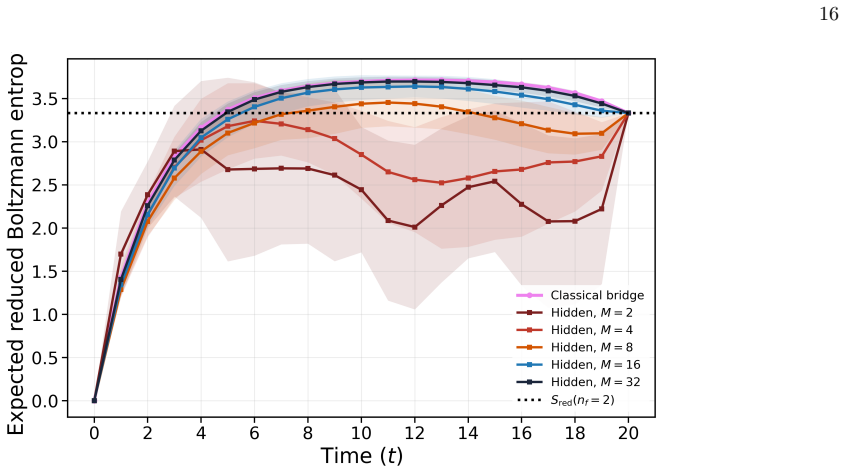
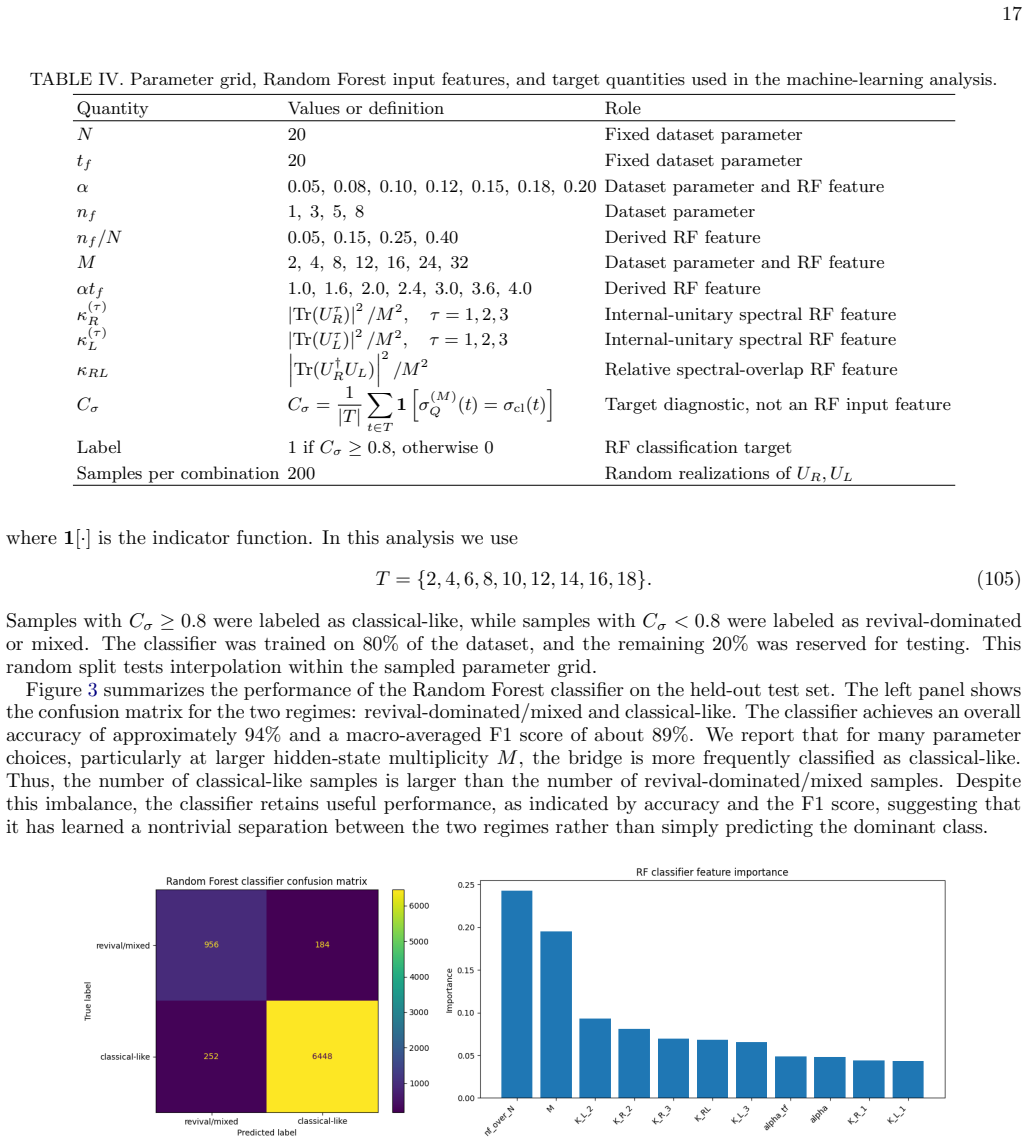
The classical Boltzmann Bridge describes entropy histories conditioned on both an initial low-entropy macrostate and a later macrostate. Unlike the usual past-only formulation of the thermodynamic arrow, this two-time conditioning can produce entropy profiles that rise above the final entropy and then decrease toward the imposed endpoint. In this work, we formulate closed quantum analogues of the Boltzmann Bridge using macro-subspace projectors, unitary time evolution, and Boltzmann entropy defined by the dimension of coarse-grained macroscopic sectors. We first study a minimal coherent chamber-qubit model, in which each particle has only a two-state chamber degree of freedom. Although this model is the most direct quantization of the classical two-box system, its bridge entropy profile is dominated by coherent oscillations and revivals rather than classical relaxation. We then introduce a hidden-microstate bridge, in which each chamber sector contains unresolved internal degrees of freedom while the full dynamics remain unitary. Numerical experiments show that increasing the internal Hilbert-space dimension suppresses sample-dependent revival behavior and produces bridge entropy profiles whose sign structure and coarse-grained shape increasingly agree with the classical Boltzmann Bridge. We further use a Random Forest classifier to explore the parameter regime separating revival-dominated quantum behavior from classical-like coarse-grained bridge behavior. These results suggest that classical two-time-conditioned entropy behavior is not recovered by quantizing the chamber variable alone, but can emerge statistically from closed quantum.
Editorial analysis
A structured set of objections, weighed in public.
Referee Report
Summary. The paper formulates closed quantum analogues of the classical Boltzmann Bridge via macro-subspace projectors, unitary evolution, and Boltzmann entropy S = log(dim(coarse sector)). A minimal chamber-qubit model exhibits revival-dominated entropy profiles; adding hidden internal microstates with increasing Hilbert-space dimension is shown numerically to suppress sample-dependent revivals, yielding sign structure and coarse-grained shapes that increasingly match the classical two-time conditioned bridge. A Random Forest classifier is used to map the parameter boundary between revival and classical-like regimes.
Significance. If the central numerical claim holds, the work supplies concrete evidence that two-time entropy conditioning can emerge statistically from closed unitary dynamics once sufficient unresolved internal degrees of freedom are present, without explicit decoherence or measurement postulates. This bears on quantum foundations of the thermodynamic arrow and on whether coarse-graining alone can recover classical bridge statistics.
major comments (2)
- [Hidden microstate bridge / Numerical experiments] Hidden-microstate bridge construction (abstract and associated numerical section): the macro-subspace projectors and the definition S = log(dim(coarse sector)) are asserted to remain valid on the enlarged space, yet no derivation shows that the two-time conditioned probabilities extracted from the full unitary evolution converge to the classical bridge measure in the large-internal-dimension limit; the effective map on the coarse space is generally non-unitary, and the paper supplies no analytic control on the error introduced by projection versus tracing.
- [Numerical experiments] Numerical experiments (abstract): the headline result that larger internal dimension suppresses revivals and produces classical-like profiles is stated without reported error bars, ensemble sizes, exact form of the Hamiltonian, or exclusion criteria for the sampled trajectories; this prevents independent verification of the data-to-claim link and of the classifier's separation of regimes.
minor comments (2)
- [Abstract] Abstract: the phrase 'closed quantum analogues' is used before the projectors and entropy definition are introduced; a brief parenthetical clarification of the coarse-graining procedure would improve readability.
- [Classifier analysis] The Random Forest classifier is mentioned only in the abstract; the manuscript should state the feature set, training/validation split, and accuracy metric in the main text so that the reported separation of revival versus classical-like regimes can be assessed.
Simulated Author's Rebuttal
We thank the referee for their thorough review and constructive suggestions. We address each major comment below, indicating the revisions we will make to improve clarity and reproducibility.
read point-by-point responses
-
Referee: Hidden-microstate bridge construction (abstract and associated numerical section): the macro-subspace projectors and the definition S = log(dim(coarse sector)) are asserted to remain valid on the enlarged space, yet no derivation shows that the two-time conditioned probabilities extracted from the full unitary evolution converge to the classical bridge measure in the large-internal-dimension limit; the effective map on the coarse space is generally non-unitary, and the paper supplies no analytic control on the error introduced by projection versus tracing.
Authors: We agree that the manuscript presents numerical evidence of increasing agreement with the classical bridge rather than a rigorous analytic derivation of convergence in the large-internal-dimension limit. The projectors and entropy definition are extended directly to the enlarged space, but we do not provide error bounds between the projected unitary dynamics and the classical conditioned measure. In the revision we will add a paragraph in the discussion section explicitly noting this limitation, distinguishing the numerical suppression of revivals from a proven limit, and outlining why an analytic treatment of the non-unitary effective map lies beyond the present scope. revision: partial
-
Referee: Numerical experiments (abstract): the headline result that larger internal dimension suppresses revivals and produces classical-like profiles is stated without reported error bars, ensemble sizes, exact form of the Hamiltonian, or exclusion criteria for the sampled trajectories; this prevents independent verification of the data-to-claim link and of the classifier's separation of regimes.
Authors: We accept this criticism and will supply the omitted details in the revised manuscript. The numerical-experiments section will report ensemble sizes, error bars on all entropy profiles, the precise Hamiltonian (including coupling strengths and internal-state structure), and the trajectory-selection criteria used for the Random Forest analysis. The abstract will be updated to reference these additions where space allows. revision: yes
Circularity Check
No significant circularity; numerical emergence claim is independent of inputs
full rationale
The paper's central claim rests on numerical experiments showing that larger internal Hilbert-space dimension in a unitary model with macro-subspace projectors yields bridge entropy profiles approaching the classical Boltzmann Bridge. No quoted equation or step reduces a reported prediction to a fitted parameter, self-citation chain, or definitional equivalence. The macro projectors and S = log(dim) definition are applied consistently to the enlarged space without the result being forced by construction. The derivation chain is self-contained against the stated unitary dynamics and coarse-graining procedure.
Axiom & Free-Parameter Ledger
axioms (2)
- domain assumption The system evolves under closed unitary quantum dynamics.
- domain assumption Boltzmann entropy is defined by the dimension of the coarse-grained macroscopic sectors.
invented entities (1)
-
hidden microstates
no independent evidence
Reference graph
Works this paper leans on
-
[1]
The same values ofN,α,t f, andn f are used in all cases
One-to-one comparison Table I compares the classical bridge, the coherent chamber-qubit bridge, and one concreteM= 2 hidden-microstate bridge. The same values ofN,α,t f, andn f are used in all cases. TheM= 2 hidden-microstate entry corresponds to one fixed realization of the internal unitaries and is therefore illustrative rather than ensemble-averaged. T...
-
[2]
mix” label indicates sample dependence, while the sign in front of “mix
Systematic dependence on hidden internal dimension The previous comparison used one concreteM= 2 hidden-microstate realization. To test whether the hidden- microstate bridge statistically approaches the classical bridge as the internal Hilbert space becomes larger, we now compare the internal dimensions M= 2,4,8,16,32.(101) 15 For each value ofM, independ...
-
[3]
R. K. Pathria and P. D. Beale,Statistical Mechanics, 3rd ed. (Academic Press, 2011)
2011
-
[4]
H. R. Brown, W. Myrvold, and J. Uffink, Studies in History and Philosophy of Science Part B: Studies in History and Philosophy of Modern Physics40, 174 (2009)
2009
-
[5]
Kubo, Journal of the Physical Society of Japan12, 570 (1957)
R. Kubo, Journal of the Physical Society of Japan12, 570 (1957)
1957
-
[6]
J. M. Ziman,Electrons and Phonons: The Theory of Transport Phenomena in Solids(Oxford University Press, Oxford, 1960)
1960
-
[7]
D. A. Broido, M. Malorny, G. Birner, N. Mingo, and D. A. Stewart, Applied Physics Letters91, 231922 (2007)
2007
-
[8]
Kazemian and G
S. Kazemian and G. Fanchini, Journal of Physics: Condensed Matter38, 153001 (2026)
2026
-
[9]
D. G. Cahill, A. Bullen, and S. M. Lee, High temperatures-high pressures32, 135 (2000)
2000
-
[10]
Kazemian, P
S. Kazemian, P. Bazylewski, R. Bauld, and G. Fanchini, The Journal of Chemical Physics150, 184201 (2019)
2019
-
[11]
D. Z. Albert,Time and Chance(Harvard University Press, Cambridge, MA, 2000)
2000
-
[12]
S. M. Carroll and J. Chen, Spontaneous inflation and the origin of the arrow of time (2004), arXiv:hep-th/0410270 [hep-th]
Pith/arXiv arXiv 2004
-
[13]
Wallace, The logic of the past hypothesis (2011), arXiv:1108.5520 [physics.hist-ph]
D. Wallace, The logic of the past hypothesis (2011), arXiv:1108.5520 [physics.hist-ph]
Pith/arXiv arXiv 2011
-
[14]
E. K. Chen, The past hypothesis and the nature of physical laws (2020), arXiv:2008.00611 [physics.hist-ph]
arXiv 2020
-
[15]
R. T. Cox, American Journal of Physics14, 1 (1946)
1946
-
[16]
L. J. Savage,The Foundations of Statistics(Wiley, New York, 1954)
1954
-
[17]
de Finetti, inBreakthroughs in Statistics, edited by S
B. de Finetti, inBreakthroughs in Statistics, edited by S. Kotz and N. L. Johnson (Springer, New York, 1992) pp. 134–174
1992
-
[18]
J. Scharnhorst, D. Wolpert, and C. Rovelli, Boltzmann bridges (2024), arXiv:2407.02840 [cond-mat.stat-mech]
arXiv 2024
-
[19]
von Neumann, Nachrichten von der Gesellschaft der Wissenschaften zu G”ottingen, Mathematisch-Physikalische Klasse , 245 (1927)
J. von Neumann, Nachrichten von der Gesellschaft der Wissenschaften zu G”ottingen, Mathematisch-Physikalische Klasse , 245 (1927)
1927
-
[20]
Wehrl, Reviews of Modern Physics50, 221 (1978)
A. Wehrl, Reviews of Modern Physics50, 221 (1978)
1978
-
[21]
Goldstein, J
S. Goldstein, J. L. Lebowitz, R. Tumulka, and N. Zangh‘ı, Physical Review Letters96, 050403 (2006)
2006
-
[22]
Popescu, A
S. Popescu, A. J. Short, and A. Winter, Nature Physics2, 754 (2006)
2006
-
[23]
Aharonov, P
Y. Aharonov, P. G. Bergmann, and J. L. Lebowitz, Physical Review134, B1410 (1964)
1964
-
[24]
R. B. Griffiths, Journal of Statistical Physics36, 219 (1984)
1984
-
[25]
Omn‘es, Reviews of Modern Physics64, 339 (1992)
R. Omn‘es, Reviews of Modern Physics64, 339 (1992)
1992
-
[26]
Gell-Mann and J
M. Gell-Mann and J. B. Hartle, inComplexity, Entropy, and the Physics of Information, edited by W. H. Zurek (Addison- Wesley, Redwood City, CA, 1990) pp. 425–458
1990
-
[27]
Carleo, I
G. Carleo, I. Cirac, K. Cranmer, L. Daudet, M. Schuld, N. Tishby, L. Vogt-Maranto, and L. Zdeborov’a, Reviews of Modern Physics91, 045002 (2019)
2019
-
[28]
Arcomano, I
T. Arcomano, I. Szunyogh, J. Pathak, A. Wikner, B. R. Hunt, and E. Ott, Geophysical Research Letters47, e2020GL087776 (2020)
2020
-
[29]
M’arquez-Neila, C
P. M’arquez-Neila, C. Fisher, R. Sznitman, and K. Heng, Nature Astronomy2, 719 (2018)
2018
-
[30]
Feng, H.-j
R. Feng, H.-j. Zheng, H. Gao, A.-r. Zhang, C. Huang, J.-x. Zhang, K. Luo, and J.-r. Fan, Journal of Cleaner Production 231, 1005 (2019)
2019
-
[31]
Farhani, R
G. Farhani, R. J. Sica, and M. J. Daley, Atmospheric Measurement Techniques14, 391 (2021)
2021
-
[32]
Farhani, G
G. Farhani, G. Martucci, T. Roberts, A. Haefele, and R. J. Sica, International Journal of Remote Sensing44, 1611 (2023)
2023
-
[33]
S. Kazemian, G. Farhani, and A. Yazdi, An uncertainty-aware physics-informed neural network solution for the black– scholes equation: a novel framework for option pricing (2025), arXiv:2511.05519 [q-fin.CP]
arXiv 2025
-
[34]
Mezzadri, Notices of the American Mathematical Society54, 592 (2007)
F. Mezzadri, Notices of the American Mathematical Society54, 592 (2007)
2007
-
[35]
Breiman, Machine Learning45, 5 (2001)
L. Breiman, Machine Learning45, 5 (2001)
2001
discussion (0)
Sign in with ORCID, Apple, or X to comment. Anyone can read and Pith papers without signing in.