A study on station-keeping over irregularly shaped asteroids with different sized solar sails
Pith reviewed 2026-06-25 20:44 UTC · model grok-4.3
The pith
Smaller solar sails sustain station-keeping around small irregular asteroids with fewer attitude changes.
A machine-rendered reading of the paper's core claim, the machinery that carries it, and where it could break.
Core claim
The study finds a direct relation between solar-sail size, asteroid size, and the frequency of required attitude changes. Smaller sails can maintain station-keeping with fewer changes but fail on larger asteroids; for sufficiently small asteroids, sails smaller than those used in recent missions remain effective. These outcomes indicate that existing solar-sail technology can already support asteroid reconnaissance missions.
What carries the argument
A decision-tree algorithm that acts as a rational agent, computing successive sail orientations to keep the spacecraft near its initial orbit while accounting for non-ideal reflectivity and irregular gravity.
If this is right
- Smaller sails require fewer attitude changes than larger sails on the same asteroid.
- Sails smaller than those used in recent missions suffice for station-keeping around sufficiently small asteroids.
- Current solar-sail hardware can already enable reconnaissance missions to small irregular asteroids.
- The required attitude-change frequency increases with asteroid size for a fixed sail size.
Where Pith is reading between the lines
- Mission designers could select sail size as a direct function of target asteroid diameter to minimize control effort.
- The same decision-tree approach might be tested on other low-thrust propulsion systems or combined with occasional chemical burns.
- Validating the agent's outputs against real asteroid shape models from missions such as OSIRIS-REx would test the practical reach of the reported relation.
Load-bearing premise
The orientations chosen by the decision-tree agent actually keep the spacecraft near its initial orbit for the durations reported when non-ideal reflectivity and irregular gravity are included.
What would settle it
Running a higher-fidelity numerical integrator with the exact sequence of orientations produced by the agent and checking whether the spacecraft remains inside the reported orbital bounds for the claimed time spans.
Figures

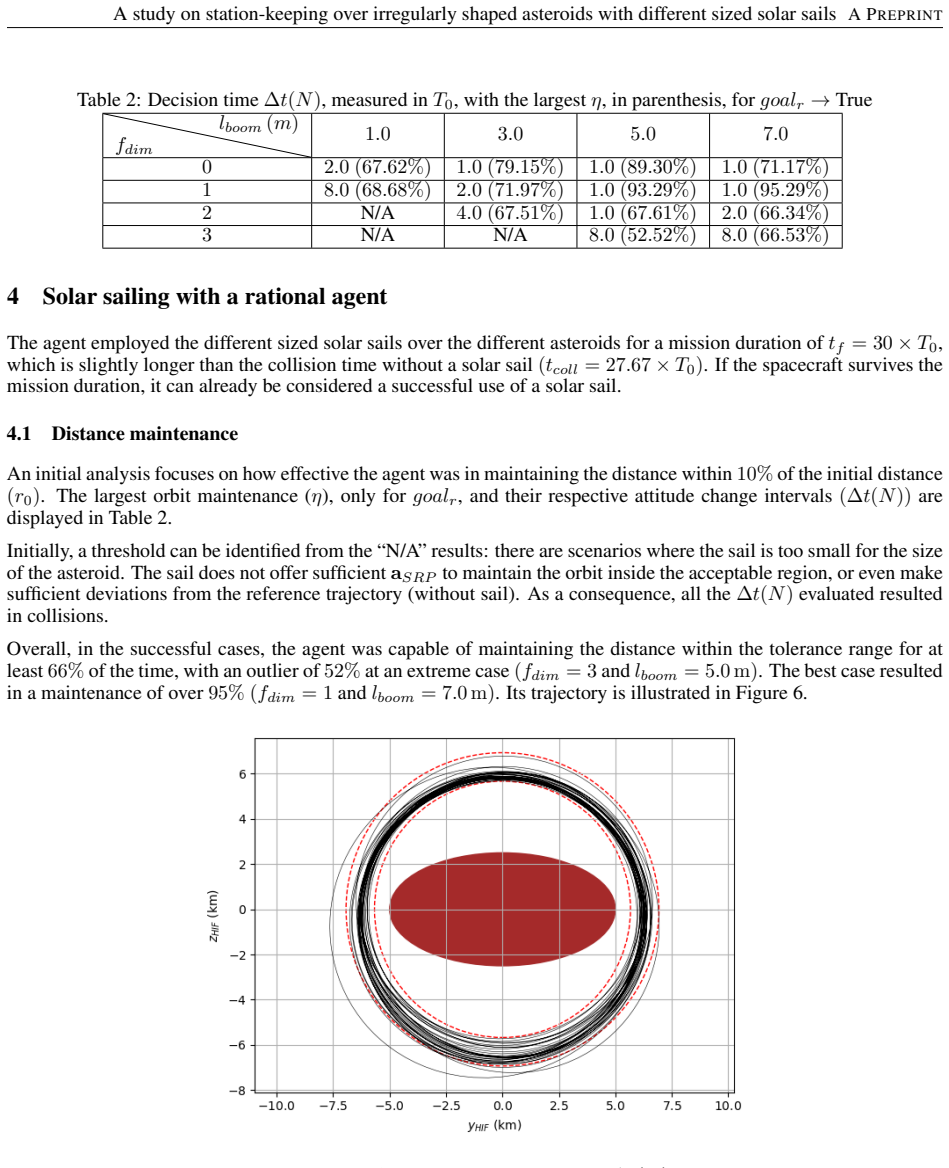
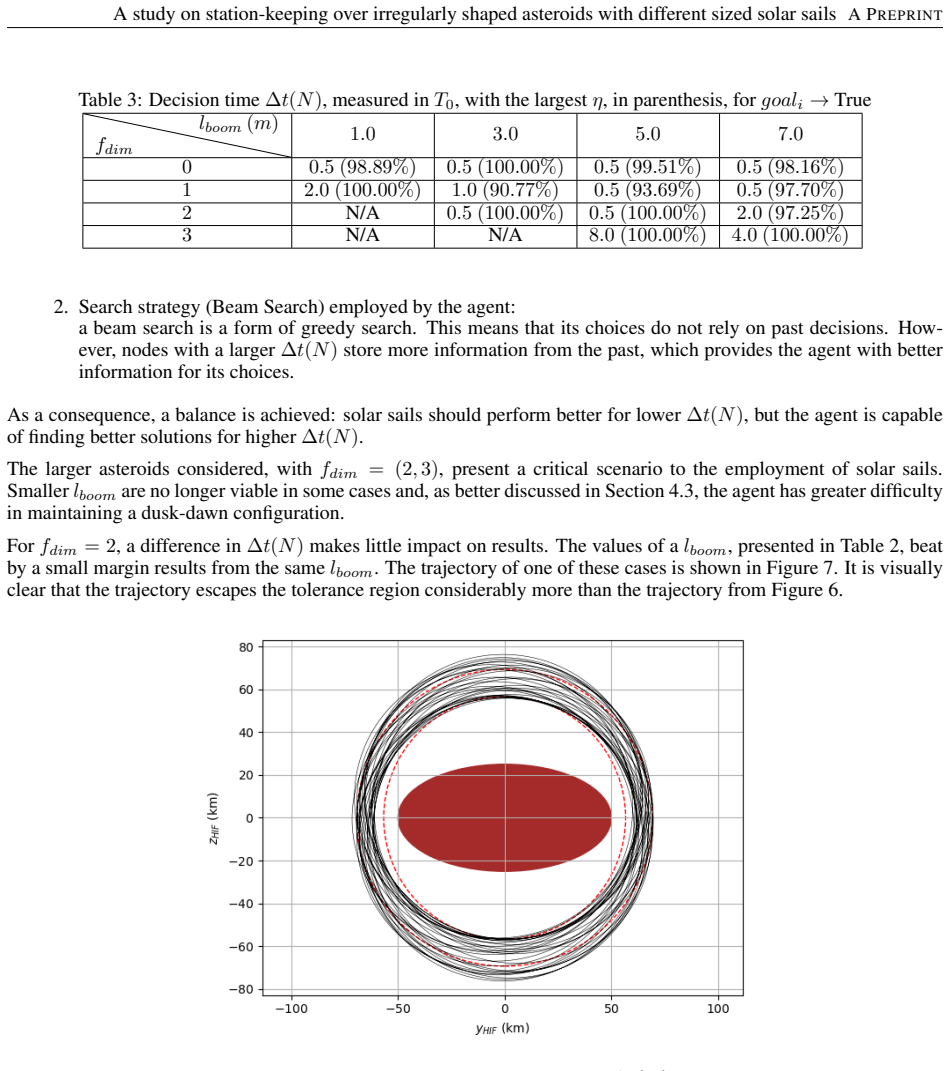


read the original abstract
Asteroid reconnaissance missions offer great contributions to a better understanding of the origins of our Solar System and planetary defense from hazardous objects. The employment of solar sails enable a greater number of missions and target asteroids, given it is a cheaper propulsion method. However, modeling the dynamics of solar sails orbiting irregular gravitational fields is a challenge. And since asteroids have a wide variety of shapes and sizes, it is important to make use of a robust optimization method that allows fast adjustments to this dynamics. This study examines the use of different solar sails and asteroid sizes for station-keeping a spacecraft orbiting an irregularly shaped asteroid. To achieve this goal, a rational agent was developed to act as an attitude guidance system. It calculates the necessary sail orientation to keep the spacecraft near its initial orbit. The agent uses a direct optimization strategy based on a decision tree algorithm in order to account for a solar sail with non-ideal reflective properties and the non-uniform gravitational field of the asteroid. By testing multiple sail sizes, this study evaluates how long the agent may maintain the same sail orientation while still being successful at its station keeping mission. This analysis is done for different asteroid sizes and a relation between different sail and asteroid sizes is established. Results reveal a relation between sail and asteroid sizes and the attitude change frequency. Smaller sails can sustain station-keeping with fewer attitude changes. However, they are not able to achieve this goal on larger asteroids. For sufficiently small asteroids, sails smaller than those used on recent missions may be more appropriate for station-keeping. These findings suggest that current solar sail technology is already capable of enabling successful asteroid reconnaissance missions.
Editorial analysis
A structured set of objections, weighed in public.
Referee Report
Summary. The manuscript develops a decision-tree optimization agent to serve as an attitude guidance system for solar sails with non-ideal reflectivity orbiting polyhedral asteroids. It performs size-sweep experiments to determine how long a given sail orientation can be held while keeping the spacecraft near its initial orbit, reports a scaling relation in which smaller sails require fewer attitude changes on smaller asteroids (but cannot succeed on larger ones), and concludes that existing solar-sail technology is already adequate for reconnaissance missions around sufficiently small asteroids.
Significance. If the agent's orientations are shown to produce bounded orbit deviations, the reported size-scaling relations would provide practical guidance for choosing sail areas in low-cost asteroid missions and could expand the set of accessible targets. The agent's use of direct optimization inside a decision tree to accommodate irregular gravity and non-ideal SRP is a methodological strength that addresses the need for rapid adjustments noted in the abstract.
major comments (3)
- [§3] §3 (decision-tree agent description): the central claim that the agent 'maintains the same sail orientation while still being successful at its station keeping mission' for the reported durations is unsupported by any closed-loop numerical propagation of the full equations of motion; no position/velocity error time series, maximum deviation metrics, or comparison against a higher-fidelity integrator are provided.
- [§4] §4 (results on attitude-change frequency): the reported relation between sail and asteroid sizes rests solely on the internal optimization outputs of the heuristic; without independent verification that the chosen orientations actually counteract the polyhedral gravity field and non-ideal SRP to keep deviations bounded, the size-scaling conclusions and the assertion that 'smaller sails ... may be more appropriate' remain unverified.
- [Abstract and §5] Abstract and §5 (conclusions): the statement that 'current solar sail technology is already capable of enabling successful asteroid reconnaissance missions' is load-bearing for the paper's final claim yet is based on unvalidated simulation durations rather than demonstrated performance against mission requirements or reference controllers.
minor comments (2)
- [Abstract] The abstract supplies no quantitative values (e.g., specific station-keeping durations, error thresholds, or asteroid radii) that would allow readers to assess the practical significance of the reported relation.
- [§3] Notation for sail area, asteroid characteristic length, and the decision-tree branching criteria should be defined explicitly with symbols and units in the methods section to improve reproducibility.
Simulated Author's Rebuttal
We thank the referee for the constructive and detailed review. The concerns about validation through closed-loop propagation and explicit error metrics are valid and highlight opportunities to strengthen the manuscript. We have revised the paper to incorporate full dynamical propagations, error time series, and tempered conclusions. Below we address each major comment.
read point-by-point responses
-
Referee: [§3] §3 (decision-tree agent description): the central claim that the agent 'maintains the same sail orientation while still being successful at its station keeping mission' for the reported durations is unsupported by any closed-loop numerical propagation of the full equations of motion; no position/velocity error time series, maximum deviation metrics, or comparison against a higher-fidelity integrator are provided.
Authors: We agree that the original manuscript lacked explicit closed-loop verification. The decision-tree agent optimizes sail orientations using the modeled polyhedral gravity and non-ideal SRP at each decision point, but we did not present the resulting integrated trajectories. In the revised §3 we now include closed-loop numerical propagations of the full equations of motion with a higher-fidelity integrator, position/velocity error time series for representative cases, and maximum deviation metrics confirming that deviations remain bounded for the reported durations. revision: yes
-
Referee: [§4] §4 (results on attitude-change frequency): the reported relation between sail and asteroid sizes rests solely on the internal optimization outputs of the heuristic; without independent verification that the chosen orientations actually counteract the polyhedral gravity field and non-ideal SRP to keep deviations bounded, the size-scaling conclusions and the assertion that 'smaller sails ... may be more appropriate' remain unverified.
Authors: We acknowledge that the size-scaling results were previously presented without separate dynamical verification. The revised manuscript now reports independent closed-loop propagations for multiple sail/asteroid size combinations. These confirm that the optimized orientations keep orbit deviations bounded, thereby supporting the reported relation that smaller sails require fewer attitude changes on smaller asteroids but lose authority on larger bodies. revision: yes
-
Referee: [Abstract and §5] Abstract and §5 (conclusions): the statement that 'current solar sail technology is already capable of enabling successful asteroid reconnaissance missions' is load-bearing for the paper's final claim yet is based on unvalidated simulation durations rather than demonstrated performance against mission requirements or reference controllers.
Authors: We agree the original wording overstated the implications. The revised abstract and §5 now qualify the claim to state that the simulations indicate current sail technology may suffice for station-keeping around sufficiently small asteroids, with added discussion relating achieved durations to typical reconnaissance mission timelines. The absolute assertion has been removed and the conclusion framed as suggestive rather than definitive. revision: partial
Circularity Check
No circularity; results from independent forward simulation of decision-tree controller
full rationale
The manuscript develops a decision-tree optimization agent to compute sail orientations accounting for non-ideal reflectivity and polyhedral gravity, then reports simulation outcomes relating sail/asteroid size to attitude-change frequency. No equation or procedure reduces a reported quantity to a fitted parameter or self-citation by construction. The central claims rest on numerical propagation of the agent's outputs rather than algebraic equivalence to inputs. This is a standard self-contained simulation study with no load-bearing self-referential steps.
Axiom & Free-Parameter Ledger
Reference graph
Works this paper leans on
-
[1]
Celestial Mechanics and Dynamical Astronomy , volume=
Gravitational potential harmonics from the shape of an homogeneous body , author=. Celestial Mechanics and Dynamical Astronomy , volume=. 1994 , publisher=
1994
-
[2]
2025 , doi=
Burns, Rich and Lauretta, Dante S , journal=. 2025 , doi=
2025
-
[3]
2023 , publisher=
DellaGiustina, Daniella N and Nolan, Michael C and Polit, Anjani T and Moreau, Michael C and Golish, Dathon R and Simon, Amy A and Adam, Coralie D and Antreasian, Peter G and Ballouz, Ronald-Louis and Barnouin, Olivier S and others , journal=. 2023 , publisher=
2023
-
[4]
Mission design and concept of operations for the
Olkin, Catherine and Vincent, Michael and Adam, Coralie and Berry, Kevin and Englander, Jacob and Gray, Sheila and Levison, Hal and Salmon, Julien and Spencer, John and Stanbridge, Dale and others , journal=. Mission design and concept of operations for the. 2024 , publisher=
2024
-
[5]
Michel, Patrick and K. The. The planetary science journal , volume=. 2022 , publisher=
2022
-
[6]
Yoshikawa, Makoto and Kawaguchi, Junichiro and Fujiwara, Akira and Tsuchiyama, Akira , booktitle=. The. 2021 , publisher=
2021
-
[7]
Asteroid
Watanabe, Sei-ichiro and Kikuchi, Shota , booktitle=. Asteroid. 2024 , publisher=
2024
-
[8]
On the Lunar Origin of Near-
Kareta, Theodore and Fuentes-Mu. On the Lunar Origin of Near-. The Astrophysical Journal Letters , volume=. 2025 , publisher=
2025
-
[9]
Achievement of the planetary defense investigations of the Double Asteroid Redirection Test (
Chabot, Nancy L and Rivkin, Andrew S and Cheng, Andrew F and Barnouin, Olivier S and Fahnestock, Eugene G and Richardson, Derek C and Stickle, Angela M and Thomas, Cristina A and Ernst, Carolyn M and Daly, R Terik and others , journal=. Achievement of the planetary defense investigations of the Double Asteroid Redirection Test (. 2024 , publisher=
2024
-
[10]
Technical Challenges and Ethical, Legal and Social Issues (
Kendal, Evie and Milligan, Tony and Elvis, Martin , journal=. Technical Challenges and Ethical, Legal and Social Issues (. 2025 , publisher=
2025
-
[11]
Planetary and Space Science , volume=
Density of asteroids , author=. Planetary and Space Science , volume=. 2012 , publisher=
2012
-
[12]
Bate, R. R. and Mueller, D. D. and White, J. E. , title =. 1971 , note =
1971
-
[13]
1999 , publisher=
An introduction to the mathematics and methods of astrodynamics , author=. 1999 , publisher=
1999
-
[14]
Curtis, H. D. , title =. 2005 , note =
2005
-
[15]
Keaton, P. W. , title =. 1986 , series =
1986
-
[16]
2012 , publisher=
Spacecraft attitude dynamics , author=. 2012 , publisher=
2012
-
[17]
Periodic orbits in the restricted three body problem with earth-moon masses , author=
-
[18]
Symmetry , volume=
Trajectories Derived from Periodic Orbits around the Lagrangian Point L1 and Lunar Swing-Bys: application in Transfers to Near-Earth Asteroids , author=. Symmetry , volume=
-
[19]
, title =
Broucke, R.A. , title =. Astrodynamics Conference , pages =
-
[20]
, title =
Wie, B. , title =. 2008 , note =
2008
-
[21]
, title =
Ogata, K. , title =. 2010 , note =
2010
-
[22]
1978 , series =
Spacecraft attitude determination and control , author =. 1978 , series =
1978
-
[23]
1993 , series =
Introduction to dynamics and control of flexible structures , author =. 1993 , series =
1993
-
[24]
Everhart, E. , journal =. 1985 , volume =. doi:10.1017/s0252921100083913 , title =
-
[25]
and Haberland, Matt and Reddy, Tyler and Cournapeau, David and Burovski, Evgeni and Peterson, Pearu and Weckesser, Warren and Bright, Jonathan and
Virtanen, Pauli and Gommers, Ralf and Oliphant, Travis E. and Haberland, Matt and Reddy, Tyler and Cournapeau, David and Burovski, Evgeni and Peterson, Pearu and Weckesser, Warren and Bright, Jonathan and. Nature Methods , year =
-
[26]
, author =
Linear algebra, analysis, discrete mathematics, functional analysis, etc. , author =. 2017 , series =
2017
-
[27]
1990 , address =
Applied numerical methods , author =. 1990 , address =
1990
-
[28]
, title =
Meirovitch, L. , title =. 1986 , note =
1986
-
[29]
Acta Astronautica , volume=
Preliminary trajectory design for NASA’s Solar Cruiser: A technology demfonstration mission , author=. Acta Astronautica , volume=. 2021 , publisher=
2021
-
[30]
62nd International Astronautical Congress 2011 , year =
The pole-sitter mission concept: An overview of recent developments and possible future applications , author =. 62nd International Astronautical Congress 2011 , year =
2011
-
[31]
Advanced Composite Solar Sail System (
Wilkie, Keats and Fernandez, Johnny , booktitle=. Advanced Composite Solar Sail System (
-
[32]
AIAA Scitech 2021 Forum , pages=
Overview of the NASA Advanced Composite Solar Sail System (ACS3) Technology Demonstration Project , author=. AIAA Scitech 2021 Forum , pages=
2021
-
[33]
2019 , institution=
Advanced Composite Solar Sail System: Demonstrating Deployable Composite Solar Sails for Future Deep Space Small Spacecraft , author=. 2019 , institution=
2019
-
[34]
2018 AIAA spacecraft structures conference , pages=
An advanced composites-based solar sail system for interplanetary small satellite missions , author=. 2018 AIAA spacecraft structures conference , pages=
2018
-
[35]
International Symposium on Solar Sailing , year=
NASA's Advanced Solar Sail Propulsion System for Low-Cost Deep Space Exploration and Science Missions that Use High Performance Rollable Composite Booms , author=. International Symposium on Solar Sailing , year=
-
[36]
LightSail 2 Mission Control , url =
-
[37]
Spencer, D. A. and Betts, B. and Bellardo, J. M. and Diaz, A. and Plante, B. and Mansell, J. R. , publisher =. Advances in Space Research , issn =. 2021 , month =. doi:10.1016/j.asr.2020.06.029 , title =
-
[38]
and Spencer, D
Mansell, J. and Spencer, D. A. and Plante, B. and Diaz, A. and Fernandez, M. and Bellardo, J. and Betts, B. and Nye, B. , title =. Proceedings... , publisher =. 2020 , organization =
2020
-
[39]
and Spencer, D
Betts, B. and Spencer, D. and Bellardo, J. and Nye, B. and Diaz, A. and Plante, B. and Mansell, J. and Fernandez, M. and Gillespie, C. and Garber, D , title =. Proceedings... , publisher =. 2019 , organization =
2019
-
[40]
and Spencer, D
Plante, B. and Spencer, D. and Betts, B. and Chait, S. and Bellardo, J. and Diaz, A. and Pham, I , title =. Proceedings... , publisher =. 2017 , organization =
2017
-
[41]
and Spencer, D
Betts, B. and Spencer, D. and Nye, B. and Munakata, R. and Bellardo, J. and Wong, S. and Diaz, A. and Ridenoure, R. and Plante, B. and Foley, J. and Vaughn, J. , title =. Proceedings... , publisher =. 2017 , organization =
2017
-
[42]
and Nye, B
Betts, B. and Nye, B. and Vaughn, J. and Greeson, E. and Chute, R. and Spencer, D. and Ridenoure, R. and Munakata, R. and Wong, S. and Diaz, A. and Stetson, D. and Foley, J. and Bellardo, J. and Plante, B. , title =. Proceedings... , publisher =. 2017 , organization =
2017
-
[43]
Tsuda, Y. and Mori, O. and Funase, R. and Sawada, H. and Yamamoto, T. and Saiki, T. and Endo, T. and Kawaguchi, J. , journal =. 2011 , volume =. doi:10.1016/j.actaastro.2011.06.005 , title =
-
[44]
Tsuda, Y. and Mori, O. and Funase, R. and Sawada, H. and Yamamoto, T. and Saiki, T. and Endo, T. and Yonekura, K. and Hoshino, H. and Kawaguchi, J. , publisher =. Acta Astronautica , issn =. 2013 , volume =. doi:10.1016/j.actaastro.2012.03.032 , title =
-
[45]
IKAROS, a Solar Sail Demonstrator and Its Application to Trojan Asteroid Exploration , booktitle =. 2012 , month =. doi:10.2514/6.2012-1748 , author =
-
[46]
61st International Astronautical Congress 2010, IAC 2010 , pages=
Attitude control of IKAROS solar sail spacecraft and its flight results , author=. 61st International Astronautical Congress 2010, IAC 2010 , pages=
2010
-
[47]
Mori, O. and Sawada, H. and Funase, R. and Morimoto, M. and Endo, T. and Yamamoto, T. and Tsuda, Y. and Kawakatsu, Y. and Kawaguchi, J. and Miyazaki, Y. and Shirasawa, Y. and Demonstration Team, IKAROS , publisher =. Transactions of the Japan society for Aeronautical and space sciences Aerospace Technology Japan , issn =. 2010 , volume =. doi:10.2322/tast...
-
[48]
Mori, O. and Tsuda, Y. and Sawada, H. and Funase, R. and Saiki, T. and Yamamoto, T. and Yonekura, K. and Hoshino, H. and Minamino, H. and Endo, T. and Kawaguchi, J. and Demonstration Team, IKAROS , publisher =. Transactions of the Japan Society for Aeronautical and Space Sciences Aerospace Technology Japan , issn =. 2012 , month =. doi:10.2322/tastj.10.po...
-
[49]
Small solar power sail demonstrator IKAROS , url =
-
[50]
Vulpetti, Giovanni and Johnson, Les and Matloff, Gregory L , booktitle=. The. 2015 , publisher=
2015
-
[51]
NanoSail-D: A solar sail demonstration mission.Acta Astronautica, 68(5):571–575, March 2011
Johnson, L. and Whorton, M. and Heaton A. and Pinson, R. and Laue, G. and Adams, C. , journal =. 2011 , volume =. doi:10.1016/j.actaastro.2010.02.008 , title =
-
[52]
Johnson, Les and Betts, Erin and Heaton, Andrew and Jones, Clif and McNutt, Leslie and Pruitt, Matt and Stott, Jim and Wallace, Darren and Wilson, Rick and Castillo-Rogez, Julie and others , booktitle=. Near
-
[53]
Near-Earth Asteroid (NEA) Scout , booktitle =. 2014 , isbn =. doi:10.2514/6.2014-4435 , author =
-
[54]
Fernandez, J. M. and Visagie, L. and Schenk, M. and Stohlman, O. R. and Aglietti, G. S. and Lappas, V. J. and Erb, S. , publisher =. Acta Astronautica , issn =. 2014 , volume =. doi:10.1016/j.actaastro.2014.06.018 , title =
-
[55]
D'Ambrosio, A. and Circi, C. and Zeng, X. , publisher =. Advances in Space Research , year =. doi:10.1016/j.asr.2019.02.021 , title =
-
[57]
and Kingston, J
Palla, C. and Kingston, J. and Hobbs, S. , title =. Proceedings... , publisher =. 2017 , organization =
2017
-
[58]
and Schenk, M
Viquerat, A. and Schenk, M. and Lappas, V. , title =. Proceedings... , publisher =. 2015 , organization =
2015
-
[59]
, title =
Friedman, L. , title =
-
[60]
and Johnson, L
Vulpetti, G. and Johnson, L. and Matloff, G. L. , title =. 2015 , note =
2015
-
[61]
McInnes, C. R. , title =. 2004 , note =
2004
-
[62]
, title =
Vulpetti, G. , title =. 2013 , edition =
2013
-
[63]
G. Vulpetti; S. Scaglione , journal =. 1999 , volume =. doi:10.1016/s0094-5765(99)00038-7 , title =
-
[64]
and Bortolami, S
Angrilli, F. and Bortolami, S. , title =. ESA Journal , year =
-
[65]
Forward, R. L. , journal =. 1990 , month =. doi:10.2514/3.26158 , title =
-
[66]
McInnes, C. R. , title =. Acta Astronautica , year =
-
[67]
McInnes, C. R. , title =. The Philosophical Transactions of the Royal Society London , year =
-
[68]
McInnes, C. R. , title =. Advances in Space Research , year =
-
[69]
, title =
Wie, B. , title =. Journal of Spacecraft and Rockets , year =
-
[70]
Wie, Bong , journal =. 2004 , month =. doi:10.2514/1.11134 , title =
-
[71]
Wie, Bong , journal =. 2004 , month =. doi:10.2514/1.11133 , title =
-
[72]
and Smirnov, G
Guerman, A. and Smirnov, G. and Pereira, M. C. , title =. Advances in the Astronautical Sciences , year =
-
[73]
and Smirnov, G
Guerman, A. and Smirnov, G. and Pereira, M. C. , title =. Proceedings... , publisher =. 2008 , organization =
2008
-
[74]
Contribution to the dynamics of a solar sail in the earth-sun system , author=
-
[75]
Advances in Space Research , volume=
Wrinkling analysis of solar-photon sails , author=. Advances in Space Research , volume=
-
[76]
Journal of Guidance, Control, and Dynamics , volume=
Parametric model and optimal control of solar sails with optical degradation , author=. Journal of Guidance, Control, and Dynamics , volume=
-
[77]
An update to the
Heaton, Andy F and Artusio-Glimpse, Alexandra , booktitle =. An update to the. 2015 , doi=
2015
-
[78]
Spacecraft Structures Conference , pages=
Optical control of solar sails using distributed reflectivity , author=. Spacecraft Structures Conference , pages=. 2014 , doi=
2014
-
[79]
Zhang, X. and Zhou, C. , journal =. 2017 , month =. doi:10.1016/j.cja.2017.08.006 , title =
-
[80]
Zeng, X. and Jiang, F. and Junfeng, L. , publisher =. Research in Astronomy and Astrophysics , year =. doi:10.1088/1674-4527/15/4/011 , title =
-
[81]
Zeng, X. and Gong, S.P. and Junfeng, L. and Alfriend, K. , publisher =. Journal of Guidance Control and Dynamics , year =. doi:10.2514/1.G001061 , title =
discussion (0)
Sign in with ORCID, Apple, or X to comment. Anyone can read and Pith papers without signing in.