REVIEW 1 major objections 46 references
SafeGen: LLM-Driven Assertion Generation and Fault Criticality Evaluation for Functional Safety
T0 review · 1 major / 0 minor · reviewed 2026-06-25 · grok-4.3
Pith's one-line read SafeGen uses an LLM and Hyper Knowledge Graph to generate design-aware assertions for semantic fault criticality assessment in functional safety.
desk verdict SafeGen ties LLMs to an FMEDA-derived HyperKG for traceable assertion generation and semantic fault grading, but the abstract gives no numbers to back the quality claims. read the letter →
The pith
A machine-rendered reading of the paper's core claim, the machinery that carries it, and where it could break.
The reading
What carries the argument
The document-level Hyper Knowledge Graph (HyperKG) enriched with FMEDA guidelines and RTL data, which guides LLM generation of specification-linked Functional Safety Assertions (FSAs) for traceable fault assessment.
What would settle it
Demonstration that assertions produced by SafeGen either miss critical faults affecting system safety or incorrectly grade faults due to inaccurate HyperKG enrichment from the documents.
Extended reading notes
Core claim
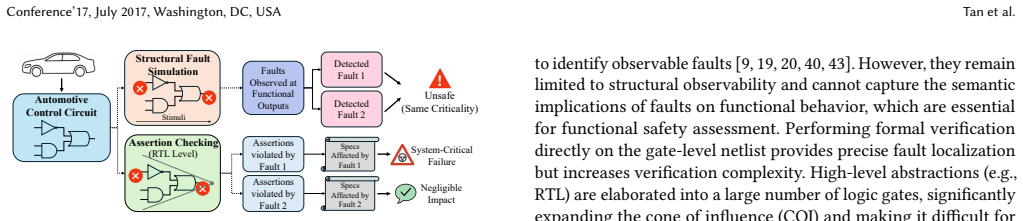
SafeGen leverages large language models and a document-level Hyper Knowledge Graph that incorporates Failure Modes, Effects, and Diagnostic Analysis guidelines to extract verifiable specifications from design and safety documents. The graph is enriched with register-transfer-level information to generate Functional Safety Assertions that are semantically grounded and design-aware. Each assertion is linked to its corresponding specification for traceability. A gate-to-RTL fault-mapping mechanism with formal property verification enables semantic-level fault criticality grading based on assertion violations, demonstrated on a field-oriented control system co-simulation platform.
Load-bearing premise
The document-level Hyper Knowledge Graph accurately incorporates FMEDA guidelines and RTL information to produce verifiable specifications and design-aware Functional Safety Assertions.
Editorial extensions
If this is right
- Generates higher-quality assertions than existing LLM-based frameworks.
- Provides greater semantic interpretability in fault criticality assessment than traditional simulation.
- Supports evaluation of both stuck-at and bridging faults via gate-to-RTL mapping.
- Enables traceable reasoning throughout the assessment process.
- Validated on a digital-physical co-simulation platform for a field-oriented control system.
Reading between the lines
- The method could be adapted for other safety-critical domains like medical devices or aerospace electronics.
- Semantic traceability may reduce the time required for safety case documentation and certification.
- Further integration with simulation tools could create hybrid analysis workflows that combine semantic and quantitative insights.
Editorial analysis
A structured set of objections, weighed in public.
Referee Report
Summary. The manuscript presents SafeGen, an LLM-driven framework for functional safety-oriented fault criticality assessment in automotive chip design. It constructs a document-level Hyper Knowledge Graph (HyperKG) that incorporates FMEDA guidelines to extract verifiable specifications from design and safety documents, enriches it with RTL information to generate specification-linked Functional Safety Assertions (FSAs), applies gate-to-RTL fault mapping for stuck-at and bridging faults, and uses formal property verification (FPV) for semantic-level grading of fault criticality. Validation occurs via a digital-physical co-simulation platform on a field-oriented control (FOC) system. The central claim is that SafeGen produces higher-quality assertions than existing LLM-based frameworks and greater semantic interpretability than traditional simulation-based methods.
Significance. If the experimental results hold, the framework could improve functional safety analysis by replacing overly conservative module-level simulation with traceable, design-aware assertions that link faults directly to system-level specifications. The emphasis on semantic interpretability and specification traceability addresses a practical gap in automotive safety workflows.
major comments (1)
- [Abstract] Abstract: The claim that 'Experimental results demonstrate that SafeGen generates higher-quality assertions than existing LLM-based assertion generation frameworks while providing greater semantic interpretability in fault criticality assessment compared with traditional simulation-based approaches' is unsupported by any quantitative metrics, baseline descriptions, dataset details, or error analysis in the provided text. This absence makes the central experimental claim impossible to evaluate.
Simulated Author's Rebuttal
We thank the referee for the constructive feedback on the abstract. We address the concern point-by-point below and will revise the manuscript accordingly to strengthen the presentation of our experimental claims.
read point-by-point responses
-
Referee: [Abstract] Abstract: The claim that 'Experimental results demonstrate that SafeGen generates higher-quality assertions than existing LLM-based assertion generation frameworks while providing greater semantic interpretability in fault criticality assessment compared with traditional simulation-based approaches' is unsupported by any quantitative metrics, baseline descriptions, dataset details, or error analysis in the provided text. This absence makes the central experimental claim impossible to evaluate.
Authors: We agree that the abstract, in its current form, presents a high-level summary of the results without embedding the supporting quantitative details. The full manuscript contains dedicated experimental sections that include quantitative metrics (e.g., assertion correctness, coverage, and relevance scores), baseline comparisons against prior LLM-based frameworks, dataset descriptions from the FOC system and FMEDA documents, and error analysis. To make the central claim directly evaluable from the abstract itself, we will revise the abstract to concisely incorporate key quantitative highlights, baseline names, and dataset references while preserving its length constraints. This revision will be made in the next version of the manuscript. revision: yes
Circularity Check
No significant circularity in derivation chain
full rationale
The paper describes an engineering pipeline (LLM + document-level HyperKG enriched with FMEDA guidelines and RTL data to generate linked FSAs, followed by gate-to-RTL fault mapping and FPV) whose outputs are validated experimentally via co-simulation on an FOC system. No equations, fitted parameters, or quantitative predictions appear; claims of higher-quality assertions rest on direct comparison to baselines rather than any reduction of results to self-referential inputs. No self-citation load-bearing steps, uniqueness theorems, or ansatzes are invoked. The derivation is therefore self-contained as a traceable methodology without circular reduction.
Assumptions & free parameters
assumptions (1)
- domain assumption FMEDA guidelines provide a reliable basis for extracting verifiable safety specifications from design documents
invented entities (2)
-
Hyper Knowledge Graph (HyperKG)
-
Functional Safety Assertions (FSAs)
Cite this review
Pith. "Pith review of SafeGen: LLM-Driven Assertion Generation and Fault Criticality Evaluation for Functional Safety." pith.science (2026). https://pith.science/paper/X3TK2CBN
@misc{pith2026260625296,
  author       = {Pith},
  title        = {Pith review of: SafeGen: LLM-Driven Assertion Generation and Fault Criticality Evaluation for Functional Safety},
  year         = {2026},
  howpublished = {\url{https://pith.science/paper/X3TK2CBN}},
  note         = {Machine review of arXiv:2606.25296}
}
read the original abstract
With advances in autonomous driving and electric vehicle technologies, functional safety has become a critical requirement in automotive chip design. Traditional simulation-based fault analysis is often overly conservative at the module level and fails to accurately reflect fault criticality. This paper presents SafeGen, an LLM-driven, formal-verification-assisted framework for functional-safety-oriented fault criticality assessment. SafeGen leverages large language models (LLMs) and a document-level Hyper Knowledge Graph (HyperKG) that incorporates Failure Modes, Effects, and Diagnostic Analysis (FMEDA) guidelines to extract verifiable specifications from design and safety documents and evaluate their relevance to overall system safety. The HyperKG is further enriched with register-transfer-level (RTL) information to guide the generation of Functional Safety Assertions (FSAs) that are both semantically grounded and design-aware. Each assertion is linked to its corresponding specification, enabling traceable reasoning throughout the assessment process. A gate-to-RTL fault-mapping mechanism supporting both stuck-at and bridging faults, combined with formal property verification (FPV), enables semantic-level fault criticality grading based on specification-linked assertion violations. A digital-physical co-simulation platform for a field-oriented control (FOC) system is developed to validate SafeGen. Experimental results demonstrate that SafeGen generates higher-quality assertions than existing LLM-based assertion generation frameworks while providing greater semantic interpretability in fault criticality assessment compared with traditional simulation-based approaches.
Figures


Figures from the paper (3 more)


Reference graph
Works this paper leans on
-
[1]
IEEE Draft Standard for Fault Accounting and Coverage Reporting to Digital Modules (FACR).IEEE P1804/D1.7, September 2016(2016), 1–76
2016. IEEE Draft Standard for Fault Accounting and Coverage Reporting to Digital Modules (FACR).IEEE P1804/D1.7, September 2016(2016), 1–76. SafeGen: LLM-Driven Assertion Generation and Fault Criticality Evaluation for Functional Safety Conference’17, July 2017, Washington, DC, USA
2016
-
[2]
ISO 26262: Road vehicles — Functional safety
2018. ISO 26262: Road vehicles — Functional safety. Second edition, Parts 1–12
2018
-
[3]
Yasin Abbasi Yadkori, Ilja Kuzborskij, András György, and Csaba Szepesvari
-
[4]
To believe or not to believe your llm: Iterative prompting for estimating epistemic uncertainty.Advances in Neural Information Processing Systems37 (2024), 58077–58117
2024
-
[5]
Abramovici, B
M. Abramovici, B. Krishnamurthy, R. Mathews, B. Rogers, M. Schulz, and S. Seth
-
[6]
In1988 IEEE International Test Conference (ITC)
What is the Path to Fast Fault Simulation?. In1988 IEEE International Test Conference (ITC). IEEE, 10–17
-
[7]
Dinesh Reddy Ankireddy, Sudipta Paria, Aritra Dasgupta, Sandip Ray, and Swarup Bhunia. 2025. LASSO: LLM-Aided Security Property Generation for Assertion- based SoC Verification. In2025 ACM/IEEE 7th Symposium on Machine Learning for CAD (MLCAD). IEEE, 1–10
2025
-
[8]
Ahmet Cagri Bagbaba, Felipe Augusto da Silva, Matteo Sonza Reorda, Said Ham- dioui, Maksim Jenihhin, and Christian Sauer. 2022. Automated identification of application-dependent safe faults in automotive systems-on-a-chips.Electronics 11, 3 (2022), 319
2022
Show all 46 references
-
[9]
Yunsheng Bai, Ghaith Bany Hamad, Syed Suhaib, and Haoxing Ren. 2025. Asser- tionForge: Enhancing Formal Verification Assertion Generation with Structured Representation of Specifications and RTL. InProceedings of the IEEE International Conference on LLM-Aided Design (LAD). Sta...
2025
-
[10]
Alessandro Bernardini, Wolfgang Ecker, and Ulf Schlichtmann. 2016. Where formal verification can help in functional safety analysis. In2016 IEEE/ACM International Conference on Computer-Aided Design (ICCAD). IEEE, 1–8
2016
-
[11]
Cadence Design Systems, Inc. 2025. Jasper Functional Safety Verification App User Guide.User Guide, Product Version 2025.06
2025
-
[12]
Cadence Design Systems, Inc. 2025. Xcelium Safety Fault Simulator User Guide. User Guide, Product Version 2025.06
2025
-
[13]
Hui-Na Chao, Hua-Wei Li, Xiaoyu Song, Tian-Cheng Wang, and Xiao-Wei Li
-
[14]
Journal of Computer Science and Technology35, 5 (2020), 1198–1216
Evaluating and Constraining Hardware Assertions with Absent Scenarios. Journal of Computer Science and Technology35, 5 (2020), 1198–1216
2020
-
[15]
Arjun Chaudhuri, Ching-Yuan Chen, Jonti Talukdar, Siddarth Madala, Ab- hishek Kumar Dubey, and Krishnendu Chakrabarty. 2021. Efficient fault-criticality analysis for AI accelerators using a neural twin. In2021 IEEE International Test Conference (ITC). IEEE, 73–82
2021
-
[16]
Arjun Chaudhuri, Jonti Talukdar, and Krishnendu Chakrabarty. 2022. Machine Learning for Testing Machine-Learning Hardware: A Virtuous Cycle. InProceed- ings of the 41st IEEE/ACM International Conference on Computer-Aided Design. 1–6
2022
-
[17]
Arjun Chaudhuri, Jonti Talukdar, Jinwook Jung, Gi-Joon Nam, and Krishnendu Chakrabarty. 2021. Fault-criticality assessment for AI accelerators using graph convolutional networks. In2021 Design, Automation & Test in Europe Conference & Exhibition (DATE). IEEE, 1596–1599
2021
-
[18]
Arjun Chaudhuri, Jonti Talukdar, Fei Su, and Krishnendu Chakrabarty. 2022. Functional criticality analysis of structural faults in AI accelerators.IEEE Trans- actions on Computer-Aided Design of Integrated Circuits and Systems41, 12 (2022), 5657–5670
2022
-
[19]
Yung-Yuan Chen, Chung-Hsien Hsu, and Kuen-Long Leu. 2009. SoC-level risk assessment using FMEA approach in system design with SystemC. In2009 IEEE International Symposium on Industrial Embedded Systems. IEEE, 82–89
2009
-
[20]
Natalia Cherezova, Konstantin Shibin, Maksim Jenihhin, and Artur Jutman. 2023. Understanding fault-tolerance vulnerabilities in advanced SoC FPGAs for critical applications.Microelectronics Reliability146 (2023), 115010
2023
-
[21]
Edmund Clarke, Armin Biere, Richard Raimi, and Yunshan Zhu. 2001. Bounded model checking using satisfiability solving.Formal methods in system design19, 1 (2001), 7–34
2001
-
[22]
Felipe Augusto da Silva, Ahmet Cagri Bagbaba, Said Hamdioui, and Christian Sauer. 2021. An automated formal-based approach for reducing undetected faults in ISO 26262 hardware compliant designs. In2021 IEEE International Test Conference (ITC). IEEE, 329–333
2021
-
[23]
Felipe Augusto da Silva, Ahmet Cagri Bagbaba, Sandro Sartoni, Riccardo Cantoro, Matteo Sonza Reorda, Said Hamdioui, and Christian Sauer. 2020. Determined- Safe Faults Identification: A step towards ISO26262 hardware compliant designs. In2020 IEEE European Test Symposium (ETS)....
2020
-
[24]
Alessandro Danese, Nicolò Dalla Riva, and Graziano Pravadelli. 2017. A-team: Automatic template-based assertion miner. InProceedings of the 54th Annual Design Automation Conference 2017. 1–6
2017
-
[25]
Sanjay Das, Shamik Kundu, Pooja Madhusoodhanan, Prasanth Viswanathan Pillai, Rubin Parekhji, Arnab Raha, Suvadeep Banerjee, Suriya Natarajan, and Kanad Basu. 2024. Graph Learning-based Fault Criticality Analysis for Enhancing Functional Safety of E/E Systems. InProceedings of ...
2024
-
[26]
Darren Edge, Ha Trinh, Newman Cheng, Joshua Bradley, Alex Chao, Apurva Mody, Steven Truitt, Dasha Metropolitansky, Robert Osazuwa Ness, and Jonathan Larson. 2024. From local to global: A graph rag approach to query-focused summarization.arXiv preprint arXiv:2404.16130(2024)
2024 arXiv
-
[27]
Shift-Left DFT
Hiroyuki Iwata, Yoichi Maeda, Jun Matsushima, Oussama Laouamri, Naveen Khanna, Jeff Mayer, and Nilanjan Mukherjee. 2023. A New Framework for RTL Test Points Insertion Facilitating a “Shift-Left DFT” Strategy. In2023 IEEE International Test Conference (ITC). IEEE, 1–10
2023
-
[28]
JEDEC Solid State Technology Association. 2013. Dictionary of Terms for Solid- State Technology — 6th Edition
2013
-
[29]
Rahul Kande, Hammond Pearce, Benjamin Tan, Brendan Dolan-Gavitt, Shailja Thakur, Ramesh Karri, and Jeyavijayan Rajendran. 2024. (Security) assertions by large language models.IEEE Transactions on Information Forensics and Security 19 (2024), 4374–4389
2024
-
[30]
Andraž Kontarček, Primož Bajec, Mitja Nemec, Vanja Ambrožič, and David Nedeljković. 2015. Cost-effective three-phase PMSM drive tolerant to open-phase fault.IEEE Transactions on Industrial Electronics62, 11 (2015), 6708–6718
2015
-
[31]
Haoran Luo, Guanting Chen, Yandan Zheng, Xiaobao Wu, Yikai Guo, Qika Lin, Yu Feng, Zemin Kuang, Meina Song, Yifan Zhu, et al. 2025. HyperGraphRAG: Retrieval-Augmented Generation via Hypergraph-Structured Knowledge Repre- sentation.arXiv preprint arXiv:2503.21322(2025)
2025
-
[32]
MS Merzoug, F Naceri, et al . 2008. Comparison of field-oriented control and direct torque control for permanent magnet synchronous motor (PMSM).World Academy of Science, Engineering and Technology45 (2008), 299–304
2008
-
[33]
Alessandra Nardi and Antonino Armato. 2017. Functional safety methodolo- gies for automotive applications. In2017 IEEE/ACM International Conference on Computer-Aided Design (ICCAD). IEEE, 970–975
2017
-
[34]
Marcelo Orenes-Vera, Aninda Manocha, David Wentzlaff, and Margaret Martonosi. 2021. Autosva: Democratizing formal verification of rtl module interactions. In2021 58th ACM/IEEE Design Automation Conference (DAC). IEEE, 535–540
2021
-
[35]
Rob Palin, David Ward, Ibrahim Habli, and Roger Rivett. 2011. ISO 26262 safety cases: Compliance and assurance. In6th IET International Conference on System Safety 2011. IET, B12
2011
-
[36]
Subhajit Paul, Ansuman Banerjee, Sumana Ghosh, Sudhakar Surendran, and Raj Kumar Gajavelly. 2025. LISA: LLM Informed Systemverilog Assertion gener- ation with RAG and Chain-of-Thought. In2025 IEEE Computer Society Annual Symposium on VLSI (ISVLSI), Vol. 1. IEEE, 1–6
2025
-
[37]
Mahesh Prabhu and Jacob A Abraham. 2012. Functional test generation for hard to detect stuck-at faults using RTL model checking. In2012 17th IEEE European Test Symposium (ETS). IEEE, 1–6
2012
-
[38]
Vaishnavi Pulavarthi, Deeksha Nandal, Soham Dan, and Debjit Pal. 2025. Are LLMs Ready for Practical Adoption for Assertion Generation?. In2025 Design, Automation & Test in Europe Conference (DATE). IEEE, 1–7
2025
-
[39]
Vaishnavi Pulavarthi, Deeksha Nandal, Soham Dan, and Debjit Pal. 2025. As- sertionbench: A benchmark to evaluate large-language models for assertion generation. InFindings of the Association for Computational Linguistics: NAACL
2025
-
[40]
Syed Qutub, Florian Geissler, Yang Peng, Ralf Gräfe, Michael Paulitsch, Gereon Hinz, and Alois Knoll. 2022. Hardware faults that matter: understanding and estimating the safety impact of hardware faults on object detection DNNs. In International Conference on Computer Safety, ...
2022
-
[41]
Shinya Takamaeda-Yamazaki. 2015. Pyverilog: A python-based hardware de- sign processing toolkit for verilog hdl. InInternational Symposium on Applied Reconfigurable Computing. Springer, 451–460
2015
-
[42]
Enyuan Tian, Yiwei Ci, Qiusong Yang, Yufeng Li, and Zhichao Lyu. 2025. Assert- Coder: LLM-Based Assertion Generation via Multimodal Specification Extraction. arXiv preprint arXiv:2507.10338(2025)
2025
-
[43]
Adrian Traskov, Thorsten Ehrenberg, Sacha Loitz, Abdelouahab Ayari, Avidan Efody, and Joseph Hupcey III. 2016. Fault proof: Using formal techniques for safety verification and fault analysis. In2016 Design and Verification Conference and Exhibition DVCON Europe. DVCON. 27–32
2016
-
[44]
Xuan Wang. 2025. FPGA-FOC: An FPGA-based Field Oriented Control (FOC) for driving BLDC/PMSM motor. https://github.com/WangXuan95/FPGA-FOC
2025
-
[45]
Zhiyuan Yan, Wenji Fang, Mengming Li, Min Li, Shang Liu, Zhiyao Xie, and Hongce Zhang. 2025. Assertllm: Generating hardware verification assertions from design specifications via multi-llms. InProceedings of the 30th Asia and South Pacific Design Automation Conference. 614–621
2025
-
[46]
Ping Yeung, Doug Smith, and Abdelouahab Ayari. 2018. Whose fault is it formally? formal techniques for optimizing iso 26262 fault analysis. (2018)
2018
Reviewed June 25, 2026 · model on record in the stance chip above.
Discussion (0). Continue with ORCID to comment.