Dynamic dissipative structures in bistable magnetic ordered spin crossover systems: self-oscillations of magnetization
Pith reviewed 2026-06-25 19:48 UTC · model grok-4.3
The pith
Bistable magnetic spin crossover systems can exhibit self-oscillations of magnetization under nonequilibrium conditions.
A machine-rendered reading of the paper's core claim, the machinery that carries it, and where it could break.
Core claim
The paper claims that theoretical analysis of nonlinear dynamical equations for bistable magnetically ordered spin crossover systems reveals the possibility of self-oscillations of magnetization under nonequilibrium conditions. These oscillations constitute dynamic dissipative structures that emerge spontaneously rather than being imposed externally.
What carries the argument
A set of nonlinear dynamical equations whose solutions exhibit self-oscillations of magnetization in the bistable spin crossover system under nonequilibrium driving.
If this is right
- Magnetization can spontaneously enter a time-periodic regime instead of settling to a static value.
- Dynamic dissipative structures become observable in this class of magnetic materials.
- Nonequilibrium driving provides a route to control the temporal behavior of magnetization without external periodic forcing.
- Similar oscillatory modes may appear in other bistable systems that combine magnetic ordering with spin crossover.
Where Pith is reading between the lines
- The same equations might be adapted to predict oscillation frequencies or amplitudes once specific material parameters are inserted.
- Connection to other known bistable magnetic phenomena could be tested by varying temperature or external field in experiment.
- Device applications might follow if the oscillations can be synchronized or read out electrically.
Load-bearing premise
The behavior of these bistable magnetic systems is captured by nonlinear dynamical equations that admit oscillatory solutions when driven out of equilibrium.
What would settle it
Experimental measurement on a real magnetically ordered spin crossover material showing only monotonic relaxation of magnetization to a fixed value under continuous nonequilibrium driving, with no sustained oscillations.
Figures



read the original abstract
Dissipative systems can exhibit a variety of behavioral modes, ranging from complex deterministic chaos to the spontaneous emergence of ordered structures. A simple example of the latter is Benard cells. More complex examples include lasers, droplet clusters, the Belousov--Zhabotinsky reaction, and biological life. Of particular interest in the context of the formation of spatiotemporal dissipative structures are bistable systems with spin crossover. This paper discusses the possibility of observing self-oscillations of magnetization in magnetically ordered systems with spin crossover. The results of theoretical calculations of the nonlinear dynamics of bistable magnetic systems under nonequilibrium conditions are presented.
Editorial analysis
A structured set of objections, weighed in public.
Referee Report
Summary. The manuscript claims that bistable magnetic ordered spin crossover systems under nonequilibrium conditions can exhibit self-oscillations of magnetization as dissipative structures, based on theoretical calculations of their nonlinear dynamics.
Significance. If the calculations were shown to be valid with explicit, derivable equations admitting stable limit cycles for physically plausible parameters, the result could contribute to understanding nonequilibrium dynamics in spin-crossover magnets. The manuscript provides neither machine-checked proofs, reproducible code, nor falsifiable predictions, and the abstract supplies no equations or validation against data.
major comments (2)
- [Abstract] Abstract: the central claim that 'the results of theoretical calculations of the nonlinear dynamics' demonstrate self-oscillations is unsupported because no explicit system of ODEs (or PDEs) coupling magnetization, spin-crossover fraction, temperature/field, or driving terms is supplied, nor any parameter values or stability analysis.
- No section or equation: without a concrete mean-field or microscopic derivation of the dynamical equations, it is impossible to check whether any reported oscillatory solutions are genuine or reduce to a fitted quantity by construction.
Simulated Author's Rebuttal
We thank the referee for the detailed review. The concerns raised about the lack of explicit dynamical equations are valid, and we will revise the manuscript accordingly to include the necessary details on the ODE system, derivation, parameters, and stability analysis. This will allow verification of the self-oscillatory behavior as dissipative structures.
read point-by-point responses
-
Referee: [Abstract] Abstract: the central claim that 'the results of theoretical calculations of the nonlinear dynamics' demonstrate self-oscillations is unsupported because no explicit system of ODEs (or PDEs) coupling magnetization, spin-crossover fraction, temperature/field, or driving terms is supplied, nor any parameter values or stability analysis.
Authors: We agree that the abstract and the presentation should include the explicit equations. In the revised version, we will expand the abstract if appropriate and add a dedicated section describing the system of ODEs derived from mean-field theory for the coupled magnetization and spin-crossover fraction, including the nonequilibrium driving terms, specific parameter values used, and the stability analysis confirming the existence of stable limit cycles for physically plausible parameters. revision: yes
-
Referee: [—] No section or equation: without a concrete mean-field or microscopic derivation of the dynamical equations, it is impossible to check whether any reported oscillatory solutions are genuine or reduce to a fitted quantity by construction.
Authors: The original manuscript focused on the results of the calculations rather than the full derivation. We acknowledge this omission and will include in the revision a clear mean-field derivation of the dynamical equations, ensuring that the oscillatory solutions can be verified independently. This addresses the concern that the solutions might be constructed rather than emergent from the dynamics. revision: yes
Circularity Check
No circularity identified; abstract asserts computational results without exhibiting any derivation steps, equations, or self-referential reductions.
full rationale
The provided abstract and context contain no equations, parameter fits, self-citations, or derivation chain that could be inspected for circularity. The central claim is an assertion that 'theoretical calculations of the nonlinear dynamics' yield self-oscillations, but no model equations, ansatzes, or uniqueness theorems are quoted. Absent any load-bearing step that reduces to its own inputs by construction, the finding is no significant circularity. This is the expected outcome when the text supplies no inspectable derivation.
Axiom & Free-Parameter Ledger
Reference graph
Works this paper leans on
-
[1]
Here, Vu is the parameter of elastic inter- molecular interaction, and g1 and g2 are the electron- vibrational coupling constants
describe, respectively, the elastic interaction of cations at neighbor- ing lattice sites and the electron-vibrational (vibronic) interaction. Here, Vu is the parameter of elastic inter- molecular interaction, and g1 and g2 are the electron- vibrational coupling constants. The contribution to the electron-phonon interaction in Eq. (
-
[2]
that is linear in the displacement operator ˆu leads to a difference in the metal-ligand bond lengths in the LS and HS states. Indeed, the different signs in front of the operators X HS,HS i and X LS,LS i in the electron- vibronic interaction correspond to the opposite influence of the displacement u =⟨ˆu⟩ on the energy of these states. Here and below, the a...
-
[3]
we get ˆHτ − ph = ∑ i ( ˆp2 i 2M + 1 2 [k0 + 2g2 (1− 2nHS )] ˆu2 i ) − 1 2Vu ∑ ⟨i,j ⟩ ˆui ˆuj− g1 ∑ i ˆui ˆτz i, (4) where nLS = ⣨ X LS,LS i ⟩ and nHS = ⣨ X HS,HS i ⟩ are the populations of the LS and HS states. From Eq. ( 4) it is clear that the frequencies of local oscillations are ω HS (LS) = √ kHS (LS) / M , where kHS = k0− 2g2 and kLS = k0 + 2g2. Thu...
-
[4]
For a simple cubic lattice along the [1, 1, 1] direction, the phonon dispersion is given by ω q = √ ω 2 [ 1− Vu 3k0 (cosqx + cosqy + cosqz) ]
can be reduced to the form ˆHτ − ph = ∑ q ω q ( b† qbq + 1 2 ) − 1√ N ∑ i, q ( giqbq +g∗ iqb† q ) ˆτz i, (5) wheregiq =gqeiq·Ri,gq = 1√ 2M ω q g1. For a simple cubic lattice along the [1, 1, 1] direction, the phonon dispersion is given by ω q = √ ω 2 [ 1− Vu 3k0 (cosqx + cosqy + cosqz) ] . Here, ω = √ k M , with k =kLS− 4g2nHS , or ω = √ ω 2 LS− nHS 4g2 M...
-
[5]
We will take into account only nearest-neighbor interactions
is transformed into the effective Hamiltonian ˆH ef f = ∆ τ ∑ i ˆτz i − 1 2 ∑ i,j Jτ (i,j ) ˆτz i ˆτz j, (7) which acts in the τ-subspace of the Hilbert space and describes the elastic interaction Jτ (i,j ) = 1 N ∑ q giq g∗ jq ω q = 1 N ∑ q g2 q ω q eiq·(Ri− Rj ) between 3d ions at different sites of the crystal lattice. We will take into account only neare...
-
[6]
can be elimi- nated not only by the Lang–Firsov transformation. To this end, it is convenient to pass to new operators [66] γ † q =b† q− gq ω q ˆτz − q, γq =bq− gq ω q ˆτz q, (8) which satisfy the same commutation relations as the orig- inal phonon creation and annihilation operators b† q and bq: [ γq′,γ † q ] = [ bq′,b † q ] =δqq ′. Then, substituting (
-
[7]
(9) Using ( 8), ⣨ γ † − q +γq ⟩ = ⣨ b† − q +bq ⟩ − 2gq ω q ⟨ ˆτz q ⟩
into ( 5) yields ˆHτ − ph = ∑ q ω q ( γ † qγq + 1 2 ) − ∑ q g2 q ω q ˆτz q ˆτz − q. (9) Using ( 8), ⣨ γ † − q +γq ⟩ = ⣨ b† − q +bq ⟩ − 2gq ω q ⟨ ˆτz q ⟩ . (10) Since ⣨ γ † − q +γq ⟩ = 0, it follows from ( 10) that⣨ b† − q +bq ⟩ = 2gq ω q ⟨ ˆτz q ⟩ . For magnetically ordered SC systems, most of which are antiferromagnets, in addition to the interatomic ela...
-
[8]
The states |ϕ k,C⟩ can in turn be represented as a linear combination |ϕ k,C⟩ =CLS|LS⟩C + +S∑ s=− S Cσ HS|HS,s ⟩C, where|HS,s ⟩ =|HS⟩|s⟩
can be writ- ten as a direct product of the states |ϕ k,C⟩ for different sublattices: |ψ k⟩ =|ϕ k,A⟩|ϕ k,B⟩. The states |ϕ k,C⟩ can in turn be represented as a linear combination |ϕ k,C⟩ =CLS|LS⟩C + +S∑ s=− S Cσ HS|HS,s ⟩C, where|HS,s ⟩ =|HS⟩|s⟩. The basis states |s⟩ are eigen- states of the spin projection operator ˆSz: ˆSz|s⟩ = s|s⟩, with s =−S,−S + 1,.....
-
[9]
If we take the thermodynamic Helmholtz potential (free energy F ) asU , then instead of (
can be re- duced to the form d dtnHS =χ 1 (nHS,m ), d dtm =χ 2 (nHS,m ), (24) 7 whereχ 1(2) (nHS,m ) are certain functions, or to the form d dtnHS =− d dnHS U (nHS,m ), d dtm =− d dmU (nHS,m ), (25) where U (nHS,m ) =− nHS∫ 0 χ 1 (x,m )dx =− m∫ 0 χ 2 (nHS,x )dx is a dynamical potential. If we take the thermodynamic Helmholtz potential (free energy F ) asU...
-
[10]
From Eqs
we obtain the Landau–Khalatnikov relaxation equa- tions: ∂m ∂t = ΓJSnHS ( θ eβD τ +θSBS (βSD S)− nHSm ) , (26a) ∂τ ∂t = ΓJτ ( 1 2 θ− eβD τ eβD τ +θ− τ ) + m nHS ∂m ∂t , (26b) where Γ is the kinetic coefficient, DS =JSnHSm, Dτ = ∆ τ− Jττ, θ = sinh [(2S + 1)βD S/2] sinh [βD S/2] , BS (x) = (2S + 1) 2S coth [ (2S + 1) 2S x ] − 1 2S coth ( 1 2Sx ) is the Brillo...
-
[11]
Therefore,m (∆ ,T ) and nHS (∆ ,T ), satisfying Eqs
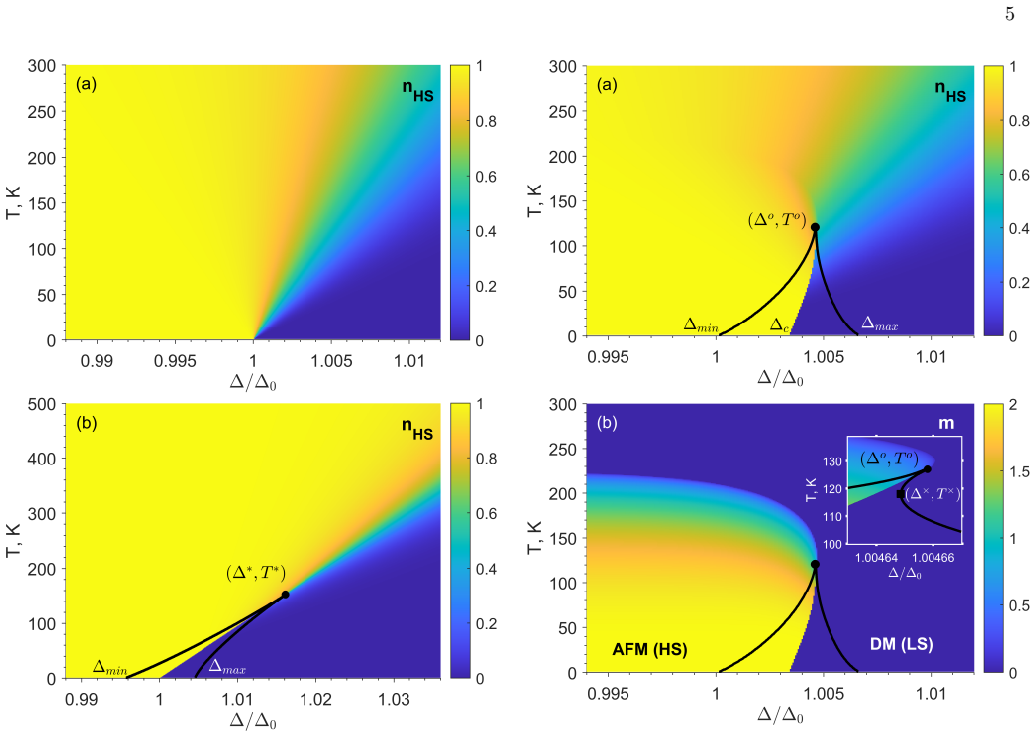
and ( 26) are thermodynamically equilibrium. Therefore,m (∆ ,T ) and nHS (∆ ,T ), satisfying Eqs. ( 16) and ( 26) with ∂m ∂t = ∂τ ∂t = ∂T ∂t = 0 and I = 0 coincide completely with those found by solving the self-consistent eigenvalue problem ( 15). From Eq. ( 26a) it is seen that a change in the mag- netization m can occur both due to a change in the popu...
-
[12]
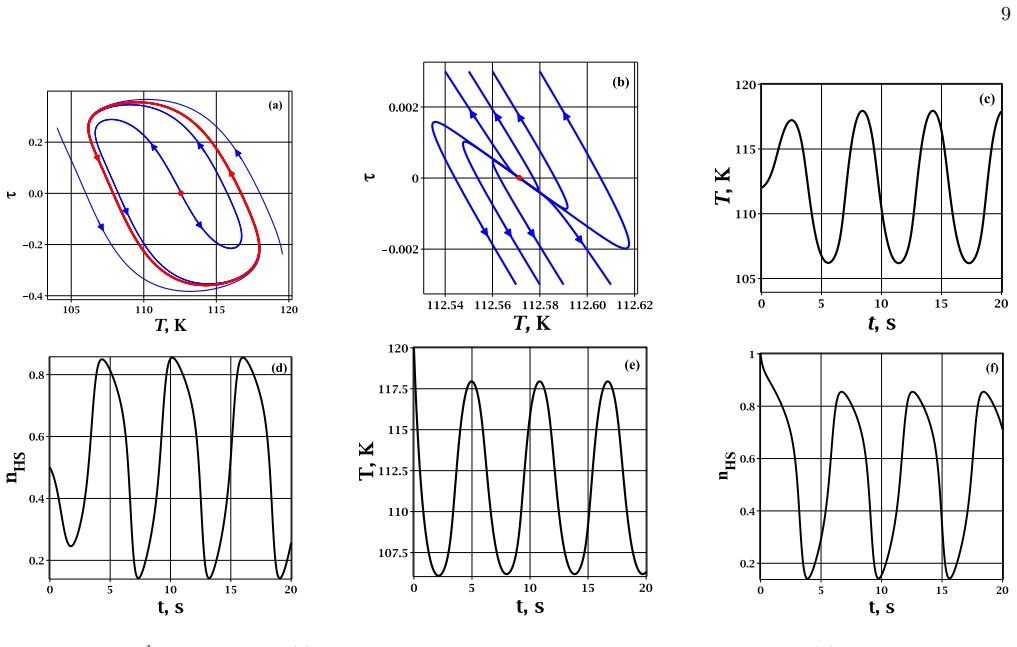
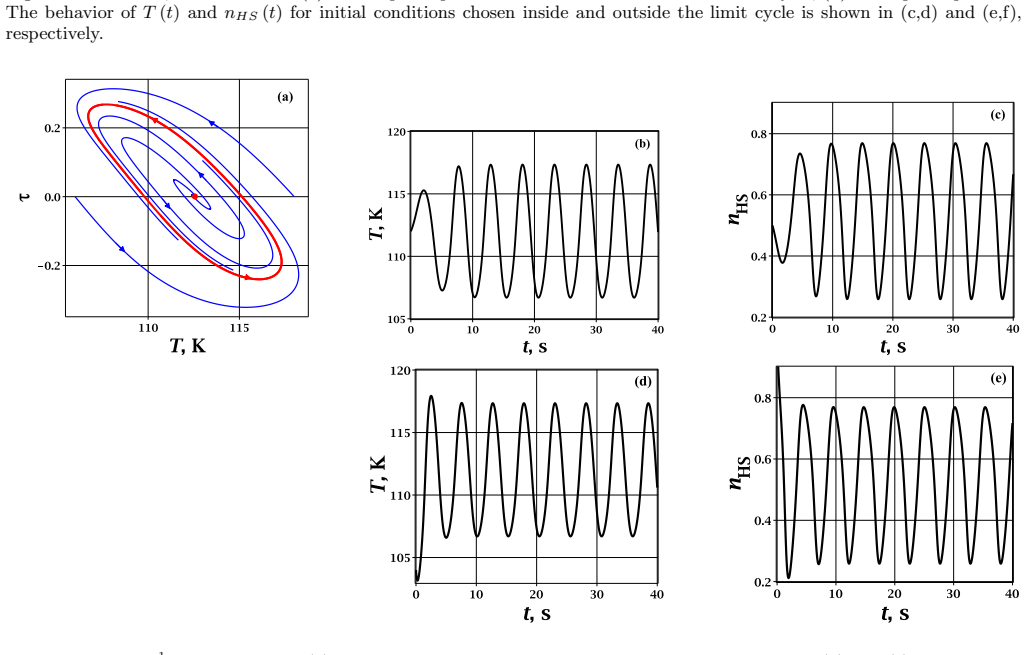
we obtain a single equation ( 27) for τ ∂τ ∂t =− ΓJτ [ τ + 1 2 tanh ( β 1 2Dτ )] . (27) The system of autonomous dynamical equations ( 16) and ( 27) was first presented in paper [41], where its solutions in the form of limit cycles were found, de- scribing stable self-oscillations of the population nHS and temperature T . In their calculations, the au- tho...
-
[13]
To this end, we expand the right- hand sides of Eqs
and ( 27) around the station- ary point ( T0,τ 0). To this end, we expand the right- hand sides of Eqs. ( 16) and ( 27) in a power series in the small quantitiesδτ (t) andδT (t) and keep only the linear terms. The linearized system of Eqs. ( 16) and ( 27) can be written as dδ dt = Λ δ, (29) where δ = ( δτ (t) δT (t) ) , and Λ = ( Λ 11 Λ 12 Λ 21 Λ 22 ) = ...
-
[14]
5, Teq = 112
8 K, Γ = 1 / 19 K − 1 s− 1,Jτ = 152 K, ln g = 7, ρ = 0. 5, Teq = 112. 6 K, ∆ S = 788 K [41]. Let TR = 75 K [41]. We plot all stationary points on the bifurcation diagram (Fig. 3), where the parabola Det (Λ) = T r2(Λ) 4 , corre- sponding to the condition of multiple roots Dλ (Λ) = 0, shows the boundary between nodes and foci. The regions of nodes and foci ...
-
[15]
and ( 27). If, however, we consider the case where I = 0 but ∆ H CP ̸= 0 (which is interesting because then feedback is possible without external action and arises due to nonequilibrium processes within the system itself), then for JS = 0 the existence of limit cycles becomes impossible. This can be easily verified by examining Fig. 9, where the blue lines...
-
[16]
Since the LS state is nonmagnetic, it is evident that a change in the population nHS will inevitably affect the magnetization m of the material
and (26) and the Belousov–Zhabotinsky equations, magneti- cally ordered SC systems exhibit nonlinear mechanisms that ensure periodic transitions from one state to another (self-oscillations). Since the LS state is nonmagnetic, it is evident that a change in the population nHS will inevitably affect the magnetization m of the material. We have succeeded in ...
-
[17]
G¨ utlich and H
P. G¨ utlich and H. Goodwin, eds.,Spin Crossover in Tran- sition Metal Compounds I–III (Springer Berlin, Heidel- berg, 2004)
2004
-
[18]
Okimoto, T
Y. Okimoto, T. Saitoh, Y. Kobayashi, and S. Ishi- hara, eds., Spin-Crossover Cobaltite (Springer Singapore, 2021)
2021
-
[19]
M. A. Halcrow, ed., Spin-Crossover Materials: Properties and Applications (John Wiley and Sons, Ltd, 2013)
2013
-
[20]
Bousseksou, G
A. Bousseksou, G. Molnar, L. Salmon, and W. Nicolazzi, Molecular spin crossover phenomenon: recent achieve- ments and prospects, Chem. Soc. Rev. 40, 3313 (2011)
2011
-
[21]
O. Kahn and C. J. Martinez, Spin-transition polymers: From molecular materials to- ward memory devices, Science 279, 44 (1998) , https://www.science.org/doi/pdf/10.1126/science.279.5347.44
-
[22]
N.-T. Yao, L. Zhao, H.-Y. Sun, C. Yi, Y.- H. Guan, Y.-M. Li, H. Oshio, Y.-S. Meng, and T. Liu, Simultaneous photo-induced mag- netic and dielectric switching in an iron(ii)-based spin-crossover hofmann-type metal-organic frame- work, Angewandte Chemie 134, e202208208 (2022) , https://onlinelibrary.wiley.com/doi/pdf/10.1002/ange.202208208
-
[23]
R. Torres-Cavanillas, M. Gavara-Edo, and E. Coronado, Bistable spin-crossover nanoparticles for molecu- lar electronics, Advanced Materials 36, 2307718 (2024) , https://advanced.onlinelibrary.wiley.com/doi/pdf/10.1002/adma.2023 13 Figure 10. (a) Temperature dependence of the solutions of Eq . (34) for different values of the spin gap ∆ S. (b) Enlarged view...
-
[24]
C. Yi, Y.-S. Meng, L. Zhao, N.-T. Yao, Q. Liu, W. Wen, R.-X. Li, Y.-Y. Zhu, H. Oshio, and T. Liu, A smart molecule showing spin crossover responsive aggregation- induced emission, CCS Chemistry 5, 915 (2023) , https://www.chinesechemsoc.org/doi/pdf/10.31635/ccschem.022.202201950
-
[25]
O. A. Qamar, F. Jamil, M. Hussain, M. Mustafa, R. U. Rehman, A. Inayat, M. S. Habib, and M. Sajid, A review on fe-based spin crossover complexes with synergetic conductive and fluorescent properties, Chemical Papers 77, 7331 (2023)
2023
-
[26]
O. I. Kucheriv, V. V. Oliynyk, V. V. Zagorodnii, V. L. Launets, and I. A. Gural’skiy, Spin-crossover materials towards microwave radiation switches, Scientific Reports 6, 38334 (2016)
2016
-
[27]
R. Rabelo, L. M. Toma, A. Bentama, S.-E. Stiriba, R. Ruiz-Garcia, and J. Cano, Exploring spin-crossover cobalt(ii) single-ion magnets as multifunctional and multiresponsive magnetic devices: Advancements and prospects in molecular spintronics and quan- tum computing technologies, Magnetochemistry 10, 10.3390/magnetochemistry10120107 (2024)
-
[28]
I. A. Gural’skiy, C. M. Quintero, J. S. Costa, P. Demont, G. Molnar, L. Salmon, H. J. Shep- herd, and A. Bousseksou, Spin crossover compos- ite materials for electrothermomechanical actuators, J. Mater. Chem. C 2, 2949 (2014)
2014
-
[29]
S. E. Alavi, B. Martin, Y. Zan, X. Yang, M. Piedrahita- Bello, W. Nicolazzi, J.-F. Ganghoffer, L. Salmon, G. Mol- nar, and A. Bousseksou, Dynamical mechanical anal- ysis and micromechanics simulations of spin-crossover polymer particulate composites: Toward soft ac- tuator devices, Chemistry of Materials 35, 3276 (2023) , https://doi.org/10.1021/acs.chemma...
-
[30]
M. Seredyuk, K. Znovjyak, F. J. Valverde-Munoz, I. da Silva, M. C. Munoz, Y. S. Moroz, and J. A. Real, 105 k wide room temperature spin transi- tion memory due to a supramolecular latch mechanism, Journal of the American Chemical Society 144, 14297 (2022) , pMID: 35900921, https://doi.org/10.1021/jacs.2c05417
-
[31]
Piedrahita-Bello, X
M. Piedrahita-Bello, X. Yang, S. E. Alavi, G. Molnar, L. Salmon, and A. Bousseksou, Anisotropic spin-crossover composite actua- tors displaying pre-programmed movements, Sensors and Actuators B: Chemical 393, 134147 (2023)
2023
-
[32]
Shao, Y.-S
Z. Shao, Y.-S. Meng, Y.-Y. Zhu, and T. Liu, Spin crossover in metal – organic cages, Dalton Trans. 54, 12432 (2025)
2025
-
[33]
S. Kamilya, B. Dey, K. Kaushik, S. Shukla, S. Mehta, and A. Mondal, Realm of spin state switching materi- als: Toward realization of molecular and nanoscale devices, Chemistry of Materials 36, 4889 (2024) , https://doi.org/10.1021/acs.chemmater.3c02654
-
[34]
Harding and D
P. Harding and D. J. Harding, A beginner’s guide to spin crossover, CrystEngComm 28, 1707 (2026)
2026
-
[35]
L. Cambi and L. Szeg¨ o, ¨Uber die magnetis- che susceptibilit¨ at der komplexen verbindungen, Berichte der deutschen chemischen Gesellschaft (A and B Ser ies) 64, 2591 (1931) , https://chemistry-europe.onlinelibrary.wiley.com/doi/pdf/10.1002/cber.19310641002
-
[36]
Ohkoshi, S
S.-i. Ohkoshi, S. Takano, K. Imoto, M. Yoshikiyo, A. Namai, and H. Tokoro, 90-degree optical switching of output second-harmonic light in chiral photomagnet, Nature Photonics 8, 65 (2014)
2014
-
[37]
Lunser, E
K. Lunser, E. Kavak, K. Gurpinar, B. Emre, O. Atakol, E. Stern-Taulats, M. Porta, A. Planes, P. Lloveras, J.-L. Tamarit, and L. Manosa, Elastocaloric, barocaloric and magnetocaloric effects in spin crossover polymer compos- ite films, Nature Communications 15, 6171 (2024)
2024
-
[38]
Lunser, C
K. Lunser, C. Salazar Mejia, T. Gottschall, K. Gurpinar, O. Atakol, E. Kavak, B. Emre, E. Stern-Taulats, and L. Manosa, Magnetocaloric effects in the prototype spin crossover complex [fe(l)2](bf4)2 in pulsed magnetic fields , APL Materials 13, 011105 (2025)
2025
-
[39]
R. Li, Z. Zhang, Y. S. Bibik, I. A. Gural’skiy, I. V. Zatovsky, Z. Liu, Q. Li, B. Li, G. Levchenko, and B. Liu, Colossal barocaloric effect of the spin- crossover compound fe(pz)2(bh3cn)2 near room temper- ature, Applied Physics Letters 124, 122202 (2024)
2024
-
[40]
Oppermann, F
M. Oppermann, F. Zinna, J. Lacour, and M. Chergui, Chiral control of spin-crossover dynamics in fe(ii) com- plexes, Nature Chemistry 14, 739 (2022)
2022
-
[41]
Zheng, J
Y. Zheng, J. Yong, Z. Zhu, J. Chen, Z. Song, and J. Gao, Spin crossover in metal-organic framework for improved separation of c2h2/ch4 at room temperature, Journal of Solid State Chemistry 304, 122554 (2021)
2021
-
[42]
P. He and S.-F. Zhu, Spin crossover and its application in organometallic catalysis: Concepts and recent progress, Chemistry–A European Journal 30, e202403437 (2024) , https://chemistry-europe.onlinelibrary.wiley.com/doi/pdf/10.1002/chem.202
-
[43]
F. Fiaz, A. Siddique, M. F. Rabbee, M. B. Hanif, S. M. Al-Baqami, S. M. S. Jillani, N. S. Almuqati, M. R. Rahman, M. A. Chowdhury, M. N. Akhtar, M. M. R. Khan, M. M. Rahman, and T. A. Sheikh, Advances in spin crossover metal complexes: a com- prehensive review on its gas sensing applications, Reviews in Inorganic Chemistry 46, 35 (2026)
2026
-
[44]
K. P. Kepp, Heme: From quantum spin crossover to oxygen manager of life, Coordination Chemistry Reviews 344, 363 (2017) , chemical Bonding: ”State of the Art”
2017
-
[45]
A. Lambrou, A. Ioannou, and E. Pinakoulaki, Spin crossover in nitrito-myoglobin as re- vealed by resonance raman spectroscopy, Chemistry–A European Journal 22, 12176 (2016) , https://chemistry-europe.onlinelibrary.wiley.com/doi/pdf/10.1002/chem.201
-
[46]
Kinschel, C
D. Kinschel, C. Bacellar, O. Cannelli, B. Sorokin, T. Katayama, G. F. Mancini, J. R. Rouxel, Y. Obara, J. Nishitani, H. Ito, T. Ito, N. Kurahashi, C. Hi- gashimura, S. Kudo, T. Keane, F. A. Lima, W. Gawelda, P. Zalden, S. Schulz, J. M. Budarz, D. Khakhulin, A. Galler, C. Bressler, C. J. Milne, T. Penfold, M. Yabashi, T. Suzuki, K. Misawa, and M. Chergui, ...
2020
-
[47]
Kurokawa, J
D. Kurokawa, J. S. Gueriba, and W. A. Dino, Spin-dependent o2 binding to hemoglobin, ACS Omega 3, 9241 (2018)
2018
-
[48]
Vasiliki K, T
V. Vasiliki K, T. Charalampos, and P. Eftychia, Reversible thermally induced spin crossover in the myoglobin-nitrito adduct directly monitored by reso- nance raman spectroscopy, RSC Adv. 13, 9020 (2023)
2023
-
[49]
M. W. Mara, R. G. Hadt, M. E. Reinhard, T. Kroll, H. Lim, R. W. Hartsock, R. Alonso-Mori, M. Chollet, J. M. Glownia, S. Nelson, D. Sokaras, K. Kunnus, K. O. Hodgson, B. Hedman, U. Bergmann, K. J. Gaffney, and E. I. Solomon, Metalloprotein entatic control of ligand- metal bonds quantified by ultrafast x-ray spectroscopy, 15 Science 356, 1276 (2017)
2017
-
[50]
G. E. Shephard, C. Houser, J. W. Hernlund, J. J. Valencia-Cardona, R. G. Tronnes, and R. M. Wentz- covitch, Seismological expression of the iron spin crossover in ferropericlase in the earth’s lower mantle, Nature Communications 12, 5905 (2021)
2021
-
[51]
J.-F. Lin, G. Vanko, S. D. Jacobsen, V. Iota, V. V. Struzhkin, V. B. Prakapenka, A. Kuznetsov, and C.-S. Yoo, Spin transition zone in earth’s lower mantle, Science 317, 1740 (2007) , https://www.science.org/doi/pdf/10.1126/science.1144997
-
[52]
V. E. Trautner, S. Stackhouse, A. R. Turner, P. Koele- meijer, D. R. Davies, A. S. J. Mendez, N. Satta, A. Kurnosov, H. P. Liermann, and H. Marquardt, Compressibility of ferropericlase at high-temperature: Evidence for the iron spin crossover in seismic to- mography, Earth and Planetary Science Letters 618, 10.1016/j.epsl.2023.118296 (2023)
-
[53]
Cobden, J
L. Cobden, J. Zhuang, W. Lei, R. Wentzcovitch, J. Trampert, and J. Tromp, Full-waveform tomogra- phy reveals iron spin crossover in earth’s lower mantle, Nature Communications 15, 1961 (2024)
1961
-
[54]
C. D. Polyzou, P. Gkolfi, C. T. Chasapis, V. Bekiari, A. Zianna, G. Psomas, M. Ondrej, and V. Tan- goulis, Stimuli-responsive spin crossover nanoparti- cles for drug delivery and dna-binding studies, Dalton Trans. 51, 12427 (2022)
2022
-
[55]
Tsukiashi, K
A. Tsukiashi, K. S. Min, H. Kitayama, H. Tera- sawa, S. Yoshinaga, M. Takeda, L. F. Lindoy, and S. Hayami, Application of spin-crossover water sol- uble nanoparticles for use as mri contrast agents, Scientific Reports 8, 14911 (2018)
2018
-
[56]
Varret, M
F. Varret, M. Paez-Espejo, and K. Boukheddaden, Light-induced instability generated by photo- thermal effect in switchable molecular crystals, Europhysics Letters 104, 27003 (2013)
2013
-
[57]
Boukheddaden, M
K. Boukheddaden, M. Paez-Espejo, F. Varret, and M. Sy, Autocatalytic spin-crossover transition: Non- linear dynamics induced by a photothermal instability, Phys. Rev. B 89, 224303 (2014)
2014
-
[58]
M. Sy, R. Traiche, H. Fourati, Y. Singh, F. Varret, and K. Boukheddaden, Spatiotemporal investigations on light-driven high-spin–low-spin interface dynamics in th e thermal hysteresis region of a spin-crossover single crys- tal, The Journal of Physical Chemistry C 122, 20952 (2018)
2018
-
[59]
Collet and P
E. Collet and P. Guionneau, Structural analysis of spin-crossover materials: From molecules to materials, Comptes Rendus Chimie 21, 1133 (2018) , spin crossover phenomenon
2018
-
[60]
Fourati, G
H. Fourati, G. Bouchez, M. Paez-Espejo, S. Triki, and K. Boukheddaden, Spatio-temporal investigations of the incomplete spin transition in a single crystal of [fe(2- pytrz)2Pt(CN)4]3h2o: Experiment and theory, Crystals 9, 46 (2019)
2019
-
[61]
K. Boukheddaden, H. Fourati, Y. Singh, and G. Chas- tanet, Evidence of photo-thermal effects on the first-order thermo-induced spin transition of [Fe(NCSe)(py)22(m- bpypz)] spin-crossover material, Magnetochemistry 5, 10.3390/magnetochemistry5020021 (2019)
-
[62]
Sy and K
M. Sy and K. Boukheddaden, Dance of interference patterns during the spin transition of a single crystal, The Journal of Physical Chemistry C 124, 28093 (2020)
2020
-
[63]
M. Ndiaye, Y. Singh, H. Fourati, M. Sy, B. Lo, and K. Boukheddaden, Isomorphism between the electro-elastic modeling of the spin transi- tion and ising-like model with competing inter- actions: Elastic generation of self-organized spin states, Journal of Applied Physics 129, 153901 (2021) , https://pubs.aip.org/aip/jap/article-pdf/doi/10.1063/5.0045689/1526
-
[64]
Singh, K
Y. Singh, K. Affes, N.-I. Belmouri, and K. Boukhed- daden, Clamping of spin-crossover solid induc- ing crystal bending and spatial spin organization, Materials Today Physics 27, 100842 (2022)
2022
-
[65]
Fourati, M
H. Fourati, M. Ndiaye, M. Sy, S. Triki, G. Chastanet, S. Pillet, and K. Boukheddaden, Light-induced thermal hysteresis and high-spin low-spin domain formation ev- idenced by optical microscopy in a spin-crossover single crystal, Phys. Rev. B 105, 174436 (2022)
2022
-
[66]
N. E. I. Belmouri, N. di Scala, and K. Boukhed- daden, 3d self-organization of spin crossover multi-layers emerging from the alliance of elastic anisotropy and lattice frustration, Journal of Physics and Chemistry of Solids 190, 111985 (2024)
2024
-
[67]
Slimani, F
A. Slimani, F. Varret, K. Boukheddaden, D. Garrot, H. Oubouchou, and S. Kaizaki, Velocity of the high-spin low-spin interface inside the thermal hysteresis loop of a spin-crossover crystal, via photothermal control of the interface motion, Phys. Rev. Lett. 110, 087208 (2013)
2013
-
[68]
M. Sy, F. Varret, K. Boukheddaden, G. Bouchez, J. Mar- rot, S. Kawata, and S. Kaizaki, Structure-driven ori- entation of the high-spin–low-spin interface in a spin- crossover single crystal, Angewandte Chemie Interna- tional Edition 53, 7539 (2014)
2014
-
[69]
Paez-Espejo, M
M. Paez-Espejo, M. Sy, F. Varret, and K. Boukheddaden, Quantitative macroscopic treatment of the spatiotempo- ral properties of spin crossover solids based on a reaction diffusion equation, Phys. Rev. B 89, 024306 (2014)
2014
-
[70]
M. Sy, D. Garrot, A. Slimani, M. Paez-Espejo, F. Var- ret, and K. Boukheddaden, Reversible control by light of the high-spin low-spin elastic interface inside the bistable region of a robust spin-transition single crystal , Angewandte Chemie International Edition 55, 1755 (2016) , https://onlinelibrary.wiley.com/doi/pdf/10.1002/anie.201509294
-
[71]
K. Boukheddaden, M. Sy, and F. Varret, Emergence of dynamical dissipative structures in a bistable spin crossover solid under light: Experience and theory, Advanced Theory and Simulations 1, 1800080 (2018) , https://onlinelibrary.wiley.com/doi/pdf/10.1002/adts.201800080
-
[72]
Nishihara, A
T. Nishihara, A. Bousseksou, and K. Tanaka, Dis- sipative structure in the photo-induced phase under steady light irradiation in the spin crossover complex, Opt. Express 21, 31179 (2013)
2013
-
[73]
Haken, Synergetics
H. Haken, Synergetics. An Introduction: Nonequilibrium Phase Transitions and Self-Organization in Physics, Chemistry and Biology (Springer Berlin, Heidelberg, 2012)
2012
-
[74]
I. S. Lyubutin and A. G. Gavriliuk, Research on phase transformations in 3d-metal oxides at high and ultrahigh pressure: state of the art, Phys. Usp. 52, 989 (2009)
2009
-
[75]
Tanabe and S
Y. Tanabe and S. Sugano, On the absorption spectra of complex ions. ii., Journal of the Physical Society of Japan 9, 766 (1954)
1954
-
[76]
D’Avino, A
G. D’Avino, A. Painelli, and K. Boukheddaden, Vibronic model for spin crossover complexes, Phys. Rev. B 84, 104119 (2011)
2011
-
[77]
Knizek, Z
K. Knizek, Z. Jirak, J. Hejtmanek, M. Veverka, M. Marysko, G. Maris, and T. Palstra, Structural anoma- 16 lies associated with the electronic and spin transitions in lncoo3, Eur. Phys. J. B 47, 213 (2005)
2005
-
[78]
Berggold, M
K. Berggold, M. Kriener, P. Becker, M. Benomar, M. Reuther, C. Zobel, and T. Lorenz, Anomalous ex- pansion and phonon damping due to the co spin-state transition in rcoo3 (r = la, pr, nd, and eu), Phys. Rev. B 78, 134402 (2008)
2008
-
[79]
P. G. Radaelli and S.-W. Cheong, Structural phenomena associated with the spin-state transition in lacoo3, Phys. Rev. B 66, 094408 (2002)
2002
-
[80]
Baier, S
J. Baier, S. Jodlauk, M. Kriener, A. Reichl, C. Zo- bel, H. Kierspel, A. Freimuth, and T. Lorenz, Spin-state transition and metal-insulator transition in la1-xeuxcoo 3, Phys. Rev. B 71, 014443 (2005)
2005
discussion (0)
Sign in with ORCID, Apple, or X to comment. Anyone can read and Pith papers without signing in.