Probing the Fundamental Nature of Particle Dark Matter
Pith reviewed 2026-06-25 21:27 UTC · model grok-4.3
The pith
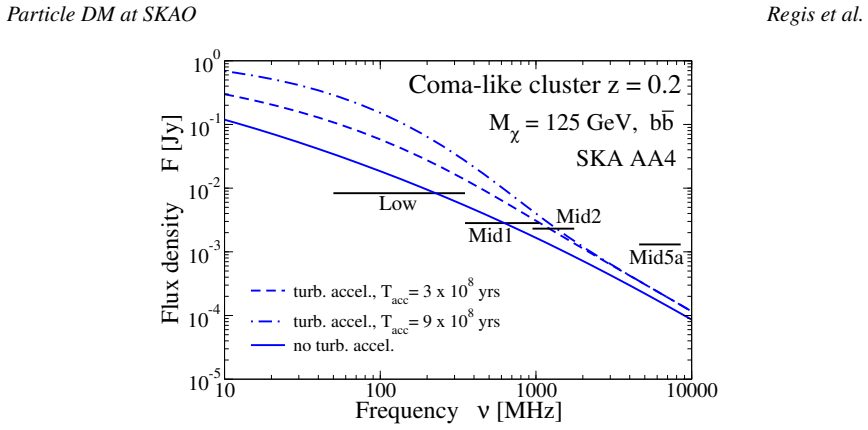
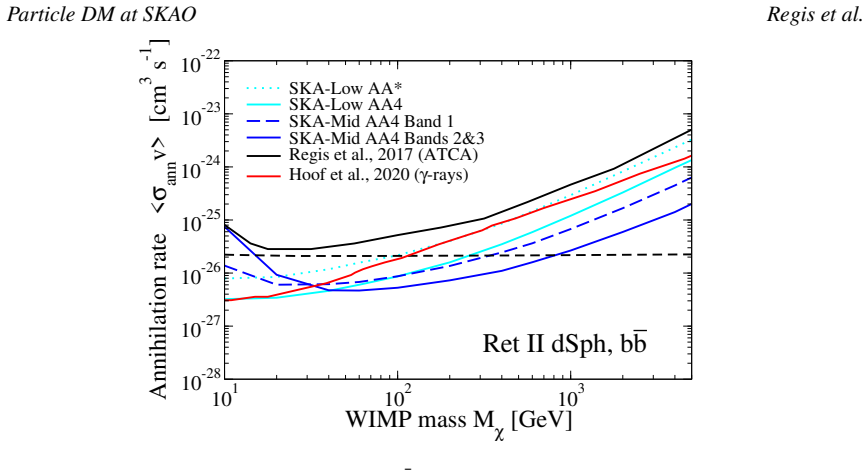
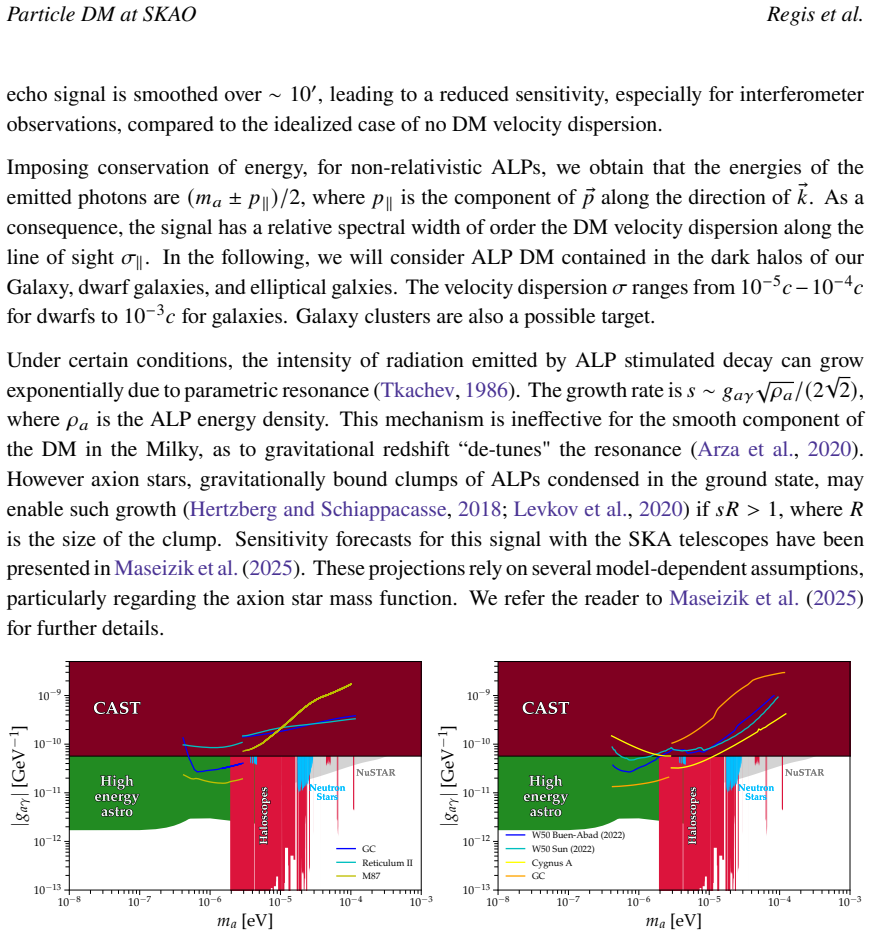
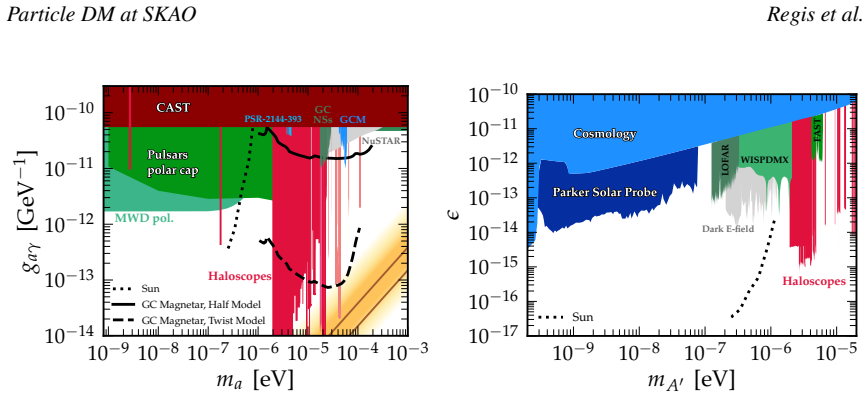
SKA telescopes can tighten constraints on sub-TeV WIMPs via synchrotron and on ALP-photon couplings via spectral and polarization signals.
A machine-rendered reading of the paper's core claim, the machinery that carries it, and where it could break.
Core claim
The central claim is that the superior continuum sensitivity of the SKA telescopes will allow progressive closure on the WIMP parameter space through detection of synchrotron radiation from annihilation products, while the spectral resolution, line sensitivity, and polarimetry of the SKA AA4 telescopes can be leveraged to constrain the ALP-photon coupling through monochromatic signatures and polarization effects.
What carries the argument
Synchrotron radiation from DM annihilation products (for WIMPs) and monochromatic photon signals plus polarization angle rotation (for ALPs), observed in radio continuum, spectral line, and polarimetric modes.
If this is right
- Competitive constraints on sub-TeV WIMPs have already been derived from SKA precursors observing dwarf galaxies, galaxy clusters, and the Large Magellanic Cloud.
- SKA continuum observations will progressively close in on the remaining WIMP parameter space.
- Spectral resolution and line sensitivity will target the nearly monochromatic ALP decay or conversion signals.
- Polarimetry capabilities will constrain ALP-photon interactions through rotation of polarization angles.
Where Pith is reading between the lines
- Successful application would prioritize targets like dwarf galaxies for SKA observing time in dark matter searches.
- Non-detections at forecasted levels would shift focus to higher-mass WIMPs or weaker ALP couplings in model building.
- The approach could be cross-checked with gamma-ray or neutrino observations to confirm or refute any signals.
Load-bearing premise
The forecasts assume that the SKA AA4 baseline design will deliver the stated sensitivity, spectral resolution, and polarimetry performance, and that astrophysical backgrounds can be sufficiently controlled to isolate any dark matter signals.
What would settle it
If SKA AA4 observations fail to reach the forecasted sensitivity or cannot separate dark matter signals from astrophysical backgrounds at the levels needed, the projected constraints on WIMP annihilation cross sections and ALP-photon couplings would not be achieved.
Figures


read the original abstract
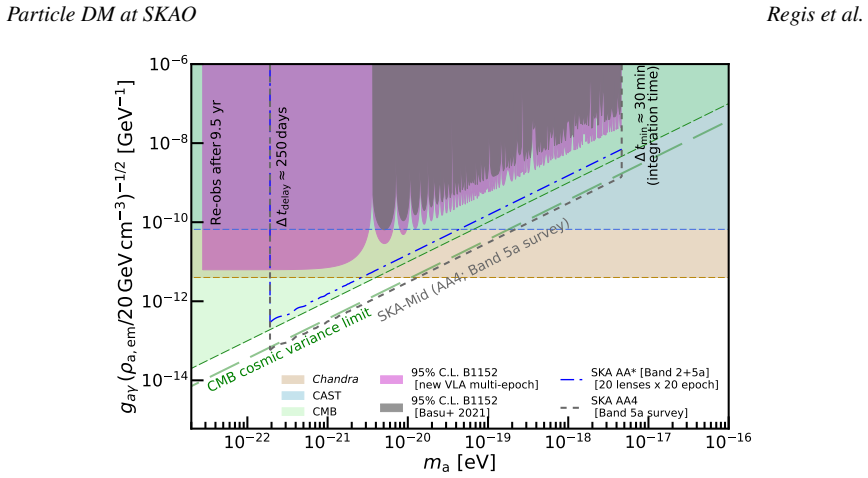
Understanding the fundamental nature of dark matter (DM) is one of the most significant scientific challenges of our time. A compelling hypothesis is that DM consists of a new, yet-to-be-discovered particle. Among the leading candidates are weakly interacting massive particles (WIMPs) and axion-like particles (ALPs), both of which can be investigated using observations with the SKA telescopes. In this chapter, we review the search for particle DM through radio observations, summarizing the current state-of-the-art and presenting forecasts for the SKA-Low and SKA-Mid telescopes in the AA4 baseline design. Radio searches for WIMPs focus on detecting synchrotron radiation originating from the products of DM annihilation using continuum observations. Competitive constraints on sub-TeV WIMPs have already been derived using SKA precursors looking at dwarf galaxies, galaxy clusters, and the Large Magellanic Cloud. We discuss how the superior continuum sensitivity of the SKA telescopes will allow us to progressively close in on the WIMP parameter space. The ALP signal arises from its decay or conversion into photon(s), which typically consists of a nearly monochromatic signature, and from rotation of polarization angles of photons interacting with ALPs. We demonstrate how the spectral resolution, line sensitivity, and polarimetry of the SKA AA4 telescopes can be leveraged to constrain the ALP-photon coupling.
Editorial analysis
A structured set of objections, weighed in public.
Referee Report
Summary. The manuscript reviews radio searches for particle dark matter with the SKA telescopes. It summarizes existing constraints on WIMPs from synchrotron continuum emission due to annihilation products (using dwarf galaxies, clusters, and the LMC from SKA precursors) and on ALPs from monochromatic photon lines or polarization rotation. It then presents forecasts showing how the continuum sensitivity of SKA-Low/Mid AA4 will progressively close WIMP parameter space and how spectral resolution, line sensitivity, and polarimetry will constrain the ALP-photon coupling.
Significance. If the forecasts are robust, the work is significant because it synthesizes how next-generation radio facilities can target sub-TeV WIMPs and ALP-photon couplings, providing a clear observational roadmap that connects radio astronomy with particle DM searches. The review of precursor limits supplies useful context for the community.
major comments (1)
- [SKA AA4 forecasts (as described in the abstract and associated discussion)] The central claim that SKA AA4 will close in on the WIMP parameter space and constrain ALP-photon coupling rests on the assumption that the stated baseline sensitivities, spectral resolution, and polarimetry performance will be realized and that astrophysical foregrounds (synchrotron, point sources, Galactic emission) can be subtracted to the required precision. The manuscript summarizes external prior constraints but supplies no new end-to-end simulations or quantitative assessment of residual systematics after foreground removal; this assumption is load-bearing for the forecasted reach.
minor comments (1)
- A summary table comparing current limits with the projected SKA AA4 constraints for representative WIMP masses and ALP couplings would improve readability and allow readers to assess the incremental gain at a glance.
Simulated Author's Rebuttal
We thank the referee for their constructive report and positive assessment of the review's significance. The manuscript is a synthesis of existing results and community forecasts rather than a presentation of new simulations. We address the single major comment below.
read point-by-point responses
-
Referee: The central claim that SKA AA4 will close in on the WIMP parameter space and constrain ALP-photon coupling rests on the assumption that the stated baseline sensitivities, spectral resolution, and polarimetry performance will be realized and that astrophysical foregrounds (synchrotron, point sources, Galactic emission) can be subtracted to the required precision. The manuscript summarizes external prior constraints but supplies no new end-to-end simulations or quantitative assessment of residual systematics after foreground removal; this assumption is load-bearing for the forecasted reach.
Authors: We agree that the forecasts rely on the published SKA AA4 baseline sensitivities and on the assumption that foregrounds can be subtracted to the necessary precision. Because this is a review chapter, we compile forecasts from the existing literature rather than generating new end-to-end simulations. To make the assumptions and limitations more transparent, we will add a dedicated subsection (in the WIMP and ALP forecast sections) that (i) states the baseline design parameters used, (ii) summarizes the current status of foreground-removal techniques in the radio literature, and (iii) cites studies that quantify residual systematics. This revision will not alter the quoted sensitivity numbers but will explicitly flag the load-bearing assumptions. revision: yes
Circularity Check
No circularity: review of external constraints plus forecasts from stated SKA design assumptions
full rationale
The paper is a review summarizing published precursor limits on WIMPs and ALPs from SKA pathfinders, then stating forecasts that explicitly rest on the AA4 baseline design sensitivities, spectral resolution, and polarimetry performance (assumed as given). No equations or derivations in the provided text reduce a claimed prediction to a quantity defined or fitted by the authors themselves. Self-citations, if present, are not load-bearing for the central claims; the forecasts are not statistically forced by any internal fit. The paper is self-contained against external benchmarks (published limits and telescope design documents).
Axiom & Free-Parameter Ledger
axioms (1)
- domain assumption Dark matter consists of new particles (WIMPs or ALPs) whose interactions produce detectable radio signatures
Reference graph
Works this paper leans on
-
[1]
2019 , eprint=
Anticipated Performance of the Square Kilometre Array -- Phase 1 (SKA1) , author=. 2019 , eprint=
2019
-
[2]
Advancing Astrophysics with the Square Kilometre Array (AASKA14) , author=. PoS. 2015
2015
-
[4]
Supersymmetric dark matter. , keywords =. doi:10.1016/0370-1573(95)00058-5 , archivePrefix =. hep-ph/9506380 , primaryClass =
work page internal anchor Pith review Pith/arXiv arXiv doi:10.1016/0370-1573(95)00058-5
-
[5]
Gaskins , title =
Jennifer M. Gaskins , title =. Contemporary Physics , volume =. 2016 , publisher =
2016
-
[6]
CMB constraints on dark matter models with large annihilation cross section. Phys. Rev. D , keywords =. doi:10.1103/PhysRevD.80.023505 , archivePrefix =. 0905.0003 , primaryClass =
work page internal anchor Pith review Pith/arXiv arXiv doi:10.1103/physrevd.80.023505
-
[7]
Hütsi, G. and Hektor, A. and Raidal, M. , year=. Constraints on leptonically annihilating dark matter from reionization and extragalactic gamma background , volume=. Astronomy & Astrophysics , publisher=. doi:10.1051/0004-6361/200912760 , number=
-
[8]
Cirelli, Marco and Iocco, Fabio and Panci, Paolo , year=. Constraints on Dark Matter annihilations from reionization and heating of the intergalactic gas , volume=. JCAP , publisher=. doi:10.1088/1475-7516/2009/10/009 , number=
-
[9]
Updated CMB constraints on dark matter annihilation cross sections , volume=
Galli, Silvia and Iocco, Fabio and Bertone, Gianfranco and Melchiorri, Alessandro , year=. Updated CMB constraints on dark matter annihilation cross sections , volume=. Physical Review D , publisher=. doi:10.1103/physrevd.84.027302 , number=
-
[10]
The Fermi Large Area Telescope on Orbit: Event Classification, Instrument Response Functions, and Calibration. Astrophys. J. Supp. , keywords =. doi:10.1088/0067-0049/203/1/4 , archivePrefix =. 1206.1896 , primaryClass =
work page internal anchor Pith review Pith/arXiv arXiv doi:10.1088/0067-0049/203/1/4
-
[11]
Stecker, F. W. Gamma-rays and neutrinos from dark matter. Nucl. Phys. B Proc. Suppl. 1996. doi:10.1016/S0920-5632(96)00511-7. arXiv:astro-ph/9607037
work page internal anchor Pith review Pith/arXiv arXiv doi:10.1016/s0920-5632(96)00511-7 1996
-
[13]
Constraints on mediator-based dark matter and scalar dark energy models using \ s\ = 13 TeV pp collision data collected by the ATLAS detector. Journal of High Energy Physics , keywords =. doi:10.1007/JHEP05(2019)142 , archivePrefix =. 1903.01400 , primaryClass =
work page internal anchor Pith review Pith/arXiv arXiv doi:10.1007/jhep05(2019)142 2019
-
[14]
Frontiers in Astronomy and Space Sciences , keywords =
Giagu, Stefano , TITLE=. Frontiers in Physics , VOLUME=. 2019 , URL=. doi:10.3389/fphy.2019.00075 , ISSN=
-
[15]
GeV-scale thermal WIMPs: Not even slightly ruled out. Phys. Rev. D , keywords =. doi:10.1103/PhysRevD.98.023016 , archivePrefix =. 1805.10305 , primaryClass =
work page internal anchor Pith review Pith/arXiv arXiv doi:10.1103/physrevd.98.023016
-
[16]
Measurements of the atmospheric neutrino flux by Super-Kamiokande: Energy spectra, geomagnetic effects, and solar modulation. Phys. Rev. D , keywords =. doi:10.1103/PhysRevD.94.052001 , archivePrefix =. 1510.08127 , primaryClass =
work page internal anchor Pith review Pith/arXiv arXiv doi:10.1103/physrevd.94.052001
-
[17]
Reviews of Modern Physics , keywords =
Dark matter annihilation to neutrinos. Reviews of Modern Physics , keywords =. doi:10.1103/RevModPhys.93.035007 , archivePrefix =. 1912.09486 , primaryClass =
-
[18]
Handbook of X-ray and Gamma-ray Astrophysics , year = 2023, eid =
H.E.S.S.: The High Energy Stereoscopic System. Handbook of X-ray and Gamma-ray Astrophysics , year = 2023, eid =. doi:10.1007/978-981-16-4544-0_69-1 , adsurl =
-
[19]
The Cherenkov Telescope Array. arXiv e-prints , keywords =. doi:10.48550/arXiv.2305.12888 , archivePrefix =. 2305.12888 , primaryClass =
-
[20]
Physics of the Dark Universe , keywords =
DARKFLUX: A new tool to analyze indirect-detection spectra of next-generation dark matter models. Physics of the Dark Universe , keywords =. doi:10.1016/j.dark.2022.101012 , archivePrefix =. 2202.03419 , primaryClass =
-
[21]
Legacy analysis of dark matter annihilation from the Milky Way dwarf spheroidal galaxies with 14 years of Fermi -LAT data. Phys. Rev. D , keywords =. doi:10.1103/PhysRevD.109.063024 , archivePrefix =. 2311.04982 , primaryClass =
-
[22]
, title =
Cirelli, M. , title =. Pramana - Journal of Physics , volume =. 2012 , doi =
2012
-
[23]
Julien Billard and Mark Boulay and Susana Cebrián and Laura Covi and Giuliana Fiorillo and Anne Green and Joachim Kopp and Béla Majorovits and Kimberly Palladino and Federica Petricca and Leszek Roszkowski (chair) and Marc Schumann , title =. 2022 , monti =. doi:10.1088/1361-6633/ac5754 , url =
-
[24]
Standard Model Summary Plots June 2021. 2021
2021
-
[25]
Planck 2018 results. VI. Cosmological parameters. Astronomy & Astrophysics , keywords =. doi:10.1051/0004-6361/201833910 , archivePrefix =. 1807.06209 , primaryClass =
work page internal anchor Pith review Pith/arXiv arXiv doi:10.1051/0004-6361/201833910 2018
-
[26]
Particle dark matter: evidence, candidates and constraints
Gianfranco Bertone and Dan Hooper and Joseph Silk. Particle dark matter: evidence, candidates and constraints. 2005. doi:http://dx.doi.org/10.1016/j.physrep.2004.08.031
-
[27]
and Blanco, Carlos and Zhang, Jonathan
Roy, Sandip and Prabhu, Anirudh and Thompson, Christopher and Witte, Samuel J. and Blanco, Carlos and Zhang, Jonathan. Searching for axion dark matter near relaxing magnetars. Phys. Rev. D. 2026. doi:10.1103/glnt-t93q. arXiv:2505.20450
-
[28]
Foster, Joshua W. and Witte, Samuel J. and Lawson, Matthew and Linden, Tim and Gajjar, Vishal and Weniger, Christoph and Safdi, Benjamin R. Extraterrestrial Axion Search with the Breakthrough Listen Galactic Center Survey. Phys. Rev. Lett. 2022. doi:10.1103/PhysRevLett.129.251102. arXiv:2202.08274
-
[29]
doi:10.1088/1475-7516/2022/10/038 , year = 2022, monti =
Javier Reynoso-Cordova and Marco Regis and Marco Taoso , title =. doi:10.1088/1475-7516/2022/10/038 , year = 2022, monti =
-
[30]
Multi-frequency dark matter searches in Omega Centauri
Beck, Geoff. Multi-frequency dark matter searches in Omega Centauri. PoS. doi:10.22323/1.444.1414
-
[31]
Identification of the long stellar stream of the prototypical massive globular cluster Centauri. Nature Astronomy , keywords =. doi:10.1038/s41550-019-0751-x , archivePrefix =. 1902.09544 , primaryClass =
work page internal anchor Pith review Pith/arXiv arXiv doi:10.1038/s41550-019-0751-x 1902
-
[32]
Searching for axion dark matter with the MeerKAT radio telescope
Zhou, Yun-Fan and others. Searching for axion dark matter with the MeerKAT radio telescope. Phys. Rev. D. 2022. doi:10.1103/PhysRevD.106.083006. arXiv:2209.09695
-
[33]
and Kahn, Yonatan and Macias, Oscar and Sun, Zhiquan and Eatough, Ralph P
Foster, Joshua W. and Kahn, Yonatan and Macias, Oscar and Sun, Zhiquan and Eatough, Ralph P. and Kondratiev, Vladislav I. and Peters, Wendy M. and Weniger, Christoph and Safdi, Benjamin R. Green Bank and Effelsberg Radio Telescope Searches for Axion Dark Matter Conversion in Neutron Star Magnetospheres. Phys. Rev. Lett. 2020. doi:10.1103/PhysRevLett.125.1...
-
[34]
and Edenton, Madeleine and Agrawal, Prakamya and Johnson, Bradley and Kavanagh, Bradley J
Walters, Liam and Shroyer, Jordan E. and Edenton, Madeleine and Agrawal, Prakamya and Johnson, Bradley and Kavanagh, Bradley J. and Marsh, David J. E. and Visinelli, Luca. Axions in Andromeda: Searching for minicluster-neutron star encounters with the Green Bank Telescope. Phys. Rev. D. 2024. doi:10.1103/PhysRevD.110.123002. arXiv:2407.13060
-
[35]
Radio Signals from Axion Dark Matter Conversion in Neutron Star Magnetospheres
Hook, Anson and Kahn, Yonatan and Safdi, Benjamin R. and Sun, Zhiquan. Radio Signals from Axion Dark Matter Conversion in Neutron Star Magnetospheres. Phys. Rev. Lett. 2018. doi:10.1103/PhysRevLett.121.241102. arXiv:1804.03145
work page internal anchor Pith review Pith/arXiv arXiv doi:10.1103/physrevlett.121.241102 2018
-
[36]
Detecting Axion Dark Matter with Radio Lines from Neutron Star Populations
Safdi, Benjamin R. and Sun, Zhiquan and Chen, Alexander Y. Detecting Axion Dark Matter with Radio Lines from Neutron Star Populations. Phys. Rev. D. 2019. doi:10.1103/PhysRevD.99.123021. arXiv:1811.01020
work page internal anchor Pith review Pith/arXiv arXiv doi:10.1103/physrevd.99.123021 2019
-
[37]
and Noordhuis, Dion and Edwards, Thomas D
Witte, Samuel J. and Noordhuis, Dion and Edwards, Thomas D. P. and Weniger, Christoph. Axion-photon conversion in neutron star magnetospheres: The role of the plasma in the Goldreich-Julian model. Phys. Rev. D. 2021. doi:10.1103/PhysRevD.104.103030. arXiv:2104.07670
-
[38]
el and Chianese, Marco and Edwards, Thomas D. P. and Weniger, Christoph , title =
Leroy, Mika\"el and Chianese, Marco and Edwards, Thomas D. P. and Weniger, Christoph , title = ". Phys. Rev. D. 2020. doi:10.1103/PhysRevD.101.123003. arXiv:1912.08815
-
[39]
and Baum, Sebastian and Lawson, Matthew and Marsh, M
Witte, Samuel J. and Baum, Sebastian and Lawson, Matthew and Marsh, M. C. David and Millar, Alexander J. and Salinas, Gustavo. Transient radio lines from axion miniclusters and axion stars. Phys. Rev. D. 2023. doi:10.1103/PhysRevD.107.063013. arXiv:2212.08079
-
[40]
Battye, R. A. and Keith, M. J. and McDonald, J. I. and Srinivasan, S. and Stappers, B. W. and Weltevrede, P. Searching for time-dependent axion dark matter signals in pulsars. Phys. Rev. D. 2023. doi:10.1103/PhysRevD.108.063001. arXiv:2303.11792
-
[41]
Bhura, U. and Battye, R. A. and McDonald, J. I. and Srinivasan, S. Axion signals from neutron star populations. JCAP. 2024. doi:10.1088/1475-7516/2024/11/029. arXiv:2407.19028
-
[42]
Pshirkov, M. S. and Popov, S. B. Conversion of Dark matter axions to photons in magnetospheres of neutron stars. J. Exp. Theor. Phys. 2009. doi:10.1134/S1063776109030030. arXiv:0711.1264
work page internal anchor Pith review Pith/arXiv arXiv doi:10.1134/s1063776109030030 2009
-
[43]
Huang, Fa Peng and Kadota, Kenji and Sekiguchi, Toyokazu and Tashiro, Hiroyuki. Radio telescope search for the resonant conversion of cold dark matter axions from the magnetized astrophysical sources. Phys. Rev. D. 2018. doi:10.1103/PhysRevD.97.123001. arXiv:1803.08230
work page internal anchor Pith review Pith/arXiv arXiv doi:10.1103/physrevd.97.123001 2018
-
[44]
The Sun as a target for axion dark matter detection
Todarello, Elisa and Regis, Marco and Taoso, Marco and Giannotti, Maurizio and Ruz, Jaime and Vogel, Julia K. The Sun as a target for axion dark matter detection. Phys. Lett. B. 2024. doi:10.1016/j.physletb.2024.138752. arXiv:2312.13984
-
[45]
Dark matter in the Reticulum II dSph: a radio search , volume=
Regis, Marco and Richter, Laura and Colafrancesco, Sergio , year=. Dark matter in the Reticulum II dSph: a radio search , volume=. JCAP , publisher=. doi:10.1088/1475-7516/2017/07/025 , number=
-
[46]
Hoof, Sebastian and Geringer-Sameth, Alex and Trotta, Roberto , year=. A global analysis of dark matter signals from 27 dwarf spheroidal galaxies using 11 years of Fermi-LAT observations , volume=. JCAP , publisher=. doi:10.1088/1475-7516/2020/02/012 , number=
-
[47]
Universal profiles for radio searches of Dark Matter in dwarf galaxies , volume=
Vollmann, Martin , year=. Universal profiles for radio searches of Dark Matter in dwarf galaxies , volume=. JCAP , publisher=. doi:10.1088/1475-7516/2021/04/068 , number=
-
[48]
Kar, Arpan and Mitra, Sourav and Mukhopadhyaya, Biswarup and Choudhury, Tirthankar Roy and Tingay, Steven , year=. Constraints on dark matter annihilation in dwarf spheroidal galaxies from low frequency radio observations , volume=. Physical Review D , publisher=. doi:10.1103/physrevd.100.043002 , number=
-
[49]
The EMU view of the Large Magellanic Cloud: troubles for sub-TeV WIMPs. JCAP , keywords =. doi:10.1088/1475-7516/2021/11/046 , archivePrefix =. 2106.08025 , primaryClass =
-
[50]
Constraints on dark matter annihilation from the FAST observation of the Coma Berenices dwarf galaxy. Phys. Rev. D , keywords =. doi:10.1103/PhysRevD.107.103011 , archivePrefix =. 2209.15590 , primaryClass =
-
[51]
Basu, Arghyadeep and Roy, Nirupam and Choudhuri, Samir and Datta, Kanan K and Sarkar, Debajyoti , year=. Stringent constraint on the radio signal from dark matter annihilation in dwarf spheroidal galaxies using the TGSS , volume=. Mon. Not. Roy. Astron. Soc. , publisher=. doi:10.1093/mnras/stab120 , number=
-
[52]
Physics of the Dark Universe , keywords =
DarkMatters: A powerful tool for WIMPy analysis. Physics of the Dark Universe , keywords =. doi:10.1016/j.dark.2024.101745 , archivePrefix =. 2408.07053 , primaryClass =
-
[53]
Anisotropic Radio-wave Scattering and the Interpretation of Solar Radio Emission Observations. Astrophys. J. , keywords =. doi:10.3847/1538-4357/ab40bb , archivePrefix =. 1909.00340 , primaryClass =
-
[54]
Radio-frequency Dark Photon Dark Matter across the Sun
An, Haipeng and Huang, Fa Peng and Liu, Jia and Xue, Wei. Radio-frequency Dark Photon Dark Matter across the Sun. Phys. Rev. Lett. 2021. doi:10.1103/PhysRevLett.126.181102. arXiv:2010.15836
-
[55]
Searching for ultralight dark matter conversion in solar corona using Low Frequency Array data
An, Haipeng and Chen, Xingyao and Ge, Shuailiang and Liu, Jia and Luo, Yan. Searching for ultralight dark matter conversion in solar corona using Low Frequency Array data. Nature Commun. 2024. doi:10.1038/s41467-024-45033-4. arXiv:2301.03622
-
[56]
An, Haipeng and Ge, Shuailiang and Liu, Jia and Liu, Mingzhe. In Situ Measurements of Dark Photon Dark Matter Using Parker Solar Probe: Going beyond the Radio Window. Phys. Rev. Lett. 2025. doi:10.1103/PhysRevLett.134.171001. arXiv:2405.12285
-
[57]
Solar Radio Emissions and Ultralight Dark Matter
An, Haipeng and Ge, Shuailiang and Liu, Jia. Solar Radio Emissions and Ultralight Dark Matter. Universe. 2023. doi:10.3390/universe9030142. arXiv:2304.01056
-
[58]
Propagation Effects in Quiet Sun Observations at Meter Wavelengths. Astrophys. J. , keywords =. doi:10.3847/1538-4357/abb949 , archivePrefix =. 2009.10604 , primaryClass =
-
[59]
McDonald, J. I. and Millington, P. Axion-photon mixing in 3D: classical equations and geometric optics. JCAP. 2024. doi:10.1088/1475-7516/2024/09/072. arXiv:2407.11192
-
[60]
McDonald, J. I. and Garbrecht, B. and Millington, P. Axion-photon conversion in 3D media and astrophysical plasmas. JCAP. 2023. doi:10.1088/1475-7516/2023/12/031. arXiv:2307.11812
-
[61]
Numerical analysis of resonant axion-photon mixing
Gin\'es, Estanis Utrilla and Noordhuis, Dion and Weniger, Christoph and Witte, Samuel J. Numerical analysis of resonant axion-photon mixing. Phys. Rev. D. 2024. doi:10.1103/PhysRevD.110.083007. arXiv:2405.08865
-
[62]
McDonald, J. I. and Witte, S. J. Generalized ray tracing for axions in astrophysical plasmas. Phys. Rev. D. 2023. doi:10.1103/PhysRevD.108.103021. arXiv:2309.08655
-
[63]
Search for Axionic Dark Matter Using the Magnetar PSR J1745-2900
Darling, Jeremy. Search for Axionic Dark Matter Using the Magnetar PSR J1745-2900. Phys. Rev. Lett. 2020. doi:10.1103/PhysRevLett.125.121103. arXiv:2008.01877
-
[64]
New Limits on Axionic Dark Matter from the Magnetar PSR J1745-2900
Darling, Jeremy. New Limits on Axionic Dark Matter from the Magnetar PSR J1745-2900. Astrophys. J. Lett. 2020. doi:10.3847/2041-8213/abb23f. arXiv:2008.11188
-
[65]
Battye, R. A. and Darling, J. and McDonald, J. I. and Srinivasan, S. Towards robust constraints on axion dark matter using PSR J1745-2900. Phys. Rev. D. 2022. doi:10.1103/PhysRevD.105.L021305. arXiv:2107.01225
-
[66]
Axion production in pulsar magnetosphere gaps
Prabhu, Anirudh. Axion production in pulsar magnetosphere gaps. Phys. Rev. D. 2021. doi:10.1103/PhysRevD.104.055038. arXiv:2104.14569
-
[67]
Noordhuis, Dion and Prabhu, Anirudh and Witte, Samuel J. and Chen, Alexander Y. and Cruz, F\'abio and Weniger, Christoph. Novel Constraints on Axions Produced in Pulsar Polar-Cap Cascades. Phys. Rev. Lett. 2023. doi:10.1103/PhysRevLett.131.111004. arXiv:2209.09917
-
[68]
Caputo, Andrea and Witte, Samuel J. and Philippov, Alexander A. and Jacobson, Ted. Pulsar Nulling and Vacuum Radio Emission from Axion Clouds. Phys. Rev. Lett. 2024. doi:10.1103/PhysRevLett.133.161001. arXiv:2311.14795
-
[69]
Axion Clouds around Neutron Stars
Noordhuis, Dion and Prabhu, Anirudh and Weniger, Christoph and Witte, Samuel J. Axion Clouds around Neutron Stars. Phys. Rev. X. 2024. doi:10.1103/PhysRevX.14.041015. arXiv:2307.11811
-
[70]
Direct Detection of Dark Photon Dark Matter Using Radio Telescopes
An, Haipeng and Ge, Shuailiang and Guo, Wen-Qing and Huang, Xiaoyuan and Liu, Jia and Lu, Zhiyao. Direct Detection of Dark Photon Dark Matter Using Radio Telescopes. Phys. Rev. Lett. 2023. doi:10.1103/PhysRevLett.130.181001. arXiv:2207.05767
-
[71]
uller, K. and others , collaboration =
Altenm\"uller, K. and others , collaboration = "CAST", title = ". Phys. Rev. Lett. 2024. doi:10.1103/PhysRevLett.133.221005. arXiv:2406.16840
- [72]
-
[73]
Arias, Paola and Cadamuro, Davide and Goodsell, Mark and Jaeckel, Joerg and Redondo, Javier and Ringwald, Andreas. WISPy Cold Dark Matter. JCAP. 2012. doi:10.1088/1475-7516/2012/06/013. arXiv:1201.5902
work page internal anchor Pith review Pith/arXiv arXiv doi:10.1088/1475-7516/2012/06/013 2012
-
[74]
McDermott, Samuel D. and Witte, Samuel J. Cosmological evolution of light dark photon dark matter. Phys. Rev. D. 2020. doi:10.1103/PhysRevD.101.063030. arXiv:1911.05086
-
[75]
Levine, Joseph and Godfrey, Benjamin and Tyson, J. Anthony and Tripathi, S. Mani and Polin, Daniel and Aminaei, Amin and Kolner, Brian H. and Stucky, Paul. New limit on dark photon kinetic mixing in the 0.2 1.2\,\, eV mass range from the Dark E-field Radio experiment. Phys. Rev. D. 2024. doi:10.1103/PhysRevD.110.032010. arXiv:2405.20444
-
[76]
First results from the WISPDMX radio frequency cavity searches for hidden photon dark matter
Nguyen, Le Hoang and Lobanov, Andrei and Horns, Dieter. First results from the WISPDMX radio frequency cavity searches for hidden photon dark matter. JCAP. 2019. doi:10.1088/1475-7516/2019/10/014. arXiv:1907.12449
-
[77]
Peccei, R. D. and Quinn, Helen R. , Doi =. Phys. Rev. D , Pages =. 1977 , Bdsk-Url-1 =
1977
-
[78]
Peccei, R. D. and Quinn, Helen R. , Doi =. Phys. Rev. Lett. , Pages =. 1977 , Bdsk-Url-1 =
1977
-
[79]
Wilczek, Frank , Doi =. Phys. Rev. Lett. , Pages =. 1978 , Bdsk-Url-1 =
1978
-
[80]
Weinberg, Steven , Doi =. Phys. Rev. Lett. , Pages =. 1978 , Bdsk-Url-1 =
1978
-
[81]
Sikivie, P. , Booktitle =. 1983 , Bdsk-Url-1 =. doi:10.1103/PhysRevLett.51.1415 , Journal =
-
[83]
Radiative Processes in Astrophysics
discussion (0)
Sign in with ORCID, Apple, or X to comment. Anyone can read and Pith papers without signing in.