Holographic correlation functions of fermions in anisotropic plasma
Pith reviewed 2026-06-25 20:16 UTC · model grok-4.3
The pith
Holographic computation reveals direction-dependent fermionic correlations and instabilities in anisotropic plasmas.
A machine-rendered reading of the paper's core claim, the machinery that carries it, and where it could break.
Core claim
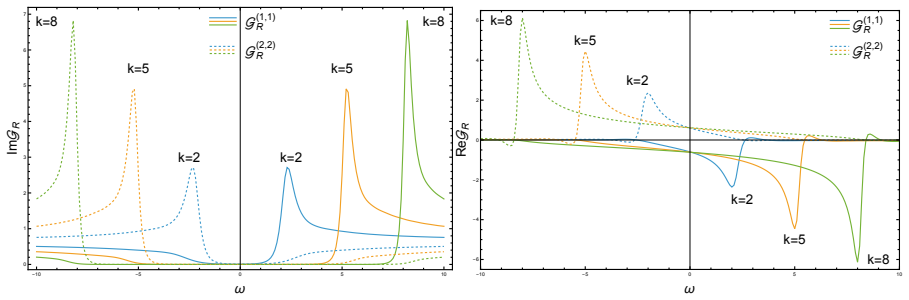
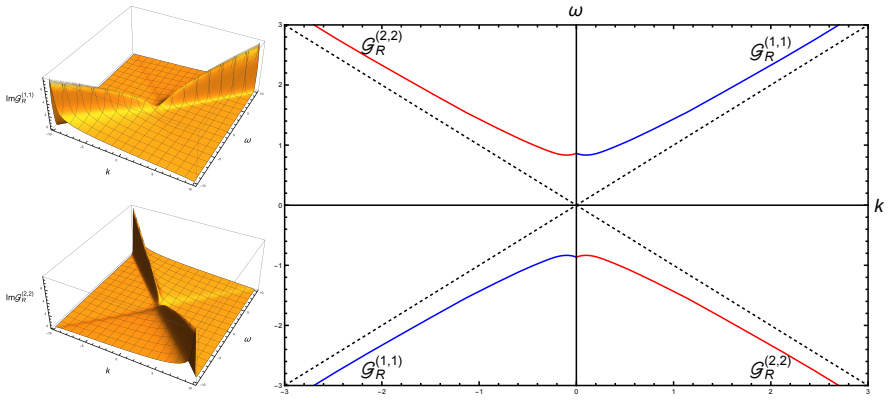
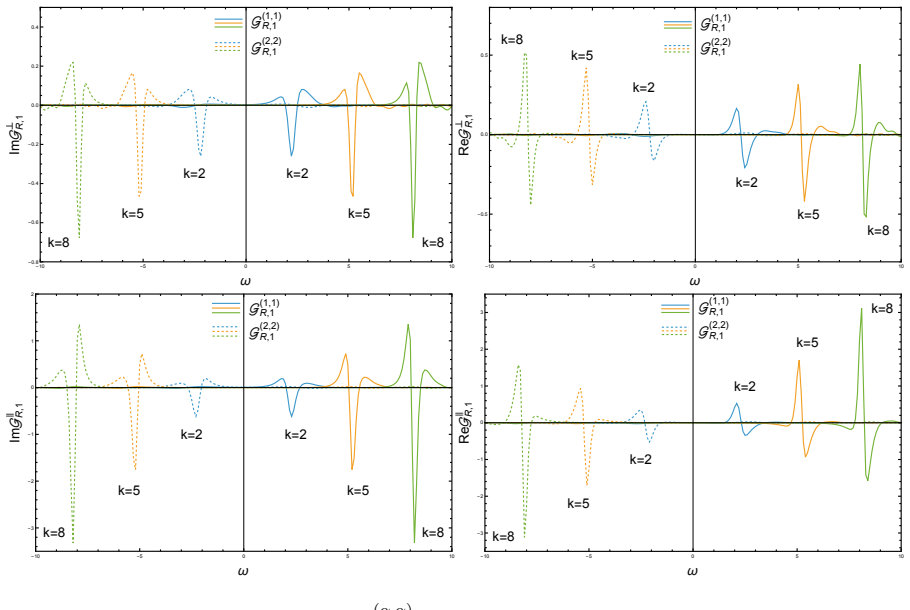
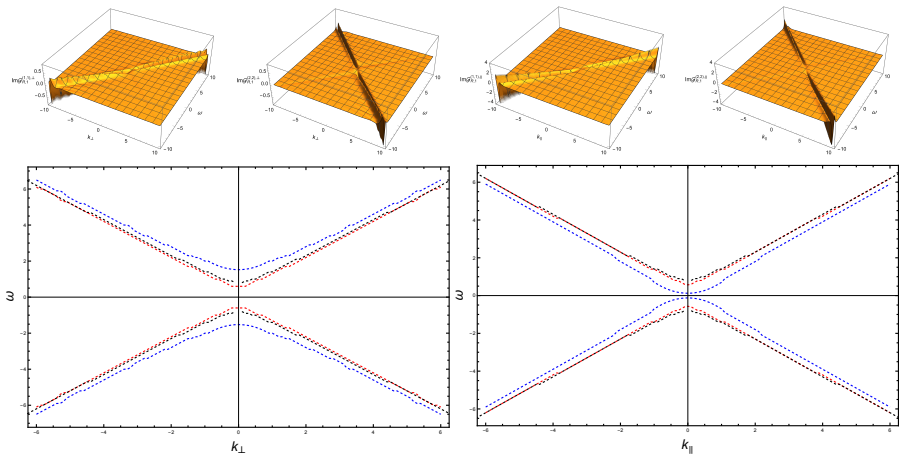
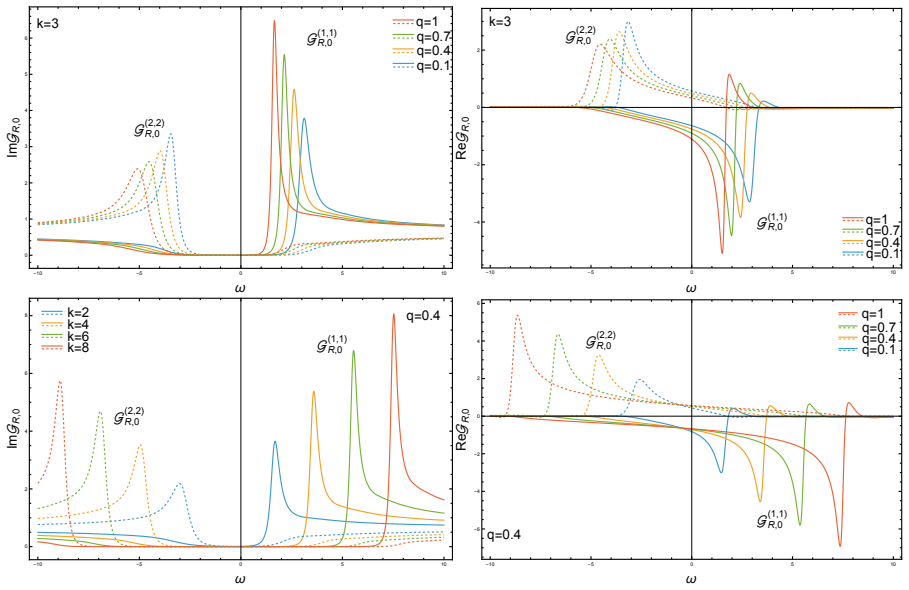
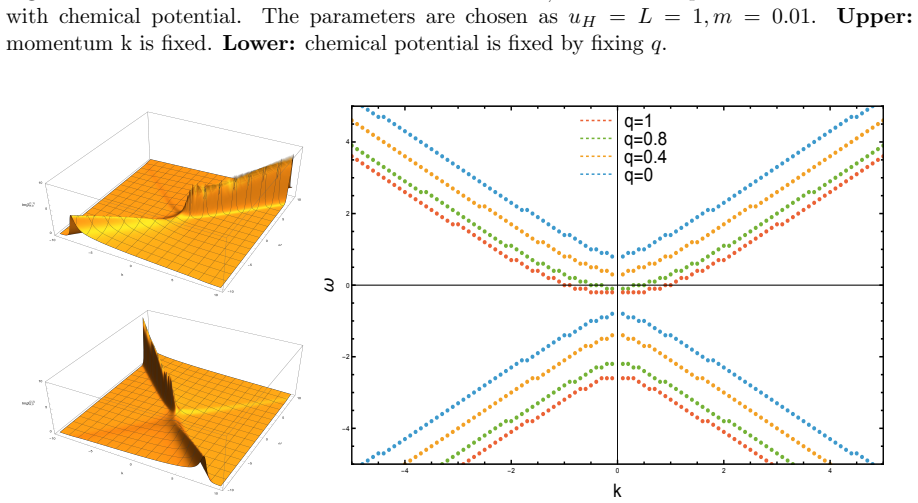
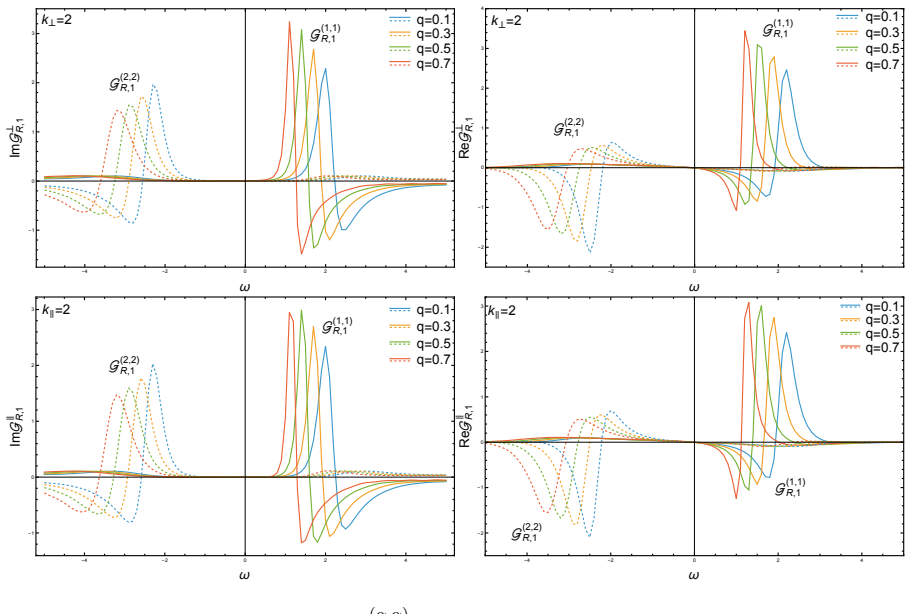
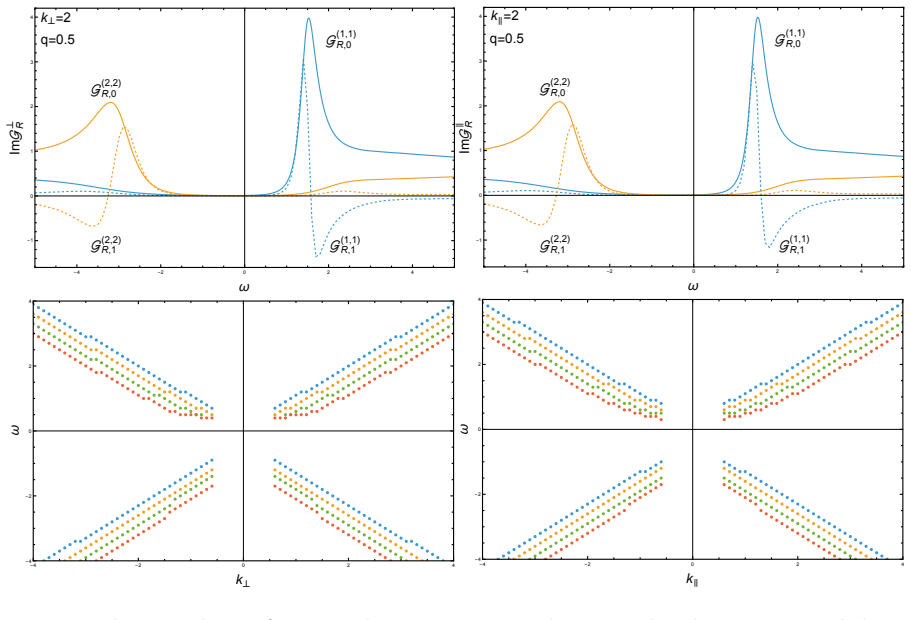
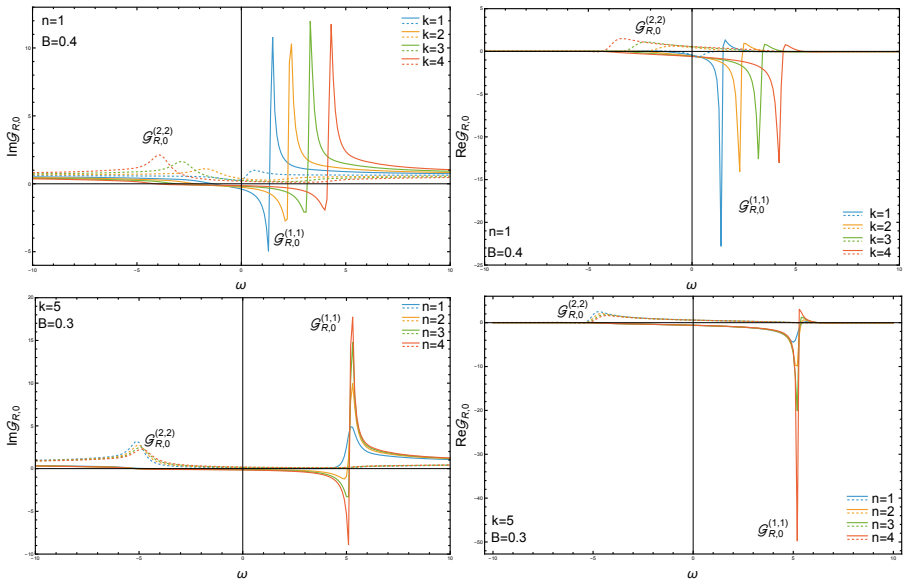
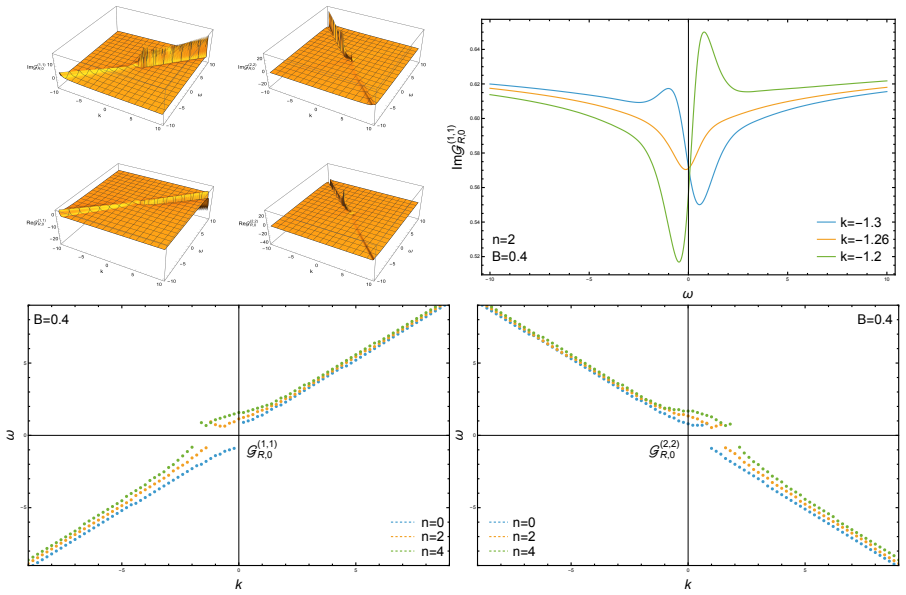
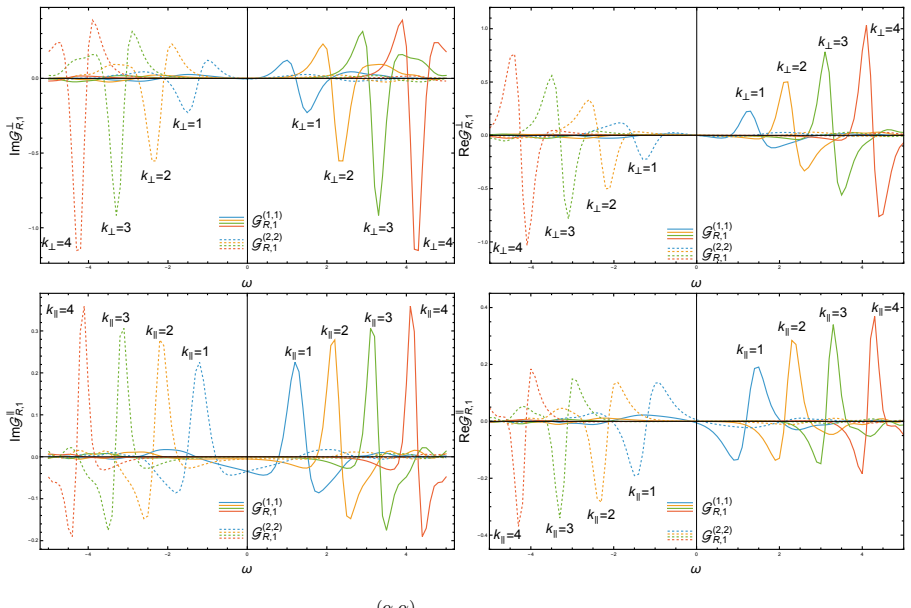
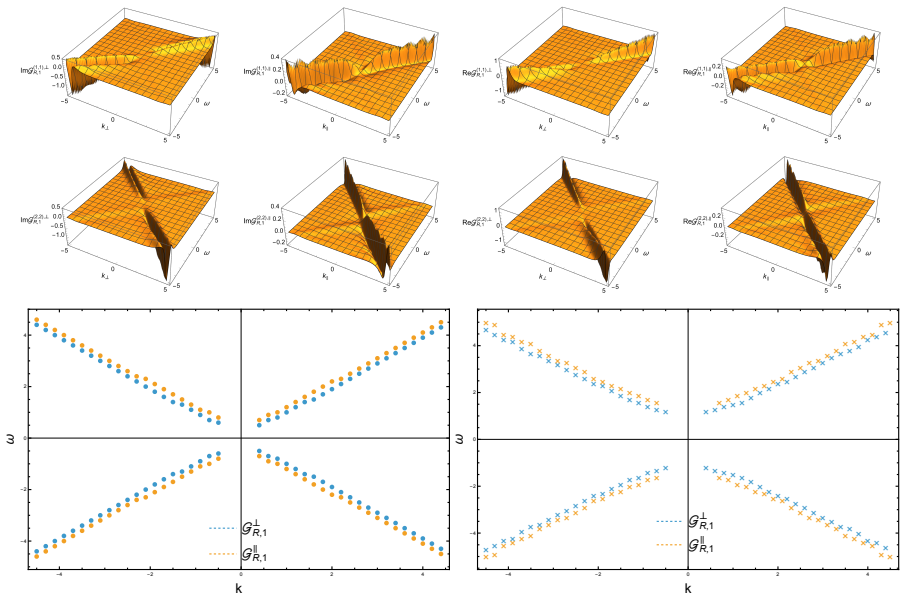
By generalizing the prescription for the retarded Green's function to anisotropic geometries, the numerical correlation functions in axion, magnetic, and flavor anisotropic plasmas exhibit direction-dependent features, with negative dips in the imaginary part for the first two models signaling instabilities, Landau levels appearing under magnetic fields, and a pseudogap without momentum dependence in the flavor case.
What carries the argument
The generalized prescription for the retarded Green's function of a probe Dirac fermion applied to anisotropic black brane backgrounds in the three holographic models.
If this is right
- The correlation functions acquire direction-dependent corrections due to anisotropy.
- Negative dips appear in the imaginary part of the Green's function for axion and magnetic field cases, indicating vacuum instabilities.
- The magnetic field case produces Landau levels in the fermionic dispersion.
- The flavor-induced anisotropy leads to a momentum-independent pseudogap suggestive of an incoherent metallic phase.
Where Pith is reading between the lines
- Such holographic results could inform models of quark-gluon plasma in heavy-ion experiments where anisotropy arises from initial conditions.
- The pseudogap finding might connect to observations in anisotropic condensed matter systems like certain superconductors or strange metals.
- Further work could test if these features persist when including backreaction or different fermion masses.
Load-bearing premise
The standard holographic prescription for the retarded Green's function remains valid and accurate when extended to these anisotropic geometries without missing important contributions from the anisotropy.
What would settle it
A calculation showing that the imaginary part of the Green's function remains positive for the axion-induced anisotropic model, or that the pseudogap depends on momentum in the flavor model, would challenge the reported numerical results.
Figures

read the original abstract
By using the gauge-gravity duality, we study the holographic fermionic correlation functions in strongly coupled anisotropic plasmas. Starting from the isotropic black AdS background, we revisit the prescription for computing the retarded Green\textquoteright s function of a probe Dirac fermion and then generalize the formulas with respect to the anisotropic geometries. The method is applied to three distinct holographic models that capture different physical origins of anisotropy: axion-induced, magnetic-field-induced and unquenched-flavor-induced. Numerical results for the holographic correlation functions reveal direction-dependent corrections, negative dips in the imaginary part signalling vacuum instabilities (axion and magnetic field), Landau levels in the fermionic dispersion (magnetic field), and a momentum-independent pseudogap indicating an incoherent metallic phase (flavors). Our results complement and go beyond the hard thermal loop approximation, providing non-perturbative insights into fermionic excitations in strongly coupled anisotropic plasmas relevant for heavy-ion collisions and certain condensed matter systems.
Editorial analysis
A structured set of objections, weighed in public.
Referee Report
Summary. The manuscript revisits the prescription for the retarded Green's function of a probe Dirac fermion in isotropic black AdS and generalizes the formulas to anisotropic geometries. It applies the method to three holographic models with different physical origins of anisotropy (axion-induced, magnetic-field-induced, and unquenched-flavor-induced). Numerical results are reported for direction-dependent corrections to the correlation functions, negative dips in the imaginary part interpreted as signaling vacuum instabilities, Landau levels in the fermionic dispersion, and a momentum-independent pseudogap.
Significance. If the results hold, the work provides non-perturbative insights into fermionic excitations in strongly coupled anisotropic plasmas that complement the hard thermal loop approximation, with relevance to heavy-ion collisions and certain condensed matter systems. A positive aspect is that the central outputs are obtained via direct numerical evaluation from the bulk geometries rather than being defined by construction in terms of fitted parameters.
minor comments (2)
- [the section on the prescription for the retarded Green's function] The section revisiting and generalizing the prescription for the retarded Green's function would benefit from a more explicit statement of the modified boundary conditions for the spinors and a verification that the isotropic limit is recovered without additional assumptions; this is a presentation issue but affects clarity of the numerical results that follow.
- The abstract and introduction could specify the range of anisotropy parameters explored in the numerics and the criteria used to distinguish physical signals (e.g., negative dips) from possible numerical artifacts.
Simulated Author's Rebuttal
We thank the referee for the positive assessment of our work and for the recommendation of minor revision. The referee's summary accurately reflects the scope and results of the manuscript. No specific major comments were raised in the report.
Circularity Check
No significant circularity
full rationale
The paper presents a direct numerical extension of the standard holographic prescription for retarded Green's functions from isotropic AdS black branes to three anisotropic geometries (axion, magnetic field, flavors). The central outputs are computed spectral functions and dispersion relations extracted from the bulk Dirac equation solutions; no fitted parameters are redefined as predictions, no self-citation chain supplies a uniqueness theorem or ansatz that forces the results, and the reported features (Landau levels, pseudogap, instabilities) arise as numerical consequences of the geometries rather than by construction from the inputs. The derivation chain is therefore self-contained against external benchmarks.
Axiom & Free-Parameter Ledger
axioms (1)
- domain assumption Gauge-gravity duality applies to the fermionic sector in these anisotropic black brane geometries
Reference graph
Works this paper leans on
-
[1]
Large N field theories, string theory and gravity,
O. Aharony, S. S. Gubser, J. M. Maldacena, H. Ooguri, and Y. Oz, “Large N field theories, string theory and gravity,”Phys. Rept.323(2000) 183–386,arXiv:hep-th/9905111
Pith/arXiv arXiv 2000
-
[2]
The LargeNlimit of superconformal field theories and supergravity,
J. M. Maldacena, “The LargeNlimit of superconformal field theories and supergravity,” Adv. Theor. Math. Phys.2(1998) 231–252,arXiv:hep-th/9711200
Pith/arXiv arXiv 1998
-
[3]
Anti de Sitter space and holography,
E. Witten, “Anti de Sitter space and holography,”Adv. Theor. Math. Phys.2(1998) 253–291,arXiv:hep-th/9802150
Pith/arXiv arXiv 1998
-
[4]
Why does the quark gluon plasma at RHIC behave as a nearly ideal fluid?,
E. Shuryak, “Why does the quark gluon plasma at RHIC behave as a nearly ideal fluid?,” Prog. Part. Nucl. Phys.53(2004) 273–303,arXiv:hep-ph/0312227
Pith/arXiv arXiv 2004
-
[5]
What RHIC experiments and theory tell us about properties of quark-gluon plasma?,
E. V. Shuryak, “What RHIC experiments and theory tell us about properties of quark-gluon plasma?,”Nucl. Phys. A750(2005) 64–83,arXiv:hep-ph/0405066
Pith/arXiv arXiv 2005
-
[6]
W. Florkowski and R. Ryblewski, “Highly-anisotropic and strongly-dissipative hydrodynamics for early stages of relativistic heavy-ion collisions,”Phys. Rev. C83 (2011) 034907,arXiv:1007.0130 [nucl-th]
Pith/arXiv arXiv 2011
-
[7]
Dissipative Dynamics of Highly Anisotropic Systems,
M. Martinez and M. Strickland, “Dissipative Dynamics of Highly Anisotropic Systems,” Nucl. Phys. A848(2010) 183–197,arXiv:1007.0889 [nucl-th]
Pith/arXiv arXiv 2010
-
[8]
Non-boost-invariant anisotropic dynamics,
M. Martinez and M. Strickland, “Non-boost-invariant anisotropic dynamics,”Nucl. Phys. A856(2011) 68–87,arXiv:1011.3056 [nucl-th]
Pith/arXiv arXiv 2011
-
[9]
Non-boost-invariant motion of dissipative and highly anisotropic fluid,
R. Ryblewski and W. Florkowski, “Non-boost-invariant motion of dissipative and highly anisotropic fluid,”J. Phys. G38(2011) 015104,arXiv:1007.4662 [nucl-th]
Pith/arXiv arXiv 2011
-
[11]
Phase transitions of an anisotropic N=4 super Yang-Mills plasma via holography,
E. Banks, “Phase transitions of an anisotropic N=4 super Yang-Mills plasma via holography,”JHEP07(2016) 085,arXiv:1604.03552 [hep-th]
Pith/arXiv arXiv 2016
-
[12]
Strongly-coupled anisotropic gauge theories and holography,
D. Giataganas, U. G¨ ursoy, and J. F. Pedraza, “Strongly-coupled anisotropic gauge theories and holography,”Phys. Rev. Lett.121no. 12, (2018) 121601,arXiv:1708.05691 [hep-th]
Pith/arXiv arXiv 2018
-
[13]
Thermal Field Theory,
M. L. Bellac, “Thermal Field Theory,”Cambridge University Press(2000)
2000
-
[14]
Finite-Temperature Field Theory: Principles and Applications,
J. Kapusta and C. Gale, “Finite-Temperature Field Theory: Principles and Applications,” Cambridge University Press(2006) . 34
2006
-
[15]
M. Harada and Y. Nemoto, “Quasi-fermion spectrum at finite temperature from coupled Schwinger-Dyson equations for a fermion-boson system,”Phys. Rev. D78(2008) 014004, arXiv:0803.3257 [hep-ph]
Pith/arXiv arXiv 2008
-
[16]
Vanishing Thermal Mass in the Strongly Coupled QCD/QED medium,
H. Nakkagawa, H. Yokota, and K. Yoshida, “Vanishing Thermal Mass in the Strongly Coupled QCD/QED medium,”Phys. Rev. D85(2012) 031902,arXiv:1111.0117 [hep-ph]
Pith/arXiv arXiv 2012
-
[17]
A Non-Fermi Liquid from a Charged Black Hole: A Critical Fermi Ball,
S.-S. Lee, “A Non-Fermi Liquid from a Charged Black Hole: A Critical Fermi Ball,”Phys. Rev. D79(2009) 086006,arXiv:0809.3402 [hep-th]
Pith/arXiv arXiv 2009
-
[18]
Non-Fermi liquids from holography,
H. Liu, J. McGreevy, and D. Vegh, “Non-Fermi liquids from holography,”Phys. Rev. D 83(2011) 065029,arXiv:0903.2477 [hep-th]
Pith/arXiv arXiv 2011
-
[19]
Real-time response in AdS/CFT with application to spinors,
N. Iqbal and H. Liu, “Real-time response in AdS/CFT with application to spinors,” Fortsch. Phys.57(2009) 367–384,arXiv:0903.2596 [hep-th]
Pith/arXiv arXiv 2009
-
[20]
Correlation function of flavored fermion in holographic QCD,
S.-w. Li, Y.-p. Zhang, and H.-q. Li, “Correlation function of flavored fermion in holographic QCD,”Phys. Rev. D109no. 8, (2024) 086020,arXiv:2307.13357 [hep-th]
arXiv 2024
-
[21]
Holographic spectroscopy of fermion with instantons,
S.-w. Li, Y.-p. Zhang, and H.-q. Li, “Holographic spectroscopy of fermion with instantons,”Eur. Phys. J. C85no. 8, (2025) 830,arXiv:2406.11557 [hep-th]
arXiv 2025
-
[22]
Worldvolume fermions as baryons in holographic quantum chromodynamics with instantons,
S.-w. Li, H.-q. Li, and Y.-p. Zhang, “Worldvolume fermions as baryons in holographic quantum chromodynamics with instantons,”Commun. Theor. Phys.77no. 1, (2025) 015203,arXiv:2402.01197 [hep-th]
arXiv 2025
-
[23]
Worldvolume fermion as baryon with homogeneous instantons in holographic QCD3,
S.-w. Li and X.-t. Zhang, “Worldvolume fermion as baryon with homogeneous instantons in holographic QCD3,”Phys. Rev. D112no. 2, (2025) 026001,arXiv:2503.24173 [hep-th]
arXiv 2025
-
[24]
Spin polarization of holographic baryon in strongly coupled fluid,
S.-w. Li and S. Lin, “Spin polarization of holographic baryon in strongly coupled fluid,” Phys. Rev. D112no. 7, (2025) 074009,arXiv:2505.21883 [hep-th]
arXiv 2025
-
[25]
Holographic Non-Fermi Liquid in a Background Magnetic Field,
P. Basu, J. He, A. Mukherjee, and H.-H. Shieh, “Holographic Non-Fermi Liquid in a Background Magnetic Field,”Phys. Rev. D82(2010) 044036,arXiv:0908.1436 [hep-th]
Pith/arXiv arXiv 2010
-
[26]
Anisotropic Fermi surface from holography,
L. Q. Fang, X.-H. Ge, J.-P. Wu, and H.-Q. Leng, “Anisotropic Fermi surface from holography,”Phys. Rev. D91no. 12, (2015) 126009,arXiv:1409.6062 [hep-th]
Pith/arXiv arXiv 2015
-
[27]
Low-energy hadronic physics in holographic QCD 3 with anisotropy,
S.-w. Li, “Low-energy hadronic physics in holographic QCD 3 with anisotropy,” arXiv:2604.24046 [hep-th]. 35
-
[28]
The anisotropic N=4 super Yang-Mills plasma and its instabilities,
D. Mateos and D. Trancanelli, “The anisotropic N=4 super Yang-Mills plasma and its instabilities,”Phys. Rev. Lett.107(2011) 101601,arXiv:1105.3472 [hep-th]
Pith/arXiv arXiv 2011
-
[29]
Thermodynamics of anisotropic branes,
D. ´Avila, D. Fern´ andez, L. Pati˜ no, and D. Trancanelli, “Thermodynamics of anisotropic branes,”JHEP11(2016) 132,arXiv:1609.02167 [hep-th]
Pith/arXiv arXiv 2016
-
[30]
Thermodynamics and Instabilities of a Strongly Coupled Anisotropic Plasma,
D. Mateos and D. Trancanelli, “Thermodynamics and Instabilities of a Strongly Coupled Anisotropic Plasma,”JHEP07(2011) 054,arXiv:1106.1637 [hep-th]
Pith/arXiv arXiv 2011
-
[31]
Anisotropic plasma at finiteU(1) chemical potential,
L. Cheng, X.-H. Ge, and S.-J. Sin, “Anisotropic plasma at finiteU(1) chemical potential,” JHEP07(2014) 083,arXiv:1404.5027 [hep-th]
Pith/arXiv arXiv 2014
-
[32]
Anisotropic plasma with a chemical potential and scheme-independent instabilities,
L. Cheng, X.-H. Ge, and S.-J. Sin, “Anisotropic plasma with a chemical potential and scheme-independent instabilities,”Phys. Lett. B734(2014) 116–121,arXiv:1404.1994 [hep-th]
Pith/arXiv arXiv 2014
-
[33]
Charged Magnetic Brane Solutions in AdS (5) and the fate of the third law of thermodynamics,
E. D’Hoker and P. Kraus, “Charged Magnetic Brane Solutions in AdS (5) and the fate of the third law of thermodynamics,”JHEP03(2010) 095,arXiv:0911.4518 [hep-th]
Pith/arXiv arXiv 2010
-
[34]
Magnetic Brane Solutions in AdS,
E. D’Hoker and P. Kraus, “Magnetic Brane Solutions in AdS,”JHEP10(2009) 088, arXiv:0908.3875 [hep-th]
Pith/arXiv arXiv 2009
-
[35]
No inverse magnetic catalysis in the QCD hard and soft wall models,
D. Dudal, D. R. Granado, and T. G. Mertens, “No inverse magnetic catalysis in the QCD hard and soft wall models,”Phys. Rev. D93no. 12, (2016) 125004,arXiv:1511.04042 [hep-th]
Pith/arXiv arXiv 2016
-
[36]
Holographic spin alignment of J/ψ meson in magnetized plasma,
Y.-Q. Zhao, X.-L. Sheng, S.-W. Li, and D. Hou, “Holographic spin alignment of J/ψ meson in magnetized plasma,”JHEP08(2024) 070,arXiv:2403.07468 [hep-ph]
arXiv 2024
-
[37]
Anisotropic D3-D5 black holes with unquenched flavors,
J. M. Penin, A. V. Ramallo, and D. Zoakos, “Anisotropic D3-D5 black holes with unquenched flavors,”JHEP02(2018) 139,arXiv:1710.00548 [hep-th]
Pith/arXiv arXiv 2018
-
[38]
Flavored anisotropic black holes,
A. Garbayo, C. Hoyos, N. Jokela, J. M. Pen´ ın, and A. V. Ramallo, “Flavored anisotropic black holes,”JHEP10(2022) 061,arXiv:2208.04958 [hep-th]
arXiv 2022
-
[39]
Holographic spontaneous anisotropy,
C. Hoyos, N. Jokela, J. M. Pen´ ın, and A. V. Ramallo, “Holographic spontaneous anisotropy,”JHEP04(2020) 062,arXiv:2001.08218 [hep-th]
arXiv 2020
-
[40]
Spectrum of Elementary Fermi Excitations in Quark Gluon Plasma. (In Russian),
V. V. Klimov, “Spectrum of Elementary Fermi Excitations in Quark Gluon Plasma. (In Russian),”Sov. J. Nucl. Phys.33(1981) 934–935
1981
-
[41]
Hard Thermal Loop—Theory and applications,
N. Haque and M. G. Mustafa, “Hard Thermal Loop—Theory and applications,”Prog. Part. Nucl. Phys.140(2025) 104136,arXiv:2404.08734 [hep-ph]. 36
arXiv 2025
-
[42]
Self-energy of Strongly Interacting Fermions in Medium: a Holographic Approach,
Y. Seo, S.-J. Sin, and Y. Zhou, “Self-energy of Strongly Interacting Fermions in Medium: a Holographic Approach,”Phys. Lett. B723(2013) 207–212,arXiv:1205.3377 [hep-th]
Pith/arXiv arXiv 2013
-
[43]
Thermal Mass and Plasmino for Strongly Interacting Fermions,
Y. Seo, S.-J. Sin, and Y. Zhou, “Thermal Mass and Plasmino for Strongly Interacting Fermions,”JHEP06(2013) 076,arXiv:1305.1446 [hep-th]
Pith/arXiv arXiv 2013
-
[44]
Holographic QCD 3 and Chern-Simons theory from anisotropic supergravity,
S.-w. Li, S.-k. Luo, and Y.-q. Hu, “Holographic QCD 3 and Chern-Simons theory from anisotropic supergravity,”JHEP06(2022) 040,arXiv:2203.14489 [hep-th]
arXiv 2022
-
[45]
T. Sch¨ afer and E. V. Shuryak, “Instantons in QCD,”Rev. Mod. Phys.70(1998) 323–426, arXiv:hep-ph/9610451
Pith/arXiv arXiv 1998
-
[46]
QCD and Instantons at Finite Temperature,
D. J. Gross, R. D. Pisarski, and L. G. Yaffe, “QCD and Instantons at Finite Temperature,”Rev. Mod. Phys.53(1981) 43
1981
-
[47]
Theta dependence of SU(N) gauge theories in the presence of a topological term,
E. Vicari and H. Panagopoulos, “Theta dependence of SU(N) gauge theories in the presence of a topological term,”Phys. Rept.470(2009) 93–150,arXiv:0803.1593 [hep-th]
Pith/arXiv arXiv 2009
-
[48]
Quantum Chromodynamics:Perturbative and Nonperturbative Aspects,
B. L. Ioffe, “Quantum Chromodynamics:Perturbative and Nonperturbative Aspects,” Cambridge University Press(2010)
2010
-
[49]
Instantons and Large N,
M. Marino, “Instantons and Large N,”Cambridge University Press(2015)
2015
-
[50]
The QCD Vacuum, Hadrons and Superdense Matter,
E. V. Shuryak, “The QCD Vacuum, Hadrons and Superdense Matter,”World Scientific (2004)
2004
-
[51]
Phase diagram of QCD in a magnetic field: A review,
J. O. Andersen, W. R. Naylor, and A. Tranberg, “Phase diagram of QCD in a magnetic field: A review,”Rev. Mod. Phys.88(2016) 025001,arXiv:1411.7176 [hep-ph]
Pith/arXiv arXiv 2016
-
[52]
Chiral magnetic and vortical effects in high-energy nuclear collisions—A status report,
D. E. Kharzeev, J. Liao, S. A. Voloshin, and G. Wang, “Chiral magnetic and vortical effects in high-energy nuclear collisions—A status report,”Prog. Part. Nucl. Phys.88 (2016) 1–28,arXiv:1511.04050 [hep-ph]
Pith/arXiv arXiv 2016
-
[53]
Real-time dynamics of the Chiral Magnetic Effect,
K. Fukushima, D. E. Kharzeev, and H. J. Warringa, “Real-time dynamics of the Chiral Magnetic Effect,”Phys. Rev. Lett.104(2010) 212001,arXiv:1002.2495 [hep-ph]
Pith/arXiv arXiv 2010
-
[54]
Particle production in strong electromagnetic fields in relativistic heavy-ion collisions,
K. Tuchin, “Particle production in strong electromagnetic fields in relativistic heavy-ion collisions,”Adv. High Energy Phys.2013(2013) 490495,arXiv:1301.0099 [hep-ph]
Pith/arXiv arXiv 2013
-
[55]
Pair Production at Strong Coupling in Weak External Fields,
I. K. Affleck, O. Alvarez, and N. S. Manton, “Pair Production at Strong Coupling in Weak External Fields,”Nucl. Phys. B197(1982) 509–519. 37
1982
-
[56]
On gauge invariance and vacuum polarization,
J. S. Schwinger, “On gauge invariance and vacuum polarization,”Phys. Rev.82(1951) 664–679
1951
-
[57]
Interaction-driven localization in holography,
A. Donos and S. A. Hartnoll, “Interaction-driven localization in holography,”Nature Phys.9(2013) 649–655,arXiv:1212.2998 [hep-th]
Pith/arXiv arXiv 2013
-
[58]
Theory of universal incoherent metallic transport,
S. A. Hartnoll, “Theory of universal incoherent metallic transport,”Nature Phys.11 (2015) 54,arXiv:1405.3651 [cond-mat.str-el]
Pith/arXiv arXiv 2015
-
[59]
Momentum dissipation and effective theories of coherent and incoherent transport,
R. A. Davison and B. Gout´ eraux, “Momentum dissipation and effective theories of coherent and incoherent transport,”JHEP01(2015) 039,arXiv:1411.1062 [hep-th]
Pith/arXiv arXiv 2015
-
[60]
Spatial Modulation and Conductivities in Effective Holographic Theories,
M. Rangamani, M. Rozali, and D. Smyth, “Spatial Modulation and Conductivities in Effective Holographic Theories,”JHEP07(2015) 024,arXiv:1505.05171 [hep-th]
Pith/arXiv arXiv 2015
-
[61]
Melting of generalized Wigner crystals in transition metal dichalcogenide heterobilayer Moir ˜A©systems,
M. Matty and E. Kim, “Melting of generalized Wigner crystals in transition metal dichalcogenide heterobilayer Moir ˜A©systems,”Nature Commun.13no. 7098, (2022) 7
2022
-
[62]
B. Spivak and S. Kivelson, “Intermediate phases of the two dimensional electron fluid between the fermi liquid and the wigner crystal,” 2004. https://arxiv.org/abs/cond-mat/0310712
Pith/arXiv arXiv 2004
-
[63]
Electronic liquid crystalline phases in a spin-orbit coupled two-dimensional electron gas,
E. Berg, M. S. Rudner, and S. A. Kivelson, “Electronic liquid crystalline phases in a spin-orbit coupled two-dimensional electron gas,”Physical Review B85no. 3, (Jan.,
-
[64]
http://dx.doi.org/10.1103/PhysRevB.85.035116. 38
discussion (0)
Sign in with ORCID, Apple, or X to comment. Anyone can read and Pith papers without signing in.