Valence-change-driven reduction of antiphase boundaries in spinel ferrite epitaxial films
Pith reviewed 2026-06-25 20:46 UTC · model grok-4.3
The pith
Post-oxidation annealing in oxygen plasma reduces antiphase boundary density in spinel ferrite films and thins the magnetic dead layer.
A machine-rendered reading of the paper's core claim, the machinery that carries it, and where it could break.
Core claim
Post-oxidation proceeds through a topotactic solid-state reaction in which Fe^{2.5+} ions are oxidized to Fe^{3+}, accompanied by cation rearrangement across APBs, thereby reducing APB density without degrading crystallinity and leading to improved magnetic properties in spinel ferrite epitaxial films.
What carries the argument
The topotactic solid-state reaction driven by valence change of iron ions, which enables cation rearrangement across antiphase boundaries.
If this is right
- Larger antiphase domains produce thinner magnetic dead layers near the substrate interface.
- Saturation magnetization rises and the magnetic hysteresis squareness ratio improves.
- The spinel crystal structure and epitaxial strain stay intact throughout the process.
- The valence-driven cation rearrangement across boundaries provides the mechanism for density reduction.
Where Pith is reading between the lines
- The same plasma step might lower defect densities in other spinel compositions or on different substrates.
- Interface engineering via controlled oxidation could extend to spintronic or sensor devices that rely on clean magnetic interfaces.
- If the rearrangement works at higher temperatures or different gas pressures, the method could be adapted for thicker films or patterned structures.
Load-bearing premise
The assumption that the observed reduction in magnetic dead layer thickness results specifically from the increase in antiphase domain size rather than other changes induced by the plasma annealing.
What would settle it
A measurement showing reduced magnetic dead layer thickness with no increase in antiphase domain size, or increased domain size with no change in dead layer thickness, would challenge the proposed causal link.
Figures
read the original abstract
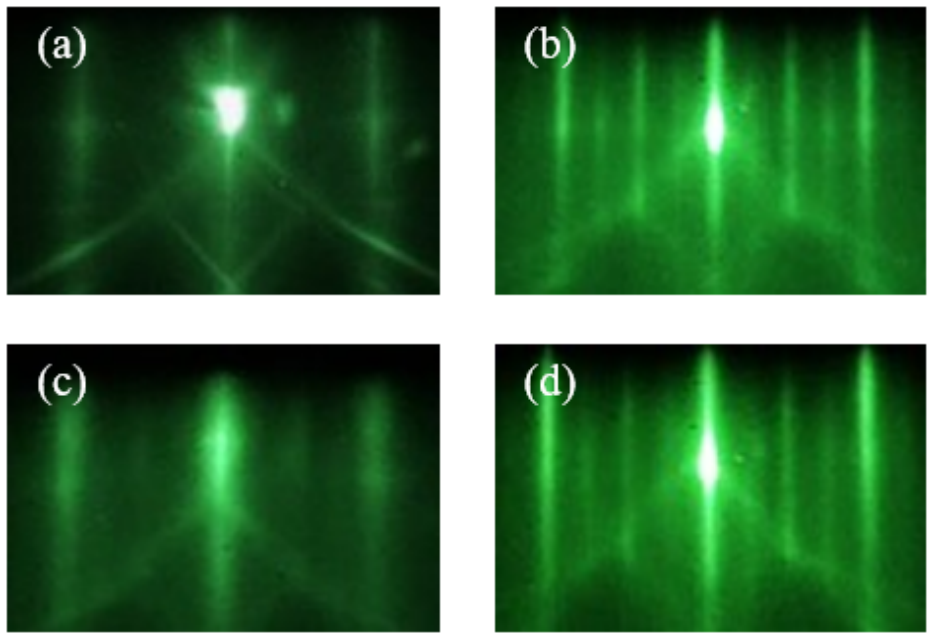
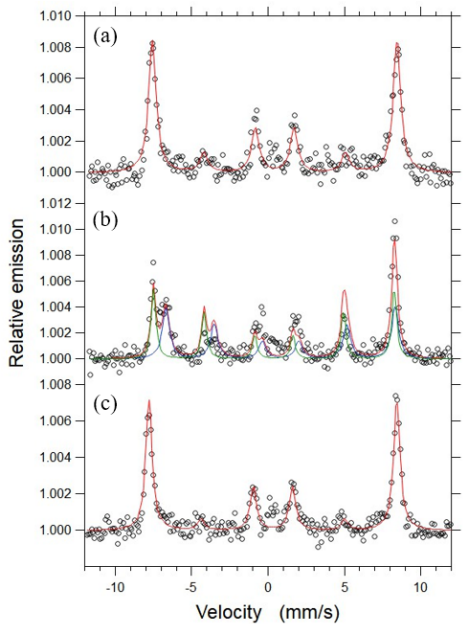
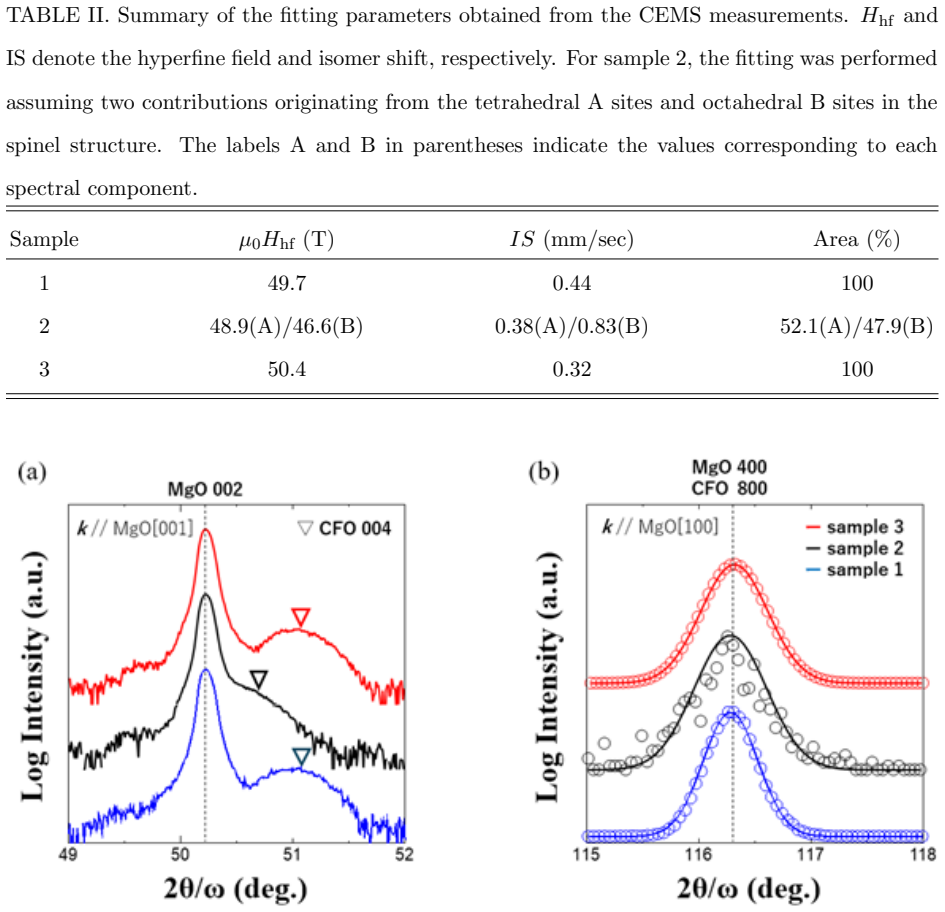
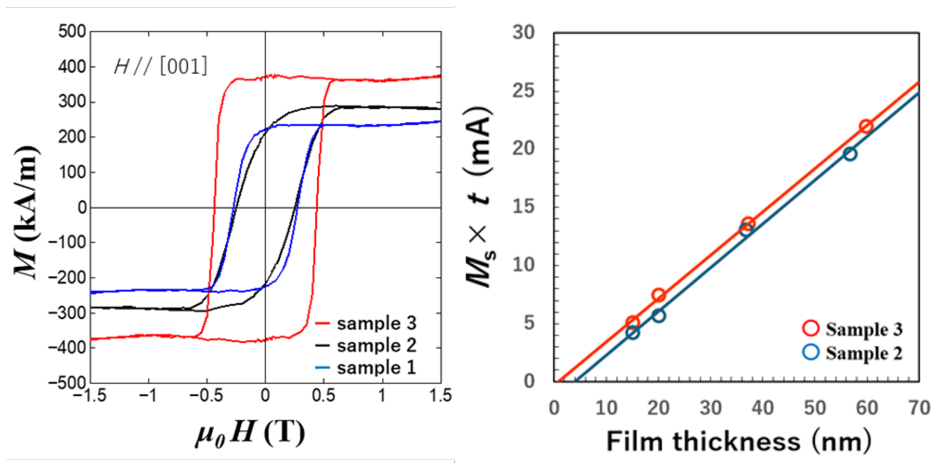
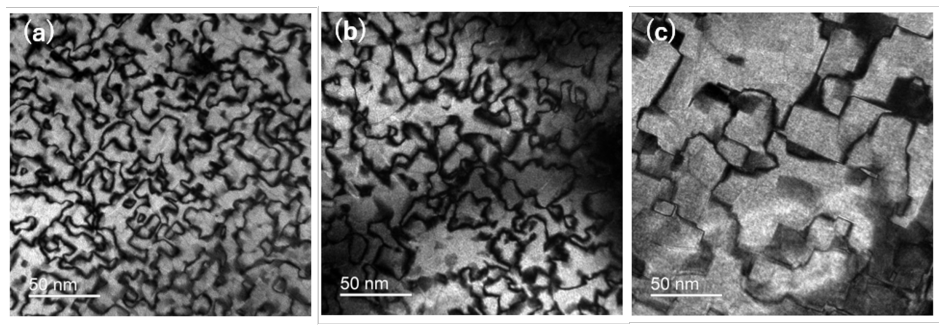
Antiphase boundaries (APBs) formed in thin films sometimes cause severe degradation of their physical properties. In particular, a high density of APBs in spinel ferrite films generates a non-negligible magnetic dead layer near the interface. In this study, we examined the effect of post-oxidation annealing in an oxygen plasma atmosphere on Co$_{0.125}$Fe$_{2.875}$O$_4$(001) thin films grown on MgO(001) as a model system. The thickness of the magnetic dead layer was found to be significantly reduced after post-oxidation, resulting in an increase in the saturation magnetization and an improved squareness ratio. Dark-field transmission electron microscopy analysis revealed that the post-oxidation process increased the antiphase domain size, indicating a substantial reduction in APB density. Furthermore, reflection high-energy electron diffraction and x-ray diffraction measurements confirmed that the spinel crystal structure and epitaxial strain were preserved after post-oxidation. These results suggest that post-oxidation proceeds through a topotactic solid-state reaction in which Fe$^{2.5+}$ ions are oxidized to Fe$^{3+}$, accompanied by cation rearrangement across APBs, thereby reducing APB density without degrading crystallinity and leading to improved magnetic properties in spinel ferrite epitaxial films.
Editorial analysis
A structured set of objections, weighed in public.
Referee Report
Summary. The manuscript reports that post-oxidation annealing in an oxygen plasma on Co_{0.125}Fe_{2.875}O_4(001) epitaxial films on MgO(001) increases antiphase domain size (via dark-field TEM), reduces APB density, thins the magnetic dead layer, and improves saturation magnetization and squareness ratio while preserving spinel structure and epitaxial strain (via RHEED and XRD). The proposed mechanism is a topotactic solid-state reaction oxidizing Fe^{2.5+} to Fe^{3+} with cation rearrangement across APBs.
Significance. If the observed correlation can be shown to be causal, the work would demonstrate a practical post-growth plasma treatment for reducing APB-related magnetic degradation in spinel ferrite films without loss of crystallinity or strain. The multi-technique consistency across magnetization, TEM, RHEED, and XRD is a strength of the experimental design.
major comments (2)
- [Abstract and proposed mechanism] The central claim that APB density reduction drives the dead-layer thinning rests on temporal coincidence after plasma annealing rather than direct evidence. No quantitative correlation (dead-layer thickness vs. domain size across samples) or control experiments isolating APB density from other plasma effects (e.g., surface reconstruction or sub-percent stoichiometry shifts) are described; RHEED/XRD confirm average structure but are insensitive to local valence gradients at interfaces.
- [Magnetic and TEM characterization results] The reported improvements lack quantitative error bars, raw data presentation, or detailed exclusion criteria for sample-to-sample variation, which limits assessment of the reproducibility and magnitude of the dead-layer reduction and magnetization gains.
minor comments (2)
- The abstract and methods should specify film thickness, growth parameters, and plasma annealing conditions (temperature, duration, pressure) for full reproducibility.
- TEM dark-field images and magnetization hysteresis loops would benefit from explicit scale bars, statistical analysis of domain sizes, and indication of measurement uncertainties.
Simulated Author's Rebuttal
We thank the referee for the constructive comments. We address each major comment below, indicating planned revisions where appropriate.
read point-by-point responses
-
Referee: [Abstract and proposed mechanism] The central claim that APB density reduction drives the dead-layer thinning rests on temporal coincidence after plasma annealing rather than direct evidence. No quantitative correlation (dead-layer thickness vs. domain size across samples) or control experiments isolating APB density from other plasma effects (e.g., surface reconstruction or sub-percent stoichiometry shifts) are described; RHEED/XRD confirm average structure but are insensitive to local valence gradients at interfaces.
Authors: We acknowledge that the link between APB density reduction and dead-layer thinning is based on the observed correlation after identical plasma treatment rather than direct causal proof or quantitative cross-sample correlation. The multi-technique data (TEM domain size increase, magnetometry dead-layer reduction, and preserved average structure via RHEED/XRD) are consistent with the proposed topotactic oxidation and cation rearrangement mechanism, but we agree that local valence gradients at interfaces are not directly probed. We will revise the abstract and discussion sections to explicitly describe the evidence as correlative and to discuss possible contributions from other plasma-induced effects such as surface changes. revision: partial
-
Referee: [Magnetic and TEM characterization results] The reported improvements lack quantitative error bars, raw data presentation, or detailed exclusion criteria for sample-to-sample variation, which limits assessment of the reproducibility and magnitude of the dead-layer reduction and magnetization gains.
Authors: We agree that the magnetic results would be strengthened by error bars, raw data, and clearer description of sample handling. In the revised manuscript we will add error bars to all reported magnetization and dead-layer values, include representative raw hysteresis loops (in the main text or SI), and add a methods paragraph detailing sample selection, measurement protocols, and any exclusion criteria applied. revision: yes
Circularity Check
No significant circularity; purely experimental report with direct measurements
full rationale
The manuscript presents an experimental study of thin-film growth, post-oxidation annealing, and characterization via dark-field TEM (antiphase domain size), RHEED/XRD (structure and strain), and magnetometry (dead-layer thickness, Ms, squareness). No equations, ansatzes, fitted parameters, or derivations appear in the provided text or abstract. The central observations are temporal coincidence of APB density reduction and dead-layer thinning after plasma annealing; the suggested topotactic mechanism is offered as an interpretation of the data rather than a derived result. No self-citations are invoked as load-bearing uniqueness theorems or to smuggle ansatzes. The paper is therefore self-contained against external benchmarks and receives the default non-circularity score.
Axiom & Free-Parameter Ledger
axioms (1)
- domain assumption Standard interpretation of dark-field TEM contrast as indicating antiphase domain size in spinel films
Reference graph
Works this paper leans on
-
[1]
Suzuki, R
Y. Suzuki, R. B. van Dover, E. M. Gyorgy, J. M. Phillips, V. Korenivski, D. J. Werder, C. H. Chen, R. J. Cava, J. J. Krajewski, W. F. Peck, and K. B. Do, Applied Physics Letters68, 714–716 (1996)
1996
-
[2]
X. Y. Zheng, S. Channa, L. J. Riddiford, J. J. Wisser, K. Mahalingam, C. T. Bowers, M. E. McConney, A. T. N’Diaye, A. Vailionis, E. Cogulu, H. Ren, Z. Galazka, A. D. Kent, and Y. Suzuki, Nature Communications14, 10.1038/s41467-023-40733-9 (2023)
-
[3]
F. Wang, X. Wang, J. Zhu, H. Yang, X. Kong, and X. Liu, Scientific Reports6, 10.1038/srep37892 (2016). 11
-
[4]
M. M. El-Masry and M. M. Arman, Scientific Reports15, 10.1038/s41598-025-99604-6 (2025)
-
[5]
T. Ojima, T. Tainosho, S. Sharmin, and H. Yanagihara, AIP Advances8, 10.1063/1.5012133 (2018)
-
[6]
U. L¨ uders, M. Bibes, K. Bouzehouane, E. Jacquet, J.-P. Contour, S. Fusil, J.-F. Bobo, J. Fontcuberta, A. Barth´ el´ emy, and A. Fert, Applied Physics Letters88, 10.1063/1.2172647 (2006)
-
[7]
Uchida, J
K. Uchida, J. Xiao, H. Adachi, J. Ohe, S. Takahashi, J. Ieda, T. Ota, Y. Kajiwara, H. Umezawa, H. Kawai, G. E. W. Bauer, S. Maekawa, and E. Saitoh, Nature Materials9, 894–897 (2010)
2010
-
[8]
D. Venkateshvaran, M. Althammer, A. Nielsen, S. Gepr¨ ags, M. S. Ramachandra Rao, S. T. B. Goennenwein, M. Opel, and R. Gross, Physical Review B79, 10.1103/physrevb.79.134405 (2009)
-
[9]
W. Eerenstein, T. T. M. Palstra, T. Hibma, and S. Celotto, Physical Review B66, 10.1103/physrevb.66.201101 (2002)
-
[10]
D. T. Margulies, F. T. Parker, M. L. Rudee, F. E. Spada, J. N. Chapman, P. R. Aitchison, and A. E. Berkowitz, Physical Review Letters79, 5162–5165 (1997)
1997
-
[11]
F. C. Voogt, T. T. M. Palstra, L. Niesen, O. C. Rogojanu, M. A. James, and T. Hibma, Physical Review B57, R8107–R8110 (1998)
1998
-
[12]
Z. Li, J. Lu, L. Jin, J. Rusz, V. Kocevski, H. Yanagihara, E. Kita, J. Mayer, R. E. Dunin-Borkowski, H. Xiang, and X. Zhong, Advanced Functional Materials31, 10.1002/adfm.202008306 (2021)
-
[13]
Niizeki, Y
T. Niizeki, Y. Utsumi, R. Aoyama, H. Yanagihara, J.-i. Inoue, Y. Yamasaki, H. Nakao, K. Koike, and E. Kita, Applied Physics Letters103, 162407 (2013)
2013
-
[14]
Tainosho, J.-i
T. Tainosho, J.-i. Inoue, S. Sharmin, M. Takeguchi, E. Kita, and H. Yanagihara, Applied Physics Letters114, 092408 (2019)
2019
-
[15]
H. Onoda, H. Sukegawa, J. Inoue, and H. Yanagihara, Advanced Materials Interfaces8, 10.1002/admi.202101034 (2021)
-
[16]
Hibma, F
T. Hibma, F. C. Voogt, L. Niesen, P. A. A. van der Heijden, W. J. M. de Jonge, J. J. T. M. Donkers, and P. J. van der Zaag, Journal of Applied Physics85, 5291 (1999)
1999
-
[17]
Celotto, W
S. Celotto, W. Eerenstein, and T. Hibma, The European Physical Journal B - Condensed Matter36, 271–279 (2003). 12
2003
-
[18]
K. P. McKenna, F. Hofer, D. Gilks, V. K. Lazarov, C. Chen, Z. Wang, and Y. Ikuhara, Nature Communications5, 10.1038/ncomms6740 (2014)
-
[19]
Regmi, Z
S. Regmi, Z. Li, S. KC, R. Mahat, A. Rastogi, R. Datta, and A. Gupta, Applied Physics Letters121, 102401 (2022)
2022
-
[20]
A. Kumar, E. Wetterskog, E. Lewin, C.-W. Tai, S. Akansel, S. Husain, T. Edvinsson, R. Bru- cas, S. Chaudhary, and P. Svedlindh, Physical Review Materials2, 10.1103/physrevmateri- als.2.054407 (2018)
-
[21]
Y. Nonaka, Y. K. Wakabayashi, G. Shibata, S. Sakamoto, K. Ikeda, Z. Chi, Y. Wan, M. Suzuki, A. Tanaka, M. Tanaka, and A. Fujimori, Physical Review Materials7, 10.1103/physrevmate- rials.7.044413 (2023)
-
[22]
Gilks, L
D. Gilks, L. Lari, K. Matsuzaki, H. Hosono, T. Susaki, and V. K. Lazarov, Journal of Applied Physics115, 17C107 (2014)
2014
-
[23]
W. Eerenstein, T. T. M. Palstra, T. Hibma, and S. Celotto, Physical Review B68, 10.1103/physrevb.68.014428 (2003)
-
[24]
G¨ utlich, B
P. G¨ utlich, B. E, and A. X. Trautwein,M¨ ossbauer Spectroscopy and Transition Metal Chem- istry(Springer, Heidelberg, 2011)
2011
-
[25]
M. Morishita, T. Ichikawa, M. A. Tanaka, M. Furuta, D. Mashimo, S. Honda, J. Okabayashi, and K. Mibu, Physical Review Materials7, 10.1103/physrevmaterials.7.054402 (2023). 13
discussion (0)
Sign in with ORCID, Apple, or X to comment. Anyone can read and Pith papers without signing in.