Quantity-Dependent Bulk-to-Wall Observability of Surface Loading in Rarefied Hypersonic Flow over Triangular Protrusions
Pith reviewed 2026-06-25 20:10 UTC · model grok-4.3
The pith
Rarefied wall loads on triangular protrusions draw from bulk gas at quantity-specific distances rather than any fixed neighborhood size.
A machine-rendered reading of the paper's core claim, the machinery that carries it, and where it could break.
Core claim
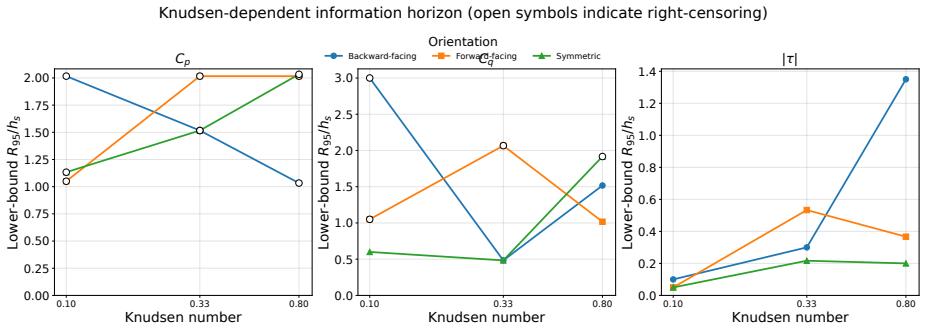
Rarefied surface loading has no single information length. Full-domain descriptors reduce errors from 45.5% to 13.8% for Cp and from 72.6% to 12.9% for Cq, whereas shear improves only from 49.1% to 31.9%. Heat transfer exhibits the clearest order-hs nonlocal support, pressure is frequently right-censored beyond 3hs, and shear saturates at shorter radii but remains least identifiable.
What carries the argument
R95, the smallest tested radius whose complete wall-profile error lies within 5% of the full-domain descriptor error, applied to circular neighborhoods summarized by weighted statistics, extrema, nearest-point values, and tangent-normal gradients.
If this is right
- Pressure loading can often be approximated from neighborhoods no larger than 3hs while heat transfer requires neighborhoods at least hs in radius.
- Shear stress remains the least predictable quantity even when the entire domain is included.
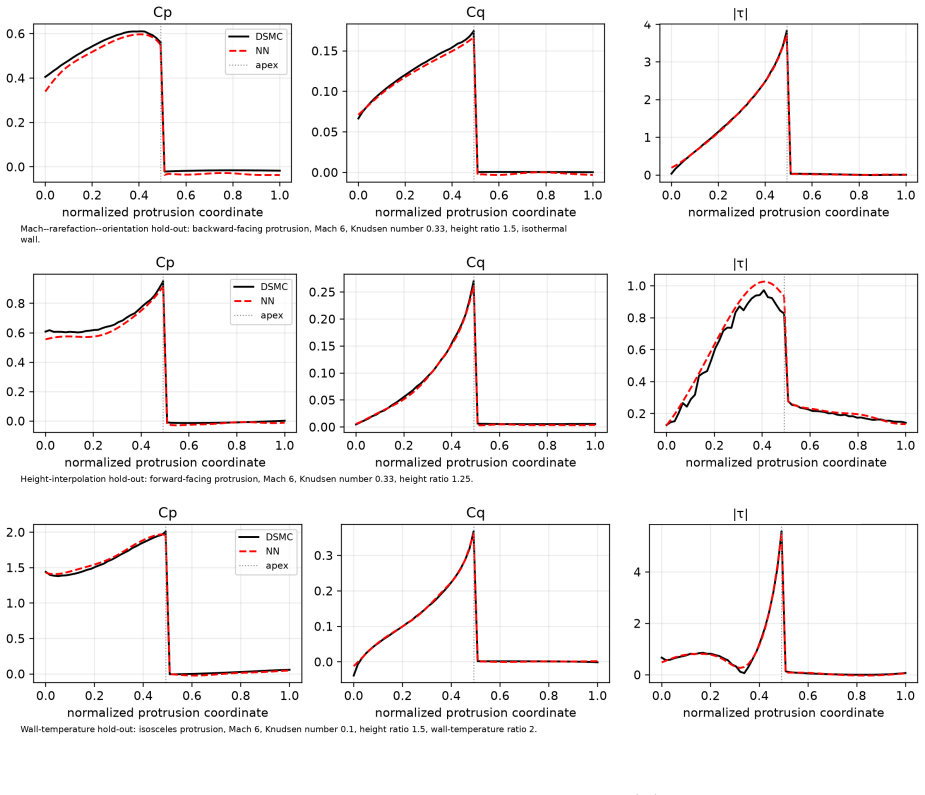
- Coordinate-conditioned surrogates preserve the same quantity-dependent hierarchy of information lengths.
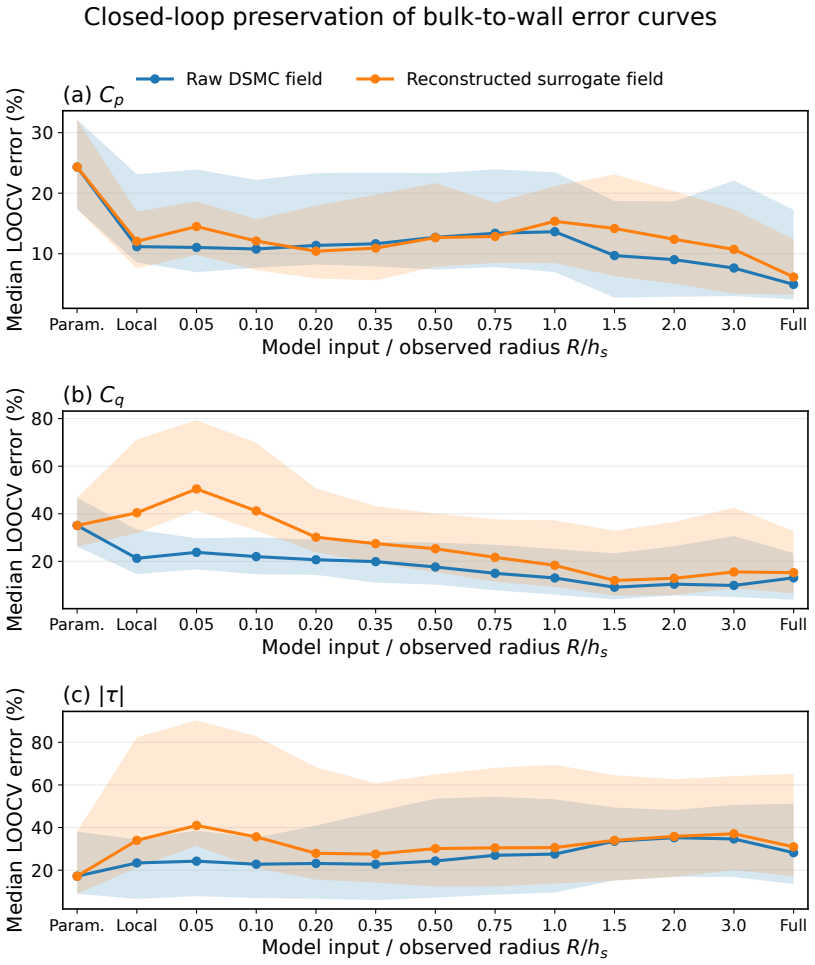
- Closed-loop audit of the surrogates shows the largest preservation loss occurs for forward-facing heat transfer and shear.
Where Pith is reading between the lines
- Modeling codes that assume a single cutoff distance for all surface quantities will under-resolve heat transfer on protrusions.
- Sensor placement strategies on hypersonic surfaces may need separate spacing rules for pressure versus heat-flux gauges.
- The observed saturation of shear error suggests that local wall gradients alone are insufficient even at short range.
Load-bearing premise
Circular neighborhoods summarized by those particular statistics and gradients of velocity, temperature, and pressure capture the relevant bulk information needed to predict wall loads.
What would settle it
Re-running the error curves with a different neighborhood shape or with an entirely different set of bulk summary statistics and checking whether the hierarchy of R95 values across Cp, Cq, and shear disappears.
Figures


read the original abstract
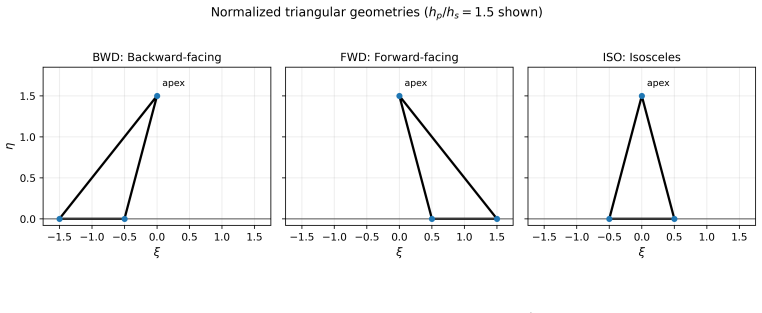
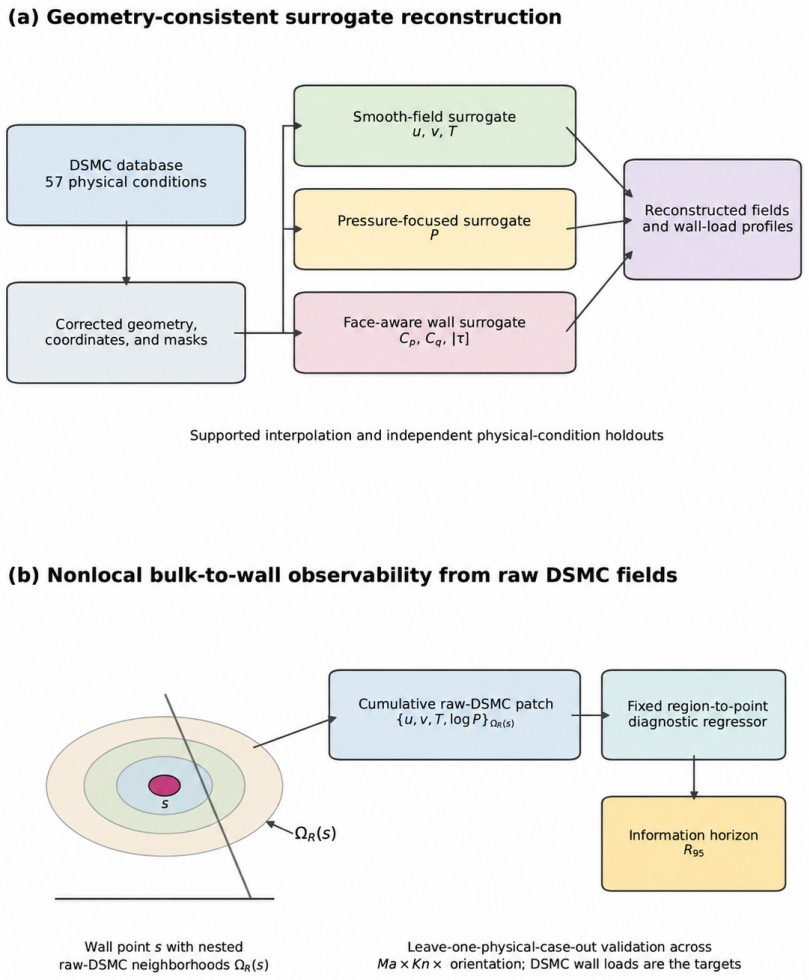
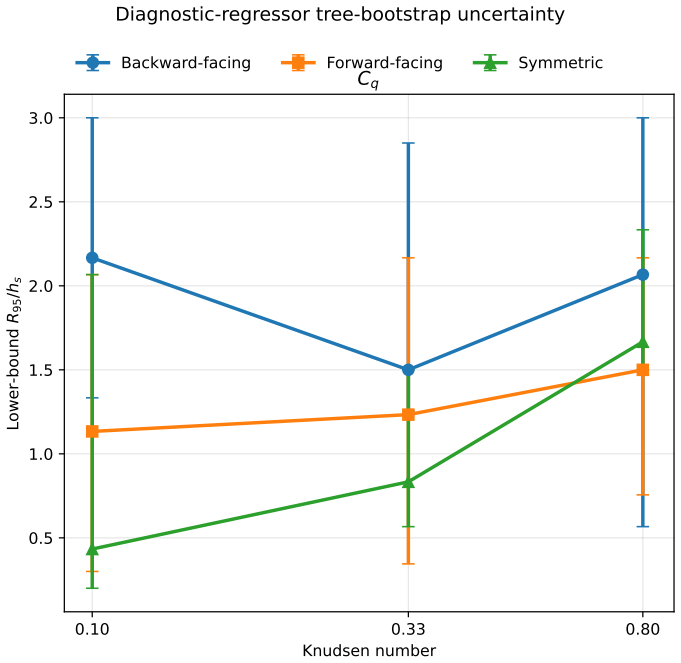
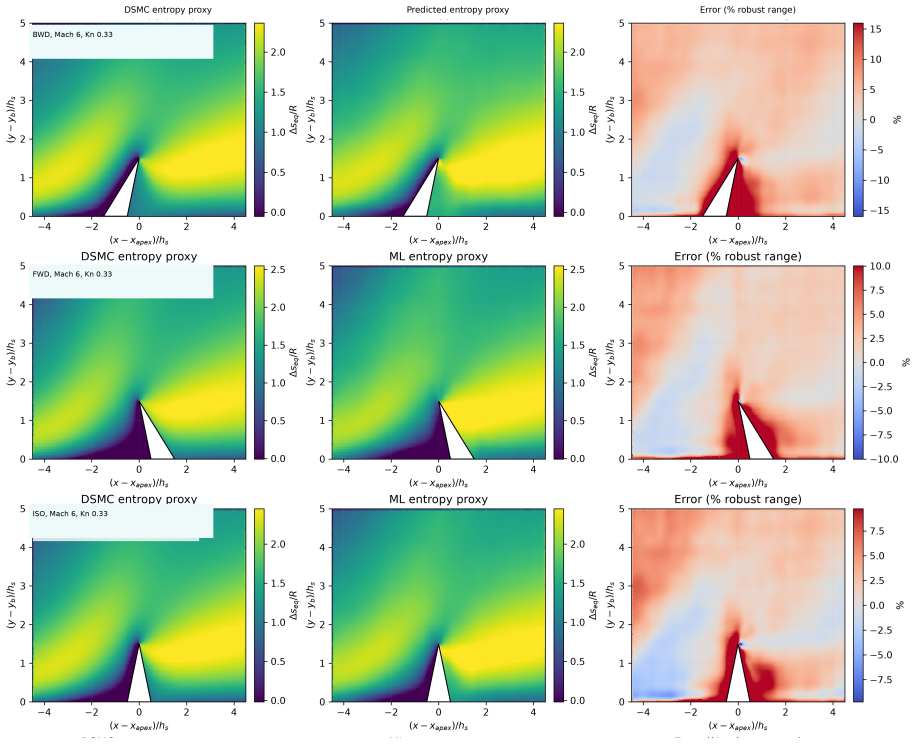
Localized protrusions on hypersonic vehicles generate pressure, heat-transfer, and shear loads whose rarefied response can depend on gas beyond the immediate wall neighborhood. This work quantifies that bulk-to-wall dependence for triangular protrusions and tests whether coordinate-conditioned surrogates preserve it. Geometry-consistent surrogates are trained for direct simulation Monte Carlo (DSMC) velocity, temperature, pressure, and wall-load profiles over Mach numbers 4--8, Knudsen numbers (Kn) 0.1--0.8, and three protrusion orientations. The central analysis is performed on raw DSMC fields. Around each wall point, circular neighborhoods of increasing radius are summarized by weighted statistics, extrema, nearest-point values, and tangent-normal gradients of velocity, temperature, and pressure. A fixed region-to-point diagnostic predicts the pressure coefficient ($C_p$), heat-transfer coefficient ($C_q$), and shear-stress magnitude ($|\tau|$). We define $R_{95}$ as the smallest tested radius whose complete wall-profile error lies within 5\% of the full-domain descriptor error. The principal physical result is that rarefied surface loading has no single information length. Full-domain descriptors reduce errors from 45.5\% to 13.8\% for $C_p$ and from 72.6\% to 12.9\% for $C_q$, whereas shear improves only from 49.1\% to 31.9\%. Heat transfer exhibits the clearest order-$h_s$ nonlocal support, where $h_s$ is the protrusion-base length. Pressure is frequently right-censored beyond $3h_s$, and shear saturates at shorter radii but remains least identifiable. Ridge-regression and threshold controls preserve this hierarchy, while a closed-loop audit shows partial surrogate preservation, with the largest degradation in forward-facing heat transfer and shear.
Editorial analysis
A structured set of objections, weighed in public.
Referee Report
Summary. The manuscript analyzes bulk-to-wall information transfer for surface loads (Cp, Cq, and shear) on triangular protrusions in rarefied hypersonic flows (Mach 4-8, Kn 0.1-0.8) using raw DSMC fields. Circular neighborhoods of increasing radius around wall points are summarized via weighted statistics, extrema, nearest-point values, and tangent-normal gradients of velocity, temperature, and pressure; these descriptors are used to predict wall loads via a fixed region-to-point diagnostic. The central result is that rarefied surface loading has no single information length, quantified by R95 (the smallest radius where wall-profile error is within 5% of full-domain error), with full-domain descriptors yielding error reductions from 45.5% to 13.8% for Cp, 72.6% to 12.9% for Cq, and 49.1% to 31.9% for shear; heat transfer shows clearest order-hs nonlocal support while shear saturates earlier.
Significance. If the result holds, the quantity-specific nonlocal support demonstrated here would be a useful constraint for constructing reduced-order models or surrogates in rarefied hypersonic aerodynamics, showing that pressure and heat transfer require longer-range bulk information than shear. The direct use of raw DSMC fields, the explicit R95 metric, and the closed-loop surrogate audit provide concrete, reproducible diagnostics that could be extended to other geometries.
major comments (1)
- [Abstract (paragraph beginning 'Around each wall point, circular neighborhoods...')] Abstract (paragraph beginning 'Around each wall point, circular neighborhoods...'): The isotropic circular neighborhoods weight all azimuths equally when summarizing velocity, temperature, and pressure fields. At Mach 4-8 the molecular velocity distribution is strongly anisotropic, with molecules incident on a wall point originating predominantly from upstream; the reported hierarchy of error reductions (larger gains for Cp/Cq than for shear) and the claim of no single information length could therefore be an artifact of mixing irrelevant downstream data into the descriptors rather than a property of the underlying physics. A directional (e.g., upstream-weighted) neighborhood test is needed to confirm that the observed R95 values and differential improvements are robust.
Simulated Author's Rebuttal
We thank the referee for the constructive comment on potential effects of flow anisotropy. We respond point-by-point below.
read point-by-point responses
-
Referee: The isotropic circular neighborhoods weight all azimuths equally when summarizing velocity, temperature, and pressure fields. At Mach 4-8 the molecular velocity distribution is strongly anisotropic, with molecules incident on a wall point originating predominantly from upstream; the reported hierarchy of error reductions (larger gains for Cp/Cq than for shear) and the claim of no single information length could therefore be an artifact of mixing irrelevant downstream data into the descriptors rather than a property of the underlying physics. A directional (e.g., upstream-weighted) neighborhood test is needed to confirm that the observed R95 values and differential improvements are robust.
Authors: The DSMC fields already incorporate the strong upstream bias of the molecular velocity distribution at Mach 4-8. Circular neighborhoods aggregate weighted statistics, extrema, and gradients over these inherently anisotropic fields without presupposing isotropy or a preferred direction; this choice identifies the minimal radius R95 while remaining geometry- and orientation-agnostic. The observed quantity-specific hierarchy (heat transfer requiring longest support, shear saturating earliest) is consistent with the distinct moments of the distribution function that govern each load. We agree that an explicit upstream-weighted test would provide additional confirmation. In revision we will add a supplementary directional-neighborhood analysis on representative cases to verify robustness of the R95 values and error reductions. revision: partial
Circularity Check
No circularity: empirical error analysis on raw DSMC fields
full rationale
The paper's central result—that rarefied surface loading has no single information length—is obtained by directly computing weighted statistics, extrema, nearest-point values, and gradients from raw DSMC velocity/temperature/pressure fields inside circular neighborhoods of increasing radius, then measuring prediction error for Cp, Cq, and |τ| against the actual DSMC wall loads. R95 is defined as the radius at which the wall-profile error reaches within 5% of the full-domain error; this reduction is measured, not fitted by construction. No self-definitional steps, no fitted parameters renamed as predictions, and no load-bearing self-citations appear in the derivation. The analysis remains self-contained against the external DSMC benchmark.
Axiom & Free-Parameter Ledger
axioms (1)
- domain assumption DSMC simulations accurately represent the rarefied gas dynamics for the stated Mach and Knudsen ranges
Reference graph
Works this paper leans on
-
[1]
Schneider, S. P., ``Summary of hypersonic boundary-layer transition experiments on blunt bodies with roughness", Journal of Spacecraft and Rockets, 45, 1090--1105 (2008). doi:10.2514/1.37431 https://doi.org/10.2514/1.37431
-
[2]
Berry, S. A., Horvath, T. J., ``Discrete-roughness transition for hypersonic flight vehicles", Journal of Spacecraft and Rockets, 45, 216--227 (2008). doi:10.2514/1.30970 https://doi.org/10.2514/1.30970
-
[3]
Grotowsky, I. M. G., Ballmann, J., ``Numerical investigation of hypersonic step-flows", Shock Waves, 10, 57--72 (2000). doi:10.1007/s001930050179 https://doi.org/10.1007/s001930050179
-
[4]
Estruch, D., MacManus, D. G., Stollery, J. L., Lawson, N. J., Garry, K. P., ``Hypersonic interference heating in the vicinity of surface protuberances", Experiments in Fluids, 49, 683--699 (2010). doi:10.1007/s00348-010-0844-x https://doi.org/10.1007/s00348-010-0844-x
-
[5]
Chang, C.-L., Choudhari, M., Li, F., ``Numerical computations of hypersonic boundary-layer over surface irregularities" in 48th AIAA Aerospace Sciences Meeting, pp. AIAA 2010-1572 (2010). doi:10.2514/6.2010-1572 https://doi.org/10.2514/6.2010-1572
-
[6]
doi:10.1080/19942060.2012.11015424 https://doi.org/10.1080/19942060.2012.11015424
Qamar, A., Sanghi, S., ``Aerodynamics characteristic of axisymmetric surface protuberance in supersonic regime", Engineering Applications of Computational Fluid Mechanics, 6, 316--335 (2012). doi:10.1080/19942060.2012.11015424 https://doi.org/10.1080/19942060.2012.11015424
-
[7]
De Tullio, N., Paredes, P., Sandham, N. D., Theofilis, V., ``Laminar-turbulent transition induced by a discrete roughness element in a supersonic boundary layer", Journal of Fluid Mechanics, 735, 613--646 (2013). doi:10.1017/jfm.2013.520 https://doi.org/10.1017/jfm.2013.520
-
[8]
Hahn, P. V., Frendi, A., ``Interaction of three-dimensional protuberances with a supersonic turbulent boundary layer", AIAA Journal, 51, 1657--1666 (2013). doi:10.2514/1.J052101 https://doi.org/10.2514/1.J052101
-
[9]
Kumar, C. S., Reddy, K. P. J., ``Experimental investigation of heat fluxes in the vicinity of protuberances on a flat plate at hypersonic speeds", Journal of Heat Transfer, 135, 121701 (2013). doi:10.1115/1.4024667 https://doi.org/10.1115/1.4024667
-
[10]
Kumar, C. S., Reddy, K. P. J., ``Hypersonic interference heating on cones with short three-dimensional protuberances", Experimental Thermal and Fluid Science, 55, 29--41 (2014). doi:10.1016/j.expthermflusci.2014.02.013 https://doi.org/10.1016/j.expthermflusci.2014.02.013
-
[11]
Avallone, F., Schrijer, F. F. J., Cardone, G., ``Infrared thermography of transition due to isolated roughness elements in hypersonic flows", Physics of Fluids, 28, 024106 (2016). doi:10.1063/1.4941527 https://doi.org/10.1063/1.4941527
-
[12]
doi:10.1016/j.compfluid.2017.08.006 https://doi.org/10.1016/j.compfluid.2017.08.006
Duan, Z., Xiao, Z., ``Hypersonic transition induced by three isolated roughness elements on a flat plate", Computers and Fluids, 157, 1--13 (2017). doi:10.1016/j.compfluid.2017.08.006 https://doi.org/10.1016/j.compfluid.2017.08.006
-
[13]
doi:10.1017/jfm.2018.706 https://doi.org/10.1017/jfm.2018.706
Di Giovanni, A., Stemmer, C., ``Cross-flow-type breakdown induced by distributed roughness in the boundary layer of a hypersonic capsule configuration", Journal of Fluid Mechanics, 856, 470--503 (2018). doi:10.1017/jfm.2018.706 https://doi.org/10.1017/jfm.2018.706
-
[14]
Akshay, N., Nagaraja, S. R., ``Analysis of hypersonic flow over pin protrusions on a blunt body" in Recent Advances in Sustainable Technologies, pp. 293--302 (2021). doi:10.1007/978-981-16-0976-3\_28 https://doi.org/10.1007/978-981-16-0976-3_28
-
[15]
Blanco-Casares, A., Jacobs, G. B., ``Wall roughness effects on the supersonic flow over a circular cylinder", Shock Waves, 32, 643--663 (2022). doi:10.1007/s00193-022-01098-y https://doi.org/10.1007/s00193-022-01098-y
-
[16]
doi:10.2514/1.A35319 https://doi.org/10.2514/1.A35319
Tsutsui, F., Takagi, Y., Takimoto, H., Kitamura, K., Nonaka, S., ``Side force characteristics of slender-bodied supersonic vehicle with two protuberances", Journal of Spacecraft and Rockets, 59, 1697--1712 (2022). doi:10.2514/1.A35319 https://doi.org/10.2514/1.A35319
-
[17]
Chandrakumar, V. C. M., Nagaraja, S. R., ``Study of effect of protrusions on cones in hypersonic flow" in Recent Developments in Mechanics and Design, pp. 235--242 (2023). doi:10.1007/978-981-19-4140-5\_20 https://doi.org/10.1007/978-981-19-4140-5_20
-
[18]
doi:10.1063/5.0137902 https://doi.org/10.1063/5.0137902
Haley, C., Zhong, X., ``Roughness effect on hypersonic second mode instability and transition on a cone", Physics of Fluids, 35, 014108 (2023). doi:10.1063/5.0137902 https://doi.org/10.1063/5.0137902
-
[19]
doi:10.2514/1.A35908 https://doi.org/10.2514/1.A35908
Leopardi, M., Paciorri, R., Assonitis, A., Neri, A., Barbagallo, D., ``Effects of protuberances on surface loads on the Vega-C launch vehicle", Journal of Spacecraft and Rockets (2024). doi:10.2514/1.A35908 https://doi.org/10.2514/1.A35908
-
[20]
Pullin, D. I., Harvey, J. K., ``Direct simulation calculations of the rarefied flow past a forward-facing step", AIAA Journal, 15, 124--126 (1977). doi:10.2514/3.7310 https://doi.org/10.2514/3.7310
-
[21]
Leite, P. H. M., Santos, W. F. N., ``Computational analysis of a rarefied hypersonic flow over combined gap/step geometries", Advances in Aerospace Sciences, 7, 369--394 (2015). doi:10.1051/eucass/201507369 https://doi.org/10.1051/eucass/201507369
-
[22]
Nabapure, D., Murthy, R. C., ``DSMC simulation of rarefied gas flow over a wall mounted cube" in ASME Fluids Engineering Division Summer Meeting (2019). doi:10.1115/AJKFluids2019-5447 https://doi.org/10.1115/AJKFluids2019-5447
-
[23]
doi:10.1088/1757-899X/887/1/012015 https://doi.org/10.1088/1757-899X/887/1/012015
Wang, L., Fang, S., ``Effect of obstacle's length-to-height ratio on aerodynamic quantities of rarefied hypersonic flow", IOP Conference Series: Materials Science and Engineering, 887, 012015 (2020). doi:10.1088/1757-899X/887/1/012015 https://doi.org/10.1088/1757-899X/887/1/012015
-
[24]
Nabapure, D., Murthy, R. C., ``DSMC investigation of rarefied gas flow over a 2D forward-facing step: Effect of Knudsen number", Acta Astronautica, 178, 89--109 (2021). doi:10.1016/j.actaastro.2020.08.030 https://doi.org/10.1016/j.actaastro.2020.08.030
-
[25]
doi:10.1017/jfm.2020.73 https://doi.org/10.1017/jfm.2020.73
Manela, A., Gibelli, L., ``Free-molecular and near-free-molecular gas flows over backward facing steps", Journal of Fluid Mechanics, 889, A22 (2020). doi:10.1017/jfm.2020.73 https://doi.org/10.1017/jfm.2020.73
-
[26]
doi:10.1016/j.vacuum.2018.06.026 https://doi.org/10.1016/j.vacuum.2018.06.026
Gavasane, A., Agrawal, A., Bhandarkar, U., ``Study of rarefied gas flows in backward facing micro-step using direct simulation Monte Carlo", Vacuum, 155, 249--259 (2018). doi:10.1016/j.vacuum.2018.06.026 https://doi.org/10.1016/j.vacuum.2018.06.026
-
[27]
doi:10.1063/5.0090538 https://doi.org/10.1063/5.0090538
Mahdavi, Amirmehran, Roohi, Ehsan, ``A study on micro-step flow using a hybrid direct simulation Monte Carlo-Fokker-Planck approach", Physics of Fluids, 34, 062007 (2022). doi:10.1063/5.0090538 https://doi.org/10.1063/5.0090538
-
[28]
doi:10.1016/j.applthermaleng.2025.126763 https://doi.org/10.1016/j.applthermaleng.2025.126763
Sabouri, Moslem, Lekzian, Elyas, ``Thermal and flow effects of corner rounding in rarefied hypersonic step flows", Applied Thermal Engineering, 274, 126763 (2025). doi:10.1016/j.applthermaleng.2025.126763 https://doi.org/10.1016/j.applthermaleng.2025.126763
-
[29]
doi:10.1007/s10494-026-00741-3 https://doi.org/10.1007/s10494-026-00741-3
Sabouri, Moslem, Lekzian, Elyas, ``Study of Triangle-shaped Protrusions Exposed to High-speed Flow in Rarefied Regime", Flow, Turbulence and Combustion, 116, 47 (2026). doi:10.1007/s10494-026-00741-3 https://doi.org/10.1007/s10494-026-00741-3
-
[30]
doi:10.1017/9781139683494 https://doi.org/10.1017/9781139683494
Boyd, Iain D., Schwartzentruber, Thomas E., Nonequilibrium Gas Dynamics and Molecular Simulation, Cambridge University Press (2017). doi:10.1017/9781139683494 https://doi.org/10.1017/9781139683494
-
[31]
doi:10.1063/1.5099042 https://doi.org/10.1063/1.5099042
Stefanov, Stefan K., ``On the basic concepts of the direct simulation Monte Carlo method", Physics of Fluids, 31, 067104 (2019). doi:10.1063/1.5099042 https://doi.org/10.1063/1.5099042
-
[32]
Plimpton, S. J., Moore, S. G., Borner, A., Stagg, A. K., Koehler, T. P., Torczynski, J. R., Gallis, M. A., ``Direct simulation Monte Carlo on petaflop supercomputers and beyond", Physics of Fluids, 31, 086101 (2019). doi:10.1063/1.5108534 https://doi.org/10.1063/1.5108534
-
[33]
doi:10.2514/3.49461 https://doi.org/10.2514/3.49461
Becker, M., Robben, F., Cattolica, R., ``Velocity distribution functions near the leading edge of a flat plate", AIAA Journal, 12, 1247--1253 (1974). doi:10.2514/3.49461 https://doi.org/10.2514/3.49461
-
[34]
doi:10.1016/j.compfluid.2011.04.019 https://doi.org/10.1016/j.compfluid.2011.04.019
Sun, Z.-X., Tang, Z., He, Y.-L., Tao, W.-Q., ``Proper cell dimension and number of particles per cell for DSMC", Computers and Fluids, 50, 1--9 (2011). doi:10.1016/j.compfluid.2011.04.019 https://doi.org/10.1016/j.compfluid.2011.04.019
-
[35]
doi:10.1016/j.compfluid.2019.03.007 https://doi.org/10.1016/j.compfluid.2019.03.007
Shamseddine, M., Lakkis, I., ``A novel spatio-temporally adaptive parallel three-dimensional DSMC solver for unsteady rarefied micro/nano gas flows", Computers and Fluids, 186, 1--14 (2019). doi:10.1016/j.compfluid.2019.03.007 https://doi.org/10.1016/j.compfluid.2019.03.007
-
[36]
doi:10.1088/1402-4896/ad5a46 https://doi.org/10.1088/1402-4896/ad5a46
Sabouri, Moslem, Zakeri, R., Ebrahimi, A., ``Improving computational efficiency in DSMC simulations of vacuum gas dynamics with a fixed number of particles per cell", Physica Scripta, 99, 085213 (2024). doi:10.1088/1402-4896/ad5a46 https://doi.org/10.1088/1402-4896/ad5a46
-
[37]
Raissi, M., Perdikaris, P., Karniadakis, G. E., ``Physics-informed neural networks: A deep learning framework for solving forward and inverse problems involving nonlinear partial differential equations", Journal of Computational Physics, 378, 686--707 (2019). doi:10.1016/j.jcp.2018.10.045 https://doi.org/10.1016/j.jcp.2018.10.045
-
[38]
Kevrekidis, Lu Lu, Paris Perdikaris, Sifan Wang, and Liu Yang
Karniadakis, G. E., Kevrekidis, I. G., Lu, L., Perdikaris, P., Wang, S., Yang, L., ``Physics-informed machine learning", Nature Reviews Physics, 3, 422--440 (2021). doi:10.1038/s42254-021-00314-5 https://doi.org/10.1038/s42254-021-00314-5
-
[39]
Mosaic: A Benchmark Suite for Differentiable Physics Solvers — Rehmann et al., 2026 13
Lu, Lu, Jin, Pengzhan, Pang, Guofei, Zhang, Zhongqiang, Karniadakis, George Em, ``Learning nonlinear operators via DeepONet based on the universal approximation theorem of operators", Nature Machine Intelligence, 3, 218--229 (2021). doi:10.1038/s42256-021-00302-5 https://doi.org/10.1038/s42256-021-00302-5
-
[40]
doi:10.1103/PhysRevFluids.5.104401 https://doi.org/10.1103/PhysRevFluids.5.104401
Maulik, Romit, Fukami, Kai, Ramachandra, Nesar, Fukagata, Koji, Taira, Kunihiko, ``Probabilistic neural networks for fluid flow surrogate modeling and data recovery", Physical Review Fluids, 5, 104401 (2020). doi:10.1103/PhysRevFluids.5.104401 https://doi.org/10.1103/PhysRevFluids.5.104401
-
[41]
doi:10.1016/j.physd.2022.133454 https://doi.org/10.1016/j.physd.2022.133454
Morimoto, Masaki, Fukami, Kai, Maulik, Romit, Vinuesa, Ricardo, Fukagata, Koji, ``Assessments of epistemic uncertainty using Gaussian stochastic weight averaging for fluid-flow regression", Physica D, 440, 133454 (2022). doi:10.1016/j.physd.2022.133454 https://doi.org/10.1016/j.physd.2022.133454
-
[42]
doi:10.1016/j.jcp.2025.114432 https://doi.org/10.1016/j.jcp.2025.114432
Peyvan, Ahmad, Kumar, Varun, Karniadakis, George Em, ``Fusion-DeepONet: a data-efficient neural operator for geometry-dependent hypersonic and supersonic flows", Journal of Computational Physics, 544, 114432 (2026). doi:10.1016/j.jcp.2025.114432 https://doi.org/10.1016/j.jcp.2025.114432
-
[43]
doi:10.1007/s10404-026-02899-8 https://doi.org/10.1007/s10404-026-02899-8
Roohi, Ehsan, Mahdavi, Amirmehran, ``Analysis of the rarefied flow at micro-step using a DeepONet surrogate model with a physics-guided zonal loss function", Microfluidics and Nanofluidics, 30, 44 (2026). doi:10.1007/s10404-026-02899-8 https://doi.org/10.1007/s10404-026-02899-8
-
[44]
Z. Luo, L. Wang, J. Xu, M. Chen, J. Yuan, and A. C. C. Tan, ``Flow reconstruction from sparse sensors based on reduced-order autoencoder state estimation,'' Physics of Fluids 35, 077107 (2023). doi:10.1063/5.0155039 https://doi.org/10.1063/5.0155039
-
[45]
M. Y. Hosseini and Y. Shiri, ``Flow field reconstruction from sparse sensor measurements with physics-informed neural networks,'' Physics of Fluids 36, 073606 (2024). doi:10.1063/5.0211680 https://doi.org/10.1063/5.0211680
-
[46]
K. Fukami, R. Maulik, N. Ramachandra, K. Fukagata, and K. Taira, ``Global field reconstruction from sparse sensors with Voronoi tessellation-assisted deep learning,'' Nature Machine Intelligence 3, 945--951 (2021). doi:10.1038/s42256-021-00402-2 https://doi.org/10.1038/s42256-021-00402-2
-
[47]
J. E. Santos, Z. R. Fox, A. Mohan, D. O'Malley, H. Viswanathan, and N. Lubbers, ``Development of the Senseiver for efficient field reconstruction from sparse observations,'' Nature Machine Intelligence 5, 1317--1325 (2023). doi:10.1038/s42256-023-00746-x https://doi.org/10.1038/s42256-023-00746-x
-
[48]
X. Zhao, X. Chen, Z. Gong, W. Zhou, W. Yao, and Y. Zhang, ``RecFNO: A resolution-invariant flow and heat field reconstruction method from sparse observations via Fourier neural operator,'' International Journal of Thermal Sciences 195, 108619 (2024). doi:10.1016/j.ijthermalsci.2023.108619 https://doi.org/10.1016/j.ijthermalsci.2023.108619
-
[49]
J. P. Williams, O. Zahn, and J. N. Kutz, ``Sensing with shallow recurrent decoder networks,'' Proceedings of the Royal Society A 480, 20240054 (2024). doi:10.1098/rspa.2024.0054 https://doi.org/10.1098/rspa.2024.0054
-
[50]
X. Kong, Q. Fan, J. Li, and W. He, ``Reconstructing flow field from sparse sensor data: A deep learning framework combining autoencoder and cross-attention mechanism,'' Physics of Fluids 37, 097119 (2025). doi:10.1063/5.0289122 https://doi.org/10.1063/5.0289122
-
[51]
X. Wang, Z. Li, Y. Zhang, H. Wen, and B. Wang, ``Observation-guided generative flow field reconstruction of rotating detonation combustor,'' Physics of Fluids 37, 116110 (2025). doi:10.1063/5.0300394 https://doi.org/10.1063/5.0300394
-
[52]
Y.-Q. Zhang, J.-Z. Peng, Z.-Q. Wang, W.-J. Yuan, Y.-B. Li, Z.-F. Zhou, H.-R. Xie, and W.-T. Wu, ``High-fidelity flow-field reconstruction from sparse sensors using a hybrid graph neural network-transformer architecture,'' Physics of Fluids 38, 023610 (2026). doi:10.1063/5.0307325 https://doi.org/10.1063/5.0307325
-
[53]
K. Manohar, B. W. Brunton, J. N. Kutz, and S. L. Brunton, ``Data-driven sparse sensor placement for reconstruction: Demonstrating the benefits of exploiting known patterns,'' IEEE Control Systems Magazine 38, 63--86 (2018). doi:10.1109/MCS.2018.2810460 https://doi.org/10.1109/MCS.2018.2810460
-
[54]
N. B. Erichson, L. Mathelin, Z. Yao, S. L. Brunton, M. W. Mahoney, and J. N. Kutz, ``Shallow neural networks for fluid flow reconstruction with limited sensors,'' Proceedings of the Royal Society A 476, 20200097 (2020). doi:10.1098/rspa.2020.0097 https://doi.org/10.1098/rspa.2020.0097
-
[55]
Y. Liang, C. Hou, G. Y. Cornejo Maceda, A. Ianiro, S. Discetti, A. Meil\'an-Vila, D. Sornette, S. C. Lera, J. Chen, X. He, and B. R. Noack, ``Sensor optimization for urban wind estimation with a cluster-based probabilistic framework,'' Physics of Fluids 38, 045131 (2026). doi:10.1063/5.0303585 https://doi.org/10.1063/5.0303585
-
[56]
X. Li, B. Hu, and L. Wu, ``A non-localized spatial--temporal constitutive relation in rarefied gas dynamics,'' Physics of Fluids 36, 102018 (2024). doi:10.1063/5.0228567 https://doi.org/10.1063/5.0228567
-
[57]
P. Geurts, D. Ernst, and L. Wehenkel, ``Extremely randomized trees,'' Machine Learning 63, 3--42 (2006). doi:10.1007/s10994-006-6226-1 https://doi.org/10.1007/s10994-006-6226-1
-
[58]
B. Efron, ``Bootstrap methods: Another look at the jackknife,'' The Annals of Statistics 7, 1--26 (1979). doi:10.1214/aos/1176344552 https://doi.org/10.1214/aos/1176344552
discussion (0)
Sign in with ORCID, Apple, or X to comment. Anyone can read and Pith papers without signing in.