Implementation and Extension of the Variance-Reduced BGK Method in PICLas
Pith reviewed 2026-06-25 20:16 UTC · model grok-4.3
The pith
The variance-reduced BGK scheme extended in PICLas reproduces standard BGK results exactly while handling low-signal flows efficiently.
A machine-rendered reading of the paper's core claim, the machinery that carries it, and where it could break.
Core claim
The variance-reduced BGK-DSMC scheme, once equipped with the modified estimators and collision operators, produces results in exact agreement with standard BGK simulations and efficiently resolves low-signal phenomena such as thermal transpiration in microchannels, as verified through 1D, 2D, and axisymmetric test cases inside the PICLas framework.
What carries the argument
Variance-reduced BGK-DSMC scheme with modified flow estimators and collision operators that support Shakhov and Ellipsoidal Statistical models, adaptive equilibria, variable weights, and axisymmetry.
If this is right
- VRBGK and standard BGK simulations agree exactly on all tested cases.
- The method resolves thermal transpiration in a microchannel at far lower cost than conventional particle schemes.
- Axisymmetry and variable particle weights extend the scheme to problems with rotational symmetry and spatially varying resolution needs.
- Shakhov and Ellipsoidal Statistical collision models are available inside the variance-reduced framework without loss of the noise-reduction property.
Where Pith is reading between the lines
- The same estimator modifications could be ported to other kinetic models that currently suffer from noise in near-equilibrium regimes.
- Variable weights combined with axisymmetry may reduce computational cost further in long, narrow channels by concentrating particles where gradients are strongest.
- Adaptive equilibria might allow seamless switching between equilibrium and non-equilibrium regions inside a single run.
Load-bearing premise
The modifications to flow estimators and collision operators improve stability without adding systematic bias or changing the underlying physics of the variance-reduced scheme.
What would settle it
A thermal transpiration microchannel run in which the VRBGK solution deviates from the known analytical result by more than the remaining statistical fluctuation.
Figures

read the original abstract
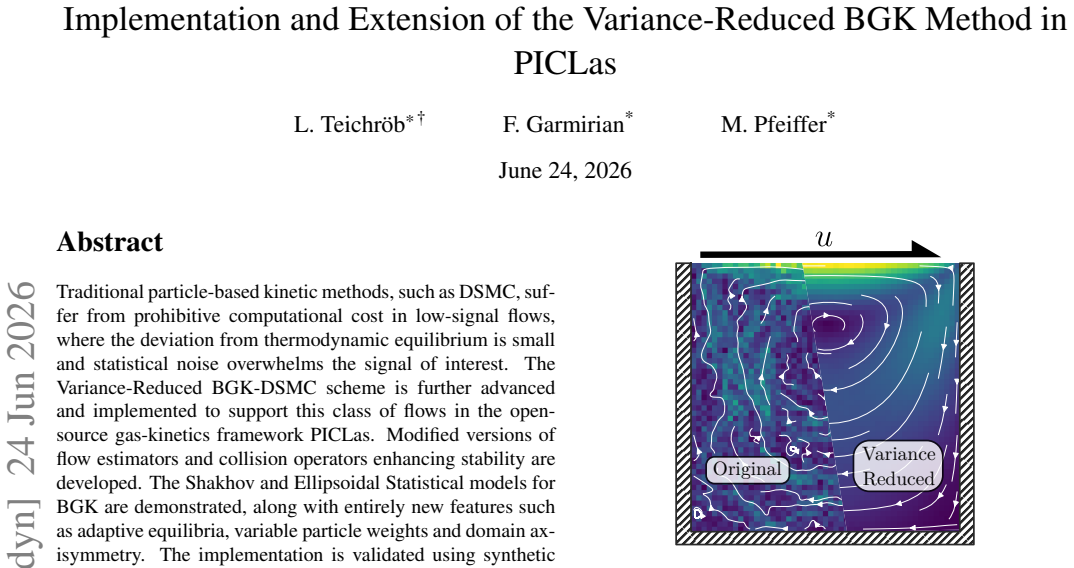
Traditional particle-based kinetic methods, such as DSMC, suffer from prohibitive computational cost in low-signal flows, where the deviation from thermodynamic equilibrium is small and statistical noise overwhelms the signal of interest. The Variance-Reduced BGK-DSMC scheme is further advanced and implemented to support this class of flows in the open-source gas-kinetics framework PICLas. Modified versions of flow estimators and collision operators enhancing stability are developed. The Shakhov and Ellipsoidal Statistical models for BGK are demonstrated, along with entirely new features such as adaptive equilibria, variable particle weights and domain axisymmetry. The implementation is validated using synthetic benchmarks, 1D, 2D and axisymmetric simulations. Comparison of VRBGK to BGK simulations shows exact agreement of the models. A further comparison with an analytical solution of thermal transpiration in a microchannel showcases the low-signal efficiency of the method as well as newly proposed features.
Editorial analysis
A structured set of objections, weighed in public.
Referee Report
Summary. The manuscript implements the Variance-Reduced BGK (VRBGK) scheme in the open-source PICLas framework, introducing modified flow estimators and collision operators for stability, the Shakhov and Ellipsoidal Statistical BGK models, and new capabilities including adaptive equilibria, variable particle weights, and axisymmetric domains. Validation consists of synthetic benchmarks plus 1D/2D/axisymmetric test cases that are reported to show exact agreement with standard BGK simulations and agreement with an analytical thermal transpiration solution in a microchannel, thereby demonstrating low-signal efficiency.
Significance. If the central validation claims hold under quantitative scrutiny, the work would supply a practical, open-source tool for particle-based simulation of low-signal rarefied flows where conventional DSMC is noise-limited. The stability modifications and added features (axisymmetry, variable weights) could extend applicability to microchannel and axisymmetric problems; explicit confirmation that the modifications preserve moments and equilibria would strengthen in the variance-reduction approach.
major comments (2)
- [Abstract and validation sections] Abstract and validation sections: the claim of 'exact agreement' between VRBGK and BGK is presented without any reported quantitative metrics (maximum relative error, L2 norms on density/velocity/temperature moments, or convergence rates with particle number); this absence prevents independent verification that the modified estimators and collision operators introduce no systematic bias.
- [Validation sections] Validation sections: the comparison to the analytical thermal transpiration solution does not quantify the signal strength (e.g., Mach or Knudsen number regime), noise reduction factor, or computational cost savings relative to standard BGK, leaving the 'low-signal efficiency' claim without measurable support.
minor comments (2)
- [Abstract] The abstract lists 'synthetic benchmarks, 1D, 2D and axisymmetric simulations' but does not indicate which new features (adaptive equilibria, variable weights) are exercised in each case; a short table mapping features to test cases would improve clarity.
- [Methods] Notation for the modified estimators and collision operators should be introduced with explicit equations early in the methods section rather than only in the implementation description.
Simulated Author's Rebuttal
We thank the referee for the constructive comments, which highlight opportunities to strengthen the quantitative support for our validation claims. We will revise the manuscript accordingly to include the requested metrics and details.
read point-by-point responses
-
Referee: [Abstract and validation sections] Abstract and validation sections: the claim of 'exact agreement' between VRBGK and BGK is presented without any reported quantitative metrics (maximum relative error, L2 norms on density/velocity/temperature moments, or convergence rates with particle number); this absence prevents independent verification that the modified estimators and collision operators introduce no systematic bias.
Authors: We agree that the absence of quantitative error metrics limits independent verification. The current manuscript relies on visual agreement in the presented figures for the claim of exact agreement. In the revised version we will add explicit metrics, including maximum relative errors and L2 norms on the density, velocity and temperature fields for the 1D, 2D and axisymmetric benchmark cases, together with any observed dependence on particle number. revision: yes
-
Referee: [Validation sections] Validation sections: the comparison to the analytical thermal transpiration solution does not quantify the signal strength (e.g., Mach or Knudsen number regime), noise reduction factor, or computational cost savings relative to standard BGK, leaving the 'low-signal efficiency' claim without measurable support.
Authors: We acknowledge that the manuscript does not currently report numerical values for signal strength, noise reduction factor or computational savings in the thermal transpiration example. In the revision we will specify the Mach and Knudsen numbers of the test case, provide an estimate of the achieved noise reduction relative to standard BGK, and include a brief comparison of computational effort to support the efficiency claim. revision: yes
Circularity Check
Implementation paper with external analytical validation; no derivation reduces to inputs
full rationale
The work is an implementation and extension of the prior VRBGK scheme, validated by direct numerical agreement with standard BGK (testing no bias from modifications) and by reproduction of an independent analytical thermal transpiration solution. No equations define a quantity in terms of itself, no fitted parameters are relabeled as predictions, and no load-bearing premise rests on a self-citation chain. The central claims are externally falsifiable against the analytical benchmark and the unmodified BGK reference, satisfying the criteria for a self-contained, non-circular result.
Axiom & Free-Parameter Ledger
Reference graph
Works this paper leans on
-
[1]
G. A. Bird. 1st ed. Oxford University Press, 1994.ISBN: 0-19-856195-4
1994
-
[2]
Application High- lights of the DSMC Analysis Code (DAC) Software for Simulating Rarefied Flows
G. J LeBeau and F. E Lumpkin III. “Application High- lights of the DSMC Analysis Code (DAC) Software for Simulating Rarefied Flows”. In:Computer Methods in Applied Mechanics and Engineering. Minisymposium on Methods for Flow Simulation and Modeling 191.6 (Dec. 2001), pp. 595–609.ISSN: 0045-7825.DOI:10. 1016/S0045-7825(01)00304-8
2001
-
[3]
On the Unsteadiness of Shock–Laminar Bound- ary Layer Interactions of Hypersonic Flows over a Dou- ble Cone
Ozgur Tumuklu, Vassilis Theofilis, and Deborah A. Levin. “On the Unsteadiness of Shock–Laminar Bound- ary Layer Interactions of Hypersonic Flows over a Dou- ble Cone”. In:Physics of Fluids30.10 (Oct. 2018), p. 106111.ISSN: 1070-6631.DOI:10 . 1063 / 1 . 5047791
2018
-
[4]
Marcel Pfeiffer et al. “Numerical Simulation of an Iron Meteoroid Entering into Earth’s Atmosphere Us- ing DSMC and a Radiation Solver with Comparison to Ground Testing Data”. In:Icarus407 (Jan. 2024), p. 115768.ISSN: 0019-1035.DOI:10 . 1016 / j . icarus.2023.115768
arXiv 2024
-
[5]
Direct Simula- tion Monte Carlo: Recent Advances and Applications
E.S. Oran, C.K. Oh, and B.Z. Cybyk. “Direct Simula- tion Monte Carlo: Recent Advances and Applications”. In:Annual Review of Fluid Mechanics30.1 (Jan. 1998), pp. 403–441.ISSN: 0066-4189, 1545-4479.DOI:10 . 1146/annurev.fluid.30.1.403
1998
-
[6]
Alina A. Alexeenko et al. “Numerical Modeling of Ax- isymmetric and Three-Dimensional Flows in Micro- electromechanical Systems Nozzles”. In:AIAA Journal 40.5 (May 2002), pp. 897–904.ISSN: 0001-1452, 1533- 385X.DOI:10.2514/2.1726. 10
-
[7]
Hassan Akhlaghi, Ehsan Roohi, and Stefan Stefanov. “A Comprehensive Review on Micro- and Nano-Scale Gas Flow Effects: Slip-jump Phenomena, Knudsen Para- dox, Thermally-Driven Flows, and Knudsen Pumps”. In:Physics Reports997 (Jan. 2023), pp. 1–60.ISSN: 03701573.DOI:10.1016/j.physrep.2022.10.004
-
[8]
P. L. Bhatnagar, E. P. Gross, and M. Krook. “A Model for Collision Processes in Gases. I. Small Amplitude Processes in Charged and Neutral One-Component Sys- tems”. In:Physical Review94.3 (May 1954), pp. 511– 525.DOI:10.1103/PhysRev.94.511
-
[9]
Discrete velocity model and implicit scheme for the BGK equation of rarefied gas dynamics
Luc Mieussens. “Discrete Velocity Model and Implicit Scheme for the BGK Equation of Rarefied Gas Dy- namics”. In:Mathematical Models and Methods in Ap- plied Sciences10.08 (Nov. 2000), pp. 1121–1149.ISSN: 0218-2025.DOI:10.1142/S0218202500000562
-
[10]
Kun Xu and Juan-Chen Huang. “A Unified Gas-Kinetic Scheme for Continuum and Rarefied Flows”. In:Journal of Computational Physics229.20 (Oct. 2010), pp. 7747– 7764.ISSN: 00219991.DOI:10.1016/j.jcp.2010. 06.032
-
[11]
Discrete Uni- fied Gas Kinetic Scheme for All Knudsen Number Flows: Low-speed Isothermal Case
Zhaoli Guo, Kun Xu, and Ruijie Wang. “Discrete Uni- fied Gas Kinetic Scheme for All Knudsen Number Flows: Low-speed Isothermal Case”. In:Physical Re- view E88.3 (Sept. 2013), p. 033305.ISSN: 1539-3755, 1550-2376.DOI:10.1103/PhysRevE.88.033305
-
[12]
Implementation of asymptotic preserving discrete velocity methods into the simulation code PICLas
Félix Garmirian and Marcel Pfeiffer. “Implementation of asymptotic preserving discrete velocity methods into the simulation code PICLas”. In:Computer Physics Communications314 (2025), p. 109648.ISSN: 0010- 4655.DOI:10.1016/j.cpc.2025.109648
-
[13]
Variance reduction for Monte Carlo solutions of the Boltzmann equation
Lowell L. Baker and Nicolas G. Hadjiconstantinou. “Variance reduction for Monte Carlo solutions of the Boltzmann equation”. In:Physics of Fluids17.5 (Apr. 2005), p. 051703.ISSN: 1070-6631.DOI:10 . 1063 / 1.1899210. eprint:https://pubs.aip.org/aip/ pof / article - pdf / doi / 10 . 1063 / 1 . 1899210 / 14770930/051703_1_online.pdf
2005
-
[14]
Low-variance direct Monte Carlo simulations using importance weights
Husain A. Al-Mohssen and Nicolas G. Hadjiconstanti- nou. “Low-variance direct Monte Carlo simulations using importance weights”. In:ESAIM: M2AN44.5 (2010), pp. 1069–1083.DOI:10.1051/m2an/2010052
-
[15]
An Excursion with the Boltzmann Equation at Low Speeds: variance-reduced DSMC
Husain A. Al-Mohssen. “An Excursion with the Boltzmann Equation at Low Speeds: variance-reduced DSMC”. PhD thesis. 2010
2010
-
[16]
Variance- Reduced Direct Simulation Monte Carlo with the Bhatnagar-Gross-Krook Collision Operator
C. D. Landon and N. G. Hadjiconstantinou. “Variance- Reduced Direct Simulation Monte Carlo with the Bhatnagar-Gross-Krook Collision Operator”. In:AIP Conference Proceedings1333.1 (May 2011), pp. 277– 282.ISSN: 0094-243X.DOI:10.1063/1.3562661
-
[17]
Direct Simulation Method Based on BGK Equation
Jun Li. “Direct Simulation Method Based on BGK Equation”. In:AIP Conference Proceedings1333.1 (May 2011), pp. 283–288.ISSN: 0094-243X.DOI:10. 1063/1.3562662. eprint:https://pubs.aip.org/ aip/acp/article- pdf/1333/1/283/11563196/ 283_1_online.pdf
2011
-
[18]
Variance Reduction for Fokker–Planck Based Particle Monte Carlo Schemes
M. Hossein Gorji, Nemanja Andric, and Patrick Jenny. “Variance Reduction for Fokker–Planck Based Particle Monte Carlo Schemes”. In:Journal of Computational Physics295 (Aug. 2015), pp. 644–664.ISSN: 00219991. DOI:10.1016/j.jcp.2015.04.008
-
[19]
Lukas Netterdon et al.Variance Reduction in the Fokker- Planck Particle Method for Rarefied Gases Using Quasi- Random Numbers. Jan. 2026.DOI:10.48550/arXiv. 2601.14461. arXiv:2601.14461 [math]
work page internal anchor Pith review doi:10.48550/arxiv 2026
-
[20]
Statistical Simulation of Low-Speed Rarefied Gas Flows
Jing Fan and Ching Shen. “Statistical Simulation of Low-Speed Rarefied Gas Flows”. In:Journal of Compu- tational Physics167.2 (2001), pp. 393–412.ISSN: 0021- 9991.DOI:10.1006/jcph.2000.6681
-
[21]
Ching Shen, Jing Fan, and Chong Xie. “Statistical simulation of rarefied gas flows in micro-channels”. In:Journal of Computational Physics189.2 (2003), pp. 512–526.ISSN: 0021-9991.DOI:10.1016/S0021- 9991(03)00231-6
-
[22]
Information preser- vation method for the case of temperature variation
C. Shen, J. Z. Jiang, and J. Fan. “Information preser- vation method for the case of temperature variation”. In:AIP Conference Proceedings585.1 (Aug. 2001), pp. 185–192.ISSN: 0094-243X.DOI:10 . 1063 / 1 . 1407562. eprint:https : / / pubs . aip . org / aip / acp / article - pdf / 585 / 1 / 185 / 11740141 / 185 _ 1_online.pdf
2001
-
[23]
A Direct Simulation Method for Subsonic, Microscale Gas Flows
Quanhua Sun and Iain D. Boyd. “A Direct Simulation Method for Subsonic, Microscale Gas Flows”. In:Jour- nal of Computational Physics179.2 (2002), pp. 400– 425.ISSN: 0021-9991.DOI:10 . 1006 / jcph . 2002 . 7061
2002
-
[24]
Multi- ple temperature model for the information preservation method and its application to nonequilibrium gas flows
Jun Zhang, Jing Fan, and Jianzheng Jiang. “Multi- ple temperature model for the information preservation method and its application to nonequilibrium gas flows”. In:Journal of Computational Physics230.19 (2011), pp. 7250–7265.ISSN: 0021-9991.DOI:10 . 1016 / j . jcp.2011.05.025
2011
-
[25]
S. Fasoulas et al. “Combining Particle-in-Cell and Di- rect Simulation Monte Carlo for the Simulation of Re- active Plasma Flows”. In:Physics of Fluids31.7 (July 2019), p. 072006.ISSN: 1070-6631, 1089-7666.DOI: 10.1063/1.5097638
-
[26]
Generalization of the Krook kinetic relaxation equation
E. M. Shakhov. “Generalization of the Krook kinetic relaxation equation”. In:Fluid Dynamics3 (5 Sept. 1968), pp. 95–96.ISSN: 1573-8507.DOI:10 . 1007 / BF01029546
1968
-
[27]
New Statistical Models for Ki- netic Theory: Methods of Construction
Lowell H. Holway Jr. “New Statistical Models for Ki- netic Theory: Methods of Construction”. In:The Physics of Fluids9.9 (Sept. 1966), pp. 1658–1673.ISSN: 0031- 9171.DOI:10.1063/1.1761920
-
[28]
Coupled Particle-In-Cell and Direct Simulation Monte Carlo method for simulating reactive plasma flows
Claus-Dieter Munz et al. “Coupled Particle-In-Cell and Direct Simulation Monte Carlo method for simulating reactive plasma flows”. In:Comptes Rendus Mécanique 342.10 (2014), pp. 662–670.ISSN: 1631-0721.DOI:10. 1016/j.crme.2014.07.005
2014
-
[29]
A Perspective on the Use of Control Variables to Increase the Efficiency of Monte Carlo Simulations
S. S. Lavenberg and P. D. Welch. “A Perspective on the Use of Control Variables to Increase the Efficiency of Monte Carlo Simulations”. In:Management Science 27.3 (1981), pp. 322–335.ISSN: 00251909, 15265501. 11
1981
-
[30]
Sheldon Ross.Chapter 9 - Variance Reduction Tech- niques. 5th ed. Academic Press, 2013, pp. 153–231. ISBN: 978-0-12-415825-2.DOI:10 . 1016 / B978 - 0 - 12-415825-2.00009-7
2013
-
[31]
Weighted Particle Variance Reduction of Direct Simulation Monte Carlo for the Bhatnagar- Gross-Krook Collision Operator
Colin Landon. “Weighted Particle Variance Reduction of Direct Simulation Monte Carlo for the Bhatnagar- Gross-Krook Collision Operator”. BA thesis. Jan. 2010
2010
-
[32]
Subsonic flow bound- ary conditions for the direct simulation Monte Carlo method
Erin Farbar and Iain D. Boyd. “Subsonic flow bound- ary conditions for the direct simulation Monte Carlo method”. In:Computers & Fluids102 (2014), pp. 99– 110.ISSN: 0045-7930.DOI:10.1016/j.compfluid. 2014.06.025
-
[33]
Numerical study of steady flow inside a lid-driven square cavity for Reynolds number up to 50000
Azzouz Amin, Samir Houat, and Oussama Benhizia. “Numerical study of steady flow inside a lid-driven square cavity for Reynolds number up to 50000”. In: Congrès français de mécanique. Lille, France, Aug. 2017
2017
-
[34]
Xiaowei Wang et al. “Knudsen pumps: a review”. In: Microsystems & Nanoengineering6.1, 26 (Dec. 2020), p. 26.DOI:10.1038/s41378-020-0135-5
-
[35]
Rarefied gas flow through a long tube at any temperature ratio
Felix Sharipov. “Rarefied gas flow through a long tube at any temperature ratio”. In:Journal of Vacuum Science & Technology A14.4 (July 1996), pp. 2627–2635.ISSN: 0734-2101.DOI:10.1116/1.579991
-
[36]
Monolithic integration of Knudsen pumps to form a complete, self-sufficient fluidic system for microscale gas chromatography
Xiangyu Zhao et al. “Monolithic integration of Knudsen pumps to form a complete, self-sufficient fluidic system for microscale gas chromatography”. In:Microsystems & Nanoengineering11 (2025). 12
2025
discussion (0)
Sign in with ORCID, Apple, or X to comment. Anyone can read and Pith papers without signing in.