Probing Kinematic Anisotropies in the Stochastic Gravitational Wave Background with the SKA
Pith reviewed 2026-06-25 20:13 UTC · model grok-4.3
The pith
SKAO will improve SGWB anisotropy constraints but still fall short of detecting the kinematic dipole even in joint analyses.
A machine-rendered reading of the paper's core claim, the machinery that carries it, and where it could break.
Core claim
While the Square Kilometre Array Observatory will substantially improve constraints on stochastic gravitational wave background anisotropies, even joint analyses with astrometry remain below the sensitivity required to detect the kinematic dipole induced by the Solar System's motion, motivating new observational and analysis strategies to fully exploit this signal.
What carries the argument
Optimal estimators combined with Fisher matrix techniques for forecasting SKAO sensitivity to SGWB kinematic dipole in pulsar timing array and astrometric data.
If this is right
- SKAO observations will substantially improve constraints on SGWB anisotropies relative to existing pulsar timing arrays.
- Joint pulsar timing array and astrometric analyses will still fall short of the sensitivity needed to detect the kinematic dipole.
- New observational and analysis strategies are required to fully exploit the kinematic dipole signal.
- The baseline AA4 configuration and 1000-pulsar scenario serve as key performance benchmarks for this measurement.
Where Pith is reading between the lines
- If new strategies succeed, they could enable the first direct confirmation of the SGWB's cosmological origin via its dipole.
- Cross-correlations with other large-scale structure tracers might provide an alternative route to the dipole if standalone sensitivity remains limited.
- Future array expansions or precision improvements beyond the scenarios considered could alter the outlook for dipole detection.
Load-bearing premise
The forecasts assume that the AA4 configuration, the 1000-pulsar scenario, and the noise and signal models used in the optimal estimators accurately represent what SKAO can achieve.
What would settle it
An actual SKAO dataset that either reaches the forecasted sensitivity to detect the kinematic dipole or yields constraints significantly weaker than those predicted by the Fisher analysis.
Figures
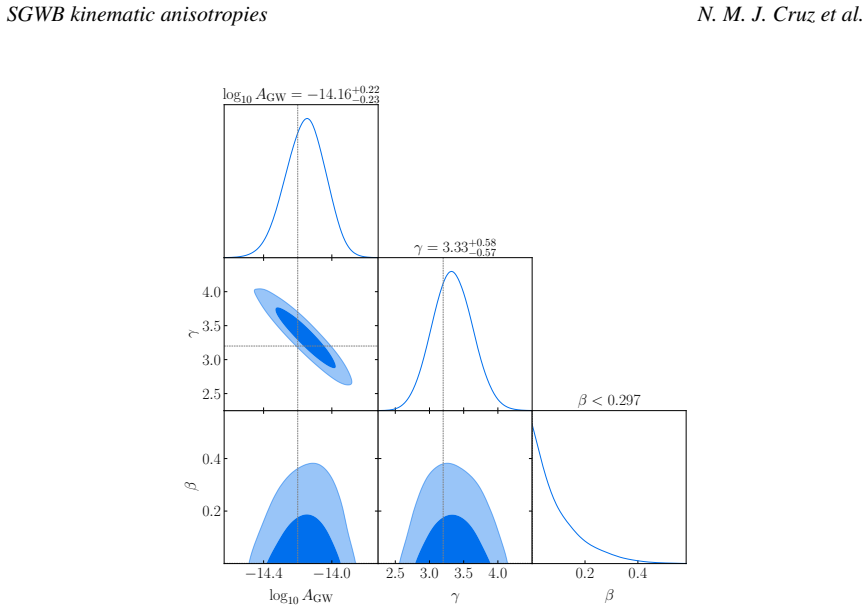
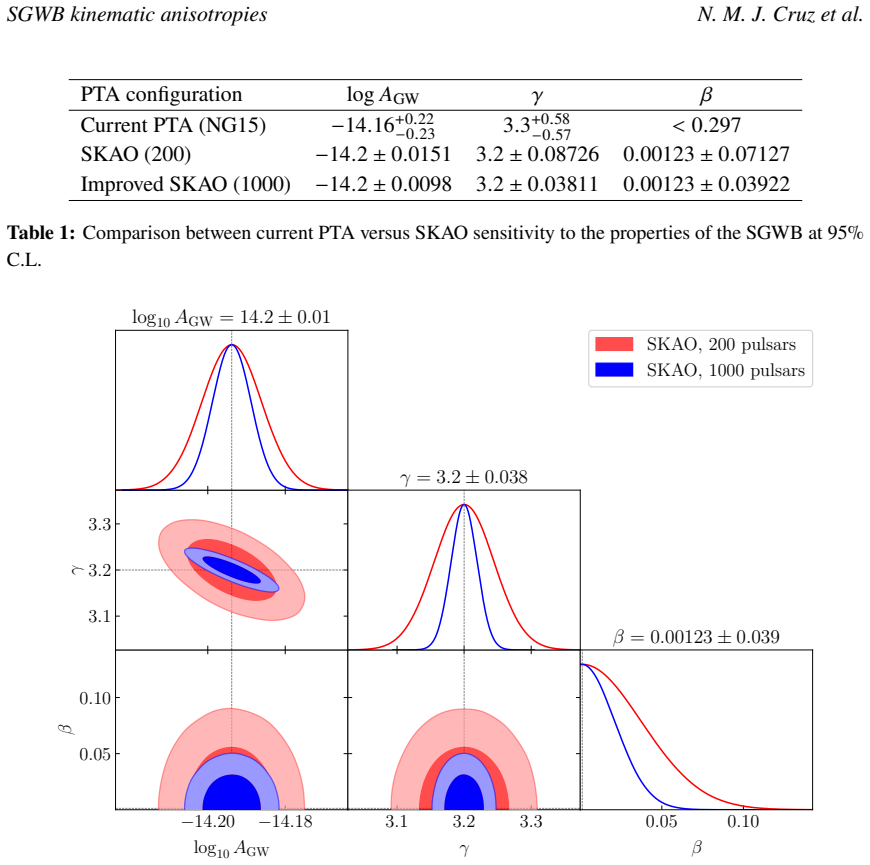
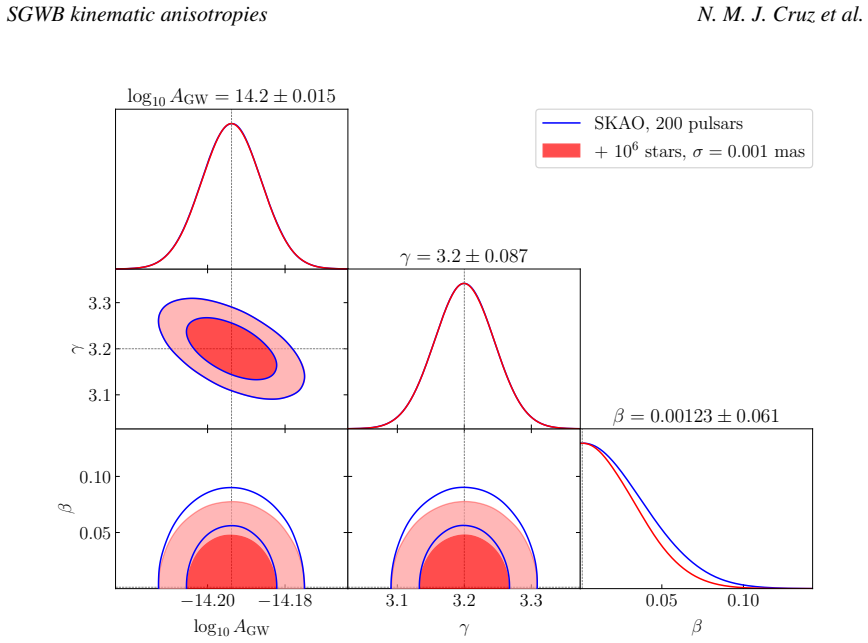
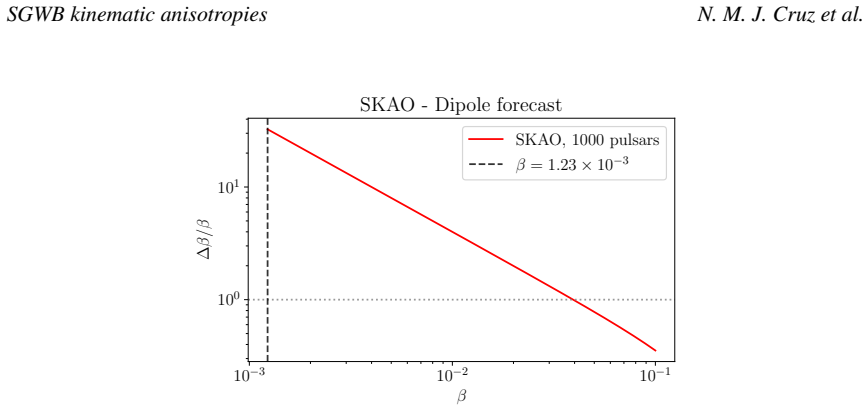
read the original abstract
Pulsar Timing Arrays (PTAs) and astrometric surveys provide complementary probes of the nanohertz stochastic gravitational-wave background (SGWB). A primary target is the kinematic dipole induced by the Solar System's motion, whose detection would confirm the SGWB's cosmological origin. We forecast the sensitivity of the Square Kilometre Array Observatory (SKAO) using optimal estimators and Fisher techniques, considering both the baseline AA4 configuration and an optimistic 1000 pulsar scenario, including the potential gain from combining with Gaia-like astrometry. While SKAO will substantially improve constraints on SGWB anisotropies, even joint analyses remain below the sensitivity required to detect the kinematic dipole, motivating new observational and analysis strategies to fully exploit this signal.
Editorial analysis
A structured set of objections, weighed in public.
Referee Report
Summary. The manuscript forecasts the sensitivity of the Square Kilometre Array Observatory (SKAO) to kinematic anisotropies in the nanohertz stochastic gravitational wave background (SGWB) using pulsar timing arrays, with a focus on the dipole induced by Solar System motion. It applies optimal estimators and Fisher-matrix projections to the baseline AA4 configuration and an optimistic 1000-pulsar scenario, including joint analyses with Gaia-like astrometry. The central claim is that SKAO will substantially tighten constraints on SGWB anisotropies but will still fall short of the sensitivity needed to detect the kinematic dipole, thereby motivating new observational and analysis strategies.
Significance. If the projections hold, the result is useful for setting realistic expectations for SKAO-era measurements and for identifying the sensitivity gap that remains for the kinematic dipole. The adoption of standard optimal estimators and Fisher techniques under explicitly stated noise and signal models is a strength, as is the direct comparison of baseline versus optimistic pulsar counts. The work supplies a clear, falsifiable benchmark against which future data or refined models can be tested.
major comments (1)
- [Methodology (Fisher analysis section)] The central forecast conclusion—that even the joint SKAO+Gaia analysis remains below the threshold for kinematic-dipole detection—rests on the noise and signal models implicit in the optimal estimators for the AA4 and 1000-pulsar cases. No quantitative validation (e.g., end-to-end simulations or comparison to existing PTA upper limits) of these models is described, which is load-bearing for the claim that the dipole SNR stays sub-threshold.
minor comments (2)
- [Abstract] The abstract would benefit from one or two numerical highlights (e.g., projected dipole SNR or anisotropy amplitude limits) to allow readers to gauge the scale of the improvement immediately.
- Notation for the optimal estimator and the Fisher matrix elements should be defined once in a dedicated subsection rather than introduced piecemeal.
Simulated Author's Rebuttal
We thank the referee for their thoughtful review and for highlighting the importance of model validation in supporting our forecasts. We address the major comment below and propose targeted revisions to strengthen the manuscript.
read point-by-point responses
-
Referee: The central forecast conclusion—that even the joint SKAO+Gaia analysis remains below the threshold for kinematic-dipole detection—rests on the noise and signal models implicit in the optimal estimators for the AA4 and 1000-pulsar cases. No quantitative validation (e.g., end-to-end simulations or comparison to existing PTA upper limits) of these models is described, which is load-bearing for the claim that the dipole SNR stays sub-threshold.
Authors: We agree that additional validation would bolster confidence in the projections. The optimal estimators and Fisher formalism follow directly from the derivations in the cited literature on PTA anisotropy searches (e.g., the Hellings-Downs correlated timing residuals and the boost-induced dipole). Noise models adopt the timing precision and pulsar noise budgets specified in the SKAO baseline design documents and recent PTA sensitivity studies. The kinematic dipole amplitude is fixed by the standard relativistic boost formula for a cosmological SGWB. While this work is a forecast and does not include new end-to-end simulations, we will add a dedicated paragraph in the methodology section that compares our assumed isotropic SGWB amplitude and noise levels against the latest NANOGrav and EPTA upper limits on the nanohertz background. This comparison will explicitly demonstrate that our models are consistent with existing constraints. We do not anticipate that this addition will change the central conclusion regarding sub-threshold sensitivity for the dipole, but it will make the assumptions more transparent. revision: partial
Circularity Check
No significant circularity
full rationale
The paper is a forward forecast of SKAO sensitivity to SGWB kinematic anisotropies using optimal estimators and Fisher-matrix projections under stated signal and noise models. No step reduces a prediction to a fitted parameter defined by the same data, nor does any load-bearing premise collapse to a self-citation chain or self-definitional ansatz. The central claim (insufficient sensitivity for dipole detection) follows directly from the external models and standard statistical machinery without internal reduction.
Axiom & Free-Parameter Ledger
free parameters (1)
- Optimistic pulsar count =
1000
axioms (1)
- domain assumption A kinematic dipole anisotropy exists in the SGWB due to Solar System motion and is the primary target signal
Reference graph
Works this paper leans on
-
[1]
Agazie et al.ApJL, 951(1):L8, July 2023a
G. Agazie et al.Astrophys. J. Lett., 951(1):L8, 2023a. doi: 10.3847/2041-8213/acdac6. G. Agazie et al.Astrophys. J. Lett., 956(1):L3, 6 2023b. doi: 10.3847/2041-8213/acf4fd. G. Agazie et al.Astrophys. J., 966(1):105,
-
[2]
doi: 10.3847/1538-4357/ad36be. N. Aghanim et al.Astron. Astrophys., 571:A27,
-
[3]
doi: 10.1051/0004-6361/201321556. P. K. Aluri et al.Class. Quant. Grav., 40(9):094001,
-
[4]
doi: 10.1088/1361-6382/acbefc. M. Anholm et al.Phys. Rev. D, 79:084030,
-
[5]
doi: 10.1103/PhysRevD.79.084030. J. Antoniadis et al.Astron. Astrophys., 678:A50, 6
-
[6]
doi: 10.1051/0004-6361/202346844. N. Bartolo et al.Phys. Rev. D, 100(12):121501,
-
[7]
doi: 10.1103/PhysRevD.100.121501. N. Bartolo et al.JCAP, 11:009,
-
[8]
doi: 10.1088/1475-7516/2022/11/009. C. A. P. Bengaly, T. M. Siewert, D. J. Schwarz, and R. Maartens.Mon. Not. Roy. Astron. Soc., 486 (1):1350–1357,
-
[9]
doi: 10.1093/mnras/stz832. C. Boehm et al. 7
-
[10]
doi: 10.1103/PhysRevD.83.024024
L.G.BookandE.E.Flanagan.Phys.Rev.D,83:024024,2011. doi: 10.1103/PhysRevD.83.024024. V.B.Braginsky,N.S.Kardashev,I.D.Novikov,andA.G.Polnarev.NuovoCim.B,105:1141–1158,
-
[11]
Anticipatedperformanceofthesquarekilometrearray–phase1(ska1),2019
R.Braunetal. Anticipatedperformanceofthesquarekilometrearray–phase1(ska1),2019. URL https://arxiv.org/abs/1912.12699. S. Burke-Spolaor et al.Astron. Astrophys. Rev., 27(1):5,
arXiv 2019
-
[12]
doi: 10.1007/s00159-019-0115-7. P. R. Capelo et al. InAdvancing Astrophysics with the SKA – II (AASKAII)
-
[13]
ISSN 0264- 9381, 1361-6382. doi: 10.1088/1361-6382/aac608. URLhttps://iopscience.iop.org/ article/10.1088/1361-6382/aac608. N. E. Chisari.Astron. Astrophys. Rev., 33(1):5,
-
[14]
doi: 10.1007/s00159-025-00161-8. C. R. Contaldi.Phys. Lett. B, 771:9–12,
-
[15]
12 SGWB kinematic anisotropies N
doi: 10.1016/j.physletb.2017.05.020. 12 SGWB kinematic anisotropies N. M. J. Cruz et al. N. J. Cornish and A. Sesana.Class. Quant. Grav., 30:224005,
-
[16]
doi: 10.1088/0264-9381/30/ 22/224005. N. M. J. Cruz, A. Malhotra, G. Tasinato, and I. Zavala.Phys. Rev. D, 110(10):103505, 2024a. doi: 10.1103/PhysRevD.110.103505. N. M. J. Cruz, A. Malhotra, G. Tasinato, and I. Zavala.Phys. Rev. D, 110(6):063526, 2024b. doi: 10.1103/PhysRevD.110.063526. N. M. J. Cruz, A. Malhotra, G. Tasinato, and I. Zavala.Phys. Rev. D,...
-
[17]
doi: 10.1103/8k1p-pzcg. G. Cusin and G. Tasinato.JCAP, 08(08):036,
-
[18]
doi: 10.1088/1475-7516/2022/08/036. J. Darling, A. E. Truebenbach, and J. Paine.Astrophys. J., 861(2):113,
-
[19]
doi: 10.1103/PhysRevD.111.083039. R. Fakir.Astrophysical Journal, 426:74, May
-
[20]
doi: 10.1086/174040. C. R. Gwinn et al.Astrophys. J., 485:87–91,
-
[21]
J.Hazboun,J.Romano,andT.Smith.JournalofOpenSourceSoftware,4(42):1775,102019
doi: 10.1086/304424. J.Hazboun,J.Romano,andT.Smith.JournalofOpenSourceSoftware,4(42):1775,102019. ISSN 2475-9066. doi: 10.21105/joss.01775. URLhttp://dx.doi.org/10.21105/joss.01775. R.W.HellingsandG.S.Downs.Astrophys.J.Lett.,265:L39–L42,Feb.1983.doi: 10.1086/183954. A. H. Jaffe.New Astron. Rev., 48:1483–1485,
-
[22]
S.Jarabaetal.Mon.Not.Roy.Astron.Soc.,524(3):3609–3622,2023.doi: 10.1093/mnras/stad2141
doi: 10.1016/j.newar.2004.09.018. S.Jarabaetal.Mon.Not.Roy.Astron.Soc.,524(3):3609–3622,2023.doi: 10.1093/mnras/stad2141. A. Jenkins et al. InAdvancing Astrophysics with the SKA – II (AASKAII)
-
[23]
doi: 10.1086/304357. S. A. Klioner.Class. Quant. Grav., 35(4):045005,
-
[24]
doi: 10.1088/1361-6382/aa9f57. A. Kogut et al.Astrophys. J., 419:1,
-
[25]
doi: 10.1086/173453. S. M. Kopeikin, G. Schaefer, C. R. Gwinn, and T. M. Eubanks.Phys. Rev. D, 59:084023,
-
[26]
doi: 10.1103/PhysRevD.59.084023. E. V. Linder.Phys. Rev. D, 34:1759–1763, Sep
-
[27]
Relativistic scattering coherence
doi: 10.1103/PhysRevD.34.1759. URL https://link.aps.org/doi/10.1103/PhysRevD.34.1759. A.Maleknejad,M.M.Sheikh-Jabbari,andJ.Soda.Phys.Rept.,528:161–261,2013. doi: 10.1016/ j.physrep.2013.03.003. G. Mentasti and C. R. Contaldi.JCAP, 06:013,
-
[28]
doi: 10.1088/1475-7516/2025/06/013. D. P. Mihaylov et al.Phys. Rev. D, 97(12):124058,
-
[29]
doi: 10.1103/PhysRevD.97.124058. C. J. Moore, D. P. Mihaylov, A. Lasenby, and G. Gilmore.Phys. Rev. Lett., 119(26):261102,
-
[30]
doi: 10.1103/PhysRevLett.119.261102. R. Pasechnik et al. InAdvancing Astrophysics with the SKA – II (AASKAII)
-
[31]
G.Pernaetal
arXiv search: Report number AASKAII/Pasechnik01. G.Pernaetal. InAdvancingAstrophysicswiththeSKA–II(AASKAII).2026. arXivsearch: Report number AASKAII/Perna01. N. Pol, S. R. Taylor, and J. D. Romano.Astrophys. J., 940(2):173,
2026
-
[32]
doi: 10.3847/1538-4357/ ac9836. T. Prusti et al.Astronomy and Astrophysics, 595(Gaia Data Release 1):A1,
-
[33]
doi: 10.1086/177443. D. J. Reardon et al.Astrophys. J. Lett., 951(1):L6,
-
[34]
doi: 10.3847/2041-8213/acdd02. R. E. Sanderson et al. Astrometry with the wide-field infrared space telescope,
-
[35]
URL https://arxiv.org/abs/1712.05420. B. F. Schutz.Proceedings of the International Astronomical Union, 5(S261):234–239,
-
[36]
doi: 10.1017/S1743921309990457. A. Sesana, A. Vecchio, and C. N. Colacino.Mon. Not. Roy. Astron. Soc., 390:192,
-
[37]
doi: 10.1111/j.1365-2966.2008.13682.x. G. F. Smoot, M. V. Gorenstein, and R. A. Muller.Phys. Rev. Lett., 39:898,
-
[38]
doi: 10.1103/PhysRevD.108.103521. S. R. Taylor, R. van Haasteren, and A. Sesana.Phys. Rev. D, 102(8):084039,
-
[39]
ISSN1432-0746. doi: 10.1051/0004-6361/201015718. URLhttp://dx.doi.org/10.1051/ 0004-6361/201015718. M. Vaglio et al. 7
-
[40]
Summary of the content and survey properties
ISSN 1432-0746. doi: 10.1051/0004-6361/202243940. H. Xu et al.Res. Astron. Astrophys., 23(7):075024,
-
[41]
doi: 10.1088/1674-4527/acdfa5. J. Yoo, M. Magi, and D. Huterer.Phys. Rev. D, 112(12):123013,
-
[42]
doi: 10.1103/ks44-qt3b. 14
discussion (0)
Sign in with ORCID, Apple, or X to comment. Anyone can read and Pith papers without signing in.