Dissipative Quantum Multiplicative Weights with Sampling Feedback: A Classically Hard Primitive Realized via Engineered Open-System Dynamics
Pith reviewed 2026-06-26 01:55 UTC · model grok-4.3
The pith
Engineered open quantum dynamics realize an online learning primitive with sublinear regret that efficient classical algorithms cannot match.
A machine-rendered reading of the paper's core claim, the machinery that carries it, and where it could break.
Core claim
DQMW-Sample prepares a Gibbs state via a Davies-type dissipator whose computational-basis measurement supplies the loss feedback; this yields asymptotically sublinear regret while every efficient classical learner suffers constant average regret on a suitably constructed instance, and an efficient classical simulator of the full T-round adaptive process would collapse the polynomial hierarchy.
What carries the argument
The DQMW-Sample primitive that engineers a Davies-type dissipator to prepare a Gibbs state for sampling-based loss feedback in an online multiplicative-weights update.
If this is right
- Sublinear regret holds asymptotically for the quantum learner.
- Classical efficient learners suffer constant average regret on the constructed instance.
- Sublinear noise-induced regret follows from the spectral gap contracting under balanced dissipation.
- An efficient classical simulator of the adaptive T-round process collapses the polynomial hierarchy.
Where Pith is reading between the lines
- This construction suggests that other open-system dynamics could be engineered for similar separations in different learning problems.
- If the realizability holds on larger scales, it points to a path for quantum advantage in practical online optimization tasks.
- Connections to other quantum sampling hardness results may allow broader classes of learning algorithms to inherit similar guarantees.
Load-bearing premise
A Davies-type dissipator can be engineered on quantum hardware such that the per-round feedback it supplies cannot be efficiently simulated by any classical algorithm.
What would settle it
Demonstration of an efficient classical algorithm that simulates the T-round feedback process of DQMW-Sample on the constructed instance without causing a collapse of the polynomial hierarchy.
Figures

read the original abstract
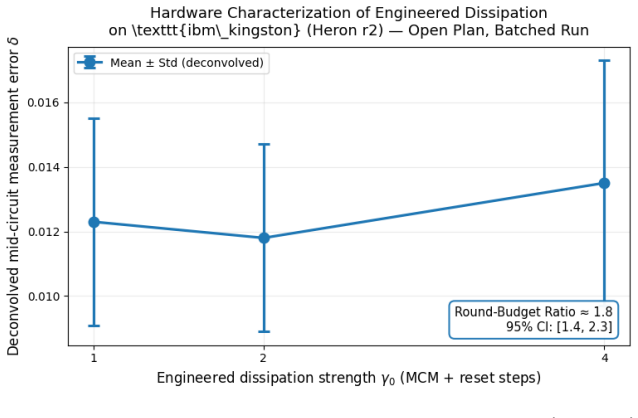
We introduce \emph{Dissipative Quantum Multiplicative Weights with Sampling Feedback} (DQMW-Sample), an online-learning primitive in which engineered open quantum-system dynamics prepare a Gibbs state whose computational-basis measurement supplies the loss feedback. The central conceptual contribution is to lift the computational hardness of constant-temperature Gibbs sampling into a physically realizable online-learning primitive. By engineering a Davies-type dissipator whose per-round feedback cannot be efficiently simulated classically, we obtain a learning-theoretic separation in which DQMW-Sample achieves asymptotically sublinear regret while every efficient classical learner suffers constant average regret on a suitably constructed instance. We further prove that the spectral gap of the engineered dissipator contracts hardware noise, yielding sublinear noise-induced regret under a balanced dissipation schedule, and we strengthen the single-round hardness to the full adaptive interaction: an efficient classical simulator of the entire $T$-round feedback process would collapse the polynomial hierarchy. We state the required realizability assumption in explicit form and report an initial hardware characterization on the IBM Heron~r2 processor. These results position DQMW-Sample as a concrete route toward computational advantage in online learning that is grounded in complexity theory and compatible with near-term superconducting hardware.
Editorial analysis
A structured set of objections, weighed in public.
Referee Report
Summary. The manuscript introduces Dissipative Quantum Multiplicative Weights with Sampling Feedback (DQMW-Sample), an online-learning primitive that employs engineered Davies-type open-system dissipators to prepare a Gibbs state whose computational-basis samples supply loss feedback. It claims that, under an explicit realizability assumption, this yields asymptotically sublinear regret for the quantum protocol while every efficient classical learner incurs constant average regret on a suitably constructed instance; it further claims that an efficient classical simulator of the full adaptive T-round interaction collapses the polynomial hierarchy, that noise contraction under a balanced dissipation schedule yields sublinear noise-induced regret, and that an initial hardware characterization has been performed on the IBM Heron r2 processor.
Significance. If the realizability assumption can be met and the regret and complexity arguments hold, the work supplies a concrete, complexity-theoretic route to computational advantage in online learning that is compatible with near-term superconducting hardware. The explicit statement of the assumption and the attempt to lift constant-temperature Gibbs-sampling hardness into an adaptive online-learning setting are notable strengths.
major comments (2)
- [hardware characterization section] § on realizability assumption and hardware characterization: the manuscript states the assumption explicitly but provides only an 'initial hardware characterization' on IBM Heron r2; no quantitative bounds are given showing that realistic control errors and decoherence preserve both the #P-hardness of the per-round samples and the adaptive PH-collapse property of the T-round process.
- [noise contraction section] § on noise-induced regret: the claim that the spectral gap contracts hardware noise to yield sublinear noise-induced regret under a balanced dissipation schedule is central to the separation; the manuscript must supply the explicit contraction mapping or error-propagation bound that relates the engineered dissipator's gap to the realized hardware noise strength.
minor comments (1)
- [regret analysis] Notation for the balanced dissipation schedule should be introduced with a clear equation reference before it is invoked in the regret analysis.
Simulated Author's Rebuttal
We thank the referee for the detailed and constructive report. We address each major comment below, indicating revisions where appropriate and noting limitations where the requested analysis exceeds the current scope.
read point-by-point responses
-
Referee: [hardware characterization section] § on realizability assumption and hardware characterization: the manuscript states the assumption explicitly but provides only an 'initial hardware characterization' on IBM Heron r2; no quantitative bounds are given showing that realistic control errors and decoherence preserve both the #P-hardness of the per-round samples and the adaptive PH-collapse property of the T-round process.
Authors: The manuscript explicitly states the realizability assumption and labels the IBM Heron r2 data as an 'initial hardware characterization.' We agree that quantitative bounds relating control errors and decoherence to preservation of #P-hardness and the adaptive PH-collapse are not supplied. Such bounds would require a separate, detailed error-propagation analysis that is outside the scope of the present work; we will revise the text to clarify this limitation and the conditions under which the hardness claims are expected to hold. revision: partial
-
Referee: [noise contraction section] § on noise-induced regret: the claim that the spectral gap contracts hardware noise to yield sublinear noise-induced regret under a balanced dissipation schedule is central to the separation; the manuscript must supply the explicit contraction mapping or error-propagation bound that relates the engineered dissipator's gap to the realized hardware noise strength.
Authors: The noise contraction section contains the proof that the spectral gap of the engineered dissipator contracts hardware noise, yielding sublinear noise-induced regret under the balanced schedule. We will revise the manuscript to present the contraction mapping and the associated error-propagation bound in fully explicit form, including the relevant inequalities relating the dissipator gap to the noise strength. revision: yes
- Providing quantitative bounds that demonstrate preservation of #P-hardness and the adaptive PH-collapse property under realistic control errors and decoherence.
Circularity Check
No significant circularity; central separation is explicitly conditional on a stated realizability assumption rather than derived by construction.
full rationale
The paper states the required realizability assumption in explicit form (abstract) and does not derive the classical hardness of the per-round feedback from the DQMW-Sample construction itself. The learning-theoretic separation (sublinear quantum regret vs. constant classical regret) and the PH-collapse claim for the T-round process are presented as consequences of this assumption plus standard complexity arguments. No self-citations, fitted parameters renamed as predictions, self-definitional equations, or ansatzes smuggled via prior work appear in the provided text. The derivation chain for regret bounds and noise contraction is therefore self-contained against external benchmarks once the assumption is granted.
Axiom & Free-Parameter Ledger
axioms (1)
- domain assumption Davies-type dissipator can be engineered with per-round feedback that is classically hard to simulate
invented entities (1)
-
DQMW-Sample
no independent evidence
Reference graph
Works this paper leans on
-
[1]
Brendan McMahan, Krishna Pillutla, Thomas Steinke, and Abhradeep Thakurta
T. Bergamaschi, C.-F. Chen, and Y. Liu,Quantum computational advantage with constant- temperature Gibbs sampling, in2024 IEEE 65th Annual Symposium on Foundations of Com- puter Science (FOCS)(IEEE, 2024), pp. 1063–1085. doi:10.1109/FOCS61266.2024.00071. arXiv:2404.14639
-
[2]
Brendan McMahan, Krishna Pillutla, Thomas Steinke, and Abhradeep Thakurta
A. Bakshi, A. Liu, A. Moitra, and E. Tang,High-temperature Gibbs states are unentan- gled and efficiently preparable, in2024 IEEE 65th Annual Symposium on Foundations of Computer Science (FOCS)(IEEE, 2024), pp. 1027–1036. doi:10.1109/FOCS61266.2024.00068. arXiv:2403.16850
-
[3]
C. Yin and A. Lucas,Polynomial-time classical sampling of high-temperature quantum Gibbs states, 2023. arXiv:2305.18514. doi:10.48550/arXiv.2305.18514
-
[4]
S. Arora, E. Hazan, and S. Kale. The multiplicative weights update method: a meta-algorithm and applications.Theory of Computing, 8(1):121–164, 2012. doi:10.4086/toc.2012.v008a006
-
[5]
Cesa-Bianchi and G
N. Cesa-Bianchi and G. Lugosi.Prediction, Learning, and Games. Cambridge University Press,
-
[6]
doi:10.1017/CBO9780511546921. 10
-
[7]
E. Hazan. Introduction to online convex optimization.Foundations and Trends in Optimization, 2(3–4):157–325, 2016. doi:10.1561/2400000013
-
[8]
Tsuda, G
K. Tsuda, G. R¨ atsch, and M. K. Warmuth. Matrix exponentiated gradient updates for on-line learning and Bregman projection.JMLR, 6:995–1018, 2005.https://www.jmlr.org/papers/ v6/tsuda05a.html
2005
-
[9]
M. K. Warmuth and D. Kuzmin. Online variance minimization. InCOLT, pages 514–528, 2006. doi:10.1007/11776420 38
-
[10]
S. Arora and S. Kale. A combinatorial, primal-dual approach to semidefinite programs.Journal of the ACM, 63(2):12:1–12:35, 2016. doi:10.1145/2837020
-
[11]
S. Aaronson, X. Chen, E. Hazan, S. Kale, and A. Nayak. Online learning of quantum states. InNeurIPS, 2018. arXiv:1802.09025
arXiv 2018
-
[12]
X. Chen, E. Hazan, T. Li, Z. Lu, X. Wang, and R. Yang. Adaptive online learning of quantum states.Quantum, 8:1471, 2024. doi:10.22331/q-2024-09-12-1471. arXiv:2206.00220
-
[13]
Benjamin, Suguru Endo, Keisuke Fujii, Jarrod R
M. Cerezo et al. Variational quantum algorithms.Nature Reviews Physics, 3:625–644, 2021. doi:10.1038/s42254-021-00348-9. arXiv:2012.09265
-
[14]
A review on Quantum Approximate Optimization Algorithm and its variants , volume=
K. Blekos et al. A review on Quantum Approximate Optimization Algorithm and its variants. Physics Reports, 1068:1–66, 2024. doi:10.1016/j.physrep.2024.03.002. arXiv:2306.09198
-
[15]
L. Huynh et al. Quantum-Inspired Machine Learning: a Survey. arXiv:2308.11269, 2023
arXiv 2023
-
[16]
F. G. S. L. Brand˜ ao et al. Quantum algorithms: a survey of applications and end-to-end complexities. arXiv:2310.03011, 2023
arXiv 2023
-
[17]
Quantum advantage with shallow circuits
S. Bravyi, D. Gosset, and R. K¨ onig. Quantum advantage with shallow circuits.Science, 362(6412):308–311, 2018. doi:10.1126/science.aar3106. arXiv:1704.00690
work page internal anchor Pith review Pith/arXiv arXiv doi:10.1126/science.aar3106 2018
- [18]
-
[19]
C. Rouz´ e, D. Stilck Fran¸ ca, and ´A. M. Alhambra,Optimal quantum algorithm for Gibbs state preparation,Phys. Rev. Lett.136, 060601 (2026). doi:10.1103/PhysRevLett.136.060601. arXiv:2411.04885
-
[20]
E. Brunner, L. Coopmans, G. Matos, M. Rosenkranz, F. Sauvage, and Y. Kikuchi,Lindblad engineering for quantum Gibbs state preparation under the eigenstate thermalization hypothesis, Quantum9, 1843 (2025). doi:10.22331/q-2025-08-29-1843. arXiv:2412.17706
-
[21]
Fourier -- M ukai transforms in algebraic geometry
Breuer, H.-P. & Petruccione, F.The Theory of Open Quantum Systems(Oxford University Press, 2002). doi:10.1093/acprof:oso/9780199213900.001.0001
work page doi:10.1093/acprof:oso/9780199213900.001.0001 2002
-
[22]
An algebraic condition for the approach to equilibrium of an open quantum system
Spohn, H. An algebraic condition for the approach to equilibrium of an open quantum system. Lett. Math. Phys.2, 33–38 (1977). doi:10.1007/BF00420668
-
[23]
Oblivious dimension reduction for k-means: beyond subspaces and the johnson-lindenstrauss lemma
Tang, E. A quantum-inspired classical algorithm for recommendation systems. InProceedings of the 51st Annual ACM SIGACT Symposium on Theory of Computing (STOC), 217–228 (2019). doi:10.1145/3313276.3316310. arXiv:1807.04271
-
[24]
Tang, E. Quantum Principal Component Analysis Only Achieves an Exponential Speedup Because of Its State Preparation Assumptions.Phys. Rev. Lett.127, 060503 (2021). doi:10.1103/PhysRevLett.127.060503. arXiv:2007.06814
-
[25]
Chia, N.-H.et al.Sampling-based sublinear low-rank matrix arithmetic framework for de- quantizing quantum machine learning.J. ACM69(5), 33:1–33:72 (2022). doi:10.1145/3549524. arXiv:1910.06151
-
[26]
Chowdhury, A. N. & Somma, R. D. Quantum algorithms for Gibbs sampling and hitting-time estimation.Quantum Inf. Comput.17, 41–64 (2017). doi:10.26421/QIC17.1-2-3. arXiv:1603.02940
work page internal anchor Pith review Pith/arXiv arXiv doi:10.26421/qic17.1-2-3 2017
-
[27]
van Apeldoorn, J.et al.Quantum SDP-Solvers: Better upper and lower bounds.Quantum4, 230 (2020). doi:10.22331/q-2020-02-14-230. arXiv:1705.01843. 11
-
[28]
L., Rakhlin, A
Abernethy, J., Bartlett, P. L., Rakhlin, A. & Tewari, A. Optimal strategies and minimax lower bounds for online convex games. InProceedings of the 21st Annual Conference on Learn- ing Theory (COLT), 415–424 (2008).https://www.learningtheory.org/colt2008/papers/ COLT2008.pdf
2008
-
[29]
Lindblad, G. On the generators of quantum dynamical semigroups.Commun. Math. Phys. 48, 119–130 (1976). doi:10.1007/BF01608499
-
[30]
Gorini, V., Kossakowski, A. & Sudarshan, E. C. G. Completely positive dynamical semigroups of N-level systems.J. Math. Phys.17, 821–825 (1976). doi:10.1063/1.522979
-
[31]
Approach to equilibrium for completely positive dynamical semigroups of N-level systems.Rep
Spohn, H. Approach to equilibrium for completely positive dynamical semigroups of N-level systems.Rep. Math. Phys.10, 189–194 (1976). doi:10.1016/0034-4877(76)90040-9
-
[32]
B.Quantum Theory of Open Systems(Academic Press, London/New York, 1976)
Davies, E. B.Quantum Theory of Open Systems(Academic Press, London/New York, 1976)
1976
-
[33]
Verstraete, F., Wolf, M. M. & Cirac, J. I. Quantum computation and quantum-state engineering driven by dissipation.Nat. Phys.5, 633–636 (2009). doi:10.1038/nphys1342. arXiv:0803.1447
work page internal anchor Pith review Pith/arXiv arXiv doi:10.1038/nphys1342 2009
-
[34]
Diehl, S.et al.Quantum states and phases in driven open quantum systems with cold atoms. Nat. Phys.4, 878–883 (2008). doi:10.1038/nphys1073. arXiv:0803.1482
work page internal anchor Pith review Pith/arXiv arXiv doi:10.1038/nphys1073 2008
-
[35]
Weimer, H.et al.A Rydberg quantum simulator.Nat. Phys.6, 382–388 (2010). doi:10.1038/nphys1614. arXiv:0907.1657
work page internal anchor Pith review Pith/arXiv arXiv doi:10.1038/nphys1614 2010
-
[36]
An Open-System Quantum Simulator with Trapped Ions
Barreiro, J. T.et al.An open-system quantum simulator with trapped ions.Nature470, 486–491 (2011). doi:10.1038/nature09801. arXiv:1104.1146
work page internal anchor Pith review Pith/arXiv arXiv doi:10.1038/nature09801 2011
-
[37]
Harrington, P. M., Mueller, E. J. & Murch, K. W. Engineered dissipation for quan- tum information science.Nat. Rev. Phys.4, 660–671 (2022). doi:10.1038/s42254-022-00494-8. arXiv:2202.05280
-
[38]
Kastoryano, M. J. & Temme, K. Quantum logarithmic Sobolev inequalities and rapid mixing. J. Math. Phys.54, 052202 (2013). doi:10.1063/1.4804995. arXiv:1207.3261
work page internal anchor Pith review Pith/arXiv arXiv doi:10.1063/1.4804995 2013
-
[39]
Stability of local quantum dissipative systems
Cubitt, T. S., Lucia, A., Michalakis, S. & Perez-Garcia, D. Stability of local quantum dissi- pative systems.Commun. Math. Phys.337, 1275–1315 (2015). doi:10.1007/s00220-015-2355-3. arXiv:1303.4744
work page internal anchor Pith review Pith/arXiv arXiv doi:10.1007/s00220-015-2355-3 2015
-
[40]
Hypercontractivity of quasi-free quantum semigroups
Temme, K., Pastawski, F. & Kastoryano, M. J. Hypercontractivity of quasi-free quantum semigroups.J. Phys. A: Math. Theor.47, 405303 (2014). doi:10.1088/1751-8113/47/40/405303. arXiv:1403.5224
work page internal anchor Pith review Pith/arXiv arXiv doi:10.1088/1751-8113/47/40/405303 2014
-
[41]
Davies, E. B. Generators of dynamical semigroups.J. Funct. Anal.34, 421–432 (1979). doi:10.1016/0022-1236(79)90085-5
-
[42]
Audenaert, K. M. R. A sharp continuity estimate for the von Neumann entropy.J. Phys. A: Math. Theor.40, 8127–8136 (2007). doi:10.1088/1751-8113/40/28/S18. arXiv:quant- ph/0610146
-
[43]
Kitaev, A. Yu., Shen, A. H. & Vyalyi, M. N.Classical and Quantum Computation. Graduate Studies in Mathematics, vol. 47 (American Mathematical Society, 2002). doi:10.1090/gsm/047
-
[44]
Y. Hwang and J. Jiang. Gibbs state preparation for commuting Hamiltonian: mapping to classical Gibbs sampling. arXiv:2410.04909 (2024)
arXiv 2024
-
[45]
D. Gamarnik, B. T. Kiani, and A. Zlokapa. Slow mixing of quantum Gibbs samplers. arXiv:2411.04300 (2024)
arXiv 2024
-
[46]
E. R. Anschuetz. Efficient learning implies quantum glassiness. arXiv:2505.00087 (2025)
Pith/arXiv arXiv 2025
-
[47]
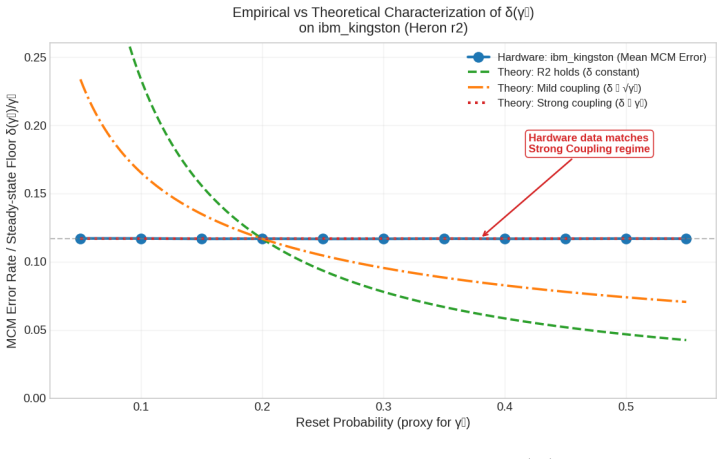
T. Kuwahara, K. Kato, and F. G. S. L. Brand˜ ao. Clustering of conditional mutual information and quantum Gibbs states above a threshold temperature.Phys. Rev. Lett.124, 220601 (2020). doi:10.1103/PhysRevLett.124.220601. arXiv:1910.09425. 12 Figure 4:Lindblad-model emulation of the noise–dissipation couplingδ(γ 0).Steady-state deviation floor ∥ρss−ρGibbs∥...
-
[48]
classically simulating DQMW-Sample
Under the standard hardness assumption that no such efficient classical sampler forµ ⋆exists (on pain of collapsing the polynomial hierarchy), no such classical algorithmA class can exist. Consequently, there is no efficient classical algorithm that can simulate the sampling step that supplies the loss feedback to the multiplicative-weights update of DQMW...
discussion (0)
Sign in with ORCID, Apple, or X to comment. Anyone can read and Pith papers without signing in.