Thermal Emission of Dark Photons from Earth's Core
Pith reviewed 2026-06-26 01:37 UTC · model grok-4.3
The pith
Earth's hot core thermally produces sub-eV dark photons, yielding new bounds on their kinetic mixing parameter via cooling and direct detection.
A machine-rendered reading of the paper's core claim, the machinery that carries it, and where it could break.
Core claim
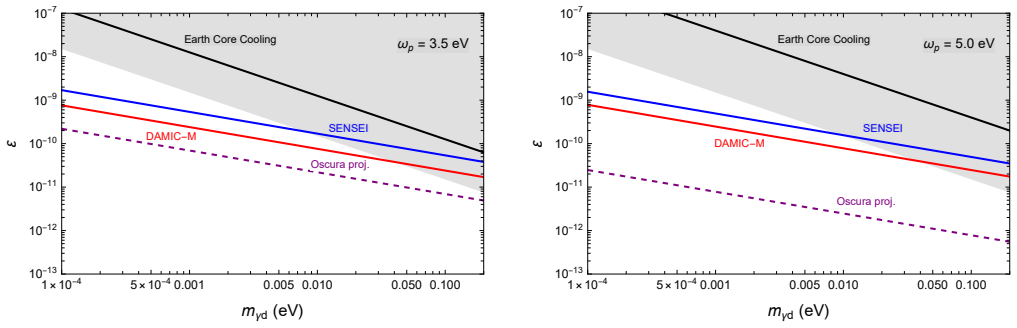
Dark photons in the sub-eV regime may be produced by the Earth's hot core, representing a much less extreme environment than stellar cores. Estimates using Earth core cooling arguments as well as dark matter direct detection bounds from SENSEI and DAMIC-M experiments suggest that the current results constrain new dark photon parameter space. The proposed Oscura experiment may reach two to three orders of magnitude below existing bounds on ε, for dark photon masses ∼10^{-4} eV, depending on the assumed parameters characterizing the Earth core.
What carries the argument
Thermal production of dark photons through kinetic mixing with photons inside the hot, dense plasma of Earth's core, with the resulting energy loss bounded by geophysical cooling observations.
If this is right
- SENSEI and DAMIC-M data already exclude portions of ε parameter space allowed by prior bounds.
- Oscura could probe ε values two to three orders of magnitude smaller than current limits for masses near 10^{-4} eV.
- Earth's core provides a calculable terrestrial source of dark photons complementary to stellar production.
- The resulting constraints vary with the specific geophysical parameters adopted for the core.
Where Pith is reading between the lines
- The same production mechanism could be applied to other planets or moons with hot interiors to generate additional constraints.
- Detector design for dark matter searches could be tuned to look for a steady terrestrial flux of dark photons.
- Significant dark photon energy loss might alter long-term models of planetary thermal evolution.
Load-bearing premise
The temperature, density, and composition of Earth's core are known well enough to compute a reliable thermal dark photon emission rate that cooling data can constrain without other energy-loss channels dominating.
What would settle it
Refined measurements of Earth's core heat flow or temperature that leave no room for the additional energy loss predicted by the calculated dark photon emission rate at the claimed values of ε.
Figures
read the original abstract
Dark photons in the sub-eV regime may be produced by the Earth's hot core, representing a much less extreme environment than stellar cores. We consider this possibility and estimate constraints on the kinetic mixing parameter $\varepsilon$ that governs dark photon coupling to charged particles, using Earth core cooling arguments, as well as dark matter direct detection bounds from SENSEI and DAMIC-M experiments. Our estimates suggest that the current results from these experiments constrain new dark photon parameter space. We also find that the proposed Oscura experiment may reach two to three orders of magnitude below existing bounds on $\varepsilon$, for dark photon masses $\sim 10^{-4}$ eV, depending on the assumed parameters characterizing the Earth core.
Editorial analysis
A structured set of objections, weighed in public.
Referee Report
Summary. The paper claims that sub-eV dark photons can be thermally produced in Earth's core via kinetic mixing and uses core cooling arguments together with direct-detection limits from SENSEI and DAMIC-M to constrain the mixing parameter ε. It asserts that existing data already probe new parameter space and that the proposed Oscura experiment could improve bounds by two to three orders of magnitude near m_γ' ∼ 10^{-4} eV, with all results depending on the assumed geophysical parameters of the core.
Significance. If the production rate can be shown to be robust against geophysical uncertainties, the work would supply a novel terrestrial source for dark-photon constraints that is complementary to stellar cooling bounds. The explicit linkage to near-term direct-detection experiments is a positive feature. However, the manuscript provides only high-level estimates without derivations or error propagation, so the claimed constraints remain provisional.
major comments (2)
- [Abstract and Earth core model section] Abstract and § on Earth core model: the production rate (plasmon conversion or bremsstrahlung) depends on core temperature, density, and electron/ion number densities, yet the text supplies neither an explicit functional form nor propagation of the documented 10–30 % geophysical uncertainties. A factor-of-ten shift in luminosity would move the derived ε bounds by an order of magnitude, rendering the “new parameter space” claim and the Oscura projection unreliable.
- [Cooling argument paragraph] Cooling argument paragraph: the manuscript invokes Earth core cooling to bound ε but does not compare the dark-photon luminosity to other energy-loss channels or quantify how the assumed core parameters enter the final limit. Without this, the cooling bound cannot be shown to be competitive or even applicable.
minor comments (2)
- [Introduction] Notation for the kinetic mixing parameter ε is introduced without an explicit definition of the Lagrangian term; add the standard definition at first use.
- [Figures] Figure captions should state the exact core temperature, density, and composition values adopted for each curve so that the dependence on assumptions is immediately visible.
Simulated Author's Rebuttal
We thank the referee for the detailed and constructive comments. We address each major comment below and indicate planned revisions to strengthen the manuscript.
read point-by-point responses
-
Referee: [Abstract and Earth core model section] Abstract and § on Earth core model: the production rate (plasmon conversion or bremsstrahlung) depends on core temperature, density, and electron/ion number densities, yet the text supplies neither an explicit functional form nor propagation of the documented 10–30 % geophysical uncertainties. A factor-of-ten shift in luminosity would move the derived ε bounds by an order of magnitude, rendering the “new parameter space” claim and the Oscura projection unreliable.
Authors: We agree that explicit functional forms and uncertainty propagation are needed. In revision we will add the standard expressions for plasmon conversion (∝ ε² ω_p² / (ω_p² - m_γ'²)²) and bremsstrahlung rates, together with a sensitivity table showing how 10–30 % variations in T and ρ propagate to luminosity (typically a factor 1.2–1.7 rather than 10, because rates scale as powers of density and temperature). Since L ∝ ε² the resulting shift in ε is only √1.2–√1.7 ≈ 1.1–1.3. We will also display the Oscura projection with this uncertainty band to confirm that new parameter space remains probed. revision: yes
-
Referee: [Cooling argument paragraph] Cooling argument paragraph: the manuscript invokes Earth core cooling to bound ε but does not compare the dark-photon luminosity to other energy-loss channels or quantify how the assumed core parameters enter the final limit. Without this, the cooling bound cannot be shown to be competitive or even applicable.
Authors: The cooling bound requires that dark-photon luminosity not exceed the fraction of the measured core heat flow (∼10–20 TW) that can be attributed to exotic channels. In revision we will add an explicit comparison to standard channels (mantle convection, conduction) and show the dependence L(T,ρ) ∝ T^{3/2} exp(−m_γ'/T) ρ² (or the appropriate power for each process), using the fiducial values T=5700 K, ρ=11 g cm^{-3}. This will demonstrate that the bound is applicable and competitive with stellar limits once the parameter dependence is quantified. revision: yes
Circularity Check
No circularity; derivation uses external geophysical inputs and experimental bounds
full rationale
The paper calculates thermal dark photon production via standard kinetic mixing rates applied to external geophysical models of Earth's core (temperature, density, composition) and compares the resulting luminosity or flux to cooling limits and direct-detection bounds from SENSEI, DAMIC-M, and Oscura. No step reduces a claimed constraint or prediction to a quantity fitted or defined by the paper's own equations; no self-citation is load-bearing, and no ansatz or uniqueness theorem is smuggled in. The central estimates therefore remain independent of the paper's internal definitions.
Axiom & Free-Parameter Ledger
free parameters (1)
- Earth core temperature, density, and composition parameters
axioms (1)
- domain assumption Dark photons couple to charged particles via kinetic mixing parameter ε and can be thermally produced in hot dense matter
Reference graph
Works this paper leans on
-
[1]
Earth Core Cooling
(solid blue) and DAMIC-M [25] experiments (solid red). The last line is a projection for the proposed Oscura experiment [26] (dashed purple). Here, we have setω p = 3.5eV . emission characterized by energies ofO(ω p)in Eq. (4), we haveq e ∼2keV . Hence, at the level of our approximations, we may expect screening not to have a significant effect on our est...
-
[2]
N. Arkani-Hamed, D. P. Finkbeiner, T. R. Slatyer, and N. Weiner, A Theory of Dark Matter, Phys. Rev. D79, 015014 (2009), arXiv:0810.0713 [hep-ph]
Pith/arXiv arXiv 2009
-
[3]
Holdom, Two U(1)’s and Epsilon Charge Shifts, Phys
B. Holdom, Two U(1)’s and Epsilon Charge Shifts, Phys. Lett. B166, 196 (1986)
1986
-
[4]
E. C. G. Stueckelberg, Interaction energy in electrodynamics and in the field theory of nuclear forces, Helv. Phys. Acta11, 225 (1938)
1938
-
[5]
M. Pospelov, A. Ritz, and M. B. V oloshin, Secluded WIMP Dark Matter, Phys. Lett. B662, 53 (2008), arXiv:0711.4866 [hep-ph]
Pith/arXiv arXiv 2008
-
[6]
C. J. Davies, Cooling history of earth’s core with high thermal conductivity, Physics of the Earth and Planetary Interiors247, 65 (2015)
2015
-
[7]
J. N. Bahcall, A. M. Serenelli, and S. Basu, 10,000 standard solar models: a Monte Carlo simulation, Astrophys. J. Suppl. 165, 400 (2006), arXiv:astro-ph/0511337
Pith/arXiv arXiv 2006
-
[8]
H. Davoudiasl and P. Huber, Thermal production of axions in 4 the Earth, Phys. Rev. D79, 095024 (2009), arXiv:0903.0618 [hep-ph]
Pith/arXiv arXiv 2009
-
[9]
A. Mirizzi, J. Redondo, and G. Sigl, Microwave Background Constraints on Mixing of Photons with Hidden Photons, JCAP 03, 026, arXiv:0901.0014 [hep-ph]
-
[10]
J. Jaeckel and A. Ringwald, The Low-Energy Frontier of Particle Physics, Ann. Rev. Nucl. Part. Sci.60, 405 (2010), arXiv:1002.0329 [hep-ph]
Pith/arXiv arXiv 2010
-
[11]
Dimopoulos, G
S. Dimopoulos, G. D. Starkman, and B. W. Lynn, Atomic En- hancements in the Detection of Weakly Interacting Particles, Phys. Lett. B168, 145 (1986)
1986
-
[12]
F. T. Avignone, III, R. L. Brodzinski, S. Dimopoulos, G. D. Starkman, A. K. Drukier, D. N. Spergel, G. Gelmini, and B. W. Lynn, Laboratory Limits on Solar Axions From an Ultralow Background Germanium Spectrometer, Phys. Rev. D35, 2752 (1987)
1987
-
[13]
H. An, M. Pospelov, J. Pradler, and A. Ritz, Direct Detection Constraints on Dark Photon Dark Matter, Phys. Lett. B747, 331 (2015), arXiv:1412.8378 [hep-ph]
Pith/arXiv arXiv 2015
-
[14]
I. M. Bloch, R. Essig, K. Tobioka, T. V olansky, and T.-T. Yu, Searching for Dark Absorption with Direct Detection Experi- ments, JHEP06, 087, arXiv:1608.02123 [hep-ph]
-
[15]
Y . Hochberg, T. Lin, and K. M. Zurek, Absorption of light dark matter in semiconductors, Phys. Rev. D95, 023013 (2017), arXiv:1608.01994 [hep-ph]
Pith/arXiv arXiv 2017
-
[16]
A. C. Shekar, B. Dutta, B. Hu, A. Schneider, and L. Strigari, work in progress (2026)
2026
-
[17]
F. Wu, S. Wu, C.-Z. Wang, K.-M. Ho, R. M. Wentzcovitch, and Y . Sun, Melting temperature of iron under the earth’s inner core condition from deep machine learning, Geoscience Fron- tiers15, 101925 (2024)
2024
-
[18]
Nautiyal and S
T. Nautiyal and S. Auluck, Electronic structure of ferromag- netic iron: Fermi surface, Physical Review B32, 6424 (1985)
1985
-
[19]
H. An, M. Pospelov, and J. Pradler, New stellar constraints on dark photons, Phys. Lett. B725, 190 (2013), arXiv:1302.3884 [hep-ph]
Pith/arXiv arXiv 2013
-
[20]
H. An, M. Pospelov, and J. Pradler, Dark Matter Detectors as Dark Photon Helioscopes, Phys. Rev. Lett.111, 041302 (2013), arXiv:1304.3461 [hep-ph]
Pith/arXiv arXiv 2013
-
[21]
Kumar and S
M. Kumar and S. Auluck, Effect of pressure on the magneto- optical properties of bcc and bct iron, Physica B: Condensed Matter390, 185 (2007)
2007
-
[22]
J. K. Butler, M. Martinez, R. Kilci, and G. A. Evans, Optical properties of iron to 30 ev, Materials Sciences and Applications 12, 622 (2021)
2021
-
[23]
A. Caputo and R. Essig, The Dark Photon: a 2026 Perspective (2026) arXiv:2603.08430 [hep-ph]
Pith/arXiv arXiv 2026
-
[24]
O’Hare, Axionlimits: Repository of axion and dark photon constraints,https://github.com/cajohare/ AxionLimits(2020), accessed: May 2025
C. O’Hare, Axionlimits: Repository of axion and dark photon constraints,https://github.com/cajohare/ AxionLimits(2020), accessed: May 2025
2020
-
[25]
P. Adariet al.(SENSEI), First Direct-Detection Results on Sub- GeV Dark Matter Using the SENSEI Detector at SNOLAB, Phys. Rev. Lett.134, 011804 (2025), arXiv:2312.13342 [astro- ph.CO]
arXiv 2025
-
[26]
Aggarwalet al.(DAMIC-M), Probing Benchmark Models of Hidden-Sector Dark Matter with DAMIC-M, Phys
K. Aggarwalet al.(DAMIC-M), Probing Benchmark Models of Hidden-Sector Dark Matter with DAMIC-M, Phys. Rev. Lett. 135, 071002 (2025), arXiv:2503.14617 [hep-ex]
arXiv 2025
-
[27]
Aguilar-Arevaloet al.(Oscura), The Oscura Experiment, (2022), arXiv:2202.10518 [astro-ph.IM]
A. Aguilar-Arevaloet al.(Oscura), The Oscura Experiment, (2022), arXiv:2202.10518 [astro-ph.IM]
arXiv 2022
-
[28]
J. Tiffenberg, M. Sofo-Haro, A. Drlica-Wagner, R. Essig, Y . Guardincerri, S. Holland, T. V olansky, and T.-T. Yu (SEN- SEI), Single-electron and single-photon sensitivity with a sil- icon Skipper CCD, Phys. Rev. Lett.119, 131802 (2017), arXiv:1706.00028 [physics.ins-det]
Pith/arXiv arXiv 2017
-
[29]
I. M. Blochet al.(SENSEI), SENSEI at SNOLAB: Single- Electron Event Rate and Implications for Dark Matter, Phys. Rev. Lett.134, 161002 (2025), arXiv:2410.18716 [astro- ph.CO]
arXiv 2025
-
[30]
P. Salucci, F. Nesti, G. Gentile, and C. F. Martins, The dark matter density at the Sun’s location, Astron. Astrophys.523, A83 (2010), arXiv:1003.3101 [astro-ph.GA]
Pith/arXiv arXiv 2010
-
[31]
M. Pospelov, A. Ritz, and M. B. V oloshin, Bosonic super- WIMPs as keV-scale dark matter, Phys. Rev. D78, 115012 (2008), arXiv:0807.3279 [hep-ph]. 5
Pith/arXiv arXiv 2008
discussion (0)
Sign in with ORCID, Apple, or X to comment. Anyone can read and Pith papers without signing in.