Studying the QCD Matter produced in Heavy-Ion Collisions using the MUSES Calculation Engine
Pith reviewed 2026-06-26 00:45 UTC · model grok-4.3
The pith
MUSES Calculation Engine performs relativistic viscous hydrodynamic simulations of heavy-ion collisions with equations of state featuring a movable critical point.
A machine-rendered reading of the paper's core claim, the machinery that carries it, and where it could break.
Core claim
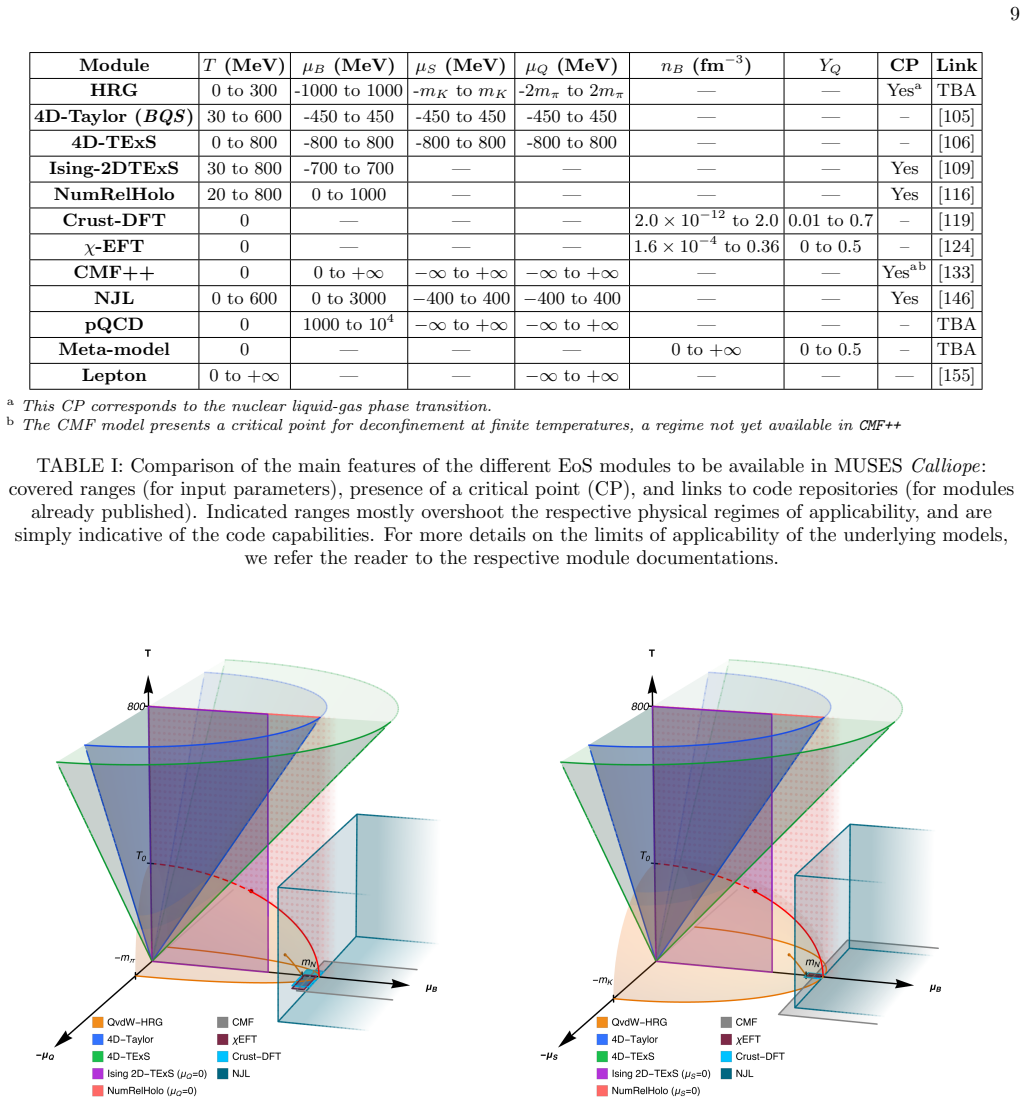
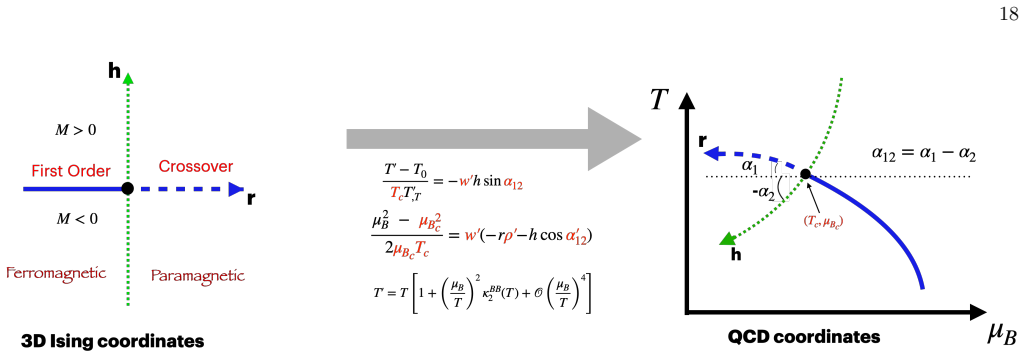
The MUSES Calculation Engine Calliope supplies modules for equations of state from lattice QCD or phenomenological models with or without a critical point, spanning two to four dimensions in temperature and chemical potentials, plus modules for thermodynamic quantities such as pressure Hessian elements and transport coefficients. It supports workflows that merge equations of state consistently and feed results into an equation of state inverter for hydrodynamic use. This framework is applied to relativistic viscous hydrodynamic simulations at √s_NN = 7.7, 19.6, and 39 GeV using equations of state with extended T and μ_B coverage, a movable critical point, and transport coefficients that phen
What carries the argument
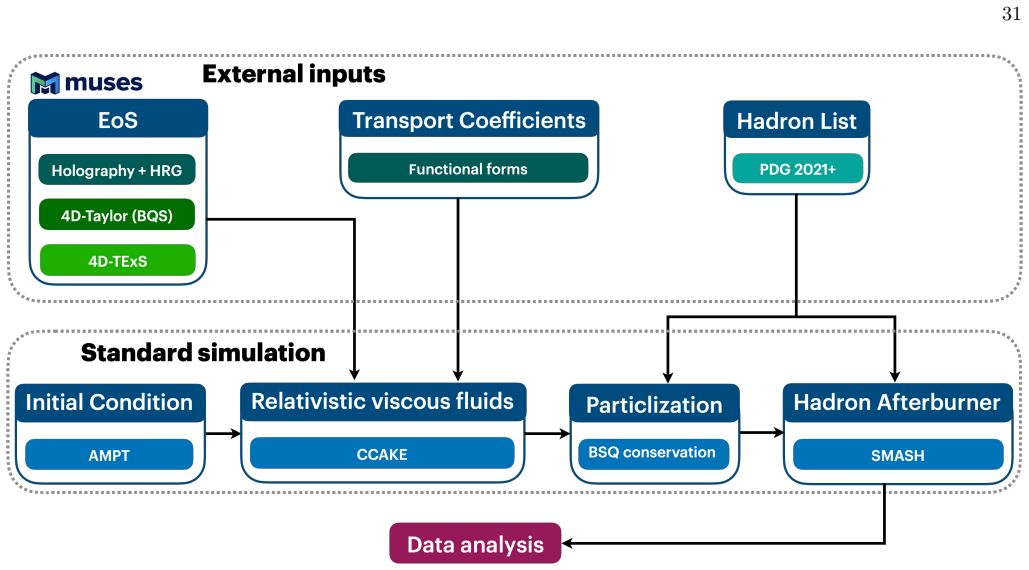
The MUSES Calculation Engine Calliope, which integrates equations of state modules, thermodynamic calculators, and an equation of state inverter to prepare inputs for hydrodynamic simulations.
If this is right
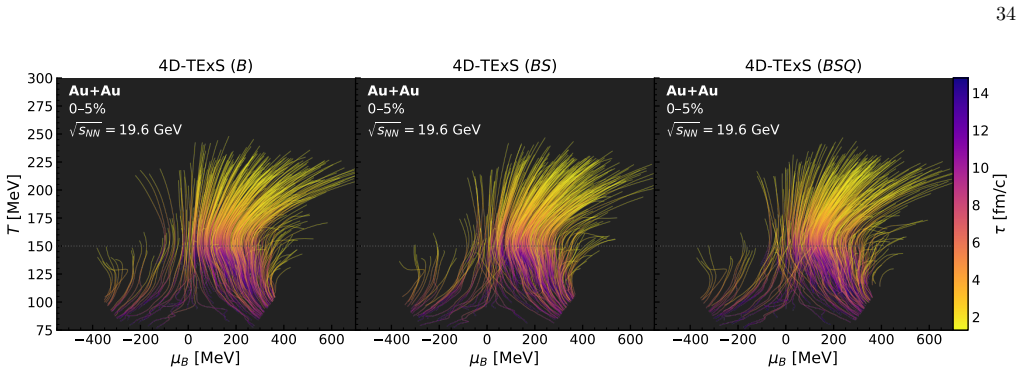
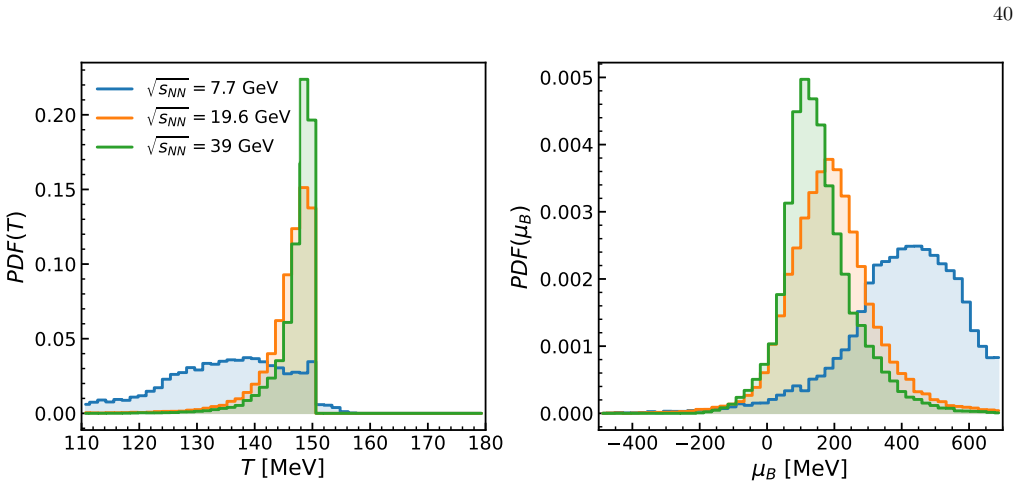
- Hydrodynamic simulations become possible with equations of state that include a movable critical point at multiple collision energies.
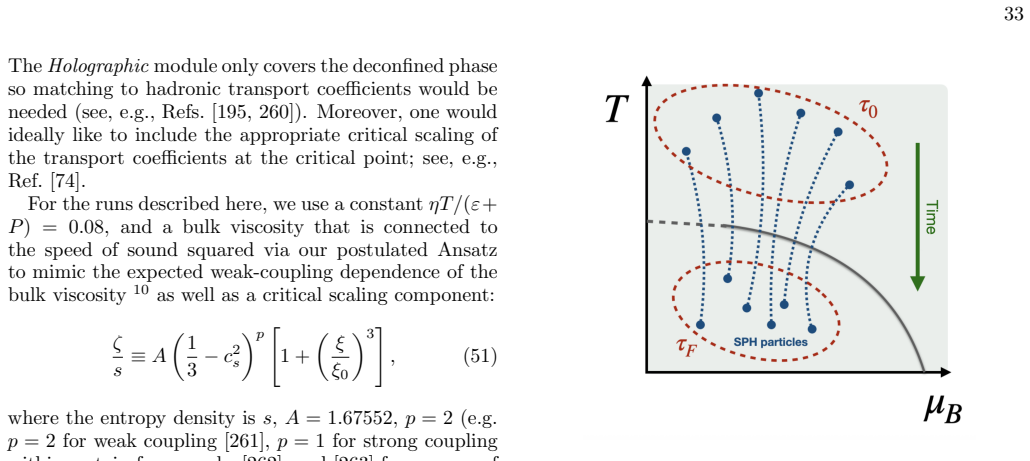
- Transport coefficients can include phenomenological encoding of critical scaling near the critical point.
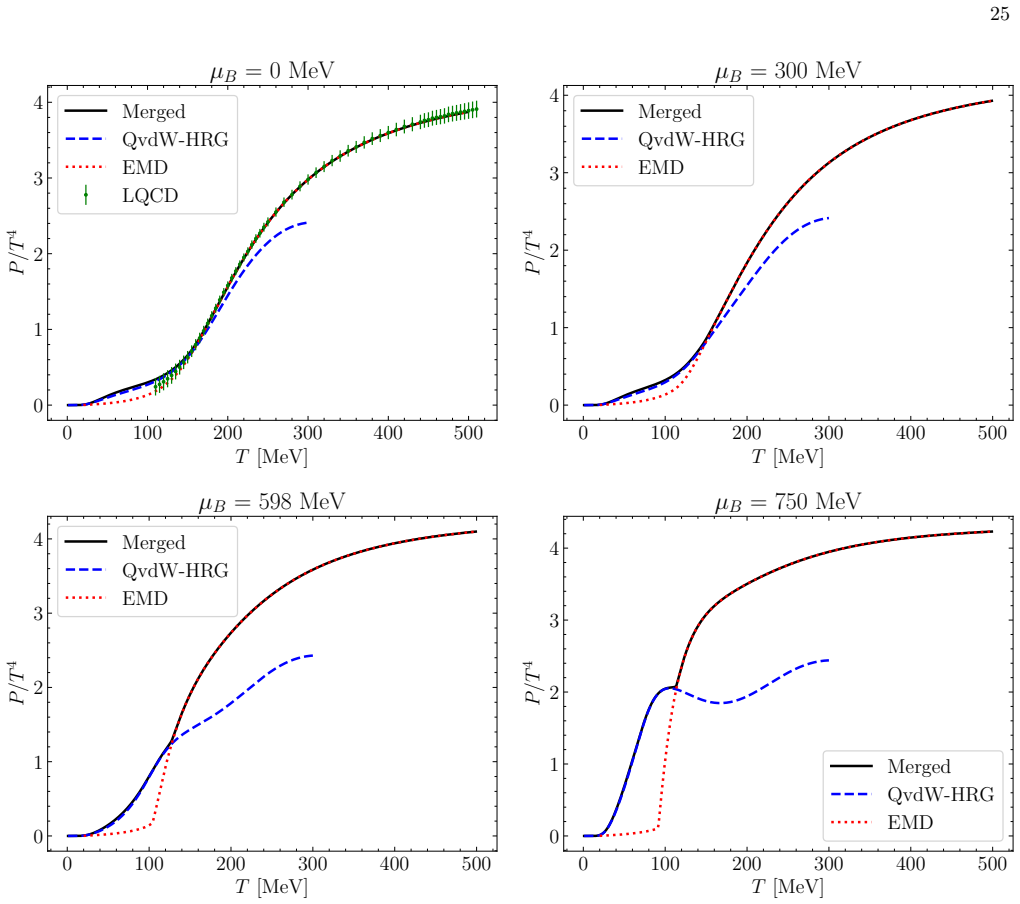
- Different equations of state can be merged to extend coverage in temperature and baryon chemical potential while maintaining thermodynamic consistency.
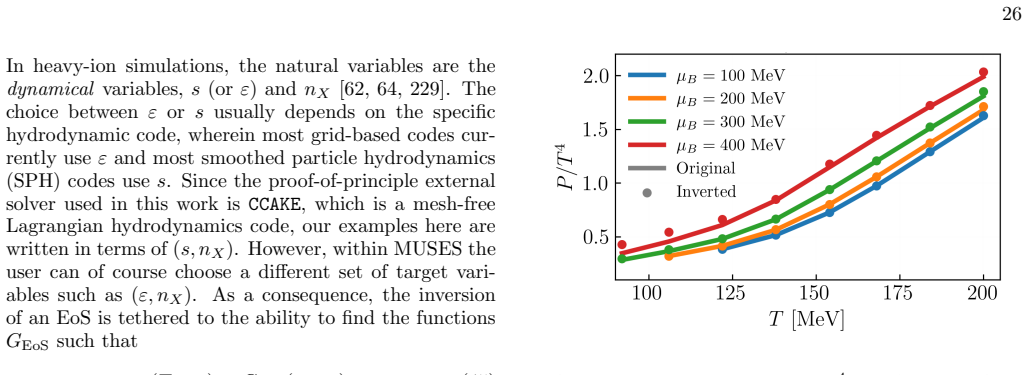
- Inverted equations of state produce direct inputs ready for use in relativistic viscous hydrodynamic codes.
Where Pith is reading between the lines
- This setup could allow direct tests of how shifting the critical point location alters predicted observables such as elliptic flow at the listed energies.
- Inclusion of strangeness and electric charge chemical potentials in four-dimensional equations of state may reduce uncertainties when comparing to real collision data that involve net strangeness and charge.
- The same merging and inversion workflow could be reused to incorporate future lattice QCD results with improved critical point constraints.
Load-bearing premise
The phenomenological transport coefficients accurately capture critical scaling behavior near the movable critical point without introducing uncontrolled artifacts.
What would settle it
A systematic mismatch between the simulated flow harmonics or particle yields at √s_NN = 7.7 GeV and experimental data that persists after varying the critical point location would indicate the setup does not correctly capture the relevant physics.
Figures






read the original abstract
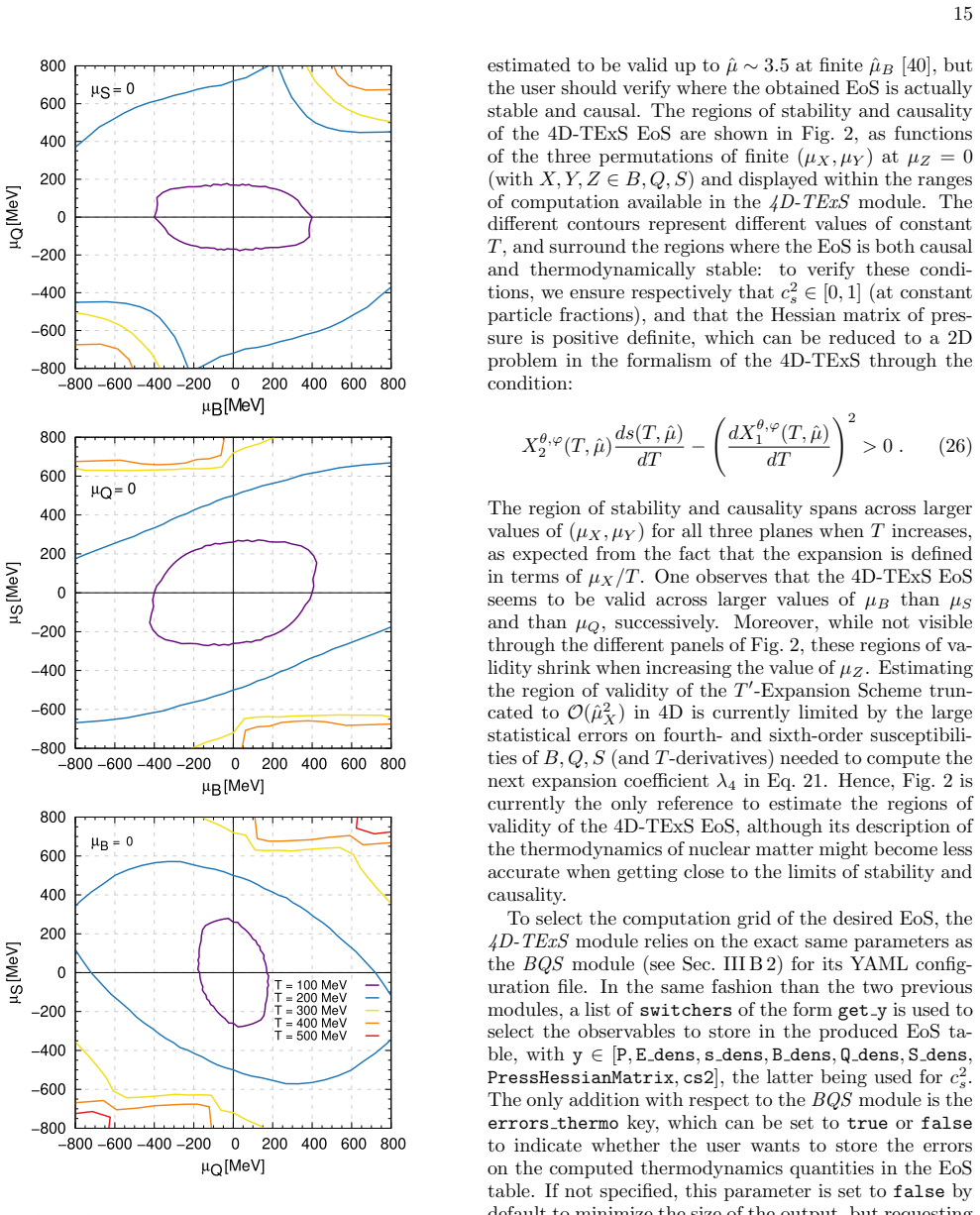
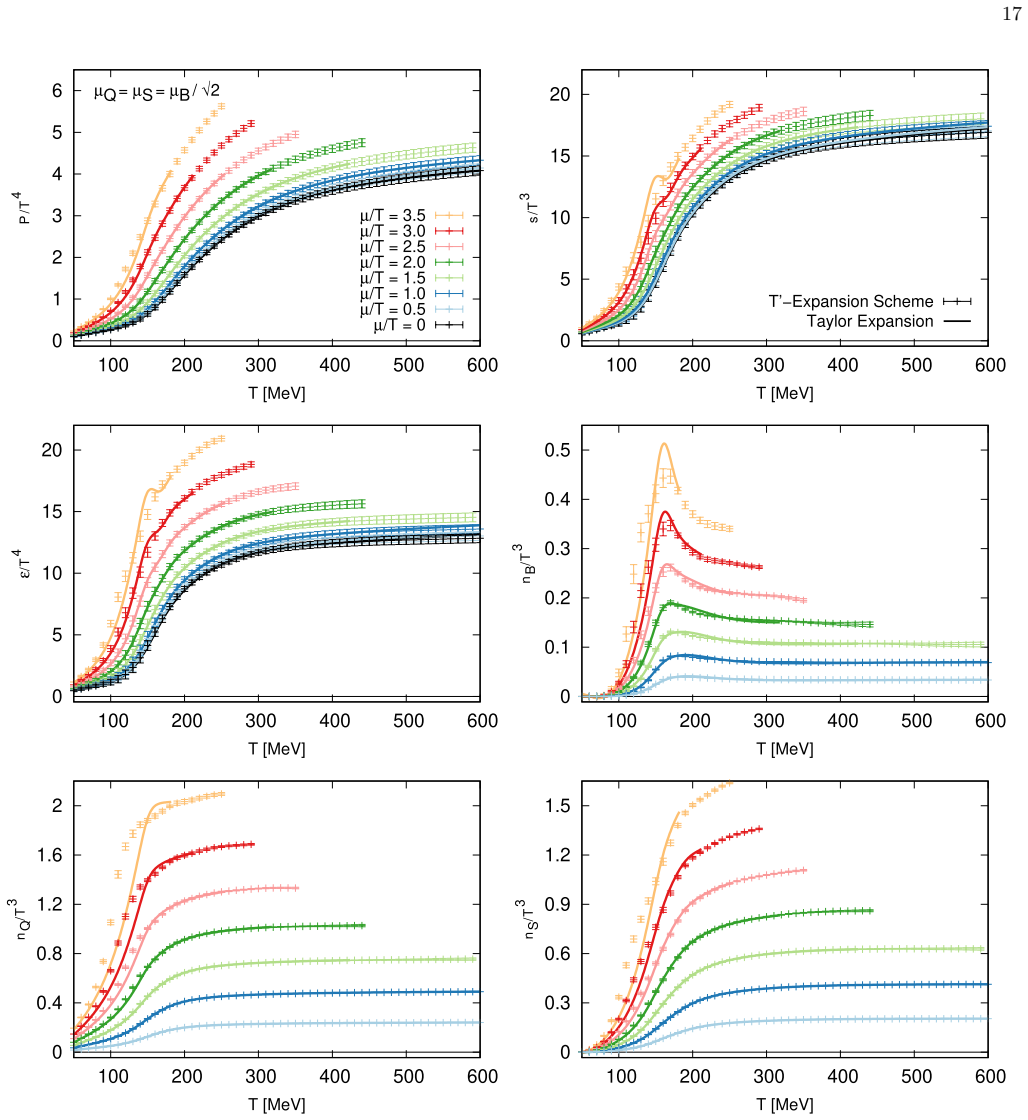
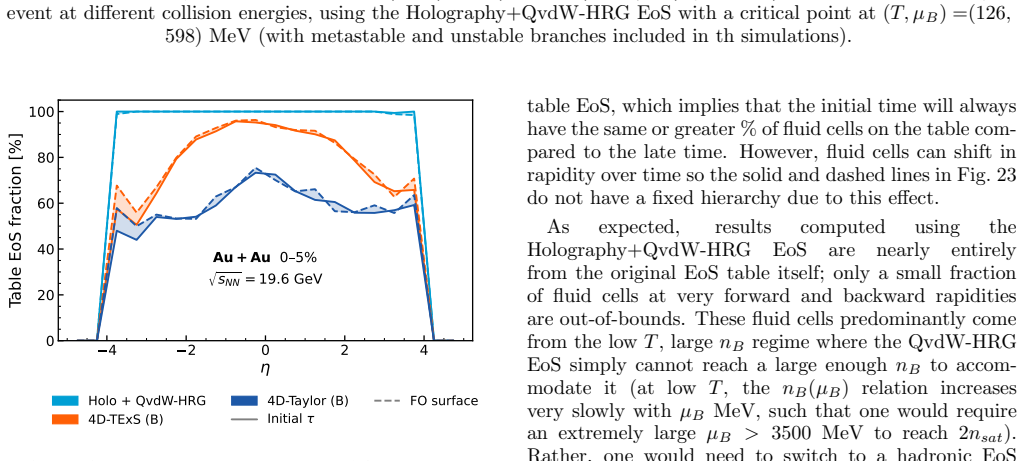
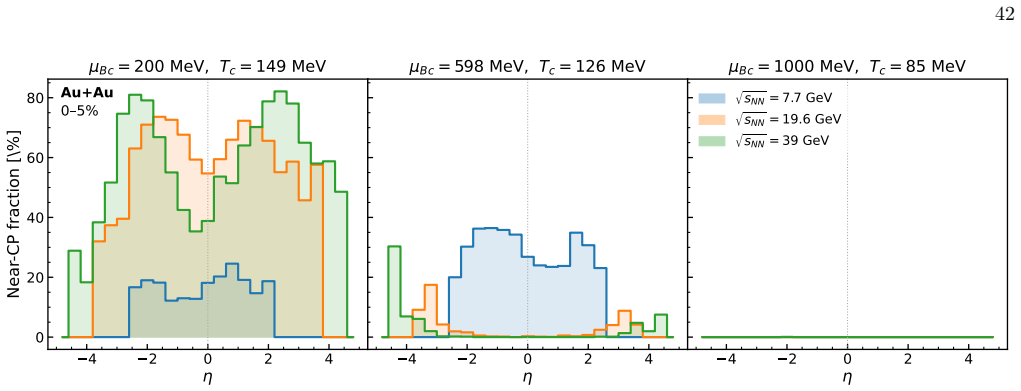
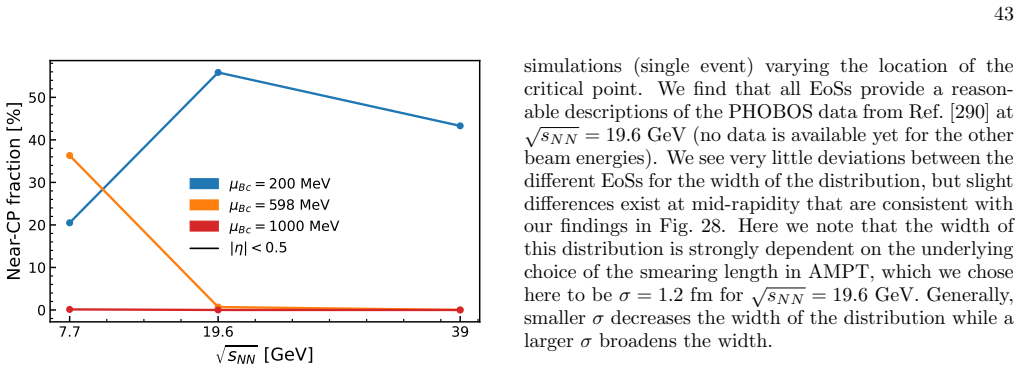
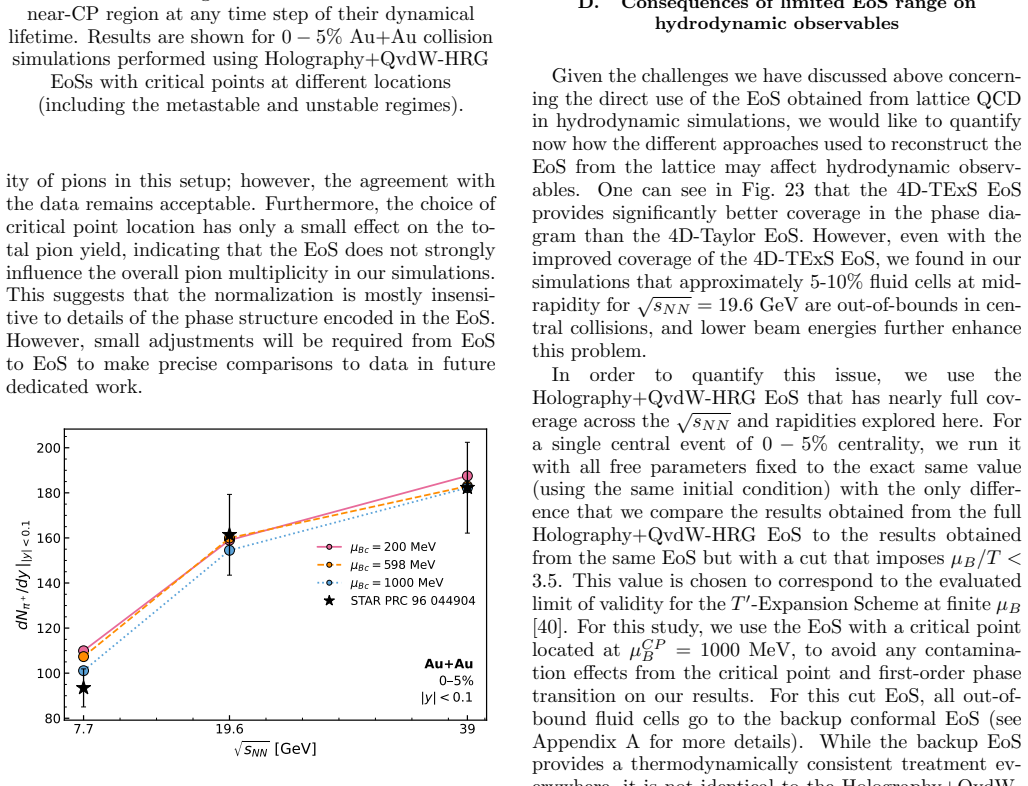
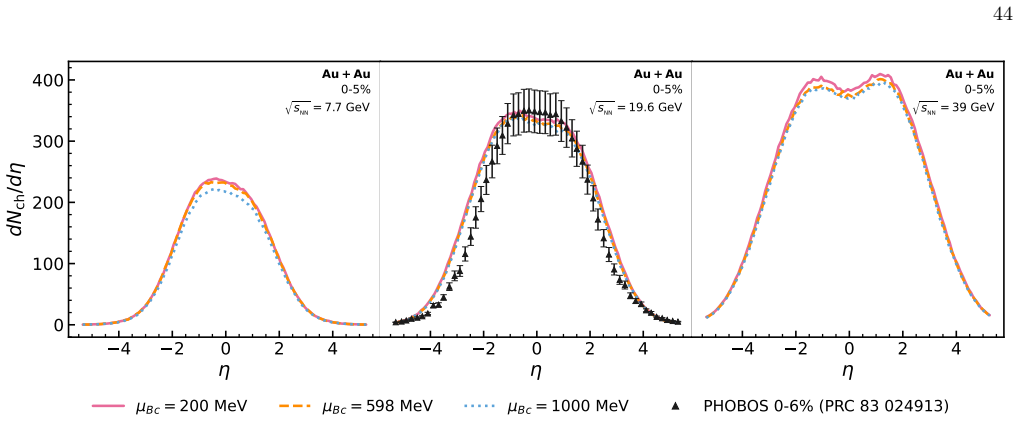
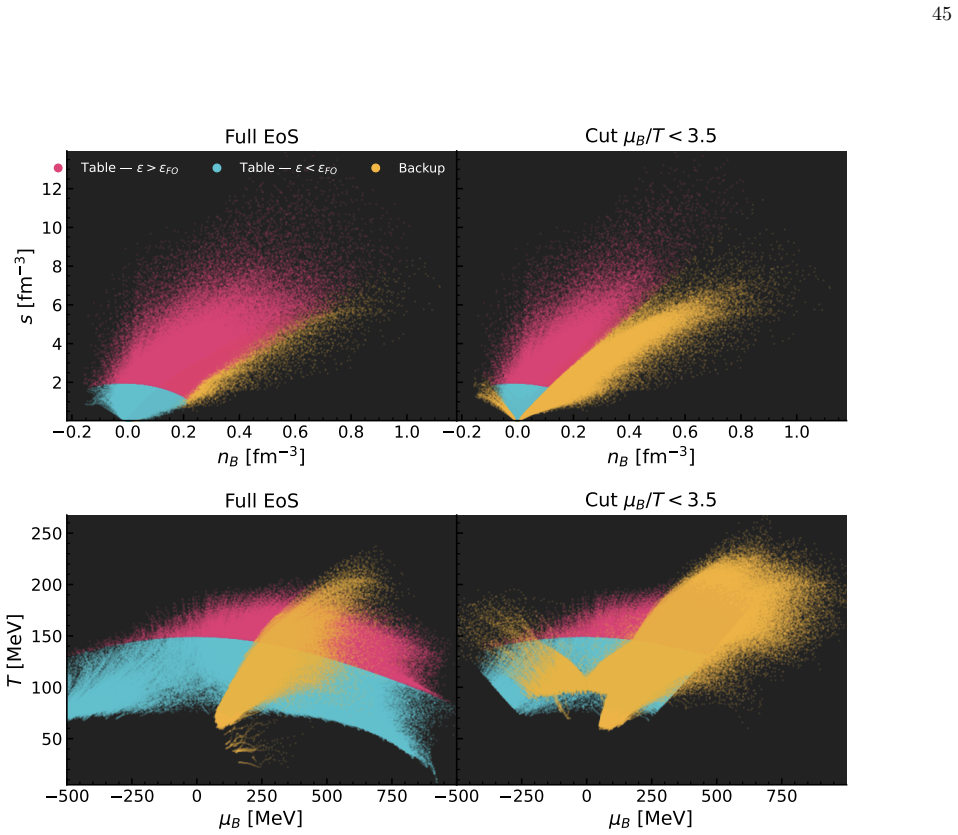
The equation of state of hot and dense matter is essential for describing heavy-ion collisions at all collision energies. Here, we explore the capabilities of the latest version of the MUSES Calculation Engine, $\textit{Calliope}$, focusing on software modules and workflows that compute the equation of state and observable properties of the matter produced in heavy-ion collisions. These include several equations of state, ranging from first-principles lattice QCD to phenomenological approaches, with or without a critical point, and with phase-space dimensionality ranging from two dimensions defined by temperature $T$ and baryon chemical potential $\mu_B$, to four dimensions after the addition of strangeness and electric-charge chemical potentials $\mu_S$ and $\mu_Q$. We also discuss modules that provide additional thermodynamic quantities and observables relevant for heavy-ion modeling, including elements of the pressure Hessian matrix and transport coefficients. Workflow examples are constructed that merge two equations of state thermodynamically consistently to extend phase-diagram coverage, and feed the results into an equation of state inverter to produce inputs suitable for hydrodynamic simulations. Finally, we apply this framework to perform a relativistic viscous hydrodynamic simulation with equations of state with an extended $T$ and $\mu_B$ coverage and a movable critical point, including effects from transport coefficients that phenomenologically encode critical scaling, at collision energies $\sqrt{s_{NN}}=7.7, 19.6$, and $39$ GeV.
Editorial analysis
A structured set of objections, weighed in public.
Referee Report
Summary. The manuscript presents the MUSES Calculation Engine (Calliope) and its software modules for generating equations of state (EOS) spanning lattice QCD results to phenomenological models with or without a critical point, in 2D (T, μ_B) to 4D (including μ_S, μ_Q) phase space. It describes workflows for thermodynamically consistent merging of EOS, computation of additional thermodynamic quantities including pressure Hessian elements and transport coefficients, EOS inversion for hydrodynamic use, and an application performing relativistic viscous hydrodynamic simulations at √s_NN = 7.7, 19.6, and 39 GeV that incorporate a movable critical point and transport coefficients encoding critical scaling.
Significance. If the described workflows function as outlined, the engine offers a practical integrated platform for heavy-ion collision modeling by combining first-principles and phenomenological inputs with consistent merging and hydro-ready outputs. The explicit support for movable critical points and phenomenological critical scaling in transport coefficients, together with the demonstrated merging and inversion steps, strengthens its utility for RHIC beam-energy-scan studies.
minor comments (3)
- [Abstract] Abstract: the phrase 'transport coefficients that phenomenologically encode critical scaling' is used without a reference to the explicit functional form or module name; adding a brief pointer to the relevant section or equation would improve traceability for readers.
- [Abstract] Abstract: the collision energies are given as √s_NN=7.7, 19.6, and 39 GeV; the manuscript should adopt a uniform notation (e.g., √s_{NN}) throughout and define the symbol on first use.
- The description of the hydrodynamic application states that the EOS have 'extended T and μ_B coverage' after merging, but does not quantify the extension (e.g., the new range in T or μ_B); a short statement or table entry would make the improvement concrete.
Simulated Author's Rebuttal
We thank the referee for the positive summary of our work on the MUSES Calculation Engine (Calliope) and for recommending minor revision. No specific major comments were listed in the report, so we have no points to address point-by-point at this stage. We remain available to incorporate any additional feedback or clarifications that may arise.
Circularity Check
No significant circularity; software demonstration using external inputs
full rationale
The manuscript presents the MUSES Calliope engine as a modular workflow tool that ingests pre-existing lattice QCD and phenomenological EOS tables (with or without critical points), merges them thermodynamically, inverts for hydro variables, and feeds results into standard relativistic viscous hydro codes at fixed beam energies. No load-bearing derivation reduces a claimed prediction to a fitted parameter or self-citation by the paper's own equations. The transport-coefficient module is described as 'phenomenologically encode critical scaling' without asserting that the encoding is accurate or artifact-free; the central claim is simply that the framework can incorporate such modules. All cited EOS and hydro methods are external to the present work and are not redefined inside it. This is the expected 0-2 outcome for an engineering/software paper whose value lies in integration rather than novel first-principles reduction.
Axiom & Free-Parameter Ledger
free parameters (1)
- critical point location parameters
axioms (2)
- domain assumption Thermodynamic consistency can be maintained when merging lattice QCD and phenomenological EoS
- domain assumption Relativistic viscous hydrodynamics remains applicable at the cited collision energies
Reference graph
Works this paper leans on
-
[1]
Achenbachet al., The present and future of QCD, Nucl
P. Achenbachet al., The present and future of QCD, Nucl. Phys. A1047, 122874 (2024), arXiv:2303.02579 [hep-ph]
arXiv 2024
-
[2]
Sorensenet al., Dense nuclear matter equation of state from heavy-ion collisions, Prog
A. Sorensenet al., Dense nuclear matter equation of state from heavy-ion collisions, Prog. Part. Nucl. Phys. 134, 104080 (2024), arXiv:2301.13253 [nucl-th]
arXiv 2024
-
[3]
E. R. Most, A. Motornenko, J. Steinheimer, V. Dex- heimer, M. Hanauske, L. Rezzolla, and H. Stoecker, Probing neutron-star matter in the lab: Similarities and differences between binary mergers and heavy- ion collisions, Phys. Rev. D107, 043034 (2023), arXiv:2201.13150 [nucl-th]. 50
arXiv 2023
-
[4]
V. Dexheimer, J. Noronha, J. Noronha-Hostler, C. Ratti, and N. Yunes, Future physics perspectives on the equation of state from heavy ion collisions to neutron stars, J. Phys. G48, 073001 (2021), arXiv:2010.08834 [nucl-th]
arXiv 2021
-
[5]
R. Kumaret al.(MUSES), Theoretical and experimen- tal constraints for the equation of state of dense and hot matter, Living Rev. Rel.27, 3 (2024), arXiv:2303.17021 [nucl-th]
arXiv 2024
-
[6]
M. Gyulassy and L. McLerran, New forms of QCD mat- ter discovered at RHIC, Nucl. Phys. A750, 30 (2005), arXiv:nucl-th/0405013
Pith/arXiv arXiv 2005
-
[7]
Y. Aoki, G. Endrodi, Z. Fodor, S. D. Katz, and K. K. Sz- abo, The Order of the quantum chromodynamics transi- tion predicted by the standard model of particle physics, Nature443, 675 (2006), arXiv:hep-lat/0611014
Pith/arXiv arXiv 2006
- [8]
-
[9]
A. Lovatoet al., Long Range Plan: Dense matter the- ory for heavy-ion collisions and neutron stars, (2022), arXiv:2211.02224 [nucl-th]
arXiv 2022
-
[10]
L. Du, A. Sorensen, and M. Stephanov, The QCD phase diagram and Beam Energy Scan physics: A theory overview, Int. J. Mod. Phys. E33, 2430008 (2024), arXiv:2402.10183 [nucl-th]
arXiv 2024
-
[11]
M. A. Stephanov, K. Rajagopal, and E. V. Shuryak, Signatures of the tricritical point in QCD, Phys. Rev. Lett.81, 4816 (1998), arXiv:hep-ph/9806219
Pith/arXiv arXiv 1998
-
[12]
D. Tlusty, The RHIC Beam Energy Scan Phase II: Physics and Upgrades, in13th Conference on the In- tersections of Particle and Nuclear Physics(2018) arXiv:1810.04767 [nucl-ex]
Pith/arXiv arXiv 2018
-
[13]
B. E. Aboonaet al.(STAR), Precision Measurement of Net-Proton-Number Fluctuations in Au+Au Colli- sions at RHIC, Phys. Rev. Lett.135, 142301 (2025), arXiv:2504.00817 [nucl-ex]
arXiv 2025
-
[14]
T. Ablyazimovet al.(CBM), Challenges in QCD matter physics –The scientific programme of the Compressed Baryonic Matter experiment at FAIR, Eur. Phys. J. A 53, 60 (2017), arXiv:1607.01487 [nucl-ex]
Pith/arXiv arXiv 2017
-
[15]
M. Duranteet al., All the fun of the FAIR: fundamental physics at the facility for antiproton and ion research, Phys. Scripta94, 033001 (2019), arXiv:1903.05693 [nucl-th]
Pith/arXiv arXiv 2019
-
[16]
S. Nagamiya, Heavy-Ion Collisions toward High- Density Nuclear Matter, Entropy24, 482 (2022), arXiv:2204.12047 [nucl-ex]
arXiv 2022
-
[17]
Bazavovet al., Freeze-out Conditions in Heavy Ion Collisions from QCD Thermodynamics, Phys
A. Bazavovet al., Freeze-out Conditions in Heavy Ion Collisions from QCD Thermodynamics, Phys. Rev. Lett.109, 192302 (2012), arXiv:1208.1220 [hep-lat]
Pith/arXiv arXiv 2012
-
[18]
A. Bazavovet al., Additional Strange Hadrons from QCD Thermodynamics and Strangeness Freezeout in Heavy Ion Collisions, Phys. Rev. Lett.113, 072001 (2014), arXiv:1404.6511 [hep-lat]
Pith/arXiv arXiv 2014
-
[19]
R. Bellwied, S. Borsanyi, Z. Fodor, J. G¨ unther, S. D. Katz, C. Ratti, and K. K. Szabo, The QCD phase di- agram from analytic continuation, Phys. Lett. B751, 559 (2015), arXiv:1507.07510 [hep-lat]
Pith/arXiv arXiv 2015
-
[20]
W.-j. Fu, J. M. Pawlowski, and F. Rennecke, Strangeness Neutrality and QCD Thermodynamics, Sci- Post Phys. Core2, 002 (2020), arXiv:1808.00410 [hep- ph]
arXiv 2020
-
[21]
W.-j. Fu, J. M. Pawlowski, and F. Rennecke, Strangeness neutrality and baryon-strangeness correlations, Phys. Rev. D100, 111501 (2019), arXiv:1809.01594 [hep-ph]
arXiv 2019
-
[22]
S. Borsanyi, J. N. Guenther, R. Kara, Z. Fodor, P. Parotto, A. Pasztor, C. Ratti, and K. K. Szabo, Re- summed lattice QCD equation of state at finite baryon density: Strangeness neutrality and beyond, Phys. Rev. D105, 114504 (2022), arXiv:2202.05574 [hep-lat]
arXiv 2022
-
[23]
F. Nana, J. Salinas San Mart´ ın, and J. Noronha-Hostler, RHIC √sN N = 200 GeV hadron yields and the isospin dependent equation of state, (2024), arXiv:2411.03705 [nucl-th]
arXiv 2024
- [24]
-
[25]
J. Cleymans and K. Redlich, Unified description of freezeout parameters in relativistic heavy ion colli- sions, Phys. Rev. Lett.81, 5284 (1998), arXiv:nucl- th/9808030
arXiv 1998
-
[26]
J. Cleymans, H. Oeschler, K. Redlich, and S. Wheaton, Comparison of chemical freeze-out criteria in heavy-ion collisions, Phys. Rev. C73, 034905 (2006), arXiv:hep- ph/0511094
arXiv 2006
-
[27]
M. Troyer and U.-J. Wiese, Computational complex- ity and fundamental limitations to fermionic quantum Monte Carlo simulations, Phys. Rev. Lett.94, 170201 (2005), arXiv:cond-mat/0408370
Pith/arXiv arXiv 2005
-
[28]
Philipsen, The QCD equation of state from the lattice, Prog
O. Philipsen, The QCD equation of state from the lattice, Prog. Part. Nucl. Phys.70, 55 (2013), arXiv:1207.5999 [hep-lat]
Pith/arXiv arXiv 2013
-
[29]
P. de Forcrand and O. Philipsen, The QCD phase diagram for small densities from imaginary chemical potential, Nucl. Phys. B642, 290 (2002), arXiv:hep- lat/0205016
arXiv 2002
-
[30]
M. D’Elia and M.-P. Lombardo, Finite density QCD via imaginary chemical potential, Phys. Rev. D67, 014505 (2003), arXiv:hep-lat/0209146
Pith/arXiv arXiv 2003
-
[31]
C. Bonati, M. D’Elia, M. Mariti, M. Mesiti, F. Negro, and F. Sanfilippo, Curvature of the chiral pseudocriti- cal line in QCD: Continuum extrapolated results, Phys. Rev. D92, 054503 (2015), arXiv:1507.03571 [hep-lat]
Pith/arXiv arXiv 2015
-
[32]
M. D’Elia, G. Gagliardi, and F. Sanfilippo, Higher or- der quark number fluctuations via imaginary chemical potentials inN f = 2+1 QCD, Phys. Rev. D95, 094503 (2017), arXiv:1611.08285 [hep-lat]
Pith/arXiv arXiv 2017
-
[33]
J. N. Guenther, R. Bellwied, S. Borsanyi, Z. Fodor, S. D. Katz, A. Pasztor, C. Ratti, and K. K. Szab´ o, The QCD equation of state at finite density from an- alytical continuation, Nucl. Phys. A967, 720 (2017), arXiv:1607.02493 [hep-lat]
Pith/arXiv arXiv 2017
-
[34]
C. Bonati, M. D’Elia, F. Negro, F. Sanfilippo, and K. Zambello, Curvature of the pseudocritical line in QCD: Taylor expansion matches analytic continuation, Phys. Rev. D98, 054510 (2018), arXiv:1805.02960 [hep- lat]
Pith/arXiv arXiv 2018
-
[35]
S. Borsanyi, Z. Fodor, J. N. Guenther, S. K. Katz, K. K. Szabo, A. Pasztor, I. Portillo, and C. Ratti, Higher order fluctuations and correlations of conserved charges from lattice QCD, JHEP10, 205, arXiv:1805.04445 [hep-lat]
-
[36]
D. Bollweg, F. Karsch, S. Mukherjee, and C. Schmidt, Higher order cumulants of net baryon-number distri- butions at non-zeroµ B, Nucl. Phys. A1005, 121835 51 (2021), arXiv:2002.01837 [hep-lat]
arXiv 2021
-
[37]
S. Borsanyi, Z. Fodor, J. N. Guenther, R. Kara, S. D. Katz, P. Parotto, A. Pasztor, C. Ratti, and K. K. Szabo, QCD Crossover at Finite Chemical Potential from Lat- tice Simulations, Phys. Rev. Lett.125, 052001 (2020), arXiv:2002.02821 [hep-lat]
arXiv 2020
-
[38]
D. Bollweg, J. Goswami, O. Kaczmarek, F. Karsch, S. Mukherjee, P. Petreczky, C. Schmidt, and P. Scior (HotQCD), Taylor expansions and Pad´ e approximants for cumulants of conserved charge fluctuations at nonva- nishing chemical potentials, Phys. Rev. D105, 074511 (2022), arXiv:2202.09184 [hep-lat]
arXiv 2022
-
[39]
H. T. Ding, O. Kaczmarek, F. Karsch, P. Petreczky, M. Sarkar, C. Schmidt, and S. Sharma, Curvature of the chiral phase transition line from the magnetic equation of state of (2+1)-flavor QCD, Phys. Rev. D109, 114516 (2024), arXiv:2403.09390 [hep-lat]
arXiv 2024
-
[40]
S. Bors´ anyi, Z. Fodor, J. N. Guenther, R. Kara, S. D. Katz, P. Parotto, A. P´ asztor, C. Ratti, and K. K. Szab´ o, Lattice QCD equation of state at finite chemical poten- tial from an alternative expansion scheme, Phys. Rev. Lett.126, 232001 (2021), arXiv:2102.06660 [hep-lat]
arXiv 2021
-
[41]
J. Noronha-Hostler, P. Parotto, C. Ratti, and J. M. Stafford, Lattice-based equation of state at finite baryon number, electric charge and strangeness chem- ical potentials, Phys. Rev. C100, 064910 (2019), arXiv:1902.06723 [hep-ph]
arXiv 2019
- [42]
- [43]
-
[44]
A. Abuali, S. Bors´ anyi, Z. Fodor, J. Jahan, M. Ka- hangirwe, P. Parotto, A. P´ asztor, C. Ratti, H. Shah, and S. A. Trabulsi, New 4D lattice QCD equation of state: Extended density coverage from a general- ized T’ expansion, Phys. Rev. D112, 054502 (2025), arXiv:2504.01881 [hep-lat]
arXiv 2025
-
[45]
J. M. Campbellet al., Event generators for high-energy physics experiments, SciPost Phys.16, 130 (2024), arXiv:2203.11110 [hep-ph]
arXiv 2024
-
[46]
Werner, Core-corona separation in ultra-relativistic heavy ion collisions, Phys
K. Werner, Core-corona separation in ultra-relativistic heavy ion collisions, Phys. Rev. Lett.98, 152301 (2007), arXiv:0704.1270 [nucl-th]
Pith/arXiv arXiv 2007
-
[47]
F. Becattini and J. Manninen, Centrality dependence of strangeness production in heavy-ion collisions as a geometrical effect of core-corona superposition, Phys. Lett. B673, 19 (2009), arXiv:0811.3766 [nucl-th]
Pith/arXiv arXiv 2009
-
[48]
Y. Kanakubo, Y. Tachibana, and T. Hirano, Interplay between core and corona components in high-energy nuclear collisions, Phys. Rev. C105, 024905 (2022), arXiv:2108.07943 [nucl-th]
arXiv 2022
-
[49]
J. Auvinen, J. E. Bernhard, S. A. Bass, and I. Karpenko, Investigating the collision energy dependence ofη/s in the beam energy scan at the BNL Relativistic Heavy Ion Collider using Bayesian statistics, Phys. Rev. C97, 044905 (2018), arXiv:1706.03666 [hep-ph]
Pith/arXiv arXiv 2018
-
[50]
S. A. Jahan, H. Roch, and C. Shen, Bayesian model se- lection and uncertainty propagation for beam energy scan heavy-ion collisions, Phys. Rev. C113, 024919 (2026), arXiv:2507.11394 [nucl-th]
arXiv 2026
-
[51]
S. A. Jahan, H. Roch, and C. Shen, Bayesian anal- ysis of (3+1)D relativistic nuclear dynamics with the RHIC beam energy scan data, Phys. Rev. C110, 054905 (2024), arXiv:2408.00537 [nucl-th]
arXiv 2024
- [52]
-
[53]
Teaney, The Effects of viscosity on spectra, elliptic flow, and HBT radii, Phys
D. Teaney, The Effects of viscosity on spectra, elliptic flow, and HBT radii, Phys. Rev. C68, 034913 (2003), arXiv:nucl-th/0301099
Pith/arXiv arXiv 2003
-
[54]
Bozek, Bulk and shear viscosities of matter created in relativistic heavy-ion collisions, Phys
P. Bozek, Bulk and shear viscosities of matter created in relativistic heavy-ion collisions, Phys. Rev. C81, 034909 (2010), arXiv:0911.2397 [nucl-th]
Pith/arXiv arXiv 2010
-
[55]
M. Luzum and J.-Y. Ollitrault, Constraining the viscous freeze-out distribution function with data obtained at the BNL Relativistic Heavy Ion Collider (RHIC), Phys. Rev. C82, 014906 (2010), arXiv:1004.2023 [nucl-th]
Pith/arXiv arXiv 2010
-
[56]
A. Monnai and T. Hirano, Effects of Bulk Viscos- ity at Freezeout, Phys. Rev. C80, 054906 (2009), arXiv:0903.4436 [nucl-th]
Pith/arXiv arXiv 2009
-
[57]
S. Pratt and G. Torrieri, Coupling Relativistic Viscous Hydrodynamics to Boltzmann Descriptions, Phys. Rev. C82, 044901 (2010), arXiv:1003.0413 [nucl-th]
Pith/arXiv arXiv 2010
-
[58]
K. Dusling and T. Sch¨ afer, Bulk viscosity, particle spec- tra and flow in heavy-ion collisions, Phys. Rev. C85, 044909 (2012), arXiv:1109.5181 [hep-ph]
Pith/arXiv arXiv 2012
-
[59]
J. Noronha-Hostler, G. S. Denicol, J. Noronha, R. P. G. Andrade, and F. Grassi, Bulk Viscosity Effects in Event- by-Event Relativistic Hydrodynamics, Phys. Rev. C88, 044916 (2013), arXiv:1305.1981 [nucl-th]
Pith/arXiv arXiv 2013
-
[60]
M. Greif, J. A. Fotakis, G. S. Denicol, and C. Greiner, Diffusion of conserved charges in relativistic heavy ion collisions, Phys. Rev. Lett.120, 242301 (2018), arXiv:1711.08680 [hep-ph]
Pith/arXiv arXiv 2018
-
[61]
G. S. Denicol, C. Gale, S. Jeon, A. Monnai, B. Schenke, and C. Shen, Net baryon diffusion in fluid dynamic sim- ulations of relativistic heavy-ion collisions, Phys. Rev. C98, 034916 (2018), arXiv:1804.10557 [nucl-th]
Pith/arXiv arXiv 2018
-
[62]
I. Karpenko, P. Huovinen, and M. Bleicher, A 3+1 di- mensional viscous hydrodynamic code for relativistic heavy ion collisions, Comput. Phys. Commun.185, 3016 (2014), arXiv:1312.4160 [nucl-th]
Pith/arXiv arXiv 2014
- [63]
-
[64]
C. Plumberget al., Conservation of B, S, and Q charges in relativistic viscous hydrodynamics solved with smoothed particle hydrodynamics, Phys. Rev. C 111, 044905 (2025), arXiv:2405.09648 [nucl-th]
arXiv 2025
-
[65]
J. A. Fotakis, M. Greif, C. Greiner, G. S. Deni- col, and H. Niemi, Diffusion processes involving mul- tiple conserved charges: A study from kinetic theory and implications to the fluid-dynamical modeling of heavy ion collisions, Phys. Rev. D101, 076007 (2020), arXiv:1912.09103 [hep-ph]
arXiv 2020
-
[66]
J. A. Fotakis, E. Moln´ ar, H. Niemi, C. Greiner, and D. H. Rischke, Multicomponent relativistic dissipative fluid dynamics from the Boltzmann equation, Phys. Rev. D106, 036009 (2022), arXiv:2203.11549 [nucl-th]
arXiv 2022
-
[67]
K. P. Palaet al., NuclearConfectionery: Multi-stage Simulation Framework for Modeling Relativistic Heavy- ion Collisions, (2025), arXiv:2511.22852 [nucl-th]. 52
arXiv 2025
-
[68]
T. Dore, J. M. Karthein, I. Long, D. Mroczek, J. Noronha-Hostler, P. Parotto, C. Ratti, and Y. Ya- mauchi, Critical lensing and kurtosis near a criti- cal point in the QCD phase diagram in and out of equilibrium, Phys. Rev. D106, 094024 (2022), arXiv:2207.04086 [nucl-th]
arXiv 2022
-
[69]
X. Anet al., The BEST framework for the search for the QCD critical point and the chiral magnetic effect, Nucl. Phys. A1017, 122343 (2022), arXiv:2108.13867 [nucl-th]
arXiv 2022
-
[70]
Basar, Recent developments in relativistic hydrody- namic fluctuations, Prog
G. Basar, Recent developments in relativistic hydrody- namic fluctuations, Prog. Part. Nucl. Phys.143, 104175 (2025), arXiv:2410.02866 [hep-th]
arXiv 2025
-
[71]
X. An, G. Basar, M. Stephanov, and H.-U. Yee, Non- Gaussian fluctuation dynamics in relativistic fluids, Phys. Rev. C108, 034910 (2023), arXiv:2212.14029 [hep-th]
arXiv 2023
-
[72]
J. M. Karthein, K. Rajagopal, M. S. Pradeep, M. Stephanov, and Y. Yin, Quantifying fluctuation sig- natures of the QCD critical point using maximum en- tropy freeze-out, Phys. Rev. D113, 074010 (2026), arXiv:2508.19237 [nucl-th]
arXiv 2026
- [73]
-
[74]
A. Monnai, S. Mukherjee, and Y. Yin, Phenomenologi- cal Consequences of Enhanced Bulk Viscosity Near the QCD Critical Point, Phys. Rev. C95, 034902 (2017), arXiv:1606.00771 [nucl-th]
Pith/arXiv arXiv 2017
-
[75]
D. Oliinychenko, A. Sorensen, V. Koch, and L. McLer- ran, Sensitivity of Au+Au collisions to the symmetric nuclear matter equation of state at 2–5 nuclear sat- uration densities, Phys. Rev. C108, 034908 (2023), arXiv:2208.11996 [nucl-th]
arXiv 2023
-
[76]
D. Mroczek, M. C. Miller, J. Noronha-Hostler, and N. Yunes, Nontrivial features in the speed of sound in- side neutron stars, Phys. Rev. D110, 123009 (2024), arXiv:2309.02345 [astro-ph.HE]
arXiv 2024
-
[77]
E. R. Most, L. J. Papenfort, V. Dexheimer, M. Hanauske, S. Schramm, H. St¨ ocker, and L. Rezzolla, Signatures of quark-hadron phase transitions in general- relativistic neutron-star mergers, Phys. Rev. Lett.122, 061101 (2019), arXiv:1807.03684 [astro-ph.HE]
Pith/arXiv arXiv 2019
-
[78]
H. Rochet al.(JETSCAPE), Transport-based initial conditions for heavy-ion collisions at finite densities, Phys. Rev. C113, 024907 (2026), arXiv:2510.06996 [nucl-th]
arXiv 2026
- [79]
-
[80]
E. R. Most and C. A. Raithel, Impact of the nuclear symmetry energy on the post-merger phase of a binary neutron star coalescence, Phys. Rev. D104, 124012 (2021), arXiv:2107.06804 [astro-ph.HE]
arXiv 2021
discussion (0)
Sign in with ORCID, Apple, or X to comment. Anyone can read and Pith papers without signing in.