Isospin breaking corrections to a lattice QCD calculation of varepsilon'
Pith reviewed 2026-06-26 00:42 UTC · model grok-4.3
The pith
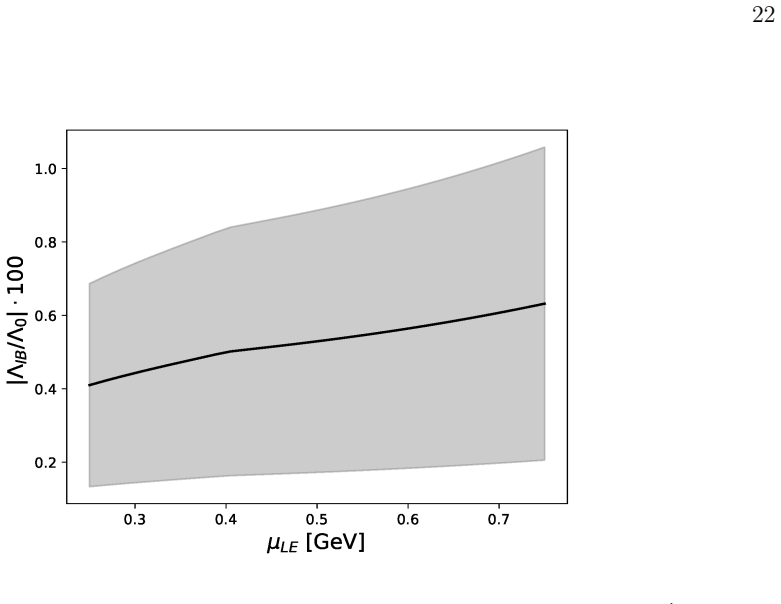
A lattice QCD+QED calculation with photons of 0.5-2 GeV energy captures all ΔI=1/2 enhanced isospin-breaking effects on ε'.
A machine-rendered reading of the paper's core claim, the machinery that carries it, and where it could break.
Core claim
All ΔI=1/2 enhanced isospin-breaking effects on ε' are captured in a QCD + QED lattice calculation in which the exchanged photon has an energy in the intermediate range 0.5-2.0 GeV. Short-distance effects above 2 GeV are not enhanced beyond the known electroweak penguin operators, infrared photons contribute nothing, and the contribution from photons below 0.5 GeV is estimated at the 0.5 percent level by chiral perturbation theory.
What carries the argument
QCD+QED lattice simulation with exchanged photons restricted to the intermediate energy window 0.5-2.0 GeV that isolates the ΔI=1/2 enhanced corrections to the kaon decay amplitudes.
If this is right
- The low-energy photon contribution to ε' is on the order of 0.5 percent.
- Short-distance effects above 2 GeV receive no additional ΔI=1/2 enhancement beyond the two electroweak penguin operators.
- Infrared photons make no contribution to ε'.
- The enhanced isospin-breaking features in kaon decay can be identified explicitly once the intermediate-photon lattice results are obtained.
Where Pith is reading between the lines
- The same energy-window separation could be applied to lattice calculations of other ΔI=1/2 suppressed or enhanced amplitudes.
- Varying the photon-energy cutoff in future simulations would provide a direct numerical test of the 0.5 percent ChPT estimate.
- The method reduces the computational cost by avoiding the need to simulate very soft photons on the lattice.
Load-bearing premise
Low-energy photons below 0.5 GeV are either not enhanced by the ΔI=1/2 rule or are suppressed by one order in chiral perturbation theory, allowing their effect on ε' to be estimated reliably at the 0.5 percent level without a full lattice treatment.
What would settle it
A lattice calculation that includes photons with energies below 0.5 GeV and finds their net contribution to ε' differs from the chiral perturbation theory estimate by more than one percent would falsify the separation of scales used here.
Figures

read the original abstract
Because of the $\Delta I = 1/2$ rule, the effects of electromagnetism and the isospin-breaking light quark mass difference on the direct CP violation parameter $\varepsilon'$ may be as large as 25\% and are consequently of immediate interest. In a lattice QCD calculation the effects of isospin breaking on the various features of kaon decay can be clearly distinguished and those effects enhanced by the $\Delta I=1/2$ rule on $\varepsilon'$ explicitly identified. We show that all such enhanced effects can be captured in a QCD + QED lattice calculation in which the exchanged photon has an energy in an accessible, intermediate range between 0.5-2.0 GeV. Short-distance effects ($2.0 \mathrm{\ GeV} \lesssim E_\gamma$), usually treated in QCD and electroweak perturbation theory, are not enhanced by the $\Delta I=1/2$ rule, beyond the well-understood contribution of the two electroweak penguin operators. Infrared photons do not contribute to $\varepsilon'$ while low-energy photons ($E_\gamma \lesssim 0.5$ GeV) are not $\Delta I=1/2$ rule enhanced or are suppressed by one order in chiral perturbation theory (ChPT). An explicit ChPT estimate of this low-energy-photon contribution, a contribution that is difficult to determine in a finite-volume lattice calculation, suggests that the effect on $\varepsilon'$ is on the order of 0.5\%.
Editorial analysis
A structured set of objections, weighed in public.
Referee Report
Summary. The manuscript proposes that all ΔI=1/2-rule-enhanced isospin-breaking effects on the direct CP-violation parameter ε' can be captured in a lattice QCD+QED calculation restricted to intermediate photon energies (0.5–2.0 GeV). Short-distance contributions above 2 GeV are argued to lack such enhancement beyond known electroweak penguins, infrared photons are stated to contribute zero, and low-energy photons below 0.5 GeV are estimated via chiral perturbation theory to affect ε' at the 0.5% level due to either absence of enhancement or suppression by an extra chiral order.
Significance. If the proposed scale separation is rigorously justified, the work would enable more feasible lattice computations of isospin-breaking corrections to ε' by avoiding the technical difficulties of very low-energy photons in finite volume. The explicit separation of enhanced effects from unenhanced ones represents a useful conceptual advance for precision kaon physics calculations.
major comments (1)
- [Abstract, paragraph discussing low-energy photons] Abstract, paragraph discussing low-energy photons: The assertion that low-energy photons (E_γ ≲ 0.5 GeV) 'are not ΔI=1/2 rule enhanced or are suppressed by one order in chiral perturbation theory (ChPT)' and thus contribute only ~0.5% is presented without a derivation, power-counting argument, or numerical validation specific to the four-quark operators relevant for ε'. This premise is load-bearing for the central claim that all enhanced effects are captured in the 0.5-2.0 GeV window.
Simulated Author's Rebuttal
We thank the referee for their careful reading and for identifying the need for a more explicit justification of the low-energy photon contribution. We address the major comment below.
read point-by-point responses
-
Referee: The assertion that low-energy photons (E_γ ≲ 0.5 GeV) 'are not ΔI=1/2 rule enhanced or are suppressed by one order in chiral perturbation theory (ChPT)' and thus contribute only ~0.5% is presented without a derivation, power-counting argument, or numerical validation specific to the four-quark operators relevant for ε'. This premise is load-bearing for the central claim that all enhanced effects are captured in the 0.5-2.0 GeV window.
Authors: We agree that the abstract states the claim concisely without including a derivation or power-counting argument. The manuscript does contain an explicit ChPT estimate yielding the ~0.5% figure, but this estimate is not accompanied by a detailed operator-specific power-counting discussion in the provided text. To address the referee's concern, we will add a short power-counting argument in the revised manuscript (in the introduction or a new subsection on scale separation) that explains the chiral structure of the relevant four-quark operators and why low-energy photons lack ΔI=1/2 enhancement or are suppressed by an extra chiral order. This addition will make the justification more transparent and self-contained while leaving the central claim unchanged. revision: yes
Circularity Check
No circularity; derivation relies on external ChPT power counting and standard QED scale separation rather than self-referential definitions or fits.
full rationale
The paper's central claim—that all ΔI=1/2-enhanced isospin-breaking effects on ε' are captured by an intermediate-energy (0.5–2 GeV) photon exchange in a QCD+QED lattice calculation—is justified by partitioning the photon spectrum into short-distance, infrared, and low-energy regimes, with the low-energy regime bounded by an explicit (external) ChPT estimate at the 0.5% level. No equation or statement reduces a derived quantity to a parameter fitted from the same data, nor does any load-bearing step rest on a self-citation whose content is itself unverified within the paper. The ChPT suppression statement is presented as an input assumption whose validity can be checked independently; it is not constructed from the lattice results being proposed. The derivation chain therefore remains self-contained against external benchmarks and receives the default non-circularity finding.
Axiom & Free-Parameter Ledger
free parameters (1)
- Photon energy cutoffs (0.5 GeV and 2.0 GeV)
axioms (3)
- domain assumption Short-distance effects (E_γ ≳ 2.0 GeV) are not enhanced by the ΔI=1/2 rule beyond the well-understood contribution of the two electroweak penguin operators.
- domain assumption Infrared photons do not contribute to ε'.
- domain assumption Low-energy photons (E_γ ≲ 0.5 GeV) are not ΔI=1/2 rule enhanced or are suppressed by one order in ChPT.
Reference graph
Works this paper leans on
-
[1]
(1) result from an isospin decomposition of π +π − and π 0π 0 decay amplitudes into those for ππ states with definite isospin
The amplitudes A0 and A2 in Eq. (1) result from an isospin decomposition of π +π − and π 0π 0 decay amplitudes into those for ππ states with definite isospin. Our amplitudes are normalized so that the partial K 0 decay rates are given by: Γ K 0→ π +π − = 1 8π |A+− |2 √ m2 K/ 4 − m2 π m2 K (2) Γ K 0→ π 0π 0 = 1 8π |A00|2 √ m2 K/ 4 − m2 π m2 K . (3) In the l...
-
[2]
This expression reduces to the standard formula for ε′ when the Be/o +− / 00 terms are omitted
− Im(A0)(Be +− + √ 2Be 00) )] . This expression reduces to the standard formula for ε′ when the Be/o +− / 00 terms are omitted. The factor of Re A2 that appears in the denominator of the third term in Eq. (11) provid es the ∆ I = 1/ 2 rule enhancement that gives these IB effects their current impor tance. Since the ∆ I = 1/ 2 rule suppression is special to...
-
[3]
leading order
∑φ aλ a has the explicit form 1√ 2 8∑ a=1 φ aλ a = 1 √ 2π 0 + 1√ 6η π + K + π − − 1√ 2π 0 + 1√ 6 η K 0 K − ¯K 0 − 2√ 6 η . (13) where {λ a}1≤ a≤ 8 are the Gell-Mann matrices. In contrast with Refs. [5–8, 24, 25] we will refer to the ChPT expan sion as an expansion in powers of momenta p2 and quark masses mq but perform a separate expan...
-
[4]
02(05)χ ren], ∑ i A(p4) i Im(G8Ni) = √ 3Fπ (M 2 K − m2 π )ImG8 · [
-
[5]
(27) These quantities contain uncertainties resulting from various sour ces related to the matching process which determines the LECs
10(05)χ ren ] . (27) These quantities contain uncertainties resulting from various sour ces related to the matching process which determines the LECs. The matching scheme uses the large Nc expansion, where Nc is the number of quark colors, which misses some of the logarithmic co rrections. To estimate the size of this effect, the authors of Ref [8] vary th...
-
[6]
There is no need to include experime ntal results for specific K → ππ decay amplitudes which themselves may involve significant infrared and Coulomb corrections
A three-flavor lattice QCD calculation of ε′, including isospin breaking effects to first order in α EM, can be performed with a minimum of Standard Model inputs: one dimensionful quantity such as MΩ to set the lattice scale, the π 0, K + and K 0 meson masses to determine the three quark masses and seven Wilson coeffi cients, determined from semi-leptonic meso...
-
[7]
The experimentally measurable quantity ε′ is defined in terms of ratios of K → ππ decay amplitudes in which the numerator and denominator involve ππ states with the same electric charges ensuring that all structure-independent I R effects cancel
-
[8]
The effects of low-energy photons can be computed from this Lagrangian
To leading order in ChPT the weak interaction effective Lagrangian involves only two terms, with complex, CP-violating coefficients G8 and G27, where the ∆ I = 1 / 2 rule requires G27 ≈ G8/ 22. The effects of low-energy photons can be computed from this Lagrangian. However, the leading-order effects in ChPT, not s uppressed by the ∆ I = 1 / 2 rule, will genera...
-
[9]
Although such quark mass effects are straight-forward to determine in a lattice Q CD calculation, their effects on ε′ will also not show a ∆ I = 1/ 2 rule enhancement
The same argument given above for the absence of leading-orde r effects of low-energy photons also applies to the effects of isospin-breaking quark masse s. Although such quark mass effects are straight-forward to determine in a lattice Q CD calculation, their effects on ε′ will also not show a ∆ I = 1/ 2 rule enhancement
-
[10]
The effects of electromagnetism on the five Wilson coefficients that describe the non-electroweak-penguin contributions to K → ππ decay should be on the order of 1%
If we leave aside the electroweak penguin operators which are alr eady included in lattice QCD calculations of ε′, we can also argue that short-distance EM effects on ε′ will also not be ∆ I = 1 / 2 rule enhanced. The effects of electromagnetism on the five Wilson coefficients that describe the non-electroweak-penguin contributions to K → ππ decay should be on...
-
[11]
T. Blum et al. , K → ππ ∆ I = 3 / 2 decay amplitude in the continuum limit, Phys. Rev. D 91, 074502 (2015), arXiv:1502.00263 [hep-lat]
Pith/arXiv arXiv 2015
-
[12]
Z. Bai et al. (RBC, UKQCD), Standard Model Prediction for Direct CP Viola tion in K → ππ Decay, Phys. Rev. Lett. 115, 212001 (2015), arXiv:1505.07863 [hep-lat]
Pith/arXiv arXiv 2015
-
[14]
T. Blum, P. A. Boyle, D. Hoying, T. Izubuchi, L. Jin, C. Jun g, C. Kelly, C. Lehner, A. Soni, and M. Tomii (RBC, UKQCD), ∆I=3/2 and ∆I=1/2 channel s of K → ππ decay at the physical point with periodic boundary conditions, Ph ys. Rev. D 108, 094517 (2023), arXiv:2306.06781 [hep-lat]
arXiv 2023
-
[15]
V. Cirigliano, J. F. Donoghue, and E. Golowich, K — > pi pi phenomenology in the presence of electromagnetism, Eur. Phys. J. C 18, 83 (2000), arXiv:hep-ph/0008290
Pith/arXiv arXiv 2000
-
[16]
V. Cirigliano, G. Ecker, H. Neufeld, and A. Pich, Isospin breaking in K — > pi pi decays, Eur. Phys. J. C 33, 369 (2004), arXiv:hep-ph/0310351
Pith/arXiv arXiv 2004
-
[17]
Gisbert and A
H. Gisbert and A. Pich, Direct cp violation in K 0 → ππ : Standard model status, Reports on Progress in Physics 81, 076201 (2018)
2018
-
[18]
V. Cirigliano, H. Gisbert, A. Pich, and A. Rodr ´ ıguez-S´anchez, Isospin-violating contributions to ǫ′/ǫ , JHEP 02, 032, arXiv:1911.01359 [hep-ph]
arXiv 1911
-
[19]
R. Abbott et al. (RBC, UKQCD), Direct CP violation and the ∆ I = 1/ 2 rule in K → ππ decay from the standard model, Phys. Rev. D 102, 054509 (2020), arXiv:2004.09440 [hep-lat]
arXiv 2020
-
[20]
Luscher, Two particle states on a torus and their rela tion to the scattering matrix, Nucl
M. Luscher, Two particle states on a torus and their rela tion to the scattering matrix, Nucl. Phys. B 354, 531 (1991)
1991
-
[21]
L. Lellouch and M. Luscher, Weak transition matrix elem ents from finite volume correlation functions, Commun. Math. Phys. 219, 31 (2001), arXiv:hep-lat/0003023
Pith/arXiv arXiv 2001
-
[22]
X. Feng and L. Jin, QED self energies from lattice QCD wit hout power-law finite-volume errors, Phys. Rev. D 100, 094509 (2019), arXiv:1812.09817 [hep-lat]
arXiv 2019
- [23]
-
[24]
Christ, X
N. Christ, X. Feng, J. Karpie, and T. Nguyen, π − π scattering, qed, and finite-volume quan- tization, Phys. Rev. D 106, 014508 (2022)
2022
-
[25]
Chao and N
E.-H. Chao and N. Christ, Calculating the two-photon ex change contribution to KL → µ +µ − decay, Phys. Rev. D 110, 054514 (2024)
2024
-
[26]
E.-H. Chao and C. Hu, Two-photon contribution to the kl → µ +µ − decay amplitude from a 1 /a ≈ 1 gev lattice (2024), arXiv:2411.00710 [hep-lat]
arXiv 2024
-
[27]
P. Boyle, E.-H. Chao, N. Christ, C. Hu, L. Jin, and Y. Zhao , An exploratory cal- culation of KL → µ +µ − decay from Lattice QCD at physical pion mass, (2025), arXiv:2509.04346 [hep-lat]
arXiv 2025
-
[28]
G. Buchalla, A. J. Buras, and M. E. Lautenbacher, Weak De cays beyond Leading Logarithms, Rev. Mod. Phys. 68, 1125 (1996), arXiv:hep-ph/9512380
Pith/arXiv arXiv 1996
-
[29]
P. A. Boyle et al. (RBC, UKQCD), Emerging understanding of the ∆ I = 1 / 2 Rule from Lattice QCD, Phys. Rev. Lett. 110, 152001 (2013), arXiv:1212.1474 [hep-lat]
arXiv 2013
-
[30]
Blum et al
T. Blum et al. (RBC), Kaon matrix elements and CP violation from quenched l attice QCD:
-
[31]
The three flavor case, Phys. Rev. D 68, 114506 (2003), arXiv:hep-lat/0110075
Pith/arXiv arXiv 2003
-
[32]
M. K. Gaillard and B. W. Lee, ∆ I = 1/2 Rule for Nonleptonic Decays in Asymptotically Free Field Theories, Phys. Rev. Lett. 33, 108 (1974)
1974
-
[33]
Altarelli and L
G. Altarelli and L. Maiani, Octet Enhancement of Nonlep tonic Weak Interactions in Asymp- totically Free Gauge Theories, Phys. Lett. B 52, 351 (1974)
1974
-
[34]
M. E. Peskin and D. V. Schroeder, An Introduction to quantum field theory (Addison-Wesley, Reading, USA, 1995)
1995
-
[35]
V. Cirigliano, J. F. Donoghue, and E. Golowich, Electro magnetic corrections to K — > pi pi. 1. Chiral perturbation theory, Phys. Rev. D 61, 093001 (2000), [Erratum: Phys.Rev.D 63, 059903 (2001)], arXiv:hep-ph/9907341
Pith/arXiv arXiv 2000
-
[36]
Cirigliano, J
V. Cirigliano, J. F. Donoghue, and E. Golowich, Electro magnetic corrections to K — > pi pi
-
[37]
Dispersive matching, Phys. Rev. D 61, 093002 (2000), arXiv:hep-ph/9909473
Pith/arXiv arXiv 2000
discussion (0)
Sign in with ORCID, Apple, or X to comment. Anyone can read and Pith papers without signing in.