Equivalence of non-local computation tasks beyond Clifford operations
Pith reviewed 2026-06-26 01:22 UTC · model grok-4.3
The pith
Redirecting a quantum system via classical control implies protocols for controlled arbitrary-basis measurements and controlled unitaries built from Cliffords plus diagonals.
A machine-rendered reading of the paper's core claim, the machinery that carries it, and where it could break.
Core claim
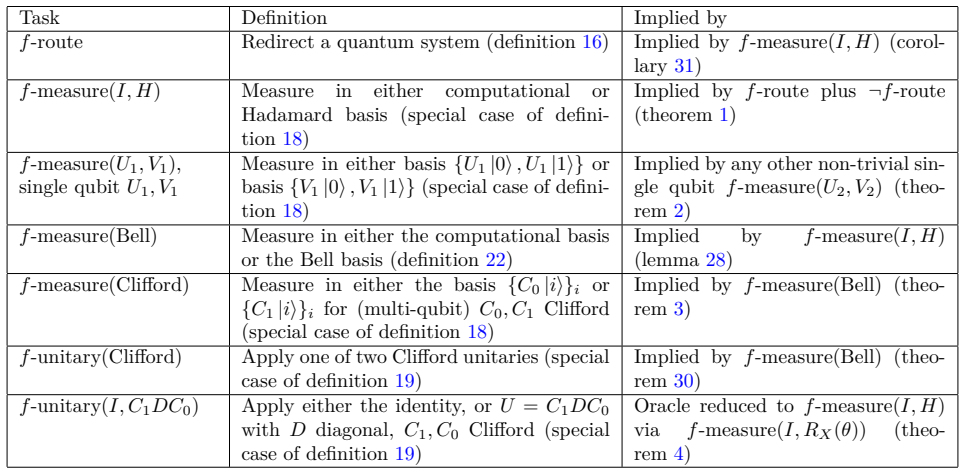
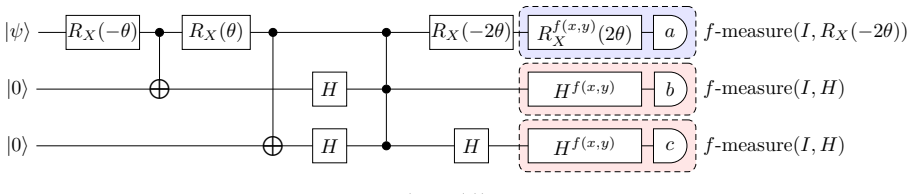
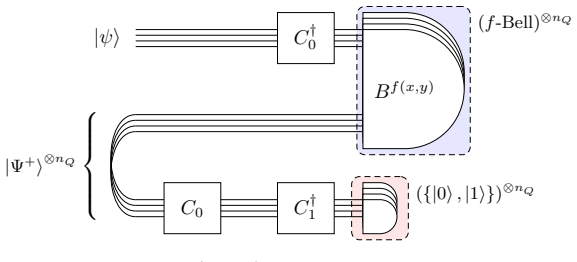
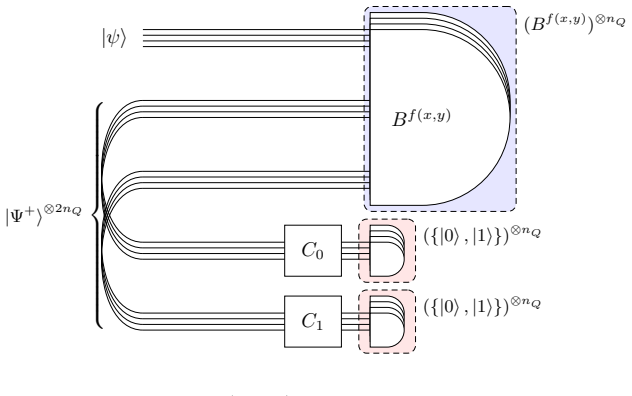
Within the large-classical-input, fixed-quantum-input regime, an implementation of the simplest redirection task based on classical control yields implementations of controlled single-qubit measurements in arbitrary bases, of any controlled Clifford unitary, and of any controlled unitary of the form U = C1 D C0 where D is an arbitrary diagonal unitary and C0, C1 are Clifford circuits; the constructions use gate teleportation and measurement-based quantum computation ideas and incur no extra entanglement or communication cost in the non-local simultaneous setting.
What carries the argument
Reductions that convert a redirection protocol into the listed controlled operations by embedding gate-teleportation and MBQC circuits inside the non-local simultaneous-communication model.
If this is right
- Position-verification schemes built from these tasks share the same asymptotic entanglement cost.
- Relative hardness ordering among the tasks is preserved under the reductions.
- Security levels of the corresponding position-verification protocols are equivalent up to the shared scaling.
- Gate-teleportation and MBQC strategies become available as tools inside non-local computation.
Where Pith is reading between the lines
- Security analyses for position verification can be reduced to studying only the simplest redirection task.
- The same reduction pattern may apply to other NLQC families once the fixed-size quantum input restriction is relaxed.
- Connections between MBQC and simultaneous-communication models could be explored in settings with multiple rounds.
Load-bearing premise
The gate-teleportation and MBQC constructions carry over to the non-local simultaneous-communication setting without extra entanglement or communication overhead.
What would settle it
An explicit non-local protocol for a controlled non-Clifford diagonal unitary whose entanglement cost is strictly lower than that of the basic redirection task, in the large-classical-input regime, would falsify the claimed implication.
Figures





read the original abstract
Non-local quantum computation (NLQC) studies how two collaborating players can implement channels on distributed systems using a single simultaneous round of quantum communication and shared entanglement. NLQC has applications in diverse areas, ranging from quantum position-verification to quantum gravity. Recently, it has been realized that the relationships among families of NLQC tasks are highly structured: many seemingly distinct tasks are related by reductions, wherein implementations of one task can be used to efficiently implement a second task. This is analogous to the notion of reduction in complexity theory, and reveals the relative hardness of NLQC tasks. In this work we continue the study of reductions among NLQC tasks. We focus on NLQC examples of the greatest interest in quantum position-verification; in particular examples involving large classical inputs and fixed-size quantum inputs, since these constitute the most feasible protocols for position-verification schemes. Within this setting, we find many new relationships among NLQC tasks. For instance, protocols for the simplest example of redirecting a quantum system based on a classical control imply protocols for controlled single qubit measurements in arbitrary bases, the controlled application of any Clifford unitary, and even the controlled application of any unitary of the form $U=C_1DC_0$ with $D$ an arbitrary diagonal unitary and $C_0, C_1$ Clifford circuits. This implies that many feasible position-verification schemes have the same asymptotic scaling for their entanglement cost, and hence a similar level of security. Our techniques rely on ideas from gate teleportation and measurement based quantum computation, among other areas, bringing several new strategies into NLQC which may be of independent interest.
Editorial analysis
A structured set of objections, weighed in public.
Referee Report
Summary. The paper claims that within the NLQC model restricted to large classical inputs and fixed-size quantum inputs, a basic redirection protocol (quantum system redirected by classical control) implies protocols for controlled single-qubit measurements in arbitrary bases, controlled Clifford unitaries, and controlled unitaries of the form U = C1 D C0 (D arbitrary diagonal, C0/C1 Clifford). These reductions are constructed via adaptations of gate teleportation and MBQC ideas, implying that the corresponding position-verification schemes share the same asymptotic entanglement cost and security scaling.
Significance. If the reductions are shown to incur no extra entanglement or communication overhead, the result is significant: it establishes a web of equivalences among NLQC tasks of direct interest to position verification, unifying their resource costs. The explicit use of gate-teleportation and MBQC constructions is a strength that the paper correctly highlights as bringing new strategies to the NLQC literature; these could be of independent interest beyond the equivalences themselves.
major comments (2)
- [§3.2] §3.2 (MBQC adaptation for controlled Cliffords): the reduction from redirection to controlled Clifford application must explicitly verify that the standard MBQC pattern (which typically involves adaptive measurements) is realized with exactly one simultaneous round of quantum communication and no additional shared entanglement; if the adaptation introduces sequential steps or extra resources, the claimed implication for U = C1 D C0 fails.
- [§4] §4 (entanglement-cost equivalence): the statement that the new protocols have identical asymptotic scaling rests on the overhead being zero in the reductions; without a concrete accounting (e.g., explicit resource counts before/after each reduction), the security-scaling conclusion for position-verification schemes is not yet load-bearing.
minor comments (2)
- Notation for the decomposition U = C1 D C0 is introduced without an explicit small example (e.g., a single-qubit case); adding one would improve readability.
- [Abstract] The abstract states the reductions exist but the main text should cross-reference the specific equations or figures that contain the explicit constructions.
Simulated Author's Rebuttal
We thank the referee for their careful reading and constructive comments on the reductions and their implications for position verification. We address each major comment below and will revise the manuscript accordingly to strengthen the explicit verification of resource overheads.
read point-by-point responses
-
Referee: [§3.2] §3.2 (MBQC adaptation for controlled Cliffords): the reduction from redirection to controlled Clifford application must explicitly verify that the standard MBQC pattern (which typically involves adaptive measurements) is realized with exactly one simultaneous round of quantum communication and no additional shared entanglement; if the adaptation introduces sequential steps or extra resources, the claimed implication for U = C1 D C0 fails.
Authors: We thank the referee for this observation. Our §3.2 construction adapts the MBQC pattern by replacing adaptive measurements with a single simultaneous round of quantum communication, where the redirection protocol supplies the classical control bits non-adaptively and gate teleportation handles the Clifford corrections without introducing sequential rounds or extra entanglement. The resulting protocol for controlled Cliffords (and hence for U = C1 D C0) therefore inherits the single-round property of the original redirection task. To address the referee's concern directly, we will add an explicit verification paragraph (with a small diagram) confirming that no additional shared entanglement or communication rounds are introduced beyond those already present in the redirection protocol. revision: yes
-
Referee: [§4] §4 (entanglement-cost equivalence): the statement that the new protocols have identical asymptotic scaling rests on the overhead being zero in the reductions; without a concrete accounting (e.g., explicit resource counts before/after each reduction), the security-scaling conclusion for position-verification schemes is not yet load-bearing.
Authors: We agree that an explicit resource accounting will make the asymptotic equivalence claim fully rigorous and load-bearing for the position-verification applications. In the revised manuscript we will insert a dedicated subsection (or table) that tabulates the entanglement and classical-communication resources for each task before and after the reductions. This accounting shows that every reduction incurs at most a constant-factor overhead independent of the input size, so the asymptotic entanglement scaling (and therefore the security scaling) remains identical across the family of tasks. We will also state the precise constant factors so that readers can verify the zero-asymptotic-overhead claim directly. revision: yes
Circularity Check
No significant circularity; reductions use standard independent constructions
full rationale
The paper derives relationships among NLQC tasks by adapting gate teleportation and MBQC to the non-local simultaneous-communication model. These are standard quantum-information techniques with no indication of self-definition, fitted inputs renamed as predictions, or load-bearing self-citations whose validity depends on the present work. The central claims rest on explicit constructions that map one protocol to another without reducing to the input by construction. The derivation chain is therefore self-contained against external benchmarks.
Axiom & Free-Parameter Ledger
axioms (2)
- domain assumption Gate teleportation and MBQC techniques extend directly to non-local simultaneous-round computation without additional resource costs.
- standard math Standard quantum mechanics and the definition of NLQC tasks with classical inputs and fixed-size quantum inputs.
Reference graph
Works this paper leans on
-
[1]
Position-based quantum cryptography: Im- possibility and constructions.SIAM Journal on Computing, 43(1):150–178, 2014
Harry Buhrman, Nishanth Chandran, Serge Fehr, Ran Gelles, Vipul Goyal, Rafail Ostrovsky, and Christian Schaffner. Position-based quantum cryptography: Im- possibility and constructions.SIAM Journal on Computing, 43(1):150–178, 2014
2014
-
[2]
Simplified instantaneous non-local quantum computation with applications to position-based cryptography.New Journal of Physics, 13(9):093036, 2011
Salman Beigi and Robert König. Simplified instantaneous non-local quantum computation with applications to position-based cryptography.New Journal of Physics, 13(9):093036, 2011
2011
-
[3]
A complexity theory for non-local quantum computation.arXiv preprint arXiv:2505.23893, 2025
Andreas Bluhm, Simon Höfer, Alex May, Mikka Stasiuk, Philip Verduyn Lunel, and Henry Yuen. A complexity theory for non-local quantum computation.arXiv preprint arXiv:2505.23893, 2025
Pith/arXiv arXiv 2025
-
[4]
Instantaneous measurement of nonlocal variables.Phys
Lev Vaidman. Instantaneous measurement of nonlocal variables.Phys. Rev. Lett., 90:010402, Jan 2003
2003
-
[5]
Adrian Kent, William J Munro, and Timothy P Spiller. Quantum tag- ging: Authenticating location via quantum information and relativistic signal- ing constraints.Physical Review A—Atomic, Molecular, and Optical Physics, 84(1):012326, 2011
2011
-
[6]
Quantum tasks in holography.Journal of High Energy Physics, 2019(10):1–39, 2019
Alex May. Quantum tasks in holography.Journal of High Energy Physics, 2019(10):1–39, 2019
2019
-
[7]
Holographic scattering requires a connected entanglement wedge.Journal of High Energy Physics, 2020(8):1–34, 2020
Alex May, Geoff Penington, and Jonathan Sorce. Holographic scattering requires a connected entanglement wedge.Journal of High Energy Physics, 2020(8):1–34, 2020
2020
-
[8]
The connected wedge theorem and its consequences.Journal of High Energy Physics, 2022(11):1–65, 2022
Alex May, Jonathan Sorce, and Beni Yoshida. The connected wedge theorem and its consequences.Journal of High Energy Physics, 2022(11):1–65, 2022
2022
-
[9]
Complexityandentanglementinnon-localcomputationandholography
AlexMay. Complexityandentanglementinnon-localcomputationandholography. Quantum, 6:864, 2022
2022
-
[10]
Relating non-local quantum computation to information theoretic cryptography.Quantum, 8:1387, 2024
Rene Allerstorfer, Harry Buhrman, Alex May, Florian Speelman, and Philip Ver- duyn Lunel. Relating non-local quantum computation to information theoretic cryptography.Quantum, 8:1387, 2024
2024
-
[11]
Conditional disclosure of secrets with quantum resources
Vahid R Asadi, Kohdai Kuroiwa, Debbie Leung, Alex May, Sabrina Pasterski, and Chris Waddell. Conditional disclosure of secrets with quantum resources. Quantum, 9:1885, 2025
2025
-
[12]
New bounds on private simultaneous quantum message passing.arXiv preprint arXiv:2606.12557, 2026
Uma Girish, Alex May, Natalie Parham, and Henry Yuen. New bounds on private simultaneous quantum message passing.arXiv preprint arXiv:2606.12557, 2026
Pith/arXiv arXiv 2026
-
[13]
Comparing classical and quantum conditional disclosure of secrets.Quantum, 10:2049, 2026
Uma Girish, Alex May, Leo Orshansky, and Chris Waddell. Comparing classical and quantum conditional disclosure of secrets.Quantum, 10:2049, 2026
2049
-
[14]
Unclonable secret sharing
Prabhanjan Ananth, Vipul Goyal, Jiahui Liu, and Qipeng Liu. Unclonable secret sharing. InInternational Conference on the Theory and Application of Cryptology and Information Security, pages 129–157. Springer, 2024
2024
-
[15]
Magic and communi- cation complexity
Uma Girish, Alex May, Natalie Parham, and Henry Yuen. Magic and communi- cation complexity. InProceedings of the 58th Annual ACM Symposium on Theory of Computing, pages 845–856, 2026. 37
2026
-
[16]
Fast protocols for local implemen- tation of bipartite nonlocal unitaries.Physical Review A—Atomic, Molecular, and Optical Physics, 85(1):012304, 2012
Li Yu, Robert B Griffiths, and Scott M Cohen. Fast protocols for local implemen- tation of bipartite nonlocal unitaries.Physical Review A—Atomic, Molecular, and Optical Physics, 85(1):012304, 2012
2012
-
[17]
Security of quantum position-verification limits hamiltonian simulation via holography.Journal of High Energy Physics, 2024(8):1–40, 2024
Harriet Apel, Toby Cubitt, Patrick Hayden, Tamara Kohler, and David Pérez- García. Security of quantum position-verification limits hamiltonian simulation via holography.Journal of High Energy Physics, 2024(8):1–40, 2024
2024
-
[18]
A single-qubit posi- tionverificationprotocolthatissecureagainstmulti-qubitattacks.Nature Physics, 18(6):623–626, 2022
Andreas Bluhm, Matthias Christandl, and Florian Speelman. A single-qubit posi- tionverificationprotocolthatissecureagainstmulti-qubitattacks.Nature Physics, 18(6):623–626, 2022
2022
-
[19]
Rank lower bounds on non-local quantum computation.arXiv preprint arXiv:2402.18647, 2024
Vahid R Asadi, Eric Culf, and Alex May. Rank lower bounds on non-local quantum computation.arXiv preprint arXiv:2402.18647, 2024
arXiv 2024
-
[20]
Linear gate bounds against natural functions for position-verification.Quantum, 9:1604, 2025
Vahid Asadi, Richard Cleve, Eric Culf, and Alex May. Linear gate bounds against natural functions for position-verification.Quantum, 9:1604, 2025
2025
-
[21]
Quantum position verification in the random oracle model
Dominique Unruh. Quantum position verification in the random oracle model. In Annual Cryptology Conference, pages 1–18. Springer, 2014
2014
-
[22]
The garden-hose model
Harry Buhrman, Serge Fehr, Christian Schaffner, and Florian Speelman. The garden-hose model. InProceedings of the 4th Conference on Innovations in Theo- retical Computer Science, pages 145–158, 2013
2013
-
[23]
Code-routing: a new attack on position verification
Joy Cree and Alex May. Code-routing: a new attack on position verification. Quantum, 7:1079, 2023
2023
-
[24]
Insecurity of position-based quantum- cryptographyprotocolsagainstentanglementattacks.Physical Review A—Atomic, Molecular, and Optical Physics, 83(1):012322, 2011
Hoi-Kwan Lau and Hoi-Kwong Lo. Insecurity of position-based quantum- cryptographyprotocolsagainstentanglementattacks.Physical Review A—Atomic, Molecular, and Optical Physics, 83(1):012322, 2011
2011
-
[25]
Practical position-based quantum cryptography.Physical Review A, 92(5):052304, 2015
Kaushik Chakraborty and Anthony Leverrier. Practical position-based quantum cryptography.Physical Review A, 92(5):052304, 2015
2015
-
[26]
Florian Speelman. Instantaneous non-local computation of low t-depth quantum circuits.arXiv preprint arXiv:1511.02839, 2015
Pith/arXiv arXiv 2015
-
[27]
Entanglement cost in non-local quantum computation.arXiv preprint arXiv:2605.02840, 2026
Alex May. Entanglement cost in non-local quantum computation.arXiv preprint arXiv:2605.02840, 2026
Pith/arXiv arXiv 2026
-
[28]
Protecting data privacy in private information retrieval schemes
Yael Gertner, Yuval Ishai, Eyal Kushilevitz, and Tal Malkin. Protecting data privacy in private information retrieval schemes. InProceedings of the thirtieth annual ACM symposium on Theory of computing, pages 151–160, 1998
1998
-
[29]
Communication complexity of conditional disclosure of secrets and attribute-based encryption
Romain Gay, Iordanis Kerenidis, and Hoeteck Wee. Communication complexity of conditional disclosure of secrets and attribute-based encryption. InAnnual Cryptology Conference, pages 485–502. Springer, 2015
2015
-
[30]
Placing conditional disclo- sure of secrets in the communication complexity universe.Journal of Cryptology, 34(2):11, 2021
Benny Applebaum and Prashant Nalini Vasudevan. Placing conditional disclo- sure of secrets in the communication complexity universe.Journal of Cryptology, 34(2):11, 2021
2021
-
[31]
Aminimalmodelforsecurecomputation
UriFeige, JoeKillian, andMoniNaor. Aminimalmodelforsecurecomputation. In Proceedings of the twenty-sixth annual ACM symposium on Theory of computing, pages 554–563, 1994
1994
-
[32]
Llorenç Escolà-Farràs and Florian Speelman. Quantum position verification in one shot: parallel repetition of thef-BB84 andf-routing protocols.arXiv preprint arXiv:2503.09544, 2025
arXiv 2025
-
[33]
Making existing quantum position verification protocols secure against arbitrary transmission loss
Rene Allerstorfer, Andreas Bluhm, Harry Buhrman, Matthias Christandl, Llorenç Escolà-Farràs, Florian Speelman, and Philip Verduyn Lunel. Making existing quantum position verification protocols secure against arbitrary transmission loss. Physical Review Letters, 135(26):260801, 2025
2025
-
[34]
Device-independent quantum position verification
Gautam A Kavuri, Abigail Gookin, Yanbao Zhang, Joshua C Bienfang, Honghao Fu, Yusuf Alnawakhtha, Soumyadip Patra, Dileep V Reddy, Michael D Mazurek, Carlos Abellán, et al. Device-independent quantum position verification. InQuan- tum 2.0, pages QM3B–3. Optica Publishing Group, 2025. 38
2025
-
[35]
Relativistic position verification with coherent states.arXiv preprint arXiv:2602.01787, 2026
Guan-Jie Fan-Yuan, Yang-Guang Shan, Cong Zhang, Yu-Long Wang, Yu-Xuan Fan, Wei-Xin Xie, De-Yong He, Shuang Wang, Zhen-Qiang Yin, Wei Chen, et al. Relativistic position verification with coherent states.arXiv preprint arXiv:2602.01787, 2026
arXiv 2026
-
[36]
Towardsexperimentaldemonstrationofquantumpositionverification using single photons.Quantum Science and Technology, 10(4):045004, 2025
Kirsten Kanneworff, Mio Poortvliet, Dirk Bouwmeester, Rene Allerstorfer, Philip Verduyn Lunel, Florian Speelman, Harry Buhrman, Petr Steindl, and Wolf- gangLöffler. Towardsexperimentaldemonstrationofquantumpositionverification using single photons.Quantum Science and Technology, 10(4):045004, 2025
2025
-
[37]
Andrea Olivo, Ulysse Chabaud, André Chailloux, and Frédéric Grosshans. Break- ing simple quantum position verification protocols with little entanglement.arXiv preprint arXiv:2007.15808, 2020
arXiv 2007
-
[38]
Leung, and Isaac L
Xinlan Zhou, Debbie W. Leung, and Isaac L. Chuang. Methodology for quantum logic gate construction.Physical Review A, 62(5), October 2000
2000
-
[39]
Probability inequalities for sums of bounded random variables
Wassily Hoeffding. Probability inequalities for sums of bounded random variables. Journal of the American statistical association, 58(301):13–30, 1963
1963
-
[40]
Elementary gates for quantum computation.Physical Review A, 52(5):3457, 1995
Adriano Barenco, Charles H Bennett, Richard Cleve, David P DiVincenzo, Nor- man Margolus, Peter Shor, Tycho Sleator, John A Smolin, and Harald Weinfurter. Elementary gates for quantum computation.Physical Review A, 52(5):3457, 1995
1995
-
[41]
One-way quantum computation.Quantum in- formation: From foundations to quantum technology applications, pages 449–473, 2016
Dan Browne and Hans Briegel. One-way quantum computation.Quantum in- formation: From foundations to quantum technology applications, pages 449–473, 2016
2016
-
[42]
Asymptotic teleportation scheme as a uni- versal programmable quantum processor.Physical Review Letters, 101(24):240501, 2008
Satoshi Ishizaka and Tohya Hiroshima. Asymptotic teleportation scheme as a uni- versal programmable quantum processor.Physical Review Letters, 101(24):240501, 2008. 39
2008
discussion (0)
Sign in with ORCID, Apple, or X to comment. Anyone can read and Pith papers without signing in.