Global analysis of a minimally extended scotogenic model
Pith reviewed 2026-06-26 04:22 UTC · model grok-4.3
The pith
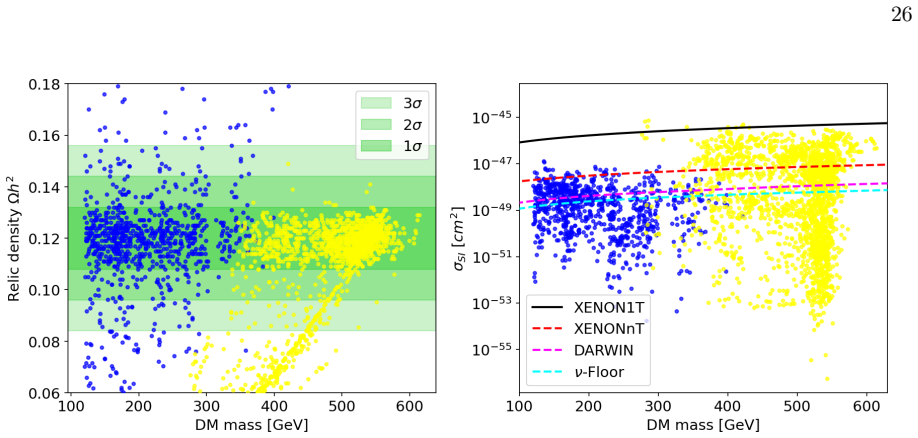
Global analysis of minimally extended scotogenic model constrains fermionic dark matter to 120-350 GeV and CP-odd scalar to 350-600 GeV.
A machine-rendered reading of the paper's core claim, the machinery that carries it, and where it could break.
Core claim
A comprehensive numerical scan of the minimally extended scotogenic model yields viable parameter space that simultaneously satisfies all theoretical and experimental constraints, with a fermionic dark matter candidate mass between 120 and 350 GeV, a CP-odd scalar mass between 350 and 600 GeV, a clear preference for the normal neutrino mass hierarchy once the DESI bound is imposed, and a Z to invisible branching ratio compatible with existing measurements at the 3 sigma level.
What carries the argument
The minimally extended scalar sector that restores high-scale vacuum stability while retaining the scotogenic radiative mechanism for neutrino masses and the stability of the dark matter candidate.
If this is right
- The DESI BAO bound excludes the inverted neutrino hierarchy if upheld by other experiments.
- Oblique parameters fall inside the projected sensitivity of future precision measurements.
- Fermionic dark matter masses are restricted to the interval 120-350 GeV.
- The CP-odd scalar mass is restricted to the interval 350-600 GeV.
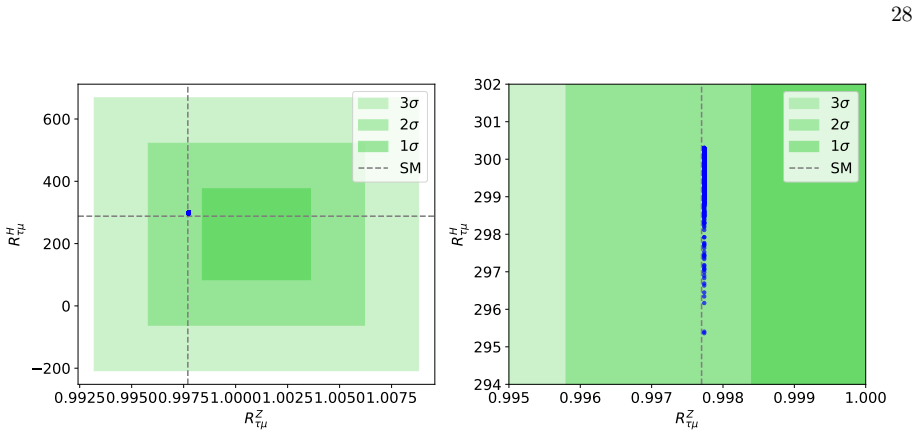
- The Z to invisible decay width remains compatible with the world average and recent ATLAS data at 3 sigma.
Where Pith is reading between the lines
- The reported mass windows for dark matter and the CP-odd scalar point to concrete search channels at current and future colliders.
- The preference for normal hierarchy under the DESI bound can be cross-checked by independent neutrino oscillation and cosmology experiments.
- The projected oblique-parameter shifts offer a near-term target for electroweak precision programs at proposed lepton colliders.
Load-bearing premise
The chosen minimal addition to the scalar sector is enough to restore vacuum stability and the numerical scan samples the viable parameter space without large gaps or biases.
What would settle it
Independent experimental confirmation that the neutrino mass hierarchy is inverted would exclude all viable regions found by the scan.
Figures

read the original abstract
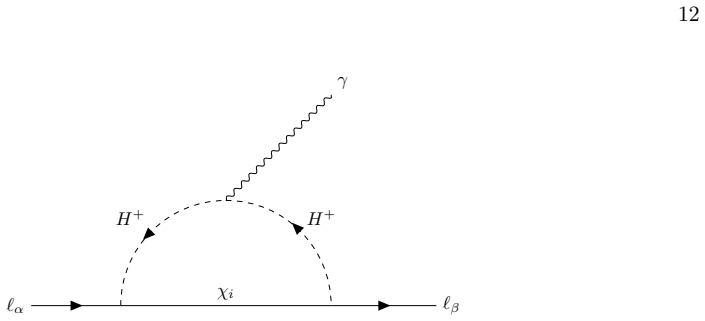
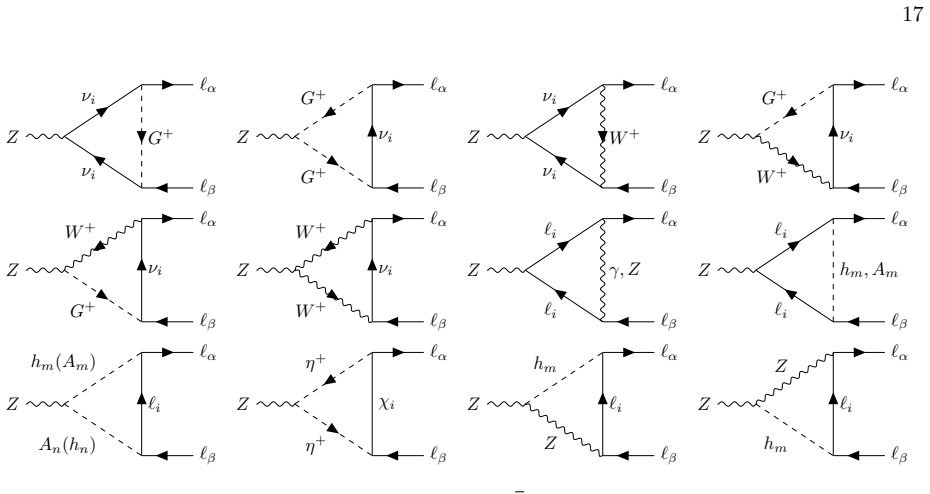
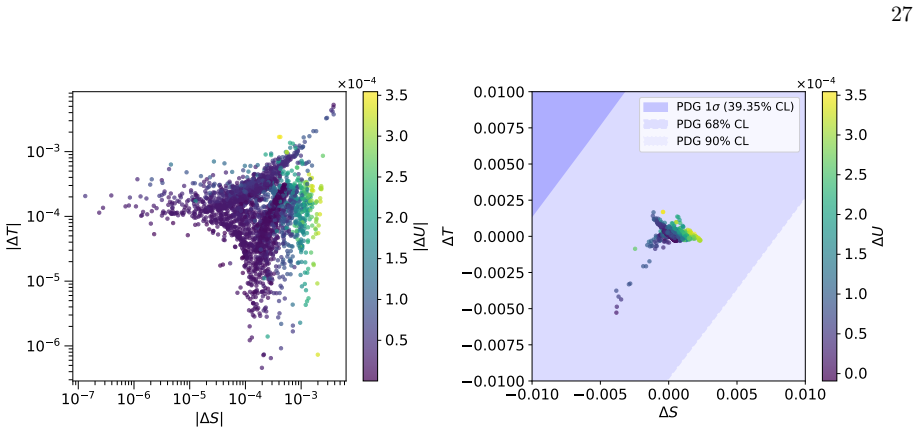
We perform a global analysis of a minimally extended scotogenic model motivated by observed non-zero neutrino masses, viable dark matter (DM) candidates, and the instability of the Standard Model (SM) vacuum at high-energies. We examine the bounded-from-below conditions, vacuum stability, and RG-driven perturbativity bounds arising from the extended scalar sector, alongside a comprehensive set of flavor and electroweak (EW) precision observables - including the muon anomalous magnetic moment $\Delta a_{\mu}$, the radiative decays $\ell_{\alpha} \rightarrow \ell_{\beta} \gamma$ and $\ell_{\alpha} \rightarrow 3\ell_{\beta}$, and the $\mu \rightarrow e$ conversion rate, the oblique parameters, and leptonic decays of $Z$ and $H$ bosons. A numerical scan reveals four notable features: the DESI BAO bound would rule out the inverted hierarchy if confirmed by other experiments; the oblique parameters are projected to be within the reach of future precision measurements; the viable fermionic DM candidate mass lies in the range $120-350 \func{GeV}$, while the CP-odd scalar is constrained to $350-600 \func{GeV}$; and our result on $Z \rightarrow \func{Invisible}$ is compatible with the world average at the $3\sigma$ level and is favored by the recent ATLAS measurement at the $3\sigma$ level.
Editorial analysis
A structured set of objections, weighed in public.
Referee Report
Summary. The manuscript performs a global analysis of a minimally extended scotogenic model to simultaneously address non-zero neutrino masses, viable dark matter candidates, and SM vacuum instability. It incorporates bounded-from-below conditions, vacuum stability, RG-driven perturbativity bounds from the extended scalar sector, and a broad set of flavor and electroweak precision observables (including Δa_μ, ℓ_α → ℓ_β γ, ℓ_α → 3ℓ_β, μ → e conversion, oblique parameters, and leptonic Z/H decays). A numerical scan over the parameter space yields four main results: the DESI BAO bound would rule out the inverted neutrino hierarchy if confirmed; oblique parameters lie within reach of future precision measurements; viable fermionic DM masses are 120-350 GeV and the CP-odd scalar is 350-600 GeV; and the Z → invisible width is compatible with the world average at 3σ and favored by recent ATLAS data at 3σ.
Significance. If the numerical scan is shown to be robust and unbiased, the work supplies concrete, testable constraints on an extension of the scotogenic framework that unifies several BSM motivations. The reported mass windows for the fermionic DM and CP-odd scalar, together with the hierarchy implication from DESI, constitute falsifiable predictions for upcoming experiments. The breadth of included observables (flavor, precision EW, and stability) is a methodological strength.
major comments (2)
- [numerical scan results] The section presenting the numerical scan results does not specify the sampling algorithm, prior ranges on the Yukawa couplings and scalar masses, treatment of parameter correlations, or convergence criteria used to generate the quoted mass ranges (120-350 GeV for fermionic DM and 350-600 GeV for the CP-odd scalar) and hierarchy statements. These omissions are load-bearing because all four notable features are direct outputs of the scan rather than independent predictions.
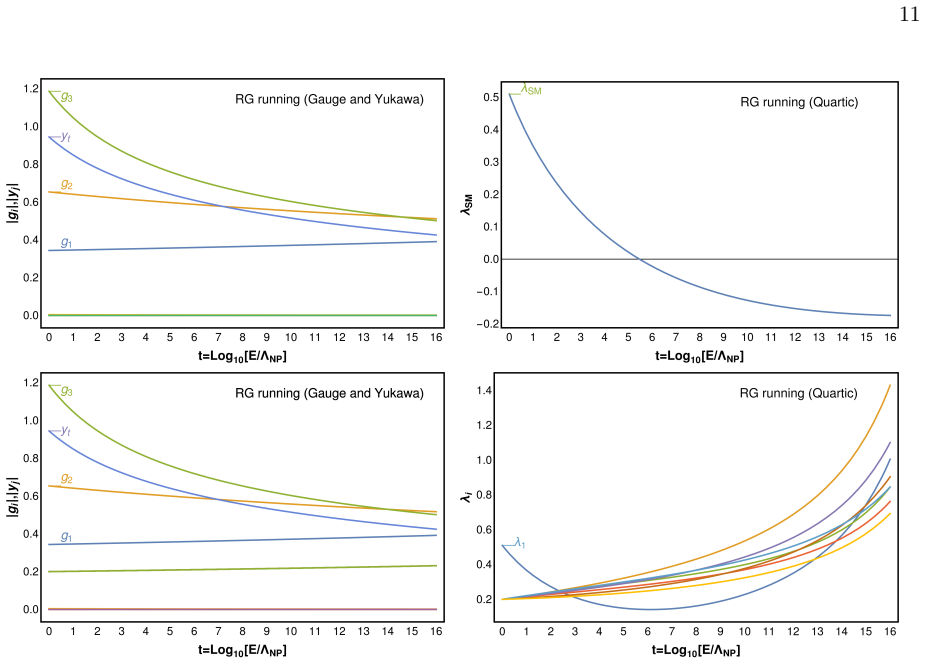
- [model definition and constraints] The claim that the chosen minimal scalar extension restores vacuum stability and perturbativity while preserving all other model features lacks explicit verification of the RG evolution and bounded-from-below conditions for the added parameters; incomplete enforcement could introduce bias into the viable regions sampled for the neutrino hierarchy and DM mass ranges.
minor comments (1)
- [abstract] The abstract states compatibility of Z → invisible 'at the 3σ level' with both the world average and ATLAS but does not quote the numerical prediction or the exact pull values.
Simulated Author's Rebuttal
We thank the referee for the careful reading of our manuscript and the constructive comments. We address each major point below and agree that additional methodological details and explicit verifications will strengthen the presentation of our results.
read point-by-point responses
-
Referee: The section presenting the numerical scan results does not specify the sampling algorithm, prior ranges on the Yukawa couplings and scalar masses, treatment of parameter correlations, or convergence criteria used to generate the quoted mass ranges (120-350 GeV for fermionic DM and 350-600 GeV for the CP-odd scalar) and hierarchy statements. These omissions are load-bearing because all four notable features are direct outputs of the scan rather than independent predictions.
Authors: We agree that a more detailed description of the scan is required. In the revised manuscript we will insert a new subsection (likely Section 4.1) that specifies the sampling algorithm employed, the prior ranges adopted for the Yukawa couplings and scalar masses, the treatment of parameter correlations, and the convergence criteria used to obtain the reported mass windows and hierarchy statements. This addition will make the robustness of the quoted ranges fully transparent. revision: yes
-
Referee: The claim that the chosen minimal scalar extension restores vacuum stability and perturbativity while preserving all other model features lacks explicit verification of the RG evolution and bounded-from-below conditions for the added parameters; incomplete enforcement could introduce bias into the viable regions sampled for the neutrino hierarchy and DM mass ranges.
Authors: We acknowledge that the manuscript would benefit from more explicit documentation of the RG evolution and bounded-from-below conditions for the newly introduced scalar parameters. In the revision we will add a dedicated paragraph (or short appendix) presenting the relevant RG trajectories and confirming that the bounded-from-below conditions remain satisfied throughout the scanned parameter space, thereby removing any potential ambiguity regarding bias in the viable regions. revision: yes
Circularity Check
Numerical scan outputs are direct constraint results with no circular reduction
full rationale
The paper conducts a global numerical scan over the parameter space of the minimally extended scotogenic model, enforcing bounded-from-below conditions, vacuum stability, RG perturbativity, and experimental observables including oblique parameters, flavor processes, and Z/H decays. The four notable features (DESI impact on hierarchy, future reach of oblique parameters, viable DM and scalar mass windows, and Z invisible compatibility) are explicitly the surviving regions after these constraints are applied. No step claims a first-principles derivation that reduces by construction to the scan inputs, no self-citation is load-bearing for any uniqueness theorem, and no fitted quantity is relabeled as an independent prediction. The chain is a standard computational exploration of viable parameter space and remains self-contained.
Axiom & Free-Parameter Ledger
free parameters (1)
- Yukawa couplings and scalar masses in the extension
axioms (2)
- domain assumption Radiative neutrino mass generation via scotogenic loops remains valid after minimal extension
- ad hoc to paper Numerical scan covers all viable regions without missing solutions
invented entities (1)
-
Minimally extended scalar sector
no independent evidence
Reference graph
Works this paper leans on
-
[1]
Generate an initial point in the parameter space yielding a finite log likelihood value, defined as lnL= X i lnL i =− X i Opred i − Oexp i 2 2σ2 i ,(49) whereO pred i andO exp i denote the predicted and experimental values of thei-th observable, respectively, andσ i is the corresponding 1σuncertainty
-
[2]
Propose a candidate point sampled from a Gaussian distribution centered on the current point
-
[3]
Evaluate theχ 2 value at the candidate point and determine whether to accept or reject it according to the Metropolis–Hastings criterion
-
[4]
Repeat steps 2–4 until the chain reaches sufficient convergence. The primary observables driving the MCMC algorithm are the SM Higgs boson mass at one-loop level and the relic density, whose experimental values are taken asm h = 125.20±0.11 GeV [71] and Ωh 2 = 0.120±0.012 of Equation 13, respectively. The ranges of the input parameters are listed in Table...
-
[5]
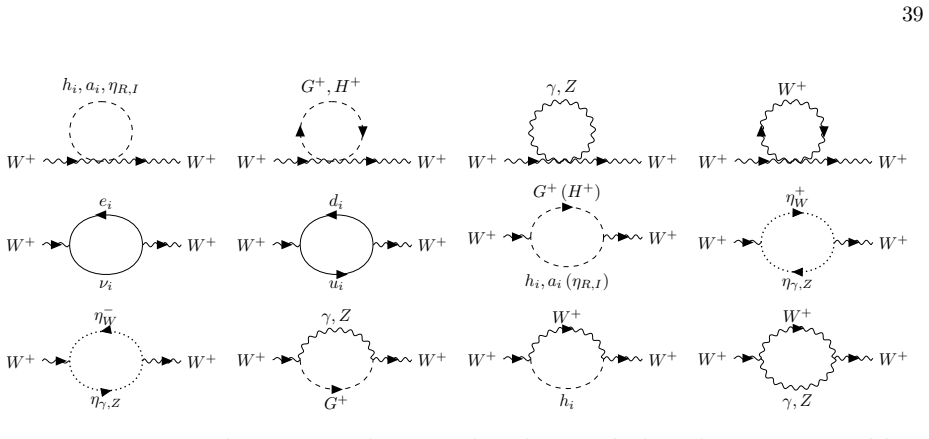
For the sixth diagram, an equivalent diagram with reversed charge flow is included
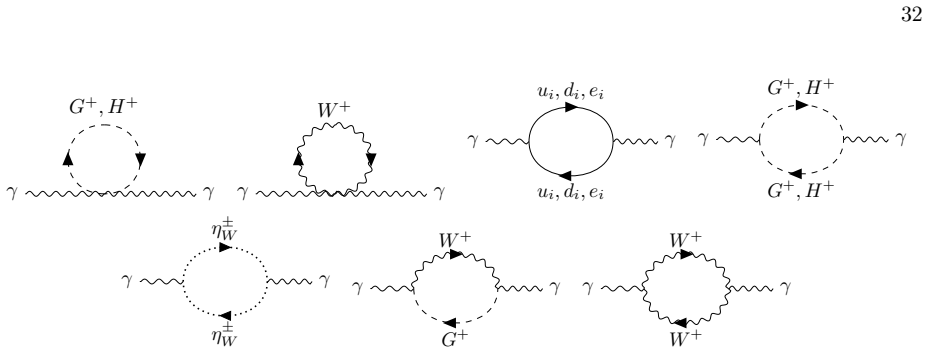
Photon self-energy The diagrams contributing to the photon SE in this work are seen in Figure 15: The counter- term for the photon self-energy in the scotogenic model is given in Equation B1: δZAA =− ∂ΣAA T p2 ∂p2 p2=0 = e2(s2 w −1) 144c2w(D−1)π 2 " Nc 3X i=1 (2D−4)B 0(0, m2 di, m2 di) + 8m2 di DB0(0, m2 di, m2 di) 32 γ γ G+,H + γ γ W + γ γ ui,d i,e i ui,...
-
[6]
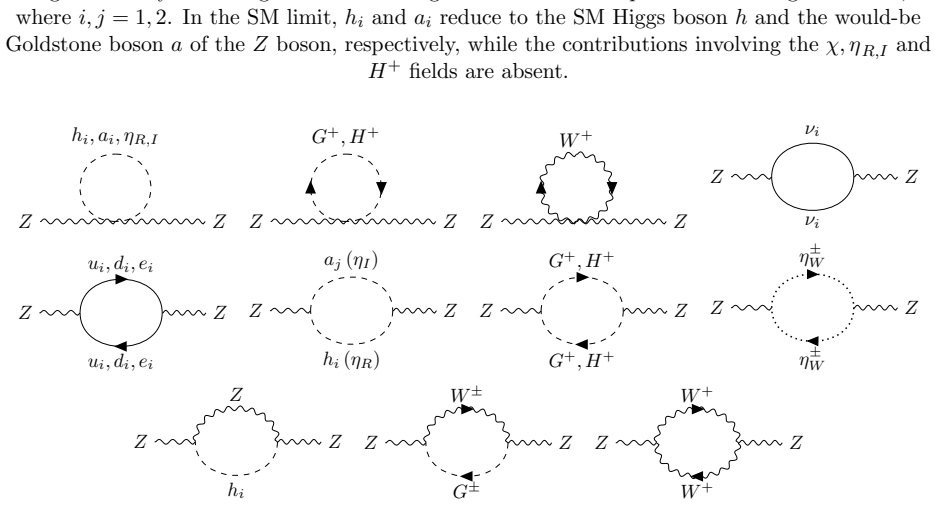
3.Zself-energy FromZSE, the tadpole contributions start to appear
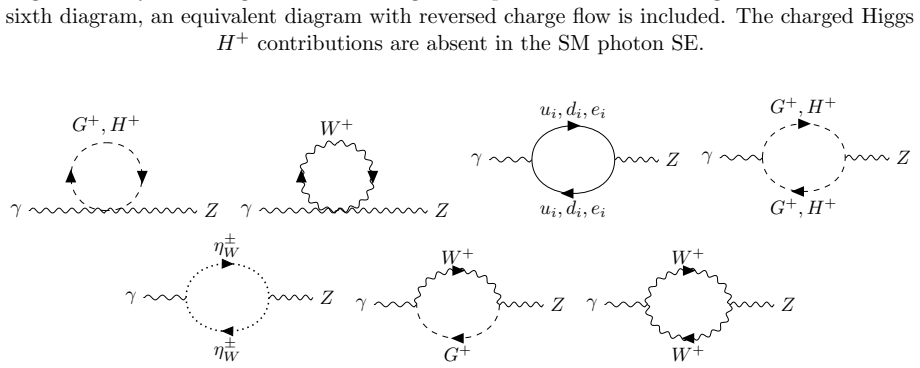
Photon-Zself-energy The diagrams contributing to the photon-ZSE in this work are seen in Figure 16: The counter- 33 terms for the photon-Zself-energy in the scotogenic model is given in Equation B2: δZZA = 2 M 2 Z ΣAZ T (0) =− e2cw B0 0, M2 W , M2 W 4π2sw , δZAZ =−2 Re ΣAZ T M 2 Z M 2 Z = e2 144c w(1−D)M 2 Zπ2sw " + 36M2 H ± 1−2s 2 w B0 0, M2 H ±, M2 H ± ...
-
[7]
∂Σh1h1 p2 ∂p2 # p2=m2 h1 ,(B8) δZh1h2 = 2 m2 h1 −m 2 h2 Re Σh1h2 m2 h2 ,(B9) δZh2h1 = 2 m2 h2 −m 2 h1 Re Σh1h2 m2 h1 ,(B10) δZh2h2 =−Re
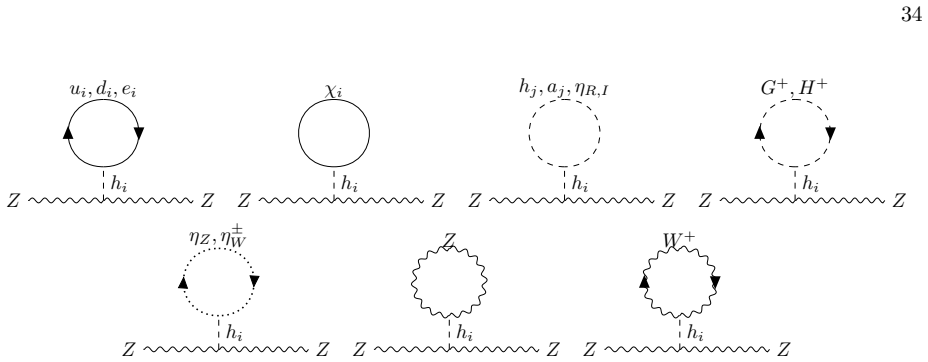
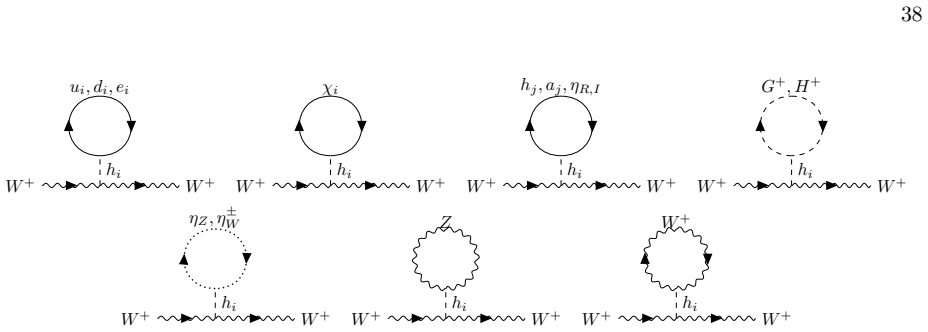
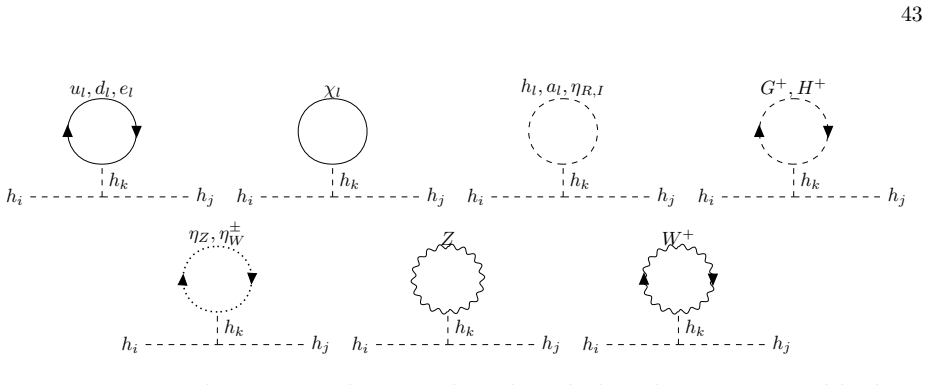
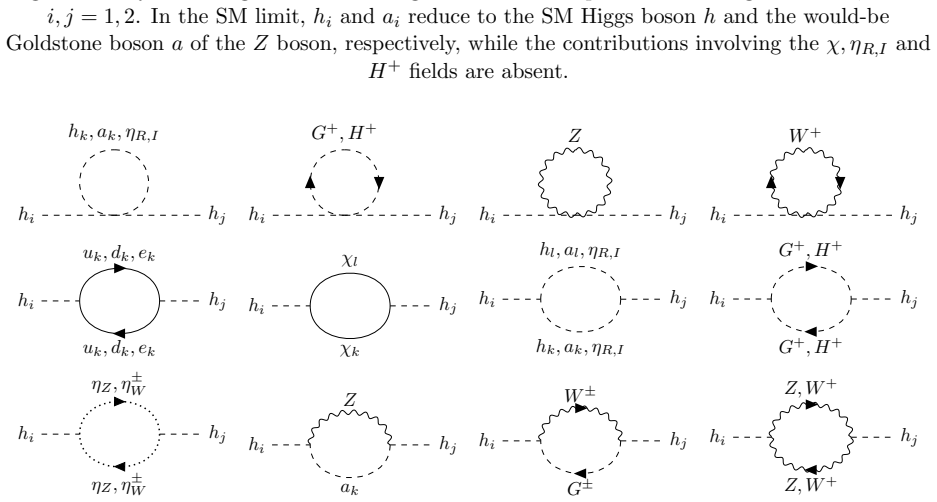
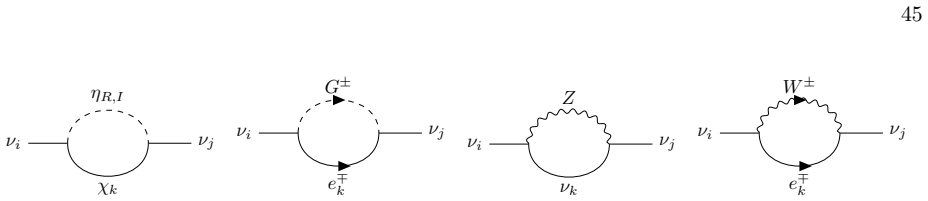
Scalar self-energy The diagrams contributing to the scalar tadpole and SE are seen in Figure 21 and Figure 22. Since the scalar sector is extended, the mass and field CTs are defined as follows. In what follows, 43 hi hj ul, dl, el hk hi hj χl hk hi hj hl,a l,ηR,I hk hi hj G+, H+ hk hi hj ηZ,η± W hk hi hj Z hk hi hj W + hk Figure 21: Feynman diagrams cont...
-
[8]
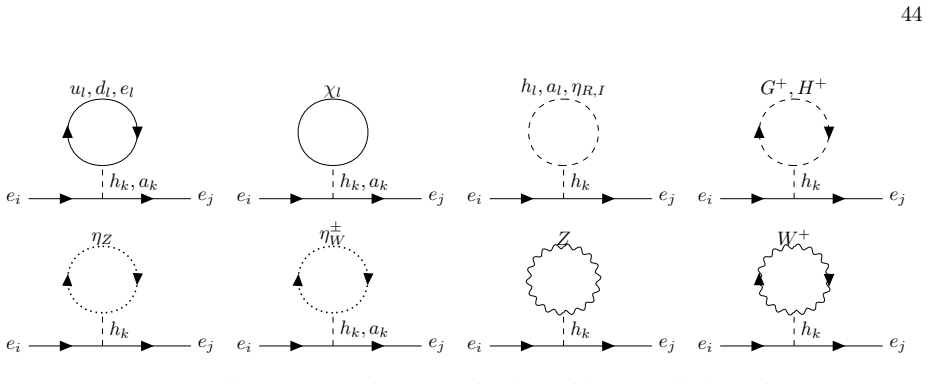
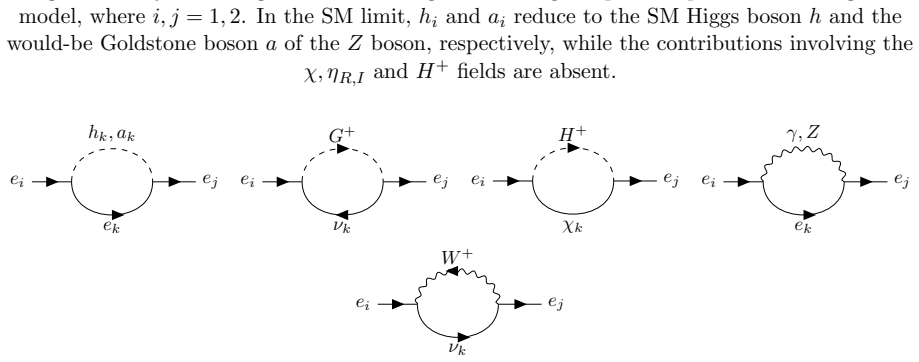
Charged lepton self-energy The diagrams contributing to the chaged lepton tadpole and SE are seen in Figure 23 and Figure 24. Following [75], the charged lepton propagator - with incoming and outgoing leptons indexed byjandi, respectively - can be decomposed in terms of the projected self-energies with distinct Dirac structures as: Γf ij (p) =iδ ij /p−m i...
-
[9]
Consequently, only SE contributions arise
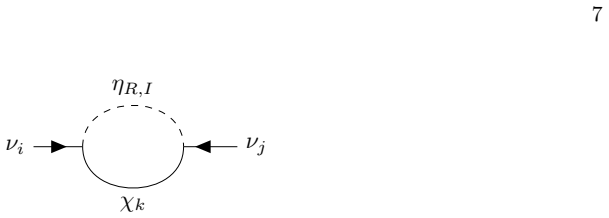
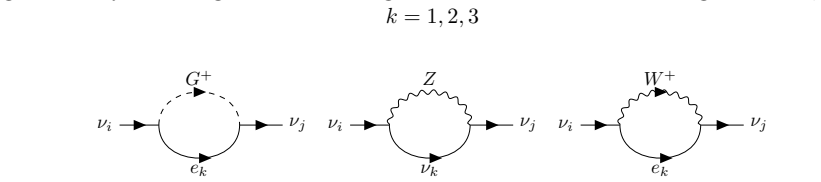
Neutrino self-energy In the neutrino sector, tadpole contributions are absent in both the SM and the BSM model, as there is noh i −v−vvertex. Consequently, only SE contributions arise. The diagrams contributing to the neutrino SE in the scotogenic model and the SM are shown in Figures 25 and 26, respectively. The diagonal and off-diagonal CTs for the neut...
-
[10]
The scalar potential then reduces to: V4 (a=d=e= 0) = 1 4 p λ2b− p λ6c 2 + 1 2 p λ2λ6 +λ 8 bc,(C5) which gives rise to the first condition: λ8 + 1 2 p λ2λ6 >0 (C6) 47
a=0 Whena= 0, the parametersdandevanish as a consequence of the inequality C3. The scalar potential then reduces to: V4 (a=d=e= 0) = 1 4 p λ2b− p λ6c 2 + 1 2 p λ2λ6 +λ 8 bc,(C5) which gives rise to the first condition: λ8 + 1 2 p λ2λ6 >0 (C6) 47
-
[11]
V4 (b=d=e= 0) = 1 4 p λ1a− p λ6c 2 + 1 2 p λ1λ6 +λ 7 ac,(C7) which yields the second condition: λ7 + 1 2 p λ1λ6 >0 (C8)
b=0 Whenb= 0, the derivation follows analogously to the previous casea= 0. V4 (b=d=e= 0) = 1 4 p λ1a− p λ6c 2 + 1 2 p λ1λ6 +λ 7 ac,(C7) which yields the second condition: λ7 + 1 2 p λ1λ6 >0 (C8)
-
[12]
First, we take the direction defined byd=e= 0
c=0 Whenc= 0, the reduced scalar potential is: V4 (c= 0) = 1 4 p λ1a− p λ2b 2 + 1 2 p λ1λ2 +λ 3 ab+λ 4 d2 +e 2 + 1 2 λ5 d2 −e 2 .(C9) To derive the BFB conditions, we need to examine additional field directions. First, we take the direction defined byd=e= 0. The scalar potential further reduces to: V4 (c=d=e= 0) = 1 4 p λ1a− p λ2b 2 + 1 2 p λ1λ2 +λ 3 ab,(...
-
[13]
(C14) 48 In this direction, the inequality can be rewritten in terms of the parametercalone: ab≥d 2 +e 2 λ6√λ1λ2 c2 ≥d 2 +e 2
a= p λ6/λ1c, b= p λ6/λ2c With this direction, the scalar potential reduces to: V4 a= r λ6 λ1 c, b= r λ6 λ2 c ! = 3 4 λ6 + λ3λ6√λ1λ2 +λ 7 r λ6 λ1 +λ 8 r λ6 λ2 ! c2 +λ 4 d2 +e 2 + 1 2 λ5 d2 −e 2 ≡λ ac2 +λ 4 d2 +e 2 + 1 2 λ5 d2 −e 2 . (C14) 48 In this direction, the inequality can be rewritten in terms of the parametercalone: ab≥d 2 +e 2 λ6√λ1λ2 c2 ≥d 2 +e 2...
-
[14]
Standard Model The SM RGEs are as follows: β(1) (g1) = 41 10 g3 1 (D2) β(1) (g2) =− 19 6 g3 2 (D3) β(1) (g3) =−7g 3 3 (D4) β(1)(y(i,j) u ) = −17 20 g2 1 − 9 4 g2 2 −8g 2 3 + 3 Tr h yuy† u i + 3 Tr h ydy† d i + Tr h yey† e i y(i,j) u − 3 2 yuy† dyd −y uy† uyu (i,j) (D5) β(1)(y(i,j) d ) = 1 4 −g2 1 −9g 2 2 −32g 2 3 + 12 Tr h ydy† d i + 4 Tr h yey† e i + 12 ...
-
[15]
Scotogenic Model The Scotogenic RGEs are as follows: β(1) (g1) = 21 5 g3 1 (D9) β(1) (g2) =−3g 3 2 (D10) β(1) (g3) =−7g 3 3 (D11) β(1)(y(i,j) u ) = −17 20 g2 1 − 9 4 g2 2 −8g 2 3 + 3 Tr h ydy† d i + Tr h yey† e i + 3 Tr h yuy† u i y(i,j) u − 3 2 yuy† dyd −y uy† uyu (i,j) (D12) β(1)(y(i,j) d ) = 1 4 −g2 1 −9g 2 2 −32g 2 3 + 12 Tr h ydy† d i + 4 Tr h yey† e...
- [16]
- [17]
-
[18]
N. Aghanim et al. (Planck), Astron. Astrophys.641, A6 (2020), [Erratum: Astron.Astrophys. 652, C4 (2021)], 1807.06209
Pith/arXiv arXiv 2020
-
[19]
Fleischer and F
J. Fleischer and F. Jegerlehner, Phys. Rev. D23, 2001 (1981)
2001
-
[20]
A. A. Markov, inDynamic Probabilistic Systems, Volume 1: Markov Chains, edited by R. Howard (John Wiley and Sons, 1971), reprinted in Appendix B
1971
- [21]
-
[22]
R. Aliberti et al., Phys. Rept.1143, 1 (2025), 2505.21476
Pith/arXiv arXiv 2025
-
[23]
J. A. Casas and A. Ibarra, Nucl. Phys. B618, 171 (2001), hep-ph/0103065
Pith/arXiv arXiv 2001
-
[24]
I. Esteban, M. C. Gonzalez-Garcia, M. Maltoni, I. Martinez-Soler, J. P. Pinheiro, and T. Schwetz, JHEP12, 216 (2024), 2410.05380
Pith/arXiv arXiv 2024
-
[25]
F. Boudjema, G. Drieu La Rochelle, and A. Mariano, Phys. Rev. D89, 115020 (2014), 1403.7459
Pith/arXiv arXiv 2014
-
[26]
J. Harz, B. Herrmann, M. Klasen, K. Kovarik, and P. Steppeler, Phys. Rev. D93, 114023 (2016), 1602.08103
Pith/arXiv arXiv 2016
-
[27]
G. Alguero, G. Belanger, F. Boudjema, S. Chakraborti, A. Goudelis, S. Kraml, A. Mjallal, and A. Pukhov, Comput. Phys. Commun.299, 109133 (2024), 2312.14894
arXiv 2024
-
[28]
D. Buttazzo, G. Degrassi, P. P. Giardino, G. F. Giudice, F. Sala, A. Salvio, and A. Strumia, JHEP12, 089 (2013), 1307.3536
Pith/arXiv arXiv 2013
-
[29]
J. E. Camargo-Molina and B. O’Leary (2014), https://github.com/JoseEliel/VevaciousPlusPlus
2014
-
[30]
J. E. Camargo-Molina, B. O’Leary, W. Porod, and F. Staub, Eur. Phys. J. C73, 2588 (2013), 1307.1477
Pith/arXiv arXiv 2013
-
[31]
A. E. C´ arcamo Hern´ andez, K. Kowalska, H. Lee, and D. Rizzo, Phys. Rev. D109, 035010 (2024), 2309.13968. 51
arXiv 2024
- [32]
-
[33]
V. Shtabovenko, R. Mertig, and F. Orellana, Comput. Phys. Commun.256, 107478 (2020), 2001.04407
Pith/arXiv arXiv 2020
-
[34]
V. Shtabovenko, R. Mertig, and F. Orellana, Comput. Phys. Commun.207, 432 (2016), 1601.01167
Pith/arXiv arXiv 2016
-
[35]
Krause, Master’s thesis, KIT, Karlsruhe, TP (2016)
M. Krause, Master’s thesis, KIT, Karlsruhe, TP (2016)
2016
- [36]
-
[37]
W. Porod and F. Staub, Comput. Phys. Commun.183, 2458 (2012), 1104.1573
Pith/arXiv arXiv 2012
-
[38]
A. Czarnecki, W. J. Marciano, and A. Vainshtein, Phys. Rev. D67, 073006 (2003), [Erratum: Phys.Rev.D 73, 119901 (2006)], hep-ph/0212229
Pith/arXiv arXiv 2003
-
[39]
K. Melnikov and A. Vainshtein, Phys. Rev. D70, 113006 (2004), hep-ph/0312226
Pith/arXiv arXiv 2004
-
[40]
T. Aoyama, M. Hayakawa, T. Kinoshita, and M. Nio, Phys. Rev. Lett.109, 111808 (2012), 1205.5370
Pith/arXiv arXiv 2012
-
[41]
A. Kurz, T. Liu, P. Marquard, and M. Steinhauser, Phys. Lett. B734, 144 (2014), 1403.6400
Pith/arXiv arXiv 2014
-
[42]
M. Davier, A. Hoecker, B. Malaescu, and Z. Zhang, Eur. Phys. J. C71, 1515 (2011), [Erratum: Eur.Phys.J.C 72, 1874 (2012)], 1010.4180
Pith/arXiv arXiv 2011
-
[43]
C. Gnendiger, D. St¨ ockinger, and H. St¨ ockinger-Kim, Phys. Rev. D88, 053005 (2013), 1306.5546
Pith/arXiv arXiv 2013
-
[44]
G. Colangelo, M. Hoferichter, A. Nyffeler, M. Passera, and P. Stoffer, Phys. Lett. B735, 90 (2014), 1403.7512
Pith/arXiv arXiv 2014
-
[45]
M. Davier, A. Hoecker, B. Malaescu, and Z. Zhang, Eur. Phys. J. C77, 827 (2017), 1706.09436
Pith/arXiv arXiv 2017
-
[46]
P. Masjuan and P. Sanchez-Puertas, Phys. Rev. D95, 054026 (2017), 1701.05829
Pith/arXiv arXiv 2017
-
[47]
G. Colangelo, M. Hoferichter, M. Procura, and P. Stoffer, JHEP04, 161 (2017), 1702.07347
Pith/arXiv arXiv 2017
-
[48]
M. Hoferichter, B.-L. Hoid, B. Kubis, S. Leupold, and S. P. Schneider, JHEP10, 141 (2018), 1808.04823
Pith/arXiv arXiv 2018
-
[49]
A. Keshavarzi, D. Nomura, and T. Teubner, Phys. Rev. D97, 114025 (2018), 1802.02995
Pith/arXiv arXiv 2018
-
[50]
G. Colangelo, M. Hoferichter, and P. Stoffer, JHEP02, 006 (2019), 1810.00007
Pith/arXiv arXiv 2019
-
[51]
M. Hoferichter, B.-L. Hoid, and B. Kubis, JHEP08, 137 (2019), 1907.01556
arXiv 2019
- [52]
-
[53]
A. Keshavarzi, D. Nomura, and T. Teubner, Phys. Rev. D101, 014029 (2020), 1911.00367
arXiv 2020
-
[54]
A. G´ erardin, H. B. Meyer, and A. Nyffeler, Phys. Rev. D100, 034520 (2019), 1903.09471
arXiv 2019
-
[55]
J. Bijnens, N. Hermansson-Truedsson, and A. Rodr´ ıguez-S´ anchez, Phys. Lett. B798, 134994 (2019), 1908.03331
arXiv 2019
-
[56]
G. Colangelo, F. Hagelstein, M. Hoferichter, L. Laub, and P. Stoffer, JHEP03, 101 (2020), 1910.13432
arXiv 2020
-
[57]
T. Blum, N. Christ, M. Hayakawa, T. Izubuchi, L. Jin, C. Jung, and C. Lehner, Phys. Rev. Lett.124, 132002 (2020), 1911.08123
arXiv 2020
-
[58]
Aoyama, T
T. Aoyama, T. Kinoshita, and M. Nio, Atoms7, 28 (2019)
2019
-
[59]
G. W. Bennett et al. (Muon g-2), Phys. Rev. D73, 072003 (2006), hep-ex/0602035
Pith/arXiv arXiv 2006
- [60]
-
[61]
D. P. Aguillard et al. (Muon g-2), Phys. Rev. Lett.131, 161802 (2023), 2308.06230
arXiv 2023
-
[62]
D. P. Aguillard et al. (Muon g-2), Phys. Rev. Lett.135, 101802 (2025), 2506.03069
arXiv 2025
-
[63]
A. Alvarez, A. Banik, R. Cepedello, B. Herrmann, W. Porod, M. Sarazin, and M. Schnelke, JHEP06, 163 (2023), 2301.08485
arXiv 2023
-
[64]
A. Darricau, H. Lee, J. Orloff, and A. M. Teixeira, Eur. Phys. J. C85, 1234 (2025), 2506.23383
arXiv 2025
-
[65]
K. Afanaciev et al. (MEG II), Eur. Phys. J. C85, 1177 (2025), [Erratum: Eur.Phys.J.C 85, 1317 (2025)], 2504.15711
arXiv 2025
-
[66]
A. M. Baldini et al. (MEG II), Eur. Phys. J. C78, 380 (2018), 1801.04688
Pith/arXiv arXiv 2018
-
[67]
B. Aubert et al. (BaBar), Phys. Rev. Lett.104, 021802 (2010), 0908.2381
Pith/arXiv arXiv 2010
-
[68]
W. Altmannshofer et al. (Belle-II), PTEP2019, 123C01 (2019), [Erratum: PTEP 2020, 029201 (2020)], 1808.10567
arXiv 2019
- [69]
-
[70]
Bellgardt et al
U. Bellgardt et al. (SINDRUM), Nucl. Phys. B299, 1 (1988)
1988
- [71]
-
[72]
K. Hayasaka et al., Phys. Lett. B687, 139 (2010), 1001.3221
Pith/arXiv arXiv 2010
- [73]
-
[74]
Abada et al
A. Abada et al. (FCC), Eur. Phys. J. C79, 474 (2019)
2019
-
[75]
T. M. Nguyen (DeeMe), PoSFPCP2015, 060 (2015)
2015
-
[76]
B. E. Krikler (COMET), in17th International Workshop on Neutrino Factories and Future Neutrino Facilities(2015), 1512.08564. 52
Pith/arXiv arXiv 2015
- [77]
-
[78]
Moritsu (COMET), Universe8, 196 (2022), 2203.06365
M. Moritsu (COMET), Universe8, 196 (2022), 2203.06365
arXiv 2022
- [79]
-
[80]
A. Abada, M. E. Krauss, W. Porod, F. Staub, A. Vicente, and C. Weiland, JHEP11, 048 (2014), 1408.0138
Pith/arXiv arXiv 2014
discussion (0)
Sign in with ORCID, Apple, or X to comment. Anyone can read and Pith papers without signing in.