A sharp order-three obstruction to the aggregation of conditional price-of-risk attribution
Pith reviewed 2026-06-26 01:46 UTC · model grok-4.3
The pith
A conditional price-of-risk decomposition fails to aggregate across three drivers even when every pair satisfies immersion.
A machine-rendered reading of the paper's core claim, the machinery that carries it, and where it could break.
Core claim
The decomposition of the squared price-of-risk premium into intervention-stable premium, confounding wedge, and information loss is well-posed exactly when the driver filtration is immersed in the price filtration. Every one- and two-driver sub-book can satisfy immersion while the pooled triple reveals a future innovation, yielding a minimal order-three obstruction to aggregation that is invisible to singleton and pairwise screens. The failure separates into combinatorial masking and anticipative coupling and is a matter of immersion, not of no-arbitrage.
What carries the argument
The order-three obstruction to immersion aggregation, the filtration analogue of Bernstein's pairwise-but-not-mutually-independent triple.
If this is right
- Attribution screens limited to single or pairwise checks can certify admissibility that does not survive pooling.
- The confounding wedge and information loss need not add consistently when drivers are combined.
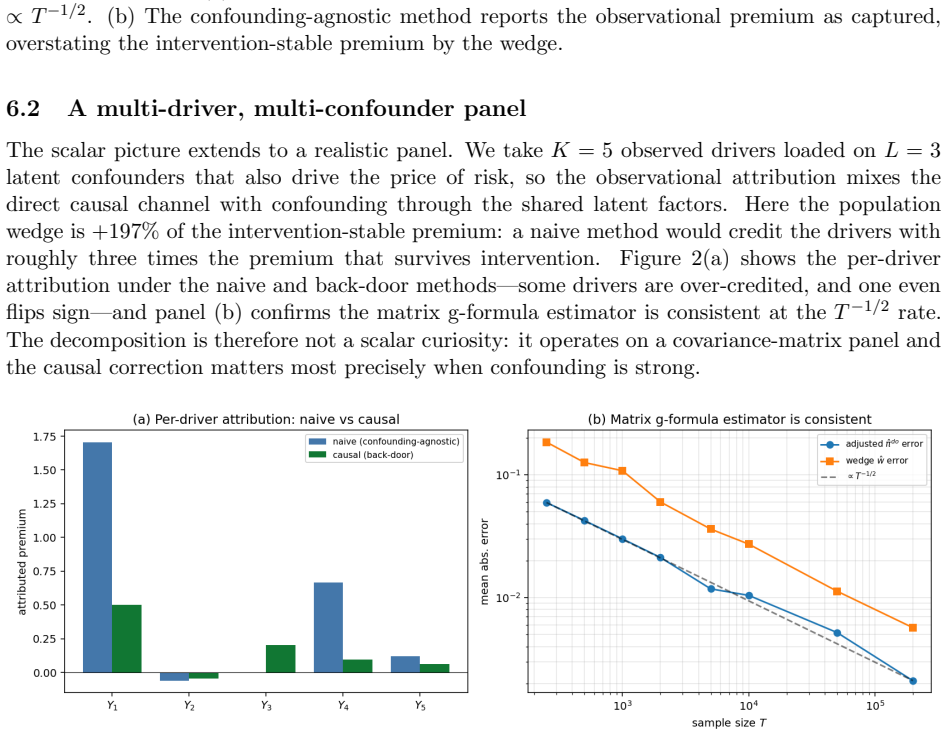
- The decomposition and its causal correction remain estimable on synthetic single- and multi-driver panels.
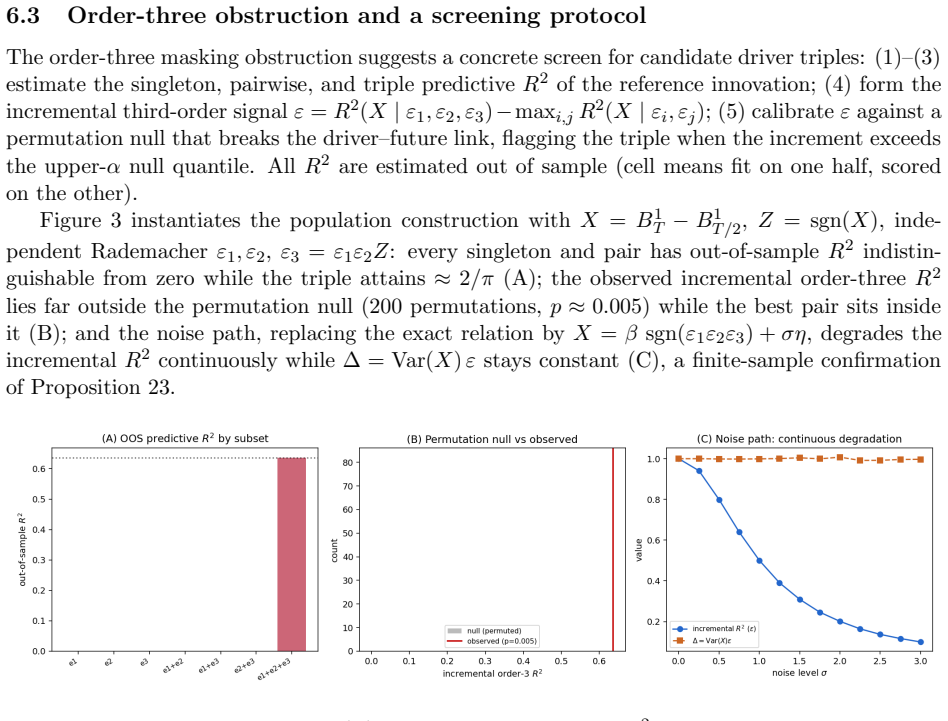
- A permutation-calibrated screen detects planted order-three leakage with controlled false positives.
Where Pith is reading between the lines
- Risk attribution procedures may need to verify joint immersion over all relevant driver combinations rather than relying on subset checks.
- The separation into masking and coupling opens the possibility of targeted diagnostics that isolate which ingredient drives the failure.
- Similar order-three phenomena could appear in other filtration-based causal attributions outside finance.
Load-bearing premise
Pairwise immersion of sub-books is assumed to guarantee immersion of the pooled triple, yet this can fail.
What would settle it
A concrete triple of drivers in which every pair satisfies immersion of its sub-book filtration but the pooled triple does not, as constructed and detected in the synthetic panel experiments.
Figures


read the original abstract
We study the squared price-of-risk premium of a portfolio -- an integrated conditional squared Sharpe-ratio functional, not an expected excess return -- and its attribution to causal drivers. Relative to a declared admissible benchmark it decomposes into intervention-stable premium, a signed causal distortion (the confounding wedge), and a nonnegative information loss; the loss is an $L^2$ projection residual, the wedge is not. The decomposition is well posed exactly when the driver filtration is immersed in the price filtration. It need not aggregate across portfolios pooling drivers: we identify an order-three obstruction that is invisible to every singleton and pairwise admissibility screen -- each one- and two-driver sub-book is immersed while the pooled triple reveals a future innovation -- the analogue of Bernstein's pairwise-but-not-mutually-independent triple, and minimal relative to such pairwise diagnostics. We separate its two ingredients, combinatorial masking and anticipative coupling. The failure is one of immersion, not of no-arbitrage. Experiments on synthetic single- and multi-driver panels show the decomposition and its causal correction are estimable, and that a permutation-calibrated screen detects planted order-three leakage with controlled false positives.
Editorial analysis
A structured set of objections, weighed in public.
Referee Report
Summary. The paper studies the squared price-of-risk premium of a portfolio and its decomposition into intervention-stable premium, signed causal distortion (confounding wedge), and nonnegative information loss (L2 projection residual). The decomposition is well-posed precisely when the driver filtration is immersed in the price filtration. The central claim is the existence of a minimal order-three obstruction to aggregation: each one- and two-driver sub-book satisfies immersion, yet the pooled triple reveals a future innovation (analogous to Bernstein's pairwise-but-not-mutually-independent triple). The authors separate combinatorial masking from anticipative coupling, show the failure is one of immersion rather than no-arbitrage, and supply synthetic single- and multi-driver panels demonstrating that the decomposition and its causal correction are estimable while a permutation-calibrated screen detects planted order-three leakage with controlled false positives.
Significance. If the identification holds, the result supplies a sharp, minimal counterexample showing that pairwise immersion diagnostics are insufficient to guarantee well-posedness of the squared price-of-risk attribution when drivers are pooled. The separation of masking and coupling ingredients, together with the synthetic experiments that plant and recover the obstruction, provides concrete, falsifiable evidence of the phenomenon and a practical detection tool. This strengthens the paper's contribution to causal attribution methods in portfolio risk premia by exhibiting a load-bearing limitation invisible to standard singleton/pairwise screens.
minor comments (3)
- [§1] The abstract and §1 state that the order-three example is 'minimal relative to such pairwise diagnostics,' but the manuscript does not explicitly compare the construction against all possible order-three filtrations or prove minimality in the lattice of immersion failures; a short remark or reference to the smallest counterexample in the filtration lattice would clarify this.
- [Experiments section] In the synthetic experiments, the permutation screen is reported to control false positives, yet the precise calibration procedure (number of permutations, exact test statistic, and how 'controlled' is quantified) is only summarized; adding a short algorithmic box or pseudocode would improve reproducibility without altering the central claim.
- [Notation and §2] Notation for the filtrations (driver vs. price) and the immersion operator is introduced early but reused with slight variations in the decomposition equations; a consolidated notation table or consistent use of subscripts throughout would reduce reader effort.
Simulated Author's Rebuttal
We thank the referee for the supportive summary, significance assessment, and recommendation of minor revision. The report correctly identifies the core contribution as a minimal order-three obstruction to aggregation of conditional price-of-risk decompositions that evades pairwise immersion screens. No specific major comments are raised in the report, so we have no points requiring substantive rebuttal or disagreement. We will incorporate any minor editorial or presentational suggestions in the revised version.
Circularity Check
No significant circularity detected
full rationale
The paper constructs a mathematical counterexample showing that pairwise immersion of sub-books does not imply immersion of the pooled triple, blocking aggregation of the squared price-of-risk decomposition. This is presented as an existence result under explicitly stated immersion conditions, analogous to Bernstein's triple, with separation of combinatorial masking and anticipative coupling. The well-posedness claim is tied directly to the immersion definition without reduction to fitted quantities, self-referential parameters, or load-bearing self-citations. No equations or steps in the abstract reduce the central obstruction claim to its own inputs by construction; the derivation remains self-contained as a theoretical identification rather than a statistical prediction or renamed empirical pattern.
Axiom & Free-Parameter Ledger
axioms (1)
- domain assumption The driver filtration is immersed in the price filtration for the decomposition to be well posed.
Reference graph
Works this paper leans on
-
[1]
Abhyankar, D
A. Abhyankar, D. Basu, A. Stremme,The optimal use of return predictability: an empirical study, Journal of Financial and Quantitative Analysis47(2012), no. 5, 973–1001
2012
-
[2]
Ankirchner, S
S. Ankirchner, S. Dereich, and P. Imkeller,The Shannon information of filtrations and the additional logarithmic utility of insiders, Ann. Probab.34(2006), 743–778
2006
-
[3]
A. Rodriguez Dominguez,Admissible information structures, immersion, and the order of non-anticipative aggregation, preprint, 2026 (superseding arXiv:2601.12541)
Pith/arXiv arXiv 2026
-
[4]
A. Rodriguez Dominguez,Causal PDE-control models: a structural framework for dynamic portfolio optimization, preprint arXiv:2509.09585, 2025
Pith/arXiv arXiv 2025
-
[5]
W. E. Ferson, A. F. Siegel,The efficient use of conditioning information in portfolios, Journal of Finance56(2001), 967–982
2001
-
[6]
L. P. Hansen and S. F. Richard,The role of conditioning information in deducing testable restrictions implied by dynamic asset pricing models, Econometrica55(1987), no. 3, 587–613
1987
-
[7]
Jacod,Grossissement initial, hypoth` ese (H’), et th´ eor` eme de Girsanov, in S´ eminaire de Calcul Stochastique 1982/83, Lecture Notes in Math.1118, Springer, 1985, 15–35
J. Jacod,Grossissement initial, hypoth` ese (H’), et th´ eor` eme de Girsanov, in S´ eminaire de Calcul Stochastique 1982/83, Lecture Notes in Math.1118, Springer, 1985, 15–35. 17
1982
-
[8]
Kardaras,Market viability via absence of arbitrage of the first kind, Finance Stoch.16 (2012), 651–667
C. Kardaras,Market viability via absence of arbitrage of the first kind, Finance Stoch.16 (2012), 651–667
2012
-
[9]
Karatzas and C
I. Karatzas and C. Kardaras,The num´ eraire portfolio in semimartingale financial models, Finance Stoch.11(2007), 447–493
2007
-
[10]
Mityagin,The zero set of a real analytic function, Mathematical Notes107(2020), 529–530
B. Mityagin,The zero set of a real analytic function, Mathematical Notes107(2020), 529–530
2020
-
[11]
Pearl,Causality: Models, Reasoning, and Inference, 2nd ed., Cambridge University Press, 2009
J. Pearl,Causality: Models, Reasoning, and Inference, 2nd ed., Cambridge University Press, 2009
2009
-
[12]
Peters, P
J. Peters, P. B¨ uhlmann, and N. Meinshausen,Causal inference by using invariant prediction: identification and confidence intervals, J. R. Stat. Soc. Ser. B78(2016), 947–1012
2016
-
[13]
P. E. Protter,Stochastic Integration and Differential Equations, 2nd ed., Springer, 2004
2004
-
[14]
Robins,A new approach to causal inference in mortality studies with a sustained exposure period, Math
J. Robins,A new approach to causal inference in mortality studies with a sustained exposure period, Math. Modelling7(1986), 1393–1512
1986
-
[15]
Shimizu, P
S. Shimizu, P. O. Hoyer, A. Hyv¨ arinen, and A. Kerminen,A linear non-Gaussian acyclic model for causal discovery, J. Mach. Learn. Res.7(2006), 2003–2030
2006
-
[16]
Spirtes, C
P. Spirtes, C. Glymour, and R. Scheines,Causation, Prediction, and Search, 2nd ed., MIT Press, 2000. 18
2000
discussion (0)
Sign in with ORCID, Apple, or X to comment. Anyone can read and Pith papers without signing in.