HERETIX: A Hermetic, Enriched, Rare-Event Time Projection Chamber in Xenon
Pith reviewed 2026-06-26 02:36 UTC · model grok-4.3
The pith
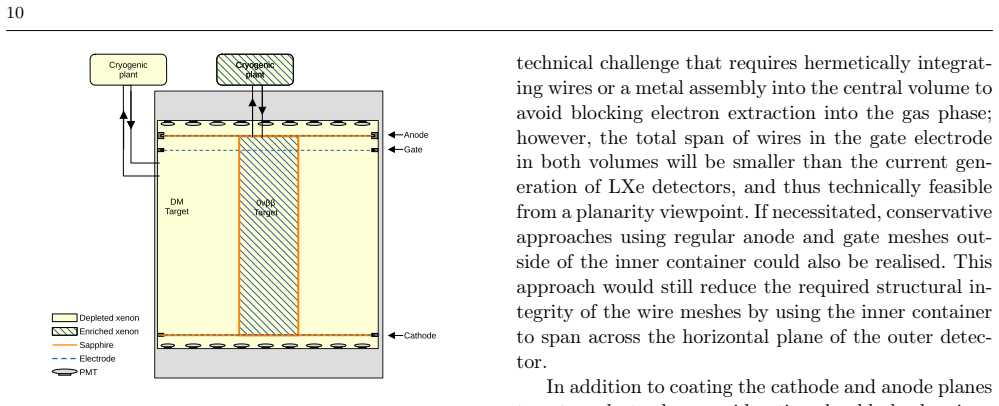
A hermetically sealed sapphire vessel of 90% enriched 136Xe inside a depleted xenon TPC enables simultaneous leading sensitivity to both 0νββ decay and dark matter.
A machine-rendered reading of the paper's core claim, the machinery that carries it, and where it could break.
Core claim
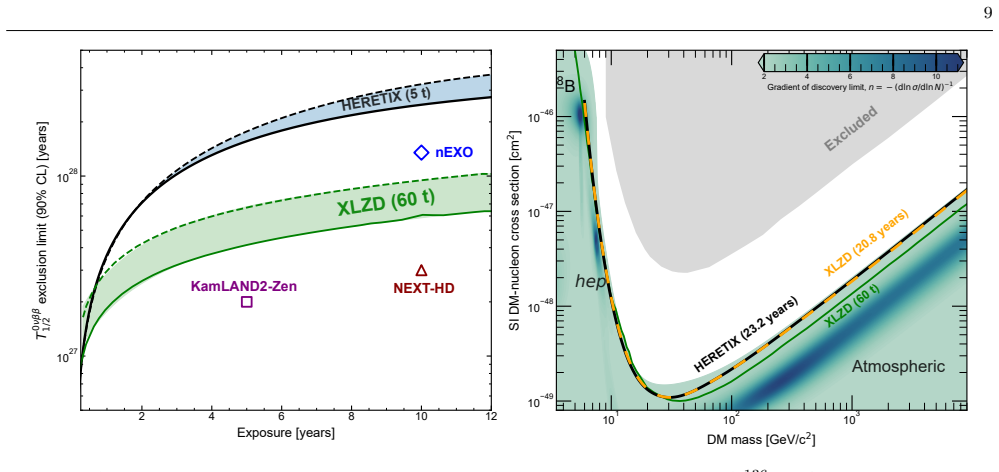
HERETIX consists of two nested time projection chambers in which a hermetically sealed sapphire vessel containing xenon enriched to 90% 136Xe forms the inner detector for 0νββ searches. Monte Carlo studies indicate that material-induced backgrounds can be effectively eliminated, yielding a projected 0νββ half-life sensitivity of 3.2 × 10^28 years at 90% confidence level after a 10-year exposure, while the surrounding xenon volume, depleted in 136Xe, preserves the excellent dark matter sensitivity of large liquid xenon detectors.
What carries the argument
The hermetically sealed sapphire vessel containing xenon enriched to 90% in 136Xe, which supplies the ultra-low-background inner volume for the 0νββ search.
If this is right
- Material-induced backgrounds are removed for the 0νββ search.
- Projected 0νββ half-life sensitivity reaches 3.2 × 10^28 years at 90% CL after 10 years.
- The outer depleted xenon volume retains the dark matter reach of existing large liquid xenon detectors.
- A single instrument addresses both WIMP and 0νββ physics goals simultaneously.
Where Pith is reading between the lines
- If the sapphire vessel works as modeled, comparable hermetic enclosures could be added to existing or future noble-liquid detectors for other isotopes.
- The dual-volume layout could lower the infrastructure cost of running separate experiments for each physics target.
- Long-term correlated data from the same exposure period would link constraints on neutrino mass and dark matter properties.
Load-bearing premise
The Monte Carlo simulations correctly predict that the hermetically sealed sapphire vessel will eliminate material-induced backgrounds to the level required for the stated sensitivity without additional unmodeled effects from construction or operation.
What would settle it
Direct measurement of background rates in the inner volume that exceed the Monte Carlo prediction by more than the margin needed to reach 3.2 × 10^28 years would falsify the projected sensitivity.
Figures

read the original abstract
Xenon-based time projection chambers have established themselves as one of the most powerful technologies for rare-event searches. HERETIX is a proposed multi-tonne liquid xenon observatory featuring two nested time projection chambers that enable the simultaneous optimisation of searches for weakly interacting massive particles and neutrinoless double beta decay ($0\nu\beta\beta$) of $^{136}$Xe. A hermetically sealed sapphire vessel containing xenon enriched to 90% $^{136}$Xe forms the inner detector, providing an ultra-low-background environment for $0\nu\beta\beta$ searches. Monte Carlo studies indicate that material-induced backgrounds can be effectively eliminated, yielding a projected $0\nu\beta\beta$ half-life sensitivity of $3.2 \times 10^{28} \, \mathrm{years}$ at 90% confidence level after a 10-year exposure, while the surrounding xenon volume, depleted in $^{136}$Xe, preserves the excellent dark matter sensitivity of large liquid xenon detectors. HERETIX therefore offers a unified experimental approach capable of delivering leading sensitivity to two of the most compelling questions in fundamental physics.
Editorial analysis
A structured set of objections, weighed in public.
Referee Report
Summary. The manuscript proposes HERETIX, a multi-tonne liquid xenon time projection chamber observatory with two nested detectors. An inner hermetically sealed sapphire vessel holds 90% enriched 136Xe for 0νββ searches, while the outer depleted-Xe volume targets WIMP dark matter. Monte Carlo studies are cited to claim that material-induced backgrounds are eliminated by the sapphire vessel, projecting a 0νββ half-life sensitivity of 3.2 × 10^28 years at 90% CL after 10 years exposure.
Significance. If the Monte Carlo projections can be substantiated with detailed methodology, background budgets, and validation, the design would constitute a notable technical advance by enabling simultaneous leading sensitivities to both 0νββ and dark matter in a single apparatus while preserving the background performance of large LXe detectors.
major comments (1)
- [Abstract] Abstract: The headline sensitivity of 3.2 × 10^28 years is derived entirely from Monte Carlo studies asserting that the hermetically sealed sapphire vessel eliminates material-induced backgrounds to negligible levels. No quantitative background budget, simulation methodology, radio-purity assumptions, or comparison to measured rates in existing LXe TPCs (e.g., XENONnT or LZ) is supplied, rendering the central claim impossible to evaluate.
Simulated Author's Rebuttal
We thank the referee for the careful reading and for highlighting the need for greater transparency in the Monte Carlo background modeling. The comment is well taken; the present manuscript does not supply the quantitative details required to evaluate the central sensitivity claim. We outline our planned revisions below.
read point-by-point responses
-
Referee: [Abstract] Abstract: The headline sensitivity of 3.2 × 10^28 years is derived entirely from Monte Carlo studies asserting that the hermetically sealed sapphire vessel eliminates material-induced backgrounds to negligible levels. No quantitative background budget, simulation methodology, radio-purity assumptions, or comparison to measured rates in existing LXe TPCs (e.g., XENONnT or LZ) is supplied, rendering the central claim impossible to evaluate.
Authors: We agree that the abstract and main text currently present the 3.2 × 10^28 yr sensitivity without the supporting quantitative information. In the revised manuscript we will add a new subsection (likely in the Methods or Backgrounds section) that (i) describes the GEANT4-based simulation framework and event selection, (ii) tabulates the assumed radio-purity levels for the sapphire vessel, electrodes, and other inner-detector components, (iii) provides the resulting background index in the 0νββ ROI together with the dominant contributions, and (iv) compares these rates to the measured backgrounds reported by XENONnT and LZ. These additions will allow the reader to assess the realism of the projection. revision: yes
Circularity Check
No circularity: sensitivity projection is a forward MC estimate, not a self-referential derivation
full rationale
The manuscript is a detector design proposal whose central claim is a projected 0νββ sensitivity obtained from Monte Carlo studies of background rejection by a hermetically sealed sapphire vessel. No equations, fitted parameters, or derivations appear in the provided text. The projection does not reduce to its own inputs by construction, nor does any self-citation chain or ansatz smuggling occur. The result is an external simulation output under stated assumptions rather than an internal tautology, satisfying the criterion for a self-contained design study with score 0.
Axiom & Free-Parameter Ledger
free parameters (2)
- 136Xe enrichment fraction (90%)
- Exposure duration (10 years)
axioms (1)
- domain assumption Monte Carlo simulations accurately model all relevant backgrounds and detector response for the proposed geometry.
invented entities (1)
-
Hermetically sealed sapphire inner vessel
no independent evidence
Reference graph
Works this paper leans on
-
[1]
T. Marrodán Undagoitia and L. Rauch,Dark matter direct-detection experiments,J. Phys. G43(2016) 013001 [1509.08767]
Pith/arXiv arXiv 2016
-
[2]
L. Roszkowski, E.M. Sessolo and S. Trojanowski,WIMP dark matter candidates and searches—current status and future prospects,Rept. Prog. Phys.81(2018) 066201 [1707.06277]
Pith/arXiv arXiv 2018
-
[3]
M.J. Dolinski, A.W.P. Poon and W. Rodejohann, Neutrinoless Double-Beta Decay: Status and Prospects, Ann. Rev. Nucl. Part. Sci.69(2019) 219 [1902.04097]
arXiv 2019
-
[4]
Agostini, G
M. Agostini, G. Benato, J.A. Detwiler, J. Menéndez and F. Vissani,Toward the discovery of matter creation with neutrinolessββdecay,Rev. Mod. Phys.95(2023) 025002
2023
-
[5]
M. Misiaszek and N. Rossi,Direct Detection of Dark Matter: A Critical Review,Symmetry16(2024) 201 [2310.20472]
arXiv 2024
-
[6]
L. Miramonti and V. Toso,Neutrinoless double beta decay in 2025,Mod. Phys. Lett. A40(2025) 2530006. 7.XENONcollaboration,The XENONnT dark matter experiment,Eur. Phys. J. C84(2024) 784 [2402.10446]
arXiv 2025
-
[7]
D. Akerib et al.,The LUX-ZEPLIN (LZ) experiment, Nuclear Instruments and Methods in Physics Research Section A: Accelerators, Spectrometers, Detectors and Associated Equipment953(2020) 163047
2020
-
[8]
M. Auger et al.,The EXO-200 detector, part I: Detector design and construction,JINST7(2012) P05010 [1202.2192]. 10.NEXTcollaboration,The NEXT experiment,Nucl. Part. Phys. Proc.273-275(2016) 1732 [1411.2433]
Pith/arXiv arXiv 2012
-
[9]
J.D. Lewin and P.F. Smith,Review of mathematics, numerical factors, and corrections for dark matter experiments based on elastic nuclear recoil, Astroparticle Physics6(1996) 87. 12.LUXcollaboration,Discrimination of electronic recoils from nuclear recoils in two-phase xenon time projection chambers,Phys. Rev. D102(2020) 112002 [2004.06304]
arXiv 1996
-
[10]
Akerib,LUX, ZEPLIN and LUX-ZEPLIN: Developments in liquid xenon detectors and the search for WIMP dark matter,Nuclear Physics B1003(2024) 116437
D.S. Akerib,LUX, ZEPLIN and LUX-ZEPLIN: Developments in liquid xenon detectors and the search for WIMP dark matter,Nuclear Physics B1003(2024) 116437
2024
-
[11]
Z. Bo et al.,Dark Matter Search Results from 1.54 Tonne·Year Exposure of PandaX-4T,Physical Review Letters134(2025) 011805 [2408.00664]. 15.XENONcollaboration,XENONnT analysis: Signal reconstruction, calibration, and event selection,Phys. Rev. D111(2025) 062006 [2409.08778]. 16.LUXcollaboration,Calibration, event reconstruction, data analysis, and limit c...
arXiv 2025
-
[12]
Meija, T.B
J. Meija, T.B. Coplen, M. Berglund, W.A. Brand, P. De Bièvre, M. Gröning et al.,Atomic weights of the elements 2013 (iupac technical report),Pure and Applied Chemistry88(2016) 265
2013
-
[13]
Redshaw, E
M. Redshaw, E. Wingfield, J. McDaniel and E.G. Myers,Mass and double-beta-decayqvalue of 136Xe,Phys. Rev. Lett.98(2007) 053003
2007
-
[14]
G. Anton, I. Badhrees, P.S. Barbeau, D. Beck, V. Belov, T. Bhatta et al.,Search for neutrinoless double-βdecay with the complete EXO-200 dataset,Physical Review Letters123(2019) 161802 [1906.02723]. 20.NEXTcollaboration,The NEXT-100 Detector, 2505.17848. 21.nEXOcollaboration,nEXO: neutrinoless double beta decay search beyond 1028 year half-life sensitivit...
arXiv 2019
-
[15]
B. Carew, A.R. Caddell, T.N. Maity and C.A.J. O’Hare,Neutrino fog for dark matter-electron scattering experiments,Phys. Rev. D109(2024) 083016 [2312.04303]. 23.XLZDcollaboration,The XLZD Design Book: towards the next-generation liquid xenon observatory for dark matter and neutrino physics,Eur. Phys. J. C85 (2025) 1192 [2410.17137]
arXiv 2024
-
[16]
J. Aalbers et al.,Neutrinoless double beta decay sensitivity of the XLZD rare event observatory,Journal of Physics G: Nuclear and Particle Physics52(2025) 045102. 25.XENONcollaboration,Improved quality tests of R11410-21 photomultiplier tubes for the XENONnT experiment,Journal of Instrumentation16(2021) P08033 [2104.15051]. 26.GEANT4collaboration,GEANT4 -...
arXiv 2025
-
[17]
Wang and S.a
G. Wang and S.a. Wang,A novel low-background photomultiplier tube r12699 in the pandax experiment, Journal of Instrumentation21(2026) C03030
2026
-
[18]
D. Chernyak et al.,Enhanced sensitivity to trace U238 impurity of sapphire via coincidence neutron activation analysis,Phys. Rev. C113(2026) 015803 [2508.04232]. 31.XENONcollaboration,Physics reach of the XENON1T dark matter experiment,JCAP04(2016) 027 [1512.07501]
arXiv 2026
-
[19]
Althüser,Search for Dark Matter and other beyond the Standard Model physics with XENON1T and XENONnT,University of Muenster(2023)
L. Althüser,Search for Dark Matter and other beyond the Standard Model physics with XENON1T and XENONnT,University of Muenster(2023)
2023
-
[20]
Sapphire datasheet
Meller optics, “Sapphire datasheet.” https://melleroptics.com/wp-content/uploads/2021/ 10/SAPPHIRE-REFRACTIVE-INDEX.pdf
2021
-
[21]
Sapphire datasheet
TYDEX optics, “Sapphire datasheet.”https: //www.tydexoptics.com/pdf/Synthetic_Sapphire.pdf. 15
-
[22]
Madland, E.D
D.G. Madland, E.D. Arthur, G.P. Estes, J.E. Stewart, M. Bozoian, R.T. Perry et al.,SOURCES 4A: A code for calculating (α,n), spontaneous fission, and delayed neutron sources and spectra, Report LA-13639-MS, Los Alamos National Laboratory, Los Alamos, NM (Sept., 1999)
1999
-
[23]
Conti, R
E. Conti, R. DeVoe, G. Gratta, T. Koffas, S. Waldman, J. Wodin et al.,Correlated fluctuations between luminescence and ionization in liquid xenon,Phys. Rev. B68(2003) 054201
2003
-
[24]
E. Aprile et al.,Energy resolution and linearity of XENON1T in the MeV energy range,European Physical Journal C80(2020) 785 [2003.03825]
arXiv 2020
-
[25]
Lung et al.,Characterization of the Hamamatsu R11410-10 3-in
K. Lung et al.,Characterization of the Hamamatsu R11410-10 3-in. photomultiplier tube for liquid xenon dark matter direct detection experiments,Nucl. Instrum. Meth. A696(2012) 32. 39.XENONcollaboration,First Dark Matter Search with Nuclear Recoils from the XENONnT Experiment,Phys. Rev. Lett.131(2023) 041003 [2303.14729]
arXiv 2012
-
[26]
Grant,Results from KamLAND-ZEN and SNO+,
C. Grant,Results from KamLAND-ZEN and SNO+,
-
[27]
10.5281/zenodo.4142683. 41.NEXTcollaboration,Sensitivity of a tonne-scale NEXT detector for neutrinoless double beta decay searches,JHEP2021(2021) 164 [2005.06467]
-
[28]
D. Baxter, I.M. Bloch, E. Bodnia, X. Chen, J. Conrad, P.D. Gangi et al.,Recommended conventions for reporting results from direct dark matter searches, European Physical Journal C, 81, 907 (2021)(2021) [2105.00599]. 43.LZcollaboration,Dark Matter Search Results from 4.2Tonne−Years of Exposure of the LUX-ZEPLIN (LZ) Experiment,Phys. Rev. Lett.135(2025) 011...
arXiv 2021
-
[29]
K. Arisaka, H. Wang, P.F. Smith, D. Cline, A. Teymourian, E. Brown et al.,XAX: a multi-ton, multi-target detection system for dark matter, double beta decay and pp solar neutrinos,Astroparticle Physics 31(2008) 63 [0808.3968]
Pith/arXiv arXiv 2008
-
[30]
J.J. Gomez-Cadenas, F. Guinea, M.M. Fogler, M.I. Katsnelson, J. Martin-Albo, F. Monrabal et al., GraXe, graphene and xenon for neutrinoless double beta decay searches,JCAP 02 (2012) 0372012(2011) 037 [1110.6133]
Pith/arXiv arXiv 2012
-
[31]
Bernstein, M
A. Bernstein, M. Clark, R. Essig, M. Fernandez-Serra, A. Kopec, R. Lang et al.,LBECA: A Low Background Electron Counting Apparatus for Sub-GeV Dark Matter Detection,Journal of Physics: Conference Series1468 (2020) 012035
2020
-
[32]
K. Sato, M. Yamashita, K. Ichimura, Y. Itow, S. Kazama, S. Moriyama et al.,Development of a dual-phase xenon TPC with a quartz chamber for direct dark matter searches,PTEP2020(2020) 113H02 [1910.13831]
arXiv 2020
-
[33]
Dierle, A
J. Dierle, A. Brown, H. Fischer, R. Glade-Beucke, J. Grigat, F. Kuger et al.,Reduction of222Rn-induced backgrounds in a hermetic dual-phase xenon time projection chamber,The European Physical Journal C 83(2023)
2023
-
[34]
Investigations on a custom-made silicon-based microchannel plate as active transverse energy filter for the KATRIN experiment
C. Gönner, “Investigations on a custom-made silicon-based microchannel plate as active transverse energy filter for the KATRIN experiment.” University of Münster, 10, 2022
2022
-
[35]
D.S. Leonard et al.,Systematic study of trace radioactive impurities in candidate construction materials for EXO-200,Nucl. Instrum. Meth. A591 (2008) 490 [0709.4524]
Pith/arXiv arXiv 2008
-
[36]
Sapphire datasheet
Thorlabs, “Sapphire datasheet.”https://www. thorlabs.com/sapphire-windows?tabName=Graphs
-
[37]
D. Schulte, M. Murra, P. Schulte, C. Huhmann and C. Weinheimer,Ultra-clean radon-free four cylinder magnetically-coupled piston pump,Journal of Instrumentation16(2021) P09011. 54.XENONcollaboration,Application and modeling of an online distillation method to reduce krypton and argon in XENON1T,Progress of Theoretical and Experimental Physics2022(2022) 053...
arXiv 2021
discussion (0)
Sign in with ORCID, Apple, or X to comment. Anyone can read and Pith papers without signing in.