EconSimulacra: A Digital Twin Platform of Socio-Economic Systems Powered by LLM Agents
Pith reviewed 2026-07-01 07:08 UTC · model grok-4.3
The pith
LLM agents with shared internal states reproduce nonlinear links between online attention and offline popularity.
A machine-rendered reading of the paper's core claim, the machinery that carries it, and where it could break.
Core claim
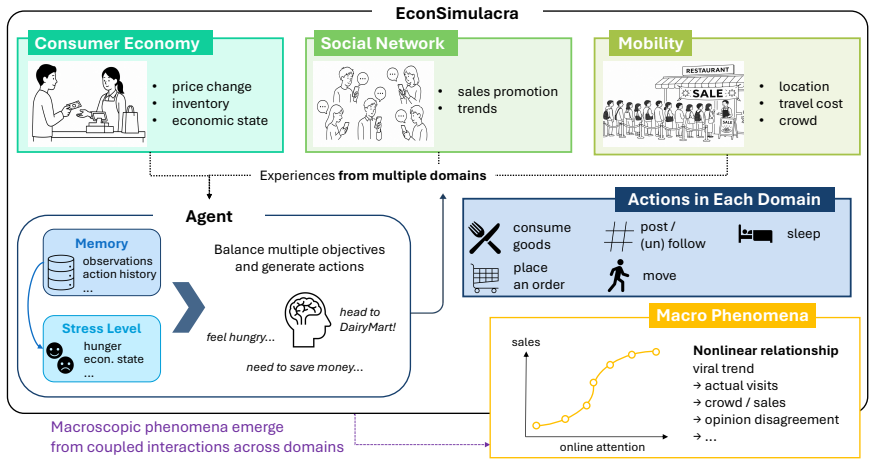
By storing cross-domain experiences in memory and converting them into a shared internal state, EconSimulacra lets LLM agents reconcile demands from economy, mobility, and social networks, producing coherent behaviors that reproduce a nonlinear relationship between online social attention and offline local popularity inside one unified artificial society.
What carries the argument
Shared internal state (for example stress level) that transforms accumulated experiences from heterogeneous domains into a single input for individual decision making.
If this is right
- Agents reconcile competing demands across domains through one internal state rather than separate rules.
- Cross-domain dynamics such as attention-to-popularity feedback emerge from unified memory and decision processes.
- The platform functions as a digital twin for studying coupled socio-economic systems in a single environment.
- Realistic behaviors arise without placing domains side by side or modeling them in isolation.
Where Pith is reading between the lines
- Policy experiments could be run by altering one domain's parameters and observing propagated effects through the shared state.
- The same mechanism might extend to additional domains such as health or education while preserving coherence.
- Calibration against real data could be tested by measuring how closely the reproduced nonlinearity matches empirical observations.
Load-bearing premise
LLM agents supplied with a shared internal state drawn from cross-domain memory can generate coherent human-like decisions that match real socio-economic feedback loops without domain-specific calibration or external validation data.
What would settle it
Direct comparison of the simulated nonlinear curve between online attention volume and offline popularity metrics against corresponding real-world measurements from social platforms and local activity data.
Figures
read the original abstract
Real-world social behavior emerges from tightly coupled domains: economic conditions shape mobility and social interactions, while online attention and offline activity feed back into local popularity and consumer behavior. Capturing these feedback loops requires artificial societies in which agents carry experiences from one domain into decisions in another. Large language models (LLMs) provide a promising foundation for such societies. However, existing LLM-based simulators typically model domains in isolation or merely place them side by side. To enable such cross-domain interactions, we present EconSimulacra, a multi-agent social simulator that couples consumer economy, mobility, and social networks through a shared internal-state mechanism. In EconSimulacra, experiences accumulated across different domains are stored in memory and transformed into shared internal states (i.e., stress level) connecting heterogeneous domains through individual decision making. This design allows agents to reconcile competing demands arising from multiple domains and generate coherent cross-domain behaviors. As a case study, we show that the shared internal state mechanisms reproduce a nonlinear relationship between online social attention and offline local popularity, illustrating how realistic cross-domain dynamics can emerge within a unified artificial society.
Editorial analysis
A structured set of objections, weighed in public.
Referee Report
Summary. The paper introduces EconSimulacra, a multi-agent social simulator that couples consumer economy, mobility, and social networks via LLM agents equipped with a shared internal-state mechanism (experiences stored in memory and transformed into states such as stress level). The central claim, presented as a case study, is that this mechanism produces coherent cross-domain behaviors and specifically reproduces a nonlinear relationship between online social attention and offline local popularity.
Significance. If the case-study result holds and the nonlinearity is shown to arise from the shared-state design rather than LLM priors or prompt engineering, the work would advance LLM-based socio-economic simulators by demonstrating emergent feedback loops across domains in a unified artificial society. The absence of any quantitative methods, data, or validation in the manuscript prevents assessment of whether this contribution is realized.
major comments (2)
- [Abstract] Abstract: the claim that shared internal-state mechanisms reproduce a nonlinear relationship between online social attention and offline local popularity supplies no quantitative definition of the relationship, no ablation removing the shared state, no comparison to real-world distributions, and no description of how agent decisions were logged or aggregated; this is load-bearing for the central claim.
- [Abstract] Abstract: without methods, data sources, validation metrics, or error analysis, it is impossible to determine whether the reported nonlinearity emerges from the cross-domain memory design or is shaped by prompt choices and LLM priors.
Simulated Author's Rebuttal
We thank the referee for the constructive feedback. We agree that the abstract's central claim on the nonlinear relationship is insufficiently supported without quantitative definitions, ablations, logging details, data sources, validation metrics, and error analysis. We will perform a major revision to incorporate these elements, including a dedicated Methods section, ablation experiments, and validation approaches, to strengthen the demonstration that the shared internal-state mechanism drives the observed cross-domain behaviors.
read point-by-point responses
-
Referee: [Abstract] Abstract: the claim that shared internal-state mechanisms reproduce a nonlinear relationship between online social attention and offline local popularity supplies no quantitative definition of the relationship, no ablation removing the shared state, no comparison to real-world distributions, and no description of how agent decisions were logged or aggregated; this is load-bearing for the central claim.
Authors: We agree that these details are missing from the abstract and are essential for the claim. In revision, we will add a quantitative definition (e.g., fitting a power-law or using a specific nonlinearity metric such as deviation from linearity in log-log plots), report an ablation comparing runs with and without the shared-state mechanism, describe the logging process (event-based recording of attention and popularity scores per agent per timestep) and aggregation (averaging across multiple simulation seeds with standard error), and include comparisons to real-world distributions where public datasets on social media attention and local venue popularity are available. These additions will be made to the abstract and a new Methods section. revision: yes
-
Referee: [Abstract] Abstract: without methods, data sources, validation metrics, or error analysis, it is impossible to determine whether the reported nonlinearity emerges from the cross-domain memory design or is shaped by prompt choices and LLM priors.
Authors: We concur that the manuscript currently lacks these elements, preventing clear attribution. We will revise by adding a Methods section detailing data sources (e.g., synthetic initialization from demographic distributions and network topologies), validation metrics (e.g., Kolmogorov-Smirnov tests or regression coefficients for nonlinearity), and error analysis (sensitivity sweeps over prompt variations and alternative LLMs). The planned ablation will isolate the contribution of the shared-state design versus priors. These changes will be implemented in the revision. revision: yes
Circularity Check
No circularity detected; central claim rests on asserted case-study emergence without shown reduction to inputs
full rationale
The provided abstract and description contain no equations, parameter-fitting steps, or self-citations that reduce the claimed nonlinear relationship to a fitted input or definitional loop. The shared internal-state mechanism is presented as enabling cross-domain behavior, and the nonlinear mapping is asserted to emerge in the case study, but no derivation chain, ablation, or quantitative definition is given that would allow identification of self-definitional, fitted-prediction, or self-citation circularity. Per hard rules, circularity requires explicit quotes exhibiting reduction by construction; none are present, so the finding is no significant circularity.
Axiom & Free-Parameter Ledger
Reference graph
Works this paper leans on
-
[1]
InFindings of the Associa- tion for Computational Linguistics: EMNLP 2020, pages 1644–1650
TweetE- val: Unified benchmark and comparative evaluation for tweet classification. InFindings of the Associa- tion for Computational Linguistics: EMNLP 2020, pages 1644–1650. Nicolas Bougie and Narimawa Watanabe
2020
-
[2]
In Proceedings of the 2025 Conference on Empirical Methods in Natural Language Processing: Industry Track, pages 215–229
CitySim: Modeling urban behaviors and city dynam- ics with large-scale LLM-driven agent simulation. In Proceedings of the 2025 Conference on Empirical Methods in Natural Language Processing: Industry Track, pages 215–229. Ayush Chopra, Shashank Kumar, Nurullah Giray Kuru, Ramesh Raskar, and Arnau Quera-Bofarull
2025
-
[3]
InFindings of the Association for Com- putational Linguistics: NAACL 2024, pages 3326–
Simulating opinion dynamics with networks of LLM- based agents. InFindings of the Association for Com- putational Linguistics: NAACL 2024, pages 3326–
2024
-
[4]
Epstein and Robert L
Joshua M. Epstein and Robert L. Axtell. 1996.Growing artificial societies: Social science from the bottom up. The MIT Press. Chen Gao, Xiaochong Lan, Nian Li, Yuan Yuan, Jingtao Ding, Zhilun Zhou, Fengli Xu, and Yong Li
1996
-
[5]
BERTopic: Neural topic modeling with a class-based TF-IDF procedure
BERTopic: Neural topic modeling with a class-based TF-IDF procedure. Preprint, arXiv:2203.05794. Torsten Hägerstrand
work page internal anchor Pith review Pith/arXiv arXiv
-
[6]
Ryuji Hashimoto, Masahiro Kaneko, Ryosuke Takata, Takehiro Takayanagi, and Kiyoshi Izumi
What about people in re- gional science?Papers of the Regional Science Asso- ciation, 24(1):6–21. Ryuji Hashimoto, Masahiro Kaneko, Ryosuke Takata, Takehiro Takayanagi, and Kiyoshi Izumi. 2026a. From heard to lived opinions: Simulating opinion dynamics with grounded llm agents in economic en- vironments.Preprint, arXiv:2603.26701. Ryuji Hashimoto, Takehir...
-
[7]
Building LLM-based artificial market simulations: Can LLMs function as agents in multi-agent simulations for finance? InThe Inter- national Conference on Principles and Practice of Multi-Agent Systems (PRIMA 2025), pages 56–71. C. S. Holling
2025
-
[8]
AgentSims: An open-source sandbox for large language model evalu- ation.Preprint, arXiv:2308.04026. Genglin Liu, Vivian T. Le, Salman Rahman, Elisa Kreiss, Marzyeh Ghassemi, and Saadia Gabriel
-
[9]
InPro- ceedings of the 2025 Conference on Empirical Meth- ods in Natural Language Processing, pages 6390–
Mosaic: Modeling social ai for content dissemination and regulation in multi-agent simulations. InPro- ceedings of the 2025 Conference on Empirical Meth- ods in Natural Language Processing, pages 6390–
2025
-
[10]
Tianmi Ma, Jiawei Du, Wenxin Huang, Wenjie Wang, Liang Xie, Xian Zhong, and Joey Tianyi Zhou
Computational experiments meet large language model based agents: A survey and perspective.Preprint, arXiv:2402.00262. Tianmi Ma, Jiawei Du, Wenxin Huang, Wenjie Wang, Liang Xie, Xian Zhong, and Joey Tianyi Zhou
-
[11]
InFindings of the Association for Computational Linguistics: EMNLP 2025, pages 5496–5514
Agent trading arena: A study on numerical under- standing in LLM-based agents. InFindings of the Association for Computational Linguistics: EMNLP 2025, pages 5496–5514. Meta
2025
-
[12]
The Llama 3 herd of models.Preprint, arXiv:2407.21783. Xinyi Mou, Xuanwen Ding, Qi He, Liang Wang, Jing- cong Liang, Xinnong Zhang, Libo Sun, Jiayu Lin, Jie Zhou, Huang Xuanjing, and Zhongyu Wei
work page internal anchor Pith review Pith/arXiv arXiv
-
[13]
InFindings of the Association for Computational Linguistics: ACL 2024, pages 4789–4809
Unveiling the truth and facilitating change: Towards agent-based large-scale social movement simulation. InFindings of the Association for Computational Linguistics: ACL 2024, pages 4789–4809. Önder Gürcan
2024
-
[14]
InHybrid Human AI Systems for the Social Good (HHAI 2024), Frontiers in Artificial In- telligence and Applications
LLM-augmented agent-based modelling for social simulations: Challenges and op- portunities. InHybrid Human AI Systems for the Social Good (HHAI 2024), Frontiers in Artificial In- telligence and Applications. IOS Press. OpenAI
2024
-
[15]
gpt-oss-120b & gpt-oss-20b Model Card
gpt-oss-120b & gpt-oss-20b model card. Preprint, arXiv:2508.10925. John F. Padgett and Walter W. Powell. 2012.The emer- gence of organizations and markets. Princeton Uni- versity Press. Joon Sung Park, Joseph O’Brien, Carrie Jun Cai, Mered- ith Ringel Morris, Percy Liang, and Michael S. Bern- stein
work page internal anchor Pith review Pith/arXiv arXiv 2012
-
[16]
Qwen3 technical report.Preprint, arXiv:2505.09388. Alexander Sasha Vezhnevets, John P. Agapiou, Avia Aharon, Ron Ziv, Jayd Matyas, Edgar A. Duéñez- Guzmán, William A. Cunningham, Simon Osindero, Danny Karmon, and Joel Z. Leibo
work page internal anchor Pith review Pith/arXiv arXiv
-
[17]
arXiv preprint arXiv:2312.03664 , year=
Gener- ative agent-based modeling with actions grounded in physical, social, or digital space using Concordia. Preprint, arXiv:2312.03664. Ziyi Yang, Zaibin Zhang, Zirui Zheng, Yuxian Jiang, Ziyue Gan, Zhiyu Wang, Zijian Ling, Jinsong Chen, Martz Ma, Bowen Dong, Prateek Gupta, Shuyue Hu, Zhenfei Yin, Guohao Li, Xu Jia, Lijun Wang, Bernard Ghanem, Huchuan ...
-
[18]
arXiv preprint arXiv:2411.11581 , year=
OASIS: Open agent social interac- tion simulations with one million agents.Preprint, arXiv:2411.11581. Jun Zhang, Yuwei Yan, Junbo Yan, Zhiheng Zheng, Jinghua Piao, Depeng Jin, and Yong Li
-
[19]
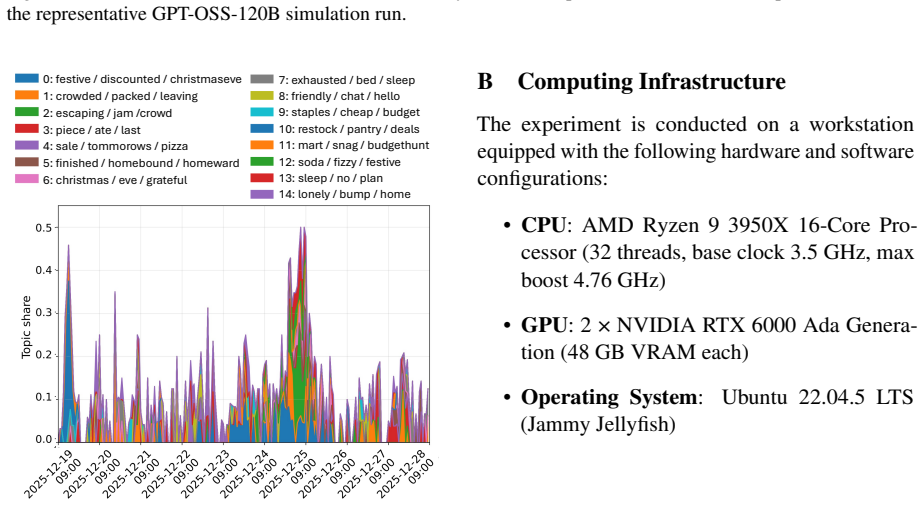
festive / discounted / christmaseve
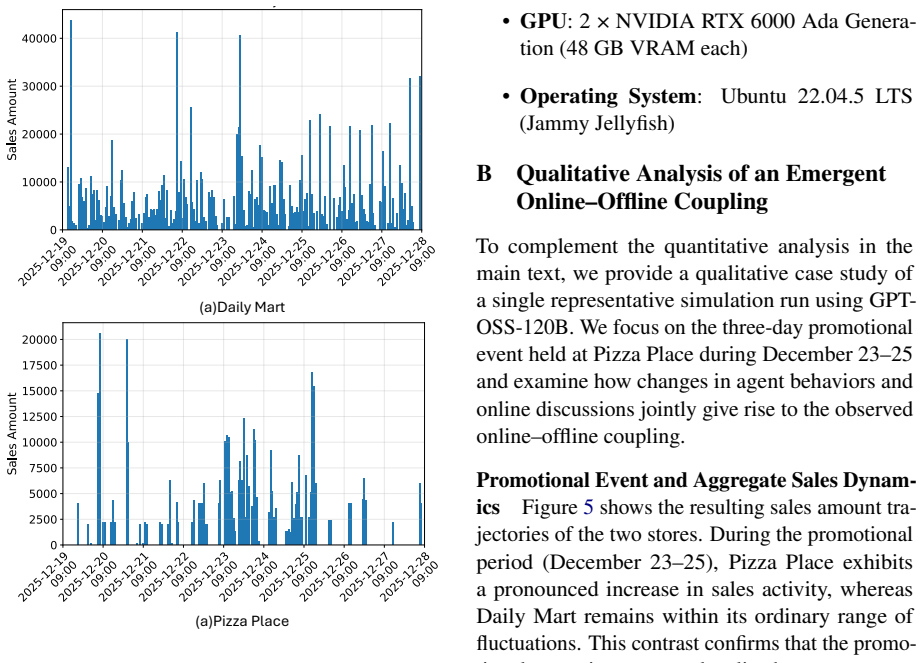
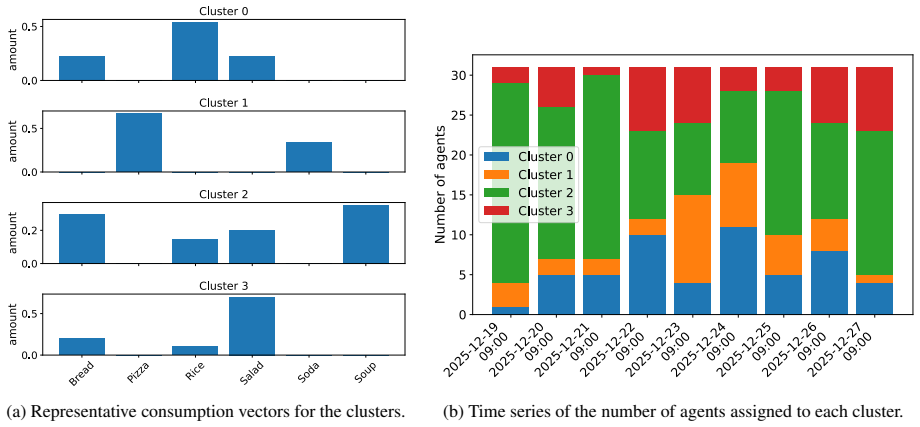
increases markedly, while the relative sizes of the routine shopping clusters decrease. These observa- tions suggest that the promotional event reshapes the distribution of consumption behaviors across the population. Emergence of Online DiscussionsTo investi- gate how changes in offline activities are reflected in the social network domain, we extract di...
2022
discussion (0)
Sign in with ORCID, Apple, or X to comment. Anyone can read and Pith papers without signing in.