Non-topological solitons in biadjoint scalar field theory
Pith reviewed 2026-06-26 03:09 UTC · model grok-4.3
The pith
Biadjoint scalar field theory supports time-dependent non-topological solitons protected by a U(1) charge from colour space rotations.
A machine-rendered reading of the paper's core claim, the machinery that carries it, and where it could break.
Core claim
Using an ansatz that can be embedded in any choice of non-abelian colour groups, biadjoint scalar theory admits a family of time-dependent non-topological solitons whose existence is protected by carrying a U(1) charge associated with certain rotations in colour space. The solutions are closely related to Q-ball solutions in other scalar field theories. The solution set contains configurations that are stable under small perturbations within a consistent truncation of the theory, have finite energy, and are localised.
What carries the argument
The embeddable ansatz for the scalar fields that permits U(1)-charged time-dependent solutions analogous to Q-balls, with the U(1) charge arising from rotations in colour space.
If this is right
- The solutions carry finite energy and remain localised in space.
- A subset of the solutions is stable under small perturbations in a consistent truncation.
- The construction and the associated U(1) charge protection apply for any choice of non-abelian colour group.
- The solutions are time-dependent and directly analogous to Q-ball solutions known in other scalar theories.
Where Pith is reading between the lines
- The existence of these charged solitons may constrain or enrich the nonlinear sector relevant to double-copy relations between theories.
- Numerical simulations of the full equations of motion beyond the truncation could test whether the stable subset survives in the complete theory.
- The same charge-protection mechanism might generate analogous solitons in other multi-scalar theories with similar internal symmetries.
Load-bearing premise
The ansatz that can be embedded in any choice of non-abelian colour groups is sufficient to construct and analyze the full family of solutions and their stability properties.
What would settle it
An explicit check or numerical evolution showing that the constructed solutions have divergent energy or become unstable under perturbations inside the truncation would disprove the claims of existence and stability.
Figures

read the original abstract
Biadjoint scalar theory has been widely studied, due to its being closely related to the double copy correspondence linking gauge, gravity and related theories. In this paper, we continue a programme of work in elucidating non-linear solutions of this theory, and find a family of new solutions that are richer and more complex than previous cases. Using an ansatz that can be embedded in any choice of non-abelian colour groups, we demonstrate the existence of non-topological solitons, whose existence is protected by carrying a U(1) charge associated with certain rotations in colour space. The solutions are time-dependent, and closely related to the well-known Q-ball solutions in other scalar field theories. We also show explicitly that our solution set contains those that are stable under small perturbations within a consistent truncation of the theory, and have finite energy in addition to being localised.
Editorial analysis
A structured set of objections, weighed in public.
Referee Report
Summary. The paper constructs a family of time-dependent non-topological soliton solutions (Q-ball-like) in biadjoint scalar theory via a colour-rotation ansatz embeddable in arbitrary non-abelian groups. The solutions carry a conserved U(1) charge, are localised with finite energy, and the authors claim that a subset is stable against small perturbations inside a consistent truncation of the theory.
Significance. If the truncation is shown to be complete, the explicit construction would usefully enlarge the catalogue of non-linear solutions in biadjoint theories and their double-copy relatives. The group-agnostic ansatz and the demonstration of finite-energy, localised configurations are concrete strengths.
major comments (2)
- [§4] §4 (stability analysis): the claim that solutions are stable under small perturbations is demonstrated only inside a truncation. No argument is given that this truncation exhausts all fluctuation channels that couple to the time-dependent U(1) charge or to the full biadjoint indices outside the chosen embedding; a negative mode in an omitted channel would invalidate the stability statement even if the truncated spectrum is positive.
- [§3.2] §3.2, Eq. (3.15): the ansatz is stated to close under the equations of motion for any choice of colour group, but the reduction of the energy functional and the charge conservation law are performed only after fixing a specific embedding; it is not shown that the same closure and finiteness properties survive for generic embeddings without additional constraints.
minor comments (2)
- The notation for the biadjoint indices and the U(1) generator is introduced without a clear summary table; a short table listing the generators and their commutation relations would improve readability.
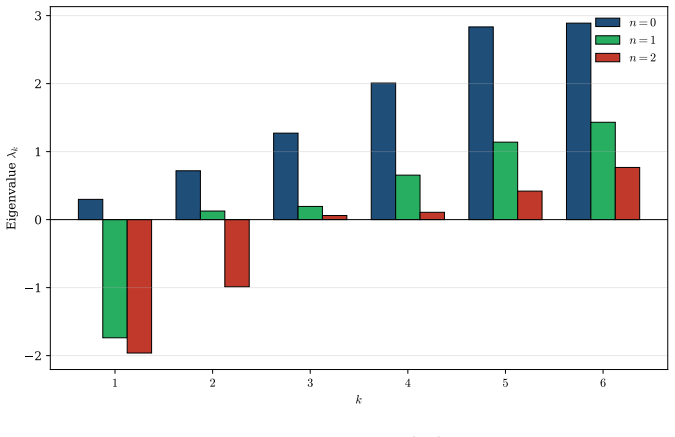
- Figure 2 caption does not state the value of the frequency parameter ω used for the plotted profiles.
Simulated Author's Rebuttal
We thank the referee for the careful reading and constructive comments on the manuscript. We address each major comment below.
read point-by-point responses
-
Referee: [§4] §4 (stability analysis): the claim that solutions are stable under small perturbations is demonstrated only inside a truncation. No argument is given that this truncation exhausts all fluctuation channels that couple to the time-dependent U(1) charge or to the full biadjoint indices outside the chosen embedding; a negative mode in an omitted channel would invalidate the stability statement even if the truncated spectrum is positive.
Authors: We agree that the stability demonstration is performed only inside the consistent truncation, as stated in the manuscript. The truncation incorporates the modes tied to the U(1) charge and the chosen colour embedding, but we did not supply an argument that it captures every possible fluctuation channel in the complete theory. We will revise §4 to state the scope of the claim more explicitly and to note that a full analysis of all channels lies beyond the present work. This is a partial revision. revision: partial
-
Referee: [§3.2] §3.2, Eq. (3.15): the ansatz is stated to close under the equations of motion for any choice of colour group, but the reduction of the energy functional and the charge conservation law are performed only after fixing a specific embedding; it is not shown that the same closure and finiteness properties survive for generic embeddings without additional constraints.
Authors: The ansatz is introduced in §3.2 in a form that closes under the equations of motion for arbitrary non-abelian groups, with the colour algebra factoring out before any embedding is chosen. The radial profile functions that determine localisation and finite energy are the same for any embedding; only overall group-theoretic prefactors appear in the energy and charge, which do not alter these properties. We will add an explicit remark in §3.2 confirming that closure, finiteness and localisation hold for generic embeddings without further constraints. revision: yes
Circularity Check
No circularity: solutions constructed from ansatz and shown stable in truncation without reduction to inputs
full rationale
The paper introduces an ansatz embeddable in arbitrary non-abelian groups, uses it to exhibit time-dependent non-topological solitons carrying U(1) charge (analogous to Q-balls), and explicitly verifies stability under perturbations plus finite localized energy inside a consistent truncation. None of these steps reduce by the paper's own equations to fitted parameters, self-definitions, or self-citation chains; the existence and stability claims rest on direct construction and analysis rather than renaming or importing uniqueness from prior self-work. The derivation chain is therefore self-contained against external benchmarks.
Axiom & Free-Parameter Ledger
Reference graph
Works this paper leans on
-
[1]
A Relation Between Tree Amplitudes of Closed and Open Strings,
H. Kawai, D. Lewellen, and S. Tye, “A Relation Between Tree Amplitudes of Closed and Open Strings,”Nucl.Phys.B269(1986) 1
1986
-
[2]
New Relations for Gauge-Theory Amplitudes,
Z. Bern, J. Carrasco, and H. Johansson, “New Relations for Gauge-Theory Amplitudes,” Phys.Rev.D78(2008) 085011,0805.3993
Pith/arXiv arXiv 2008
-
[3]
Perturbative Quantum Gravity as a Double Copy of Gauge Theory,
Z. Bern, J. J. M. Carrasco, and H. Johansson, “Perturbative Quantum Gravity as a Double Copy of Gauge Theory,”Phys.Rev.Lett.105(2010) 061602,1004.0476
Pith/arXiv arXiv 2010
-
[4]
Gravity as the Square of Gauge Theory,
Z. Bern, T. Dennen, Y.-t. Huang, and M. Kiermaier, “Gravity as the Square of Gauge Theory,”Phys.Rev.D82(2010) 065003,1004.0693
Pith/arXiv arXiv 2010
-
[5]
Black holes and the double copy,
R. Monteiro, D. O’Connell, and C. D. White, “Black holes and the double copy,”JHEP 1412(2014) 056,1410.0239
Pith/arXiv arXiv 2014
-
[6]
The classical double copy for Taub-NUT spacetime,
A. Luna, R. Monteiro, D. O’Connell, and C. D. White, “The classical double copy for Taub-NUT spacetime,”Phys. Lett.B750(2015) 272–277,1507.01869
Pith/arXiv arXiv 2015
-
[7]
Static Spherically Symmetric Kerr-Schild Metrics and Implications for the Classical Double Copy,
A. K. Ridgway and M. B. Wise, “Static Spherically Symmetric Kerr-Schild Metrics and Implications for the Classical Double Copy,”Phys. Rev.D94(2016), no. 4, 044023, 1512.02243
Pith/arXiv arXiv 2016
-
[8]
The Kerr-Schild double copy in curved spacetime,
N. Bahjat-Abbas, A. Luna, and C. D. White, “The Kerr-Schild double copy in curved spacetime,”JHEP12(2017) 004,1710.01953
Pith/arXiv arXiv 2017
-
[9]
The classical double copy in maximally symmetric spacetimes,
M. Carrillo-Gonz´ alez, R. Penco, and M. Trodden, “The classical double copy in maximally symmetric spacetimes,”JHEP04(2018) 028,1711.01296. 12
Pith/arXiv arXiv 2018
-
[10]
The classical double copy in three spacetime dimensions,
M. Carrillo Gonz´ alez, B. Melcher, K. Ratliff, S. Watson, and C. D. White, “The classical double copy in three spacetime dimensions,”JHEP07(2019) 167,1904.11001
Pith/arXiv arXiv 2019
-
[11]
Kerr-Schild Double Copy and Complex Worldlines,
I. Bah, R. Dempsey, and P. Weck, “Kerr-Schild Double Copy and Complex Worldlines,” JHEP02(2020) 180,1910.04197
arXiv 2020
-
[12]
Kerr-Schild double copy of the Coulomb solution in three dimensions,
G. Alkac, M. K. Gumus, and M. A. Olpak, “Kerr-Schild double copy of the Coulomb solution in three dimensions,”Phys. Rev. D104(2021), no. 4, 044034,2105.11550
arXiv 2021
-
[13]
Generalized black holes in 3D Kerr-Schild double copy,
G. Alkac, M. K. Gumus, and M. A. Olpak, “Generalized black holes in 3D Kerr-Schild double copy,”Phys. Rev. D106(2022), no. 2, 026013,2205.08503
arXiv 2022
-
[14]
Type D Spacetimes and the Weyl Double Copy,
A. Luna, R. Monteiro, I. Nicholson, and D. O’Connell, “Type D Spacetimes and the Weyl Double Copy,”Class. Quant. Grav.36(2019) 065003,1810.08183
Pith/arXiv arXiv 2019
-
[15]
Anti-Self-Dual Spacetimes, Gravitational Instantons and Knotted Zeros of the Weyl Tensor,
S. Sabharwal and J. W. Dalhuisen, “Anti-Self-Dual Spacetimes, Gravitational Instantons and Knotted Zeros of the Weyl Tensor,”JHEP07(2019) 004,1904.06030
Pith/arXiv arXiv 2019
-
[16]
R. Alawadhi, D. S. Berman, and B. Spence, “Weyl doubling,”JHEP09(2020) 127, 2007.03264
arXiv 2020
-
[17]
Weyl Double Copy for Gravitational Waves,
H. Godazgar, M. Godazgar, R. Monteiro, D. Peinador Veiga, and C. N. Pope, “Weyl Double Copy for Gravitational Waves,”Phys. Rev. Lett.126(2021), no. 10, 101103,2010.02925
arXiv 2021
-
[18]
Twistorial Foundation for the Classical Double Copy,
C. D. White, “Twistorial Foundation for the Classical Double Copy,”Phys. Rev. Lett.126 (2021), no. 6, 061602,2012.02479
arXiv 2021
-
[19]
E. Chac´ on, H. Garc´ ıa-Compe´ an, A. Luna, R. Monteiro, and C. D. White, “New heavenly double copies,”JHEP03(2021) 247,2008.09603
arXiv 2021
-
[20]
The Weyl double copy from twistor space,
E. Chac´ on, S. Nagy, and C. D. White, “The Weyl double copy from twistor space,”JHEP 05(2021) 2239,2103.16441
arXiv 2021
-
[21]
Double copy of the multipole expansion,
E. Chac´ on, A. Luna, and C. D. White, “Double copy of the multipole expansion,”Phys. Rev. D106(2022), no. 8, 086020,2108.07702
arXiv 2022
-
[22]
Alternative formulations of the twistor double copy,
E. Chac´ on, S. Nagy, and C. D. White, “Alternative formulations of the twistor double copy,”JHEP03(2022) 180,2112.06764
arXiv 2022
-
[23]
Compactifying the Kerr-Schild double copy,
R. Dempsey and P. Weck, “Compactifying the Kerr-Schild double copy,”JHEP05(2023) 198,2211.14327
arXiv 2023
-
[24]
Einstein-Maxwell theory and the Weyl double copy,
D. A. Easson, T. Manton, and A. Svesko, “Einstein-Maxwell theory and the Weyl double copy,”Phys. Rev. D107(2023), no. 4, 044063,2210.16339
arXiv 2023
-
[25]
Aligned fields double copy to Kerr-NUT-(A)dS,
S. Chawla and C. Keeler, “Aligned fields double copy to Kerr-NUT-(A)dS,”JHEP04 (2023) 005,2209.09275
arXiv 2023
-
[26]
The Weyl double copy in vacuum spacetimes with a cosmological constant,
S. Han, “The Weyl double copy in vacuum spacetimes with a cosmological constant,”JHEP 09(2022) 238,2205.08654. 13
arXiv 2022
-
[27]
Non-perturbative aspects of the self-dual double copy,
K. Armstrong-Williams, C. D. White, and S. Wikeley, “Non-perturbative aspects of the self-dual double copy,”JHEP08(2022) 160,2205.02136
arXiv 2022
-
[28]
Weyl double copy and massless free-fields in curved spacetimes,
S. Han, “Weyl double copy and massless free-fields in curved spacetimes,”Class. Quant. Grav.39(2022), no. 22, 225009,2204.01907
arXiv 2022
-
[29]
The Newman-Penrose Map and the Classical Double Copy,
G. Elor, K. Farnsworth, M. L. Graesser, and G. Herczeg, “The Newman-Penrose Map and the Classical Double Copy,”JHEP12(2020) 121,2006.08630
arXiv 2020
-
[30]
Twistor space origins of the Newman-Penrose map,
K. Farnsworth, M. L. Graesser, and G. Herczeg, “Twistor space origins of the Newman-Penrose map,”SciPost Phys.13(2022), no. 4, 099,2104.09525
arXiv 2022
-
[31]
Yang-Mills origin of gravitational symmetries,
A. Anastasiou, L. Borsten, M. J. Duff, L. J. Hughes, and S. Nagy, “Yang-Mills origin of gravitational symmetries,”Phys. Rev. Lett.113(2014), no. 23, 231606,1408.4434
Pith/arXiv arXiv 2014
-
[32]
Comments on the double copy construction for gravitational theories,
G. Lopes Cardoso, G. Inverso, S. Nagy, and S. Nampuri, “Comments on the double copy construction for gravitational theories,” in17th Hellenic School and Workshops on Elementary Particle Physics and Gravity (CORFU2017) Corfu, Greece, September 2-28,
-
[33]
Gravity as Gauge Theory Squared: A Ghost Story,
A. Anastasiou, L. Borsten, M. J. Duff, S. Nagy, and M. Zoccali, “Gravity as Gauge Theory Squared: A Ghost Story,”Phys. Rev. Lett.121(2018), no. 21, 211601,1807.02486
arXiv 2018
-
[34]
The convolutional double copy: a case study with a point,
A. Luna, S. Nagy, and C. White, “The convolutional double copy: a case study with a point,”JHEP09(2020) 062,2004.11254
arXiv 2020
-
[35]
The pure BRST Einstein-Hilbert Lagrangian from the double-copy to cubic order,
L. Borsten and S. Nagy, “The pure BRST Einstein-Hilbert Lagrangian from the double-copy to cubic order,”JHEP07(2020) 093,2004.14945
arXiv 2020
-
[36]
Becchi-Rouet-Stora-Tyutin-Lagrangian Double Copy of Yang-Mills Theory,
L. Borsten, B. Jurco, H. Kim, T. Macrelli, C. Saemann, and M. Wolf, “Becchi-Rouet-Stora-Tyutin-Lagrangian Double Copy of Yang-Mills Theory,”Phys. Rev. Lett.126(2021), no. 19, 191601,2007.13803
arXiv 2021
-
[37]
Classical gluon and graviton radiation from the bi-adjoint scalar double copy,
W. D. Goldberger, S. G. Prabhu, and J. O. Thompson, “Classical gluon and graviton radiation from the bi-adjoint scalar double copy,”Phys. Rev.D96(2017), no. 6, 065009, 1705.09263
Pith/arXiv arXiv 2017
-
[38]
Bound states and the classical double copy,
W. D. Goldberger and A. K. Ridgway, “Bound states and the classical double copy,”Phys. Rev.D97(2018), no. 8, 085019,1711.09493
Pith/arXiv arXiv 2018
-
[39]
Spinning particles, axion radiation, and the classical double copy,
W. D. Goldberger, J. Li, and S. G. Prabhu, “Spinning particles, axion radiation, and the classical double copy,”Phys. Rev.D97(2018), no. 10, 105018,1712.09250
Pith/arXiv arXiv 2018
-
[40]
Strings, extended objects, and the classical double copy,
W. D. Goldberger and J. Li, “Strings, extended objects, and the classical double copy,” JHEP02(2020) 092,1912.01650
arXiv 2020
-
[41]
Radiation and the classical double copy for color charges,
W. D. Goldberger and A. K. Ridgway, “Radiation and the classical double copy for color charges,”Phys. Rev.D95(2017), no. 12, 125010,1611.03493
Pith/arXiv arXiv 2017
-
[42]
The classical double copy in curved spacetimes: perturbative Yang-Mills from the bi-adjoint scalar,
S. G. Prabhu, “The classical double copy in curved spacetimes: perturbative Yang-Mills from the bi-adjoint scalar,”JHEP05(2024) 117,2011.06588. 14
arXiv 2024
-
[43]
Perturbative spacetimes from Yang-Mills theory,
A. Luna, R. Monteiro, I. Nicholson, A. Ochirov, D. O’Connell, N. Westerberg, and C. D. White, “Perturbative spacetimes from Yang-Mills theory,”JHEP04(2017) 069, 1611.07508
Pith/arXiv arXiv 2017
-
[44]
Inelastic Black Hole Scattering from Charged Scalar Amplitudes,
A. Luna, I. Nicholson, D. O’Connell, and C. D. White, “Inelastic Black Hole Scattering from Charged Scalar Amplitudes,”JHEP03(2018) 044,1711.03901
Pith/arXiv arXiv 2018
-
[45]
Symmetry for Flavor-Kinematics Duality from an Action,
C. Cheung and C.-H. Shen, “Symmetry for Flavor-Kinematics Duality from an Action,” Phys. Rev. Lett.118(2017), no. 12, 121601,1612.00868
Pith/arXiv arXiv 2017
-
[46]
Covariant color-kinematics duality,
C. Cheung and J. Mangan, “Covariant color-kinematics duality,”JHEP11(2021) 069, 2108.02276
arXiv 2021
-
[47]
C. Cheung, A. Helset, and J. Parra-Martinez, “Geometry-kinematics duality,”Phys. Rev. D 106(2022), no. 4, 045016,2202.06972
arXiv 2022
-
[48]
Non-perturbative Double Copy in Flatland,
C. Cheung, J. Mangan, J. Parra-Martinez, and N. Shah, “Non-perturbative Double Copy in Flatland,”Phys. Rev. Lett.129(2022), no. 22, 221602,2204.07130
arXiv 2022
-
[49]
The Penrose limit of the Weyl double copy,
S. Chawla, K. Fransen, and C. Keeler, “The Penrose limit of the Weyl double copy,”Class. Quant. Grav.41(2024), no. 24, 245015,2406.14601
arXiv 2024
-
[50]
On type-II Spacetimes and the Double Copy for Fluids Metrics,
C. Keeler and N. Monga, “On type-II Spacetimes and the Double Copy for Fluids Metrics,” 2404.03195
-
[51]
Black hole horizons from the double copy,
S. Chawla and C. Keeler, “Black hole horizons from the double copy,”Class. Quant. Grav. 40(2023), no. 22, 225004,2306.02417
arXiv 2023
-
[52]
Classical double copy of nonsingular black holes,
D. A. Easson, C. Keeler, and T. Manton, “Classical double copy of nonsingular black holes,”Phys. Rev. D102(2020), no. 8, 086015,2007.16186
arXiv 2020
-
[53]
Deriving Weyl double copies with sources,
K. Armstrong-Williams, N. Moynihan, and C. D. White, “Deriving Weyl double copies with sources,”2407.18107
-
[54]
A spinorial double copy forN= 0 supergravity,
K. Armstrong-Williams and C. D. White, “A spinorial double copy forN= 0 supergravity,”JHEP05(2023) 047,2303.04631
arXiv 2023
-
[55]
Double Kerr-Schild spacetimes and the Newman-Penrose map,
K. Farnsworth, M. L. Graesser, and G. Herczeg, “Double Kerr-Schild spacetimes and the Newman-Penrose map,”JHEP10(2023) 010,2306.16445
arXiv 2023
-
[56]
Classical strings and the double copy,
R. Morieri, I. Pesando, M. L. Reichenberg Ashby, and C. D. White, “Classical strings and the double copy,”2602.10907
-
[57]
Hawking radiation meets the double copy,
R. Aoude, D. O’Connell, M. Sergola, and C. D. White, “Hawking radiation meets the double copy,”JHEP05(2026) 166,2510.25866
Pith/arXiv arXiv 2026
-
[58]
The Smarr Formula is Gauss’s Law: A Kerr-Schild Single-Copy Perspective,
G. Alkac, “The Smarr Formula is Gauss’s Law: A Kerr-Schild Single-Copy Perspective,” 2605.14707
-
[59]
Classifying double copies and multicopies in AdS,
V. E. Didenko and N. K. Dosmanbetov, “Classifying double copies and multicopies in AdS,” 2605.12359. 15
-
[60]
Black Hole Interiors as a Laboratory for Time-Dependent Classical Double Copy,
D. A. Easson and T. Manton, “Black Hole Interiors as a Laboratory for Time-Dependent Classical Double Copy,”2604.19920
-
[61]
Self-dual classical higher-spin multicopy,
N. Misuna, D. Ponomarev, and A. Solomin, “Self-dual classical higher-spin multicopy,” 2604.13646
-
[62]
Kerr-Schild Double Copy of the Randall-Sundrum Black String,
J. A. Rodr´ ıguez, “Kerr-Schild Double Copy of the Randall-Sundrum Black String,” 2604.05447
-
[63]
Untwisting the double copy: the zeroth copy as an optical seed,
D. A. Easson and M. J. Falato, “Untwisting the double copy: the zeroth copy as an optical seed,”JHEP05(2026) 249,2604.05103
Pith/arXiv arXiv 2026
-
[64]
Kerr-Schild solutions in Multigravity and the Classical Double Copy,
H. Garc´ ıa-Compe´ an and E. Rivera-Oliva, “Kerr-Schild solutions in Multigravity and the Classical Double Copy,”2602.16905
-
[65]
Double Copy Root of Hawking Thermality,
J. J. M. Carrasco and Y. Chen, “Double Copy Root of Hawking Thermality,”Phys. Rev. Lett.136(2026), no. 8, 081604,2511.01832
arXiv 2026
-
[66]
Hawking Radiation from the Double Copy,
A. Ilderton, W. Lindved, and K. Rajeev, “Hawking Radiation from the Double Copy,” Phys. Rev. Lett.136(2026), no. 8, 081603,2510.25852
arXiv 2026
-
[67]
Gravity as the square of gauge theory: a review,
L. Borsten, “Gravity as the square of gauge theory: a review,”Riv. Nuovo Cim.43(2020), no. 3, 97–186
2020
-
[68]
The Duality Between Color and Kinematics and its Applications,
Z. Bern, J. J. Carrasco, M. Chiodaroli, H. Johansson, and R. Roiban, “The Duality Between Color and Kinematics and its Applications,”1909.01358
arXiv 1909
-
[69]
Snowmass White Paper: the Double Copy and its Applications,
T. Adamo, J. J. M. Carrasco, M. Carrillo-Gonz´ alez, M. Chiodaroli, H. Elvang, H. Johansson, D. O’Connell, R. Roiban, and O. Schlotterer, “Snowmass White Paper: the Double Copy and its Applications,” in2022 Snowmass Summer Study. 4, 2022.2204.06547
arXiv 2022
-
[70]
Chapter 2: An invitation to color-kinematics duality and the double copy,
Z. Bern, J. J. Carrasco, M. Chiodaroli, H. Johansson, and R. Roiban, “Chapter 2: An invitation to color-kinematics duality and the double copy,”J. Phys. A55(2022), no. 44, 443003,2203.13013
arXiv 2022
-
[71]
Double copy—from optics to quantum gravity: tutorial,
C. D. White, “Double copy—from optics to quantum gravity: tutorial,”J. Opt. Soc. Am. B 38(2021), no. 11, 3319–3330,2105.06809
arXiv 2021
-
[72]
C. D. White,The Classical Double Copy. World Scientific, 5, 2024
2024
-
[73]
The Kinematic Algebra From the Self-Dual Sector,
R. Monteiro and D. O’Connell, “The Kinematic Algebra From the Self-Dual Sector,”JHEP 1107(2011) 007,1105.2565
Pith/arXiv arXiv 2011
-
[74]
Double Copy from Homotopy Algebras,
L. Borsten, H. Kim, B. Jurco, T. Macrelli, C. Saemann, and M. Wolf, “Double Copy from Homotopy Algebras,”Fortsch. Phys.69(2021), no. 8-9, 2100075,2102.11390
arXiv 2021
-
[75]
S-duality and the double copy,
R. Alawadhi, D. S. Berman, B. Spence, and D. Peinador Veiga, “S-duality and the double copy,”JHEP03(2020) 059,1911.06797
arXiv 2020
-
[76]
Ehlers as EM duality in the double copy,
A. Banerjee, E. O. Colg´ ain, J. A. Rosabal, and H. Yavartanoo, “Ehlers as EM duality in the double copy,”Phys. Rev. D102(2020) 126017,1912.02597. 16
arXiv 2020
-
[77]
Double copy of electric-magnetic duality,
Y.-T. Huang, U. Kol, and D. O’Connell, “Double copy of electric-magnetic duality,”Phys. Rev. D102(2020), no. 4, 046005,1911.06318
arXiv 2020
-
[78]
The self-dual classical double copy, and the Eguchi-Hanson instanton,
D. S. Berman, E. Chac´ on, A. Luna, and C. D. White, “The self-dual classical double copy, and the Eguchi-Hanson instanton,”JHEP01(2019) 107,1809.04063
Pith/arXiv arXiv 2019
-
[79]
Topology and Wilson lines: global aspects of the double copy,
L. Alfonsi, C. D. White, and S. Wikeley, “Topology and Wilson lines: global aspects of the double copy,”JHEP07(2020) 091,2004.07181
arXiv 2020
-
[80]
The single copy of the gravitational holonomy,
R. Alawadhi, D. S. Berman, C. D. White, and S. Wikeley, “The single copy of the gravitational holonomy,”JHEP10(2021) 229,2107.01114
arXiv 2021
discussion (0)
Sign in with ORCID, Apple, or X to comment. Anyone can read and Pith papers without signing in.