A 0.651-approximation to quantum Max Cut via Rydberg atoms
Pith reviewed 2026-06-26 04:19 UTC · model grok-4.3
The pith
Hybrid algorithm using Rydberg atoms achieves 0.651 approximation ratio for quantum Max Cut
A machine-rendered reading of the paper's core claim, the machinery that carries it, and where it could break.
Core claim
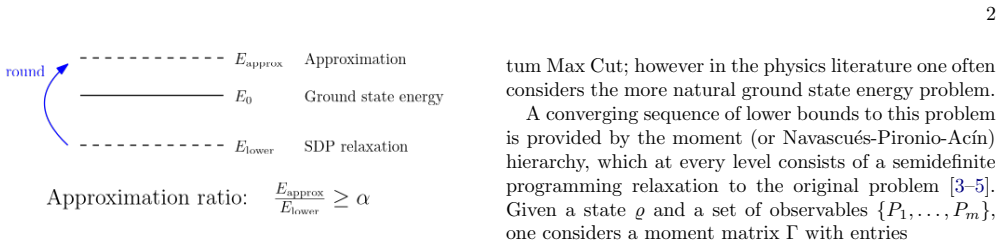
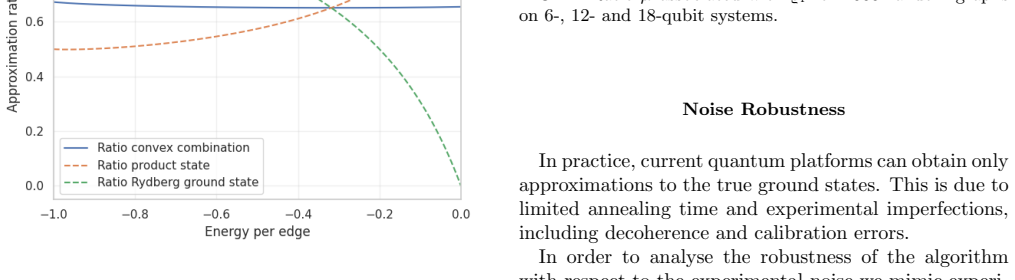
By using the natural quantum dynamics of Rydberg atom systems in combination with semidefinite programming and randomized rounding, the algorithm achieves a conditional approximation ratio of 0.651 for quantum Max Cut, compared to 0.614 from SDP alone. The advantage persists if the annealing procedure obtains a state with only 89 percent of the true ground state energy.
What carries the argument
The hybrid quantum-classical algorithm that integrates Rydberg atom annealing output with SDP and randomized rounding to produce the improved approximation
If this is right
- It provides a better approximation than pure classical SDP methods for quantum Max Cut
- The method is robust to imperfect quantum annealing reaching only 89 percent of ground state energy
- It opens a route for hybrid algorithms combining quantum dynamics with classical optimization
- The ratio is conditional on the performance of the Rydberg system
Where Pith is reading between the lines
- This approach might generalize to other QMA-complete problems if similar quantum dynamics can be harnessed
- If Rydberg systems can be scaled, it could lead to practical quantum advantage in approximation tasks
- The 0.651 ratio might be improved further by better integration or different quantum systems
- It suggests that physical quantum systems can provide an independent advantage beyond what SDP captures
Load-bearing premise
The specific combination of Rydberg-atom annealing output with SDP and randomized rounding actually produces the stated 0.651 ratio
What would settle it
An experiment or calculation showing that the Rydberg output does not provide any additional information beyond what the SDP already uses, resulting in no improvement over 0.614
Figures



read the original abstract
Quantum Max Cut, also known as the anti-ferromagnetic Heisenberg Hamiltonian, is a QMA-complete problem which serves as a benchmark for approximation algorithms in quantum physics. Here we develop a hybrid approximation algorithm to quantum Max Cut, which uses the natural quantum dynamics of Rydberg atom systems in combination with semidefinite programming and randomized rounding. It achieves a conditional approximation ratio of $0.651$, compared to the best-known ratio of $0.614$ that relies on semidefinite programming alone. The algorithm is robust in the sense that the advantage persists even if the annealing procedure of the Rydberg atom system obtains a state whose energy is only $89\%$ of its true ground state energy. Our approach opens a new route for hybrid quantum-classical algorithms that combine quantum with classical optimization methods.
Editorial analysis
A structured set of objections, weighed in public.
Referee Report
Summary. The manuscript develops a hybrid approximation algorithm for Quantum Max Cut (the anti-ferromagnetic Heisenberg model) that combines Rydberg-atom annealing dynamics with semidefinite programming and randomized rounding. It claims a conditional approximation ratio of 0.651 (versus the prior 0.614 SDP-only bound) that remains valid even when the Rydberg procedure reaches only 89% of the true ground-state energy.
Significance. If the hybrid ratio derivation is correct, the result would constitute a concrete improvement in approximation algorithms for a QMA-complete problem by integrating physical quantum dynamics with classical post-processing, and would supply an explicit robustness threshold (89%) that could guide future hybrid quantum-classical schemes.
major comments (1)
- [Abstract (paragraph 2)] The central claim that the Rydberg output, when inserted into the SDP and rounding pipeline, produces a 0.651 ratio (even at 89% ground-state energy) is load-bearing but is stated without an explicit calculation or bound in the provided text. The abstract asserts the numerical improvement but supplies no equations relating the Rydberg expectation values or overlap to the final ratio, so it is impossible to verify that the advantage is not already subsumed by the classical 0.614 analysis.
minor comments (1)
- The term 'conditional approximation ratio' is used without a precise statement of the conditioning assumptions (e.g., on the Rydberg state fidelity or the SDP feasible set).
Simulated Author's Rebuttal
We thank the referee for the careful reading and for highlighting the need for greater transparency in the abstract. We address the comment below and will make the requested revision to the manuscript.
read point-by-point responses
-
Referee: [Abstract (paragraph 2)] The central claim that the Rydberg output, when inserted into the SDP and rounding pipeline, produces a 0.651 ratio (even at 89% ground-state energy) is load-bearing but is stated without an explicit calculation or bound in the provided text. The abstract asserts the numerical improvement but supplies no equations relating the Rydberg expectation values or overlap to the final ratio, so it is impossible to verify that the advantage is not already subsumed by the classical 0.614 analysis.
Authors: We agree that the abstract, as currently written, does not contain the explicit relation or bound and therefore does not allow immediate verification of the improvement. The full derivation appears in Section 4, where we show how the Rydberg expectation value ρ is substituted into the SDP objective and how the resulting vector is rounded to obtain the 0.651 guarantee; the same section also derives the 89 % robustness threshold by bounding the degradation in the SDP value as a function of the energy deficit. To make this traceable from the abstract, we will add one sentence that states the key relation between the Rydberg overlap and the improved ratio and points to the relevant theorem. This change will be made in the revised version. revision: yes
Circularity Check
No circularity: 0.651 ratio presented as algorithmic output, not self-defined or fitted
full rationale
The abstract states the hybrid algorithm (Rydberg annealing + SDP + randomized rounding) achieves a conditional 0.651 ratio, robust to 89% ground-state energy. No equations or text in the provided material define the ratio in terms of itself, rename a fitted parameter as a prediction, or rely on self-citation chains for the central claim. The improvement over the 0.614 SDP baseline is asserted as a consequence of the described pipeline without reduction to tautology. This matches the default expectation of a non-circular paper; the derivation chain is treated as self-contained pending explicit equations in the full manuscript.
Axiom & Free-Parameter Ledger
Reference graph
Works this paper leans on
-
[1]
HybQuant
For each qubiti, concatenate the 3 columns ofLcor- responding toX i, Yi, Zi, to construct a set of unit vectors xi ∈R 9n [7]. Now sample a random matrixR∈R 3×9n with mean zero and standard deviation one. Then set, vi = Rxi ∥Rxi∥ = aX i aY i aZ i .(7) It is known that substituting these coefficients into Eq.(6) returns at least 0.498 of the true ...
2024
-
[2]
M. X. Goemans and D. P. Williamson, J. ACM42, 1115–1145 (1995)
1995
-
[3]
Cubitt and A
T. Cubitt and A. Montanaro, SIAM Journal on Comput- ing45, 268 (2016)
2016
-
[4]
J. W. Helton, Annals of Mathematics156, 675 (2002)
2002
-
[5]
Navascu´ es, S
M. Navascu´ es, S. Pironio, and A. Ac´ ın, New Journal of Physics10, 073013 (2008)
2008
-
[6]
Pironio, M
S. Pironio, M. Navascu´ es, and A. Ac´ ın, SIAM Journal on Optimization20, 2157–2180 (2010)
2010
-
[7]
Baumgratz and M
T. Baumgratz and M. B. Plenio, New Journal of Physics 14, 023027 (2012)
2012
-
[8]
Gharibian and O
S. Gharibian and O. Parekh, Leibniz International Pro- ceedings in Informatics (LIPIcs)145, 31:1 (2019)
2019
-
[9]
Anshu, D
A. Anshu, D. Gosset, and K. Morenz, Beyond product state approximations for a quantum analogue of Max Cut (2020). 6
2020
-
[10]
Parekh and K
O. Parekh and K. Thompson, Schloss Dagstuhl – Leibniz- Zentrum f¨ ur Informatik Leibniz International Proceed- ings in Informatics (LIPIcs),198, 102:1 (2021)
2021
-
[11]
Lee, Optimizing quantum circuit parameters via SDP (2022), arXiv:2209.00789
E. Lee, Optimizing quantum circuit parameters via SDP (2022), arXiv:2209.00789
arXiv 2022
-
[12]
King, Quantum7, 1180 (2023)
R. King, Quantum7, 1180 (2023)
2023
-
[13]
Lee and O
E. Lee and O. Parekh, Schloss Dagstuhl – Leibniz- Zentrum f¨ ur Informatik297, 105:1 (2024)
2024
-
[14]
S. Gribling, L. Sinjorgo, and R. Sotirov, Improved ap- proximation ratios for the quantum max-cut problem on general, triangle-free and bipartite graphs (2025), arXiv:2504.11120
arXiv 2025
-
[15]
A. Apte, E. Lee, K. Marwaha, O. Parekh, and J. Sud, chloss Dagstuhl – Leibniz-Zentrum f¨ ur Informatik351, 101:1 (2025)
2025
-
[16]
A. Bakshi, A. Basu, P. Kothari, and A. Li, Sharp bounds on the eigenvalues of Kikuchi graphs and applications to quantum max cut (2026), arXiv:2605.14994
Pith/arXiv arXiv 2026
-
[17]
A. Apte, O. Parekh, and J. Sud, Conjectured bounds for 2-local Hamiltonians via token graphs (2025), arXiv:2506.03441
Pith/arXiv arXiv 2025
- [18]
-
[19]
Lubinski, C
T. Lubinski, C. Granade, A. Anderson, A. Geller, M. Roetteler, A. Petrenko, and B. Heim, Frontiers in Physics10, 940293 (2022)
2022
-
[20]
Cerezo, A
M. Cerezo, A. Arrasmith, R. Babbush, S. C. Benjamin, S. Endo, K. Fujii, J. R. McClean, K. Mitarai, X. Yuan, L. Cincio,et al., Nature Reviews Physics3, 625 (2021)
2021
-
[21]
S. Kim, S.-W. Ahn, I.-S. Suh, A. W. Dowling, E. Lee, and T. Luo, npj Quantum Information11, 10.1038/s41534- 025-01020-1 (2025)
- [22]
-
[23]
Zhou, S.-T
L. Zhou, S.-T. Wang, S. Choi, H. Pichler, and M. D. Lukin, Physical Review X10, 021067 (2020)
2020
-
[24]
Tene-Cohen, T
Y. Tene-Cohen, T. Kelman, O. Lev, and A. Makmal, npj Quantum Information12, 50 (2026)
2026
-
[25]
Z. Wang, S. Hadfield, Z. Jiang, and E. G. Rieffel, Physical Review A97, 022304 (2018)
2018
-
[26]
R. J. Banks, D. E. Browne, and P. Warburton, Quantum 8, 1253 (2024)
2024
-
[27]
Gao and et.al, Phys
D. Gao and et.al, Phys. Rev. Lett.134, 090601 (2025)
2025
-
[28]
Deng and et.al, Phys
Y.-H. Deng and et.al, Phys. Rev. Lett.131, 150601 (2023)
2023
-
[29]
Google Quantum AI and Collaborators., Observation of constructive interference at the edge of quantum ergod- icity (2025)
2025
-
[30]
Proctor, K
T. Proctor, K. Young, A. Baczewski, and et al, Nature Reviews Physics7, 105–118 (2025)
2025
-
[31]
Abbas, A
A. Abbas, A. Ambainis, B. Augustino, and et al., Nature Reviews Physics6, 718–735 (2024)
2024
-
[32]
A. Kshetrimayum, S. S. Jahromi, S. Singh, and R. Or´ us, Quantum advantage: a tensor network perspective (2026), arXiv:2603.18825
arXiv 2026
-
[33]
Hangleiter, Has quantum advantage been achieved? (2026), arXiv:2603.09901
D. Hangleiter, Has quantum advantage been achieved? (2026), arXiv:2603.09901
arXiv 2026
-
[34]
Boyd and L
S. Boyd and L. Vandenberghe,Convex Optimization (Cambridge University Press, Cambridge, UK, 2004)
2004
-
[35]
Henriet, L
L. Henriet, L. Beguin, A. Signoles, T. Lahaye, A. Browaeys, G.-O. Reymond, and C. Jurczak, Quantum 4, 327 (2020)
2020
-
[36]
C. Chen, G. Bornet, M. Bintz, G. Emperauger, L. Leclerc, V. S. Liu, P. Scholl, D. Barredo, J. Hauschild, S. Chatterjee,et al., Nature616, 691 (2023)
2023
-
[37]
Bornet, G
G. Bornet, G. Emperauger, C. Chen, B. Ye, M. Block, M. Bintz, J. A. Boyd, D. Barredo, T. Comparin, F. Mez- zacapo,et al., Nature621, 728 (2023)
2023
-
[38]
Geier, N
S. Geier, N. Thaicharoen, C. Hainaut, T. Franz, A. Salzinger, A. Tebben, D. Grimshandl, G. Z¨ urn, and M. Weidem¨ uller, Science374, 1149 (2021)
2021
-
[39]
A. W. Glaetzle, M. Dalmonte, R. Nath, C. Gross, I. Bloch, and P. Zoller, Physical Review Letters114, 173002 (2015)
2015
-
[40]
Bluvstein, H
D. Bluvstein, H. Levine, G. Semeghini, T. T. Wang, S. Ebadi, M. Kalinowski, A. Keesling, N. Maskara, H. Pichler, M. Greiner,et al., Nature604, 451 (2022)
2022
-
[41]
Whitlock, A
S. Whitlock, A. W. Glaetzle, and P. Hannaford, Journal of Physics B: Atomic, Molecular and Optical Physics50, 074001 (2017)
2017
-
[42]
T. H. Cormen, C. E. Leiserson, R. L. Rivest, and C. Stein, Introduction to Algorithms, 3rd ed. (MIT Press, 2009)
2009
-
[43]
Silv´ erio, S
H. Silv´ erio, S. Grijalva, C. Dalyac, L. Leclerc, P. J. Kar- alekas, N. Shammah, M. Beji, L.-P. Henry, and L. Hen- riet, Quantum6, 629 (2022)
2022
-
[44]
J. Wang, D. Jansen, I. Frerot, M.-O. Renou, V. Magron, and A. Ac´ ın, Scalable ground-state certification of quan- tum spin systems via structured noncommutative poly- nomial optimization (2026), arXiv:2604.01555
arXiv 2026
-
[45]
Briet, F
J. Briet, F. M. de Oliveira Filho, and F. Vallentin, Theory of Computing10, 77–105 (2014)
2014
-
[46]
Gatermann and P
K. Gatermann and P. A. Parrilo, Journal of Pure and Applied Algebra192, 95–128 (2004). 7 Appendix A: Numerical results Approximation for random graphs The main text introduced Algorithm 1 to approximate the ground state energy of the QMC Hamiltonian, Hqmc =− 1 4 X (ij)∈E ωij(I−X iXj −Y iYj −Z iZj).(A1) We compared the upper bound from Eqs. (20), (23) with...
2004
-
[47]
To construct Bloch vectorsv i ∈R 3, we use the following result
By construction, these satisfy: xixj = 1 2 tr((XiXj +Y iYj)ϱr).(C7) Now note that these are unit vectorsx i have with dimen- sion 4ninstead of 3. To construct Bloch vectorsv i ∈R 3, we use the following result. Lemma 5(Bri¨ et-de Oliveira Filho-Vallentin [44], Lemma 2.1).Letx i,x j be unit vectors inR n and let R∈R r×n be a random matrix whose entries are...
discussion (0)
Sign in with ORCID, Apple, or X to comment. Anyone can read and Pith papers without signing in.