Machine learning fully hadronic events with spectral functions
Pith reviewed 2026-06-29 02:13 UTC · model grok-4.3
The pith
A neural network using two-point spectral functions as features extends the expected gluino mass reach by 150 GeV over ATLAS results in fully hadronic events.
A machine-rendered reading of the paper's core claim, the machinery that carries it, and where it could break.
Core claim
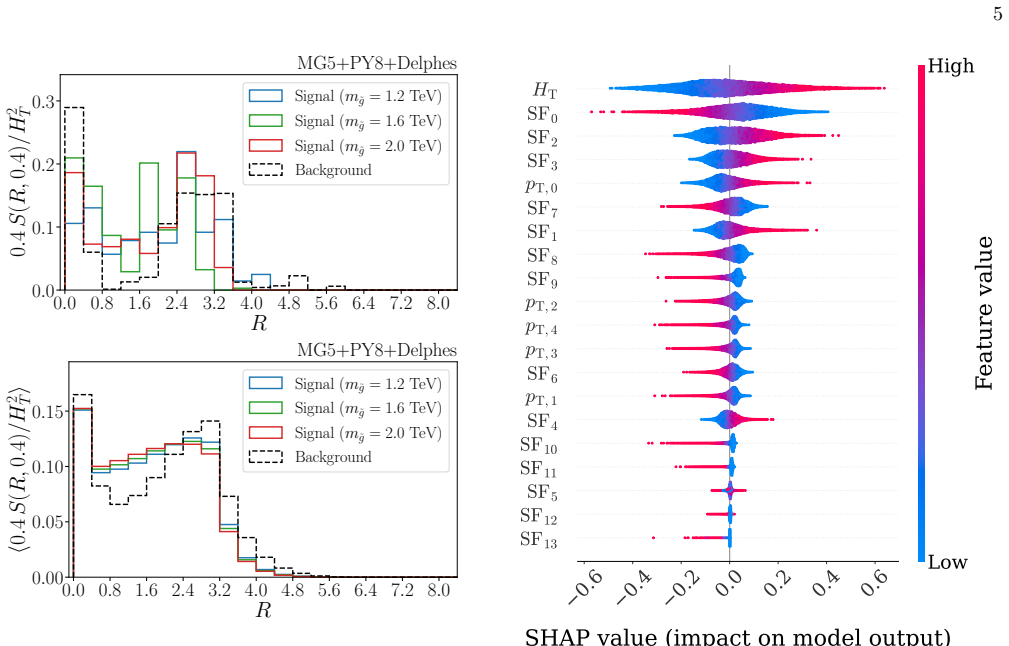
The two-point correlation spectral function maps the transverse-momentum data of an event into a one-dimensional function of the angular distance, encoding the event information modulo collider isometries and jet permutations, and is defined independently of the jet multiplicity. When supplied to a dense neural network for discriminating gluino-pair production followed by decay to top quarks and neutralino against fully hadronic top-antitop background, the spectral-function features improve the expected reach in gluino mass by roughly 150 GeV relative to a recent ATLAS analysis and by roughly 250 GeV relative to the same network trained on jet kinematics alone, using 139 fb inverse of 13 TeV
What carries the argument
The two-point correlation spectral function, which converts an event's transverse-momentum data into a one-dimensional angular-distance function that is independent of jet multiplicity.
If this is right
- The spectral-function input improves discrimination power beyond what jet kinematics alone can achieve in the same network architecture.
- The improvement translates directly into sensitivity to gluino masses roughly 150 GeV higher than those excluded by the referenced ATLAS search.
- The method works with existing LHC datasets and does not require changes to standard jet reconstruction.
- The same spectral representation can be fed to other machine-learning models for fully hadronic final states that suffer from variable jet multiplicity.
Where Pith is reading between the lines
- The approach could be tested on other new-physics signals that produce many jets, such as stops or heavy resonances decaying hadronically.
- Replacing the dense network with a graph or transformer architecture that also respects permutation symmetry might yield further gains while still using the spectral function.
- Higher-order correlation functions could be explored if the added computational cost remains modest, potentially capturing more event structure.
Load-bearing premise
The spectral function retains enough information to distinguish signal from background without major loss from the angular integration or from how QCD radiation is modeled in simulation.
What would settle it
Apply the trained network to a signal-depleted control region in real 13 TeV collision data and verify whether the observed separation power between signal-like and background-like events matches the separation obtained in simulation.
Figures



read the original abstract
Characterising fully hadronic events is a difficult task at hadron colliders. Signal jets from the hard process are mingled with an arbitrary number of ISR and FSR jets, leading to a large combinatorial background. This also poses a challenge for machine-learning analyses, where the number of input features is fixed while the jet multiplicity fluctuates from event to event due to QCD radiation. In this work, we explore the use of the two-point correlation spectral function as an input feature for machine-learning analyses of such events. The spectral function maps the transverse-momentum data of an event into a one-dimensional function of the angular distance, encoding the event information modulo collider isometries and jet permutations, and is defined independently of the jet multiplicity. As a concrete benchmark we apply the method to discriminate gluino-pair production followed by $\tilde{g} \to t \bar{t} \tilde{\chi}_1^0$ against the fully hadronic $t \bar{t}$ background. With $139~{\rm fb}^{-1}$ of $\sqrt{s} = 13$ TeV $pp$ collision data, a dense neural network supplied with spectral-function features improves the expected reach in gluino-mass by roughly 150 GeV relative to a recent ATLAS analysis, and by roughly 250 GeV relative to the same network trained on jet kinematics alone.
Editorial analysis
A structured set of objections, weighed in public.
Referee Report
Summary. The manuscript introduces the two-point correlation spectral function C(ΔR) as a jet-multiplicity-independent input feature for dense neural networks applied to fully hadronic final states. For the benchmark of gluino-pair production (g̃ → tt̃χ̃¹⁰) versus fully hadronic tt̄ at 13 TeV, the spectral-function NN improves the expected gluino-mass reach by ~150 GeV relative to a recent ATLAS analysis and by ~250 GeV relative to an otherwise identical network trained on jet kinematics, using 139 fb⁻¹ of data.
Significance. If the performance gain survives realistic variations, the method supplies an isometry- and permutation-invariant representation that directly addresses the variable-multiplicity problem in hadronic ML analyses. Credit is due for the explicit construction that is defined independently of jet multiplicity and for the concrete, falsifiable benchmark against both an experimental analysis and a jet-kinematics baseline.
major comments (2)
- [§3 and §5.2] §3 (spectral-function definition) and §5.2 (training/validation): the central claim that C(ΔR) retains sufficient signal/background separation after angular integration rests on the assumption that QCD radiation modeling does not introduce a systematic bias between signal and tt̄; no explicit variation of parton-shower parameters or comparison of different generators is reported, which is load-bearing for the quoted 150–250 GeV improvement.
- [Table 2 and Fig. 6] Table 2 / Fig. 6 (performance metrics): the reported gains are given without tabulated systematic uncertainties arising from the choice of training/validation split or from the mapping of multi-particle events onto the spectral function; this information is required to assess whether the improvement is robust or could be an artifact of the particular MC samples.
minor comments (2)
- [Eq. (3)] The notation for the angular variable in Eq. (3) is introduced without an explicit statement of the range and binning used in the numerical implementation.
- [Fig. 4] Figure captions for the ROC curves should state the exact event selection and luminosity scaling applied to the background.
Simulated Author's Rebuttal
We thank the referee for the careful reading and positive evaluation of the significance of our work. We address the two major comments below and will incorporate revisions to strengthen the robustness claims.
read point-by-point responses
-
Referee: [§3 and §5.2] §3 (spectral-function definition) and §5.2 (training/validation): the central claim that C(ΔR) retains sufficient signal/background separation after angular integration rests on the assumption that QCD radiation modeling does not introduce a systematic bias between signal and tt̄; no explicit variation of parton-shower parameters or comparison of different generators is reported, which is load-bearing for the quoted 150–250 GeV improvement.
Authors: We agree that explicit validation against variations in QCD modeling is necessary to support the quoted performance gains. In the revised manuscript we will add a dedicated subsection in §5.2 presenting results with (i) varied Pythia parton-shower parameters (e.g., ISR/FSR scales and hadronization tunes) and (ii) an alternative generator (Herwig) for both signal and background samples. These checks will quantify any residual bias in the spectral-function separation power. revision: yes
-
Referee: [Table 2 and Fig. 6] Table 2 / Fig. 6 (performance metrics): the reported gains are given without tabulated systematic uncertainties arising from the choice of training/validation split or from the mapping of multi-particle events onto the spectral function; this information is required to assess whether the improvement is robust or could be an artifact of the particular MC samples.
Authors: We accept that the absence of tabulated uncertainties on the performance metrics limits the assessment of robustness. The revised version will include (i) results from k-fold cross-validation to estimate variance due to training/validation splits and (ii) a study of the sensitivity of the spectral function to the choice of angular binning and pT weighting. These uncertainties will be added to Table 2 and discussed in the caption and text of Fig. 6. revision: yes
Circularity Check
No circularity: empirical ML performance gain is not reduced to input by construction
full rationale
The paper defines the two-point spectral function C(ΔR) as a mapping from event pT data to a 1D angular-distance function that is invariant under isometries and permutations and independent of jet multiplicity. It then trains a dense neural network on this representation (versus jet-kinematics inputs) and reports an empirical improvement in expected gluino-mass reach on simulated 13 TeV events. This performance delta is obtained by standard supervised training and evaluation on held-out Monte Carlo samples; it is not a fitted parameter renamed as a prediction, nor is any central claim justified solely by self-citation or by an ansatz smuggled through prior work. No equation equates the reported reach gain to a quantity defined by the same training data, and the derivation chain remains self-contained against external benchmarks.
Axiom & Free-Parameter Ledger
Reference graph
Works this paper leans on
-
[1]
DataMATTER
= 1, defines the corresponding95%CL gluino-mass exclusion reach, under this assumption. As can be seen, the baseline analysis has by far the weakest reach: the gain in signal acceptance is more than offset by the very larget¯tbackground that survives the relaxed selection. Tightening the kinematic thresholds and re-introducing theM Σ J >100GeV cut, as in ...
2018
-
[2]
T. Plehn, “Lectures on LHC Physics,”Lect. Notes Phys. 844(2012) 1–193,arXiv:0910.4182 [hep-ph]
Pith/arXiv arXiv 2012
-
[3]
Model-Independent Jets plus Missing Energy Searches,
J. Alwall, M.-P. Le, M. Lisanti, and J. G. Wacker, “Model-Independent Jets plus Missing Energy Searches,”Phys. Rev. D79(2009) 015005, arXiv:0809.3264 [hep-ph]
Pith/arXiv arXiv 2009
-
[4]
High Multiplicity Searches at the LHC Using Jet Masses,
A. Hook, E. Izaguirre, M. Lisanti, and J. G. Wacker, “High Multiplicity Searches at the LHC Using Jet Masses,”Phys. Rev. D85(2012) 055029, arXiv:1202.0558 [hep-ph]
Pith/arXiv arXiv 2012
-
[5]
M. R. Buckley, T. Plehn, and M. Takeuchi, “Buckets of Tops,”JHEP08(2013) 086,arXiv:1302.6238 [hep-ph]
Pith/arXiv arXiv 2013
-
[6]
Toward Full LHC Coverage of Natural Supersymmetry,
J. A. Evans, Y. Kats, D. Shih, and M. J. Strassler, “Toward Full LHC Coverage of Natural Supersymmetry,”JHEP07(2014) 101, arXiv:1310.5758 [hep-ph]
Pith/arXiv arXiv 2014
-
[7]
Multi-hadron final states in RPV supersymmetric models with extra matter,
M. Asano, K. Sakurai, and T. T. Yanagida, “Multi-hadron final states in RPV supersymmetric models with extra matter,”Phys. Lett. B736(2014) 356–360,arXiv:1405.4009 [hep-ph]
Pith/arXiv arXiv 2014
-
[8]
Least constrained supersymmetry withR-parity violation,
J. Li, T. Li, and W. Zhang, “Least constrained supersymmetry withR-parity violation,”Phys. Rev. D 99no. 3, (2019) 036011,arXiv:1805.06172 [hep-ph]
Pith/arXiv arXiv 2019
-
[9]
Jet Substructure at the Large Hadron Collider: Experimental Review,
R. Kogleret al., “Jet Substructure at the Large Hadron Collider: Experimental Review,”Rev. Mod. Phys.91 no. 4, (2019) 045003,arXiv:1803.06991 [hep-ex]
arXiv 2019
-
[10]
S. Marzani, G. Soyez, and M. Spannowsky,Looking inside jets: an introduction to jet substructure and boosted-object phenomenology, vol. 958. Springer, 2019. arXiv:1901.10342 [hep-ph]
Pith/arXiv arXiv 2019
-
[11]
A. J. Larkoski, I. Moult, and B. Nachman, “Jet Substructure at the Large Hadron Collider: A Review of Recent Advances in Theory and Machine Learning,” Phys. Rept.841(2020) 1–63,arXiv:1709.04464 [hep-ph]
arXiv 2020
-
[12]
Phenomenology of event shapes at hadron colliders,
A. Banfi, G. P. Salam, and G. Zanderighi, “Phenomenology of event shapes at hadron colliders,” JHEP06(2010) 038,arXiv:1001.4082 [hep-ph]. [12]A TLASCollaboration, G. Aadet al., “Measurement of hadronic event shapes in high-pT multijet final states at√s= 13TeV with the ATLAS detector,”JHEP01 (2021) 188,arXiv:2007.12600 [hep-ex]. [Erratum: JHEP 12, 053 (2021)]
Pith/arXiv arXiv 2010
-
[13]
The Machine Learning landscape of top taggers,
A. Butteret al., “The Machine Learning landscape of top taggers,”SciPost Phys.7(2019) 014, arXiv:1902.09914 [hep-ph]
arXiv 2019
-
[14]
Searching for Exotic Particles in High-Energy Physics with Deep Learning,
P. Baldi, P. Sadowski, and D. Whiteson, “Searching for Exotic Particles in High-Energy Physics with Deep Learning,”Nature Commun.5(2014) 4308, arXiv:1402.4735 [hep-ph]
Pith/arXiv arXiv 2014
-
[15]
Deep Neural Networks for Physics Analysis on low-level whole-detector data at the LHC,
W. Bhimji, S. A. Farrell, T. Kurth, M. Paganini, Prabhat, and E. Racah, “Deep Neural Networks for Physics Analysis on low-level whole-detector data at the LHC,”J. Phys. Conf. Ser.1085no. 4, (2018) 042034, arXiv:1711.03573 [hep-ex]
Pith/arXiv arXiv 2018
-
[16]
Large-Scale Deep Learning for Multi-Jet Event Classification,
J. Kimet al., “Large-Scale Deep Learning for Multi-Jet Event Classification,”arXiv:2207.11710 [hep-ex]
-
[17]
Machine learning classification of sphalerons and black holes at the LHC,
A. S. Grefsrud, T. Buanes, F. Koutroulis, A. Lipniacka, R. Maselek, A. Papaefstathiou, K. Sakurai, T. B. Sjursen, and I. Slazyk, “Machine learning classification of sphalerons and black holes at the LHC,”Eur. Phys. J. C84no. 4, (2024) 442,arXiv:2310.15227 [hep-ph]
arXiv 2024
-
[18]
Machine learning electroweakino production,
R. Maselek, M. M. Nojiri, and K. Sakurai, “Machine learning electroweakino production,”Eur. Phys. J. C 85no. 6, (2025) 605,arXiv:2411.00093 [hep-ph]
arXiv 2025
-
[19]
Pulling Out All the Tops with Computer Vision and Deep Learning,
S. Macaluso and D. Shih, “Pulling Out All the Tops with Computer Vision and Deep Learning,”JHEP10 (2018) 121,arXiv:1803.00107 [hep-ph]
Pith/arXiv arXiv 2018
-
[20]
A Lorentz-equivariant transformer for all of the LHC,
J. Brehmer, V. Bresó, P. de Haan, T. Plehn, H. Qu, J. Spinner, and J. Thaler, “A Lorentz-equivariant transformer for all of the LHC,”SciPost Phys.19no. 4, (2025) 108,arXiv:2411.00446 [hep-ph]
arXiv 2025
-
[21]
Exploring Optimal Transport for Event-Level Anomaly Detection at the Large Hadron Collider,
N. Craig, J. N. Howard, and H. Li, “Exploring Optimal Transport for Event-Level Anomaly Detection at the Large Hadron Collider,”arXiv:2401.15542 [hep-ph]
-
[22]
Optimal Transport Event Representation for Anomaly Detection,
T. Cai, A. Bhargava, and B. Nachman, “Optimal Transport Event Representation for Anomaly Detection,”arXiv:2512.04839 [hep-ph]
-
[23]
Spectral Analysis of Jet Substructure with Neural Networks: Boosted Higgs Case,
S. H. Lim and M. M. Nojiri, “Spectral Analysis of Jet Substructure with Neural Networks: Boosted Higgs Case,”JHEP10(2018) 181,arXiv:1807.03312 [hep-ph]
Pith/arXiv arXiv 2018
-
[24]
Interpretable deep learning for two-prong jet classification with jet spectra,
A. Chakraborty, S. H. Lim, and M. M. Nojiri, “Interpretable deep learning for two-prong jet classification with jet spectra,”JHEP07(2019) 135, arXiv:1904.02092 [hep-ph]
arXiv 2019
-
[25]
A spectral metric for collider geometry,
A. J. Larkoski and J. Thaler, “A spectral metric for collider geometry,”JHEP08(2023) 107, arXiv:2305.03751 [hep-ph]. [26]A TLASCollaboration, G. Aadet al., “Search for supersymmetry in final states with missing transverse momentum and three or more b-jets in 139 fb−1 of proton–proton collisions at√s= 13TeV with the ATLAS detector,”Eur. Phys. J. C83no. 7, ...
arXiv 2023
-
[26]
J. Alwall, M. Herquet, F. Maltoni, O. Mattelaer, and T. Stelzer, “MadGraph 5 : Going Beyond,”JHEP06 (2011) 128,arXiv:1106.0522 [hep-ph]
Pith/arXiv arXiv 2011
-
[27]
A Brief Introduction to PYTHIA 8.1,
T. Sjostrand, S. Mrenna, and P. Z. Skands, “A Brief Introduction to PYTHIA 8.1,”Comput. Phys. Commun. 178(2008) 852–867,arXiv:0710.3820 [hep-ph]
Pith/arXiv arXiv 2008
-
[28]
Tuning PYTHIA 8.1: the Monash 2013 Tune,
P. Skands, S. Carrazza, and J. Rojo, “Tuning PYTHIA 8.1: the Monash 2013 Tune,”Eur. Phys. J. C74no. 8, (2014) 3024,arXiv:1404.5630 [hep-ph]
Pith/arXiv arXiv 2013
-
[29]
Parton distributions with LHC data,
R. D. Ballet al., “Parton distributions with LHC data,” Nucl. Phys. B867(2013) 244–289,arXiv:1207.1303 [hep-ph]
Pith/arXiv arXiv 2013
-
[30]
SUSY Cross Sections
SUSY Cross Section Working Group, “SUSY Cross Sections.”https://twiki.cern.ch/twiki/bin/view/ LHCPhysics/SUSYCrossSections, 2026
2026
-
[31]
Towards NNLL resummation: hard matching coefficients for squark and gluino hadroproduction,
W. Beenakker, T. Janssen, S. Lepoeter, M. Krämer, A. Kulesza, E. Laenen, I. Niessen, S. Thewes, and T. Van Daal, “Towards NNLL resummation: hard matching coefficients for squark and gluino hadroproduction,”JHEP10(2013) 120, arXiv:1304.6354 [hep-ph]. [33]DELPHES 3Collaboration, J. de Favereau, C. Delaere, P. Demin, A. Giammanco, V. Lemaître, A. Mertens, an...
Pith/arXiv arXiv 2013
-
[32]
M. Cacciari, G. P. Salam, and G. Soyez, “FastJet User Manual,”Eur. Phys. J. C72(2012) 1896, arXiv:1111.6097 [hep-ph]
Pith/arXiv arXiv 2012
-
[33]
A unified approach to interpreting model predictions,
S. M. Lundberg and S.-I. Lee, “A unified approach to interpreting model predictions,” inAdvances in Neural Information Processing Systems 30, pp. 4765–4774. Curran Associates, Inc., 2017.arXiv:1705.07874 [cs.AI]
Pith/arXiv arXiv 2017
-
[34]
Spey: Smooth inference for reinterpretation studies,
J. Y. Araz, “Spey: Smooth inference for reinterpretation studies,”SciPost Phys.16no. 1, (2024) 032, arXiv:2307.06996 [hep-ph]
arXiv 2024
-
[35]
Mahdi, “Altakach313/ml_spectralf_fullyhadronic: Companion code and models for machine learning fully hadronic events with spectral functions v1.0.0,” June, 2026.https://doi.org/10.5281/zenodo.20807676
discussion (0)
Sign in with ORCID, Apple, or X to comment. Anyone can read and Pith papers without signing in.