Multi-parameter two-photon polarimetry at the quantum limit
Pith reviewed 2026-06-29 02:02 UTC · model grok-4.3
The pith
A two-photon experiment reaches the joint quantum Cramér-Rao bound for two polarization parameters at once with roughly 200 photon pairs.
A machine-rendered reading of the paper's core claim, the machinery that carries it, and where it could break.
Core claim
The authors demonstrate an experimental protocol for two-photon polarimetry that approaches the quantum Cramér-Rao bound simultaneously in two polarisation parameters across a wide range of the parameter space, using as few as approximately 200 photon pairs.
What carries the argument
A two-photon polarization measurement scheme constructed to overcome the intrinsic incompatibility of quantum measurements for the two chosen parameters and thereby reach the joint bound.
If this is right
- Enables polarimetric sensing with dim light sources that would otherwise be limited by shot noise.
- Provides a practical route for applications in X-ray astronomy where photon flux is low.
- Reduces the risk of damage to photosensitive samples by keeping the total photon number small.
- Shows that joint multi-parameter estimation at the quantum limit is experimentally feasible for polarization.
Where Pith is reading between the lines
- Similar two-photon schemes might be adapted to estimate other pairs of incompatible parameters in quantum optics.
- The low photon requirement suggests the protocol could be combined with heralded sources to further reduce background noise.
- If the measurement design generalizes, it could inform sensor architectures for quantum-enhanced imaging in low-light regimes.
Load-bearing premise
It is possible to design and implement a two-photon polarization measurement that reaches the joint quantum bound despite the incompatibility between optimal measurements of the two parameters.
What would settle it
An experiment in which the achieved precision for both parameters remains noticeably above the joint quantum bound for multiple tested values in the parameter space.
Figures


read the original abstract
Photonic quantum metrology has demonstrated advantages in precision and resource efficiency for a wide range of applications, with several schemes approaching the fundamental quantum Cram\'er-Rao precision bound (QCRB). However, the intrinsic incompatibility of quantum measurements represents a hurdle in extending these advantages to the simultaneous estimation of multiple parameters. In this paper, we present an experimental protocol approaching the QCRB simultaneously in two polarisation parameters, across a wide range of the parameter space, with as few as $\sim 200$ photon pairs, offering advantages for polarimetric sensing for dim sources such as in X-ray astronomy or photosensitive samples.
Editorial analysis
A structured set of objections, weighed in public.
Referee Report
Summary. The manuscript presents an experimental protocol for simultaneous estimation of two polarization parameters using two-photon states. It constructs an explicit POVM, computes the quantum Fisher information (QFI) matrix for the two-photon state, reports measured 2x2 covariance matrices at multiple points across the parameter space, and shows that the experimental precision matrix lies within statistical error of the inverse QFI, achieving performance close to the joint QCRB with as few as ~200 photon pairs.
Significance. If the reported comparison holds, the result demonstrates that measurement incompatibility for multiple parameters can be overcome in a concrete two-photon polarization setting, providing a resource-efficient route to joint quantum-limited polarimetry. The low photon number regime and direct covariance-to-QFI comparison are particularly relevant for applications involving dim sources such as X-ray astronomy or photosensitive samples. The explicit POVM construction and falsifiable covariance data constitute a clear experimental advance.
minor comments (2)
- [Abstract] Abstract: the phrase 'approaching the QCRB' would be strengthened by a brief quantitative statement (e.g., 'within X% of the bound on average') rather than leaving the degree of approach implicit.
- [Introduction] The manuscript would benefit from an explicit statement of the two chosen polarization parameters (e.g., their Stokes or Bloch-vector components) already in the abstract or introduction.
Simulated Author's Rebuttal
We thank the referee for their positive assessment of the manuscript and for recommending acceptance. No major comments were raised in the report.
Circularity Check
No significant circularity in derivation or claims
full rationale
The paper supplies an explicit POVM construction for the two-photon polarization measurement, computes the QFI matrix directly from the two-photon state, reports measured 2x2 covariance matrices at multiple parameter-space points, and compares the experimental precision matrix to the inverse QFI within statistical error. These steps are independent of any fitted parameter being renamed as a prediction, and no load-bearing premise reduces to a self-citation chain or self-definitional loop. The experimental claim of approaching the joint QCRB with ~200 pairs is supported by coincidence statistics and error bars rather than by construction from the paper's own inputs.
Axiom & Free-Parameter Ledger
Reference graph
Works this paper leans on
-
[1]
E. Polino, M. Valeri, N. Spagnolo, and F. Sciarrino, AVS Quantum Science2, 10.1116/5.0007577 (2020)
-
[2]
Pirandola, B
S. Pirandola, B. R. Bardhan, T. Gehring, C. Weedbrook, and S. Lloyd, Nature Photonics12, 724 (2018)
2018
-
[3]
B. L. Higgins, D. W. Berry, S. D. Bartlett, H. M. Wise- man, and G. J. Pryde, Nature450, 393 (2007)
2007
-
[4]
G. Y. Xiang, B. L. Higgins, D. W. Berry, H. M. Wiseman, and G. J. Pryde, Nature Photonics5, 43 (2011)
2011
-
[5]
Harnchaiwat, F
N. Harnchaiwat, F. Zhu, N. Westerberg, E. Gauger, and J. Leach, Optics express28, 2210 (2020)
2020
-
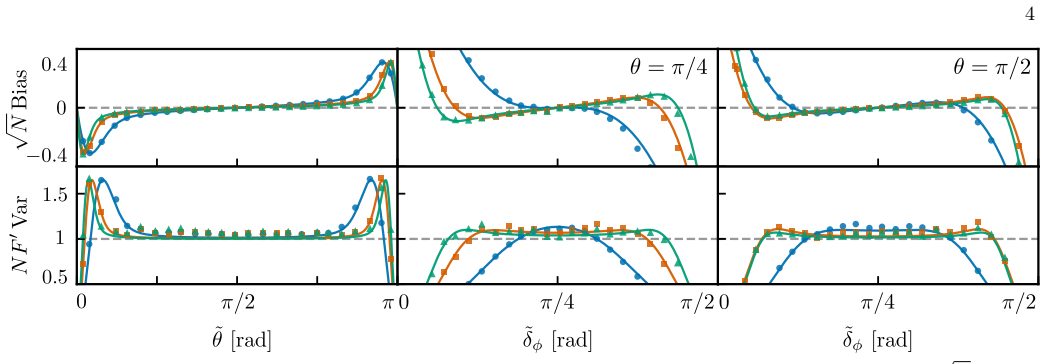
[6]
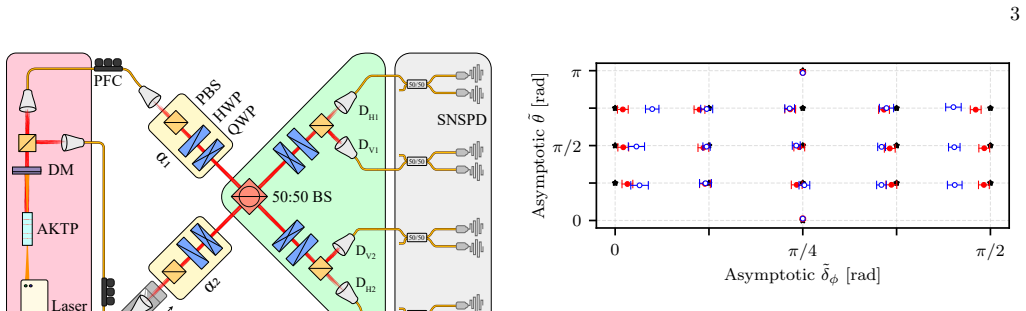
Daryanoosh, S
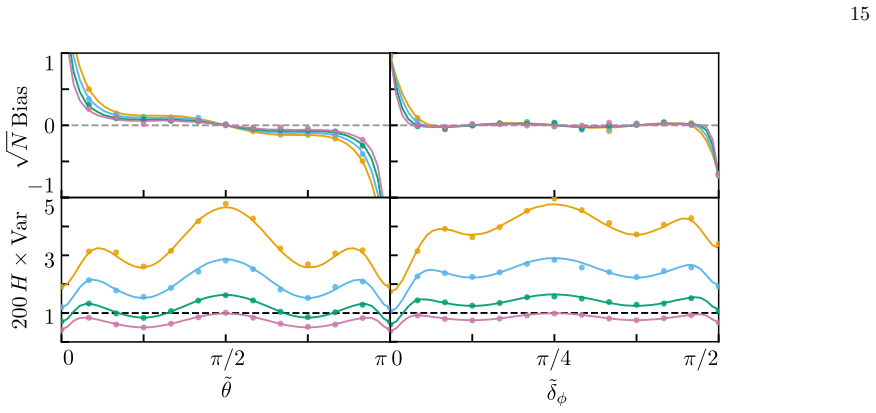
S. Daryanoosh, S. Slussarenko, D. W. Berry, H. M. Wise- man, and G. J. Pryde, Nature Communications9, 4606 (2018)
2018
-
[7]
C. W. Helstrom, Journal of Statistical Physics1, 231 (1969)
1969
-
[8]
S. L. Braunstein and C. M. Caves, Phys. Rev. Lett.72, 3439 (1994)
1994
-
[9]
T. S. Woodworth, C. Hermann-Avigliano, K. W. C. Chan, and A. M. Marino, EPJ Quantum Technology9, 38 (2022)
2022
-
[10]
Triggiani, G
D. Triggiani, G. Psaroudis, and V. Tamma, Phys. Rev. Appl.19, 044068 (2023)
2023
-
[11]
R. M. Brooks, L. Maggio, T. Jaeken, J. Ho, E. M. Gauger, V. Tamma, and A. Fedrizzi, Physical Review Letters136, 060803 (2026)
2026
-
[12]
Triggiani and V
D. Triggiani and V. Tamma, Phys. Rev. A111, 032605 6 (2025)
2025
-
[13]
Muratore, D
S. Muratore, D. Triggiani, and V. Tamma, Physical Re- view Applied23, 054033 (2025)
2025
-
[14]
Triggiani and V
D. Triggiani and V. Tamma, Phys. Rev. Lett.132, 180802 (2024)
2024
-
[15]
B. Guo, Z. Chen, L. Maggio, W. Wu, S. Liu, V. Tamma, and J. Fan, Physical Review A112, 013719 (2025)
2025
-
[16]
E. J. Allen, J. Sabines-Chesterking, A. R. McMillan, S. K. Joshi, P. S. Turner, and J. C. F. Matthews, Physical Review Research2, 033243 (2020)
2020
-
[17]
Slussarenko, M
S. Slussarenko, M. M. Weston, H. M. Chrzanowski, L. K. Shalm, V. B. Verma, S. W. Nam, and G. J. Pryde, Nature Photonics11, 700 (2017)
2017
-
[18]
Zhao, Y.-Z
S.-R. Zhao, Y.-Z. Zhang, W.-Z. Liu, J.-Y. Guan, W. Zhang, C.-L. Li, B. Bai, M.-H. Li, Y. Liu, L. You, J. Zhang, J. Fan, F. Xu, Q. Zhang, and J.-W. Pan, Phys- ical Review X11, 031009 (2021)
2021
- [19]
-
[20]
Isogawa, G
T. Isogawa, G. Wang, B. Li, Z. Hu, S. Nishimura, A. Kanamoto, H. Yuan, and P. Cappellaro, PRX Quan- tum7, 020307 (2026)
2026
-
[21]
Y. Li, L. Joosten, Y. Baamara, P. Colciaghi, A. Sinatra, P. Treutlein, and T. Zibold, Science391, 374 (2026)
2026
-
[22]
Hatano, J
Y. Hatano, J. Shin, D. Nishitani, H. Iwatsuka, Y. Ma- suyama, H. Sugiyama, M. Ishii, S. Onoda, T. Ohshima, K. Arai, T. Iwasaki, and M. Hatano, Applied Physics Letters118, 034001 (2021)
2021
-
[23]
Ullah, ¨O
A. Ullah, ¨O. E. M¨ usteceaplio˘ glu, and M. G. A. Paris, Physical Review A113, 012408 (2026)
2026
-
[24]
Parniak, S
M. Parniak, S. Bor´ owka, K. Boroszko, W. Wasilewski, K. Banaszek, and R. Demkowicz-Dobrza´ nski, Physical Review Letters121, 250503 (2018)
2018
-
[25]
Roccia, I
E. Roccia, I. Gianani, L. Mancino, M. Sbroscia, F. Somma, M. G. Genoni, and M. Barbieri, Quantum Science and Technology3, 01LT01 (2017)
2017
-
[26]
Cimini, I
V. Cimini, I. Gianani, L. Ruggiero, T. Gasperi, M. Sbros- cia, E. Roccia, D. Tofani, F. Bruni, M. A. Ricci, and M. Barbieri, Physical Review A99, 053817 (2019)
2019
-
[27]
Roccia, V
E. Roccia, V. Cimini, M. Sbroscia, I. Gianani, L. Rug- giero, L. Mancino, M. G. Genoni, M. A. Ricci, and M. Barbieri, Optica5, 1171 (2018)
2018
-
[28]
Cimini, M
V. Cimini, M. Mellini, G. Rampioni, M. Sbroscia, L. Leoni, M. Barbieri, and I. Gianani, Optics Express 27, 35245 (2019)
2019
-
[29]
X.-Q. Zhou, H. Cable, R. Whittaker, P. Shadbolt, J. L. O’Brien, and J. C. F. Matthews, Optica2, 510 (2015)
2015
-
[30]
Szczykulska, T
M. Szczykulska, T. Baumgratz, and A. Datta, Advances in Physics: X1, 621 (2016)
2016
-
[31]
Demkowicz-Dobrza´ nski, W
R. Demkowicz-Dobrza´ nski, W. G´ orecki, and M. Gut ¸˘ a, Journal of Physics A: Mathematical and Theoretical53, 363001 (2020)
2020
-
[32]
Maggio, D
L. Maggio, D. Triggiani, P. Facchi, and V. Tamma, Phys- ica Scripta100, 035106 (2025)
2025
-
[33]
Maggio and V
L. Maggio and V. Tamma, The European Physical Jour- nal Plus141, 66 (2026)
2026
- [34]
-
[35]
Valeri, V
M. Valeri, V. Cimini, S. Piacentini, F. Ceccarelli, E. Polino, F. Hoch, G. Bizzarri, G. Corrielli, N. Spagnolo, R. Osellame, and F. Sciarrino, Physical Review Research 5, 013138 (2023)
2023
-
[36]
Cimini, M
V. Cimini, M. Valeri, S. Piacentini, F. Ceccarelli, G. Cor- rielli, R. Osellame, N. Spagnolo, and F. Sciarrino, npj Quantum Information10, 26 (2024)
2024
-
[37]
Hou, J.-F
Z. Hou, J.-F. Tang, H. Chen, H. Yuan, G.-Y. Xiang, C.-F. Li, and G.-C. Guo, Science Advances7, eabd2986 (2021)
2021
-
[38]
Sgobba, A
F. Sgobba, A. Elefante, S. Dello Russo, M. Siciliani de Cumis, and L. Santamaria Amato, Photonics10, 512 (2023)
2023
-
[39]
Yoon, J.-S
S.-J. Yoon, J.-S. Lee, C. Rockstuhl, C. Lee, and K.-G. Lee, Metrologia57, 045008 (2020)
2020
-
[40]
A. J. Hutt and S. C. Tan, Drugs52, 1 (1996)
1996
-
[41]
Lough and I
J. Lough and I. W. Wainer,Chirality in the Natural & Applied Sciences, edited by J. Lough and I. W. Wainer (Blackwell Publishing Limited, Oxford, 2002)
2002
-
[42]
D. B. Amabilino,Chirality at the Nanoscale: Nanoparti- cles, Surfaces, Materials and More(John Wiley & Sons, 2009)
2009
-
[43]
Kiepas, E
A. Kiepas, E. Voorand, F. Mubaid, P. M. Siegel, and C. M. Brown, Journal of Cell Science133, jcs242834 (2020)
2020
-
[44]
C. A. Casacio, L. S. Madsen, A. Terrasson, M. Waleed, K. Barnscheidt, B. Hage, M. A. Taylor, and W. P. Bowen, Nature594, 201 (2021)
2021
-
[45]
Costa, P
E. Costa, P. Soffitta, R. Bellazzini, A. Brez, N. Lumb, and G. Spandre, Nature411, 662 (2001)
2001
-
[46]
Bellazzini, A
R. Bellazzini, A. Brez, E. Costa, M. Minuti, F. Muleri, M. Pinchera, A. Rubini, P. Soffitta, and G. Spandre, Nu- clear Instruments and Methods in Physics Research Sec- tion A: Accelerators, Spectrometers, Detectors and As- sociated Equipment Selected papers from the 2nd Inter- national Conference Frontiers in Diagnostic Technologies (ICFDT2),720, 173 (2013)
2013
-
[47]
Zhang, A
S. Zhang, A. Santangelo, M. Feroci, Y. Xu, F. Lu, et al., Science China Physics, Mechanics & Astronomy 62, 29502 (2018)
2018
-
[48]
M. C. Weisskopf, Galaxies6, 33 (2018)
2018
-
[49]
A. S. Holevo,Probabilistic and statistical aspects of quan- tum theory, Vol. 1 (Springer Science & Business Media, 2011)
2011
-
[50]
Paris and J
M. Paris and J. Rehacek,Quantum state estimation, Vol. 649 (Springer Science & Business Media, 2004)
2004
-
[51]
C. K. Hong, Z. Y. Ou, and L. Mandel, Physical Review Letters59, 2044 (1987)
2044
-
[52]
C. J. Geyer, inInstitute of Mathematical Statistics Col- lections(Institute of Mathematical Statistics, Beach- wood, Ohio, USA, 2013) pp. 1–24
2013
-
[53]
Pickston, F
A. Pickston, F. Graffitti, P. Barrow, C. L. Morrison, J. Ho, A. M. Bra´ nczyk, and A. Fedrizzi, Optics Express 29, 6991 (2021)
2021
-
[54]
Graffitti, P
F. Graffitti, P. Barrow, M. Proietti, D. Kundys, and A. Fedrizzi, Optica5, 514 (2018)
2018
-
[55]
N. K. Langford,Encoding, manipulating and measuring quantum information in optics, PhD Thesis, The Univer- sity of Queensland (2007)
2007
-
[56]
Suzuki, Entropy21, 703 (2019)
J. Suzuki, Entropy21, 703 (2019)
2019
-
[57]
Faleo, E
T. Faleo, E. Brunner, J. W. Webb, A. Pickston, J. Ho, G. Weihs, A. Buchleitner, C. Dittel, G. Dufour, A. Fedrizzi, and R. Keil, Science Advances10, eadp9030 (2024)
2024
-
[58]
R. A. Fisher, Philosophical transactions of the Royal So- ciety of London. Series A, containing papers of a mathe- matical or physical character222, 309 (1922)
1922
-
[59]
Cram´ er,Mathematical methods of statistics, Vol
H. Cram´ er,Mathematical methods of statistics, Vol. 9 (Princeton university press, 1999)
1999
-
[60]
Acharya, T
A. Acharya, T. Kypraios, and M. Gut ¸˘ a, Journal of Physics A: Mathematical and Theoretical52, 234001 (2019). 7 Appendix A: Incorporating Imperfect Indistinguishability Here we generalise the two-photon state, allowing us to account for imperfect mode overlap on the central beam splitter and imperfect indistinguishability in extraneous degrees of freedom
2019
-
[61]
State Evolution In full generality, we define the initial state |ψ⟩= ˆa† 1(⃗ α1) ˆd† 2(⃗ α2)|0⟩(A1) where⃗ αj defines the Bloch vector that represents the polarization state of thej-th photon. We write⃗ α j in terms of polar angles as ⃗ αj = sinα j cosϕ j sinα j sinϕ j cosα j .(A2) Lower indexes of creation operators define the spatial mode of the...
-
[62]
Outcome Probabilities Double Bunching EventsWe define double bunching events as those for which both photons are detected in the sameoutput port of thesamepolarizing beam splitter. The probability of having both photons impinge on thei-th polarizing beam splitter and projected onto the state associated with the Bloch vector± ⃗βi is P±⃗βi,i;±⃗βi,i = ⟨0| ˆa...
-
[63]
However, the sensing scheme is defined on input photons having the same polar angle and with the polarising beam splitters in the same horizontal plane
Grouping Events So far the state evolution has been carried out in full generality, with no restriction on either the polarisations of the two photons or on the projection in each of the polarising beam splitters. However, the sensing scheme is defined on input photons having the same polar angle and with the polarising beam splitters in the same horizont...
-
[64]
By definition [58, 59], the maximum likelihood estimators, ˜θ, ˜δϕ, are given by 0 = X X NX ∂logP X ∂θ |θ=˜θ, 0 = X X NX ∂logP X ∂δϕ |δϕ=˜δϕ
Maximum Likelihood Estimators We consider the scenario ofNevents, of whichN X occur in each outcome,X=HH, V V, SB, C ′. By definition [58, 59], the maximum likelihood estimators, ˜θ, ˜δϕ, are given by 0 = X X NX ∂logP X ∂θ |θ=˜θ, 0 = X X NX ∂logP X ∂δϕ |δϕ=˜δϕ . (A17) Calculating the partial derivatives explicitly, we obtain forθ, X X NX ∂logP X ∂θ |θ=˜θ ...
-
[65]
We recorded∼2×10 5 detector outcomes in each basis, which were fed into a numerical maximum likelihood estimation (MLE)
Methodology To perform quantum state tomography (QST) on each of the input states, we blocked one input port to the interferometer and projected the output modes of the interferometer onto each of theX, Y, Zbases in turn, using the waveplates shown in Figure 2. We recorded∼2×10 5 detector outcomes in each basis, which were fed into a numerical maximum lik...
-
[66]
For a given input state, the outcomes in each basis will follow a binomial distribution with probabilities given by the Born rule
Precision and Bias To estimate the precision that could be achieved using state tomography, we performed another Monte-Carlo simulation at low N. For a given input state, the outcomes in each basis will follow a binomial distribution with probabilities given by the Born rule. We sampled this distribution, performed maximum likelihood estimation for each s...
discussion (0)
Sign in with ORCID, Apple, or X to comment. Anyone can read and Pith papers without signing in.