A&A community survey on the future of scientific publishing: Credibility over speed, fairness over profit, human judgment over automation
Pith reviewed 2026-06-29 01:27 UTC · model grok-4.3
The pith
A survey of nearly 3000 Astronomy & Astrophysics authors finds the community prioritizes credibility and fairness over speed and profit in publishing.
A machine-rendered reading of the paper's core claim, the machinery that carries it, and where it could break.
Core claim
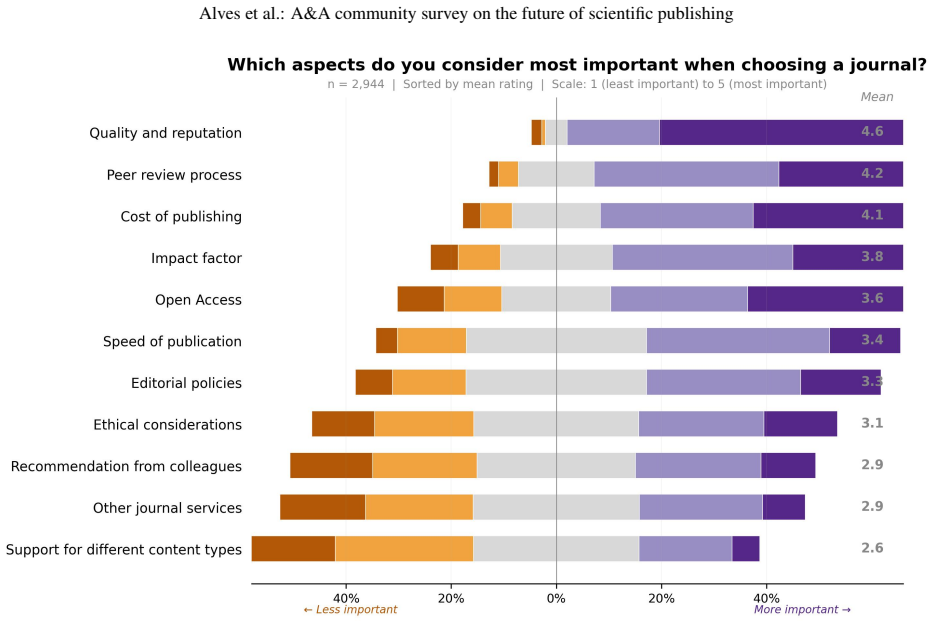
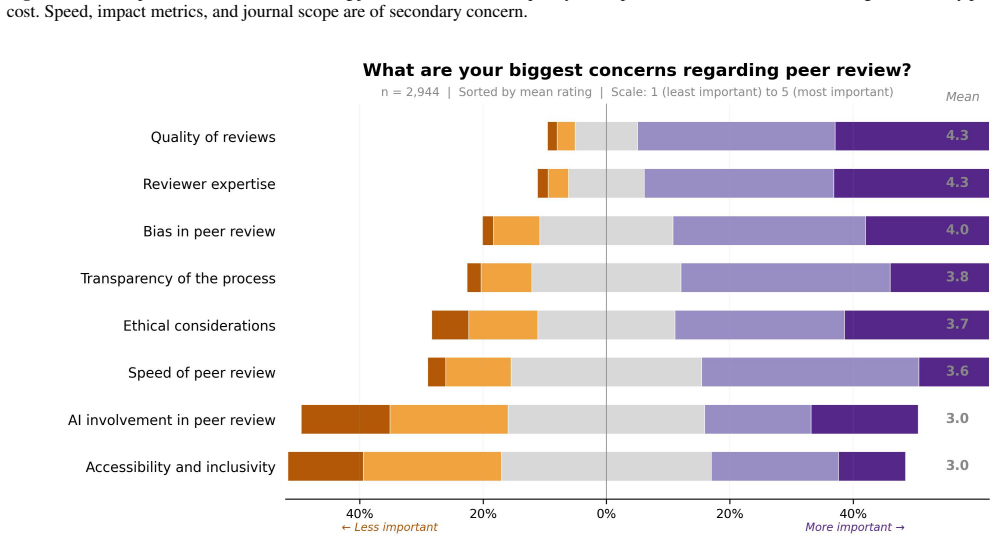
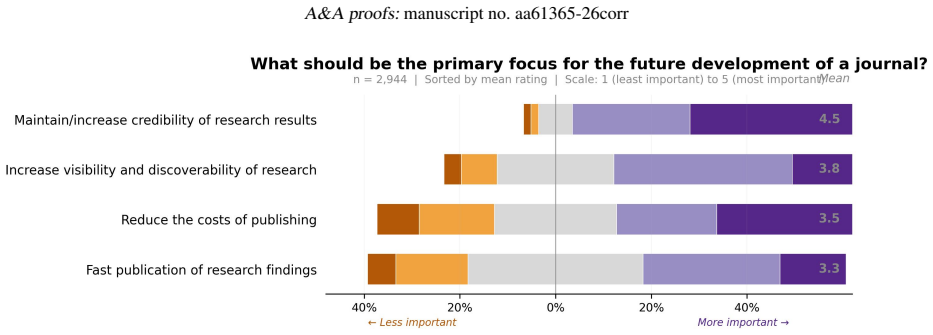
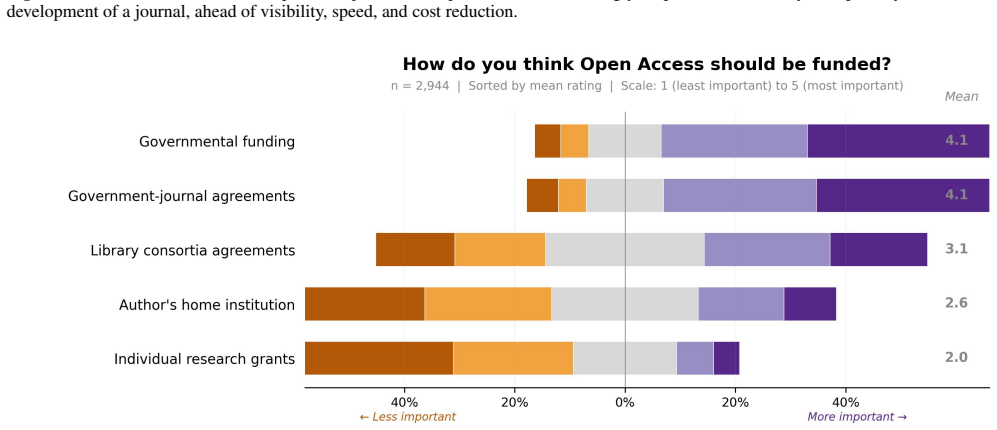
The A&A community survey documents that journal quality and reputation are the decisive factors in where authors choose to publish, followed by cost, while the main peer-review concern is reviewer expertise and fairness. Citation counts remain relevant but many want broader qualitative impact measures. The majority supports public or institutional funding for open access rather than author fees. Views on AI are polarized yet show firm opposition to autonomous AI roles in decisions or content generation. Integrity, credibility, and fairness emerge as consistent priorities, showing the community values quality over speed, fairness over profit, and human oversight over automation.
What carries the argument
The 2944 survey responses on journal choice, peer review, open access funding, research evaluation metrics, and AI roles, which map community preferences for credibility and fairness.
If this is right
- Journal policies should continue to emphasize quality and reputation as primary selection criteria.
- Peer-review systems need to prioritize mechanisms that secure reviewer expertise and fairness.
- Open-access models should move toward public or institutional funding structures.
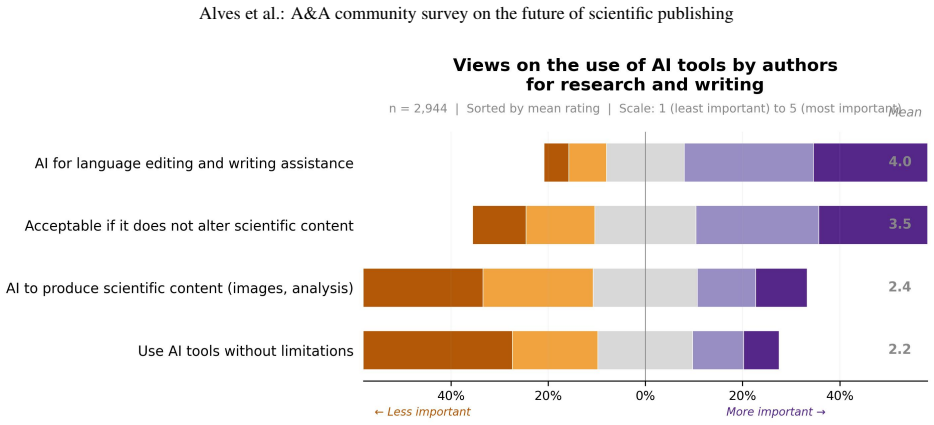
- AI integration should remain limited to supportive administrative tasks and exclude autonomous content or decision roles.
- Evaluation practices should incorporate broader qualitative impact measures alongside or instead of citation counts.
Where Pith is reading between the lines
- Similar surveys in other disciplines could test whether the same preference ordering holds outside astronomy.
- If journals adopt these priorities, publication volume may decrease while average rigor and reader trust increase.
- Persistent use of speed-focused metrics in hiring or funding could create ongoing tension with the reported community values.
- The survey design itself could be reused by other journals to gather comparable data on author sentiment.
Load-bearing premise
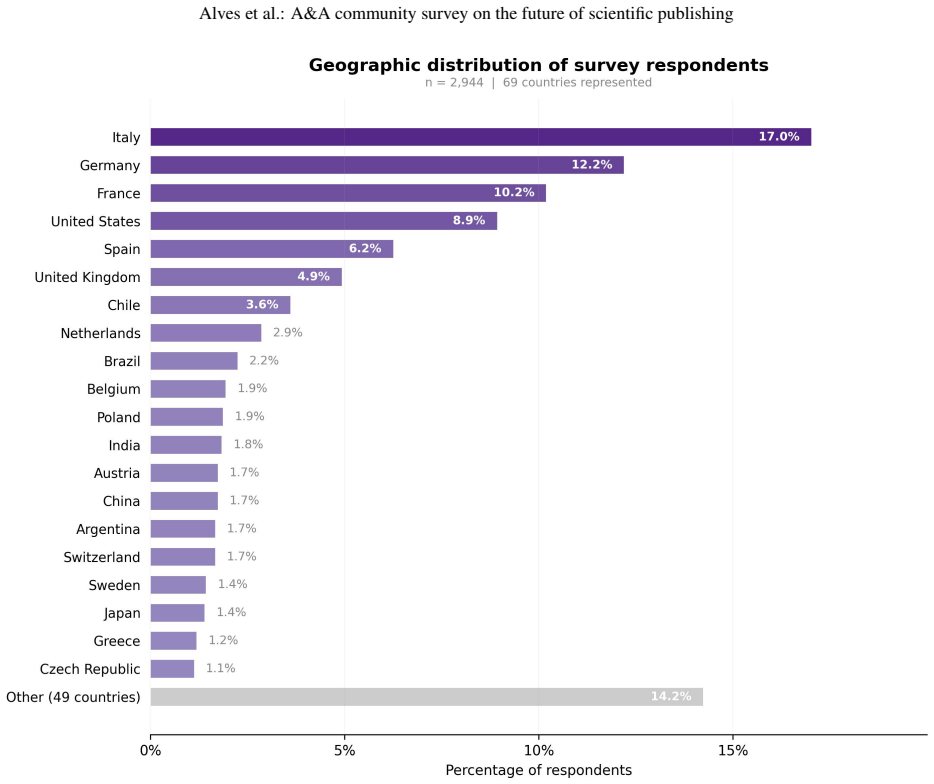
The 2944 responses, roughly 10 percent of those invited, represent the wider A&A author community without meaningful non-response bias that would alter the reported preferences.
What would settle it
A larger or differently sampled follow-up survey that finds the opposite ordering, such as speed or cost outweighing quality or widespread support for autonomous AI decisions, would falsify the central portrait of community values.
Figures



read the original abstract
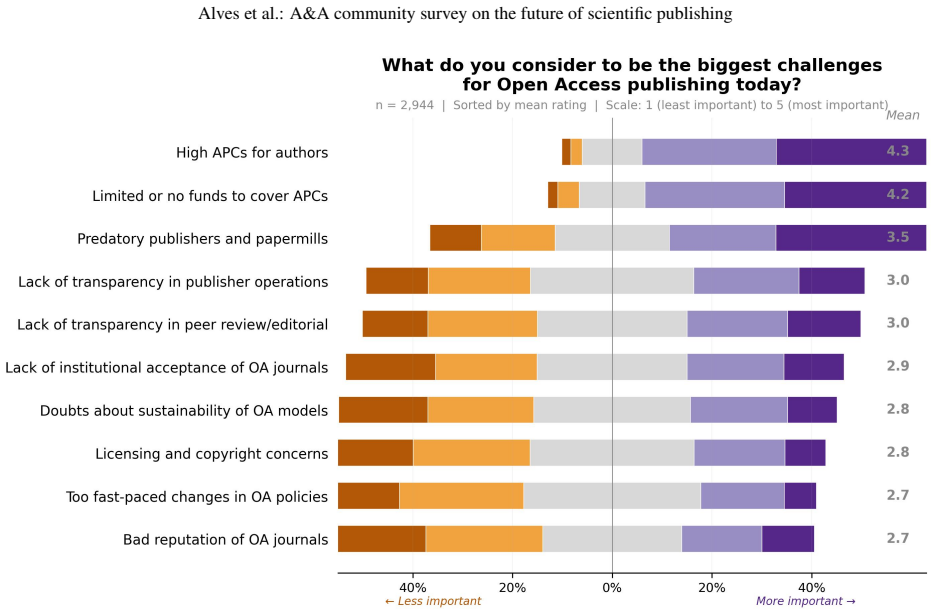
(Abridged) Scientific publishing is undergoing major change, driven by a shift toward open access (OA), the rise of artificial intelligence (AI), and growing demands for transparency, reproducibility, and equity. At the same time, rapid growth in article output strains editors and reviewers and means that metrics and speed can eclipse quality and rigor. To better understand how the community is responding, Astronomy \& Astrophysics (A\&A) commissioned the {A\&A Survey on Trends and Challenges in Scientific Publishing}, which documents community opinion on journal choice, peer review, OA, research evaluation, and the role of AI, with the goal of informing future editorial policies and the wider conversation on sustainable, ethical, and equitable scientific communication. Distributed online in May 2025 to \SI{28787} A\&A authors and co-authors, the survey drew \SI{2944} responses from 69 countries by its closing date. The responses were clear. Journal quality and reputation are the most decisive factors in deciding where to publish, followed by cost. The principal worry about peer review is reviewer expertise and fairness rather than speed. Citation counts are still an important consideration, but many respondents want broader, more qualitative measures of impact. The majority prefers public or institutional funding for OA, and views on AI are polarized, with widespread acceptance of administrative and language assistance but firm opposition to autonomous decision-making or content generation. Integrity, credibility, and fairness are common themes in every section of the responses. Overall, the survey portrays an engaged community that values quality over speed, fairness over profit, and human oversight over automation, providing A\&A with clear insight into community preference and a solid framework for shaping future policies on OA, peer review, and the responsible integration of AI.
Editorial analysis
A structured set of objections, weighed in public.
Referee Report
Summary. The manuscript reports results from the A&A Survey on Trends and Challenges in Scientific Publishing, an online survey distributed in May 2025 to 28,787 A&A authors and co-authors that received 2,944 responses from 69 countries. It summarizes respondent views on journal selection (quality/reputation ranked highest, followed by cost), peer-review concerns (reviewer expertise and fairness over speed), research evaluation (citation counts valued but desire for broader qualitative metrics), OA funding preferences (majority favoring public or institutional support), and AI roles (acceptance for administrative/language tasks but strong opposition to autonomous decisions or content generation). The paper concludes that the community prioritizes credibility, fairness, and human oversight, offering these findings as a basis for A&A editorial policies.
Significance. If the sample is representative, the survey supplies a large, multi-country dataset on researcher preferences during a period of rapid change in publishing practices. The descriptive findings on quality-over-speed and human-over-automation themes could directly inform journal policies on OA models, peer review, and AI guidelines. The scale (nearly 3,000 responses) and geographic spread are strengths, but the significance is limited by the absence of bias diagnostics that would allow readers to assess how well the reported majorities reflect the broader invited population.
major comments (3)
- [Survey Distribution and Response section] The manuscript states a response rate of 2,944 out of 28,787 (~10%) but supplies no analysis of non-response bias. There is no comparison of respondent demographics to the full invited population, no early-vs-late responder analysis, and no discussion of whether self-selection by engaged or dissatisfied authors could distort the reported preferences on quality, fairness, or AI. This is load-bearing for all headline claims about community opinion.
- [Methods] The methods description (or its absence in the abstract and main text) provides no information on survey instrument design, question validation, piloting, or steps taken to mitigate response bias or leading phrasing. Without these details it is impossible to evaluate whether the thematic findings on credibility and fairness are robust to instrument effects.
- [Results and Analysis] No statistical methods, weighting procedures, or handling of missing data are described. The paper presents raw percentages and thematic summaries without any adjustment for the low response rate or assessment of whether the observed majorities would change under plausible non-response scenarios.
minor comments (1)
- [Abstract] The abstract would benefit from an explicit limitations sentence noting the response rate and lack of bias diagnostics so readers can immediately contextualize the findings.
Simulated Author's Rebuttal
We thank the referee for their thoughtful comments on our survey manuscript. We address each major point below, indicating where we will revise the manuscript to improve transparency and acknowledge limitations. Our responses focus on what can be addressed with the available data and resources.
read point-by-point responses
-
Referee: [Survey Distribution and Response section] The manuscript states a response rate of 2,944 out of 28,787 (~10%) but supplies no analysis of non-response bias. There is no comparison of respondent demographics to the full invited population, no early-vs-late responder analysis, and no discussion of whether self-selection by engaged or dissatisfied authors could distort the reported preferences on quality, fairness, or AI. This is load-bearing for all headline claims about community opinion.
Authors: We agree that non-response bias is an important consideration for interpreting the results. Unfortunately, detailed demographic data for the full invited population of 28,787 A&A authors and co-authors are not available, preventing direct comparisons or formal bias diagnostics. We will add a new Limitations subsection that explicitly discusses potential self-selection effects, the 10% response rate, and the implications for generalizability of the headline findings on credibility and fairness. revision: partial
-
Referee: [Methods] The methods description (or its absence in the abstract and main text) provides no information on survey instrument design, question validation, piloting, or steps taken to mitigate response bias or leading phrasing. Without these details it is impossible to evaluate whether the thematic findings on credibility and fairness are robust to instrument effects.
Authors: We will expand the Methods section to describe the survey instrument development process, including collaboration with A&A editors, piloting with a small group of authors, and steps taken to use neutral phrasing and avoid leading questions. These details were omitted from the initial submission for brevity but can be added without altering the core findings. revision: yes
-
Referee: [Results and Analysis] No statistical methods, weighting procedures, or handling of missing data are described. The paper presents raw percentages and thematic summaries without any adjustment for the low response rate or assessment of whether the observed majorities would change under plausible non-response scenarios.
Authors: The analysis is intentionally descriptive, reporting raw percentages and thematic patterns as is standard for large-scale community opinion surveys. We will add explicit statements clarifying the absence of weighting or imputation, note that all key questions had high completion rates, and discuss why formal statistical adjustments were not applied given the exploratory goals. This will not change the reported majorities but will improve methodological transparency. revision: yes
Circularity Check
No circularity: descriptive survey report with no derivations or fitted claims
full rationale
The paper is a descriptive summary of 2944 survey responses on publishing preferences. It contains no equations, no parameter fitting, no predictions derived from models, and no load-bearing self-citations or uniqueness theorems. All reported findings (e.g., quality over speed, human oversight over AI) are direct tabulations or thematic summaries of the collected data, with no reduction of outputs to inputs by construction. The 10% response rate raises external validity concerns but does not create circular reasoning within the paper's own logic.
Axiom & Free-Parameter Ledger
axioms (2)
- domain assumption The survey sample is representative of the target population of A&A authors.
- domain assumption Respondents provided honest answers without systematic misunderstanding of questions.
Reference graph
Works this paper leans on
-
[1]
Ten Hot Topics around Scholarly Publishing ,author=. Publ. ,year=
-
[2]
2020 , month = sep, day =
2020
-
[3]
Xu, Xiaoting and Xie, Juan and Sun, Jianjun and Cheng, Ying , title =. Learned Publishing , volume =. doi:https://doi.org/10.1002/leap.1521 , url =. https://onlinelibrary.wiley.com/doi/pdf/10.1002/leap.1521 , abstract =
-
[4]
2026 , month = apr, day =
2026
-
[5]
Journal of the American Society for information Science and Technology , volume=
Bias in peer review , author=. Journal of the American Society for information Science and Technology , volume=. 2013 , publisher=
2013
-
[6]
Tony Ross-Hellauer , title =. F1000Research , year =. doi:10.12688/f1000research.11369.2 , url =
-
[7]
Tennant, Jonathan P. and Dugan, Jonathan M. and Graziotin, Daniel and Jacques, Damien C. and Waldner, Fran. A multi-disciplinary perspective on emergent and future innovations in peer review , journal =. 2017 , month =. doi:10.12688/f1000research.12037.3 , url =
-
[8]
2022 , month = jul, note =
Agreement on Reforming Research Assessment , author =. 2022 , month = jul, note =
2022
-
[9]
and Dumontier, Michel and Aalbersberg, IJsbrand Jan and others , title =
Wilkinson, Mark D. and Dumontier, Michel and Aalbersberg, IJsbrand Jan and others , title =. Scientific Data , volume =. 2016 , doi =
2016
-
[10]
2013 , note =
San Francisco Declaration on Research Assessment (DORA) , journal =. 2013 , note =
2013
-
[11]
Nature , volume =
Hicks, Diana and Wouters, Paul and Waltman, Ludo and de Rijcke, Sarah and Rafols, Ismael , title =. Nature , volume =. 2015 , doi =
2015
-
[12]
Learned Publishing , volume =
Crow, Raym and Gallagher, Richard and Naim, Kamran , title =. Learned Publishing , volume =. 2020 , doi =
2020
-
[13]
Nature , volume=
AI and science: what 1,600 researchers think , author=. Nature , volume=
discussion (0)
Sign in with ORCID, Apple, or X to comment. Anyone can read and Pith papers without signing in.