Nonlinear Freezing of Vibrational Polariton Transport via Mesoscale Simulations
Pith reviewed 2026-06-29 00:56 UTC · model grok-4.3
The pith
Strong pumping of the upper polariton freezes its transport and localizes energy at specific molecular sites.
A machine-rendered reading of the paper's core claim, the machinery that carries it, and where it could break.
Core claim
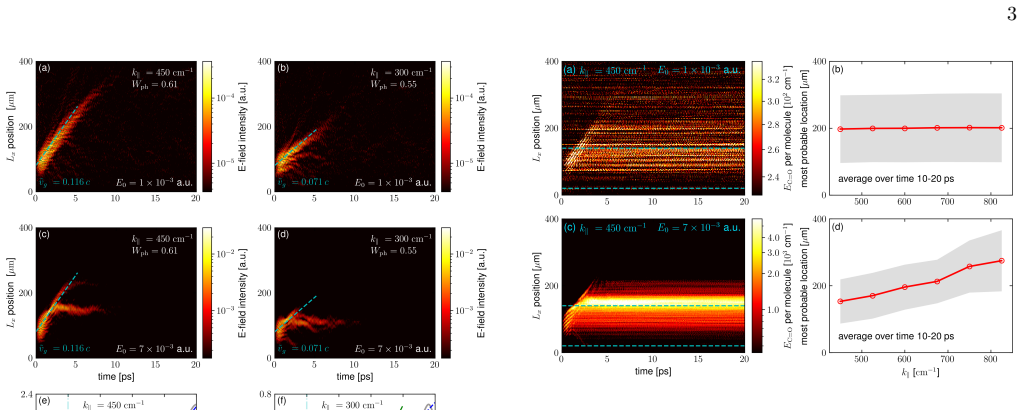
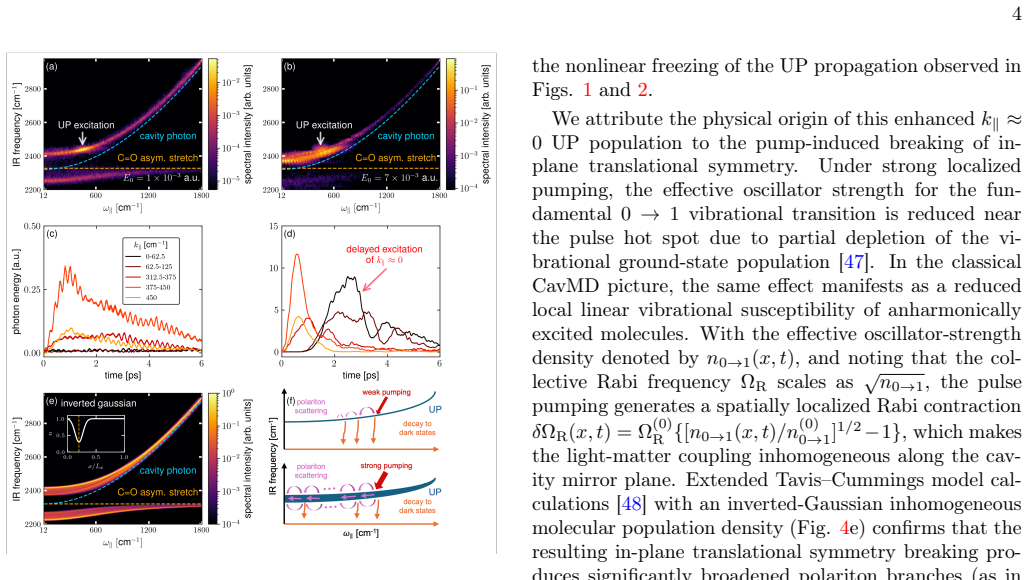
Under strong pumping of the upper polariton, the initially ballistically propagating upper polariton completely freezes and localizes energy to molecules at specific locations. This originates from pump-induced breaking of the in-plane translation symmetry: significant molecular excitations at the pulse hot spot broaden the polariton density of states, thus funneling population to the k_parallel → 0 band edge with vanishing group velocities.
What carries the argument
The mesoscale cavity molecular dynamics approach, which self-consistently evolves ~2×10^4 realistic molecular simulation cells on a two-dimensional grid coupled to an equal number of cavity modes.
If this is right
- The upper polariton undergoes complete transport freezing and energy localization under strong upper-polariton pumping.
- Pump-induced molecular excitations at the hot spot break in-plane translation symmetry.
- The broadened polariton density of states funnels population to the k_parallel = 0 band edge.
- This nonlinear freezing extends the known linear ballistic-to-diffusive turnover into a regime of vanishing group velocity.
Where Pith is reading between the lines
- The same symmetry-breaking route to freezing could appear in other polariton platforms if pumping can create a localized excitation hotspot.
- Real-cavity experiments with spatially resolved infrared imaging could directly test for the predicted localized molecular excitation spots.
- Device concepts that rely on controlled energy trapping might use pump intensity as a tunable parameter to switch transport on or off.
Load-bearing premise
The mesoscale cavity molecular dynamics approach with about 20,000 simulation cells accurately captures the nonlinear dynamics and symmetry breaking without major artifacts from the finite grid or coupling scheme.
What would settle it
A higher-resolution simulation or real-space imaging experiment that shows the upper polariton continuing to propagate ballistically without localization even under strong pumping would falsify the proposed freezing mechanism.
Figures

read the original abstract
Two-dimensional real-space imaging of vibrational polariton transport in planar Fabry--P\'erot microcavities is numerically simulated via the mesoscale cavity molecular dynamics approach, which self-consistently propagates $\sim\!2\times10^4$ realistic molecular simulation cells on a two-dimensional grid coupled to the same number of cavity modes. Beyond the well-known polariton ballistic-to-diffusive turnover in the linear response regime, these atomistic simulations reveal a nonlinear freezing mechanism of vibrational polariton transport, i.e., under strong pumping of the upper polariton, the initially ballistically propagating upper polariton completely freezes and localizes energy to molecules at specific locations. This mechanism originates from pump-induced breaking of the in-plane translation symmetry: significant molecular excitations at the pulse hot spot broaden the polariton density of states, thus funneling population to the $k_{\parallel}\rightarrow 0$ band edge with vanishing group velocities.
Editorial analysis
A structured set of objections, weighed in public.
Referee Report
Summary. The manuscript reports mesoscale cavity molecular dynamics simulations of vibrational polariton transport in planar Fabry-Pérot microcavities. Using ~2×10^4 molecular simulation cells coupled to an equal number of cavity modes on a 2D grid, the work identifies a nonlinear freezing mechanism: under strong upper-polariton pumping, initially ballistic transport ceases and energy localizes at specific molecular sites. The proposed origin is pump-induced breaking of in-plane translation symmetry via molecular excitations at the hot spot, which broadens the polariton density of states and funnels population to the k_parallel → 0 band edge where group velocities vanish. This extends the known linear ballistic-to-diffusive turnover into the nonlinear regime.
Significance. If the numerics are free of discretization artifacts, the identification of a pump-tunable symmetry-breaking route to polariton localization would be a significant advance for understanding nonlinear vibrational polariton dynamics at mesoscale. The scale of the simulation (~2×10^4 cells) is a clear strength, enabling direct observation of real-space localization without phenomenological fitting. The result, if robust, offers a concrete, falsifiable prediction for 2D imaging experiments and could guide cavity design for controlled energy funneling.
major comments (1)
- [Methods] Methods (mesoscale cavity molecular dynamics setup): No grid-size convergence tests, continuum extrapolation, or explicit checks for periodic-boundary artifacts are reported. The finite 2D lattice with exactly 2×10^4 discrete cavity modes already breaks continuous in-plane translation symmetry; under strong local pumping this discrete structure can preferentially populate the Gamma point even in the absence of the claimed nonlinear DOS broadening, raising the possibility that the observed freezing is at least partly numerical rather than physical.
minor comments (1)
- The abstract states the mechanism originates from 'pump-induced breaking of the in-plane translation symmetry' but does not clarify how this is distinguished from the built-in discrete symmetry of the simulation grid; a short clarifying sentence would improve readability.
Simulated Author's Rebuttal
We thank the referee for the positive evaluation and the constructive comment on the methods. We address the concern point by point below.
read point-by-point responses
-
Referee: [Methods] Methods (mesoscale cavity molecular dynamics setup): No grid-size convergence tests, continuum extrapolation, or explicit checks for periodic-boundary artifacts are reported. The finite 2D lattice with exactly 2×10^4 discrete cavity modes already breaks continuous in-plane translation symmetry; under strong local pumping this discrete structure can preferentially populate the Gamma point even in the absence of the claimed nonlinear DOS broadening, raising the possibility that the observed freezing is at least partly numerical rather than physical.
Authors: We agree that explicit grid-size convergence tests and discussion of discretization effects were not reported and will be added. However, the nonlinear character of the freezing provides strong evidence against a purely numerical origin: the same finite grid and periodic boundaries are used in the linear regime, where transport remains ballistic with no localization, consistent with continuous translation symmetry. Freezing and localization emerge only under strong upper-polariton pumping that drives significant molecular excitation and DOS broadening at the hot spot. In the revised manuscript we will (i) report additional simulations at grid sizes N=100² and N=150² showing that the freezing time and localization length converge, (ii) add a short discussion of the continuum limit and why the discrete k-grid does not artificially induce Gamma-point population in the nonlinear regime, and (iii) note that the localized pump minimizes periodic-boundary artifacts. These additions will confirm the physical mechanism. revision: yes
Circularity Check
No circularity: claims emerge directly from numerical simulation outputs
full rationale
The paper's central result—the nonlinear freezing and localization of upper polariton transport—is presented as an outcome of propagating ~2×10^4 molecular cells coupled to an equal number of cavity modes under strong pumping. No load-bearing step reduces by construction to a fitted parameter, self-referential definition, or self-citation chain; the symmetry-breaking mechanism and funneling to the k∥→0 band edge are reported as emergent simulation behavior rather than imposed by ansatz or prior author work. The derivation chain remains self-contained against external benchmarks.
Axiom & Free-Parameter Ledger
axioms (1)
- domain assumption The mesoscale cavity molecular dynamics method self-consistently propagates molecular simulation cells coupled to cavity modes.
Reference graph
Works this paper leans on
-
[1]
Acknowledgments.This material is based upon work supported by the U.S
which predict monotonically diminishing molecular excitations at increased distance from the source. Acknowledgments.This material is based upon work supported by the U.S. National Science Foundation un- der Grant No. CHE-2502758. This work used the Anvil HPC at Purdue University through allocation CHE250091 from the Advanced Cyberinfrastructure Co- ordin...
-
[2]
Shalabney, J
A. Shalabney, J. George, J. Hutchison, G. Pupillo, C. Genet, and T. W. Ebbesen, Coherent Coupling of Molecular Resonators with a Microcavity Mode, Nat. Commun.6, 5981 (2015)
2015
-
[3]
J. P. Long and B. S. Simpkins, Coherent Coupling be- tween a Molecular Vibration and Fabry–Perot Optical Cavity to Give Hybridized States in the Strong Coupling Limit, ACS Photonics2, 130 (2015)
2015
-
[4]
A. D. Wright, J. C. Nelson, and M. L. Weichman, Rovibrational Polaritons in Gas-Phase Methane, J. Am. Chem. Soc.145, 5982 (2023)
2023
-
[5]
Z. T. Brawley, S. Pannir-Sivajothi, J. E. Yim, Y. R. Poh, J. Yuen-Zhou, and M. Sheldon, Vibrational Weak and Strong Coupling Modify a Chemical Reaction via Cavity- Mediated Radiative Energy Transfer, Nat. Chem.17, 439 (2025)
2025
-
[6]
Thomas, J
A. Thomas, J. George, A. Shalabney, M. Dryzhakov, S. J. Varma, J. Moran, T. Chervy, X. Zhong, E. Devaux, C. Genet, J. A. Hutchison, and T. W. Ebbesen, Ground- State Chemical Reactivity under Vibrational Coupling to the Vacuum Electromagnetic Field, Angew. Chemie Int. Ed.55, 11462 (2016)
2016
-
[7]
Thomas, L
A. Thomas, L. Lethuillier-Karl, K. Nagarajan, R. M. A. Vergauwe, J. George, T. Chervy, A. Shalabney, E. De- vaux, C. Genet, J. Moran, and T. W. Ebbesen, Tilt- ing a Ground-State Reactivity Landscape by Vibrational Strong Coupling, Science363, 615 (2019)
2019
-
[8]
Hirai, H
K. Hirai, H. Ishikawa, T. Chervy, J. A. Hutchison, and H. Uji-i, Selective Crystallization via Vibrational Strong Coupling, Chem. Sci.12, 11986 (2021)
2021
-
[9]
W. Ahn, J. F. Triana, F. Recabal, F. Herrera, and B. S. Simpkins, Modification of Ground-State Chemical Reac- tivity via Light–Matter Coherence in Infrared Cavities, Science380, 1165 (2023)
2023
-
[10]
Xiang, R
B. Xiang, R. F. Ribeiro, M. Du, L. Chen, Z. Yang, J. Wang, J. Yuen-Zhou, and W. Xiong, Intermolecu- lar Vibrational Energy Transfer Enabled by Microcavity Strong Light–Matter Coupling, Science368, 665 (2020)
2020
-
[11]
T.-T. Chen, M. Du, Z. Yang, J. Yuen-Zhou, and W. Xiong, Cavity-enabled Enhancement of Ultrafast In- tramolecular Vibrational Redistribution over Pseudoro- tation, Science378, 790 (2022)
2022
-
[12]
G. Yin, T. Liu, L. Zhang, T. Sheng, H. Mao, and W.Xiong,Overcomingenergydisorderforcavity-enabled energy transfer in vibrational polaritons, Science389, 845 (2025)
2025
-
[13]
R. F. Ribeiro, L. A. Martínez-Martínez, M. Du, J. Campos-Gonzalez-Angulo, and J. Yuen-Zhou, Polari- ton Chemistry: Controlling Molecular Dynamics with Optical Cavities, Chem. Sci.9, 6325 (2018)
2018
-
[14]
T. E. Li, B. Cui, J. E. Subotnik, and A. Nitzan, Molec- ular Polaritonics: Chemical Dynamics Under Strong Light–Matter Coupling, Annu. Rev. Phys. Chem.73, 43 (2022)
2022
-
[15]
B. S. Simpkins, A. D. Dunkelberger, and I. Vurgaftman, Control, Modulation, and Analytical Descriptions of Vi- brational Strong Coupling, Chem. Rev.123, 5020 (2023)
2023
-
[16]
Mandal, M
A. Mandal, M. A. Taylor, B. M. Weight, E. R. Koessler, X. Li, and P. Huo, Theoretical Advances in Polariton Chemistry and Molecular Cavity Quantum Electrody- namics, Chem. Rev.123, 9786 (2023)
2023
-
[17]
Ruggenthaler, D
M. Ruggenthaler, D. Sidler, and A. Rubio, Understand- ing Polaritonic Chemistry from Ab Initio Quantum Elec- trodynamics, Chem. Rev.123, 11191 (2023)
2023
-
[18]
Xiang and W
B. Xiang and W. Xiong, Molecular Polaritons for Chem- istry, Photonics and Quantum Technologies, Chem. Rev. 124, 2512 (2024)
2024
-
[19]
Fregoni, F
J. Fregoni, F. J. Garcia-Vidal, and J. Feist, Theoretical Challenges in Polaritonic Chemistry, ACS Photonics9, 1096 (2022)
2022
-
[20]
Poddar and P
S. Poddar and P. Huo, Quantum Dynamics Simulations of Polariton Transport in a Bloch Surface Wave Cavity, Nanophotonics15, e70163 (2026)
2026
-
[21]
J. B. Pérez-Sánchez, A. Koner, N. P. Stern, and J. Yuen- Zhou, Simulating molecular polaritons in the collective regime using few-molecule models, Proc. Natl. Acad. Sci. 120, e2219223120 (2023)
2023
-
[22]
O. V. Kotov, J. Feist, F. J. García-Vidal, and T. O. Shegai, Casimir-Lifshitz Theory for Cavity Modification of Ground-State Energy, Phys. Rev. Lett.135, 263601 (2025)
2025
-
[23]
D. Xu, A. Mandal, J. M. Baxter, S.-W. Cheng, I. Lee, H. Su, S. Liu, D. R. Reichman, and M. Delor, Ultrafast imaging of polariton propagation and interactions, Nat. Commun.14, 3881 (2023)
2023
-
[24]
Balasubrahmaniyam, A
M. Balasubrahmaniyam, A. Simkhovich, A. Golombek, G. Sandik, G. Ankonina, and T. Schwartz, From en- hanced diffusion to ultrafast ballistic motion of hybrid light–matter excitations, Nat. Mater.22, 338 (2023)
2023
-
[25]
Xiong, Advancing a Rational Understanding of Po- lariton Chemistry, Telluride Science Workshop: Engi- neering Light-Matter Interactions: Nanostructures and 6 Polaritons (2025)
W. Xiong, Advancing a Rational Understanding of Po- lariton Chemistry, Telluride Science Workshop: Engi- neering Light-Matter Interactions: Nanostructures and 6 Polaritons (2025)
2025
-
[26]
Sokolovskii, R
I. Sokolovskii, R. H. Tichauer, D. Morozov, J. Feist, and G.Groenhof,Multi-scalemoleculardynamicssimulations of enhanced energy transfer in organic molecules under strong coupling, Nat. Commun.14, 6613 (2023)
2023
-
[27]
R. F. Ribeiro, Multimode polariton effects on molecu- lar energy transport and spectral fluctuations, Commun. Chem.5, 48 (2022)
2022
-
[28]
Suyabatmaz and R
E. Suyabatmaz and R. F. Ribeiro, Vibrational Polari- ton Transport in Disordered Media, J. Chem. Phys.159, 034701 (2023)
2023
-
[29]
Zhou, H.-T
Z. Zhou, H.-T. Chen, M. Sukharev, J. E. Subotnik, and A.Nitzan,NatureofpolaritontransportinaFabry-Perot cavity, Phys. Rev. A109, 033717 (2024)
2024
-
[30]
Engelhardt and J
G. Engelhardt and J. Cao, Polariton Localization and Dispersion Properties of Disordered Quantum Emit- ters in Multimode Microcavities, Phys. Rev. Lett.130, 213602 (2023)
2023
-
[31]
Blackham, A
L. Blackham, A. Manjalingal, S. R. Koshkaki, and A.Mandal,MicroscopicTheoryofPolaron-PolaritonDis- persion and Propagation, Nano Lett.25, 15874 (2025)
2025
-
[32]
Fowler-Wright, M
P. Fowler-Wright, M. Reitz, and J. Yuen-Zhou, Map- ping molecular polariton transport via pump-probe mi- croscopy, Nano Lett.26, 6334 (2026)
2026
-
[33]
B. X. K. Chng, B. M. Weight, M. E. Mondal, and P. Huo, Ab Initio Polariton Transport Dynamics with the Clas- sical Path Approximation, Nano Lett.26, 6055 (2026)
2026
-
[34]
Liu and H.-T
G. Liu and H.-T. Chen, Dissecting exciton-polariton transport in organic molecular crystals: Emerging con- ductivity assisted by intermolecular vibrational coupling, J. Chem. Phys.163, 174110 (2025)
2025
-
[35]
T. E. Li, Mesoscale Molecular Simulations of Fabry-Pérot Vibrational Strong Coupling, J. Chem. Theory Comput. 20, 7016 (2024)
2024
-
[36]
A. P. Thompson, H. M. Aktulga, R. Berger, D. S. Bolin- tineanu, W. M. Brown, P. S. Crozier, P. J. in ’t Veld, A. Kohlmeyer, S. G. Moore, T. D. Nguyen, R. Shan, M. J. Stevens, J. Tranchida, C. Trott, and S. J. Plimpton, LAMMPS-AFlexibleSimulationToolforParticle-based Materials Modeling at the Atomic, Neso, and Continuum Scales, Comput. Phys. Commun.271, 10...
2022
-
[38]
R. T. Cygan, V. N. Romanov, and E. M. Myshakin, Molecular Simulation of Carbon Dioxide Capture by Montmorillonite Using an Accurate and Flexible Force Field, J. Phys. Chem. C116, 13079 (2012)
2012
-
[39]
T. E. Li, A. Nitzan, and J. E. Subotnik, Cavity Molec- ular Dynamics Simulations of Vibrational Polariton- Enhanced Molecular Nonlinear Absorption, J. Chem. Phys.154, 094124 (2021)
2021
-
[41]
T. E. Li, A. Nitzan, and J. E. Subotnik, Polariton Re- laxation under Vibrational Strong Coupling: Comparing Cavity Molecular Dynamics Simulations against Fermi’s Golden Rule Rate, J. Chem. Phys.156, 134106 (2022)
2022
-
[42]
T. E. Li, A. Nitzan, and J. E. Subotnik, Collective Vi- brational Strong Coupling Effects on Molecular Vibra- tional Relaxation and Energy Transfer: Numerical In- sights via Cavity Molecular Dynamics Simulations**, Angew. Chemie Int. Ed.60, 15533 (2021)
2021
-
[44]
Xiang, R
B. Xiang, R. F. Ribeiro, A. D. Dunkelberger, J. Wang, Y. Li, B. S. Simpkins, J. C. Owrutsky, J. Yuen-Zhou, and W. Xiong, Two-dimensional Infrared Spectroscopy of Vibrational Polaritons, Proc. Natl. Acad. Sci.115, 4845 (2018)
2018
-
[45]
Xiang, R
B. Xiang, R. F. Ribeiro, L. Chen, J. Wang, M. Du, J. Yuen-Zhou, and W. Xiong, State-Selective Polariton to Dark State Relaxation Dynamics, J. Phys. Chem. A 123, 5918 (2019)
2019
-
[46]
J. J. Hopfield, Theory of the Contribution of Excitons to the Complex Dielectric Constant of Crystals, Phys. Rev. 112, 1555 (1958)
1958
-
[47]
H. Deng, H. Haug, and Y. Yamamoto, Exciton-Polariton Bose–Einstein Condensation, Rev. Mod. Phys.82, 1489 (2010)
2010
-
[48]
A. D. Dunkelberger, A. B. Grafton, I. Vurgaftman, Ö. O. Soykal, T. L. Reinecke, R. B. Davidson, B. S. Simpkins, and J. C. Owrutsky, Saturable Absorption in Solution- Phase and Cavity-Coupled Tungsten Hexacarbonyl, ACS Photonics6, 2719 (2019)
2019
-
[50]
Ciuti, P
C. Ciuti, P. Schwendimann, and A. Quattropani, Theory of polariton parametric interactions in semiconductor mi- crocavities, Semicond. Sci. Technol.18, S279 (2003)
2003
-
[51]
Carusotto and C
I. Carusotto and C. Ciuti, Quantum Fluids of Light, Rev. Mod. Phys.85, 299 (2013)
2013
-
[52]
Grochol and C
M. Grochol and C. Piermarocchi, Microcavity polaritons in disordered exciton lattices, Phys. Rev. B78, 035323 (2008)
2008
-
[53]
Abbarchi, A
M. Abbarchi, A. Amo, V. G. Sala, D. D. Solnyshkov, H. Flayac, L. Ferrier, I. Sagnes, E. Galopin, A. Lemaître, G. Malpuech, and J. Bloch, Macroscopic quantum self- trapping and Josephson oscillations of exciton polaritons, Nat. Phys.9, 275 (2013)
2013
-
[54]
Ballarini, I
D. Ballarini, I. Chestnov, D. Caputo, M. De Giorgi, L. Dominici, K. West, L. N. Pfeiffer, G. Gigli, A. Ka- vokin, and D. Sanvitto, Self-Trapping of Exciton- PolaritonCondensatesinGaAsMicrocavities,Phys.Rev. Lett.123, 047401 (2019)
2019
-
[55]
I. Y. Chestnov, T. A. Khudaiberganov, A. P. Alodjants, and A. V. Kavokin, Heat-assisted self-localization of ex- citon polaritons, Phys. Rev. B98, 115302 (2018)
2018
-
[56]
Förster, Zwischenmolekulare Energiewanderung und Fluoreszenz, Ann
T. Förster, Zwischenmolekulare Energiewanderung und Fluoreszenz, Ann. Phys.437, 55 (1948)
1948
-
[57]
T. J. Boerner, S. Deems, T. R. Furlani, S. L. Knuth, and J. Towns, ACCESS: Advancing Innovation: NSF’s Advanced Cyberinfrastructure Coordination Ecosystem: Services & Support, inPractice and Experience in Ad- vanced Research Computing(ACM,NewYork, NY,USA,
-
[58]
thermostat
T. E. Li, MaxwellLink package for self-consistent light-matter simulations, https://github.com/TaoELi/maxwelllink (2026). Supplementary Material for Nonlinear Freezing of Vibrational Polariton Transport via Mesoscale Simulations Xinwei Ji1 and Tao E. Li1,∗ 1Department of Physics and Astronomy, University of Delaware, Newark, Delaware 19716, USA CONTENTS I...
2026
-
[59]
T. E. Li, Mesoscale Molecular Simulations of Fabry-Pérot Vibrational Strong Coupling, J. Chem. Theory Comput.20, 7016 (2024)
2024
-
[60]
X. Ji, A. F. Bocanegra Vargas, G. Meng, and T. E. Li, MaxwellLink: A Unified Framework for Self-Consistent Light-Matter Simulations, J. Chem. Theory Comput.22, 2725 (2026)
2026
-
[61]
T. E. Li, A. Nitzan, and J. E. Subotnik, Cavity Molecular Dynamics Simulations of Vibrational Polariton-Enhanced Molec- ular Nonlinear Absorption, J. Chem. Phys.154, 094124 (2021)
2021
-
[62]
A. P. Thompson, H. M. Aktulga, R. Berger, D. S. Bolintineanu, W. M. Brown, P. S. Crozier, P. J. in ’t Veld, A. Kohlmeyer, S. G. Moore, T. D. Nguyen, R. Shan, M. J. Stevens, J. Tranchida, C. Trott, and S. J. Plimpton, LAMMPS - A Flexible SimulationToolforParticle-basedMaterialsModelingattheAtomic, Neso, andContinuumScales,Comput.Phys.Commun. 271, 108171 (2022)
2022
-
[63]
T. E. Li, A. Nitzan, and J. E. Subotnik, Energy-Efficient Pathway for Selectively Exciting Solute Molecules to High Vibrational States via Solvent Vibration-Polariton Pumping, Nat. Commun.13, 4203 (2022)
2022
-
[64]
T. E. Li, A. Nitzan, M. Sukharev, T. Martinez, H.-T. Chen, and J. E. Subotnik, Mixed Quantum–Classical Electrodynamics: Understanding Spontaneous Decay and Zero–Point Energy, Phys. Rev. A97, 032105 (2018)
2018
-
[65]
T. E. Li, Vibrational Polaritons with Broken In-plane Translational Symmetry, J. Chem. Phys.161, 64308 (2024)
2024
discussion (0)
Sign in with ORCID, Apple, or X to comment. Anyone can read and Pith papers without signing in.