Light and heavy meson production in small collision systems
Pith reviewed 2026-06-29 01:45 UTC · model grok-4.3
The pith
Calculations separate cold nuclear matter effects from quark-gluon plasma modifications in light and heavy meson production for O-O and Ne-Ne collisions.
A machine-rendered reading of the paper's core claim, the machinery that carries it, and where it could break.
Core claim
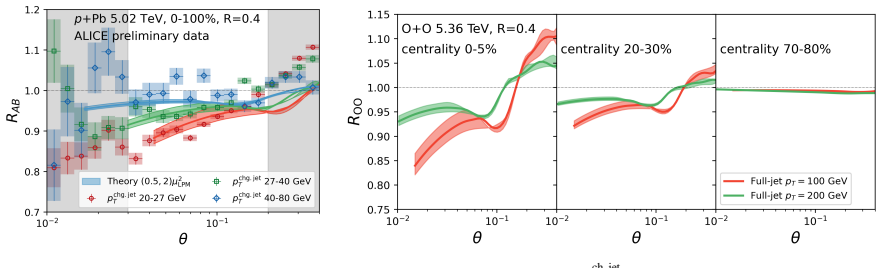
Building on recent work on particle production dynamics, the study presents updated calculations of light and heavy hadron modification in O-O and Ne-Ne collisions for selected centralities. It quantifies initial-state effects, collisional energy loss, and medium-induced radiative corrections, delivering theoretical predictions at midrapidity and forward rapidity. Comparison to available data is used to assess the relative importance of cold nuclear matter and quark-gluon plasma contributions and the role played by the heavy quark mass, with the goal of clarifying the onset of collective and deconfined behavior.
What carries the argument
The combination of perturbative QCD calculations and hydrodynamic simulations that model initial-state effects together with collisional and radiative energy loss in small collision systems.
If this is right
- Predictions at midrapidity and forward rapidity can be confronted directly with ALICE, ATLAS, CMS, and LHCb data.
- Cold nuclear matter effects are expected to dominate in smaller systems while quark-gluon plasma effects grow in importance from O-O to Ne-Ne.
- Heavy quark mass suppresses medium-induced modifications, leading to different patterns for light versus heavy mesons.
- Additional observables such as energy correlators and quarkonia can supply independent information on the formation of deconfined matter.
- The results provide new constraints on the transport properties of the produced matter.
Where Pith is reading between the lines
- If the separation holds, the same modeling approach could be applied to other small systems such as p-Pb to test consistency across collision geometries.
- Flavor-dependent suppression tied to quark mass offers a possible experimental handle for identifying the smallest systems that still form a quark-gluon plasma.
- Energy correlators could reveal medium effects at lower momentum scales than single-particle spectra, potentially extending the reach of these studies.
Load-bearing premise
Recent theoretical work on particle production dynamics supplies an accurate baseline that cleanly separates cold nuclear matter effects from medium-induced modifications.
What would settle it
If measured meson modification factors in O-O or Ne-Ne collisions deviate systematically from the calculated values in a way that cannot be absorbed by reasonable variations in the input parameters, the claimed separation between cold nuclear matter and quark-gluon plasma contributions would be falsified.
Figures

read the original abstract
Recent results from the LHC on oxygen-oxygen (O-O) and neon-neon (Ne-Ne) collisions open a new window for investigating the interplay of cold nuclear matter (CNM) and quark-gluon plasma (QGP) effects in small collision systems. Building upon recent theoretical work on particle production dynamics in heavy-ion reactions, we present an updated study of light and heavy hadron modification relative to the proton-proton baseline in these systems for selected centralities. Our analysis combines perturbative QCD and hydrodynamic simulations to quantify initial-state effect, collisional energy loss, and medium-induced radiative corrections. We give theoretical predictions at both midrapidity and forward rapidity that can be confronted with ALICE, ATLAS, CMS, and LHCb measurements. Through comparison to the available data, we discuss the relative importance of CNM and QGP effects in O-O and Ne-Ne systems and the role of the heavy quark mass. Our analysis aims to clarify the onset of collective and deconfined behavior in small systems and to provide new insights into the transport properties of matter. We further argue that investigation of other observable such as energy correlators and quarkonia can lead to a more complete picture of QGP formation in these collisions.
Editorial analysis
A structured set of objections, weighed in public.
Referee Report
Summary. The manuscript studies light and heavy meson production in O-O and Ne-Ne collisions at the LHC. It combines perturbative QCD calculations with hydrodynamic simulations to quantify initial-state CNM effects, collisional energy loss, and medium-induced radiative corrections relative to the pp baseline. Predictions are provided at mid- and forward rapidity for selected centralities, with the goal of using data comparisons to assess the relative importance of CNM versus QGP effects and the role of heavy-quark mass.
Significance. If the pQCD+hydro framework reliably isolates CNM from medium-induced modifications, the work would contribute to understanding the onset of collective behavior and deconfined matter in small systems, while also constraining transport properties. The explicit inclusion of both light and heavy hadrons plus forward-rapidity predictions is a positive feature that broadens the testable observables.
major comments (2)
- [Abstract, §2] Abstract and §2 (baseline construction): the central claim that data comparisons allow discussion of the relative importance of CNM and QGP effects rests on the accuracy of the pQCD+hydro baseline inherited from prior work. No explicit cross-check against p-Pb data (where CNM effects are independently constrained by existing measurements) is described; without such a validation the extracted CNM/QGP partitioning in O-O/Ne-Ne remains untested.
- [§4] §4 (heavy-quark mass dependence): the discussion of the role of heavy-quark mass in distinguishing CNM from QGP contributions is presented as a key result, yet the manuscript provides no quantitative sensitivity study showing how variations in the mass-dependent energy-loss parameters affect the predicted modification factors; this weakens the mass-dependence claim.
minor comments (2)
- Figure captions should explicitly state the centrality classes and rapidity ranges used for each curve to allow direct comparison with experimental bins.
- The reference list should include the specific prior theoretical works cited in the abstract so readers can trace the baseline implementation.
Simulated Author's Rebuttal
We thank the referee for the constructive comments and positive assessment of the manuscript's scope. We address each major comment below and will revise the manuscript to incorporate the suggested improvements.
read point-by-point responses
-
Referee: [Abstract, §2] Abstract and §2 (baseline construction): the central claim that data comparisons allow discussion of the relative importance of CNM and QGP effects rests on the accuracy of the pQCD+hydro baseline inherited from prior work. No explicit cross-check against p-Pb data (where CNM effects are independently constrained by existing measurements) is described; without such a validation the extracted CNM/QGP partitioning in O-O/Ne-Ne remains untested.
Authors: We acknowledge the value of an explicit cross-check within this manuscript. Although the pQCD+hydro framework was validated against p-Pb data in our prior publications (which form the baseline here), we agree to add a concise validation summary in the revised §2. This will include direct comparisons of predicted nuclear modification factors for light and heavy mesons to existing p-Pb measurements at mid- and forward rapidity, confirming the CNM modeling before its application to O-O and Ne-Ne systems. revision: yes
-
Referee: [§4] §4 (heavy-quark mass dependence): the discussion of the role of heavy-quark mass in distinguishing CNM from QGP contributions is presented as a key result, yet the manuscript provides no quantitative sensitivity study showing how variations in the mass-dependent energy-loss parameters affect the predicted modification factors; this weakens the mass-dependence claim.
Authors: We agree that a quantitative sensitivity study would strengthen the mass-dependence discussion. In the revised §4 we will add results from varying the heavy-quark mass (e.g., charm mass in the range 1.2–1.5 GeV) and the associated energy-loss parameters, showing the impact on the predicted modification factors for D mesons relative to light hadrons at both rapidities. This will explicitly quantify how mass-dependent radiative and collisional losses help separate CNM from QGP contributions. revision: yes
Circularity Check
No significant circularity in derivation chain
full rationale
The abstract states the analysis builds upon recent theoretical work on particle production dynamics but provides no equations, fitted parameters, or explicit self-citations that reduce any central prediction (e.g., CNM/QGP separation or mass dependence) to inputs by construction. No self-definitional steps, fitted-input predictions, or load-bearing self-citation chains are exhibited in the given text. The claims rest on comparison to external LHC data and a pQCD+hydro framework whose independence from the target observables is not contradicted here. This is the normal case of a self-contained study against external benchmarks.
Axiom & Free-Parameter Ledger
Reference graph
Works this paper leans on
-
[1]
W. Ke, I. Vitev, Searching for QGP droplets with high-pT hadrons and heavy flavor, Phys. Rev. C 107 (6) (2023) 064903. arXiv:2204.00634, doi:10.1103/PhysRevC.107.064903
-
[2]
G. Aad, et al., Transverse momentum, rapidity, and centrality dependence of inclusive charged-particle produc- tion in √sNN =5.02 TeVp+Pb collisions measured by the ATLAS experiment, Phys. Lett. B 763 (2016) 313–336. arXiv:1605.06436, doi:10.1016/j.physletb.2016.10.053
work page internal anchor Pith review Pith/arXiv arXiv doi:10.1016/j.physletb.2016.10.053 2016
-
[3]
N. J. Abdulameer, et al., Disentangling Centrality Bias and Final-State Effects in the Production of High-pT Neu- tral Pions Using Direct Photon in d+Au Collisions at sNN=200 GeV, Phys. Rev. Lett. 134 (2) (2025) 022302. arXiv:2303.12899, doi:10.1103/PhysRevLett.134.022302
-
[4]
Measurement of jet quenching in O+O collisions at √sNN =200 GeV by the STAR experiment at RHIC (4 2026). arXiv:2604.13935
Pith/arXiv arXiv 2026
-
[5]
Observation of suppressed charged-particle production in ultrarelativistic oxygen-oxygen collisions
A. Hayrapetyan, et al., Observation of Suppressed Charged-Particle Production in Ultrarelativistic Oxygen- Oxygen Collisions, Phys. Rev. Lett. 136 (16) (2026) 162301. arXiv:2510.09864, doi:10.1103/89sf-9t1x
work page internal anchor Pith review Pith/arXiv arXiv doi:10.1103/89sf-9t1x 2026
-
[6]
A. Belyaev, et al., System-size dependence of charged-particle suppression in ultrarelativistic nucleus-nucleus collisions (2 2026). arXiv:2602.21325
arXiv 2026
-
[7]
N. Strangmann, Nuclear Modification ofπ 0 Production in OO Collisions with ALICE, in: 60th Rencontres de Moriond on QCD and High Energy Interactions: Moriond QCD 2026, 2026. arXiv:2604.17974
Pith/arXiv arXiv 2026
-
[8]
Aaij, et al., Study of nuclear effects on charm production in light-ion collisions (5 2026)
R. Aaij, et al., Study of nuclear effects on charm production in light-ion collisions (5 2026). arXiv:2605.27273
arXiv 2026
-
[9]
H. T. Li, I. Vitev, Inverting the mass hierarchy of jet quenching effects with promptb-jet substructure, Phys. Lett. B 793 (2019) 259–264. arXiv:1801.00008, doi:10.1016/j.physletb.2019.04.052. 4
work page internal anchor Pith review Pith/arXiv arXiv doi:10.1016/j.physletb.2019.04.052 2019
-
[10]
W. Ke, B. Mecaj, I. Vitev, Renormalization group evolution for in-medium energy correlators, JHEP 04 (2026)
2026
-
[11]
arXiv:2512.11952, doi:10.1007/JHEP04(2026)155
-
[12]
W. Ke, I. Vitev, Understanding parton evolution in matter from renormalization group analysis, Phys. Lett. B 854 (2024) 138751. arXiv:2301.11940, doi:10.1016/j.physletb.2024.138751
-
[13]
K. Lee, B. Meçaj, I. Moult, Conformal collider physics meets LHC data, Phys. Rev. D 111 (1) (2025) L011502. arXiv:2205.03414, doi:10.1103/PhysRevD.111.L011502
-
[14]
W. Ke, J. Terry, I. Vitev, Toward a first-principles description of transverse momentum dependent Drell-Yan pro- duction in proton-nucleus collisions, JHEP 02 (2025) 102. arXiv:2408.10310, doi:10.1007/JHEP02(2025)102
-
[15]
R. B. Neufeld, I. Vitev, Parton showers as sources of energy-momentum deposition in the QGP and their impli- cation for shockwave formation at RHIC and at the LHC, Phys. Rev. C 86 (2012) 024905. arXiv:1105.2067, doi:10.1103/PhysRevC.86.024905
work page internal anchor Pith review Pith/arXiv arXiv doi:10.1103/physrevc.86.024905 2012
-
[16]
B. Liang-Gilman, Energy-energy correlators in small and large systems, in: 59th Rencontres de Moriond on QCD and High Energy Interactions: Moriond QCD 2025, 2025. arXiv:2506.22692
arXiv 2025
-
[17]
M. Copeland, I. Vitev, Factorizing quarkonium production matrix elements using effective field theory (5 2026). arXiv:2605.30441
Pith/arXiv arXiv 2026
-
[18]
M. Copeland, L. Dai, Y . Fu, J. Roy,ψ(2S) production in jets using NRQCD (8 2025). arXiv:2508.00814
arXiv 2025
-
[19]
M. Copeland, S. Fleming, R. Hodges, The role of the soft scale forJ/ψproduction in the transverse momentum dependent framework (9 2025). arXiv:2509.02977. 5
arXiv 2025
discussion (0)
Sign in with ORCID, Apple, or X to comment. Anyone can read and Pith papers without signing in.