REVIEW 2 major objections 5 minor 128 references
KMT-2025-BLG-2093 has θ_E = 13.1 ± 2.8 μas, placing it as only the second isolated microlens inside the Einstein Desert between free-floating planets and brown dwarfs or stars.
Reviewed by Pith at T0; open to challenge. T0 means a machine referee read the full paper against a public rubric. the ladder, T0–T4 →
KMT-2025-BLG-2093 has θ_E = 13.1 ± 2.8 μas, the second isolated microlens in the Einstein Desert, with unresolved host status and implications for Roman/Earth 2.0 FFP searches.
T0 review reviewed 2026-07-12 challenge →
load-bearing objection Second Einstein-Desert FSPL event with a clean light curve and honest caveats; the color inference is the only real soft spot and is already quantified. the 2 major comments →
KMT-2025-BLG-2093: Free-Floating Planet Candidate Near the Shore of the Einstein Desert
The pith
A machine-rendered reading of the paper's core claim, the machinery that carries it, and where it could break.
The reading
Core claim
KMT-2025-BLG-2093 is a well-fit finite-source point-lens event with θ_E = 13.1 ± 2.8 μas, making it only the second published isolated microlens that lies inside the Einstein Desert (9 μas < θ_E < 25 μas) between free-floating planets on one side and brown dwarfs and stars on the other. Its physical nature remains unresolved.
What carries the argument
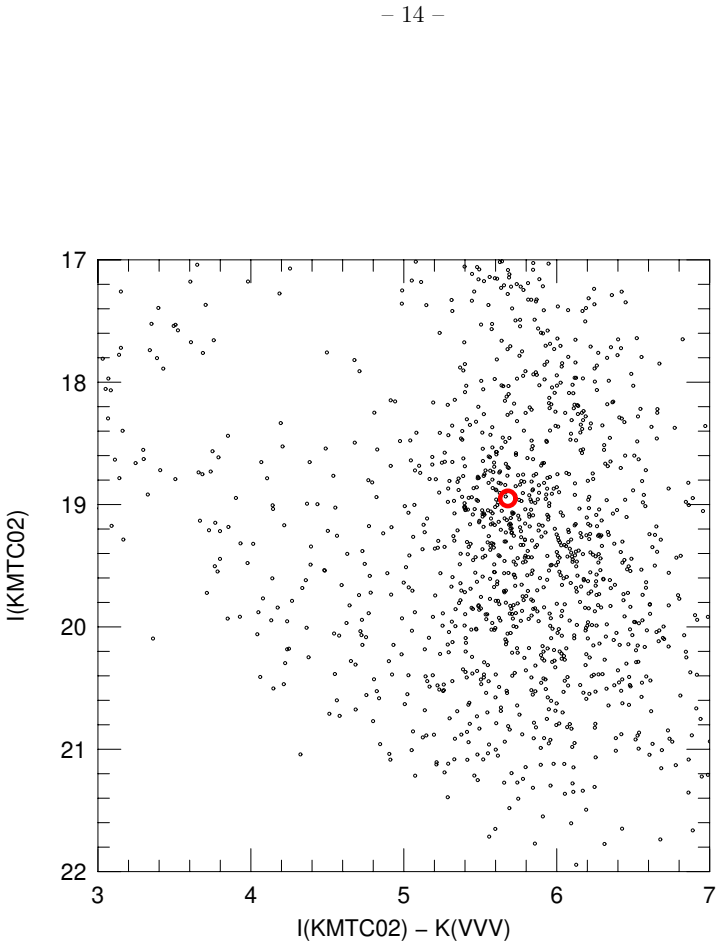
The angular Einstein radius θ_E = θ_*/ρ, obtained by measuring the normalized source radius ρ from finite-source light-curve effects and estimating the source angular radius θ_* from the source’s dereddened magnitude and an inferred color. This single quantity places the lens inside the Einstein Desert and supplies the proper-motion measurement μ_rel = θ_*/t_*.
Load-bearing premise
The source color, and therefore its angular size, is not measured but is assigned from its absolute magnitude alone, because extinction made the V-band light curve unusable.
What would settle it
Late-time high-resolution imaging that resolves a host star at the predicted separation, or a secure space-based microlens-parallax measurement that yields a mass outside the free-floating-planet range.
Editorial analysis
A structured set of objections, weighed in public.
Referee Report
Summary. The paper presents a finite-source point-lens (FSPL) analysis of the short-timescale microlensing event KMT-2025-BLG-2093. From a clean 1L1S fit (Table 1) the authors measure ρ and, after placing the source on an I/K CMD and inferring its dereddened color from absolute magnitude, obtain θ_E = 13.1 ± 2.8 μas. This places the event inside the Einstein Desert (9–25 μas) defined by Gould et al. (2022), making it only the second published isolated microlens in that interval. A 2L1S host search yields a formally significant Δχ^{2} ≈ 51 solution that is correctly judged non-compelling because the signal is dominated by a single observatory/field combination and is consistent with low-level systematics (Figure 3). The discussion situates the event’s high A_max, faint I_s,0 and low μ_rel as selection effects relevant to future FFP surveys (Roman, Earth 2.0).
Significance. If the θ_E measurement holds, the paper supplies a rare, well-documented object that sits between the free-floating-planet and brown-dwarf populations. The light-curve reduction, FSPL modeling, and careful treatment of the host-search systematics are of high technical quality and will be useful as a template for the many high-A_max, small-θ_* events expected from Roman. The explicit discussion of how faint sources and low proper motions bias the recovery of θ_E measurements is a concrete contribution to survey design.
major comments (2)
- Section 4: the entire θ_E result rests on an inferred (V−I)_0 = 0.95 ± 0.15 assigned solely from M_I,s ≈ 2.37. While the authors already adopt a generous color uncertainty and the 1-σ extremes of θ_E remain inside the Desert, the manuscript should quantify how sensitive the Desert classification is to plausible changes in the color–magnitude prior (e.g., a metal-poor sub-giant sequence or a ±0.3 mag shift in distance modulus). A short Monte-Carlo or grid test would make the claim robust rather than merely plausible.
- Section 5 / Figure 3: the dismissal of the Δχ^{2} ≈ 51 host signal is persuasive but still qualitative. The paper should report either (i) the Δχ^{2} obtained when KMTC42 is excluded or (ii) a simple residual-injection test that demonstrates how often comparable Δχ^{2} values arise from pure noise. Without that number the reader cannot judge whether the systematics argument fully closes the host possibility.
minor comments (5)
- Table 1: the Is uncertainty is listed as ±0.020 while the text (Section 4) uses ±0.20; the table value appears to be a typographical error.
- Figure 4 caption and text: the sample is described as “13 published FSPL FFP events (including one that formally lies in the Einstein Desert)”; a short table or footnote listing the 13 events and their θ_E values would make the comparison fully reproducible.
- Equation (3): the propagation statement “taking account of the strong correlation between fs and ρ” is correct but would be clearer if the covariance term or the effective scaling used were written explicitly.
- Section 2: the alert time is given as UT 04:04, 18 August 2025 and HJD' = 905.9; a single consistent time system (HJD or UT) would avoid minor confusion.
- References: Dong et al. (2026) is cited as the first Einstein-Desert mass measurement; ensure the final published citation details are updated before production.
Circularity Check
No significant circularity: θ_E is measured from light-curve ρ plus external color–surface-brightness calibration; Einstein Desert is used only for post-hoc classification.
full rationale
The paper’s central result is a standard FSPL fit (Table 1) yielding ρ and Is, followed by an Is,0 measurement from the red-clump offset on a CMD (Section 4) and an external conversion of an inferred (V−I)0 into θ* via Kervella et al. (2004) and Bessell & Brett (1988). θ_E = θ*/ρ is therefore an ordinary observational product, not forced by any definition internal to the paper. The Einstein Desert interval (9–25 μas) is imported from Gould et al. (2022) solely to classify the measured value; it does not enter the light-curve model or the θ* inference. The 2L1S host search (Section 5) is exploratory, produces only a non-compelling Δχ^{2} that the authors themselves attribute to systematics, and is not used to claim a mass or host. Self-citations supply historical context and the desert boundaries but are not load-bearing for the numerical result. No equation reduces to its own input by construction, no fitted parameter is re-labeled a prediction, and no uniqueness theorem is invoked. The derivation is therefore self-contained against external calibrations and ordinary photometric practice.
Axiom & Free-Parameter Ledger
free parameters (3)
- 1L1S light-curve parameters (t0, u0, tE, ρ, Is) =
tE = 1.36 ± 0.18 d, ρ = 0.136 ± 0.021, Is = 21.44 ± 0.20
- source color prior (V−I)0 =
0.95 ± 0.15
- 2L1S host parameters (s, q, α) =
s ≈ 6.1, q ≈ 275, α ≈ 162°
axioms (4)
- standard math Standard single-lens finite-source magnification formula and the relation θ_E = θ_*/ρ
- domain assumption Red-clump dereddened magnitude and color on this line of sight (I_cl,0 = 14.39, (V−I)_cl,0 = 1.06)
- domain assumption Color–surface-brightness relation of Kervella et al. (2004) after Bessell & Brett (1988) color transformation
- ad hoc to paper Source lies within ±0.2 mag of the mean bulge distance modulus
Cite this review
Pith. "Pith review of KMT-2025-BLG-2093: Free-Floating Planet Candidate Near the Shore of the Einstein Desert." pith.science (2026). https://pith.science/paper/Q2HDTSBV
@misc{pith2026260627725,
  author       = {Pith},
  title        = {Pith review of: KMT-2025-BLG-2093: Free-Floating Planet Candidate Near the Shore of the Einstein Desert},
  year         = {2026},
  howpublished = {\url{https://pith.science/paper/Q2HDTSBV}},
  note         = {Machine review of arXiv:2606.27725}
}
read the original abstract
We analyze KMT-2025-BLG-2093, with angular Einstein radius $\theta_{\rm E}=13.1\pm 2.8\,\mu{\rm as}$, which makes it the second isolated microlens that lies in the ``Einstein Desert'' ($9\,\mu{\rm as}<\theta_{\rm E}<25\,\mu{\rm as}$) between free-floating planets (FFPs) on one side and brown dwarfs and stars on the other. We discuss how its characteristics may give clues to future exploration of FFPs, especially in the era of satellite missions that have a major FFP focus, including Earth 2.0 and Roman.
Figures




Reference graph
Works this paper leans on
-
[1]
& Lupton, R.H.,1998, , 503, 325
Alard, C. & Lupton, R.H.,1998, , 503, 325
1998
-
[2]
Michaeldalbrow/Pydia: InitialRelease On Github., vv1.0.0, Zenodo
Albrow, M.D. Michaeldalbrow/Pydia: InitialRelease On Github., vv1.0.0, Zenodo
-
[3]
Albrow, M.\ D., Horne, K., Bramich, D.\ M., et al.\ 2009, , 397, 2099
2009
-
[4]
et al.\ 2002, , 572, 521
An, J.H., Albrow, M.D., Beaulieu, J.-P. et al.\ 2002, , 572, 521
2002
-
[5]
Batista, V., Gould, A., Dieters, S. et al. , 529, 102
-
[6]
2015, , 808, 170
Batista, V., Beaulieu, J.-P., Bennett, D.P., et al. 2015, , 808, 170
2015
-
[7]
2015, , 808, 169
Bennett, D.P., Bhattacharya, A., Anderson, J., et al. 2015, , 808, 169
2015
-
[8]
P., Bhattacharya, A., Beaulieu, J
Bennett, D. P., Bhattacharya, A., Beaulieu, J. P., et al. 2020, , 159, 68
2020
-
[9]
Yee, J.C., Feltzing, S.\ et al.\ 2013, , 549, A147
Bensby, T. Yee, J.C., Feltzing, S.\ et al.\ 2013, , 549, A147
2013
-
[10]
Bessell, M.S., & Brett, J.M.\ 1988, , 100, 1134
1988
-
[11]
Bond, I.A., Abe, F., Dodd, R.J., et al.\ 2001, , 327, 868
2001
-
[12]
2019, , 157, 121
Calchi Novati, S., Suzuki, D., Udalski, A., et al. 2019, , 157, 121
2019
-
[13]
Cassan, A., Kubas, D., Beaulieu, J.-P., et al., 2012, Nature, 481, 167
2012
-
[14]
2009a, , 695, 970
Dong, S., Gould, A., Udalski, A., et al. 2009a, , 695, 970
-
[15]
2026, Science, 391, 96
Dong, S., Wu, Z., Ryu, Y.-H.., et al. 2026, Science, 391, 96
2026
-
[16]
2009b, , 698, 1826
Dong, S., Bond, I.A., Gould, A., et al. 2009b, , 698, 1826
-
[17]
1999, , 349, 108
Dominik, M. 1999, , 349, 108
1999
-
[18]
2016, , 595, A1
Gaia Collaboration, Prusti, T., de Bruijne, J.H.J., et al. 2016, , 595, A1
2016
-
[19]
Gaia Collaboration, Brown, A. G. A., Vallenari, A., et al.\ 2018, , 616, 1
2018
-
[20]
Gaudi, B.S.\ 1998, , 506, 533
1998
-
[21]
& Gould, A.\ 1997, , 486, 85
Gaudi, B.S. & Gould, A.\ 1997, , 486, 85
1997
-
[22]
Gaudi, B.S., Albrow, M.D., An, J.\ 2002, , 566, 463
2002
-
[23]
Ge, J., Chen, W., Chen, Y., et al.\ 2024, ChJSS, 44, 400
2024
-
[24]
A., Rejkuba, M., Zoccali, M., et al.\ 2012, , 543, A13
Gonzalez, O. A., Rejkuba, M., Zoccali, M., et al.\ 2012, , 543, A13
2012
-
[25]
& Loeb, A
Gould, A. & Loeb, A. 1992, , 396, 104
1992
-
[26]
1992, , 392, 442
Gould, A. 1992, , 392, 442
1992
-
[27]
1994, , 421, L71
Gould, A. 1994, , 421, L71
1994
-
[28]
1996, , 470, 201
Gould, A. 1996, , 470, 201
1996
-
[29]
2000, , 542, 785
Gould, A. 2000, , 542, 785
2000
-
[30]
2004, , 606, 319
Gould, A. 2004, , 606, 319
2004
- [31]
-
[32]
& Bahcall, J.N
Gould, A., Miralda-Escud\'e, J. & Bahcall, J.N. 1994, , 423, L105
1994
-
[33]
Gould, A., Gaudi, B.S.\ & Han, C.\ 2003, , 591, L53
2003
-
[34]
& Yee, J.C.\ 2013, , 764, 107
Gould, A. & Yee, J.C.\ 2013, , 764, 107
2013
-
[35]
Gould, A., Dong, S., Gaudi, B.S.\ et al.\ 2010, , 720, 1073
2010
-
[36]
Gould, A., Ryu, Y.-H., Calchi Novati, S., et al.\ 2020, JKAS, 53, 9
2020
-
[37]
Gould, A., Zang, W., Mao, S., & Dong, S., 2021, RAA, 21, 133
2021
-
[38]
Gould, A., Han, C., Zang, W.., 2022, , 664A, 13
2022
-
[39]
Gould, A., Jung, Y.K., Hwang, K.-H. et. al., 2022, JKAS, 55, 173
2022
-
[40]
Griest, K.\ & Safizadeh, N.\ 1998, , 500, 37
1998
-
[41]
2006, , 638, 1080
Han, C. 2006, , 638, 1080
2006
-
[42]
& Gaudi, B.S.\ 2008, , 689, 53
Han, C. & Gaudi, B.S.\ 2008, , 689, 53
2008
-
[43]
2016, , 828, 53
Han, C., Udalski, A., Gould, A., et al. 2016, , 828, 53
2016
-
[44]
Han, C., Yee, J.C., Udalski, A., et al.\ 2019, , 158, 102
2019
-
[45]
2019, , 158, 114
Han, C., Bennett, D.P., Udalski, A., et al. 2019, , 158, 114
2019
-
[46]
2020a, , 159, 48
Han, C., Lee, C.-U., Udalski, A., et al. 2020a, , 159, 48
-
[47]
K., et al.\ 2020b, , 641A, 105
Han, C., Shin, I.-G., Jung, Y. K., et al.\ 2020b, , 641A, 105
-
[48]
Han, C., Udalski, A., Lee, C.-U., et al.\ 2021a, , 649, A90
-
[49]
Han, C., Udalski, A., Kim, D., et al.\ 2021b, , 655A, 21
-
[50]
2021a, , 650A, 89
Han, C., Udalski, A., Kim, D., et al. 2021a, , 650A, 89
-
[51]
2021b, , 652A, 145
Han, C., Albrow, M.D., Chung, S.-J., et al. 2021b, , 652A, 145
-
[52]
2021c, , 658A, 62
Han, C., Gould, A., Albrow, M.D., et al. 2021c, , 658A, 62
-
[53]
2014, , 794, 52
Henderson, C.B., Gaudi, B.S., Han, C., et al. 2014, , 794, 52
2014
-
[54]
2020, , 159, 134
Herrera-Martin, A., Albrow, A., Udalski, A., et al. 2020, , 159, 134
2020
-
[55]
T., Irwin, M
Hodgkin, S. T., Irwin, M. J., Hewett, P. C., & Warren, S. J.\ 2009, , 394, 675
2009
-
[56]
1995, , 294, 287
Hog, E., Novikov, I.D., & Polanarev, A.G. 1995, , 294, 287
1995
-
[57]
Holtzman, J.A., Watson, A.M., Baum, W.A., et al.\ 1998, , 115, 1946
1998
-
[58]
2013, , 778, 55
Hwang, K.-H., Choi, J.-Y., Bond, I.A., et al. 2013, , 778, 55
2013
-
[59]
Hwang, K.-H., Udalski, A., Shvartzvald, Y. et al. 2018a, , 155, 20
-
[60]
2018b, , 155, 259
Hwang, K.-H., Udalski, A., Bond, I.A., et al. 2018b, , 155, 259
-
[61]
Hwang, K.-H., Zang, W., Gould, A., et al.., 2022, , 163, 43
2022
-
[62]
2026, , 171, 243
Inyanya, T., Jung, Y.K., Yang, H.., et al. 2026, , 171, 243
2026
-
[63]
J., Lewis, J., Hodgkin, S., et al.\ 2004, , 5493, 411
Irwin, M. J., Lewis, J., Hodgkin, S., et al.\ 2004, , 5493, 411
2004
-
[64]
Johnson, S.A., Penny, M.T., & Gaudi, B.S.\ 2022, , 927, 63
2022
-
[65]
2019, , 158, 28
Jung, Y.K., Gould, A., Udalski, A., et al. 2019, , 158, 28
2019
-
[66]
2020a, , 160, 148
Jung, Y.K., Gould, A., Udalski, A., et al. 2020a, , 160, 148
-
[67]
2021, , 161, 293
Jung, Y.K., Han, C., Udalski, A., et al. 2021, , 161, 293
2021
-
[68]
2024, , 168, 152
Jung, Y.K., Hwang, K.-H., Yang, H., et al. 2024, , 168, 152
2024
-
[69]
Kervella, P., Bersier, D., Mourard, D., et al.\ 2004, , 428, 587
2004
-
[70]
Kervella, P., Th \'e venin, F., Di Folco, E., & S \'e gransan, D.\ 2004b, , 426, 297
-
[71]
2016, JKAS, 49, 37
Kim, S.-L., Lee, C.-U., Park, B.-G., et al. 2016, JKAS, 49, 37
2016
-
[72]
Kim, D.-J., Kim, H.-W., Hwang, K.-H., et al., 2018a, , 155, 76
-
[73]
Kim, H.-W., Hwang, K.-H., Kim, D.-J., et al. 2018b, arXiv:1804.03352
-
[74]
Kim, H.-W., Hwang, K.-H., Shvartzvald, Y., et al. 2018c, arXiv:1806.07545
-
[75]
2021, , 162, 15
Kim, H.-W., Hwang, K.-H., Gould, A., et al. 2021, , 162, 15
2021
-
[76]
2021a, , 503, 2706
Kim, Y.-H., Chung, S.-J., Udalski, A., et al. 2021a, , 503, 2706
-
[77]
2021b, , 162, 17
Kim, Y.H.., Chung, S.-J., Yee, J.-C., et al. 2021b, , 162, 17
-
[78]
Kondo, I., Yee, J.C., Bennett, D.P., et al.\ 2021, , 162, 77
2021
-
[79]
Koshimoto, N., Sumi, T., Bennett, D.P., et al.\ 2023, , 166, 107
2023
-
[80]
& Szymański, M.K.\ 1997, Acta Astron., 47, 319
Kubiak, M. & Szymański, M.K.\ 1997, Acta Astron., 47, 319
1997
This paper was first reviewed by grok-4.5 on July 12, 2026.
discussion (0)
Sign in with ORCID, Apple, or X to comment. Anyone can read and Pith papers without signing in.