Bottleneck Effects and Harmonic-Type Velocity Bounds for Periodic Quantum Walks
Pith reviewed 2026-06-29 02:50 UTC · model grok-4.3
The pith
Periodic quantum walks on the line have propagation velocities bounded above by the harmonic mean of their transmission parameters.
A machine-rendered reading of the paper's core claim, the machinery that carries it, and where it could break.
Core claim
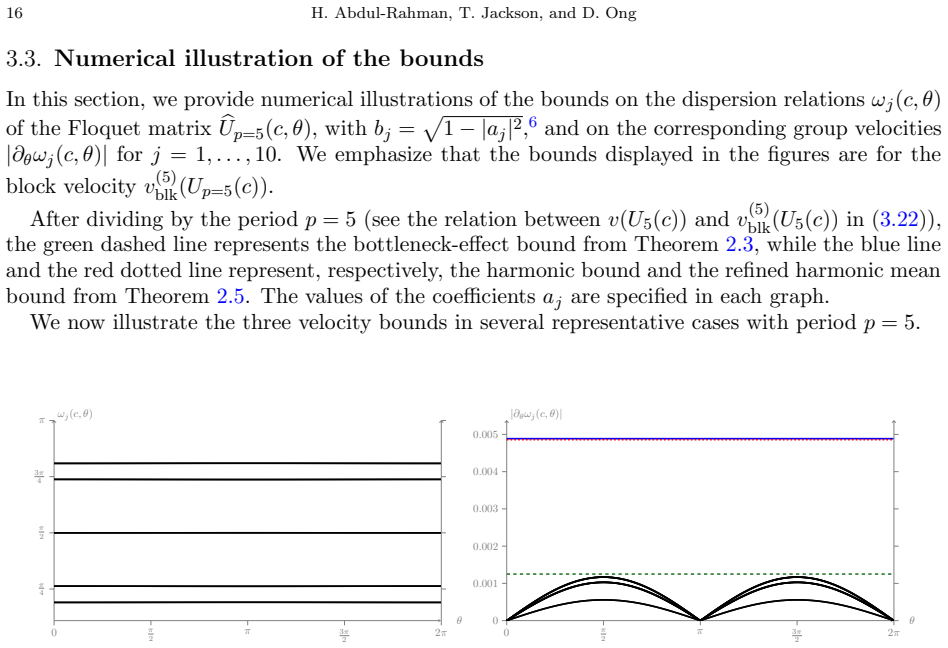
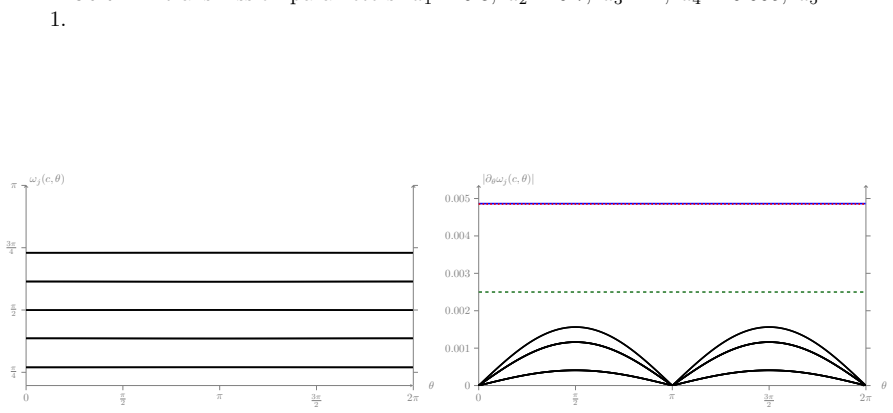
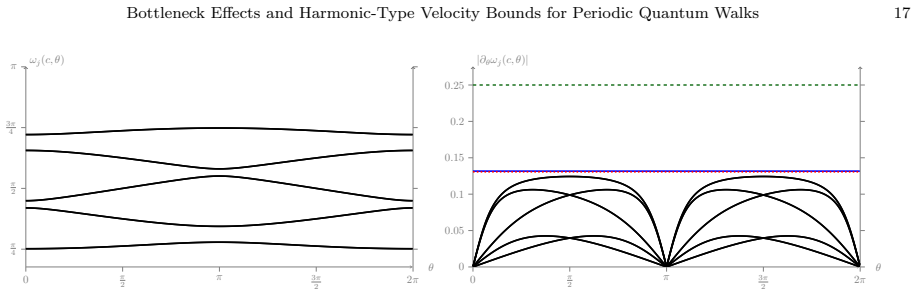
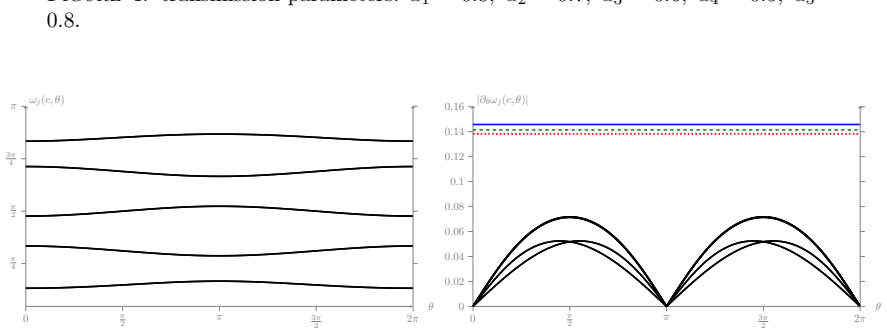
We prove explicit upper bounds on the propagation velocity of one-dimensional quantum walks with periodic coins of arbitrary period. In a perturbative regime where one transmission parameter is small, the corresponding almost reflecting coin acts as a bottleneck for transport: the velocity is bounded linearly in this parameter, with an explicit leading order estimate. For arbitrary nonzero transmission parameters, we prove a general a priori bound in terms of their harmonic mean, together with a refined version that detects the spatial variation of neighboring coins. Moreover, we prove a general lower bound on the velocity. These bounds apply directly to the corresponding CMV setting.
What carries the argument
The transmission parameters of the periodic unitary coins that set the reflection-versus-transmission balance at each site, from which velocity is read off the spectrum of the resulting unitary operator on the line.
If this is right
- In the small-transmission regime the velocity scales at most linearly with that parameter, with the leading coefficient given explicitly.
- For any collection of nonzero transmission parameters the velocity is at most a constant times their harmonic mean.
- A refined upper bound exists that tightens when neighboring coins vary spatially.
- A matching lower bound on velocity holds in the same setting.
- The same statements transfer directly to the CMV matrix setting.
Where Pith is reading between the lines
- The dominance of the harmonic mean implies that the single most reflecting coin largely sets the global speed, even when other coins transmit freely.
- These bounds could be checked by direct simulation of the walk operator for small periods and compared against the analytic expressions.
- The bottleneck picture suggests that inserting a single low-transmission coin into an otherwise transmitting chain would throttle long-range transport proportionally to that coin's parameter.
Load-bearing premise
The quantum walk is built from a repeating sequence of unitary coins whose transmission parameters alone determine reflection versus transmission, and velocity is read from the spectral properties of the infinite-line unitary they generate.
What would settle it
A numerical computation of the group velocity or spreading rate for a periodic coin sequence whose transmission parameters are known exactly, showing a speed strictly larger than the harmonic-mean upper bound or larger than the linear estimate in the small-parameter regime.
Figures


read the original abstract
We prove explicit upper bounds on the propagation velocity of one-dimensional quantum walks with periodic coins of arbitrary period. We treat two complementary settings. First, in a perturbative regime where one transmission parameter is small, we show that the corresponding almost reflecting coin acts as a bottleneck for transport: the velocity is bounded linearly in this parameter, with an explicit leading order estimate. Second, for arbitrary nonzero transmission parameters, we prove a general a priori bound in terms of their harmonic mean, together with a refined version that detects the spatial variation of neighboring coins. Moreover, we prove a general lower bound on the velocity. These bounds apply directly to the corresponding CMV setting.
Editorial analysis
A structured set of objections, weighed in public.
Referee Report
Summary. The manuscript proves explicit upper bounds on the propagation velocity of one-dimensional quantum walks with periodic coins of arbitrary period. In a perturbative regime where one transmission parameter is small, the corresponding almost-reflecting coin acts as a bottleneck, yielding a linear bound in that parameter together with an explicit leading-order estimate. For arbitrary nonzero transmission parameters, a general a priori upper bound is derived in terms of the harmonic mean of the transmission parameters, with a refined version that detects spatial variation among neighboring coins; a matching general lower bound is also established. The results apply directly to the corresponding CMV setting.
Significance. If the derivations are correct, the work supplies concrete, explicit a priori velocity estimates that highlight bottleneck phenomena in periodic quantum walks. The harmonic-mean bound and the perturbative linear estimate are notable for being direct and free of fitted parameters. The extension to CMV matrices broadens applicability within spectral theory of unitary operators. These features strengthen the contribution to mathematical physics.
minor comments (1)
- [Abstract] Abstract: the precise meaning of 'propagation velocity' (e.g., whether it is the supremum of the group velocities extracted from the spectrum of the unitary operator) is not stated explicitly; adding one sentence would improve accessibility.
Simulated Author's Rebuttal
We thank the referee for the careful reading and positive assessment of the manuscript, including the recommendation for minor revision. No major comments were raised in the report.
Circularity Check
No significant circularity detected
full rationale
The paper derives explicit a priori upper and lower bounds on propagation velocity directly from the spectral properties of the unitary operator generated by periodic coins, using the transmission parameters in perturbative and general regimes. The bottleneck bound (linear in small transmission parameter) and harmonic-mean bound are obtained via analysis of the CMV or quantum-walk operator without any reduction to fitted inputs, self-definitions, or load-bearing self-citations. The central claims rest on standard unitary and periodicity assumptions that are independent of the target velocity bounds, making the derivation self-contained.
Axiom & Free-Parameter Ledger
axioms (1)
- standard math Quantum walks are generated by unitary coin operators acting on a one-dimensional lattice
Reference graph
Works this paper leans on
-
[1]
H. Abdul-Rahman, C. Cedzich, G. Stolz, and A. H. Werner. Exponential suppression of transport in periodic electric quantum walks.arXiv:2511.15664
-
[2]
H. Abdul-Rahman, M. Darras, C. Fischbacher, and G. Stolz. Slow propagation velocities in Schr¨ odinger operators with large periodic potential.Annales Henri Poincar´ e, 26:3635–3663, 2025.arXiv:2401.11508
arXiv 2025
-
[3]
H. Abdul-Rahman, J. Fillman, C. Fischbacher, and W. Liu. Sharp polynomial velocity decay bounds for multi- dimensional periodic Schr¨ odinger operators.arXiv:2509.04381
-
[4]
H. Abdul-Rahman, T. A. Jackson, and Y. Salah. Absence of ballistic transport in quantum walks with asymp- totically reflecting sites.arXiv:2604.20654
-
[5]
H. Abdul-Rahman and G. Stolz. Exponentially decaying velocity bounds of quantum walks in periodic fields. Communications in Mathematical Physics, 403(3):1297–1327, 2023.arXiv:2302.01869
arXiv 2023
-
[6]
A. Ahlbrecht, V. B. Scholz, and R. F. Werner. Disordered quantum walks in one lattice dimension.Journal of Mathematical Physics, 52(10):102201, 2011.arXiv:1101.2298
Pith/arXiv arXiv 2011
-
[7]
A. Ahlbrecht, H. Vogts, A. H. Werner, and R. F. Werner. Asymptotic evolution of quantum walks with random coin.Journal of Mathematical Physics, 52(4):042201, 2011.arXiv:1009.2019
Pith/arXiv arXiv 2011
-
[8]
J. K. Asb´ oth. Symmetries, topological phases, and bound states in the one-dimensional quantum walk.Physical Review B, 86(19):195414, 2012.arXiv:1208.2143
Pith/arXiv arXiv 2012
-
[9]
J. K. Asb´ oth and H. Obuse. Bulk-boundary correspondence for chiral symmetric quantum walks.Physical Review B, 88(12):121406, 2013.arXiv:1303.1199
Pith/arXiv arXiv 2013
-
[10]
J. Asch and A. Joye. Lower bounds on the localisation length of balanced random quantum walks.Letters in Mathematical Physics, 109:2133–2155, 2019.arXiv:1812.05842
Pith/arXiv arXiv 2019
-
[11]
Aspuru-Guzik and P
A. Aspuru-Guzik and P. Walther. Photonic quantum simulators.Nature Physics, 8:285–291, 2012
2012
-
[12]
J. Bourgain, F. A. Gr¨ unbaum, L. Vel´ azquez, and J. Wilkening. Quantum recurrence of a subspace and operator- valued Schur functions.Communications in Mathematical Physics, 329(3):1031–1067, 2014.arXiv:1302.7286
Pith/arXiv arXiv 2014
-
[13]
O. Bourget, J. S. Howland, and A. Joye. Spectral analysis of unitary band matrices.Communications in Math- ematical Physics, 234(2):191–227, 2003.arXiv:math-ph/0204016
Pith/arXiv arXiv 2003
-
[14]
M. J. Cantero, F. A. Gr¨ unbaum, L. Moral, and L. Vel´ azquez. The CGMV method for quantum walks.Quantum Information Processing, 11(5):1149–1192, 2012
2012
-
[15]
M. J. Cantero, L. Moral, F. A. Gr¨ unbaum, and L. Vel´ azquez. Matrix-valued Szeg˝ o polynomials and quantum random walks.Communications on Pure and Applied Mathematics, 63(4):464–507, 2010.arXiv:0901.2244
Pith/arXiv arXiv 2010
-
[16]
M. J. Cantero, L. Moral, and L. Vel´ azquez. Five-diagonal matrices and zeros of orthogonal polynomials on the unit circle.Linear Algebra and its Applications, 362:29–56, 2003.arXiv:math/0204300. 46 H. Abdul-Rahman, T. Jackson, and D. Ong
Pith/arXiv arXiv 2003
-
[17]
C. Cedzich, J. Fillman, L. Li, D. C. Ong, and Q. Zhou. Exact mobility edges for almost-periodic CMV matrices via gauge symmetries.International Mathematics Research Notices, 2024:6906–6941, 2024.arXiv:2307.10909
arXiv 2024
-
[18]
C. Cedzich, J. Fillman, and D. C. Ong. Almost everything about the unitary almost-Mathieu operator.Com- munications in Mathematical Physics, 403:745–794, 2023.arXiv:2112.03216
arXiv 2023
-
[19]
C. Cedzich, J. Fillman, and L. Vel´ azquez. Absence of ballistic motion and presence of almost-ballistic motion for unitary operators with pure point spectrum.arXiv:2603.03114
-
[20]
C. Cedzich, T. Geib, F. A. Gr¨ unbaum, C. Stahl, L. Vel´ azquez, A. H. Werner, and R. F. Werner. The topolog- ical classification of one-dimensional symmetric quantum walks.Annales Henri Poincar´ e, 19(2):325–383, 2018. arXiv:1611.04439
Pith/arXiv arXiv 2018
-
[21]
C. Cedzich, A. Joye, A. H. Werner, and R. F. Werner. Exponential tail estimates for quantum lattice dynamics. Annales Henri Poincar´ e, 2025.arXiv:2408.02108
arXiv 2025
-
[22]
C. Cedzich, T. Ryb´ ar, A. H. Werner, A. Alberti, M. Genske, and R. F. Werner. Propagation of quantum walks in electric fields.Physical Review Letters, 111:160601, 2013.arXiv:1302.2081
Pith/arXiv arXiv 2013
-
[23]
C. Cedzich and A. H. Werner. Anderson localization for electric quantum walks and skew-shift CMV matrices. Communications in Mathematical Physics, 387:1257–1279, 2021.arXiv:1906.11931
arXiv 2021
-
[24]
A. M. Childs. Universal computation by quantum walk.Physical Review Letters, 102(18):180501, 2009. arXiv:0806.1972
Pith/arXiv arXiv 2009
-
[25]
D. Damanik and J. Fillman. Spectral properties of limit-periodic operators.Analysis and geometry on graphs and manifolds, 461:382–444, 2020.arXiv:1802.05794
Pith/arXiv arXiv 2020
-
[26]
D. Damanik, J. Fillman, and D. C. Ong. Spreading estimates for quantum walks on the integer lattice via power-law bounds on transfer matrices.Journal de Math´ ematiques Pures et Appliqu´ ees, 105(3):293–341, 2016. arXiv:1505.07292
Pith/arXiv arXiv 2016
-
[27]
D. Damanik, M. Lukic, and W. Yessen. Quantum dynamics of periodic and limit-periodic Jacobi and block Jacobi matrices with applications to some quantum many body problems.Communications in Mathematical Physics, 337(3):1535–1561, 2015.arXiv:1407.5067
Pith/arXiv arXiv 2015
-
[28]
D. Damanik, T. Malinovitch, and G. Young. What is ballistic transport?Journal of Spectral Theory, 2024. arXiv:2403.19618
arXiv 2024
-
[29]
J. Fillman. Spectral homogeneity of discrete one-dimensional limit-periodic operators.Journal of Spectral Theory, 7(1):201–226, 2017.arXiv:1409.7734
Pith/arXiv arXiv 2017
-
[30]
J. Fillman and D. C. Ong. Purely singular continuous spectrum for limit-periodic CMV operators with applica- tions to quantum walks.Journal of Functional Analysis, 272(12):5107–5143, 2017.arXiv:1610.06159
Pith/arXiv arXiv 2017
-
[31]
F. Gr¨ unbaum, L. Vel´ azquez, A. Werner, and R. Werner. Recurrence for discrete time unitary evolutions.Com- munications in Mathematical Physics, 320:543–569, 2013.arXiv:1202.3903
Pith/arXiv arXiv 2013
-
[32]
E. Hamza and A. Joye. Spectral transition for random quantum walks on trees.Communications in Mathematical Physics, 326(2):415–439, 2014.arXiv:1212.6078
Pith/arXiv arXiv 2014
-
[33]
E. Hamza, A. Joye, and G. Stolz. Localization for random unitary operators.Letters in Mathematical Physics, 75(3):255–272, 2006.arXiv:math-ph/0504075
Pith/arXiv arXiv 2006
-
[34]
E. Hamza, A. Joye, and G. Stolz. Dynamical localization for unitary Anderson models.Mathematical Physics, Analysis and Geometry, 12:381–444, 2009.arXiv:0903.0028
Pith/arXiv arXiv 2009
-
[35]
E. Hamza and G. Stolz. Lyapunov exponents for unitary Anderson models.Journal of Mathematical Physics, 48(4):043301, 2007.arXiv:math-ph/0611081
Pith/arXiv arXiv 2007
-
[36]
S. M. Huang, Y. Tokura, H. Akimoto, K. Kono, J. J. Lin, S. Tarucha, and K. Ono. Spin bottleneck in resonant tunneling through double quantum dots with different zeeman splittings.Physical Review Letters, 104:136801, 2010.arXiv:0904.1046
Pith/arXiv arXiv 2010
-
[37]
A. Joye and M. Merkli. Dynamical localization of quantum walks in random environments.Journal of Statistical Physics, 140(6):1025–1053, 2010.arXiv:1004.4130
Pith/arXiv arXiv 2010
-
[38]
A. Joye, A. Schaefer, and S. Warzel. Dynamical localization for general scattering quantum walks. arXiv:2602.12760
-
[39]
Kato.Perturbation Theory for Linear Operators
T. Kato.Perturbation Theory for Linear Operators. Classics in Mathematics. Springer, Berlin, Heidelberg, 1995
1995
-
[40]
J. Kempe. Quantum random walks: an introductory overview.Contemporary Physics, 44(4):307–327, 2003. arXiv:quant-ph/0303081
Pith/arXiv arXiv 2003
-
[41]
T. Kitagawa, M. S. Rudner, E. Berg, and E. Demler. Exploring topological phases with quantum walks.Physical Review A, 82(3):033429, 2010.arXiv:1003.1729
Pith/arXiv arXiv 2010
-
[42]
N. Konno. One-dimensional discrete-time quantum walks on random environments.Quantum Information Pro- cessing, 8(5):387–399, 2009.arXiv:0904.0392
Pith/arXiv arXiv 2009
-
[43]
N. Konno. Localization of an inhomogeneous discrete-time quantum walk on the line.Quantum Information Processing, 9:405–418, 2010.arXiv:0908.2213
Pith/arXiv arXiv 2010
-
[44]
K. Kumar and M. Sabri. Ergodicity in discrete-time quantum walks.arXiv:2603.16837. Bottleneck Effects and Harmonic-Type Velocity Bounds for Periodic Quantum Walks 47
-
[45]
N. P. Kumar, R. Balu, R. Laflamme, and C. M. Chandrashekar. Bounds on the dynamics of periodic quan- tum walks and emergence of the gapless and gapped Dirac equation.Physical Review A, 97(1):012116, 2018. arXiv:1711.05920
Pith/arXiv arXiv 2018
- [46]
-
[47]
A. Montanaro. Quantum algorithms: An overview.npj Quantum Information, 2:15023, 2016.arXiv:1511.04206
Pith/arXiv arXiv 2016
-
[48]
D. T. Nguyen, D. A. Nolan, and N. F. Borrelli. Localized quantum walks in quasi-periodic Fibonacci arrays of waveguides.Optics Express, 27(1):886–898, 2019
2019
-
[49]
D. C. Ong. Limit-periodic Verblunsky coefficients for orthogonal polynomials on the unit circle.Journal of Mathematical Analysis and Applications, 394(2):633–644, 2012.arXiv:1112.0988
Pith/arXiv arXiv 2012
-
[50]
Portugal.Quantum Walks and Search Algorithms
R. Portugal.Quantum Walks and Search Algorithms. Springer, New York, 2013
2013
-
[51]
Simon.Orthogonal polynomials on the unit circle
B. Simon.Orthogonal polynomials on the unit circle. Part 2: Spectral theory, volume 54 ofAmerican Mathematical Society Colloquium Publications. American Mathematical Society, Providence, RI, 2005
2005
-
[52]
B. Simon. CMV matrices: Five years after.Journal of Computational and Applied Mathematics, 208(1):120–154, 2007.arXiv:math/0603093
Pith/arXiv arXiv 2007
-
[53]
A. Suzuki. Asymptotic velocity of a position-dependent quantum walk.Quantum Information Processing, 15(1):103–119, 2016.arXiv:1507.08562
Pith/arXiv arXiv 2016
-
[54]
S. E. Venegas-Andraca. Quantum walks: A comprehensive review.Quantum Information Processing, 11:1015– 1106, 2012.arXiv:1201.4780
Pith/arXiv arXiv 2012
-
[55]
F. Wang and D. Damanik. Anderson localization for quasi-periodic CMV matrices and quantum walks.Journal of Functional Analysis, 276(6):1978–2006, 2019.arXiv:1804.00301
Pith/arXiv arXiv 1978
-
[56]
Q. Weng, L. Yang, Z. An, P. Chen, A. Tzalenchuk, W. Lu, and S. Komiyama. Quasiadiabatic electron transport in room temperature nanoelectronic devices induced by hot-phonon bottleneck.Nature Communications, 12:4752, 2021
2021
-
[57]
A. W´ ojcik, T. Luczak, P. Kurzy´ nski, A. Grudka, and M. Bednarska. Quasiperiodic dynamics of a quantum walk on the line.Physical Review Letters, 93:180601, 2004.arXiv:quant-ph/0407128. [H. Abdul-Rahman] Department of Mathematical Sciences, United Arab Emirates University, AL Ain, UAE Email address:houssam.a@uaeu.ac.ae [T. Jackson] Department of Mathemat...
Pith/arXiv arXiv 2004
discussion (0)
Sign in with ORCID, Apple, or X to comment. Anyone can read and Pith papers without signing in.