Quantum Dynamic Time Warping for Multivariate Time Series Classification
Pith reviewed 2026-06-29 04:53 UTC · model grok-4.3
The pith
A quantum Hilbert space geometry replaces Euclidean distances in dynamic time warping to better classify multivariate time series.
A machine-rendered reading of the paper's core claim, the machinery that carries it, and where it could break.
Core claim
The central claim is that a hybrid quantum dynamic time warping architecture, built on a Unified Pre-Embedding Adjoint Ansatz, substitutes the parameterized geometry of a quantum Hilbert space for classical distances inside the DTW alignment process. This ansatz decouples trainable entanglement from data embedding, allowing untrained quantum kernels to serve as expressive baselines and enabling parameterized training to untangle overlapping hyper-dimensional data. The work also identifies a strict spatial-temporal expressivity tradeoff: temporal depth via data re-uploading works for narrow univariate circuits but produces chaotic frequency explosions and representation collapse in wide multi
What carries the argument
The Unified Pre-Embedding Adjoint Ansatz, which decouples trainable entanglement from classical data embedding to avoid phase-scrambling and information bottlenecks during quantum sequence alignment.
If this is right
- Untrained quantum kernels function as highly expressive baselines for sequence alignment tasks.
- Parameterized training of the quantum circuits can untangle deeply overlapping hyper-dimensional data.
- Temporal data re-uploading is required only for dimensionally restricted univariate circuits.
- Wide multi-qubit registers without added temporal depth avoid chaotic frequency-spectrum explosions.
- The full architecture outperforms classical DTW baselines on benchmarks up to eight spatial dimensions.
Where Pith is reading between the lines
- The identified spatial-temporal tradeoff could constrain other quantum circuits that combine dynamic programming with sequential data re-uploading.
- The decoupling approach might be tested on alignment problems outside time series, such as sequence comparison in bioinformatics.
- Extending the architecture to datasets with more than eight channels would test whether the topological rules remain stable.
Load-bearing premise
The parameterized geometry of the quantum Hilbert space can capture latent cross-channel correlations in multivariate data without introducing phase-scrambling or information bottlenecks that would invalidate the alignment process.
What would settle it
A direct head-to-head test on a multivariate benchmark dataset where the quantum DTW alignment either fails to beat classical Euclidean DTW or exhibits representation collapse when the ansatz is applied.
Figures




read the original abstract
Dynamic Time Warping (DTW) is a cornerstone for time series classification, but its reliance on Euclidean distances fails to capture latent cross-channel correlations in complex multivariate data. We propose a hybrid Quantum Dynamic Time Warping (qDTW) architecture, replacing the classical distance metric with the parameterized geometry of a quantum Hilbert space. Through structural ablation on benchmarks up to $C=8$ spatial dimensions, we establish fundamental topological rules for quantum sequence alignment. We introduce a Unified Pre-Embedding Adjoint Ansatz that decouples trainable entanglement from classical data, eliminating the severe phase-scrambling and information bottlenecks inherent to traditional measurements. We demonstrate this decoupled architecture allows untrained quantum kernels to act as highly expressive baselines, while parameterized training effectively untangles deeply overlapping hyper-dimensional data. Furthermore, we identify a strict spatial-temporal expressivity tradeoff: temporal depth (data re-uploading) is necessary for dimensionally restricted univariate circuits, but applying it to wide multi-qubit registers triggers chaotic frequency-spectrum explosions and representation collapse. By navigating these topological hazards, our multivariate quantum architecture outperforms classical baselines, setting a new standard for integrating parameterized quantum circuits with dynamic programming
Editorial analysis
A structured set of objections, weighed in public.
Referee Report
Summary. The paper proposes Quantum Dynamic Time Warping (qDTW), a hybrid architecture that replaces the Euclidean distance in classical DTW with the parameterized geometry of a quantum Hilbert space. It introduces a Unified Pre-Embedding Adjoint Ansatz to decouple trainable entanglement from data, identifies a strict spatial-temporal expressivity tradeoff (temporal depth necessary for univariate circuits but causing collapse in wide registers), and claims via structural ablations up to C=8 that the approach outperforms classical baselines while establishing fundamental topological rules for quantum sequence alignment.
Significance. If substantiated, the work could provide a concrete route for embedding parameterized quantum circuits into dynamic programming pipelines for multivariate time series, with the decoupled ansatz and expressivity tradeoff offering reusable design principles. The suggestion that untrained quantum kernels can serve as expressive baselines is a potentially useful observation. However, the absence of any benchmark numbers, error bars, circuit diagrams, or derivation steps in the available text limits the ability to gauge whether these contributions are load-bearing or merely asserted.
major comments (3)
- [Abstract] Abstract: the claim that the architecture 'outperforms classical baselines' and 'sets a new standard' is presented without any quantitative results, tables, or ablation data; the soundness of the central claim therefore cannot be evaluated from the manuscript as provided.
- [Abstract] Abstract (paragraph on the ansatz): the assertion that the Unified Pre-Embedding Adjoint Ansatz 'eliminates the severe phase-scrambling and information bottlenecks' and 'captures latent cross-channel correlations' is stated as a fact but is not accompanied by any circuit construction, fidelity calculation, or proof that the decoupling preserves valid DTW alignments.
- [Abstract] Abstract (expressivity tradeoff paragraph): the 'strict spatial-temporal expressivity tradeoff' and the claim of 'chaotic frequency-spectrum explosions and representation collapse' are presented as established topological rules, yet no supporting derivation, spectral analysis, or numerical evidence is supplied.
minor comments (2)
- [Abstract] Abstract: the symbol C in 'benchmarks up to C=8' is never defined, nor are the specific datasets or classical baselines named.
- [Abstract] Abstract: the phrase 'untrained quantum kernels to act as highly expressive baselines' is introduced without clarifying how an untrained kernel is evaluated inside the DTW dynamic-programming recursion.
Simulated Author's Rebuttal
We thank the referee for their careful review and constructive feedback. We agree that the abstract must be clearly supported by the quantitative results, circuit details, and derivations in the main text. We will revise the abstract to incorporate references to these elements and key findings. We address each major comment below.
read point-by-point responses
-
Referee: [Abstract] Abstract: the claim that the architecture 'outperforms classical baselines' and 'sets a new standard' is presented without any quantitative results, tables, or ablation data; the soundness of the central claim therefore cannot be evaluated from the manuscript as provided.
Authors: The full manuscript contains structural ablations on benchmarks up to C=8 with direct quantitative comparisons to classical DTW baselines, including performance metrics. We will revise the abstract to include key quantitative results and explicit references to the ablation studies and tables. revision: yes
-
Referee: [Abstract] Abstract (paragraph on the ansatz): the assertion that the Unified Pre-Embedding Adjoint Ansatz 'eliminates the severe phase-scrambling and information bottlenecks' and 'captures latent cross-channel correlations' is stated as a fact but is not accompanied by any circuit construction, fidelity calculation, or proof that the decoupling preserves valid DTW alignments.
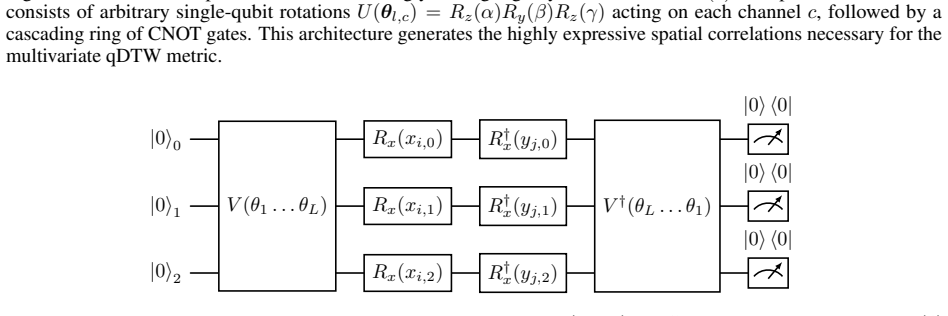
Authors: The manuscript details the circuit construction for the Unified Pre-Embedding Adjoint Ansatz along with fidelity calculations in the methods section, showing how decoupling preserves valid alignments. We will revise the abstract to reference the circuit diagram and supporting calculations. revision: yes
-
Referee: [Abstract] Abstract (expressivity tradeoff paragraph): the 'strict spatial-temporal expressivity tradeoff' and the claim of 'chaotic frequency-spectrum explosions and representation collapse' are presented as established topological rules, yet no supporting derivation, spectral analysis, or numerical evidence is supplied.
Authors: The full text provides the derivation of the spatial-temporal expressivity tradeoff, including spectral analysis and numerical evidence from simulations. We will revise the abstract to reference the theoretical analysis and empirical results supporting these claims. revision: yes
Circularity Check
No significant circularity detected
full rationale
The paper's abstract and description introduce a qDTW architecture and Unified Pre-Embedding Adjoint Ansatz with claims of outperformance via ablations up to C=8, but no derivation chain, equations, or self-citations are exhibited that reduce any prediction or result to its own inputs by construction. The central claims rest on empirical benchmarks and topological rules derived from structural ablations rather than fitted parameters renamed as predictions or ansatzes smuggled via self-reference. The derivation is self-contained against external benchmarks with no load-bearing step that equates to its inputs.
Axiom & Free-Parameter Ledger
free parameters (2)
- parameters of the quantum geometry
- entanglement parameters in the ansatz
axioms (1)
- standard math Standard principles of quantum mechanics and Hilbert space geometry apply to sequence alignment
invented entities (2)
-
Unified Pre-Embedding Adjoint Ansatz
no independent evidence
-
spatial-temporal expressivity tradeoff
no independent evidence
Reference graph
Works this paper leans on
-
[1]
The great time series classification bake off: a review and experimental evaluation of recent algorithmic advances,
A. Bagnall, J. Lines, A. Bostrom, J. Large, and E. Keogh, “The great time series classification bake off: a review and experimental evaluation of recent algorithmic advances,”Data mining and knowledge discovery, vol. 31, no. 3, pp. 606–660, 2017
2017
-
[2]
Deep learning for time series classification: a review,
H. I. Fawaz, G. Forestier, J. Weber, L. Idoumghar, and P.-A. Muller, “Deep learning for time series classification: a review,”Data mining and knowledge discovery, vol. 33, no. 4, pp. 917–963, 2019
2019
-
[3]
Dynamic programming algorithm optimization for spoken word recognition,
H. Sakoe and S. Chiba, “Dynamic programming algorithm optimization for spoken word recognition,”IEEE transactions on acoustics, speech, and signal processing, vol. 26, no. 1, pp. 43–49, 1978
1978
-
[4]
Quantum machine learning in feature hilbert spaces,
M. Schuld and N. Killoran, “Quantum machine learning in feature hilbert spaces,”Physical review letters, vol. 122, no. 4, p. 040504, 2019
2019
-
[5]
Parameterized quantum circuits as machine learning models,
M. Benedetti, E. Lloyd, S. Sackmacher, and M. Osborne, “Parameterized quantum circuits as machine learning models,”Quantum Science and Technology, vol. 4, no. 4, p. 043001, 2019
2019
-
[6]
Data re-uploading for a universal quantum classifier,
A. Pérez-Salinas, A. Cervera-Lierta, E. Gil-Fuster, and J. I. Macia, “Data re-uploading for a universal quantum classifier,”Quantum, vol. 4, p. 226, 2020
2020
-
[7]
Barren plateaus in quantum neural network training landscapes,
J. R. McClean, S. Boixo, V . N. Smelyanskiy, R. Babbush, and H. Neven, “Barren plateaus in quantum neural network training landscapes,”Nature communications, vol. 9, no. 1, p. 4812, 2018
2018
-
[8]
Exponential concentration in quantum kernel methods,
S. Thanasilp, S. Wang, M. Cerrillo, Z. Holmes, and P. J. Coles, “Exponential concentration in quantum kernel methods,”Nature Communications, vol. 15, no. 1, p. 5251, 2024
2024
-
[9]
Data re-uploading in quantum machine learning for time series: application to traffic forecasting,
N. Schetakis, P. Bonfini, N. Alisoltani, K. Blazakis, S. I. Tsintzos, A. Askitopoulos, D. Aghamalyan, P. Fafoutellis, and E. I. Vlahogiannis, “Data re-uploading in quantum machine learning for time series: application to traffic forecasting,”arXiv preprint arXiv:2501.12776, 2025
-
[10]
Convolutional quantum reservoir computing for time series forecasting: a case study on solar energy generation,
F. Strata, L. Migliori, S. Pezzuolo, C. M. Ortoleva, and E. Luzietti, “Convolutional quantum reservoir computing for time series forecasting: a case study on solar energy generation,”Research Square Preprint, 2025. 14 QKT benchmarking
2025
-
[11]
Density matrix emulation of quantum recurrent neural networks for multivariate time series prediction,
J. D. Viqueira, D. Faílde, M. M. Juane, A. Gómez, and D. Mera, “Density matrix emulation of quantum recurrent neural networks for multivariate time series prediction,”Machine Learning: Science and Technology, vol. 6, no. 1, p. 015023, 2025
2025
-
[12]
Time-warping invariant quantum recurrent neural networks via quantum-classical adaptive gating,
I. Nikoloska, O. Simeone, L. Banchi, and P. Veli ˇckovi´c, “Time-warping invariant quantum recurrent neural networks via quantum-classical adaptive gating,”Machine Learning: Science and Technology, vol. 4, p. 045038, nov 2023
2023
-
[13]
The dynamic time warping distance measure as qubo formulation,
S. Feld, C. Roch, T. Gabor, X.-T. M. To, and C. Linnhoff-Popien, “The dynamic time warping distance measure as qubo formulation,” in2020 5th International Conference on Computer and Communication Systems (ICCCS), pp. 1–5, IEEE, 2020
2020
-
[14]
Zaiou,Quantum Machine Learning Approaches for Graphs and Sequences: Application to Nuclear Safety Assessment
A. Zaiou,Quantum Machine Learning Approaches for Graphs and Sequences: Application to Nuclear Safety Assessment. PhD thesis, Université Sorbonne Paris Nord, 2022. Chapter 4.2
2022
-
[15]
Quantum embeddings for machine learning
S. Lloyd, M. Schuld, A. Ijaz, J. Bausch, and S. Dirnberger, “Quantum embeddings for machine learning,”arXiv preprint arXiv:2001.03622, 2020
-
[16]
Facenet: A unified embedding for face recognition and clustering,
F. Schroff, D. Kalenichenko, and J. Philbin, “Facenet: A unified embedding for face recognition and clustering,” inProceedings of the IEEE conference on computer vision and pattern recognition, pp. 815–823, 2015
2015
-
[17]
Supervised learning with quantum-enhanced feature spaces,
V . Havlíˇcek, A. D. Córcoles, K. Temme, A. W. Harrow, A. Kandala, J. M. Chow, and J. M. Gambetta, “Supervised learning with quantum-enhanced feature spaces,”Nature, vol. 567, no. 7747, pp. 209–212, 2019
2019
-
[18]
Effect of data encoding on the expressive power of variational quantum- machine-learning models,
M. Schuld, R. Sweke, and J. J. Meyer, “Effect of data encoding on the expressive power of variational quantum- machine-learning models,”Physical Review A, vol. 103, p. 032430, Mar 2021
2021
-
[19]
Circuit-centric quantum classifiers,
M. Schuld, A. Bocharov, K. M. Svore, and N. Wiebe, “Circuit-centric quantum classifiers,”Phys. Rev. A, vol. 101, p. 032308, Mar 2020
2020
-
[20]
The UEA multivariate time series classification archive, 2018
A. Bagnall, H. A. Dau, J. Lines, M. Flynn, J. Large, A. Bostrom, P. Southam, and E. Keogh, “The uea multivariate time series classification archive, 2018,”arXiv preprint arXiv:1811.00075, 2018
work page internal anchor Pith review Pith/arXiv arXiv 2018
-
[21]
The sleep heart health study: design, rationale, and methods,
S. F. Quan, B. V . Howard, C. Iber, J. P. Kiley, F. J. Nieto, G. T. O’Connor, D. M. Rapoport, S. Redline, J. Robbins, J. M. Samet, and P. W. Wahl, “The sleep heart health study: design, rationale, and methods,”Sleep, vol. 20, no. 12, pp. 1077–1085, 1997
1997
-
[22]
PennyLane: Automatic differentiation of hybrid quantum-classical computations
V . Bergholm, J. Izaac, M. Schuld, C. Gogolin, S. Ahmed, V . Ajith, M. S. Alam, G. Alonso-Linaje, B. Akash- Narayanan, A. Ali,et al., “Pennylane: Automatic differentiation of hybrid quantum-classical computations,”arXiv preprint arXiv:1811.04968, 2018
work page internal anchor Pith review Pith/arXiv arXiv 2018
-
[23]
Pytorch: An imperative style, high-performance deep learning library,
A. Paszke, S. Gross, F. Massa, A. Lerer, J. Bradbury, G. Chanan, T. Killeen, Z. Lin, N. Gimelshein, L. Antiga, et al., “Pytorch: An imperative style, high-performance deep learning library,” inAdvances in neural information processing systems, vol. 32, 2019
2019
-
[24]
Array programming with numpy,
C. R. Harris, K. J. Millman, S. J. Van Der Walt, R. Gommers, P. Virtanen, D. Cournapeau, E. Wieser, J. Taylor, S. Berg, N. J. Smith,et al., “Array programming with numpy,”Nature, vol. 585, no. 7825, pp. 357–362, 2020
2020
-
[25]
Gradients of parameterized quantum gates using the parameter-shift rule and gate decomposition
G. E. Crooks, “Gradients of parameterized quantum gates using the parameter-shift rule and gate decomposition,” arXiv preprint arXiv:1905.13311, 2019
work page internal anchor Pith review Pith/arXiv arXiv 1905
-
[26]
Quantum circuit learning,
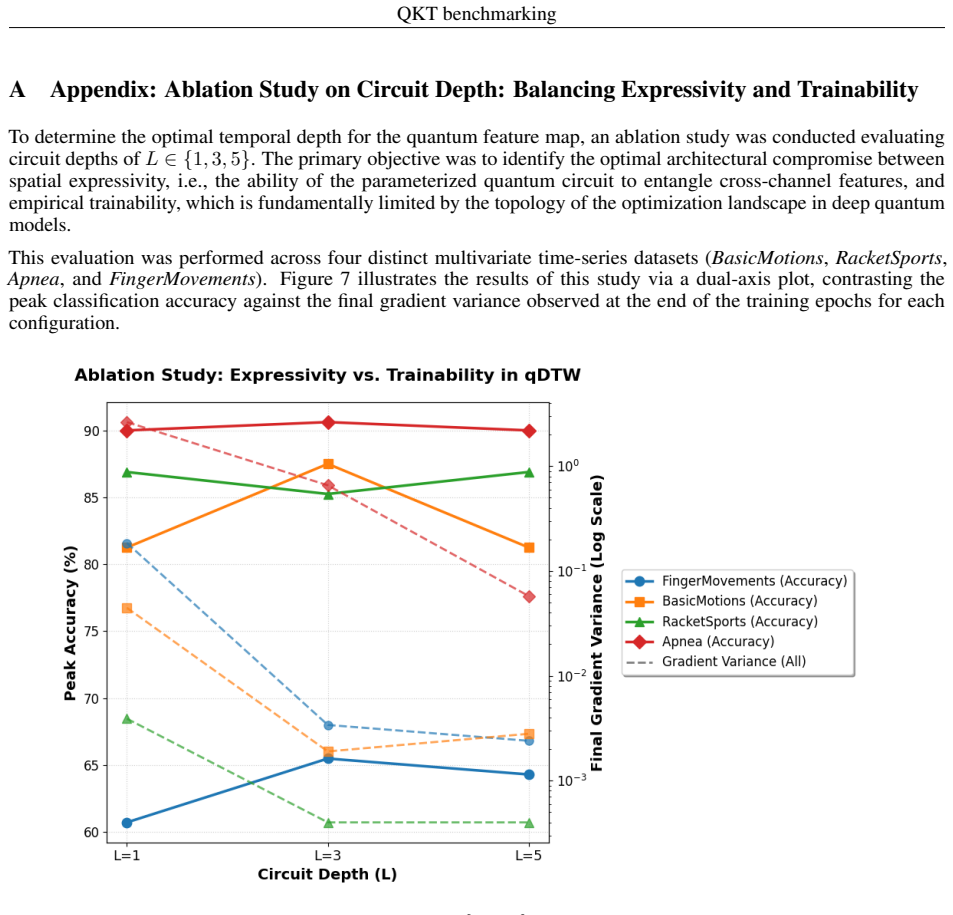
K. Mitarai, M. Negoro, M. Kitagawa, and K. Fujii, “Quantum circuit learning,”Physical Review A, vol. 98, no. 3, p. 032309, 2018. 15 QKT benchmarking A Appendix: Ablation Study on Circuit Depth: Balancing Expressivity and Trainability To determine the optimal temporal depth for the quantum feature map, an ablation study was conducted evaluating circuit dep...
2018
discussion (0)
Sign in with ORCID, Apple, or X to comment. Anyone can read and Pith papers without signing in.