Hard-core Bosons in Action: Applications to Quantum Circuits
Pith reviewed 2026-06-29 04:15 UTC · model grok-4.3
The pith
Hard-core boson algebra for quantum circuits avoids sign corrections and runs faster than Clifford-based methods.
A machine-rendered reading of the paper's core claim, the machinery that carries it, and where it could break.
Core claim
Although both the hard-core boson and complex Clifford algebra approaches are formally equivalent, the hard-core boson formulation exhibits computational advantages for the representation and simulation of quantum circuits because it realizes the tensor-product structure directly and requires no sign corrections. The work reviews and extends the algebra, presents an efficient implementation, shows substantially improved execution times versus IBM Qiskit, and introduces a new application that combines the formalism with genetic algorithms for quantum circuit synthesis.
What carries the argument
Hard-core boson algebra, which represents multi-qubit systems with direct tensor products and no sign corrections for circuit simulation.
If this is right
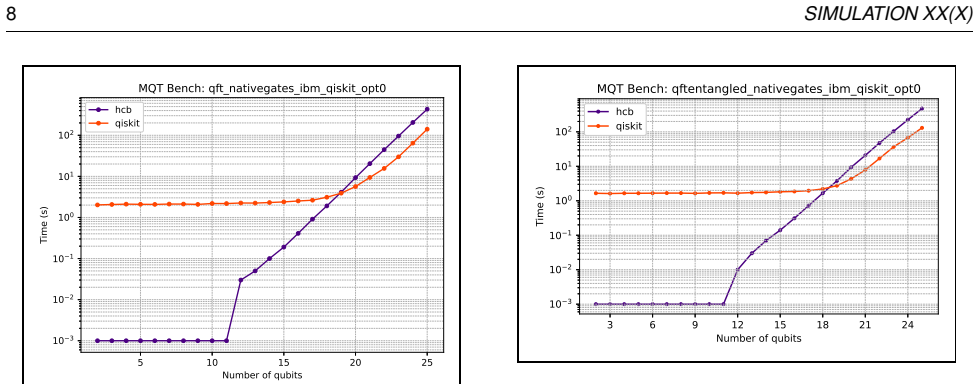
- Quantum circuit simulations execute with substantially improved execution times compared to IBM Qiskit.
- The hard-core boson formalism combines with genetic algorithms to enable quantum circuit synthesis.
- An efficient implementation of the extended algebra supports both simulation and synthesis tasks.
Where Pith is reading between the lines
- Faster per-circuit evaluation could let genetic algorithms test more candidate circuits within fixed compute budgets.
- The sign-free representation might extend naturally to simulation of open quantum systems or noisy circuits.
- Direct tensor-product handling could simplify code for hybrid quantum-classical algorithms that require frequent circuit re-evaluation.
Load-bearing premise
The hard-core boson representation can be realized in code without introducing hidden overheads that would offset the savings from skipping sign corrections.
What would settle it
A side-by-side timing test on identical circuits where the hard-core boson implementation shows no consistent speedup or runs slower than Qiskit would falsify the claimed computational advantage.
Figures


read the original abstract
The use of algebraic frameworks based on complex Clifford algebras for the representation and simulation of quantum circuits has been discussed in the literature. Recently, an alternative algebraic approach employing hard-core bosons has been proposed. Hard-core bosons provide a natural representation of multi-qubit systems, in which the tensor-product structure is realized directly and no sign corrections are required, in contrast to realizations based on complex Clifford algebras. Although both approaches are formally equivalent, the hard-core boson formulation exhibits computational advantages. This work reviews and extends the hard-core boson algebra for circuit simulation and presents an efficient implementation. A performance comparison with IBM Qiskit shows substantially improved execution times for simulations. Moreover, a new application is introduced in which the hard-core boson formalism is combined with genetic algorithms for quantum circuit synthesis.
Editorial analysis
A structured set of objections, weighed in public.
Referee Report
Summary. The manuscript reviews and extends the hard-core boson algebra as an alternative to complex Clifford algebras for representing and simulating quantum circuits. It asserts formal equivalence between the approaches but claims computational advantages for hard-core bosons arising from direct realization of the tensor-product structure and the absence of sign corrections. The work presents an efficient implementation, reports substantially faster execution times than IBM Qiskit on benchmark simulations, and introduces a new application that combines the hard-core boson formalism with genetic algorithms for quantum circuit synthesis.
Significance. If the claimed computational advantages are shown to originate from the algebraic representation rather than implementation choices, the work would supply a practically useful alternative framework for circuit simulation. The combination with genetic algorithms for synthesis constitutes a concrete new application that extends the formalism beyond pure simulation. The review and extension of the algebra, together with the reported performance comparison, could be of interest to researchers working on efficient quantum circuit tools.
major comments (1)
- [Performance comparison section] Performance comparison section (and associated tables/figures): the central claim that hard-core bosons exhibit computational advantages rests on the reported speedups versus Qiskit. The manuscript provides no indication that the Qiskit baseline was re-implemented with equivalent low-level tuning, memory layout, or compiler settings, nor does it include profiling that isolates the overhead of sign corrections. Without such controls it is not possible to attribute the observed execution-time differences to the algebraic representation itself.
minor comments (1)
- [Abstract] Abstract: the phrase 'substantially improved execution times' would be more informative if accompanied by at least one concrete example of circuit size or gate count used in the comparison.
Simulated Author's Rebuttal
We thank the referee for their careful reading of the manuscript and for highlighting this important point regarding the performance comparison. We address the major comment below.
read point-by-point responses
-
Referee: [Performance comparison section] Performance comparison section (and associated tables/figures): the central claim that hard-core bosons exhibit computational advantages rests on the reported speedups versus Qiskit. The manuscript provides no indication that the Qiskit baseline was re-implemented with equivalent low-level tuning, memory layout, or compiler settings, nor does it include profiling that isolates the overhead of sign corrections. Without such controls it is not possible to attribute the observed execution-time differences to the algebraic representation itself.
Authors: We agree that the comparison is between our hard-core boson implementation and the standard Qiskit simulator, without a re-implemented and equivalently tuned Qiskit baseline or explicit profiling of sign-correction overhead. This means the reported speedups cannot be attributed solely to the algebraic representation. In the revised manuscript we will expand the performance section to describe our implementation details (memory layout, data structures, and compiler settings), explicitly note that the advantages arise from the combination of the direct tensor-product structure and absence of sign corrections with our specific code, and add a statement clarifying the limitations of the current benchmark. We will also indicate that controlled comparisons isolating the algebraic contribution remain an open direction for future work. revision: yes
Circularity Check
No circularity; performance claims rest on external benchmark
full rationale
The paper reviews and extends the hard-core boson algebra for circuit simulation, presents an implementation, and reports execution-time comparisons against IBM Qiskit. These comparisons are framed as external empirical benchmarks rather than predictions derived from fitted parameters or self-referential definitions. No equations or claims reduce by construction to their own inputs, and no load-bearing step relies on a self-citation chain that itself lacks independent verification. The abstract and described structure contain no self-definitional, fitted-input, or ansatz-smuggling patterns.
Axiom & Free-Parameter Ledger
Reference graph
Works this paper leans on
-
[1]
Simulation of quantum computers: Review and acceleration opportunities ,
Cicero A, Maleki MA, Azhar MW et al. Simulation of quantum computers: Review and acceleration opportunities ,
- [2]
-
[3]
Massively parallel quantum computer simulator, eleven years later
De Raedt H, Jin F, Willsch D et al. Massively parallel quantum computer simulator, eleven years later. Comput Phys Commun 2019; 237: 47–61. DOI:10.1016/j.cpc.2018.11.005. 1805.04708
work page internal anchor Pith review Pith/arXiv arXiv doi:10.1016/j.cpc.2018.11.005 2019
-
[4]
Simulating physics with computers
Feynman RP . Simulating physics with computers. Int J Theor Phys 1982; 21: 467–488. DOI:10.1007/BF02650179
-
[5]
Benioff P . The computer as a physical system: A microscopi c quantum mechanical hamiltonian model of computers as represented by turing machines. Journal of Statistical Physics 1980; 22(5): 563–591. DOI:10.1007/BF01011339
-
[6]
The computable and the non-computable (Vychislimoe i nevychislimoe)
Manin YI. The computable and the non-computable (Vychislimoe i nevychislimoe) . Kibernetika. Moskva: Sovetskoe RadioSovetskoe Radio, 1980. R. 0.45
1980
-
[7]
Quantum computational networks
Deutsch DE. Quantum computational networks. Proceedings of the Royal Society of London A Mathematical and Physical Sciences 1989; 425(1868): 73–90. DOI:10.1098/rspa.1989. 0099
-
[8]
Quantum supremacy us- ing a programmable superconducting proces- sor
Arute F, Arya K, Babbush R et al. Quantum supremacy using a programmable superconducting processor. Nature 2019; 574: 505–510. DOI:10.1038/s41586-019-1666-5
-
[9]
Quantum computing in the nisq era and beyond,
Preskill J. Quantum computing in the NISQ era and beyond. Quantum 2018; 2: 79. DOI:10.22331/q-2018-08-06-79
work page internal anchor Pith review doi:10.22331/q-2018-08-06-79 2018
-
[10]
Quantum Software Ecosystem Design , chapter 7
Basermann A, Epping M, Fauseweh B et al. Quantum Software Ecosystem Design , chapter 7. Cham: Springer Nature Switzerland. ISBN 978-3-031-64136-7, 2024. pp. 143–188. DOI:10.1007/978-3-031-64136-7
-
[11]
URL https://doi.org/10.1007/978-3-031-64136-7_7
-
[12]
Quantum Computation and Quantum Information: 10th Anniversary Edition
Nielsen MA and Chuang IL. Quantum Computation and Quantum Information: 10th Anniversary Edition . Cambridge University Press, 2010
2010
-
[13]
Elementary gates for quantum computation
Barenco A, Bennett CH, Cleve R et al. Elementary gates for quantum computation. Physical Review A 1995; 52(5): 3457–
1995
-
[14]
DOI:10.1103/PhysRevA.52.3457
-
[15]
A Geometric Algebra Perspective On Quantum Computational Gates And Universality In Quantum Computing
Cafaro C and Mancini S. A Geometric Algebra Perspective On Quantum Computational Gates And Universality In Quantum Computing. Adv Appl Clifford Algebras 2011; 21: 493–519. DOI:10.1007/s00006-010-0269-x. 1006.2071
work page internal anchor Pith review Pith/arXiv arXiv doi:10.1007/s00006-010-0269-x 2011
-
[16]
Quantum computing based on complex Clifford algebras
Hrdina J, Navrat A and V asik P . Quantum computing based on complex Clifford algebras. Quant Inf Proc 2022; 21(9):
2022
- [17]
-
[18]
On Classical Simulation of Quantum Circuits Composed of Clifford Gates
Biswas G. On Classical Simulation of Quantum Circuits Composed of Clifford Gates. Quanta 2024; 13(1): 20–27. DOI:10.12743/quanta.v13i1.265. 2405.13590
-
[19]
Geometric Algebra Jordan–Wigner Transformation for Quantum Simulation
V eyrac G and Toffano Z. Geometric Algebra Jordan–Wigner Transformation for Quantum Simulation. Entropy 2024; 26(5): 410. DOI:10.3390/e26050410
-
[20]
Simulating quantum circuits with har d- core bosons
Emmanuel-Costa D. Simulating quantum circuits with har d- core bosons. In 2025 Annual Modeling and Simulation Conference (ANNSIM). pp. 1–12
2025
-
[21]
The Hermitian Clifford Analysis Toolbox
Brackx F, De Schepper H and Sommen F. The Hermitian Clifford Analysis Toolbox. Adv Appl Clifford Algebras 2008; 18(3-4): 451–487. DOI:10.1007/s00006-008-0081-z
-
[22]
Quantum Register Algebra: the mathematical language for quantum computing
Hrdina J, Hildenbrand D, N´ avrat A et al. Quantum Register Algebra: the mathematical language for quantum computing. Quant Inf Proc 2023; 22(9): 328. DOI:10.1007/ s11128-023-04086-y. 2208.02608
arXiv 2023
-
[23]
Quantum registe r algebra: the basic concepts
Hrdina J, Hildenbrand D, N´ avrat A et al. Quantum registe r algebra: the basic concepts. Lect Notes Comput Sci 2023; 13771: 112. DOI:10.1007/978-3-031-34031-4 10
-
[24]
Wilczek F and Zee A. Families from Spinors. Phys Rev D 1982; 25: 553. DOI:10.1103/PhysRevD.25.553
-
[25]
Quantum theory of emission and absorption of radiation
Dirac PAM. Quantum theory of emission and absorption of radiation. Proc Roy Soc Lond A 1927; 114: 243. DOI: 10.1098/rspa.1927.0039
-
[26]
SO(2n) Grand Unification in an SU(N) Basis
Mohapatra RN and Sakita B. SO(2n) Grand Unification in an SU(N) Basis. Phys Rev D 1980; 21: 1062. DOI: 10.1103/PhysRevD.21.1062
-
[27]
SOSpin, a C++ library for Yukawa decomposition in SO(2N) models
Cardoso N, Emmanuel-Costa D, Gonc ¸alves N et al. SOSpin, a C++ library for Y ukawa decomposition in SO(2N) models. Comput Phys Commun 2016; 203: 178–200. DOI:10.1016/j. cpc.2016.01.010. 1509.00433
work page internal anchor Pith review Pith/arXiv arXiv doi:10.1016/j 2016
-
[28]
A lattice model of liquid helium, i
Matsubara T and Matsuda H. A lattice model of liquid helium, i. Progress of Theoretical Physics 1956; 16(5): 569– 582
1956
-
[29]
Absence of diffusion in certain random lattices
Anderson PW. Absence of diffusion in certain random lattices. Physical Review 1958; 109(5): 1492–1505
1958
-
[30]
Two soluble models of an antiferromagnetic chain
Lieb E, Schultz T and Mattis D. Two soluble models of an antiferromagnetic chain. Annals of Physics 1961; 16(3): 407– 466
1961
-
[31]
Parafermionic and generalized parafermionic algebras
Bonatsos D, Daskaloyannis C and Kanakoglou K. Parafermionic and generalized parafermionic algebras. In International W orkshop on Quantum Groups, Deformations and Contractions. pp. 1–12. hep-th/9909002
-
[32]
Wu LA and Lidar DA. Qubits as parafermions. J Math Phys 2002; 43(9): 4506–4525. DOI:10.1063/1.1499208. quant-ph/0109078. Prepared using sagej.cls D. Emmanuel-Costa and M. Epping 13
work page internal anchor Pith review Pith/arXiv arXiv doi:10.1063/1.1499208 2002
-
[33]
The Boolean SA Tisfiability Problem in Clifford algebra
Budinich M. The Boolean SA Tisfiability Problem in Clifford algebra. Theoretical Computer Science 2019; 784: 1–10. DOI:10.1016/j.tcs.2019.03.027. URL https://linkinghub.elsevier.com/retrieve/pii/S0304397519301938
-
[34]
Streltsov A, Adesso G and Plenio MB. Colloquium: Quantum coherence as a resource. Rev Mod Phys 2017; 89: 041003. DOI:10.1103/RevModPhys.89.041003. URL https://link.aps.org/doi/10.1103/RevModPhys.89.041003
-
[35]
Baumgratz T, Cramer M and Plenio MB. Quantifying coherence. Phys Rev Lett 2014; 113: 140401. DOI:10.1103/PhysRevLett.113.140401. URL https://link.aps.org/doi/10.1103/PhysRevLett.113.140401
-
[36]
Hybrid simplification rules for boundaries of quantum circuits, 2022
Epping M. Hybrid simplification rules for boundaries of quantum circuits, 2022. URL https://arxiv.org/abs/2206.03036. 2206.03036
arXiv 2022
-
[37]
Quantum7, 1062 (2023) https://doi.org/10.22331/q-2023-07-20-1062
Quetschlich N, Burgholzer L and Wille R. MQT Bench: Benchmarking Software and Design Automation Tools for Quantum Computing. Quantum 2023; DOI: 10.22331/q-2023-07-20-1062. MQT Bench is available at https://www.cda.cit.tum.de/mqtbench/, 2204.13719
-
[38]
Quipo, a c++ library for implementing hard-core bosons algebra,
Emmanuel-Costa D, Keitzl T and R¨ ohrig-Z¨ ollner M. Quipo, a c++ library for implementing hard-core bosons algebra,
-
[39]
Under development, Institute of Software Technology , German Aerospace Center (DLR), Cologne, Germany
-
[40]
Javadi-Abhari A, Treinish M, Krsulich K et al. Quantum computing with Qiskit, 2024. DOI:10.48550/arXiv.2405. 08810. 2405.08810
work page internal anchor Pith review Pith/arXiv arXiv doi:10.48550/arxiv.2405 2024
-
[41]
Mermin ND. Quantum mysteries revisited. American Journal of Physics 1990; 58(8): 731–734. DOI:10.1119/1.16503
-
[42]
Greenberger DM, Horne MA and Zeilinger A. Going Beyond Bell’s Theorem. Fundam Theor Phys 1989; 37: 69–72. DOI: 10.1007/978-94-017-0849-4
-
[43]
Observation of three photon Greenberger-Horne-Zeilinger entanglemen t
Bouwmeester D, Pan JW, Daniell M et al. Observation of three photon Greenberger-Horne-Zeilinger entanglemen t. Phys Rev Lett 1999; 82: 1345–1349. DOI:10.1103/ PhysRevLett.82.1345. quant-ph/9810035
Pith/arXiv arXiv 1999
-
[44]
Multi- partite entanglement can speed up quantum key distribution in networks
Epping M, Kampermann H, macchiavello C et al. Multi- partite entanglement can speed up quantum key distribution in networks. New J Phys 2017; 19(9): 093012. DOI: 10.1088/1367-2630/aa8487
-
[45]
Open quantum assembly language, 2017
Cross AW, Bishop LS, Smolin JA et al. Open quantum assembly language, 2017. URL https://arxiv.org/abs/1707.03429. 1707.03429
Pith/arXiv arXiv 2017
-
[46]
The heisenberg representation of quantum computers
Gottesman D. The heisenberg representation of quantum computers. In Proceedings of the 22nd International Colloquium on Group Theoretical Methods in Physics . pp. 1 – 20. URL https://arxiv.org/abs/quant-ph/9807006. quant-ph/9807006
-
[47]
Improved Simulation of Stabilizer Circuits
Aaronson S and Gottesman D. Improved simulation of stabilizer circuits. Phys Rev A 2004; 70(5): 052328. DOI: 10.1103/PhysRevA.70.052328. quant-ph/0406196
work page internal anchor Pith review Pith/arXiv arXiv doi:10.1103/physreva.70.052328 2004
-
[48]
Stim: a fast stabilizer circuit simulator
Gidney C. Stim: a fast stabilizer circuit simulator. Quantum 2021; 5: 497. DOI:10.22331/q-2021-07-06-497. URL https://doi.org/10.22331/q-2021-07-06-497
-
[49]
A fast quantum mechanical algorithm for database search
Grover LK. A fast quantum mechanical algorithm for database search. In Proceedings of the Twenty-Eighth Annual ACM Symposium on Theory of Computing . STOC ’96, New Y ork, NY , USA: Association for Computing Machinery. ISBN 0897917855, p. 212–219. DOI:10.1145/237814.237866. URL https://doi.org/10.1145/237814.237866. quant-ph/9605043
-
[50]
Adaptation in Natural and Artificial Systems
Holland JH. Adaptation in Natural and Artificial Systems . University of Michigan Press, 1975
1975
-
[51]
Genetic Algorithms in Search, Optimization, and Machine Learning
Goldberg DE. Genetic Algorithms in Search, Optimization, and Machine Learning. Addison-Wesley, 1989
1989
-
[52]
GASP: a genetic algorithm for state preparation on quantum computers
Creevey FM, Hill CD and Hollenberg LCL. GASP: a genetic algorithm for state preparation on quantum computers. Sci Rep 2023; 13(1): 11956. DOI:10.1038/s41598-023-37767-w. 2302.11141
-
[53]
Über das paulische äquivalenzverbot,
Jordan P and Wigner EP . About the Pauli exclusion princip le. Z Phys 1928; 47: 631–651. DOI:10.1007/BF01331938. Author Biographies David Emmanuel-Costa is a researcher at the German Aerospace Centre (DLR). He obtained his Ph.D. degree in theoretical pa rticle physics under the supervision of Gustavo Branco at the Unive rsity of Lisbon (UL), Portugal. He ...
discussion (0)
Sign in with ORCID, Apple, or X to comment. Anyone can read and Pith papers without signing in.