New Solutions of RG Equations for α_s and y_(top)
Pith reviewed 2026-06-29 03:37 UTC · model grok-4.3
The pith
Explicit logarithmic solutions to the RG equations for the strong coupling and top Yukawa sum all perturbative orders in the high-energy limit.
A machine-rendered reading of the paper's core claim, the machinery that carries it, and where it could break.
Core claim
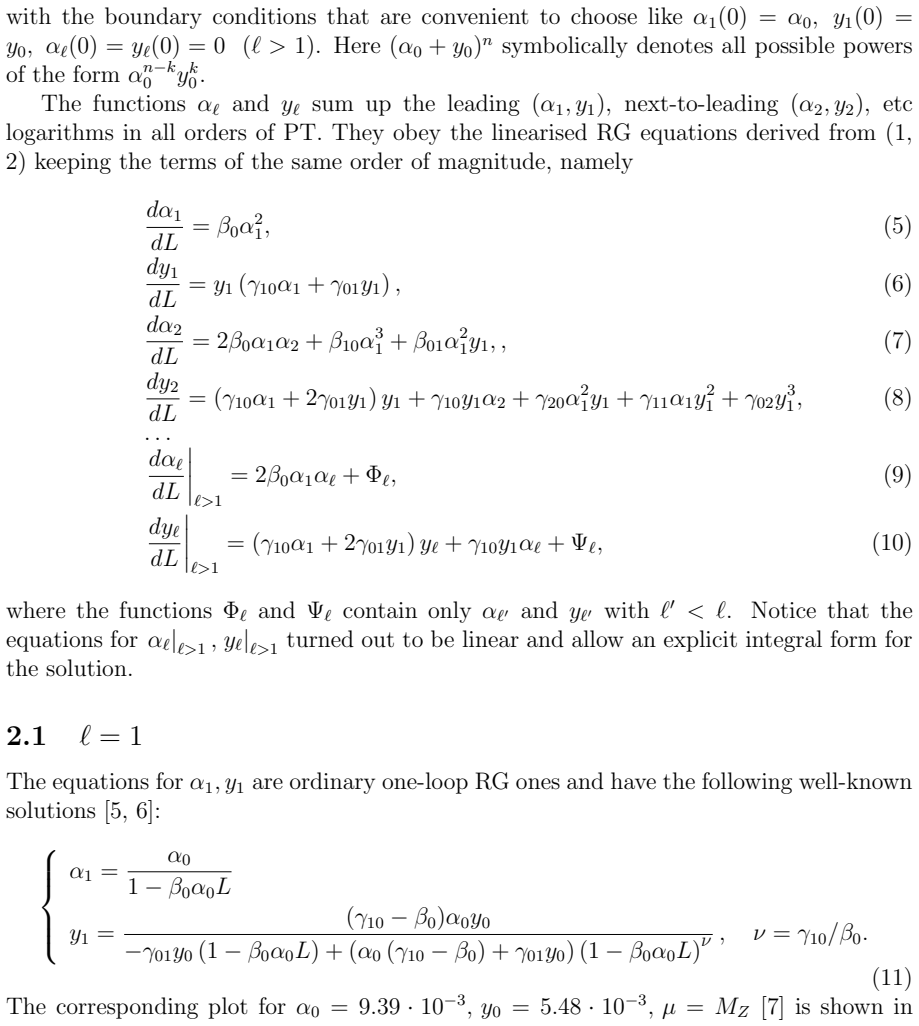
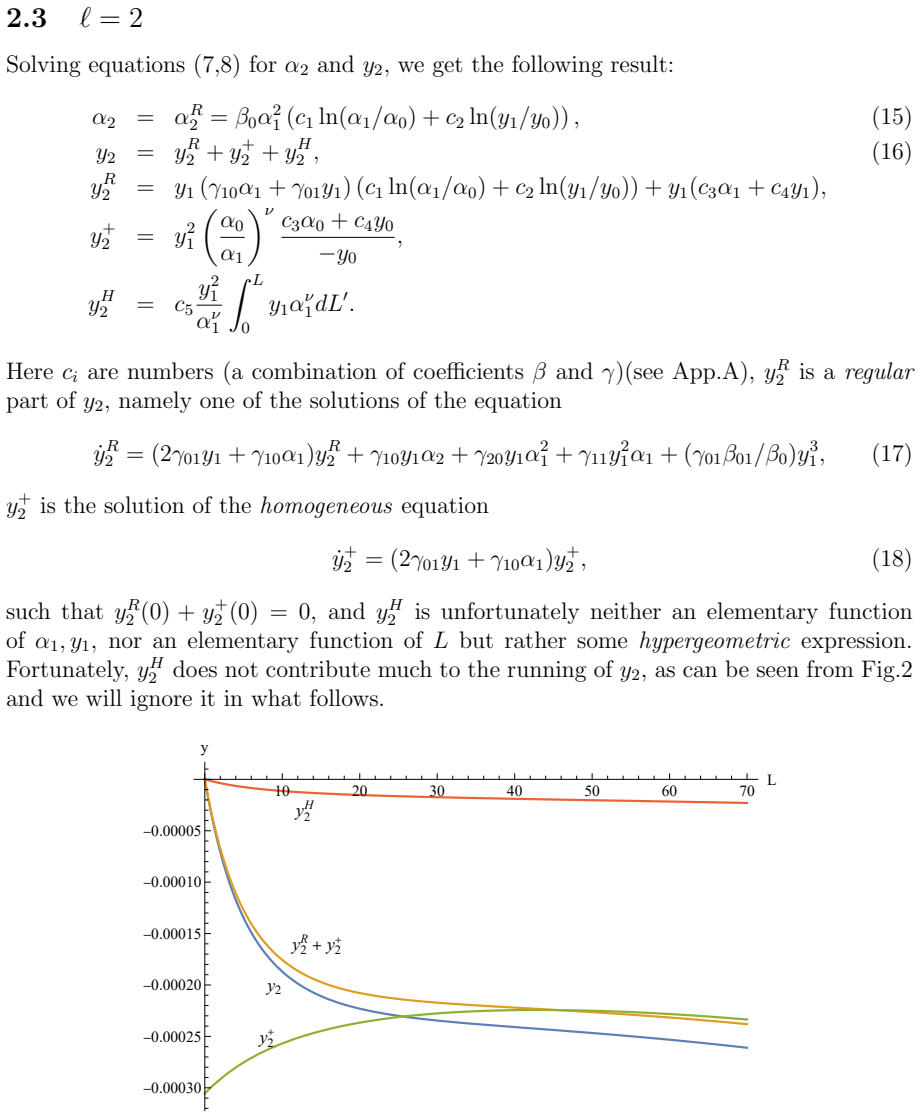
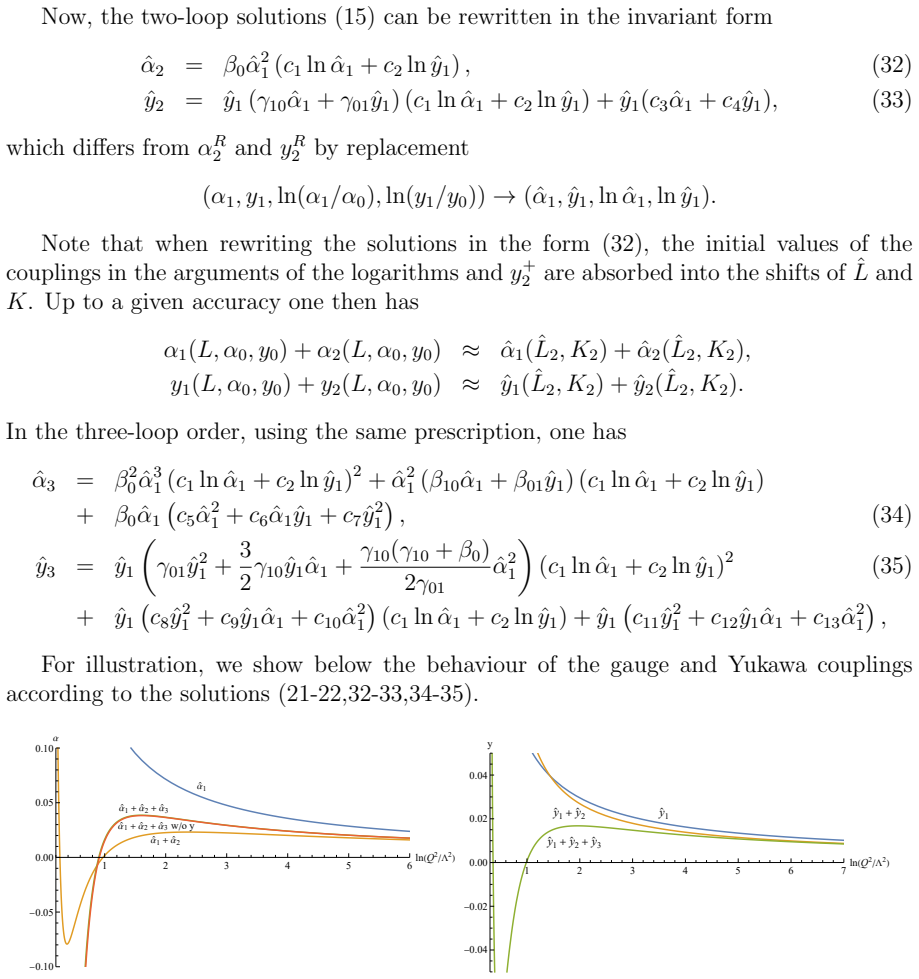
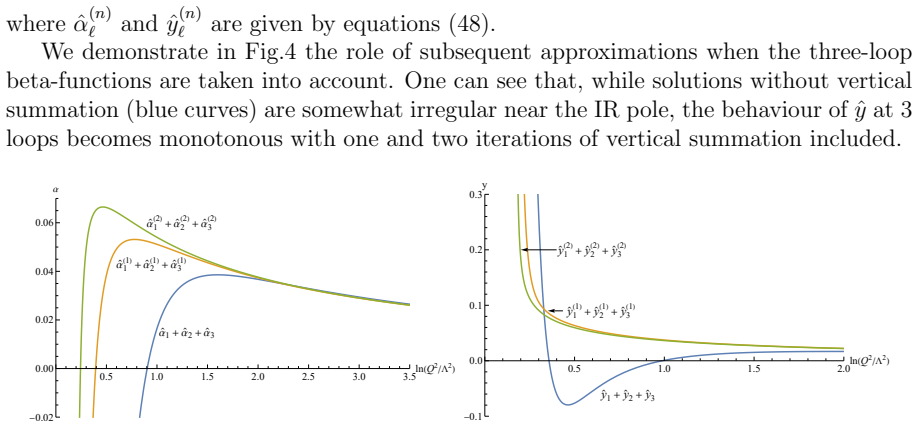
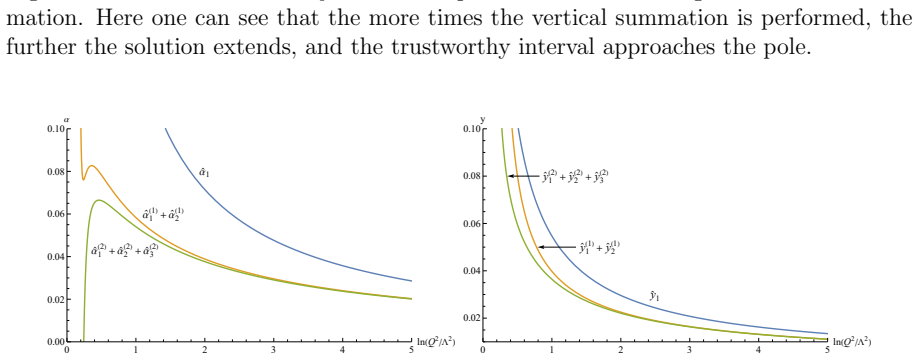
We construct simple analytical solutions of the RG equations for the running couplings α_s and y_top in the asymptotic regime. These solutions have an explicit form, contain only logarithms and no special functions, and subsequently sum up the leading, subleading, etc logarithms in all orders of PT. While the effect of y_top on the running of α_s happens to be negligible, the role of α_s on the running of y_top is essential, the account of higher orders gives a noticeable contribution.
What carries the argument
The closed-form logarithmic expressions solving the coupled differential RG equations for α_s and y_top in the asymptotic regime.
If this is right
- The running of α_s remains essentially independent of y_top.
- The running of y_top receives an essential correction from α_s.
- Higher-order logarithmic terms produce noticeable shifts in the predicted evolution of y_top.
- The solutions permit direct evaluation of the couplings at arbitrary high scales without iterative summation.
Where Pith is reading between the lines
- The same logarithmic structure could be tested for consistency when additional Standard Model couplings are restored to the system.
- The explicit forms might simplify threshold matching calculations in models that embed the Standard Model at high scales.
- Direct comparison to lattice or collider data at accessible energies could quantify the size of neglected non-asymptotic effects.
Load-bearing premise
The high-energy asymptotic regime permits a closed-form resummation of the coupled equations using only logarithmic terms without significant contributions from non-perturbative physics or additional operators.
What would settle it
A direct numerical integration of the RG equations from low to high energies followed by comparison of the resulting y_top value at a scale such as 10^16 GeV against the analytical prediction.
Figures

read the original abstract
We construct simple analytical solutions of the RG equations for the running couplings \alpha_s and y_{top} in the asymptotic regime. These solutions have an explicit form, contain only logarithms and no special functions, and subsequently sum up the leading, subleading, etc logarithms in all orders of PT. While the effect of y_{top} on the running of \alpha_s happens to be negligible, the role of \alpha_s on the running of y_{top} is essential, the account of higher orders gives a noticeable contribution.
Editorial analysis
A structured set of objections, weighed in public.
Referee Report
Summary. The manuscript constructs explicit analytical solutions to the coupled renormalization group (RG) equations governing the running of the strong coupling α_s and the top Yukawa coupling y_top in the asymptotic high-energy regime. These solutions are presented as closed-form expressions involving only logarithms (no special functions), claimed to resum the leading, subleading, and higher logarithmic terms to all orders in perturbation theory. The back-reaction of y_top on α_s is stated to be negligible, while the influence of α_s on y_top is essential, with higher-order contributions producing noticeable effects.
Significance. If the derivations and resummation properties hold, the explicit logarithmic solutions would constitute a practical analytical alternative to numerical integration of the RG flow, potentially simplifying high-scale extrapolations in QCD and the Standard Model. The emphasis on an explicit, special-function-free form is a clear strength for usability, though the absence of machine-checked proofs or reproducible code in the available text limits immediate verification.
major comments (3)
- [Abstract] Abstract, paragraph 1: the central claim that the solutions 'sum up the leading, subleading, etc logarithms in all orders of PT' is load-bearing but unsupported by any derivation steps, explicit beta-function truncation, or matching to the perturbative series; without these, the resummation property cannot be assessed.
- [Abstract] Abstract, paragraph 1: no comparison to numerical integration of the coupled RG equations or error estimates is provided, which is required to substantiate that the logarithmic forms accurately capture the asymptotic behavior under the stated conditions.
- [Abstract] Abstract, paragraph 1: the weakest assumption—that the asymptotic regime permits a closed-form logarithmic resummation without non-perturbative or higher-dimensional operator contributions—is stated but not tested against any concrete counter-example or consistency check within the manuscript's scope.
Simulated Author's Rebuttal
We thank the referee for their detailed reading of the manuscript and for highlighting points that can improve clarity. Below we respond point by point to the three major comments. We are prepared to revise the text to address the concerns about explicitness and verification.
read point-by-point responses
-
Referee: [Abstract] Abstract, paragraph 1: the central claim that the solutions 'sum up the leading, subleading, etc logarithms in all orders of PT' is load-bearing but unsupported by any derivation steps, explicit beta-function truncation, or matching to the perturbative series; without these, the resummation property cannot be assessed.
Authors: The manuscript derives the solutions in Sections 2–3 by starting from the standard one- and two-loop beta functions for α_s and y_top, imposing the asymptotic high-scale regime where the dominant terms are retained, and solving the resulting coupled differential equations analytically. The all-order logarithmic structure arises because the solution is obtained by successive integration that automatically generates the infinite series of log powers. To make the truncation and the matching to the perturbative expansion explicit, we will add a short subsection (or appendix) that states the precise beta-function truncation employed and shows the first few terms of the expanded solution. revision: partial
-
Referee: [Abstract] Abstract, paragraph 1: no comparison to numerical integration of the coupled RG equations or error estimates is provided, which is required to substantiate that the logarithmic forms accurately capture the asymptotic behavior under the stated conditions.
Authors: We agree that a direct numerical check would strengthen the presentation. In the revised version we will include a brief comparison (new figure or table) of the analytic expressions against numerical integration of the same truncated RG system over a representative range of scales, together with a quantitative error estimate derived from the difference between successive orders. revision: yes
-
Referee: [Abstract] Abstract, paragraph 1: the weakest assumption—that the asymptotic regime permits a closed-form logarithmic resummation without non-perturbative or higher-dimensional operator contributions—is stated but not tested against any concrete counter-example or consistency check within the manuscript's scope.
Authors: The assumption is the standard perturbative premise that, sufficiently far above the electroweak scale, the RG flow is governed by the known beta functions. While the manuscript does not contain an explicit counter-example, the domain of validity is already delimited by the requirement that the couplings remain perturbative. We will add one paragraph in the conclusions that recalls this limitation and notes that the solutions are intended for use inside that perturbative window. revision: partial
Circularity Check
No significant circularity identified
full rationale
The paper claims to derive explicit analytical solutions to the standard RG equations for the running couplings α_s and y_top in the asymptotic regime, expressed solely in terms of logarithms that resum perturbative orders. No load-bearing steps reduce by construction to fitted inputs, self-definitions, or self-citation chains; the central result is presented as a direct solution of the differential RG system without evidence that any 'prediction' is statistically forced or renamed from an ansatz. The derivation chain remains self-contained against the RG beta functions as external inputs.
Axiom & Free-Parameter Ledger
axioms (2)
- domain assumption Standard beta functions for α_s and y_top govern the RG flow in the perturbative regime
- ad hoc to paper Asymptotic high-energy regime permits closed-form resummation using only logarithms
Reference graph
Works this paper leans on
-
[1]
R. M. Iakhibbaev, D. I. Kazakov, and D. M. Tolkachev, New Solutions for RG Equations in QCD (2026), arXiv:2604.04766 [hep-th]
Pith/arXiv arXiv 2026
-
[2]
A.P. Bakulev, S.V. Mikhailov and N.G. Stefanis, Fractional Analytic Perturbation Theory in Minkowski space and application to Higgs boson decay into a b anti-b pair, Phys.Rev.D 75 (2007) 056005, Phys.Rev.D 77 (2008) 079901 (erratum), arXiv:hep-ph/0607040 [hep-ph]
Pith/arXiv arXiv 2007
-
[3]
Bogolyubov and D.V
N.N. Bogolyubov and D.V. Shirkov. Introduction To The Theory Of Quantized Fields. Nauka, Moscow, 1957
1957
-
[4]
A.Bednyakov and A.Pikelner. Four-Loop Gauge and Three-Loop Yukawa Beta Functions in a General Renormalizable Theory, Phys.Rev.Lett. 127.4 (2021), p. 041801. arXiv:2105.09918 [hep-ph]
arXiv 2021
-
[5]
A.E. Thomsen. Introducing RGBeta: a Mathematica package for the evaluation of renormalization group -functions Eur.Phys.J. C 81.5 (2021), p. 408, arXiv:2101.08265 [hep-ph]
arXiv 2021
-
[6]
Ibanez, C
L.E. Ibanez, C. Lopez, and C. Munoz, The Low-Energy Supersymmetric Spectrum According to N=1 Supergravity Guts, Nucl. Phys. B 256 (1985), pp. 218--252
1985
-
[7]
S. Codoban and D.I. Kazakov, Approximate analytic solutions of the renormalization group equations for Yukawa and soft couplings in SUSY models, Eur.Phys.J. C 13.4 (2000), pp. 671--679, arXiv:hep-ph/9906256 [hep-ph]
Pith/arXiv arXiv 2000
-
[8]
Takahashi et al
F. Takahashi et al. Review of Particle Physics by the Particle Data Group, Int.J.Mod.Phys. A 41 (2026), p. 2630011
2026
-
[9]
A. V. Bednyakov et al. Stability of the Electroweak Vacuum: Gauge Independence and Advanced Precision, Phys. Rev. Lett. 115.20 (2015), p. 201802. arXiv: 1507.08833 [hep-ph]
Pith/arXiv arXiv 2015
- [10]
discussion (0)
Sign in with ORCID, Apple, or X to comment. Anyone can read and Pith papers without signing in.