Multiplicity dependence of the size of the common hadron emission source in pp collisions at the LHC
Pith reviewed 2026-06-29 01:44 UTC · model grok-4.3
The pith
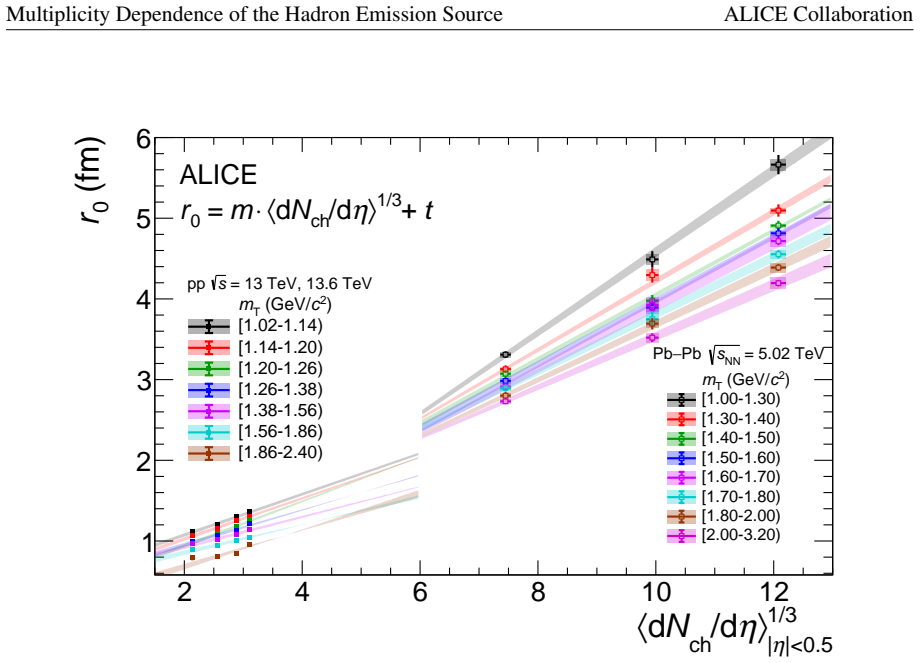
The hadron emission source in pp collisions has a multiplicity dependence distinct from that in Pb-Pb collisions.
A machine-rendered reading of the paper's core claim, the machinery that carries it, and where it could break.
Core claim
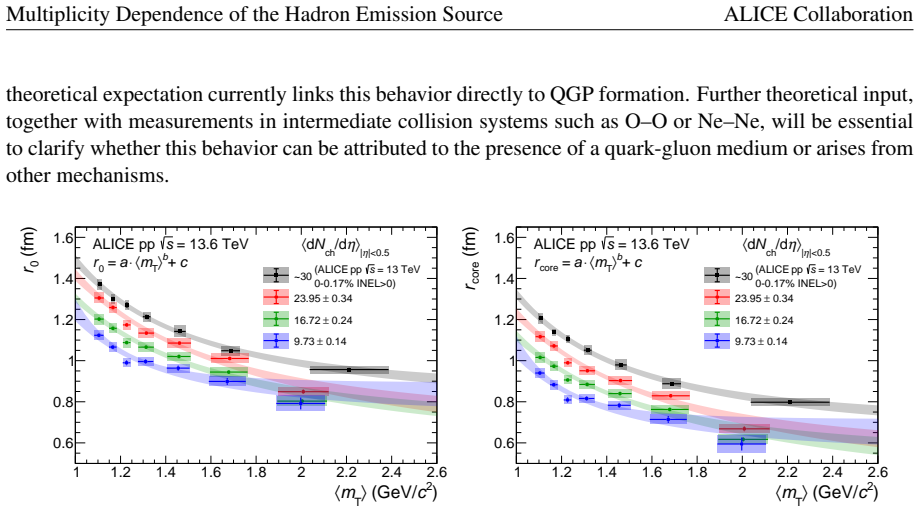
Femtoscopic radii extracted from pp collisions at 13.6 TeV exhibit a multiplicity dependence that is markedly different from those in Pb-Pb collisions at 5.02 TeV in similar m_T intervals. The radii are determined from measured correlation functions by assuming several state-of-the-art models of nucleon-nucleon interactions; the consistency among the resulting radii demonstrates robustness with respect to interaction-model assumptions. Precise knowledge of the source size in pp collisions is required for subsequent studies of residual strong interactions among hadrons.
What carries the argument
Femtoscopic extraction of source radius from two-proton correlation functions, using nucleon-nucleon interaction models to convert measured correlations into radii.
If this is right
- The source-size baseline established in pp collisions can be used to interpret femtoscopic studies of residual strong interactions among other hadron pairs.
- The observed difference in multiplicity dependence between pp and Pb-Pb systems constrains models of how the emission volume scales with collision-system size.
- The simultaneous measurement of multiplicity and m_T dependence supplies a reference for testing whether hydrodynamic or string-fragmentation pictures correctly describe particle emission in small systems.
Where Pith is reading between the lines
- The different scaling may indicate that initial-state geometry or non-equilibrium effects play a larger role in setting the emission region in pp than in heavy-ion collisions.
- Extending the same femtoscopic technique to other small systems such as p-Pb could test whether the multiplicity dependence follows a universal curve or depends on the projectile size.
- The data set could be re-analyzed with additional pair species to check whether the source size is species-independent at fixed multiplicity and m_T.
- pith_inferences are editorial extensions and not claims made by the paper.
Load-bearing premise
The conversion of measured correlation functions into source radii assumes that the chosen nucleon-nucleon interaction models are accurate enough to separate the source geometry from the final-state interaction.
What would settle it
A measurement in which the extracted radii vary significantly when different nucleon-nucleon interaction models are substituted would indicate that the source-size values are not robust.
Figures



read the original abstract
Femtoscopic analysis can shed light on hadron production in pp collisions. In this paper, proton-proton correlations measured in collisions at $\sqrt{s}=13.6$ TeV recorded with the ALICE detector at the LHC are presented. The analysis is based on the minimum bias dataset collected in 2022 following the upgrade of the ALICE detector and corresponds to an integrated luminosity of $19.3$ pb$^{-1}$. The increased integrated luminosity allows us, for the first time, to simultaneously measure the multiplicity and transverse-mass ($m_{\rm T}$) dependence of the size of the hadron-emitting source. Precise knowledge of the femtoscopic source size in pp collisions is a crucial ingredient for using femtoscopy to study the residual strong interaction among stable and unstable hadrons at the LHC. In this light, the source radius was determined from the measured correlation functions by assuming several state-of-the-art models of the nucleon$-$nucleon interactions. The consistency among the extracted radii demonstrates the robustness of the measurement with respect to interaction model assumptions. A comparison to femtoscopic radii measured in Pb$-$Pb collisions at $\sqrt{s}=5.02$ TeV reveals a markedly different multiplicity dependence in similar $m_{\rm T}$ intervals, providing new insight into the system-size dependence of particle emission dynamics.
Editorial analysis
A structured set of objections, weighed in public.
Referee Report
Summary. The manuscript reports proton-proton femtoscopic correlation functions measured in minimum-bias pp collisions at √s=13.6 TeV with the upgraded ALICE detector, using an integrated luminosity of 19.3 pb^{-1}. The source radius is extracted simultaneously as a function of charged-particle multiplicity and transverse mass m_T by fitting the measured correlation functions with several state-of-the-art nucleon-nucleon interaction models; the extracted radii are shown to be consistent across models. A direct comparison to femtoscopic radii from Pb-Pb collisions at √s=5.02 TeV in similar m_T intervals reveals a qualitatively different multiplicity dependence, interpreted as new insight into system-size dependence of particle emission dynamics.
Significance. If the central extraction and comparison hold, the result supplies a data-driven benchmark for the multiplicity and m_T evolution of the emission source in small collision systems. This benchmark is directly relevant to ongoing femtoscopic analyses of residual strong interactions among stable and unstable hadrons at the LHC. The use of multiple external interaction models together with a large dataset and explicit cross-checks of model dependence strengthens the robustness of the reported radii.
minor comments (1)
- [Abstract] Abstract: the abstract provides no details on systematic uncertainties, error bars, or data-selection criteria, which would allow full verification of the extracted radii and the multiplicity dependence claim.
Simulated Author's Rebuttal
We thank the referee for the positive assessment of the manuscript, the recognition of its robustness through the use of multiple interaction models and large dataset, and the recommendation to accept.
Circularity Check
No significant circularity; derivation is data-driven from external models
full rationale
The paper measures p-p correlation functions directly from LHC data, then converts them to source radii using NN interaction models taken from external literature (not fitted or derived inside this work). Radii are reported as consistent across several such models, and the multiplicity dependence is compared to independent Pb-Pb measurements. No equation reduces a claimed prediction to a fitted parameter or self-citation by construction; the central claim rests on external benchmarks and direct data comparison.
Axiom & Free-Parameter Ledger
axioms (1)
- domain assumption Femtoscopic correlations measured in momentum space can be used to extract the spatial size of the hadron emission source when nucleon-nucleon interaction potentials are known.
Reference graph
Works this paper leans on
-
[1]
Study of the Strong Interaction Among Hadrons with Correlations at the LHC
L. Fabbietti, V . Mantovani Sarti, and O. Vazquez Doce, “Study of the Strong Interaction Among Hadrons with Correlations at the LHC”,Ann. Rev. Nucl. Part. Sci.71(2021) 377–402, arXiv:2012.09806 [nucl-ex]. [2]ALICECollaboration, S. Acharyaet al., “Unveiling the strong interaction among hadrons at the LHC”,Nature588(2020) 232–238,arXiv:2005.11495 [nucl-ex]....
arXiv 2021
-
[2]
Proton pictures of high-energy nuclear collisions
S. E. Koonin, “Proton pictures of high-energy nuclear collisions”,Phys. Lett. B70(1977) 43–47. [8]ALICECollaboration, S. Acharyaet al., “Event-shape and multiplicity dependence of freeze-out radii in pp collisions at √s=7 TeV”,JHEP2019(2019) 108,arXiv:1901.05518 [hep-ex]. [9]ATLASCollaboration, M. Aaboudet al., “Femtoscopy with identified charged pions in...
arXiv 1977
-
[3]
Bose-Einstein correlations for Lévy stable source distributions
T. Csörg ˝o, S. Hegyi, and W. A. Zajc, “Bose-Einstein correlations for Lévy stable source distributions”,Eur , Phys. J. C - Particles and Fields36(2004) 67–78. 17 Multiplicity Dependence of the Hadron Emission Source ALICE Collaboration [16]ALICECollaboration, S. Acharyaet al., “Search for a common baryon source in high-multiplicity pp collisions at the L...
arXiv 2004
-
[4]
Resolving the HBT Puzzle in Relativistic Heavy Ion Collision
S. Pratt, “Resolving the HBT Puzzle in Relativistic Heavy Ion Collision”,Phys. Rev. Lett.102 (2009) 232301,arXiv:0811.3363 [nucl-th]
Pith/arXiv arXiv 2009
-
[5]
A. Kisiel, M. Gała˙zyn, and P. Bo˙zek, “Pion, kaon, and proton femtoscopy in Pb–Pb collisions at√sNN=2.76 TeV modeled in (3+1)D hydrodynamics”,Phys. Rev. C90(2014) 064914, arXiv:1409.4571 [nucl-th]
Pith/arXiv arXiv 2014
-
[6]
A realistic coalescence model for deuteron production
M. Mahlein, L. Barioglio, F. Bellini, L. Fabbietti, C. Pinto, B. Singh, and S. Tripathy, “A realistic coalescence model for deuteron production”,Eur , Phys. J. C83(2023) 804. https://doi.org/10.1140/epjc/s10052-023-11972-3
-
[7]
Novel model for particle emission in small collision systems
D. Mihaylov and J. González González, “Novel model for particle emission in small collision systems”,Eur . Phys. J. C83(2023) 590,arXiv:2305.08441 [hep-ph]
arXiv 2023
-
[8]
D.-F. Wang, M.-Y . Chen, Y .-G. Ma, Q.-Y . Shou, S. Zhang, and L. Zheng, “Investigating the pion emission source in pp collisions using the ampt model with subnucleon structure”,Nuclear Science and Techniques36(2025) 154. [27]ALICECollaboration, J. Adolfssonet al., “The upgrade of the ALICE TPC with GEMs and continuous readout”,JINST16(2021) P03022,arXiv:...
arXiv 2025
-
[9]
ToMCCA: a Toy Monte Carlo Coalescence Afterburner
M. Mahlein, C. Pinto, and L. Fabbietti, “ToMCCA: a Toy Monte Carlo Coalescence Afterburner”, Eur , Phys. J. C84(2024) 1136
2024
-
[10]
ToMCCA-3: A realistic 3-body coalescence model
M. Mahlein, B. Singh, M. Viviani, F. Bellini, L. Fabbietti, A. Kievsky, and L. E. Marcucci, “ToMCCA-3: A realistic 3-body coalescence model”,arXiv:2504.02491 [hep-ph]. 18 Multiplicity Dependence of the Hadron Emission Source ALICE Collaboration
-
[11]
Reevaluation of the cosmic antideuteron flux from cosmic-ray interactions and from exotic sources
L. Šerkšnyt ˙eet al., “Reevaluation of the cosmic antideuteron flux from cosmic-ray interactions and from exotic sources”,Phys. Rev. D105(2022) 083021,arXiv:2201.00925 [astro-ph.HE]. [33]ALICECollaboration, S. Acharyaet al., “Measurement of anti- 3He nuclei absorption in matter and impact on their propagation in the Galaxy”,Nature Phys.19(2023) 61–71, arX...
arXiv 2022
-
[12]
New Fast Interaction Trigger for ALICE
W. H. Trzaska, “New Fast Interaction Trigger for ALICE”,Nuclear Instruments and Methods in Physics Research Section A: Accelerators, Spectrometers, Detectors and Associated Equipment 845(2017) 463–466. Proceedings of the Vienna Conference on Instrumentation 2016. [35]ALICECollaboration, B. Abelevet al., “Technical Design Report for the Upgrade of the ALIC...
arXiv 2017
-
[13]
Femtoscopy in relativistic heavy ion collisions: Two decades of progress
M. A. Lisa, S. Pratt, R. Soltz, and U. Wiedemann, “Femtoscopy in relativistic heavy ion collisions: Two decades of progress”,Annual Review of Nuclear and Particle Science55(2005) 357–402. [40]ALICECollaboration, S. Acharyaet al., “p-p, p-ΛandΛ-Λcorrelations studied via femtoscopy in pp reactions at √s= 7 TeV”,Phys. Rev. C99(2019) 024001,arXiv:1805.12455 [nucl-ex]
Pith/arXiv arXiv 2005
-
[14]
Thermal-fist: A package for heavy-ion collisions and hadronic equation of state
V . V ovchenko and H. Stoecker, “Thermal-fist: A package for heavy-ion collisions and hadronic equation of state”,Computer Physics Communications244(2019) 295–310
2019
-
[15]
Predictions of hadron abundances in pp collisions at the LHC
F. Becattini, P. Castorina, A. Milov, and H. Satz, “Predictions of hadron abundances in pp collisions at the LHC”,Journal of Physics G: Nuclear and Particle Physics38(2011) 025002
2011
-
[16]
EPOS LHC: Test of collective hadronization with data measured at the CERN Large Hadron Collider
T. Pierog, I. Karpenko, J. M. Katzy, E. Yatsenko, and K. Werner, “EPOS LHC: Test of collective hadronization with data measured at the CERN Large Hadron Collider”,Phys. Rev. C92(2015) 034906
2015
-
[17]
Minimally nonlocal nucleon-nucleon potentials with chiral two-pion exchange including∆resonances
M. Piarulli, L. Girlanda, R. Schiavilla, R. N. Pérez, J. E. Amaro, and E. R. Arriola, “Minimally nonlocal nucleon-nucleon potentials with chiral two-pion exchange including∆resonances”, Phys. Rev. C91(2015) 024003
2015
-
[18]
Local chiral potentials with∆-intermediate states and the structure of light nuclei
M. Piarulli, L. Girlanda, R. Schiavilla, A. Kievsky, A. Lovato, L. E. Marcucci, S. C. Pieper, M. Viviani, and R. B. Wiringa, “Local chiral potentials with∆-intermediate states and the structure of light nuclei”,Phys. Rev. C94(2016) 054007
2016
-
[19]
Resonance contributions to Hanbury-Brown–Twiss correlation radii
U. A. Wiedemann and U. Heinz, “Resonance contributions to Hanbury-Brown–Twiss correlation radii”,Phys. Rev. C56(1997) 3265–3286
1997
-
[20]
T. Sjöstrand, S. Ask, J. R. Christiansen, R. Corke, N. Desai, P. Ilten, S. Mrenna, S. Prestel, C. O. Rasmussen, and P. Z. Skands, “An introduction to pythia 8.2”,Computer Physics Communications 191(June, 2015) 159–177.http://dx.doi.org/10.1016/j.cpc.2015.01.024. 19 Multiplicity Dependence of the Hadron Emission Source ALICE Collaboration
-
[21]
S. Agostinelliet al., “GEANT4 – a simulation toolkit”,Nucl. Instrum. Meth. A506(2003) 250–303. [49]ALICECollaboration, S. Acharyaet al., “Towards the understanding of the genuine three-body interaction for p–p–p and p–p–Λ”,Eur . Phys. J. A59(2023) 145,arXiv:2206.03344 [nucl-ex]
arXiv 2003
-
[22]
A femtoscopic correlation analysis tool using the schrödinger equation (cats)
D. L. Mihaylov, V . Mantovani Sarti, O. W. Arnold, L. Fabbietti, B. Hohlweger, and A. M. Mathis, “A femtoscopic correlation analysis tool using the schrödinger equation (cats)”,Eur , Phys. J. C78 (2018) .http://dx.doi.org/10.1140/epjc/s10052-018-5859-0
-
[23]
Accurate nucleon-nucleon potential with charge-independence breaking
R. B. Wiringa, V . G. J. Stoks, and R. Schiavilla, “Accurate nucleon-nucleon potential with charge-independence breaking”,Phys. Rev. C51(1995) 38–51
1995
-
[24]
Semilocal momentum-space regularized chiral two-nucleon potentials up to fifth order
P. Reinert, H. Krebs, and E. Epelbaum, “Semilocal momentum-space regularized chiral two-nucleon potentials up to fifth order”,Eur , Phys. J. A54(2018) 86. [53]ALICECollaboration, S. Acharyaet al., “Femtoscopic study of the proton-proton and proton-deuteron systems in heavy-ion collisions at the lhc”,Physics Letters B871(2025) 139921. https://www.sciencedi...
2018
-
[25]
Coarse-grained potential analysis of neutron-proton and proton-proton scattering below the pion production threshold
R. N. Pérez, J. E. Amaro, and E. R. Arriola, “Coarse-grained potential analysis of neutron-proton and proton-proton scattering below the pion production threshold”,Phys. Rev. C88(2013) 064002
2013
-
[26]
The deuteron binding energy
C. Van Der Leun and C. Alderliesten, “The deuteron binding energy”,Nucl. Phys. A380(1982) 261–269
1982
-
[27]
Light-nuclei spectra from chiral dynamics
M. Piarulli, A. Baroni,et al., “Light-nuclei spectra from chiral dynamics”,Phys. Rev. Lett.120 (2018) 052503
2018
-
[28]
Quantum monte carlo calculations of magnetic form factors in light nuclei
G. Chambers-Wall, A. Gnech, G. B. King, S. Pastore, M. Piarulli, R. Schiavilla, and R. B. Wiringa, “Quantum monte carlo calculations of magnetic form factors in light nuclei”,Phys. Rev. Lett.133(2024) 212501
2024
-
[29]
Nucleon-nucleon correlation functions from different interactions in comparison
M. Göbel and A. Kievsky, “Nucleon-nucleon correlation functions from different interactions in comparison”,Phys. Lett. B869(2025) 139835,arXiv:2505.13433 [nucl-th]. 20 Multiplicity Dependence of the Hadron Emission Source ALICE Collaboration A Norfolk potentials The Norfolk nucleon–nucleon potentials considered to evaluate the systematics of the fit corre...
arXiv 2025
discussion (0)
Sign in with ORCID, Apple, or X to comment. Anyone can read and Pith papers without signing in.