Optimizing Resource Costs: A Practical Guide to Achieving Target Security in Verifiable Blind Quantum Computing
Pith reviewed 2026-06-29 03:53 UTC · model grok-4.3
The pith
A constrained optimization framework finds the minimal number of rounds required to achieve target security in noise-robust verifiable blind quantum computing.
A machine-rendered reading of the paper's core claim, the machinery that carries it, and where it could break.
Core claim
The central discovery is that the security and noise-tolerance conditions of the round-based VBQC protocol can be encoded as constraints in an optimization problem, allowing numerical solution for the parameter values that minimize the number of rounds while preserving the protocol's proven security guarantees.
What carries the argument
The constrained optimization framework that minimizes the total number of rounds subject to the protocol's security proof constraints and noise bounds.
Load-bearing premise
The original security proof of the Leichtle protocol continues to hold when its parameters are selected via constrained numerical optimization instead of direct analytic construction.
What would settle it
Execute the optimization for chosen noise and security values, then verify whether those parameters still satisfy the completeness and soundness bounds stated in the Leichtle et al. security proof.
Figures

read the original abstract
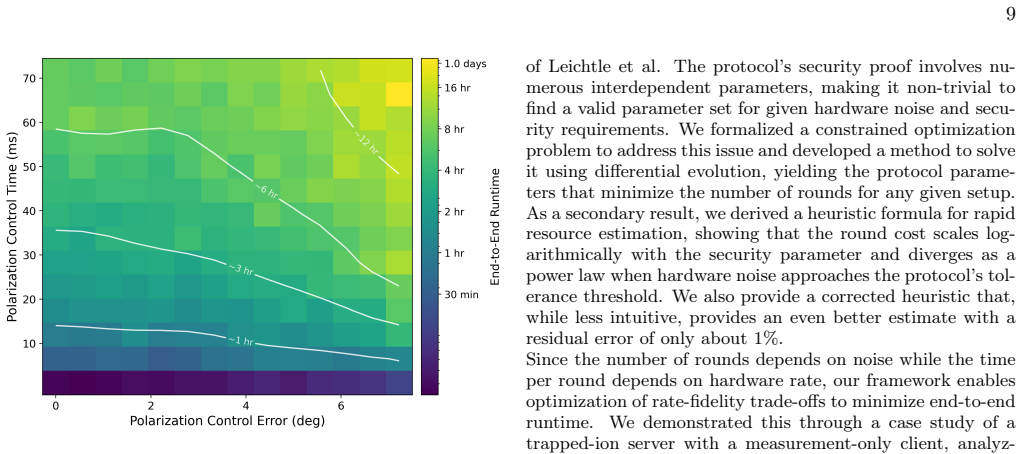
Verifiable blind quantum computing (VBQC) enables a resource-limited client to securely delegate computations to an untrusted quantum server while maintaining privacy and detecting deviations from the prescribed computation. The noise-robust VBQC protocol of Leichtle et al. achieves this through a round-based structure: the client delegates multiple computation rounds and test rounds, using the test outcomes to detect cheating while tolerating honest hardware noise. The protocol's security proof involves numerous interdependent parameters, making it non-trivial to find a valid parameter set for a given hardware noise level and security target. We formalize this as a constrained optimization problem and develop a practical framework to solve it. The framework yields the protocol parameters that minimize the number of rounds for any given setup. We derive a heuristic formula for the minimal number of rounds to help understand the scaling with noise and security targets and to provide rapid resource estimation. Since the number of rounds depends on noise while the time per round depends on hardware rate, the framework also enables optimization of rate-fidelity trade-offs to minimize end-to-end runtime. We demonstrate both applications through a case study of a trapped-ion server with a measurement-only client, showing how the client's polarization control hardware specifications translate into protocol parameters and runtime estimates, providing concrete guidance for near-term implementations.
Editorial analysis
A structured set of objections, weighed in public.
Referee Report
Summary. The manuscript formalizes parameter selection for the noise-robust VBQC protocol of Leichtle et al. as a constrained optimization problem whose objective is to minimize the total number of rounds while meeting a target security level for given hardware noise. It supplies a practical solver framework, derives a heuristic formula for the minimal round count as a function of noise and security parameters, and applies the method to a trapped-ion server with measurement-only client to produce concrete parameter sets and end-to-end runtime estimates that incorporate rate-fidelity trade-offs.
Significance. If the optimization constraints are shown to be faithful to the full set of interdependent bounds in the Leichtle et al. security theorem, the work supplies a concrete, reusable tool for resource estimation that directly supports near-term VBQC experiments by translating hardware specifications into minimal-round protocols and runtime predictions.
major comments (2)
- [Abstract; optimization formalization section] Abstract and the section describing the constrained optimization: the central claim that any optimizer output remains valid under the Leichtle et al. security theorem requires an explicit, itemized mapping from every interdependent condition in that theorem (noise tolerance, test-round acceptance thresholds, higher-order cheating-probability bounds, etc.) onto the implemented constraints. Without this mapping it is impossible to verify that the returned minimal-round solutions satisfy the original proof guarantees rather than a possibly relaxed surrogate.
- [Heuristic formula derivation] Section deriving the heuristic formula: the formula is presented as inheriting the same validity as the optimizer, yet no error analysis or comparison against the exact optimizer output is supplied for the parameter regimes used in the trapped-ion case study. This leaves open whether the heuristic systematically under- or over-estimates the required rounds when the full constraint set is enforced.
minor comments (2)
- [Notation and background] Notation for the security parameter and noise model should be introduced once with a clear reference to the corresponding quantities in Leichtle et al. to avoid ambiguity when the optimization constraints are stated.
- [Case study] The case-study figures would benefit from an additional panel or table that lists the exact constraint values returned by the optimizer alongside the heuristic prediction for direct numerical comparison.
Simulated Author's Rebuttal
We thank the referee for their careful reading and constructive comments on the manuscript. We address each major comment below.
read point-by-point responses
-
Referee: [Abstract; optimization formalization section] Abstract and the section describing the constrained optimization: the central claim that any optimizer output remains valid under the Leichtle et al. security theorem requires an explicit, itemized mapping from every interdependent condition in that theorem (noise tolerance, test-round acceptance thresholds, higher-order cheating-probability bounds, etc.) onto the implemented constraints. Without this mapping it is impossible to verify that the returned minimal-round solutions satisfy the original proof guarantees rather than a possibly relaxed surrogate.
Authors: We agree that an explicit, itemized mapping is required to substantiate the central claim. In the revised manuscript we will add a dedicated subsection (or table) that enumerates every condition appearing in the Leichtle et al. security theorem and shows its direct correspondence to the constraint implemented in the optimization framework. This addition will confirm that optimizer outputs remain faithful to the original proof guarantees. revision: yes
-
Referee: [Heuristic formula derivation] Section deriving the heuristic formula: the formula is presented as inheriting the same validity as the optimizer, yet no error analysis or comparison against the exact optimizer output is supplied for the parameter regimes used in the trapped-ion case study. This leaves open whether the heuristic systematically under- or over-estimates the required rounds when the full constraint set is enforced.
Authors: We acknowledge the absence of a quantitative validation for the heuristic. In the revised manuscript we will include a new subsection that compares heuristic predictions against exact optimizer outputs across a range of noise and security parameters, with explicit focus on the regimes of the trapped-ion case study. The comparison will report relative errors and discuss any systematic bias. revision: yes
Circularity Check
No significant circularity; optimization framework applies external security constraints
full rationale
The paper cites the Leichtle et al. security proof as the source of the constrained optimization problem and develops a solver plus heuristic for minimal rounds. No self-definitional mappings, fitted inputs renamed as predictions, or load-bearing self-citations appear in the provided text. The derivation chain remains self-contained by treating the cited protocol's bounds as given external inputs.
Axiom & Free-Parameter Ledger
axioms (1)
- domain assumption The noise-robust VBQC protocol of Leichtle et al. achieves security through round-based computation and test rounds that tolerate honest hardware noise.
Reference graph
Works this paper leans on
-
[1]
In MBQC, the computation is driven by single-qubit measure- ments performed on a highly entangled multi-qubit resource state, known as a cluster or graph state
Measurement-based quantum computing The rVBQC protocol relies on the MBQC model [19], an alternative to the more common circuit-based model. In MBQC, the computation is driven by single-qubit measure- ments performed on a highly entangled multi-qubit resource state, known as a cluster or graph state. A graph state is a quantum state that directly represen...
-
[2]
Because the client does not have the resources themselves, they delegate to a remote server
Blind delegation in the MBQC model Consider a scenario where a resource-limited client wants to execute a quantum computation. Because the client does not have the resources themselves, they delegate to a remote server. If the client wants their computation to remain pri- vate, it can use blind quantum computing (BQC) [2]. In BQC, the server remains ignor...
-
[3]
dummy qubits
Verification In addition to keeping the computation secret, we also want a way to check that the server performs as it is supposed to. This is where verification comes in. Verification is commonly achieved by embedding "traps" within the computation [9]. A trap is a qubit for which the client can deterministically determine the outcome when it is measured...
-
[4]
[14] introduces a noise-robust protocol that modifies the trap structure to enhance practi- cality and noise tolerance
The rVBQC protocol The work by Leichtle et al. [14] introduces a noise-robust protocol that modifies the trap structure to enhance practi- cality and noise tolerance. Instead of embedding individual traps within a single, large computational graph, this pro- tocol separates thentotal rounds into two sets. The full protocol consists ofdcomputation rounds, ...
-
[5]
Attacking conservatively: Attacking fewer than aZ fraction of rounds on average, avoiding detection with highprobabilitybutalsoflippingthemajorityvotewith low probability
-
[6]
Ok" or "Abort
Attacking aggressively: Attacking at least aZfraction of rounds on average, to flip the majority vote with higher probability but also have a low probability of doing this undetected. The security proof bounds both scenarios. Each bound can be tuned by independently adjusting how much statistical slack we allow around expected values for cheating strategi...
-
[7]
This means that each additional order of mag- nitude in security (adding a ‘nine’ of security) comes at a fixed, additive cost in the number of rounds
The cost of security: the resource scales linearly with -log(ϵ⋆). This means that each additional order of mag- nitude in security (adding a ‘nine’ of security) comes at a fixed, additive cost in the number of rounds
-
[8]
This impliesp max should be significantly lower thanZ/kfor the protocol to be practically im- plementable
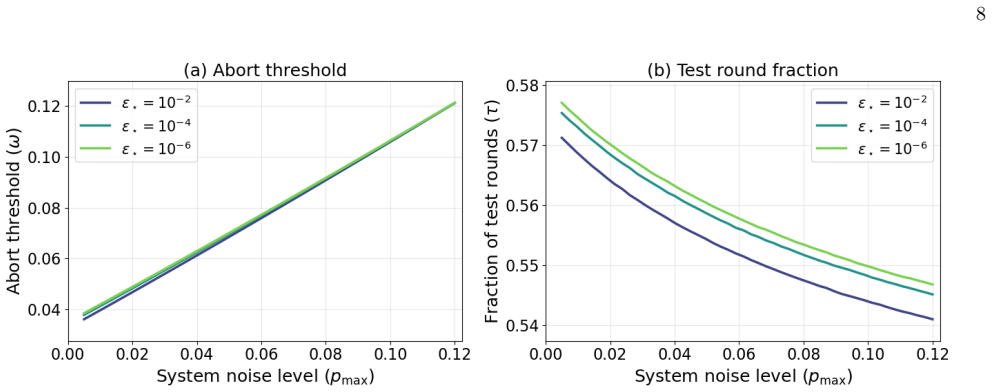
The cost of noise: the resource cost follows a power-law divergence as the hardware noise approaches it toler- ance limit. This impliesp max should be significantly lower thanZ/kfor the protocol to be practically im- plementable. We find that, while this heuristic reproduces the dominant behavior, a slow drift of the valuesaandbremains as the noise level ...
-
[9]
Collective dephasing of the trapped ions with a coher- ence time of 4 seconds [31]
-
[10]
Probability of depolarizing trapped ion when applying a single-qubit gate of 0.01 [32]
-
[11]
Probability of depolarizing trapped ion when applying a two-qubit gate of 0.05 [32]
-
[12]
Ion-photonentanglementasaWernerstatewithfidelity 0.88 [33]
-
[13]
Dark count probability at the client detecors as depo- larizing noise with depolarizing probability 0.02 [31]
-
[14]
Measurement error probability of ion trap of 0.0001 [31]
-
[15]
In the code, we made several simplifications that would lead to an incorrect implementation of the protocol, but lead to a correct estimation ofp max andt round
Loss modes: server efficiency (including coupling to fiber [34] and frequency conversion [31]) of 0.287, prob- ability of successfully transmitting through fiber of 10−10∗0.2/10 ≈0.63, detector efficiency of 0.87 [34]. In the code, we made several simplifications that would lead to an incorrect implementation of the protocol, but lead to a correct estimat...
-
[16]
is published along with the code. ACKNOWLEDGEMENTS The authors would like to thank Sounak Kar for point- ing to useful bounds, and Guus Avis, Jeroen Grimbergen, Sergio Loarte and Harold Ollivier for useful feedback on the manuscript and discussions. The authors would additionally like to thank Ben Lanyon and Tracy Northup and groups for providing informat...
-
[17]
Secure assisted quantum computa- tion.arXiv preprint quant-ph/0111046, 2001
Andrew M Childs. Secure assisted quantum computa- tion.arXiv preprint quant-ph/0111046, 2001
Pith/arXiv arXiv 2001
-
[18]
Universal blind quantum computation
Anne Broadbent, Joseph Fitzsimons, and Elham Kashefi. Universal blind quantum computation. In2009 50th an- nual IEEE symposium on foundations of computer sci- ence, pages 517–526. IEEE, 2009
2009
-
[19]
Verification of quantum computation: An overview of existing approaches.Theory of computing systems, 63(4):715–808, 2019
Alexandru Gheorghiu, Theodoros Kapourniotis, and El- ham Kashefi. Verification of quantum computation: An overview of existing approaches.Theory of computing systems, 63(4):715–808, 2019
2019
-
[20]
Fitzsimons, Anton Zeilinger, and Philip Walther
Stefanie Barz, Elham Kashefi, Anne Broadbent, Joseph F. Fitzsimons, Anton Zeilinger, and Philip Walther. Demonstration of blind quantum computing. Science, 335(6066):303–308, 2012
2012
-
[21]
Demon- stration of measurement-only blind quantum computing
Chiara Greganti, Marie-Christine Roehsner, Stefanie Barz, Tomoyuki Morimae, and Philip Walther. Demon- stration of measurement-only blind quantum computing. New Journal of Physics, 18(1):013020, 2016
2016
-
[22]
Sanders, Chao-Yang Lu, and Jian-Wei Pan
He-Liang Huang, Qi Zhao, Xiongfeng Ma, Chang Liu, Zu-En Su, Xi-Lin Wang, Li Li, Nai-Le Liu, Barry C. Sanders, Chao-Yang Lu, and Jian-Wei Pan. Experimen- tal blind quantum computing for a classical client.Phys- ical Review Letters, 119(5):050503, 2017
2017
-
[23]
Fitzsimons, Elham Kashefi, and Philip Walther
Stefanie Barz, Joseph F. Fitzsimons, Elham Kashefi, and Philip Walther. Experimental verification of quantum computation.Nature Physics, 9(11):727–731, 2013
2013
-
[24]
Ver- ifiable blind quantum computing with trapped ions and single photons.Physical Review Letters, 132(15):150604, 2024
Peter Drmota, DP Nadlinger, D Main, BC Nichol, EM Ainley, Dominik Leichtle, A Mantri, Elham Kashefi, R Srinivas, G Araneda, CJ Ballance, and DM Lucas. Ver- ifiable blind quantum computing with trapped ions and single photons.Physical Review Letters, 132(15):150604, 2024
2024
-
[25]
Uncondition- ally verifiable blind quantum computation.Phys
Joseph F Fitzsimons and Elham Kashefi. Uncondition- ally verifiable blind quantum computation.Phys. Rev. A, 96:012303, 2017
2017
-
[26]
Verifiable measurement-only blind quantum computing with sta- bilizer testing.Physical review letters, 115(22):220502, 2015
Masahito Hayashi and Tomoyuki Morimae. Verifiable measurement-only blind quantum computing with sta- bilizer testing.Physical review letters, 115(22):220502, 2015
2015
-
[27]
Classical verification of quantum com- putations
Urmila Mahadev. Classical verification of quantum com- putations. In2018 IEEE 59th Annual Symposium on Foundations of Computer Science (FOCS), pages 259–
-
[28]
Quantum Computing in the NISQ era and beyond.Quantum, 2:79, 2018
John Preskill. Quantum Computing in the NISQ era and beyond.Quantum, 2:79, 2018
2018
-
[29]
Theodoros Kapourniotis, Dominik Leichtle, Luka Mu- sic, and Harold Ollivier. Plugging leaks in fault-tolerant quantum computation and verification.arXiv preprint arXiv:2510.03227, 2025
Pith/arXiv arXiv 2025
-
[30]
Verifying bqp computations on noisy devices with minimal overhead.PRX Quantum, 2(4):040302, 2021
Dominik Leichtle, Luka Music, Elham Kashefi, and Harold Ollivier. Verifying bqp computations on noisy devices with minimal overhead.PRX Quantum, 2(4):040302, 2021
2021
-
[31]
Entanglement routing based on fidelity curves.arXiv preprint arXiv:2303.12864, 2023
Bruno C Coutinho, Raul Monteiro, Luís Bugalho, and Francisco A Monteiro. Entanglement routing based on fidelity curves.arXiv preprint arXiv:2303.12864, 2023
arXiv 2023
-
[32]
Rate-fidelity trade-off in cavity-based remote entanglement generation.Physical Review A, 110(4):042405, 2024
Kazufumi Tanji, Hiroki Takahashi, Wojciech Roga, and Masahiro Takeoka. Rate-fidelity trade-off in cavity-based remote entanglement generation.Physical Review A, 110(4):042405, 2024
2024
-
[33]
Entangling remote qubits using the single-photon protocol: an in- depth theoretical and experimental study.New Journal of Physics, 25(1):013011, 2023
Sophie LN Hermans, Matteo Pompili, L Dos Santos Mar- tins, A RP Montblanch, Hans KC Beukers, Simon Baier, Johannes Borregaard, and Ronald Hanson. Entangling remote qubits using the single-photon protocol: an in- depth theoretical and experimental study.New Journal of Physics, 25(1):013011, 2023
2023
-
[34]
Janice van Dam, Emil R Hellebek, Tzula B Propp, Junior R Gonzales-Ureta, Anders S Sørensen, and Stephanie DC Wehner. Single-click protocols for re- mote state preparation using weak coherent pulses.arXiv preprint arXiv:2508.14857, 2025
arXiv 2025
-
[35]
Aone-wayquan- tum computer.Physical review letters, 86(22):5188, 2001
RobertRaussendorfandHansJBriegel. Aone-wayquan- tum computer.Physical review letters, 86(22):5188, 2001
2001
-
[36]
Multi- party entanglement in graph states.Physical Review A, 69(6):062311, 2004
Marc Hein, Jens Eisert, and Hans J Briegel. Multi- party entanglement in graph states.Physical Review A, 69(6):062311, 2004
2004
-
[37]
Remote state preparation.Physical Review Letters, 87(7):077902, 2001
Charles H Bennett, David P DiVincenzo, Peter W Shor, John A Smolin, Barbara M Terhal, and William K Woot- ters. Remote state preparation.Physical Review Letters, 87(7):077902, 2001
2001
-
[38]
Abstract cryptogra- phy
Ueli Maurer and Renato Renner. Abstract cryptogra- phy. InInnovations in Computer Science, Beijing, 2011. Tsinghua University Press
2011
-
[39]
In this context, the ‘server’ is anything but the client itself, so any evesdropper on the channel, for example, is absorbed, from a security standpoint, into the server
-
[40]
Composable security of del- egated quantum computation
Vedran Dunjko, Joseph F Fitzsimons, Christopher Port- mann, and Renato Renner. Composable security of del- egated quantum computation. InInternational Confer- ence on the Theory and Application of Cryptology and Information Security, pages 406–425. Springer, 2014
2014
-
[41]
Differential evolution– a simple and efficient heuristic for global optimization over continuous spaces.Journal of global optimization, 11(4):341–359, 1997
Rainer Storn and Kenneth Price. Differential evolution– a simple and efficient heuristic for global optimization over continuous spaces.Journal of global optimization, 11(4):341–359, 1997
1997
-
[42]
Scipy 1.0: fundamental algorithms for sci- entific computing in python.Nature methods, 17(3):261– 272, 2020
Pauli Virtanen, Ralf Gommers, Travis E Oliphant, Matt Haberland, Tyler Reddy, David Cournapeau, Evgeni Burovski, Pearu Peterson, Warren Weckesser, Jonathan Bright, et al. Scipy 1.0: fundamental algorithms for sci- entific computing in python.Nature methods, 17(3):261– 272, 2020
2020
-
[43]
Publication code.https://gitlab.tudelft.nl/wehner-research/ security_paper_publication_code.git, 2025
Janice van Dam and Michal van Hooft. Publication code.https://gitlab.tudelft.nl/wehner-research/ security_paper_publication_code.git, 2025
2025
-
[44]
Quantum com- plexity theory
Ethan Bernstein and Umesh Vazirani. Quantum com- plexity theory. InProceedings of the twenty-fifth annual ACM symposium on Theory of computing, pages 11–20, 1993
1993
-
[45]
Hardware requirements for trapped- ion-based verifiable blind quantum computing with a measurement-only client.Quantum Science and Tech- nology, 9(4):045031, 2024
Janice van Dam, Guus Avis, Tz B Propp, F Fer- reira da Silva, Joshua A Slater, Tracy E Northup, and Stephanie Wehner. Hardware requirements for trapped- ion-based verifiable blind quantum computing with a measurement-only client.Quantum Science and Tech- nology, 9(4):045031, 2024
2024
-
[46]
NetSquid, a NETwork Simulator for QUantum Information using Discrete events.Communi- cations Physics, 4(1):164, 2021
Tim Coopmans, Robert Knegjens, Axel Dahlberg, David Maier, Loek Nijsten, Julio de Oliveira Filho, Martijn Papendrecht, Julian Rabbie, Filip Rozpędek, Matthew Skrzypczyk, et al. NetSquid, a NETwork Simulator for QUantum Information using Discrete events.Communi- cations Physics, 4(1):164, 2021. 11
2021
-
[47]
Private communica- tion, 2025
Ben Lanyon and Tracy Northup. Private communica- tion, 2025. Trapped-ion system parameters, University of Innsbruck
2025
-
[48]
Telecom-wavelength quantumrepeaternodebasedonatrapped-ionprocessor
Viktor Krutyanskiy, Marco Canteri, Martin Meraner, James Bate, Vojtech Krcmarsky, Josef Schupp, Nico- las Sangouard, and Ben P Lanyon. Telecom-wavelength quantumrepeaternodebasedonatrapped-ionprocessor. Physical Review Letters, 130(21):213601, 2023
2023
-
[49]
En- tanglement of trapped-ion qubits separated by 230 me- ters.Physical Review Letters, 130(5):050803, 2023
Viktor Krutyanskiy, Maria Galli, Vojtech Krcmarsky, Si- mon Baier, DA Fioretto, Yunfei Pu, Azadeh Mazloom, Pavel Sekatski, Marco Canteri, Markus Teller, et al. En- tanglement of trapped-ion qubits separated by 230 me- ters.Physical Review Letters, 130(5):050803, 2023
2023
-
[50]
Interface between trapped-ion qubits and traveling pho- tons with close-to-optimal efficiency.PRX Quantum, 2(2):020331, 2021
Josef Schupp, Vojtech Krcmarsky, Viktor Krutyanskiy, Martin Meraner, Tracy E Northup, and Ben P Lanyon. Interface between trapped-ion qubits and traveling pho- tons with close-to-optimal efficiency.PRX Quantum, 2(2):020331, 2021. 12 Appendix A: Glossary Here we provide an overview of the parameters introduced in this paper, for reference. We divide the pa...
2021
-
[51]
Input parameters: these parameters define the opti- mization problem and are user-provided, these are pre- sented in Table II
-
[52]
These are presented in Table III
Tuning parameters: parameters that are part of the security proof and can be tuned the find the minimal number of rounds. These are presented in Table III
-
[53]
conserva- tive
Other parameters: parameters that occur but do not fit into the above two categories. These are presented in Table IV TABLE II: Input parameters Meaning ϵ⋆ Overall security error target pmax The probability that a test round fails in an honest-but-noisy setting: deter- mined by the physical noise level of the system k The colourability of the graph that i...
discussion (0)
Sign in with ORCID, Apple, or X to comment. Anyone can read and Pith papers without signing in.