Hybrid Quantum-Classical Neural Networks for Recognizing Quantum Phases
Pith reviewed 2026-06-29 03:34 UTC · model grok-4.3
The pith
A hybrid quantum-classical neural network trained on superconducting hardware classifies topological surface code states from product states even under single-qubit Pauli errors.
A machine-rendered reading of the paper's core claim, the machinery that carries it, and where it could break.
Core claim
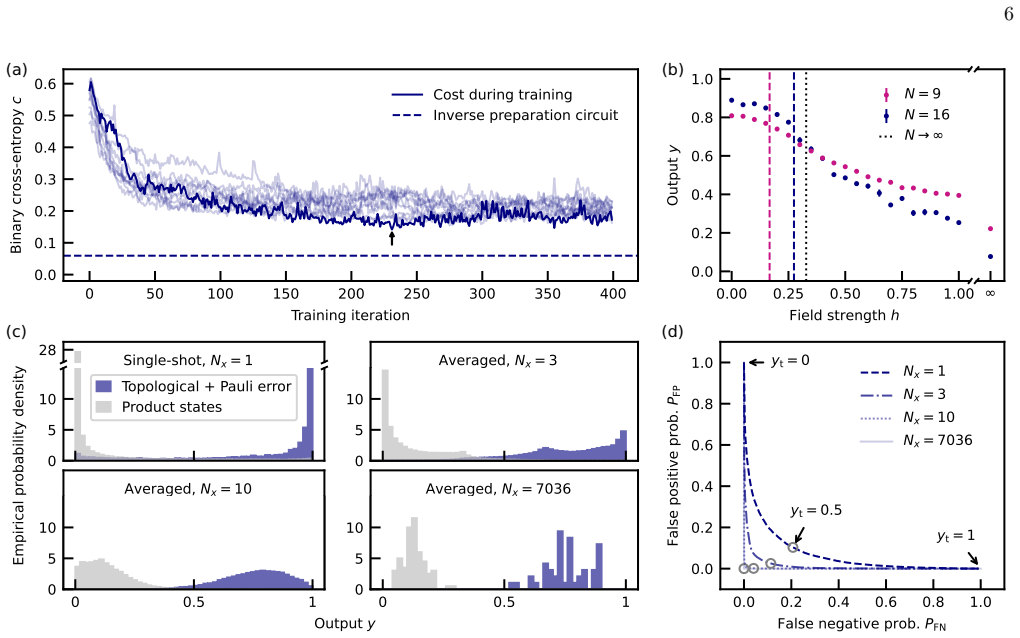
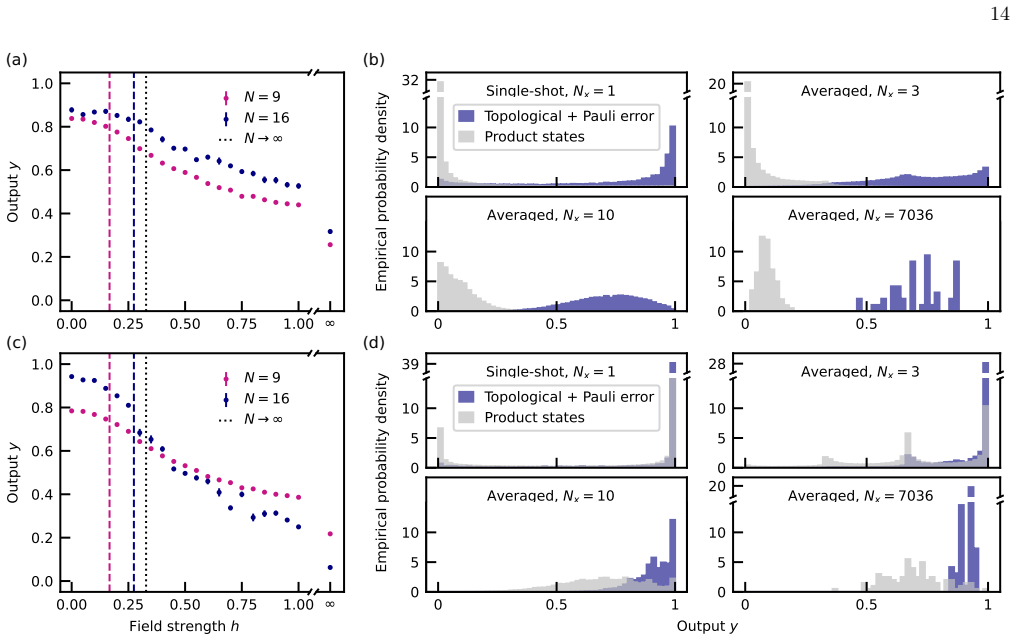
The trained classifier distinguishes topological ground states of the surface code from randomly chosen product states, even when subjected to any single-qubit Pauli error, reaching accuracies above 85% in single-shot measurements and above 99% when averaging over ten measurements.
What carries the argument
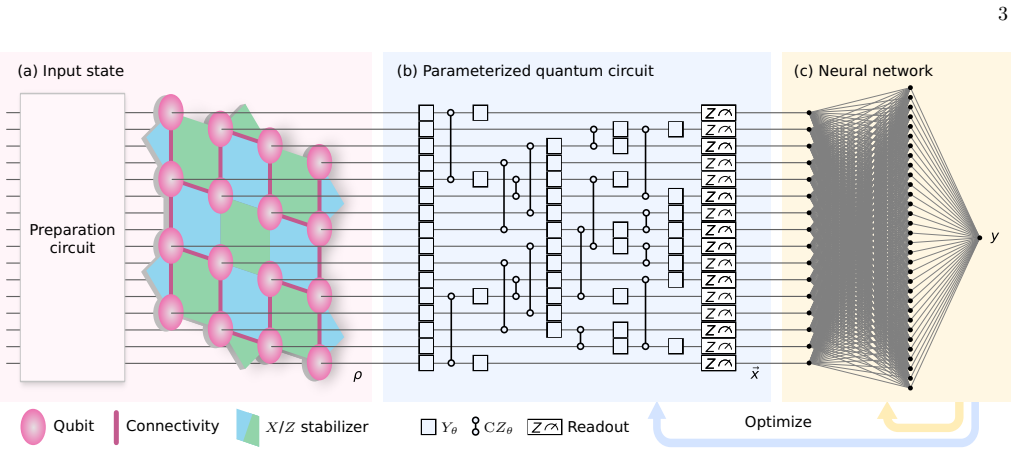
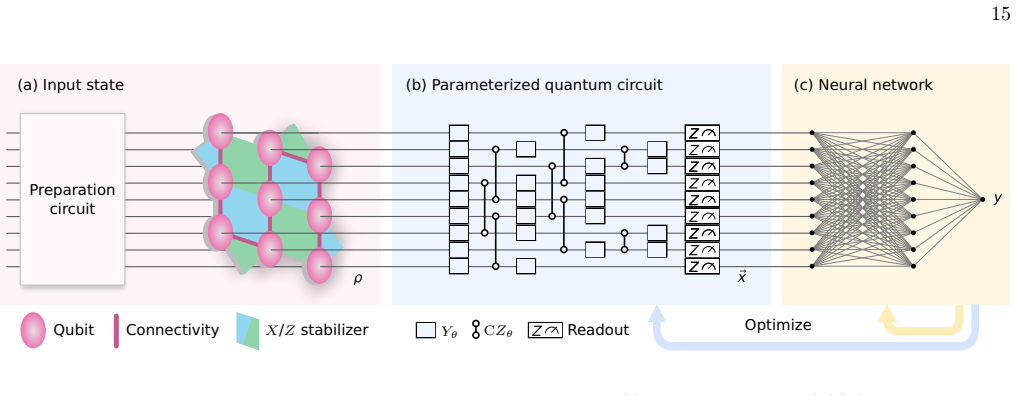
Hardware-efficient parameterized quantum circuit combined with a classical feedforward neural network, jointly optimized inside the training loop on superconducting hardware.
If this is right
- The same training procedure can be applied to other lattices and Hamiltonians where topological order must be distinguished from trivial product states.
- Averaging a modest number of shots suffices to push accuracy above 99 percent, suggesting the method tolerates realistic measurement noise.
- The approach targets regimes in which classical sample complexity grows unfavorably, offering a potential alternative for characterizing strongly correlated quantum matter.
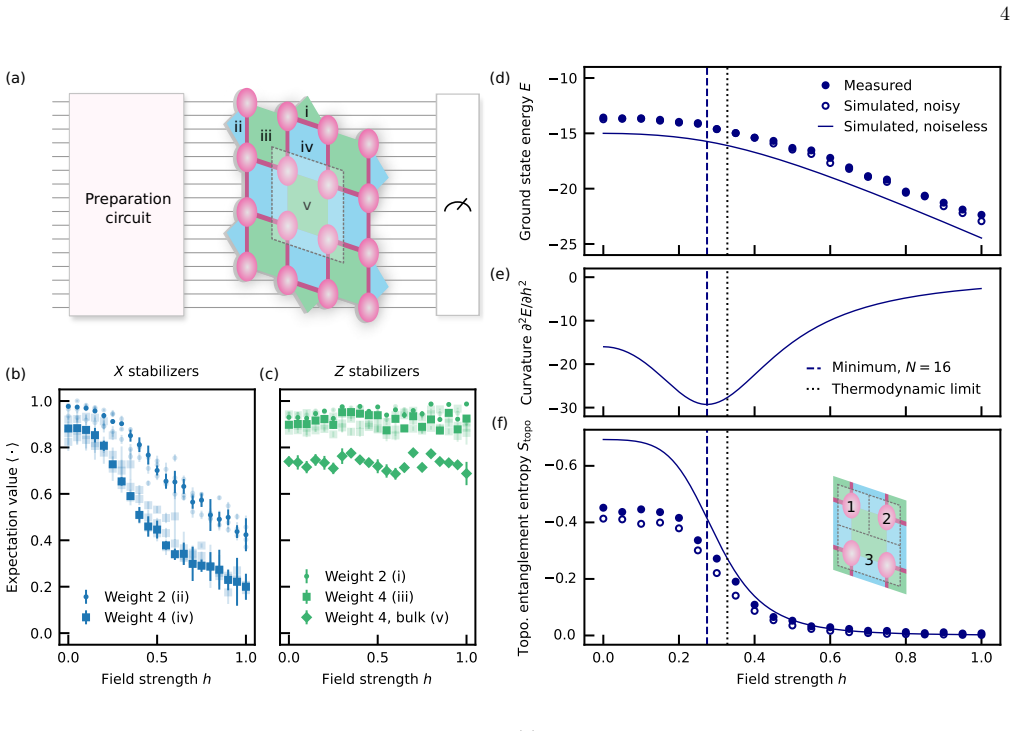
- The method scales at least to 4x4 surface-code lattices in a magnetic field while remaining executable on current superconducting processors.
Where Pith is reading between the lines
- Similar hybrid circuits could be tested on other topological models such as the toric code or fractional quantum Hall states to check whether the same error-robust classification holds.
- If the quantum circuit component can be made shallower, the method might become practical for near-term devices with fewer qubits.
- The learned quantum features could be inspected to extract interpretable diagnostics of topological order that classical networks miss.
Load-bearing premise
The joint training on real hardware embeds genuine nonlocal topological information rather than letting the classical network memorize device-specific noise patterns.
What would settle it
An experiment in which the same classical network is trained without the quantum circuit or with the quantum-circuit parameters held fixed at random values, then tested on the same error-corrupted data; if accuracy stays above 85 percent the hybrid quantum component is not required.
Figures
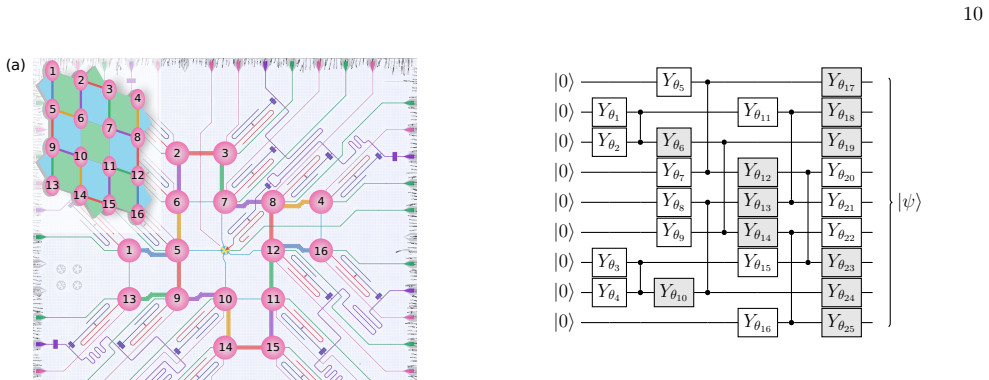
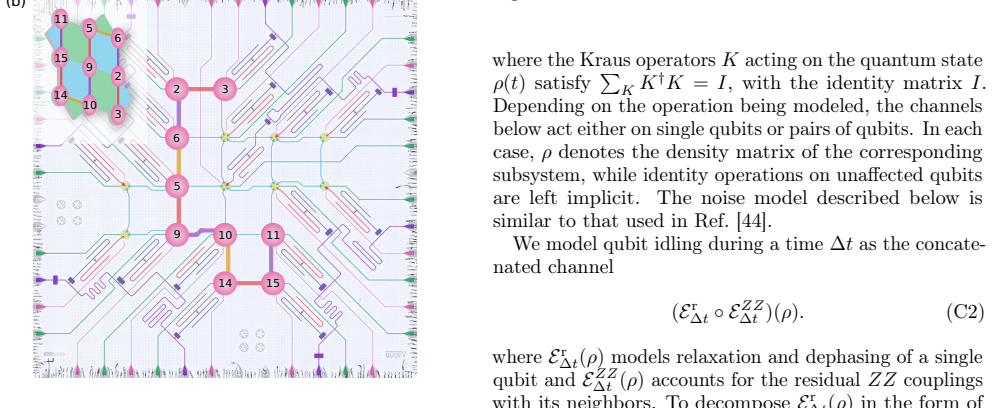
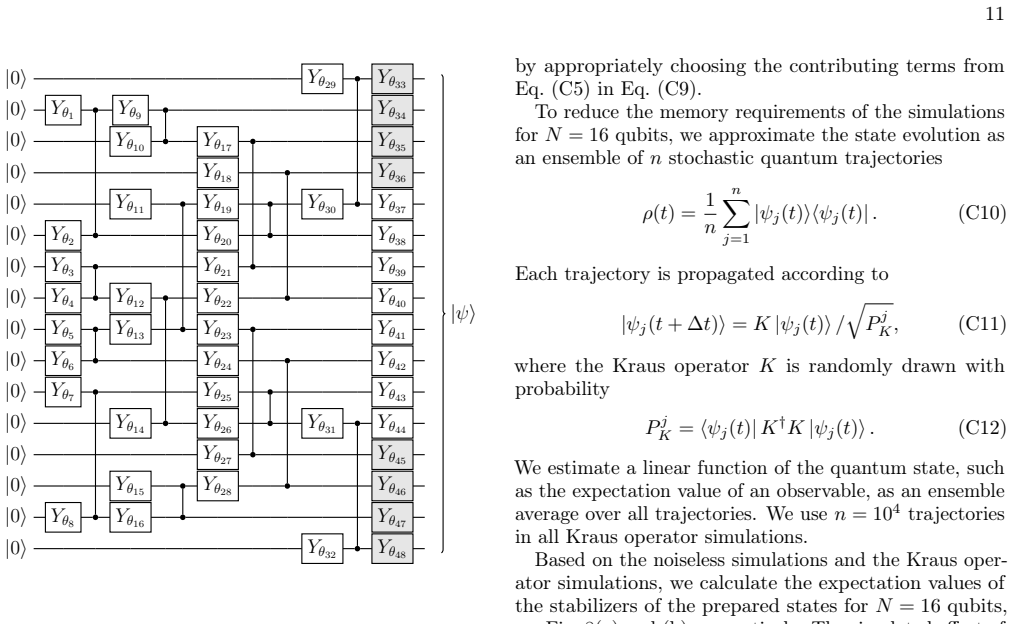
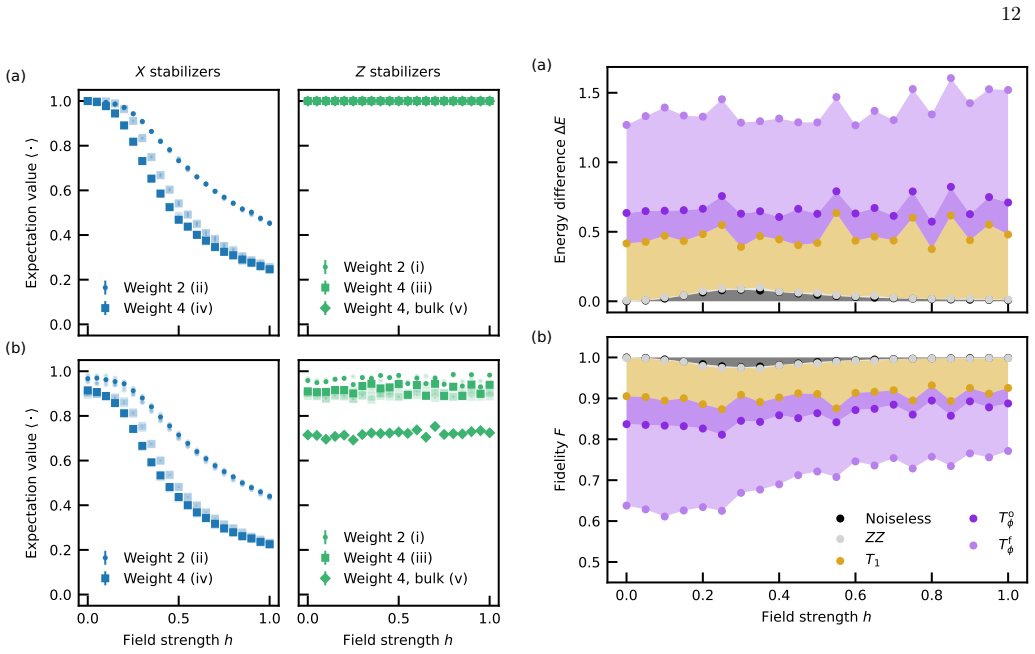
read the original abstract
Identifying quantum phases of matter is key to understanding strongly correlated materials, but remains a challenging task for both conventional computers and current quantum processors. Here, we introduce and implement a hybrid quantum-classical neural network for quantum phase recognition by combining a hardware-efficient parameterized quantum circuit and a feedforward neural network. We jointly train both components with superconducting quantum hardware in the optimization loop, to experimentally demonstrate a classifier for the quantum phases of surface code lattices with up to 4x4 sites in a magnetic field. To learn nonlocal features of the topological phase, we train the hybrid neural network to distinguish topological ground states of the surface code from a featureless ensemble of product states. This allows the trained classifier to distinguish topological ground states from randomly chosen product states, even when subjected to any single-qubit Pauli error. The classifier reaches accuracies above 85% in single-shot measurements, and above 99% when averaging over ten measurements. We expect hybrid neural networks such as the one presented here to be a promising approach for characterizing quantum states in scenarios where classical methods exhibit an unfavorable scaling of sample complexity.
Editorial analysis
A structured set of objections, weighed in public.
Referee Report
Summary. The manuscript introduces a hybrid quantum-classical neural network combining a hardware-efficient parameterized quantum circuit with a feedforward classical neural network. The components are jointly trained on superconducting quantum hardware to classify topological ground states of the surface code (lattices up to 4x4 sites in a magnetic field) against an ensemble of product states. The trained classifier is reported to distinguish these states even under any single-qubit Pauli error, achieving >85% accuracy in single-shot measurements and >99% when averaging over ten measurements.
Significance. If the experimental results are confirmed to arise from learned topological features rather than device-specific artifacts, the work provides a concrete demonstration of hybrid models for quantum phase recognition on near-term hardware. The joint training loop on superconducting processors and the claimed robustness to Pauli errors constitute experimental strengths that could guide future applications where classical sample complexity is prohibitive.
major comments (1)
- [Experimental demonstration paragraph (abstract and main text)] Experimental demonstration paragraph: The central claim requires that the hybrid model embeds nonlocal topological order (rather than hardware noise correlations) to achieve the reported accuracies. No ablations are described—such as an ideal-simulator baseline, label-shuffled controls, or noise-only inputs—to verify that performance collapses when hardware-specific readout errors or crosstalk are removed. This verification is load-bearing for the experimental demonstration.
minor comments (1)
- The manuscript should supply explicit details on the training protocol, data splitting, number of shots/runs, error mitigation methods, and statistical controls (including error bars) to permit independent verification of the quoted accuracies.
Simulated Author's Rebuttal
We thank the referee for their thorough review and constructive feedback. We address the major comment point by point below and outline the changes we will make to strengthen the experimental claims.
read point-by-point responses
-
Referee: [Experimental demonstration paragraph (abstract and main text)] Experimental demonstration paragraph: The central claim requires that the hybrid model embeds nonlocal topological order (rather than hardware noise correlations) to achieve the reported accuracies. No ablations are described—such as an ideal-simulator baseline, label-shuffled controls, or noise-only inputs—to verify that performance collapses when hardware-specific readout errors or crosstalk are removed. This verification is load-bearing for the experimental demonstration.
Authors: We agree that ablations are necessary to confirm the model learns topological features rather than exploiting hardware-specific correlations. In the revised manuscript we will add: (i) an ideal-simulator baseline showing classification performance in the absence of device noise; (ii) label-shuffled controls demonstrating that accuracy falls to chance level when labels are randomized; and (iii) noise-only input tests (random product states and pure error configurations) confirming that high accuracy requires the topological ground states. These additions will directly address the concern that performance may arise from readout errors or crosstalk. revision: yes
Circularity Check
Experimental demonstration with no derivation chain or self-referential reduction
full rationale
The manuscript reports an experimental implementation: a hybrid quantum-classical network is jointly trained on superconducting hardware to classify surface-code ground states versus product states, with reported single-shot accuracies above 85%. No equations, first-principles derivations, or predictions are claimed that could reduce by construction to fitted inputs, self-citations, or ansatzes. The central claim is an empirical hardware result, not a mathematical identity or uniqueness theorem. No load-bearing self-citation or renaming of known results appears in the provided text. This is a standard experimental report whose validity rests on controls and reproducibility rather than any circular derivation.
Axiom & Free-Parameter Ledger
Reference graph
Works this paper leans on
-
[1]
We provide the outputy of the hybrid neural network to a binary classifier with decision thresholdyt ∈ [0, 1]
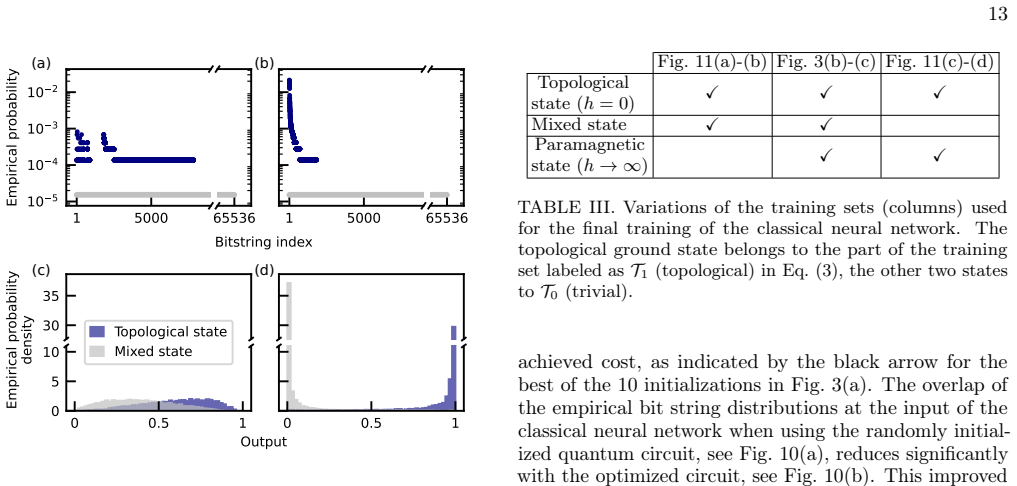
yields non-overlapping distributions for this test set. We provide the outputy of the hybrid neural network to a binary classifier with decision thresholdyt ∈ [0, 1]. The state is classified as topological fory ≥ yt and as trivial for y < y t. We estimate the error probabilities, which correspond to either classifying the trivial states as topological (fa...
2022
-
[2]
Carleo, I
G. Carleo, I. Cirac, K. Cranmer, L. Daudet, M. Schuld, N. Tishby, L. Vogt-Maranto, and L. Zdeborová, Machine learning and the physical sciences, Review of Modern Physics 91, 045002 (2019)
2019
-
[3]
Wittek, Quantum machine learning: what quantum computing means to data mining (Elsevier, 2014)
P. Wittek, Quantum machine learning: what quantum computing means to data mining (Elsevier, 2014)
2014
-
[4]
Biamonte, P
J. Biamonte, P. Wittek, N. Pancotti, P. Rebentrost, N. Wiebe, and S. Lloyd, Quantum machine learning, Na- ture 549, 195 (2017)
2017
-
[5]
Cerezo, G
M. Cerezo, G. Verdon, H.-Y. Huang, L. Cincio, and P. J. Coles, Challenges and opportunities in quantum machine learning, Nature Computational Science2, 567 (2022)
2022
-
[6]
Xia and S
R. Xia and S. Kais, Quantum machine learning for elec- tronic structure calculations, Nat. Comm.9, 4195 (2018)
2018
-
[7]
W. Guan, G. Perdue, A. Pesah, M. Schuld, K. Terashi, S. Vallecorsa, J.-R. Vlimant, W. Guan, G. Perdue, A. Pe- sah, M. Schuld, K. Terashi, S. Vallecorsa, and J.-R. Vli- mant, Quantum machine learning in high energy physics, Machine Learning: Science and Technology2, 011003 (2021)
2021
-
[8]
I.Cong, S.Choi,andM.D.Lukin,Quantumconvolutional neural networks, Nature Physics15, 1273 (2019)
2019
-
[9]
Bravo-Prieto, J
C. Bravo-Prieto, J. Lumbreras-Zarapico, L. Tagliacozzo, and J. I. Latorre, Scaling of variational quantum circuit depth for condensed matter systems, Quantum4, 272 (2020)
2020
-
[10]
D. Wu, R. Rossi, F. Vicentini, N. Astrakhantsev, F. Becca, X. Cao, J. Carrasquilla, F. Ferrari, A. Georges, M. Hibat- Allah, M. Imada, A. M. Läuchli, G. Mazzola, A. Mezza- capo, A. Millis, J. R. Moreno, T. Neupert, Y. Nomura, J. Nys, O. Parcollet, R. Pohle, I. Romero, M. Schmid, J. M. Silvester, S. Sorella, L. F. Tocchio, L. Wang, S. R. White, A. Wietek, ...
2024
-
[11]
G. Acampora, A. Ambainis, N. Ares, L. Banchi, P. Bhard- waj, D. Binosi, G. A. D. Briggs, T. Calarco, V. Dun- jko, J. Eisert, O. Ezratty, P. Erker, F. Fedele, E. Gil- Fuster, M. Gärttner, M. Granath, M. Heyl, I. Kerenidis, M. Klusch, A. F. Kockum, R. Kueng, M. Krenn, J. Lässig, A. Macaluso, S. Maniscalco, F. Marquardt, K. Michielsen, G. Muñoz Gil, D. Müssi...
arXiv 2025
-
[12]
Abbas, D
A. Abbas, D. Sutter, C. Zoufal, A. Lucchi, A. Figalli, and S. Woerner, The power of quantum neural networks, Nature Computational Science1, 403 (2021)
2021
-
[13]
Wiersema, C
R. Wiersema, C. Zhou, Y. de Sereville, J. F. Carrasquilla, 16 Y. B. Kim, and H. Yuen, Exploring entanglement and optimization within the Hamiltonian variational ansatz, PRX Quantum1, 020319 (2020)
2020
-
[14]
M. S. Rudolph, S. Lerch, S. Thanasilp, O. Kiss, O. Shaya, S. Vallecorsa, M. Grossi, and Z. Holmes, Trainability bar- riers and opportunities in quantum generative modeling, npj Quantum Information10, 116 (2024)
2024
-
[15]
Huang, M
H.-Y. Huang, M. Broughton, J. Cotler, S. Chen, J. Li, M. Mohseni, H. Neven, R. Babbush, R. Kueng, J. Preskill, and J. R. McClean, Quantum advantage in learning from experiments, Science376, 1182 (2022)
2022
-
[16]
Huang, R
H.-Y. Huang, R. Kueng, and J. Preskill, Information- theoretic bounds on quantum advantage in machine learn- ing, Phys. Rev. Lett.126, 190505 (2021)
2021
-
[17]
S. B. Bravyi and A. Y. Kitaev, Quantum codes on a lattice with boundary, arXiv:quant-ph/9811052 (1998)
Pith/arXiv arXiv 1998
-
[18]
A. Y. Kitaev, Fault-tolerant quantum computation by anyons, Annals of Physics303, 2 (2003)
2003
-
[19]
Carrasquilla and R
J. Carrasquilla and R. G. Melko, Machine learning phases of matter, Nature Physics13, 431 (2017)
2017
-
[20]
van Nieuwenburg, Y.-H
E. van Nieuwenburg, Y.-H. Liu, and S. Huber, Learning phase transitions by confusion, Nature Physics13, 435 (2017)
2017
-
[21]
Huang, R
H.-Y. Huang, R. Kueng, G. Torlai, V. V. Albert, and J. Preskill, Provably efficient machine learning for quan- tum many-body problems, Science377, eabk3333 (2022)
2022
-
[22]
I. Cong, N. Maskara, M. C. Tran, H. Pichler, G. Semegh- ini, S. F. Yelin, S. Choi, and M. D. Lukin, Enhancing detection of topological order by local error correction, Nat. Commun.15 (2024)
2024
-
[23]
Y.-J. Liu, K. Shtengel, and F. Pollmann, Simulating two- dimensional topological quantum phase transitions on a digital quantum computer, Phys. Rev. Research6, 043256 (2024)
2024
-
[24]
T. B. Wahl, W. J. Jankowski, A. Bouhon, G. Chaudhary, and R.-J. Slager, Exact projected entangled pair ground states with topological Euler invariant, Nat. Commun. 16, 284 (2025)
2025
-
[25]
Y. Teng, R. Samajdar, K. Van Kirk, F. Wilde, S. Sachdev, J. Eisert, R. Sweke, and K. Najafi, Learning topological states from randomized measurements using variational tensor-network tomography, PRX Quantum6, 040303 (2025)
2025
-
[26]
Sancho-Lorente, J
T. Sancho-Lorente, J. Román-Roche, and D. Zueco, Quan- tum kernels to learn the phases of quantum matter, Phys. Rev. A105, 042432 (2022)
2022
-
[27]
Tanji, H
A. Tanji, H. Yano, and N. Yamamoto, Quantum phase classification via partial tomography-based quantum hy- pothesis testing, Scientific Reports16, 4555 (2026)
2026
-
[28]
J. Chen, Y. Wu, Z. Yang, S. Xu, X. Ye, D. Li, K. Wang, C. Zhang, F. Jin, X. Zhu, Y. Gao, Z. Tan, Z. Cui, A. Zhang, N. Wang, Y. Zou, T. Li, F. Shen, J. Zhong, Z. Bao, Z. Zhu, Z. Song, J. Deng, H. Dong, P. Zhang, W. Zhang, H. Li, Q. Guo, Z. Wang, Y. Li, X. Wang, C. Song, and H. Wang, Quantum ensemble learning with a programmable superconducting processor, n...
2025
-
[29]
Havlicek, A
V. Havlicek, A. D. Corcoles, K. Temme, A. W. Harrow, A. Kandala, J. M. Chow, and J. M. Gambetta, Supervised learning with quantum-enhanced feature spaces, Nature 567, 209 (2019)
2019
-
[30]
Henderson, S
M. Henderson, S. Shakya, S. Pradhan, and T. Cook, Quan- volutional neural networks: powering image recognition with quantum circuits, Quantum Machine Intelligence2, 2 (2020)
2020
-
[31]
J. Liu, K. H. Lim, K. L. Wood, W. Huang, C. Guo, and H.- L. Huang, Hybrid quantum-classical convolutional neural networks, Science China Physics, Mechanics & Astronomy 64, 290311 (2021)
2021
-
[32]
Peters, J
E. Peters, J. Caldeira, A. Ho, S. Leichenauer, M. Mohseni, H. Neven, P. Spentzouris, D. Strain, and G. N. Perdue, Machine learning of high dimensional data on a noisy quantum processor, npj Quantum Information 7, 161 (2021)
2021
-
[33]
Senokosov, A
A. Senokosov, A. Sedykh, A. Sagingalieva, B. Kyriacou, and A. Melnikov, Quantum machine learning for image classification, Machine Learning: Science and Technology 5, 015040 (2024)
2024
-
[34]
Romero, J
J. Romero, J. P. Olson, and A. Aspuru-Guzik, Quantum autoencoders for efficient compression of quantum data, Quantum Science and Technology2, 045001 (2017)
2017
-
[35]
J. L. Beckey, M. Cerezo, A. Sone, and P. J. Coles, Vari- ational quantum algorithm for estimating the quantum Fisher information, Phys. Rev. Research4, 013083 (2022)
2022
-
[36]
M. R. Geller, Z. Holmes, P. J. Coles, and A. Sornborger, Experimental quantum learning of a spectral decomposi- tion, Phys. Rev. Research3, 033200 (2021)
2021
-
[37]
Gong, H.-L
M. Gong, H.-L. Huang, S. Wang, C. Guo, S. Li, Y. Wu, Q. Zhu, Y. Zhao, S. Guo, H. Qian, Y. Ye, C. Zha, F. Chen, C. Ying, J. Yu, D. Fan, D. Wu, H. Su, H. Deng, H. Rong, K. Zhang, S. Cao, J. Lin, Y. Xu, L. Sun, C. Guo, N. Li, F. Liang, A. Sakurai, K.Nemoto, W.J. Munro, Y.-H. Huo, C.-Y. Lu, C.-Z. Peng, X. Zhu, and J.-W. Pan, Quantum neuronal sensing of quantu...
2023
-
[38]
M. C. Caro, H.-Y. Huang, M. Cerezo, K. Sharma, A. Sorn- borger, L. Cincio, and P. J. Coles, Generalization in quan- tum machine learning from few training data, Nat. Com- mun. 13, 4919 (2022)
2022
-
[39]
M. C. Caro, H.-Y. Huang, N. Ezzell, J. Gibbs, A. T. Sornborger, L. Cincio, P. J. Coles, and Z. Holmes, Out-of- distribution generalization for learning quantum dynam- ics, Nat. Commun.14, 3751 (2023)
2023
-
[40]
Schuld and F
M. Schuld and F. Petruccione,Supervised Learning with Quantum Computers (Springer-Verlag GmbH, 2018)
2018
-
[41]
E. Farhi and H. Neven, Classification with quantum neu- ral networks on near term processors, arXiv:1802.06002 (2018)
Pith/arXiv arXiv 2018
-
[42]
K. Beer, D. Bondarenko, T. Farrelly, T. J. Osborne, R. Salzmann, D. Scheiermann, and R. Wolf, Training deep quantum neural networks, Nat. Commun.11, 808 (2020)
2020
-
[43]
M. Broughton, G. Verdon, T. McCourt, A. J. Martinez, J. H. Yoo, S. V. Isakov, P. Massey, M. Y. Niu, R. Halavati, E. Peters, M. Leib, A. Skolik, M. Streif, D. Von Dollen, J. R. McClean, S. Boixo, D. Bacon, A. K. Ho, H. Neven, M. E. Mohseni, D. K. Kim, J. L. Yoder, T. P. Orlando, S. Gustavsson, and W. D. Oliver, Tensorflow quantum: A software framework for ...
arXiv 2003
-
[44]
A. V. Uvarov, A. S. Kardashin, and J. D. Biamonte, Ma- chine learning phase transitions with a quantum processor, Phys. Rev. A102, 012415 (2020)
2020
-
[45]
Herrmann, S
J. Herrmann, S. M. Llima, A. Remm, P. Zapletal, N. A. McMahon, C. Scarato, F. Swiadek, C. K. Andersen, C. Hellings, S. Krinner, N. Lacroix, S. Lazăr, M. Ker- schbaum, D. C. Zanuz, G. J. Norris, M. J. Hartmann, 17 A. Wallraff, and C. Eichler, Realizing quantum convolu- tional neural networks on a superconducting quantum processor to recognize quantum phase...
2022
-
[46]
Y.-J. Liu, A. Smith, M. Knap, and F. Pollmann, Model- independent learning of quantum phases of matter with quantum convolutional neural networks, Phys. Rev. Lett. 130, 220603 (2023)
2023
-
[47]
L. C. Sander, N. A. McMahon, P. Zapletal, and M. J. Hartmann, Quantum convolutional neural network for phase recognition in two dimensions, Phys. Rev. Research 7, L042032 (2025)
2025
- [48]
-
[49]
W. Ren, W. Li, S. Xu, K. Wang, W. Jiang, F. Jin, X. Zhu, J. Chen, Z. Song, P. Zhang, H. Dong, X. Zhang, J. Deng, Y. Gao, C. Zhang, Y. Wu, B. Zhang, Q. Guo, H. Li, Z. Wang, J. Biamonte, C. Song, D.-L. Deng, and H. Wang, Experimental quantum adversarial learning with programmable superconducting qubits, Nature Com- putational Science2, 711 (2022)
2022
-
[50]
Trebst, P
S. Trebst, P. Werner, M. Troyer, K. Shtengel, and C. Nayak, Breakdown of a topological phase: Quantum phase transition in a loop gas model with tension, Phys. Rev. Lett.98, 070602 (2007)
2007
-
[51]
Lacroix, C
N. Lacroix, C. Hellings, C. K. Andersen, A. Di Paolo, A. Remm, S. Lazăr, S. Krinner, G. J. Norris, M. Gabu- reac, J. Heinsoo, A. Blais, C. Eichler, and A. Wallraff, Improving the performance of deep quantum optimization algorithms with continuous gate sets, PRX Quantum1, 020304 (2020)
2020
-
[52]
Cirstoiu, Z
C. Cirstoiu, Z. Holmes, J. Iosue, L. Cincio, P. J. Coles, and A. Sornborger, Variational fast forwarding for quan- tum simulation beyond the coherence time, npj Quantum Information 6, 82 (2020)
2020
-
[53]
Scarato, K
C. Scarato, K. Hanke, A. Remm, S. Lazăr, N. Lacroix, D. Colao Zanuz, A. Flasby, A. Wallraff, and C. Hellings, Realizing a continuous set of two-qubit gates parameter- ized by an idle time, PRX Quantum6, 040317 (2025)
2025
-
[54]
Bermejo, P
P. Bermejo, P. Braccia, M. S. Rudolph, Z. Holmes, L. Cin- cio, and M. Cerezo, Quantum convolutional neural net- works are effectively classically simulable, PRX Quantum 7, 020304 (2026)
2026
-
[55]
M. K. Hoffmann, L. C. Sander, C. Scarato, C. Hellings, J. Knörzer, M. J. Hartmann, and P. Zapletal, Hybrid quantum-classical neural network for sample-efficient recognition of topological phases, companion paper (2026)
2026
-
[56]
Hamma, R
A. Hamma, R. Ionicioiu, and P. Zanardi, Ground state entanglement and geometric entropy in the Kitaev model, Physics Letters A337, 22 (2005)
2005
-
[57]
Bluvstein, H
D. Bluvstein, H. Levine, G. Semeghini, T. T. Wang, S. Ebadi, M. Kalinowski, A. Keesling, N. Maskara, H. Pichler, M. Greiner, V. Vuletić, and M. D. Lukin, A quantum processor based on coherent transport of en- tangled atom arrays, Nature604, 451 (2022)
2022
-
[58]
Iqbal, N
M. Iqbal, N. Tantivasadakarn, T. M. Gatterman, J. A. Gerber, K. Gilmore, D.Gresh, A. Hankin, N. Hewitt, C. V. Horst, M. Matheny, T. Mengle, B. Neyenhuis, A. Vish- wanath, M. Foss-Feig, R. Verresen, and H. Dreyer, Topo- logical order from measurements and feed-forward on a trapped ion quantum computer, Communications Physics 7, 205 (2024)
2024
-
[59]
T. A. Cochran, B. Jobst, E. Rosenberg, Y. D. Lensky, G. Gyawali, N. Eassa, M. Will, A. Szasz, D. Abanin, R. Acharya, L. Aghababaie Beni, T. I. Andersen, M. Ans- mann, F. Arute, K. Arya, A. Asfaw, J. Atalaya, R. Bab- bush, B. Ballard, J. C. Bardin, A. Bengtsson, A. Bilmes, A. Bourassa, J. Bovaird, M. Broughton, D. A. Browne, B. Buchea, B. B. Buckley, T. Bu...
2025
-
[60]
K. J. Satzinger, Y.-J. Liu, A. Smith, C. Knapp, M. Newman, C. Jones, Z. Chen, C. Quintana, X. Mi, A. Dunsworth, C. Gidney, I. Aleiner, F. Arute, K. Arya, J. Atalaya, R. Babbush, J. C. Bardin, R. Barends, J. Basso, A. Bengtsson, A. Bilmes, M. Broughton, B. B. Buckley, D. A. Buell, B. Burkett, N. Bushnell, B. Chiaro, R. Collins, W. Courtney, S. Demura, A. R...
2021
-
[61]
R.-Y. Sun, T. Shirakawa, and S. Yunoki, Parametrized quantum circuit for weight-adjustable quantum loop gas, Phys. Rev. B107, L041109 (2023)
2023
-
[62]
Dusuel, M
S. Dusuel, M. Kamfor, R. Orús, K. P. Schmidt, and J. Vidal, Robustness of a perturbed topological phase, Phys. Rev. Lett.106, 107203 (2011)
2011
-
[63]
Kitaev and J
A. Kitaev and J. Preskill, Topological entanglement en- tropy, Phys. Rev. Lett.96, 110404 (2006)
2006
-
[64]
Brydges, A
T. Brydges, A. Elben, P. Jurcevic, B. Vermersch, C. Maier, B. P. Lanyon, P. Zoller, R. Blatt, and C. F. Roos, Prob- ing Rényi entanglement entropy via randomized measure- ments, Science364, 260 (2019)
2019
-
[65]
Y. Zhou, Z. Zhang, Z. Yin, S. Huai, X. Gu, X. Xu, J. Allcock, F. Liu, G. Xi, Q. Yu, H. Zhang, M. Zhang, H. Li, X. Song, Z. Wang, D. Zheng, S. An, Y. Zheng, and S. Zhang, Rapid and unconditional parametric reset pro- tocol for tunable superconducting qubits, Nat. Commun. 12, 5924 (2021)
2021
-
[66]
Dawid, J
A. Dawid, J. Arnold, B. Requena, A. Gresch, M. Płodzień, K. Donatella, K. A. Nicoli, P. Stornati, R. Koch, M. Büt- tner, R. Okuła, G. Muñoz-Gil, R. A. Vargas-Hernández, A. Cervera-Lierta, J. Carrasquilla, V. Dunjko, M. Gabrié, P. Huembeli, E. van Nieuwenburg, F. Vicentini, L. Wang, S. J. Wetzel, G. Carleo, E. Greplová, R. Krems, F. Mar- quardt, M. Tomza, ...
2025
-
[67]
D. P. Kingma and J. Ba, Adam: A method for stochastic optimization, arXiv:1412.6980 (2014)
Pith/arXiv arXiv 2014
-
[68]
T. Salimans, J. Ho, X. Chen, S. Sidor, and I. Sutskever, Evolution strategies as a scalable alternative to reinforce- ment learning, arXiv:1703.03864 (2017)
Pith/arXiv arXiv 2017
-
[69]
A. Mari, T. R. Bromley, J. Izaac, M. Schuld, and N. Killo- ran, Transfer learning in hybrid classical-quantum neural networks, Quantum4, 340 (2020)
2020
-
[70]
D. W. Hosmer, S. Lemeshow, and R. X. Sturdivant,Ap- plied logistic regression (John Wiley & Sons, 2000)
2000
-
[71]
Haller, W.-T
L. Haller, W.-T. Xu, Y.-J. Liu, and F. Pollmann, Quan- tum phase transition between symmetry enriched topolog- ical phases in tensor-network states, Phys. Rev. Research 5, 043078 (2023)
2023
-
[72]
Holmes, K
Z. Holmes, K. Sharma, M. Cerezo, and P. J. Coles, Con- necting ansatz expressibility to gradient magnitudes and barren plateaus, PRX Quantum3, 010313 (2022)
2022
-
[73]
Larocca, P
M. Larocca, P. Czarnik, K. Sharma, G. Muraleedharan, P. J. Coles, and M. Cerezo, Diagnosing barren plateaus with tools from quantum optimal control, Quantum6, 824 (2022)
2022
-
[74]
Ragone, B
M. Ragone, B. N. Bakalov, F. Sauvage, A. F. Kemper, C. Ortiz Marrero, M. Larocca, and M. Cerezo, A Lie algebraic theory of barren plateaus for deep parameterized quantum circuits, Nat. Commun.15, 7172 (2024)
2024
-
[75]
Krinner, N
S. Krinner, N. Lacroix, A. Remm, A. D. Paolo, E. Genois, C. Leroux, C. Hellings, S. Lazăr, F. Swiadek, J. Her- rmann, G. J. Norris, C. K. Andersen, M. Müller, A. Blais, C. Eichler, and A. Wallraff, Realizing repeated quantum error correction in a distance-three surface code, Nature 605, 669 (2022)
2022
-
[76]
Lacroix, L
N. Lacroix, L. Hofele, A. Remm, O. Benhayoune- Khadraoui, A. McDonald, R. Shillito, S. Lazăr, C. Hellings, F. Swiadek, D. Colao-Zanuz, A. Flasby, M. B. Panah, M. Kerschbaum, G. J. Norris, A. Blais, A. Wall- raff, and S. Krinner, Fast flux-activated leakage reduction for superconducting quantum circuits, Phys. Rev. Lett. 134, 120601 (2025)
2025
-
[77]
Bilmes, A
A. Bilmes, A. K. Händel, S. Volosheniuk, A. V. Ustinov, and J. Lisenfeld, In-situ bandaged Josephson junctions for superconducting quantum processors, Superconductor Science and Technology34, 125011 (2021)
2021
-
[78]
Hellings, N
C. Hellings, N. Lacroix, A. Remm, R. Boell, J. Herrmann, S. Lazăr, S. Krinner, F. Swiadek, C. K. Andersen, C. Eich- ler, and A. Wallraff, Calibrating magnetic flux control in superconducting circuits by compensating distortions on timescales from nanoseconds up to tens of microseconds, Phys. Rev. Research7, 043142 (2025)
2025
-
[79]
Motzoi, J
F. Motzoi, J. M. Gambetta, P. Rebentrost, and F. K. Wilhelm,Simplepulsesforeliminationofleakageinweakly nonlinear qubits, Phys. Rev. Lett.103, 110501 (2009)
2009
-
[80]
Lazăr,Improving Single-Qubit Gates in Superconduct- ing Quantum Devices , Ph.D
S. Lazăr,Improving Single-Qubit Gates in Superconduct- ing Quantum Devices , Ph.D. thesis, ETH Zurich (2023)
2023
discussion (0)
Sign in with ORCID, Apple, or X to comment. Anyone can read and Pith papers without signing in.