An Enhanced Source-Free Unsupervised Domain Adaptation Framework for Cross-Dataset EEG Emotion Recognition via Predictive Coding and Test-Time Training
Pith reviewed 2026-06-29 02:26 UTC · model grok-4.3
The pith
A source-free adaptation method using predictive coding pretraining and test-time training raises cross-dataset EEG emotion recognition accuracy without source data access.
A machine-rendered reading of the paper's core claim, the machinery that carries it, and where it could break.
Core claim
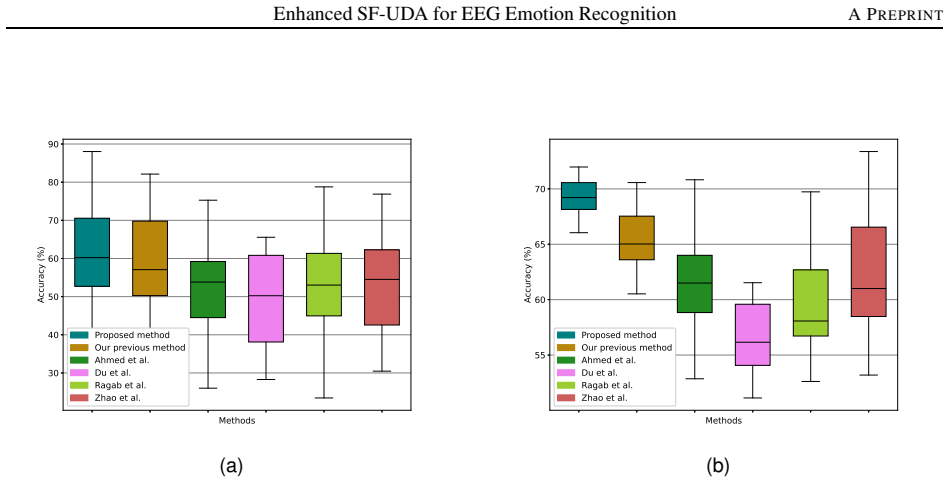
The framework establishes that non-contrastive predictive coding pretraining learns robust transferable EEG representations by modeling temporal dependencies in reconstruction, while adaptation via class-wise clustering and prediction disagreement combined with Multi-Loss Adaptive Regularization and Localized Consistency Learning, plus lightweight test-time training using predictive reconstruction loss and entropy minimization, produces stable improvements under large domain gaps, yielding 69.56% and 63.03% accuracy on SEED and DREAMER when trained on DEAP, and 61.38% and 68.90% when trained on SEED.
What carries the argument
Non-contrastive predictive coding-based self-supervised pretraining that models temporal dependencies through reconstruction, paired with class-wise clustering for target-domain structure estimation during adaptation.
Load-bearing premise
Class-wise clustering combined with prediction disagreement can produce sufficiently reliable pseudo-labels and neighborhood structure to drive stable adaptation despite large inter-dataset domain shifts and noisy labels in EEG emotion data.
What would settle it
If repeated experiments on DEAP-to-SEED adaptation yield accuracies below 65% on SEED, or if prediction disagreement fails to improve clustering stability as measured by pseudo-label consistency metrics, the claim of reliable adaptation would not hold.
Figures



read the original abstract
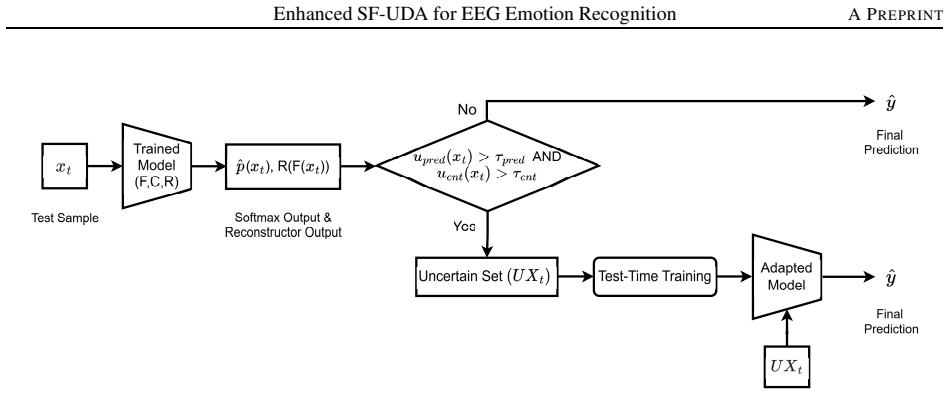
EEG-based emotion recognition is widely used in affective computing but suffers from poor generalization due to domain shifts caused by inter-subject variability, dataset differences, and recording conditions, especially in cross-dataset settings. Conventional unsupervised domain adaptation methods require source data, which is often unavailable due to privacy constraints. Although source-free UDA addresses this limitation, existing methods still struggle with large domain gaps, noisy pseudo-labels, and unstable adaptation. To address these challenges, we propose an enhanced source-free unsupervised domain adaptation (SF-UDA) framework for cross-dataset EEG emotion recognition. The framework introduces a non-contrastive predictive coding-based self-supervised pretraining strategy to learn robust and transferable EEG representations by modeling temporal dependencies in a reconstruction-based manner. During adaptation, we estimate target-domain structure through class-wise clustering and prediction disagreement, and optimize the model using a dual-stage strategy consisting of Multi-Loss Adaptive Regularization and Localized Consistency Learning, improving stability and neighborhood consistency under noisy pseudo-labels. We also propose a lightweight test-time training mechanism that enables selective online updates for uncertain samples using predictive reconstruction loss and entropy minimization. Experiments on DEAP, SEED, and DREAMER show consistent improvements over state-of-the-art SF-UDA methods, achieving 69.56% and 63.03% accuracy on SEED and DREAMER when trained on DEAP, and 61.38% and 68.90% when trained on SEED.
Editorial analysis
A structured set of objections, weighed in public.
Referee Report
Summary. The paper claims to introduce an enhanced source-free unsupervised domain adaptation framework for cross-dataset EEG emotion recognition. It uses non-contrastive predictive coding for self-supervised pretraining to learn robust representations, employs class-wise clustering and prediction disagreement to estimate target-domain structure during adaptation, applies a dual-stage optimization with Multi-Loss Adaptive Regularization and Localized Consistency Learning to handle noisy pseudo-labels, and incorporates a lightweight test-time training mechanism for selective updates. Experiments on the DEAP, SEED, and DREAMER datasets report improved accuracies over existing SF-UDA methods, including 69.56% and 63.03% on SEED and DREAMER when trained on DEAP, and 61.38% and 68.90% when trained on SEED.
Significance. If the empirical results hold under rigorous validation, the framework could advance source-free UDA for EEG by combining predictive coding pretraining with mechanisms to stabilize adaptation under noisy pseudo-labels and domain shifts. The multi-dataset evaluation and focus on privacy-preserving adaptation represent strengths that, if supported by ablations and statistical tests, would contribute to practical affective computing systems.
major comments (1)
- [Abstract] The central claim of improved adaptation performance rests on the assumption that class-wise clustering combined with prediction disagreement yields sufficiently reliable pseudo-labels and neighborhood structure despite documented large inter-dataset shifts; however, no quantitative verification (e.g., pseudo-label accuracy curves, ablation on clustering thresholds, or failure-case analysis) is provided to confirm this assumption holds for the reported gains.
Simulated Author's Rebuttal
We appreciate the referee's insightful comment on the need for quantitative verification of our pseudo-labeling approach. We address this below and will incorporate additional analyses in the revised manuscript.
read point-by-point responses
-
Referee: [Abstract] The central claim of improved adaptation performance rests on the assumption that class-wise clustering combined with prediction disagreement yields sufficiently reliable pseudo-labels and neighborhood structure despite documented large inter-dataset shifts; however, no quantitative verification (e.g., pseudo-label accuracy curves, ablation on clustering thresholds, or failure-case analysis) is provided to confirm this assumption holds for the reported gains.
Authors: We thank the referee for this observation. The reliability of the pseudo-labels is indeed crucial, and while our experiments demonstrate overall performance improvements through ablations on the multi-loss regularization and localized consistency components, we agree that direct metrics on pseudo-label accuracy are not explicitly reported. In the revised version, we will include pseudo-label accuracy curves over the adaptation process, an ablation study varying the clustering thresholds, and a discussion of cases where the method may fail due to extreme domain shifts. This will provide the requested quantitative verification. revision: yes
Circularity Check
No circularity; empirical results on public datasets with no self-referential derivations
full rationale
The paper presents an SF-UDA framework using predictive coding pretraining, class-wise clustering for pseudo-label estimation, Multi-Loss Adaptive Regularization, Localized Consistency Learning, and test-time training. All reported outcomes are empirical accuracies (e.g., 69.56% on SEED when trained on DEAP) measured on the public DEAP/SEED/DREAMER benchmarks against prior SOTA methods. No equations, loss terms, or adaptation steps are shown to reduce by construction to parameters fitted from the target outputs themselves, nor do any load-bearing claims rest on self-citations that themselves lack independent verification. The derivation chain consists of standard architectural choices and training procedures whose validity is assessed externally via cross-dataset performance numbers.
Axiom & Free-Parameter Ledger
free parameters (1)
- loss weights and clustering thresholds
axioms (1)
- domain assumption EEG signals contain learnable temporal dependencies suitable for reconstruction-based predictive coding
Reference graph
Works this paper leans on
-
[1]
Develo pment and application of emotion recognition technology—a systematic literature review,
R. Guo, H. Guo, L. Wang, M. Chen, D. Y ang, and B. Li, “Develo pment and application of emotion recognition technology—a systematic literature review,” BMC Psychology, vol. 12, no. 1, p. 95, 2024
2024
-
[2]
Technology-assisted emotion rec ognition for autism spectrum disorder (ASD) children: a systematic literature review,
M. A. Rashidan et al., “Technology-assisted emotion rec ognition for autism spectrum disorder (ASD) children: a systematic literature review,” IEEE Access, vol. 9, pp. 33638–33653, 2021
2021
-
[3]
Research progress of EEG-ba sed emotion recognition: A survey,
Y . Wang, B. Zhang, and L. Di, “Research progress of EEG-ba sed emotion recognition: A survey,” ACM Com- puting Surveys, vol. 56, no. 11, pp. 1–49, 2024
2024
-
[4]
EEG emotion recognition based on differential entropy feature matrix through 2D-CNN-LSTM network,
T. Wang, X. Huang, Z. Xiao, W . Cai, and Y . Tai, “EEG emotion recognition based on differential entropy feature matrix through 2D-CNN-LSTM network,” EURASIP J. Adv. Signal Process., vol. 2024, no. 1, p. 49, 2024
2024
-
[5]
EEG channel selection-based binary particle swarm optimization with recurrent convolutional autoenco der for emotion recognition,
N. Kouka, R. Fourati, R. Fdhila, P . Siarry, and A. M. Alimi , “EEG channel selection-based binary particle swarm optimization with recurrent convolutional autoenco der for emotion recognition,” Biomed. Signal Process. Control, vol. 84, p. 104783, 2023
2023
-
[6]
Icaps -reslstm: Improved capsule network and residual lstm for eeg emotion recognition,
C. Fan, H. Xie, J. Tao, Y . Li, G. Pei, T. Li, and Z. Lv, “Icaps -reslstm: Improved capsule network and residual lstm for eeg emotion recognition,” Biomed. Signal Process. Control, vol. 87, p. 105422, 2024
2024
-
[7]
Learning a robust unified domain adaptation framework for cross-subject EEG-based emotion recognition,
M. Jiménez-Guarneros and G. Fuentes-Pineda, “Learning a robust unified domain adaptation framework for cross-subject EEG-based emotion recognition,” Biomed. Signal Process. Control, vol. 86, p. 105138, 2023
2023
-
[8]
Adversarial domain adaptatio n-based EEG emotion transfer recognition,
T. Li, Z. Wang, and H. Liu, “Adversarial domain adaptatio n-based EEG emotion transfer recognition,” IEEE Access, 2025
2025
-
[9]
UDA-DDA: Unsupervised domain adaptatio n with dynamic distribution alignment network for emotion recognition using EEG signals,
J. Tang et al., “UDA-DDA: Unsupervised domain adaptatio n with dynamic distribution alignment network for emotion recognition using EEG signals,” Neurocomputing, 2025, p. 131715
2025
-
[10]
An adversarial discriminat ive temporal convolutional network for EEG-based cross-domain emotion recognition,
Z. He, Y . Zhong, and J. Pan, “An adversarial discriminat ive temporal convolutional network for EEG-based cross-domain emotion recognition,” Comput. Biol. Med. , vol. 141, p. 105048, 2022
2022
-
[11]
Do we really need to access t he source data? Source hypothesis transfer for unsupervised domain adaptation,
J. Liang, D. Hu, and J. Feng, “Do we really need to access t he source data? Source hypothesis transfer for unsupervised domain adaptation,” in Proc. ICML, 2020, pp. 6028–6039
2020
-
[12]
SSDA: Secure source-free domain adaptation,
S. Ahmed, A. A. Arafat, M. N. Rizve, R. Hossain, Z. Guo, an d A. S. Rakin, “SSDA: Secure source-free domain adaptation,” in Proc. IEEE/CVF ICCV, 2023, pp. 19180–19190
2023
-
[13]
Generation, augmentation, and align- ment: A pseudo-source domain-based method for source-free domain adaptation,
Y . Du, H. Y ang, M. Chen, H. Luo, J. Jiang, Y . Xin, and C. Wan g, “Generation, augmentation, and align- ment: A pseudo-source domain-based method for source-free domain adaptation,” Mach. Learn., vol. 113, no. 6, pp. 3611–3631, 2024
2024
-
[14]
SRPL-SFDA: SA M-guided reliable pseudo-labels for source-free domain adaptation in medical image segmentation,
X. Liu, J. Wu, T. Lu, S. Zhang, and G. Wang, “SRPL-SFDA: SA M-guided reliable pseudo-labels for source-free domain adaptation in medical image segmentation,” Neurocomputing, vol. 649, p. 130749, 2025
2025
-
[15]
H G-SFDA: HyperGraph learning meets source-free unsupervised domain adaptation,
J. Jiang, Q. Lv, Y . Li, Y . Du, J. Dong, S. Chen, and H. Y u, “H G-SFDA: HyperGraph learning meets source-free unsupervised domain adaptation,” IEEE Trans. Image Process., vol. 34, pp. 7542–7557, 2025
2025
-
[16]
Relative alignme nt network for source-free multimodal video domain adaptation,
Y . Huang, X. Y ang, J. Zhang, and C. Xu, “Relative alignme nt network for source-free multimodal video domain adaptation,” in Proc. 30th ACM MM, 2022, pp. 1652–1660
2022
-
[17]
Source-free domai n adaptation for medical image segmentation with Fourier style mining,
C. Y ang, X. Guo, Z. Chen, and Y . Y uan, “Source-free domai n adaptation for medical image segmentation with Fourier style mining,” Med. Image Anal. , vol. 79, p. 102457, 2022
2022
-
[18]
Source-free domain adaptation with temporal imputation for time series data,
M. Ragab, E. Eldele, M. Wu, C.-S. Foo, X. Li, and Z. Chen, “ Source-free domain adaptation with temporal imputation for time series data,” in Proc. 29th ACM SIGKDD, 2023, pp. 1989–1998
2023
-
[19]
Source-free domain adaptat ion (SFDA) for privacy-preserving seizure subtype classification,
C. Zhao, R. Peng, and D. Wu, “Source-free domain adaptat ion (SFDA) for privacy-preserving seizure subtype classification,” IEEE Trans. Neural Syst. Rehabil. Eng. , vol. 31, pp. 2315–2325, 2023
2023
-
[20]
Acti ve source-free domain adaptation for intracra- nial EEG classification via neighborhood uncertainty and di versity,
K. Wang, M. Y ang, A. Liu, C. Li, R. Qian, and X. Chen, “Acti ve source-free domain adaptation for intracra- nial EEG classification via neighborhood uncertainty and di versity,” Biomed. Signal Process. Control , vol. 104, p. 107464, 2025
2025
-
[21]
M. N. Imtiaz and N. Khan, “Towards practical emotion rec ognition: An unsupervised source-free approach for EEG domain adaptation,” arXiv preprint arXiv:2504.03707 , 2025
arXiv 2025
-
[22]
DEAP: A database for emotion analys is using physiological signals,
S. Koelstra et al., “DEAP: A database for emotion analys is using physiological signals,” IEEE Trans. Affective Comput., vol. 3, no. 1, pp. 18–31, 2011
2011
-
[23]
Investigating critical freq uency bands and channels for EEG-based emotion recog- nition with deep neural networks,
W .-L. Zheng and B.-L. Lu, “Investigating critical freq uency bands and channels for EEG-based emotion recog- nition with deep neural networks,” IEEE Trans. Auton. Ment. Dev., vol. 7, no. 3, pp. 162–175, 2015. 14 Enhanced SF-UDA for EEG Emotion Recognition A P REPRINT
2015
-
[24]
DREAMER: A database for emotion recognition through EEG and ECG signals from wireless low-cost off-the-shelf devices,
S. Katsigiannis and N. Ramzan, “DREAMER: A database for emotion recognition through EEG and ECG signals from wireless low-cost off-the-shelf devices,” IEEE J. Biomed. Health Informat., vol. 22, no. 1, pp. 98–107, 2017
2017
-
[25]
EEG-based emotion re cognition using multiple kernel learning,
Q. Cai, G.-C. Cui, and H.-X. Wang, “EEG-based emotion re cognition using multiple kernel learning,” Mach. Intell. Res., vol. 19, no. 5, pp. 472–484, 2022
2022
-
[26]
Cr oss subject emotion identification from multichannel EEG sub-bands using Tsallis entropy feature and KNN classifi er,
P . Patel, S. Balasubramanian, and R. N. Annavarapu, “Cr oss subject emotion identification from multichannel EEG sub-bands using Tsallis entropy feature and KNN classifi er,” Brain Informat., vol. 11, no. 1, p. 7, 2024
2024
-
[27]
Adaptive neural d ecision tree for EEG based emotion recognition,
Y . Zheng, J. Ding, F. Liu, and D. Wang, “Adaptive neural d ecision tree for EEG based emotion recognition,” Inf. Sci., vol. 643, p. 119160, 2023
2023
-
[28]
Emotion classifica tion of EEG signals using logistic regression classifica- tion,
A. R. Singh, G. Singh, and N. Saluja, “Emotion classifica tion of EEG signals using logistic regression classifica- tion,” in Proc. 3rd Int. Conf. Innov. T echnol. (INOCON), 2024, pp. 1–5
2024
-
[29]
Classification of EEG signal using in dependent component analysis and discrete wavelet transform based on linear discriminant analysis,
M. Melinda et al., “Classification of EEG signal using in dependent component analysis and discrete wavelet transform based on linear discriminant analysis,” JOIV: Int. J. Informat. Vis., vol. 7, no. 3, pp. 830–838, 2023
2023
-
[30]
Multi-scale masked autoencoders for cross- session emotion recognition,
M. Pang, H. Wang, J. Huang, C.-M. V ong, Z. Zeng, and C. Che n, “Multi-scale masked autoencoders for cross- session emotion recognition,” IEEE Trans. Neural Syst. Rehabil. Eng. , vol. 32, pp. 1637–1646, 2024
2024
-
[31]
EEG emotion recognition using improved graph neural network with channel selection,
X. Lin, J. Chen, W . Ma, W . Tang, and Y . Wang, “EEG emotion recognition using improved graph neural network with channel selection,” Comput. Methods Programs Biomed., vol. 231, p. 107380, 2023
2023
-
[32]
Classification of EEG signals based on sparrow search algorithm-deep belief network for brain- computer interface,
S. Wang, Z. Luo, S. Zhao, Q. Zhang, G. Liu, D. Wu, E. Yin, an d C. Chen, “Classification of EEG signals based on sparrow search algorithm-deep belief network for brain- computer interface,” Bioengineering, vol. 11, no. 1, p. 30, 2023
2023
-
[33]
Enhancing performance o f convolutional neural network-based epileptic elec- troencephalogram diagnosis by asymmetric stochastic reso nance,
Z. Shi, Z. Liao, and H. Tabata, “Enhancing performance o f convolutional neural network-based epileptic elec- troencephalogram diagnosis by asymmetric stochastic reso nance,” IEEE J. Biomed. Health Informat. , vol. 27, no. 9, pp. 4228–4239, 2023
2023
-
[34]
Unsupe rvised multi-source domain adaptation via con- trastive learning for EEG classification,
C. Xu, Y . Song, Q. Zheng, Q. Wang, and P .-A. Heng, “Unsupe rvised multi-source domain adaptation via con- trastive learning for EEG classification,” Expert Syst. Appl. , vol. 261, p. 125452, 2025
2025
-
[35]
Self-supervised learning for time ser ies analysis: Taxonomy, progress, and prospects,
K. Zhang et al., “Self-supervised learning for time ser ies analysis: Taxonomy, progress, and prospects,” IEEE Trans. Pattern Anal. Mach. Intell., vol. 46, no. 10, pp. 6775–6794, 2024
2024
-
[36]
A comprehensive sur vey on self-supervised learning for recommenda- tion,
X. Ren, W . Wei, L. Xia, and C. Huang, “A comprehensive sur vey on self-supervised learning for recommenda- tion,” ACM Comput. Surv., vol. 58, no. 1, pp. 1–38, 2025
2025
-
[37]
Self-supervised EEG emotion recognition models based on CNN,
X. Wang, Y . Ma, J. Cammon, F. Fang, Y . Gao, and Y . Zhang, “Self-supervised EEG emotion recognition models based on CNN,” IEEE Trans. Neural Syst. Rehabil. Eng. , vol. 31, pp. 1952–1962, 2023
1952
-
[38]
Applying self-supervised representation learning for emotion reco gnition using physiological signals,
K. G. Montero Quispe, D. M. S. Utyiama, E. M. dos Santos, H . A. B. F. Oliveira, and E. J. P . Souto, “Applying self-supervised representation learning for emotion reco gnition using physiological signals,” Sensors, vol. 22, no. 23, p. 9102, 2022
2022
-
[39]
Predictive coding I: Introduction,
M. Sprevak, “Predictive coding I: Introduction,” Philos. Compass, vol. 19, no. 1, p. e12950, 2024
2024
-
[40]
PC-SSL: A predictive coding-b ased self-supervised learning framework for EEG emotion recognition,
N. Sheibani and N. Khan, “PC-SSL: A predictive coding-b ased self-supervised learning framework for EEG emotion recognition,” in Proc. IEEE ICASSP, pp. 1676–1680, 2026
2026
-
[41]
Tensoria l multiview low-rank high-order graph learning for context-enhanced domain adaptation,
C. Zhu, L. Zhang, W . Luo, G. Jiang, and Q. Wang, “Tensoria l multiview low-rank high-order graph learning for context-enhanced domain adaptation,” Neural Netw., vol. 181, p. 106859, 2025
2025
-
[42]
A domain adaptation sparse repr esentation classifier for cross-domain electroencephalogram-based emotion classification,
T. Ni, Y . Ni, and J. Xue, “A domain adaptation sparse repr esentation classifier for cross-domain electroencephalogram-based emotion classification,” Front. Psychol., vol. 12, p. 721266, 2021
2021
-
[43]
Mult i-source domain transfer discriminative dictionary learning modeling for electroencephalogram-based emotion recognition,
X. Gu, W . Cai, M. Gao, Y . Jiang, X. Ning, and P . Qian, “Mult i-source domain transfer discriminative dictionary learning modeling for electroencephalogram-based emotion recognition,” IEEE Trans. Comput. Soc. Syst., vol. 9, no. 6, pp. 1604–1612, 2022
2022
-
[44]
Enhanced cross-dataset elect roencephalogram-based emotion recognition using unsupervised domain adaptation,
M. N. Imtiaz and N. Khan, “Enhanced cross-dataset elect roencephalogram-based emotion recognition using unsupervised domain adaptation,” Comput. Biol. Med. , vol. 184, p. 109394, 2025
2025
-
[45]
A comprehensiv e survey on source-free domain adaptation,
J. Li, Z. Y u, Z. Du, L. Zhu, and H. T. Shen, “A comprehensiv e survey on source-free domain adaptation,” IEEE Trans. Pattern Anal. Mach. Intell., vol. 46, no. 8, pp. 5743–5762, Aug. 2024
2024
-
[46]
Source-free domain adaptation for open-set cross-domain fault diagnosis,
J. Tian, H. Luo, S. Wu, P . Y an, and J. Zhang, “Source-free domain adaptation for open-set cross-domain fault diagnosis,” IEEE Trans. Ind. Informat., 2025
2025
-
[47]
Source-free active domain adaptation via energy-based locality preserving transfer,
X. Li, Z. Du, J. Li, L. Zhu, and K. Lu, “Source-free active domain adaptation via energy-based locality preserving transfer,” in Proc. 30th ACM MM, 2022, pp. 5802–5810. 15 Enhanced SF-UDA for EEG Emotion Recognition A P REPRINT
2022
-
[48]
Source-free domain adaptation with domain generalized pretraining for face anti-spoofing,
Y . Liu, Y . Chen, W . Dai, M. Gou, C.-T. Huang, and H. Xiong, “Source-free domain adaptation with domain generalized pretraining for face anti-spoofing,” IEEE Trans. Pattern Anal. Mach. Intell., vol. 46, no. 8, pp. 5430– 5448, 2024
2024
-
[49]
Cross-database and cross-cha nnel electrocardiogram arrhythmia heartbeat classifi- cation based on unsupervised domain adaptation,
M. N. Imtiaz and N. Khan, “Cross-database and cross-cha nnel electrocardiogram arrhythmia heartbeat classifi- cation based on unsupervised domain adaptation,” Expert Syst. Appl. , vol. 244, p. 122960, 2024
2024
-
[50]
EEG-based emotion recognition: A tutorial and review,
X. Li, Y . Zhang, P . Tiwari, D. Song, B. Hu, M. Y ang, Z. Zhao, N. Kumar, and P . Marttinen, “EEG-based emotion recognition: A tutorial and review,” ACM Comput. Surv., vol. 55, no. 4, pp. 1–57, 2022
2022
-
[51]
Domain adaptatio n for EEG emotion recognition based on latent representation similarity,
J. Li, S. Qiu, C. Du, Y . Wang, and H. He, “Domain adaptatio n for EEG emotion recognition based on latent representation similarity,” IEEE Trans. Cogn. Dev. Syst., vol. 12, no. 2, pp. 344–353, 2019
2019
-
[52]
TPRO-NET: an EEG-based e motion recognition method reflecting subtle changes in emotion,
X. Zhang, X. Cheng, and H. Liu, “TPRO-NET: an EEG-based e motion recognition method reflecting subtle changes in emotion,” Sci. Rep., vol. 14, no. 1, p. 13491, 2024
2024
-
[53]
Using deep and convolutional neural net- works for accurate emotion classification on DEAP data,
S. Tripathi, S. Acharya, R. Sharma, S. Mittal, and S. Bha ttacharya, “Using deep and convolutional neural net- works for accurate emotion classification on DEAP data,” in Proc. AAAI Conf. Artif. Intell. , vol. 31, no. 2, pp. 4746–4752, 2017
2017
-
[54]
A unified approach to inter preting model predictions,
S. M. Lundberg and S.-I. Lee, “A unified approach to inter preting model predictions,” Adv. Neural Inf. Process. Syst., vol. 30, 2017
2017
-
[55]
Preserving right pre-motor and posterior pre- frontal cortices contribute to maintaining overall basic e motion,
R. Nakajima, M. Kinoshita, H. Okita, Z. Liu, and M. Nakad a, “Preserving right pre-motor and posterior pre- frontal cortices contribute to maintaining overall basic e motion,” Front. Hum. Neurosci. , vol. 15, p. 612890, 2021
2021
-
[56]
Ide ntifying relevant asymmetry features of EEG for emotion processing,
F. I. Mouri, C. E. V alderrama, and S. G. Camorlinga, “Ide ntifying relevant asymmetry features of EEG for emotion processing,” Front. Psychol., vol. 14, p. 1217178, 2023
2023
-
[57]
Emotion recognition based on the asymmetric left and right activation,
K. S. Park, H. Choi, K. J. Lee, J. Y . Lee, K. O. An, and E. J. K im, “Emotion recognition based on the asymmetric left and right activation,” Int. J. Med. Med. Sci. , vol. 3, no. 6, pp. 201–209, 2011. 16
2011
discussion (0)
Sign in with ORCID, Apple, or X to comment. Anyone can read and Pith papers without signing in.