Real poles with opposite-sign residues in the non-perturbative quark propagator
Pith reviewed 2026-06-29 03:20 UTC · model grok-4.3
The pith
The quark propagator develops a pair of real poles with opposite-sign residues when the full non-perturbative quark-gluon vertex is dynamically included in the gap equation.
A machine-rendered reading of the paper's core claim, the machinery that carries it, and where it could break.
Core claim
Dynamically coupling the gap equation to the full quark-gluon vertex basis yields, for sub-GeV time-like momenta, a pair of real poles with opposite-sign residues in the quark propagator; no complex conjugate poles appear. This analytic structure is controlled by the joint action of the tree-level vertex component, the anomalous chromomagnetic moment, and the spin-momentum curvature form factor, whose combined strengths place the low-lying poles on the real axis while preserving a robust 350 MeV constituent mass and remaining consistent with color-confinement signals tied to positivity violation.
What carries the argument
The triplet of vertex form factors (tree-level component, anomalous chromomagnetic moment, and spin-momentum curvature) whose independent strength tuning, within a fixed truncation, moves the poles from the complex plane onto the real axis.
If this is right
- The real-pole structure evades the conceptual difficulties often linked to complex conjugate poles.
- Positivity violation, an aspect of color confinement, remains intact.
- A stable constituent quark mass of approximately 350 MeV is obtained.
- The three form factors must act jointly; altering any one individually changes the pole locations in distinct ways.
Where Pith is reading between the lines
- Similar real-pole patterns may emerge in gluon or ghost propagators once their respective full vertices are retained.
- Bound-state equations that employ this propagator could produce different spectral properties than those using complex-pole approximations.
- The result suggests that truncation artifacts, rather than fundamental dynamics, are responsible for complex poles in many existing studies.
Load-bearing premise
That the three identified vertex form factors can be varied independently in strength while the rest of the vertex and the gap-equation truncation stay fixed, and that this variation alone suffices to place the poles on the real axis.
What would settle it
A recalculation of the same gap equation with the full vertex basis but with the three form factors held at their tree-level values, or with an independent non-perturbative vertex model, that nevertheless produces complex conjugate poles below 1 GeV.
Figures


read the original abstract
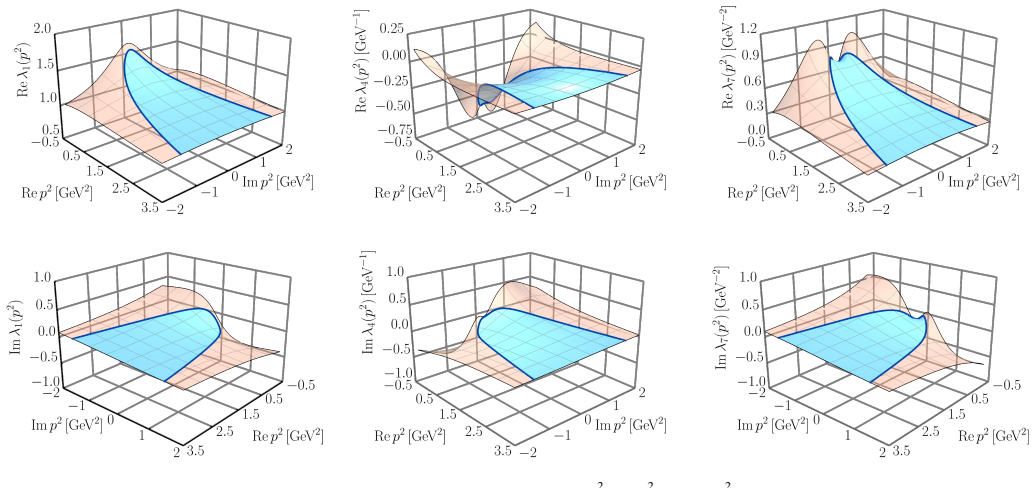
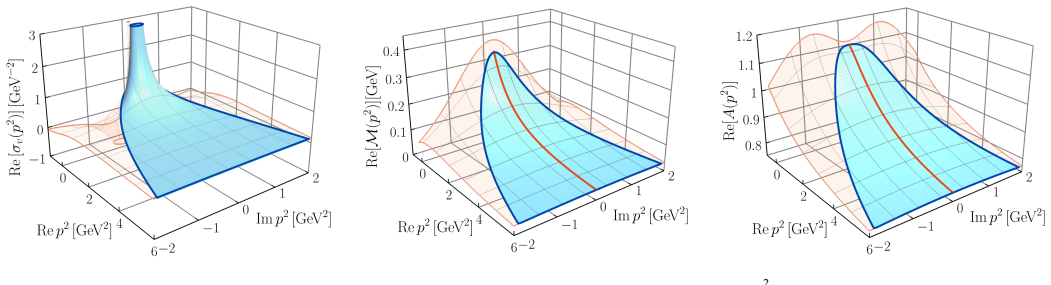
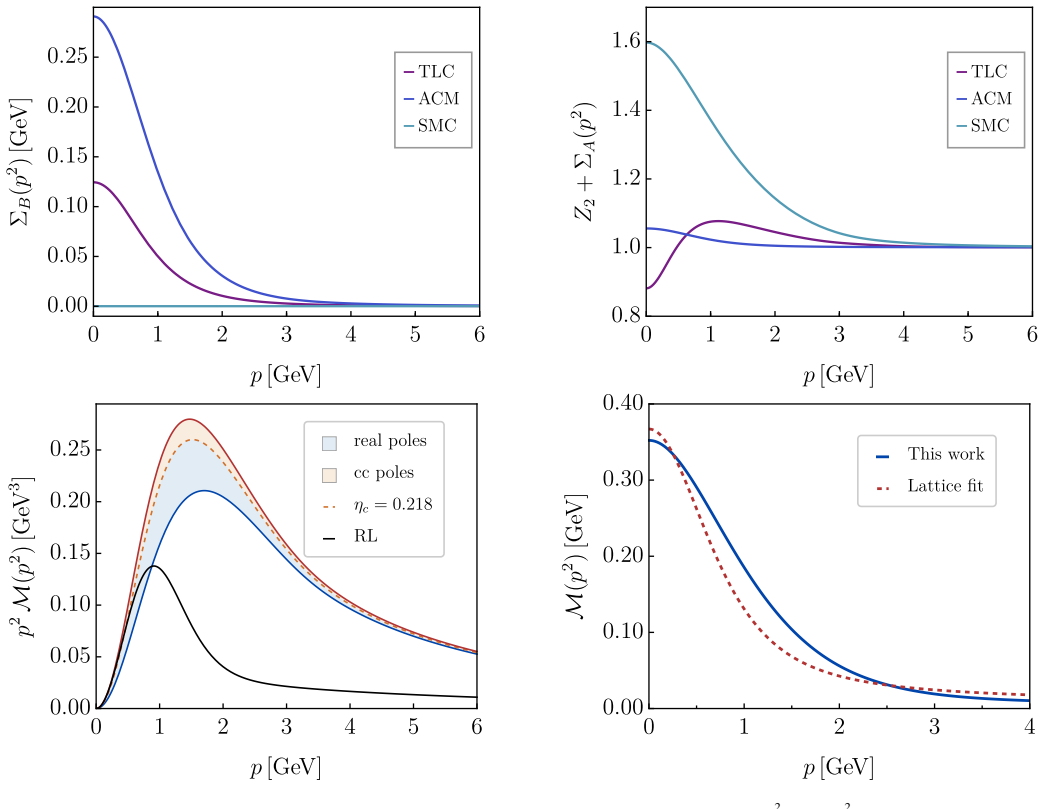
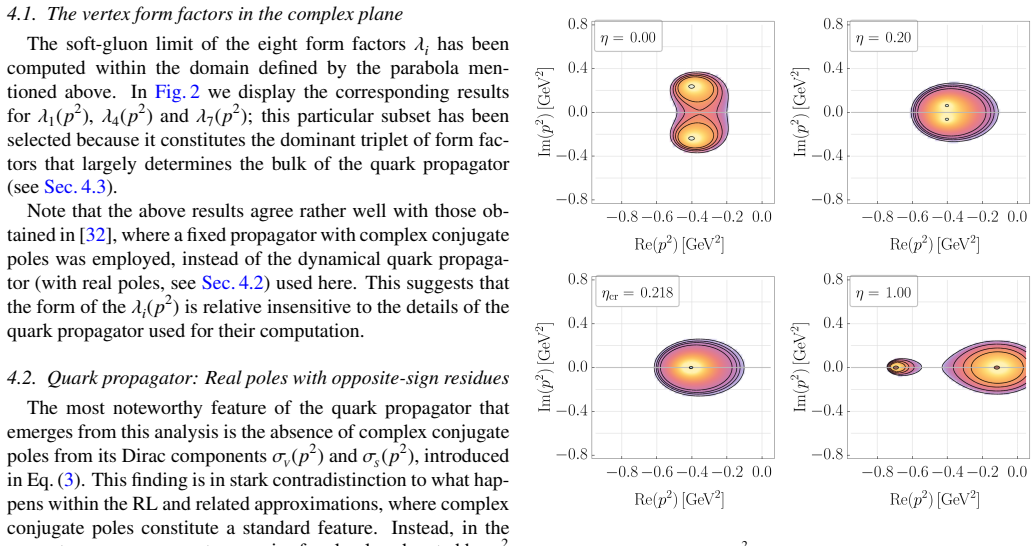
We investigate the analytic structure of the quark propagator in the Landau gauge by dynamically coupling the standard gap equation to the non-perturbative quark-gluon vertex. Employing the full vertex basis, we demonstrate that for sub-GeV time-like momenta, the proper inclusion of the underlying dynamics leads to a pair of real poles with opposite-sign residues. In particular, in stark contradistinction to the results obtained in widely used approximations, we see no sign of complex conjugate poles. This distinctive analytic structure evades conceptual shortcomings frequently associated with complex conjugate poles while remaining fully compatible with the aspects of color confinement related to positivity violation. Crucially, this novel behavior is governed by a dominant triplet of vertex form factors: the tree-level component, the anomalous chromomagnetic moment, and a component we label as "spin-momentum curvature". By gradually tuning the individual strengths of these components, we demonstrate that while they contribute in distinct ways to the quark propagator, their joint action is vital for stabilizing the system. Together, they place the low-lying poles onto the real axis while producing a robust constituent quark mass of $350$ MeV.
Editorial analysis
A structured set of objections, weighed in public.
Referee Report
Summary. The paper investigates the analytic structure of the Landau-gauge quark propagator by dynamically coupling the gap equation to the full non-perturbative quark-gluon vertex. It claims that proper inclusion of the vertex dynamics produces, for sub-GeV time-like momenta, a pair of real poles with opposite-sign residues and a constituent mass of 350 MeV, with no complex-conjugate poles; this structure is attributed to the joint action of three dominant vertex form factors (tree-level, anomalous chromomagnetic moment, and spin-momentum curvature), whose strengths are gradually tuned while the rest of the vertex basis and truncation are held fixed.
Significance. If the real-pole structure survives a fully self-consistent determination of the vertex, the result would be significant for non-perturbative QCD: it supplies an analytic continuation of the propagator that evades difficulties associated with complex poles while remaining compatible with positivity violation as a confinement signature. The identification of a specific triplet of vertex components as the controlling mechanism provides a concrete, testable handle on the quark-gluon vertex that could inform future truncations.
major comments (2)
- [Abstract] Abstract (paragraph beginning 'By gradually tuning the individual strengths...'): The central claim—that the real poles with opposite-sign residues emerge from the underlying dynamics—rests on independent variation of the three vertex form factors while the remainder of the basis and the gap-equation truncation are fixed. In a consistent treatment these form factors are generated by the same vertex equation and must satisfy the same Slavnov-Taylor identities and renormalization conditions; the independent tuning therefore introduces an extra degree of freedom whose effect on pole locations is not guaranteed to persist once the form factors are determined self-consistently.
- [Results/numerical sections] Results and numerical implementation sections: No information is supplied on numerical convergence, error control, or the concrete procedure used to verify the absence of complex poles over the full momentum range. The reported 350 MeV mass and real-pole placement are obtained only after the tuning step, so the robustness of the claimed analytic structure cannot be assessed from the given material.
Simulated Author's Rebuttal
We thank the referee for the careful reading of our manuscript and the constructive comments. We respond point by point to the major concerns below.
read point-by-point responses
-
Referee: [Abstract] Abstract (paragraph beginning 'By gradually tuning the individual strengths...'): The central claim—that the real poles with opposite-sign residues emerge from the underlying dynamics—rests on independent variation of the three vertex form factors while the remainder of the basis and the gap-equation truncation are fixed. In a consistent treatment these form factors are generated by the same vertex equation and must satisfy the same Slavnov-Taylor identities and renormalization conditions; the independent tuning therefore introduces an extra degree of freedom whose effect on pole locations is not guaranteed to persist once the form factors are determined self-consistently.
Authors: We agree that independent tuning of the three form factors introduces an extra degree of freedom absent from a fully self-consistent vertex solution. Our procedure is explicitly exploratory: it isolates the minimal triplet whose joint action stabilizes real poles, thereby furnishing a concrete target for future self-consistent calculations. We will revise the abstract and add a dedicated paragraph in the conclusions to state this limitation clearly and to emphasize that the reported structure is a diagnostic result rather than a claim of dynamical self-consistency. revision: yes
-
Referee: [Results/numerical sections] Results and numerical implementation sections: No information is supplied on numerical convergence, error control, or the concrete procedure used to verify the absence of complex poles over the full momentum range. The reported 350 MeV mass and real-pole placement are obtained only after the tuning step, so the robustness of the claimed analytic structure cannot be assessed from the given material.
Authors: The referee correctly notes the absence of numerical details. In the revised manuscript we will insert a new subsection that specifies the momentum-grid discretization, the convergence threshold for the iterative gap-equation solver, the ultraviolet cutoff dependence, and the explicit algorithm used to locate poles (analytic continuation of the denominator function on a dense complex-plane grid together with a systematic search for conjugate-pair solutions). These additions will allow independent assessment of the robustness of the 350 MeV mass and the real-pole placement. revision: yes
Circularity Check
Tuning of three vertex form factors places poles on real axis by construction
specific steps
-
fitted input called prediction
[Abstract]
"By gradually tuning the individual strengths of these components, we demonstrate that while they contribute in distinct ways to the quark propagator, their joint action is vital for stabilizing the system. Together, they place the low-lying poles onto the real axis while producing a robust constituent quark mass of 350 MeV."
The paper states that the dynamics lead to real poles, yet the placement of poles on the real axis and the specific mass value are obtained by tuning the three form-factor strengths; the reported outcome is therefore the direct result of this parameter adjustment rather than a prediction independent of the tuning.
full rationale
The paper's central claim that proper inclusion of dynamics produces real poles with opposite-sign residues is achieved explicitly by gradually tuning the strengths of the tree-level, anomalous chromomagnetic moment, and spin-momentum curvature form factors while holding the rest of the vertex basis and gap-equation truncation fixed. This tuning directly determines the pole locations and the 350 MeV mass, making the reported analytic structure dependent on the chosen parameter values rather than an independent, untuned outcome of the equations. No self-citation chains or other enumerated patterns appear in the provided text, but the explicit dependence on adjustable strengths constitutes partial circularity of the fitted-input type.
Axiom & Free-Parameter Ledger
free parameters (1)
- strengths of the three vertex form factors
axioms (2)
- domain assumption Landau gauge is the appropriate choice for studying the non-perturbative quark propagator
- domain assumption The gap equation truncation with the chosen vertex basis captures the dominant dynamics
Reference graph
Works this paper leans on
-
[1]
R. Alkofer, L. von Smekal, Phys. Rept. 353 (2001) 281. doi:10.1016/S0370-1573(01)00010-2
-
[2]
J. M. Pawlowski, D. F. Litim, S. Nedelko, L. von Smekal, Phys. Rev. Lett. 93 (2004) 152002. doi:10. 1103/PhysRevLett.93.152002
2004
-
[3]
Binosi, J
D. Binosi, J. Papavassiliou, Phys. Rept. 479 (2009) 1–
2009
-
[4]
doi:10.1016/j.physrep.2009.05.001
-
[5]
Maas, Phys
A. Maas, Phys. Rept. 524 (2013) 203–300. doi:10. 1016/j.physrep.2012.11.002
2013
-
[6]
I. C. Cloet, C. D. Roberts, Prog. Part. Nucl. Phys. 77 (2014) 1–69. doi:10.1016/j.ppnp.2014.02.001
-
[7]
M. Q. Huber, Phys. Rept. 879 (2020) 1–92. doi:10. 1016/j.physrep.2020.04.004
2020
-
[8]
N. Dupuis, L. Canet, A. Eichhorn, W. Metzner, J. M. Pawlowski, M. Tissier, N. Wschebor, Phys. Rept. 910 (2021) 1–114. doi:10.1016/j.physrep.2021. 01.001
-
[9]
M. N. Ferreira, J. Papavassiliou, Particles 6 (2023) 312–
2023
-
[10]
doi:10.3390/particles6010017
-
[11]
M. N. Ferreira, J. Papavassiliou, Prog. Part. Nucl. Phys. 144 (2025) 104186. doi:10.1016/j.ppnp.2025. 104186
-
[12]
M. Q. Huber, 2025.arXiv:2510.18960
Pith/arXiv arXiv 2025
-
[13]
R. Alkofer, W. Detmold, C. S. Fischer, P. Maris, Phys. Rev. D 70 (2004) 014014. doi:10.1103/PhysRevD.70. 014014
-
[14]
S. Strauss, C. S. Fischer, C. Kellermann, Phys. Rev. Lett. 109 (2012) 252001. doi:10.1103/PhysRevLett.109. 252001
-
[15]
T. Frederico, G. Salmè, M. Viviani, Phys. Rev. D 89 (2014) 016010. doi:10.1103/PhysRevD.89.016010
-
[16]
D. Dudal, O. Oliveira, P. J. Silva, Phys. Rev. D 89 (2014) 014010. doi:10.1103/PhysRevD.89.014010
-
[17]
W. de Paula, T. Frederico, G. Salmè, M. Viviani, Phys. Rev. D 94 (2016) 071901. doi:10.1103/PhysRevD.94. 071901
-
[18]
El-Bennich, G
B. El-Bennich, G. Krein, E. Rojas, F. E. Serna, Few Body Syst. 57 (2016) 955–963. doi:10.1007/ s00601-016-1133-x
2016
-
[19]
Tripolt, P
R.-A. Tripolt, P. Gubler, M. Ulybyshev, L. V on Smekal, Comput. Phys. Commun. 237 (2019) 129–142. doi:10. 1016/j.cpc.2018.11.012
2019
-
[20]
D. Binosi, R.-A. Tripolt, Phys. Lett. B 801 (2020) 135171. doi:10.1016/j.physletb.2019.135171
-
[21]
D. Dudal, O. Oliveira, M. Roelfs, P. Silva, Nucl. Phys. B 952 (2020) 114912. doi:10.1016/j.nuclphysb. 2019.114912
-
[23]
S. W. Li, P. Lowdon, O. Oliveira, P. J. Silva, Phys. Lett. B 803 (2020) 135329. doi:10.1016/j.physletb.2020. 135329. 9
-
[24]
S. W. Li, P. Lowdon, O. Oliveira, P. J. Silva, Phys. Lett. B 823 (2021) 136753. doi:10.1016/j.physletb.2021. 136753
-
[25]
C. S. Fischer, M. Q. Huber, Phys. Rev. D 102 (2020) 094005. doi:10.1103/PhysRevD.102.094005
-
[26]
Horak, J
J. Horak, J. Papavassiliou, J. M. Pawlowski, N. Wink, Phys. Rev. D 104 (2021) 074017. doi:10.1103/ PhysRevD.104.074017
2021
-
[27]
Horak, J
J. Horak, J. M. Pawlowski, J. Rodríguez-Quintero, J. Turnwald, J. M. Urban, N. Wink, S. Zafeiropou- los, Phys. Rev. D 105 (2022) 036014. doi:10.1103/ PhysRevD.105.036014
2022
-
[28]
J. Horak, J. M. Pawlowski, N. Wink, SciPost Phys. Core 8 (2025) 048. doi:10.21468/SciPostPhysCore.8.3. 048
-
[29]
G. Eichmann, E. Ferreira, A. Stadler, Phys. Rev. D 105 (2022) 034009. doi:10.1103/PhysRevD.105.034009
-
[30]
J. Horak, J. M. Pawlowski, N. Wink, SciPost Phys. 15 (2023) 149. doi:10.21468/SciPostPhys.15.4.149
-
[31]
M. Q. Huber, W. J. Kern, R. Alkofer, Phys. Rev. D 107 (2023) 074026. doi:10.1103/PhysRevD.107.074026
-
[32]
M. Q. Huber, W. J. Kern, R. Alkofer, Symmetry 15 (2023) 414. doi:10.3390/sym15020414
-
[33]
J. M. Pawlowski, J. Wessely, Eur. Phys. J. C 85 (2025)
2025
-
[34]
doi:10.1140/epjc/s10052-025-14683-z
-
[35]
M. N. Ferreira, A. S. Miramontes, J. M. Morgado, J. Pa- pavassiliou (2026).arXiv:2605.06242
Pith/arXiv arXiv 2026
-
[36]
P. Maris, P. C. Tandy, Phys. Rev. C 61 (2000) 045202. doi:10.1103/PhysRevC.61.045202
-
[37]
The $\pi$, $K^+$, and $K^0$ electromagnetic form factors
P. Maris, P. C. Tandy, Phys. Rev. C 62 (2000) 055204. doi:10.1103/PhysRevC.62.055204. arXiv:nucl-th/0005015
work page internal anchor Pith review Pith/arXiv arXiv doi:10.1103/physrevc.62.055204 2000
-
[38]
S. R. Cotanch, P. Maris, Phys. Rev. D 68 (2003) 036006. doi:10.1103/PhysRevD.68.036006. arXiv:nucl-th/0308008
work page internal anchor Pith review Pith/arXiv arXiv doi:10.1103/physrevd.68.036006 2003
-
[39]
Nicmorus, G
D. Nicmorus, G. Eichmann, A. Krassnigg, R. Alkofer, Phys. Rev. D 80 (2009) 054028. doi:10.1103/ PhysRevD.80.054028
2009
-
[40]
T. Hilger, M. Gomez-Rocha, A. Krassnigg, Phys. Rev. D 91 (2015) 114004. doi:10.1103/PhysRevD.91. 114004
-
[41]
Hilger, C
T. Hilger, C. Popovici, M. Gomez-Rocha, A. Krass- nigg, Phys. Rev. D 91 (2015) 034013. doi:10.1103/ PhysRevD.91.034013
2015
-
[42]
G. Eichmann, H. Sanchis-Alepuz, R. Williams, R. Alkofer, C. S. Fischer, Prog. Part. Nucl. Phys. 91 (2016) 1–100. doi:10.1016/j.ppnp.2016.07.001
-
[44]
H. Sanchis-Alepuz, R. Alkofer, C. S. Fischer, Eur. Phys. J. A 54 (2018) 41. doi:10.1140/epja/ i2018-12465-x
-
[45]
E. Weil, G. Eichmann, C. S. Fischer, R. Williams, Phys. Rev. D 96 (2017) 014021. doi:10.1103/PhysRevD.96. 014021
-
[46]
F. E. Serna, B. El-Bennich, G. Krein, Phys. Rev. D 96 (2017) 014013. doi:10.1103/PhysRevD.96.014013
-
[47]
P. C. Wallbott, G. Eichmann, C. S. Fischer, Phys. Rev. D100 (2019) 014033. doi:10.1103/PhysRevD. 100.014033
-
[48]
N. Santowsky, G. Eichmann, C. S. Fischer, P. C. Wall- bott, R. Williams, Phys. Rev. D 102 (2020) 056014. doi:10.1103/PhysRevD.102.056014
-
[49]
Á. Miramontes, A. Bashir, K. Raya, P. Roig, Phys. Rev. D 105 (2022) 074013. doi:10.1103/PhysRevD.105. 074013
-
[50]
F. Gao, A. S. Miramontes, J. Papavassiliou, J. M. Pawlowski, Phys. Lett. B 863 (2025) 139384. doi:10. 1016/j.physletb.2025.139384
arXiv 2025
-
[51]
Xu, JHEP 2024 (2024) 118
Y .-Z. Xu, JHEP 2024 (2024) 118. doi:10.1007/ JHEP07(2024)118
2024
-
[52]
J. Hoffer, G. Eichmann, C. S. Fischer, Phys. Rev. D 111 (2025) 054028. doi:10.1103/PhysRevD.111.054028
- [53]
- [54]
-
[55]
C. Shi, L. Lu, I. C. Cloët, W. Jia, P. C. Tandy, Phys. Rev. D 113 (2026) L111501. doi:10.1103/yklv-ntq9
-
[57]
A. Windisch, Phys. Rev. C 95 (2017) 045204. doi:10. 1103/PhysRevC.95.045204.arXiv:1612.06002
Pith/arXiv arXiv 2017
-
[58]
H. Sanchis-Alepuz, R. Williams, Comput. Phys. Com- mun. 232 (2018) 1–21. doi:10.1016/j.cpc.2018.05. 020
-
[59]
Á. S. Miramontes, H. Sanchis-Alepuz, Eur. Phys. J. A 55 (2019) 170. doi:10.1140/epja/i2019-12847-6. 10
-
[60]
R. Alkofer, C. S. Fischer, F. Zierler, Phys. Rev. D 113 (2026) 094002. doi:10.1103/q3kq-s8qn
-
[61]
P. Maris, P. C. Tandy, Phys. Rev. C60 (1999) 055214. doi:10.1103/PhysRevC.60.055214
-
[62]
L. Chang, C. D. Roberts, Phys. Rev. Lett. 103 (2009) 081601. doi:10.1103/PhysRevLett.103.081601
-
[63]
Kondo, M
K.-I. Kondo, M. Murakami, Phys. Rev. D 101 (2020) 074044
2020
- [64]
-
[65]
L. Chang, Y .-X. Liu, C. D. Roberts, Phys. Rev. Lett. 106 (2011) 072001. doi:10.1103/PhysRevLett.106. 072001
-
[66]
Binosi, L
D. Binosi, L. Chang, J. Papavassiliou, S.-X. Qin, C. D. Roberts, Phys. Rev. D95 (2017) 031501. doi:10.1103/ PhysRevD.95.031501
2017
-
[68]
Itzykson, J
C. Itzykson, J. B. Zuber, Quantum Field Theory, Inter- national Series in Pure and Applied Physics, New York, USA: Mcgraw-Hill (1980) 705 p., 1980
1980
-
[69]
A. C. Aguilar, M. N. Ferreira, B. M. Oliveira, J. Papavas- siliou, G. T. Linhares, Eur. Phys. J. C 84 (2024) 1231. doi:10.1140/epjc/s10052-024-13605-9
-
[70]
R. Alkofer, C. S. Fischer, F. J. Llanes-Estrada, K. Schwenzer, Annals Phys. 324 (2009) 106–172. doi:10.1016/j.aop.2008.07.001
-
[71]
R. Williams, C. S. Fischer, W. Heupel, Phys. Rev. D93 (2016) 034026. doi:10.1103/PhysRevD.93.034026
-
[72]
Cornwall, R
J. Cornwall, R. Norton, Phys. Rev. D 8 (1973) 3338–
1973
-
[73]
doi:10.1103/PhysRevD.8.3338
-
[74]
J. M. Cornwall, R. Jackiw, E. Tomboulis, Phys. Rev. D 10 (1974) 2428–2445. doi:10.1103/PhysRevD.10. 2428
-
[75]
Berges, Phys
J. Berges, Phys. Rev. D 70 (2004) 105010. doi:10.1103/ PhysRevD.70.105010
2004
-
[76]
M. E. Carrington, Y . Guo, Phys. Rev. D 83 (2011) 016006. doi:10.1103/PhysRevD.83.016006
-
[77]
A. S. Miramontes, J. M. Morgado, J. Papavassiliou, J. M. Pawlowski, Eur. Phys. J. C 85 (2025) 1055. doi:10. 1140/epjc/s10052-025-14774-x
2025
-
[78]
M. N. Ferreira, A. S. Miramontes, J. M. Morgado, J. Pa- pavassiliou, J. M. Pawlowski, Eur. Phys. J. C 86 (2026)
2026
-
[79]
doi:10.1140/epjc/s10052-026-15487-5
-
[80]
M. N. Ferreira, A. S. Miramontes, M. J. M., J. Papavas- siliou, 2026.arXiv:2604.07221
Pith/arXiv arXiv 2026
-
[81]
Eichmann, R
G. Eichmann, R. Williams, R. Alkofer, M. Vuji- novic, Phys. Rev. D89 (2014) 105014. doi:10.1103/ PhysRevD.89.105014
2014
-
[82]
A. Blum, M. Q. Huber, M. Mitter, L. von Smekal, Phys. Rev. D89 (2014) 061703. doi:10.1103/PhysRevD.89. 061703
-
[83]
M. Q. Huber, Phys. Rev. D 93 (2016) 085033. doi:10. 1103/PhysRevD.93.085033
2016
-
[84]
M. Q. Huber, Phys. Rev. D 101 (2020) 114009. doi:10. 1103/PhysRevD.101.114009
2020
discussion (0)
Sign in with ORCID, Apple, or X to comment. Anyone can read and Pith papers without signing in.