New Energy-Loss Constraints on Dark Sectors from Deeply Inelastic Scattering with Initial State Radiation
Pith reviewed 2026-06-30 00:39 UTC · model grok-4.3
The pith
Electron-proton scattering with initial-state radiation constrains dark sector particles through anomalous energy loss.
A machine-rendered reading of the paper's core claim, the machinery that carries it, and where it could break.
Core claim
We employ the joint QED and QCD factorization of deeply inelastic electron-proton scattering with generic initial state radiation to probe exotic particle emission from a dark sector through anomalous energy loss, by modifying the lepton distribution function for particles of spin up to 2 with various electron couplings and computing the resulting cross sections for MeV-GeV spin-0 particles in kinematics matched to the ePIC detector.
What carries the argument
The modified lepton distribution function that incorporates emission of a dark-sector particle alongside standard-model initial-state radiation.
If this is right
- The cross section is altered in kinematic regions where an undetected particle can produce measurable energy loss.
- The method applies to particles with spin up to 2 and a range of electron couplings.
- Kinematics can be chosen to match the forward-backward acceptance of the ePIC detector at the EIC.
- The calculation serves as a proof-of-principle for setting limits on dark-sector models via energy-loss signatures.
Where Pith is reading between the lines
- The same factorization approach could be applied to initial-state radiation from the proton to reach different dark-sector couplings.
- Limits obtained this way would complement searches that rely on missing energy or visible decays in other experiments.
- If the method works, it could be adapted to other lepton-hadron facilities to test consistency across different center-of-mass energies.
Load-bearing premise
The joint QED and QCD factorization of deeply inelastic scattering with initial-state radiation remains valid when the radiated particle belongs to a dark sector.
What would settle it
A high-precision measurement of the cross section in the chosen phase-space-limited kinematics at the EIC that shows no deviation from the standard-model prediction would rule out the existence of the considered MeV-GeV spin-0 particles with the assumed couplings.
Figures




read the original abstract
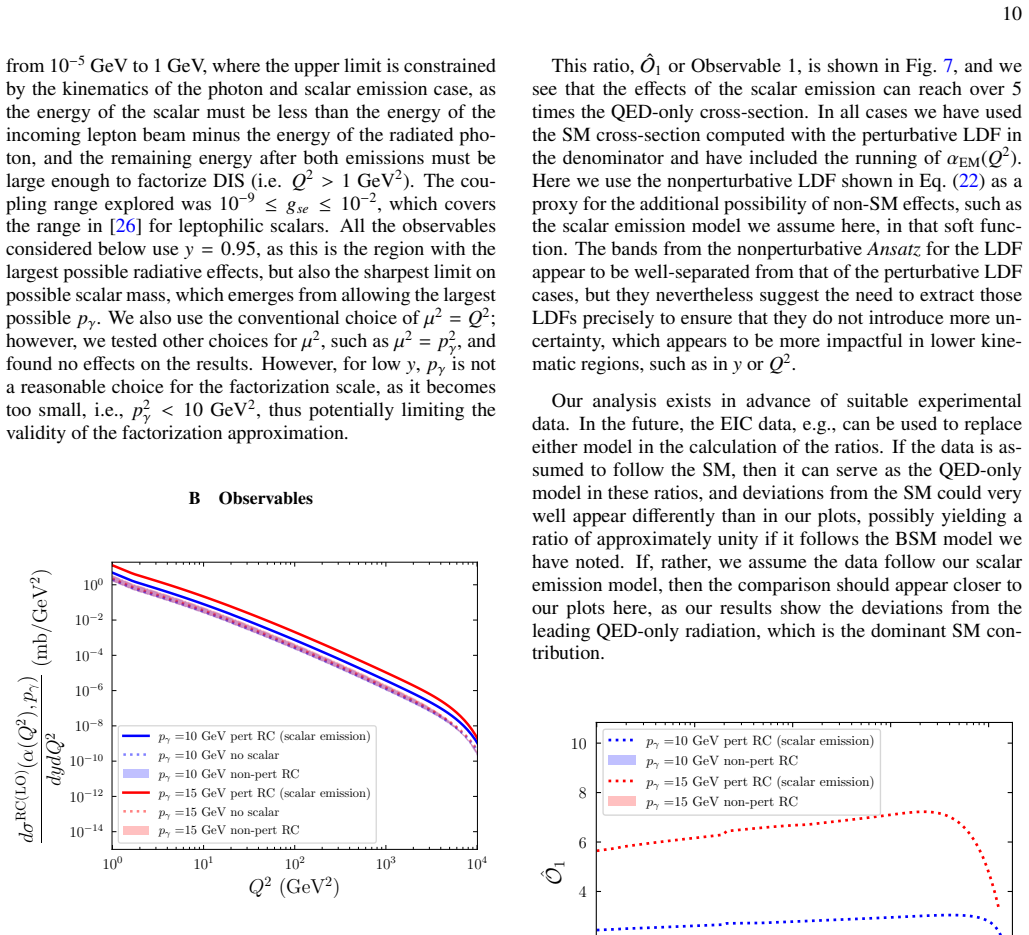
We employ the joint QED and QCD factorization of deeply inelastic, electron-proton scattering with generic initial state radiation to probe the possibility of exotic particle emission -- i.e., of weakly coupled particles originating from a dark or hidden sector -- through anomalous energy loss. We leverage this possibility through the consideration of phase-space-limited kinematic regions, for which the emission of an additional, undetected particle can particularly impact the associated cross-section. In this first paper, as a proof of principle, we focus on radiation from the incoming electron, considering the modification of the lepton distribution function from the emission of particles, that could have spin of up to 2 and various, well-motivated electron couplings. We illustrate the sensitivity of our approach through the computation of the modified cross-sections for the emission of MeV-GeV mass-scale, spin 0 particles in kinematics chosen for their sensitivity to initial state electron radiation and suitable to the forward-backward detection sensitivity of the ePIC detector at the EIC.
Editorial analysis
A structured set of objections, weighed in public.
Referee Report
Summary. The paper claims that joint QED+QCD factorization of deeply inelastic electron-proton scattering can be extended to generic initial-state radiation to constrain dark-sector particles via anomalous energy loss. It modifies the lepton distribution function for emissions of particles with spin up to 2 and various electron couplings, and illustrates the method by computing modified cross sections for MeV-GeV spin-0 particles in kinematics chosen for sensitivity to initial-state electron radiation and the forward-backward acceptance of the ePIC detector at the EIC.
Significance. If the factorization assumption holds, the approach would supply a new, data-driven handle on light dark sectors at the EIC by exploiting phase-space regions where undetected exotic ISR produces measurable suppression of the DIS cross section. The method is parameter-free in its kinematic selection once the dark-particle mass and coupling are fixed, and it directly targets the ePIC detector's capabilities.
major comments (1)
- [Abstract (factorization paragraph)] Abstract (paragraph beginning 'We employ the joint QED and QCD factorization'): The manuscript states that the standard joint QED+QCD factorization for DIS with initial-state radiation continues to apply when the radiated particle is a massive (MeV-GeV) dark scalar with arbitrary electron coupling, but provides neither a derivation nor a citation establishing that the collinear approximation and lepton-PDF factorization survive the mass and non-QCD nature of the emission. Standard factorization theorems rely on massless collinear splittings and universal splitting functions; a massive dark particle alters both the kinematics of the hard scattering and the phase-space boundaries at O(m_dark/Q), and non-universal interference terms may appear. Without an explicit proof or reference that the lepton PDF imes hard cross-section separation remains valid, the computed modified cross sections l
Simulated Author's Rebuttal
We thank the referee for their careful reading of the manuscript and for raising this important point about the applicability of the factorization framework. We address the comment below and will revise the manuscript to provide additional justification.
read point-by-point responses
-
Referee: [Abstract (factorization paragraph)] The manuscript states that the standard joint QED+QCD factorization for DIS with initial-state radiation continues to apply when the radiated particle is a massive (MeV-GeV) dark scalar with arbitrary electron coupling, but provides neither a derivation nor a citation establishing that the collinear approximation and lepton-PDF factorization survive the mass and non-QCD nature of the emission. Standard factorization theorems rely on massless collinear splittings and universal splitting functions; a massive dark particle alters both the kinematics of the hard scattering and the phase-space boundaries at O(m_dark/Q), and non-universal interference terms may appear. Without an explicit proof or reference that the lepton PDF times hard cross-section separation remains valid, the computed modified cross sections lack justification.
Authors: We agree that the manuscript would benefit from a clearer statement on the regime of validity of the factorization when applied to massive dark-sector emissions. The approach relies on the standard collinear factorization for lepton PDFs, extended by computing the splitting function for the specific electron-dark particle vertex (with mass effects retained in the kinematics of the emission). For m_dark << Q, which is satisfied in the EIC kinematics used, higher-order mass corrections and potential interference terms with standard QED/QCD radiation are power-suppressed and can be neglected at the leading-logarithmic accuracy employed. We will add a dedicated paragraph (or subsection) in the revised manuscript that sketches this reasoning, references analogous treatments of massive emissions in the literature (e.g., massive photon or axion-like particle PDFs), and explicitly states the O(m/Q) limitation. This addresses the referee's concern without altering the core results. revision: yes
Circularity Check
No circularity: factorization assumption stated but not reduced to self-input by construction
full rationale
The provided abstract and description contain no equations, no fitted parameters, and no self-citations. The paper states it employs standard joint QED+QCD factorization for DIS with ISR and extends it to dark-sector emission as a proof-of-principle computation. This is an assumption about applicability rather than a derivation that defines its output in terms of itself or renames a fit as a prediction. No load-bearing step reduces by construction to the paper's own inputs; the central claim remains an application of external factorization theorems to new kinematics. Honest non-finding applies.
Axiom & Free-Parameter Ledger
free parameters (1)
- particle mass and coupling strength
axioms (1)
- domain assumption Joint QED and QCD factorization applies to emission of dark-sector particles from the incoming electron.
Reference graph
Works this paper leans on
-
[1]
A. S. Chouet al., Snowmass Cosmic Frontier Report, inSnow- mass 2021(2022) arXiv:2211.09978 [hep-ex]
arXiv 2021
-
[2]
R. Alarconet al., Electric dipole moments and the search for new physics, inSnowmass 2021(2022) arXiv:2203.08103 [hep- 14 ph]
arXiv 2021
-
[3]
B. P. Abbottet al., Binary Black Hole Mergers in the First Ad- vanced LIGO Observing Run, Physical Review X6, 041015 (2016), arXiv:1606.04856 [gr-qc]
Pith/arXiv arXiv 2016
-
[4]
de Rham, Massive Gravity, Living Rev
C. de Rham, Massive Gravity, Living Rev. Rel.17, 7 (2014), arXiv:1401.4173 [hep-th]
Pith/arXiv arXiv 2014
-
[5]
T. Liu, W. Melnitchouk, J.-W. Qiu, and N. Sato, Factorized ap- proach to radiative corrections for inelastic lepton-hadron col- lisions, Phys. Rev. D104, 094033 (2021), arXiv:2008.02895 [hep-ph]
arXiv 2021
-
[6]
T. Liu, W. Melnitchouk, J.-W. Qiu, and N. Sato, A new ap- proach to semi-inclusive deep-inelastic scattering with QED and QCD factorization, Journal of High Energy Physics2021, 10.1007/jhep11(2021)157 (2021)
-
[7]
Cammarota, J.-W
J. Cammarota, J.-W. Qiu, K. Watanabe, and J.-Y . Zhang, Fac- torized qed and qcd contribution to deeply inelastic scattering, Phys. Rev. D112, 056007 (2025)
2025
-
[8]
Tsai, Radiative Corrections to Electron-Proton Scattering, Phys
Y .-S. Tsai, Radiative Corrections to Electron-Proton Scattering, Phys. Rev.122, 1898 (1961)
1961
-
[9]
L. W. Mo and Y . S. Tsai, Radiative corrections to elastic and inelastic ep and up scattering, Rev. Mod. Phys.41, 205 (1969)
1969
-
[10]
Tsai, RADIATIVE CORRECTIONS TO ELECTRON SCATTERINGS (1971)
Y .-S. Tsai, RADIATIVE CORRECTIONS TO ELECTRON SCATTERINGS (1971)
1971
-
[11]
D. Y . Bardin and N. M. Shumeiko, An Exact Calculation of the Lowest Order Electromagnetic Correction to the Elastic Scat- tering, Nucl. Phys.B127, 242 (1977)
1977
-
[12]
D. Y . Bardin, C. Burdik, P. C. Khristova, and T. Riemann, ELECTROWEAK RADIATIVE CORRECTIONS TO DEEP INELASTIC SCATTERING AT HERA. NEUTRAL CUR- RENT SCATTERING, Z. Phys. C42, 679 (1989)
1989
-
[13]
D. Y . Bardin, K. C. Burdik, P. K. Khristova, and T. Riemann, Electroweak radiative corrections to deep inelastic scattering at HERA. Charged current scattering, Z. Phys. C44, 149 (1989)
1989
-
[14]
B. Badelek, D. Y . Bardin, K. Kurek, and C. Scholz, Radiative correction schemes in deep inelastic muon scattering, Z. Phys. C66, 591 (1995), arXiv:hep-ph/9403238
Pith/arXiv arXiv 1995
-
[15]
Kripfganz, H
J. Kripfganz, H. J. Mohring, and H. Spiesberger, Higher order leading logarithmic QED corrections to deep inelastic e p scat- tering at very high-energies, Z. Phys. C49, 501 (1991)
1991
-
[16]
Spiesberger, QED radiative corrections for parton distribu- tions, Phys
H. Spiesberger, QED radiative corrections for parton distribu- tions, Phys. Rev. D52, 4936 (1995), arXiv:hep-ph/9412286
Pith/arXiv arXiv 1995
-
[17]
J. Blumlein and H. Kawamura, Universal higher order singlet QED corrections to unpolarized lepton scattering, Eur. Phys. J. C51, 317 (2007), arXiv:hep-ph/0701019
Pith/arXiv arXiv 2007
-
[18]
Patella, Qed corrections to hadronic observables (2017), arXiv:1702.03857 [hep-lat]
A. Patella, Qed corrections to hadronic observables (2017), arXiv:1702.03857 [hep-lat]
Pith/arXiv arXiv 2017
-
[19]
Lin, Mapping parton distributions of hadrons with lattice QCD, Prog
H.-W. Lin, Mapping parton distributions of hadrons with lattice QCD, Prog. Part. Nucl. Phys.144, 104177 (2025), arXiv:2506.05025 [hep-lat]
arXiv 2025
-
[20]
L. Cieri, G. Ferrera, and G. F. R. Sborlini, Combining qed and qcd transverse-momentum resummation for z boson produc- tion at hadron colliders, Journal of High Energy Physics2018, 10.1007/jhep08(2018)165 (2018)
-
[21]
A. Autieri, L. Cieri, G. Ferrera, and G. F. R. Sborlini, Combin- ing qed and qcd transverse-momentum resummation for w and z boson production at hadron colliders, Journal of High Energy Physics2023, 10.1007/jhep07(2023)104 (2023)
-
[22]
L. Buonocore, L. Rottoli, and P. Torrielli, Resummation of com- bined qcd-electroweak effects in drell yan lepton-pair produc- tion (2024), arXiv:2404.15112 [hep-ph]
arXiv 2024
-
[23]
A. Autieri, S. Camarda, L. Cieri, G. Ferrera, and G. Sborlini, Transverse-momentum resummation at mixed qcd⊗qed nnll accuracy for z boson production at hadron colliders (2026), arXiv:2511.07324 [hep-ph]
arXiv 2026
-
[24]
D. de Florian and L. P. Conte, Analytical solution for QCD⊗QED evolution, Eur. Phys. J. C86, 118 (2026), arXiv:2505.03520 [hep-ph]
arXiv 2026
- [25]
-
[26]
Y . Ema, P. J. Fox, M. Hostert, T. Menzo, M. Pospelov, A. Ray, and J. Zupan, Long-lived axion-like particles from tau decays (2025), arXiv:2507.15271 [hep-ph]
arXiv 2025
-
[27]
Abdul Khaleket al., Science requirements and detector con- cepts for the electron-ion collider, Nuclear Physics A1026, 122447 (2022)
R. Abdul Khaleket al., Science requirements and detector con- cepts for the electron-ion collider, Nuclear Physics A1026, 122447 (2022)
2022
-
[28]
I. Moult and H. X. Zhu, Energy Correlators: A Journey From Theory to Experiment (2025), arXiv:2506.09119 [hep-ph]
arXiv 2025
-
[29]
Y . Guo, W. V ogelsang, F. Yuan, and W. Zhao, Energy-Energy Correlators ine +e− and Deep Inelastic Scattering (2025), arXiv:2512.15896 [hep-ph]
arXiv 2025
-
[30]
Anastasiet al., Measurement of the running of the fine struc- ture constant below 1 GeV with the KLOE detector, Physics Letters B767, 485–492 (2017)
A. Anastasiet al., Measurement of the running of the fine struc- ture constant below 1 GeV with the KLOE detector, Physics Letters B767, 485–492 (2017)
2017
-
[31]
E. L. Berger and J. Qiu, Understanding the cross section for isolated prompt photon production, Physics Letters B248, 371 (1990)
1990
-
[32]
Weinberg, Photons and gravitons ins-matrix theory: Deriva- tion of charge conservation and equality of gravitational and inertial mass, Phys
S. Weinberg, Photons and gravitons ins-matrix theory: Deriva- tion of charge conservation and equality of gravitational and inertial mass, Phys. Rev.135, B1049 (1964)
1964
-
[33]
Fierz and W
M. Fierz and W. Pauli, On relativistic wave equations for par- ticles of arbitrary spin in an electromagnetic field, Proc. Roy. Soc. Lond. A173, 211 (1939)
1939
-
[34]
Maggiore,Gravitational Waves: V olume 1: Theory and Ex- periments(Oxford University Press, 2007)
M. Maggiore,Gravitational Waves: V olume 1: Theory and Ex- periments(Oxford University Press, 2007)
2007
-
[35]
J. C. Collins, D. E. Soper, and G. F. Sterman, Factorization for Short Distance Hadron - Hadron Scattering, Nucl. Phys. B261, 104 (1985)
1985
-
[36]
J. C. Collins and D. E. Soper, Parton distribution and decay functions, Nuclear Physics B194, 445 (1982)
1982
-
[37]
Collins,F oundations of Perturbative QCD, V ol
J. Collins,F oundations of Perturbative QCD, V ol. 32 (Cam- bridge University Press, 2011)
2011
-
[38]
J. B. Kogut and D. E. Soper, Quantum Electrodynamics in the Infinite Momentum Frame, Phys. Rev. D1, 2901 (1970)
1970
-
[39]
G. P. Lepage and S. J. Brodsky, Exclusive processes in perturba- tive quantum chromodynamics, Phys. Rev. D22, 2157 (1980)
1980
-
[40]
Altarelli and G
G. Altarelli and G. Parisi, Asymptotic Freedom in Parton Lan- guage, Nucl. Phys. B126, 298 (1977)
1977
-
[41]
V . N. Gribov and L. N. Lipatov, Deep inelastic e p scattering in perturbation theory, Sov. J. Nucl. Phys.15, 438 (1972)
1972
-
[42]
D. de Florian, G. F. R. Sborlini, and G. Rodrigo, QED correc- tions to the Altarelli–Parisi splitting functions, Eur. Phys. J. C 76, 282 (2016), arXiv:1512.00612 [hep-ph]
Pith/arXiv arXiv 2016
-
[43]
D. de Florian, G. F. R. Sborlini, and G. Rodrigo, Two-loop QED corrections to the Altarelli-Parisi splitting functions, JHEP 2016(10), 056, arXiv:1606.02887 [hep-ph]
Pith/arXiv arXiv 2016
-
[44]
Silveira and A
V . Silveira and A. Zee, SCALAR PHANTOMS, Phys. Lett. B 161, 136 (1985)
1985
-
[45]
D. J. E. Marsh, Axion Cosmology, Phys. Rept.643, 1 (2016), arXiv:1510.07633 [astro-ph.CO]
Pith/arXiv arXiv 2016
-
[46]
J. M. Cline, K. Kainulainen, P. Scott, and C. Weniger, Update on scalar singlet dark matter, Phys. Rev. D88, 055025 (2013), [Erratum: Phys.Rev.D 92, 039906 (2015)], arXiv:1306.4710 [hep-ph]
Pith/arXiv arXiv 2013
-
[47]
M. S. Turner, Windows on the Axion, Phys. Rept.197, 67 (1990). 15
1990
-
[48]
Alexanderet al., Dark Sectors 2016 Workshop: Community Report (2016) arXiv:1608.08632 [hep-ph]
J. Alexanderet al., Dark Sectors 2016 Workshop: Community Report (2016) arXiv:1608.08632 [hep-ph]
Pith/arXiv arXiv 2016
-
[49]
Langacker, The Physics of HeavyZ ′ Gauge Bosons, Rev
P. Langacker, The Physics of HeavyZ ′ Gauge Bosons, Rev. Mod. Phys.81, 1199 (2009), arXiv:0801.1345 [hep-ph]
Pith/arXiv arXiv 2009
-
[50]
T. Han, J. D. Lykken, and R.-J. Zhang, On Kaluza-Klein states from large extra dimensions, Phys. Rev. D59, 105006 (1999), arXiv:hep-ph/9811350
Pith/arXiv arXiv 1999
-
[51]
J. F. Donoghue, M. M. Ivanov, and A. Shkerin, EPFL Lec- tures on General Relativity as a Quantum Field Theory (2017), arXiv:1702.00319 [hep-th]
Pith/arXiv arXiv 2017
-
[52]
G. D’Amico, C. de Rham, S. Dubovsky, G. Gabadadze, D. Pirt- skhalava, and A. J. Tolley, Massive Cosmologies, Phys. Rev. D 84, 124046 (2011), arXiv:1108.5231 [hep-th]
Pith/arXiv arXiv 2011
-
[53]
V . A. Rubakov, Lorentz-violating graviton masses: Getting around ghosts, low strong coupling scale and VDVZ discon- tinuity (2004), arXiv:hep-th/0407104
Pith/arXiv arXiv 2004
-
[54]
V . A. Rubakov and P. G. Tinyakov, Infrared-modified grav- ities and massive gravitons, Phys. Usp.51, 759 (2008), arXiv:0802.4379 [hep-th]
Pith/arXiv arXiv 2008
-
[55]
D. Blas, J. Carlton, and C. McCabe, Massive graviton dark matter searches with long-baseline atom interferometers, Phys. Rev. D111, 115020 (2025), arXiv:2412.14282 [hep-ph]
arXiv 2025
-
[56]
A. I. Vainshtein, To the problem of nonvanishing gravitation mass, Phys. Lett. B39, 393 (1972)
1972
-
[57]
E. Babichev and C. Deffayet, An introduction to the Vain- shtein mechanism, Class. Quant. Grav.30, 184001 (2013), arXiv:1304.7240 [gr-qc]
Pith/arXiv arXiv 2013
-
[58]
L. Alberte, C. de Rham, A. Momeni, J. Rumbutis, and A. J. Tol- ley, Positivity Constraints on Interacting Spin-2 Fields, JHEP 2020(3), 097, arXiv:1910.11799 [hep-th]
arXiv 2020
- [59]
-
[60]
R. D. Peccei and H. R. Quinn, CP Conservation in the Presence of Instantons, Phys. Rev. Lett.38, 1440 (1977)
1977
-
[61]
P. Adshead and K. D. Lozanov, Axion anomalies, JHEP2022 (8), 077, arXiv:2112.07645 [hep-th]
-
[62]
S. L. Adler, Axial vector vertex in spinor electrodynamics, Phys. Rev.177, 2426 (1969)
1969
-
[63]
J. S. Bell and R. Jackiw, A PCAC puzzle:π 0 →γγin theσ model, Nuovo Cim. A60, 47 (1969)
1969
-
[64]
S. L. Adler and W. A. Bardeen, Absence of higher order correc- tions in the anomalous axial vector divergence equation, Phys. Rev.182, 1517 (1969)
1969
-
[65]
S. J. Brodsky, S. Gardner, and D. S. Hwang, Discrete symme- tries on the light front and a general relation connecting the nu- cleon electric dipole and anomalous magnetic moments, Phys. Rev. D73, 036007 (2006)
2006
-
[66]
I. Abtet al.(ZEUS), Measurement of jet production in deep inelastic scattering and NNLO determination of the strong coupling at ZEUS, Eur. Phys. J. C83, 1082 (2023), arXiv:2309.02889 [hep-ex]
arXiv 2023
-
[67]
H. Bossiet al.(Electron-Positron Alliance), Energy Corre- lators from Partons to Hadrons: Unveiling the Dynamics of the Strong Interactions with Archival ALEPH Data (2025), arXiv:2511.00149 [hep-ph]
arXiv 2025
-
[68]
T.-J. Houet al., New CTEQ global analysis of quantum chro- modynamics with high-precision data from the LHC, Phys. Rev. D103, 014013 (2021), arXiv:1912.10053 [hep-ph]
Pith/arXiv arXiv 2021
-
[69]
T. Han, Y . Ma, and K. Xie, Quark and gluon contents of a lepton at high energies, JHEP2022(2), 154, arXiv:2103.09844 [hep- ph]
-
[70]
A. Accardiet al., Electron Ion Collider: The Next QCD Fron- tier: Understanding the glue that binds us all, Eur. Phys. J. A 52, 268 (2016), arXiv:1212.1701 [nucl-ex]
Pith/arXiv arXiv 2016
-
[71]
Y . M. Andreevet al.(NA64), Searching for Light Dark Matter and Dark Sectors with the NA64 experiment at the CERN SPS (2025), arXiv:2505.14291 [hep-ex]
arXiv 2025
-
[72]
Akessonet al., LDMX – The Light Dark Matter eXperiment (2025), arXiv:2508.11833 [hep-ex]
T. Akessonet al., LDMX – The Light Dark Matter eXperiment (2025), arXiv:2508.11833 [hep-ex]
arXiv 2025
-
[73]
H. Yang, DarkSHINE: Search for Light Dark Matter at the SHINE Facility in Shanghai, in32nd International Sympo- sium on Lepton Photon Interactions at High Energies: Lepton- Photon 2025(2025) arXiv:2512.13301 [hep-ex]
arXiv 2025
discussion (0)
Sign in with ORCID, Apple, or X to comment. Anyone can read and Pith papers without signing in.