Gravitational waves from graviton bremsstrahlung in scalar leptoquark decays
Pith reviewed 2026-06-30 09:59 UTC · model grok-4.3
The pith
Superheavy scalar leptoquarks produce a stochastic gravitational wave background from graviton bremsstrahlung that resonant cavity detectors could observe.
A machine-rendered reading of the paper's core claim, the machinery that carries it, and where it could break.
Core claim
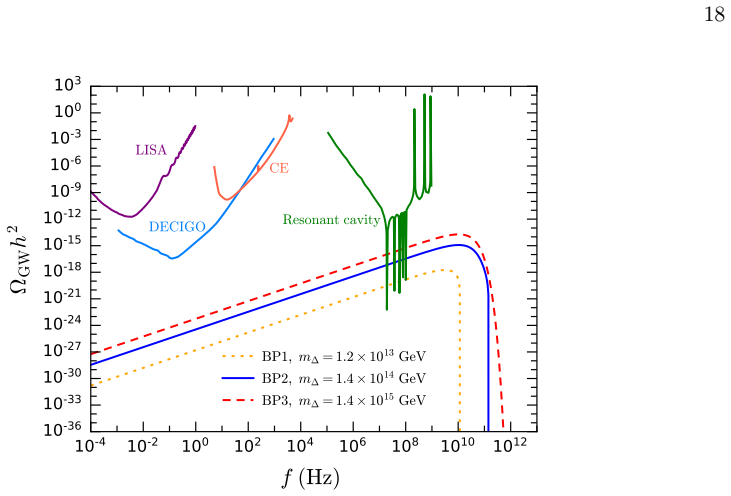
Scalar leptoquarks in the SU(5) grand unified theory, forced to be superheavy by proton decay bounds, produce a stochastic gravitational wave background through graviton bremsstrahlung induced by quantum gravity. Solving the Boltzmann equation for the leptoquark number density evolution allows computation of the gravitational wave spectrum, which high-frequency resonant cavity detectors could probe.
What carries the argument
The Boltzmann equation for the scalar leptoquark number density, which determines the abundance available for decays that emit gravitons and thereby sets the amplitude of the stochastic gravitational wave spectrum.
If this is right
- The gravitational wave spectrum follows directly from the leptoquark decay kinematics and the early-universe number density evolution.
- Proton decay constraints indirectly make the quantum gravity effect more accessible rather than less.
- High-frequency gravitational wave searches become a probe of grand unified theories through this indirect channel.
- The signal takes the form of a broad stochastic background rather than discrete events.
Where Pith is reading between the lines
- Similar graviton bremsstrahlung signals could arise from other heavy colored scalars in extended models if their masses are also pushed high by stability bounds.
- A positive detection would simultaneously support the existence of leptoquarks and the relevance of quantum gravity corrections at unification scales.
- Detector development focused on the relevant high-frequency band would gain motivation from this particle-physics source.
- The calculation framework could be applied to other early-universe decay processes that involve quantum gravity emission.
Load-bearing premise
Proton decay bounds require the scalar leptoquarks to be superheavy enough that the quantum-gravity-induced graviton bremsstrahlung signal avoids severe suppression.
What would settle it
No gravitational wave signal appearing in resonant cavity detectors at the frequencies and amplitudes predicted from the computed leptoquark spectrum would falsify the central claim.
Figures
read the original abstract
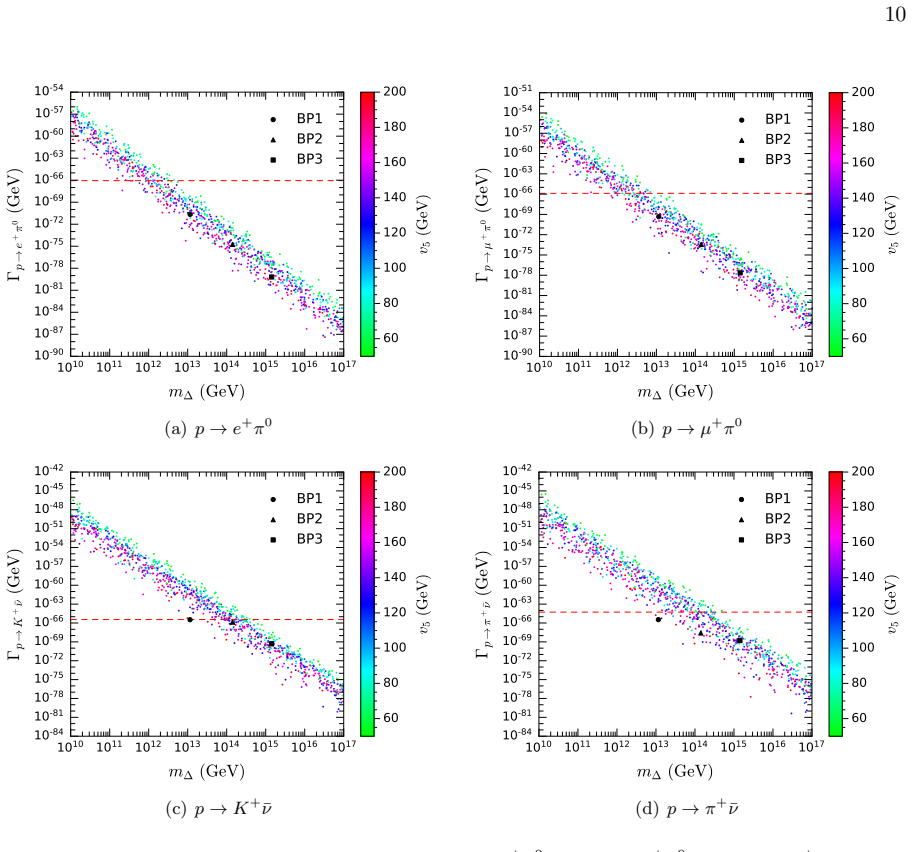
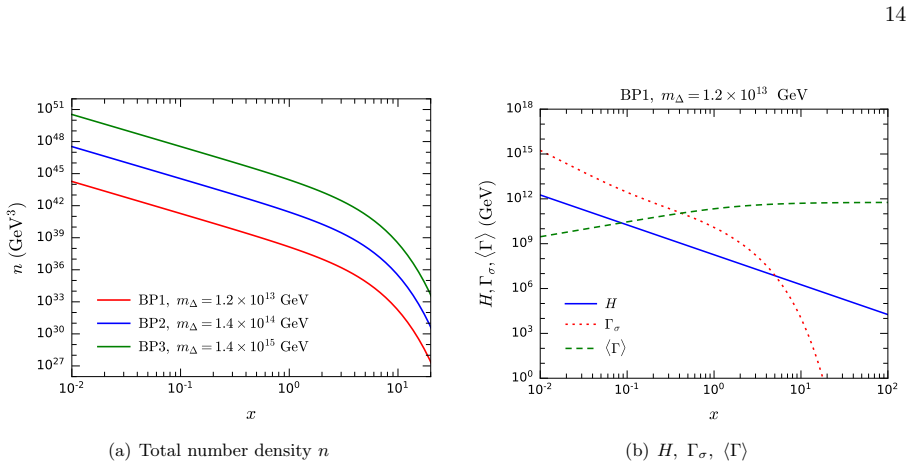
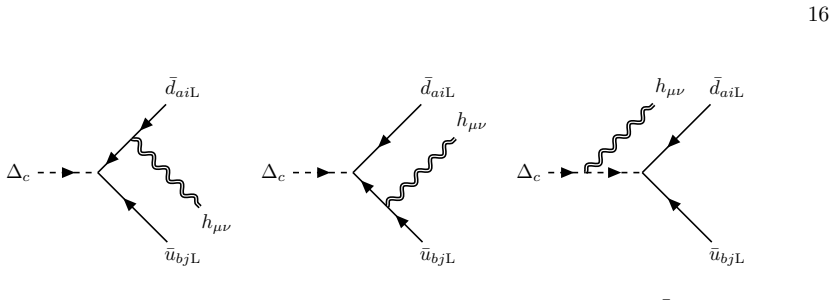
We study the stochastic gravitational wave background originated from graviton bremsstrahlung in decays of scalar leptoquarks, which are colored scalar bosons simultaneously coupling to a quark and a lepton. We take the scalar leptoquarks in the $\mathrm{SU}(5)$ grand unified theory as a concrete example. Stringent experimental bounds on proton decay force these particles to be superheavy, which in turn renders their graviton bremsstrahlung, induced by quantum gravity effects, less suppressed. By solving the relevant Boltzmann equation, we trace the evolution of the scalar leptoquark number density in the early universe and use it to compute the resulting gravitational wave spectrum. We find that high-frequency gravitational wave detectors employing resonant cavity techniques offer a promising means to probe such signals.
Editorial analysis
A structured set of objections, weighed in public.
Referee Report
Summary. The paper claims that scalar leptoquarks in SU(5) GUT, constrained to be superheavy by proton decay bounds, generate a stochastic GW background via quantum-gravity-induced graviton bremsstrahlung in their decays. Solving the Boltzmann equation for the leptoquark number density evolution in the early universe allows computation of the resulting GW spectrum, with the conclusion that high-frequency resonant-cavity detectors offer a promising probe.
Significance. If the result holds, the work links GUT-scale physics to high-frequency GW detection through a forward prediction based on standard early-universe dynamics and the Boltzmann equation. The explicit solution of the number-density evolution is a methodological strength that addresses abundance questions directly.
major comments (2)
- [Abstract] Abstract: the statement that superheavy masses render the graviton bremsstrahlung 'less suppressed' is load-bearing for the signal amplitude, yet the manuscript provides no explicit scaling (e.g., branching ratio ∝ m_LQ^n / M_Pl^n) or effective operator to justify why larger m_LQ increases rather than decreases the rate; this must be derived in the rate-calculation section.
- [Boltzmann equation solution] Boltzmann-equation solution (early-universe evolution section): although the abstract states that the number density is traced, the manuscript must explicitly demonstrate that the resulting abundance yields Ω_GW above detector thresholds for any realistic T_rh; without this, the production bottleneck raised in the stress-test note remains unaddressed in the provided text.
minor comments (2)
- The abstract should briefly state the assumed reheating temperature or production channel used in the Boltzmann solution to allow immediate assessment of abundance suppression.
- Notation for the graviton bremsstrahlung process (quantum-gravity-induced) should be defined with a reference to the relevant effective Lagrangian or Feynman rules when first introduced.
Simulated Author's Rebuttal
We thank the referee for the careful reading and constructive comments, which help strengthen the presentation of our results. We address each major comment below and will incorporate the suggested clarifications in the revised manuscript.
read point-by-point responses
-
Referee: [Abstract] Abstract: the statement that superheavy masses render the graviton bremsstrahlung 'less suppressed' is load-bearing for the signal amplitude, yet the manuscript provides no explicit scaling (e.g., branching ratio ∝ m_LQ^n / M_Pl^n) or effective operator to justify why larger m_LQ increases rather than decreases the rate; this must be derived in the rate-calculation section.
Authors: We agree that an explicit derivation of the scaling is required to support the claim. The rate-calculation section introduces the dimension-5 effective operator for graviton emission but does not isolate the m_LQ dependence of the branching ratio. In the revision we will add a short derivation showing that the two-body decay width scales linearly with m_LQ while the graviton-bremsstrahlung width acquires an extra (m_LQ/M_Pl)^2 factor from the operator; the resulting branching ratio therefore grows with m_LQ, rendering the process less suppressed for superheavy masses. This paragraph will be inserted in the rate-calculation section. revision: yes
-
Referee: [Boltzmann equation solution] Boltzmann-equation solution (early-universe evolution section): although the abstract states that the number density is traced, the manuscript must explicitly demonstrate that the resulting abundance yields Ω_GW above detector thresholds for any realistic T_rh; without this, the production bottleneck raised in the stress-test note remains unaddressed in the provided text.
Authors: The manuscript solves the Boltzmann equation for the leptoquark number density and computes the resulting GW spectrum for benchmark parameters. To address the referee’s request we will expand the early-universe section with an explicit scan over reheating temperatures in the realistic range T_rh ≳ m_LQ, demonstrating that the integrated Ω_GW lies above the projected sensitivity of resonant-cavity detectors for all T_rh above the leptoquark mass scale. We will also enlarge the discussion of the stress-test note to quantify the minimal abundance needed to surpass detector thresholds. revision: yes
Circularity Check
No significant circularity; forward prediction from Boltzmann evolution
full rationale
The paper solves the Boltzmann equation for scalar leptoquark number density evolution in the early universe and computes the resulting GW spectrum as a standard forward calculation. No self-definitional relations, fitted parameters renamed as predictions, or load-bearing self-citations appear in the abstract or described derivation. The result is presented as a prediction from standard dynamics and proton-decay bounds, without reducing to its inputs by construction. This is the normal non-circular case for such phenomenological calculations.
Axiom & Free-Parameter Ledger
axioms (1)
- domain assumption SU(5) GUT contains scalar leptoquarks whose masses are forced above ~10^15 GeV by proton-decay limits
invented entities (1)
-
graviton bremsstrahlung process induced by quantum gravity
no independent evidence
Reference graph
Works this paper leans on
-
[1]
interactions violate both lepton and baryon numbers, mediating proton decay, which pushes their masses well beyond the electroweak scale into the superheavy regime
are also displayed. interactions violate both lepton and baryon numbers, mediating proton decay, which pushes their masses well beyond the electroweak scale into the superheavy regime. Because of quantum gravitational processes, decays of these superheavy particles in the early universe are inevitably accompanied by graviton bremsstrahlung. The resulting ...
-
[2]
Observation of Gravitational Waves from a Binary Black Hole Merger
LIGO Scientific, Virgo Collaboration, B. P. Abbott et al. , “Observation of Gravitational Waves from a Binary Black Hole Merger,” Phys. Rev. Lett. 116 (2016) 061102, arXiv:1602.03837 [gr-qc]
work page internal anchor Pith review Pith/arXiv arXiv 2016
-
[3]
Infrared photons and gravitons,
S. Weinberg, “Infrared photons and gravitons,” Phys. Rev. 140 (1965) B516–B524
1965
-
[4]
Stochastic Gravitational Waves from Particle Origin,
K. Nakayama and Y. Tang, “Stochastic Gravitational Waves from Particle Origin,” Phys. Lett. B 788 (2019) 341–346, arXiv:1810.04975 [hep-ph] . [Erratum: Phys.Lett.B 839, 137787 (2023)]
-
[5]
Stochastic Gravitational Waves from Inflaton Decays,
D. Huang and L. Yin, “Stochastic Gravitational Waves from Inflaton Decays,” Phys. Rev. D 100 (2019) 043538, arXiv:1905.08510 [hep-ph]
-
[6]
Bremsstrahlung high-frequency gravitational wave signatures of high-scale nonthermal leptogenesis,
A. Ghoshal, R. Samanta, and G. White, “Bremsstrahlung high-frequency gravitational wave signatures of high-scale nonthermal leptogenesis,” Phys. Rev. D 108 (2023) 035019, arXiv:2211.10433 [hep-ph]
-
[7]
Gravitational wave from graviton Bremsstrahlung during reheating,
B. Barman, N. Bernal, Y. Xu, and ´O. Zapata, “Gravitational wave from graviton Bremsstrahlung during reheating,” JCAP 05 (2023) 019, arXiv:2301.11345 [hep-ph]
-
[8]
Gravitational waves from inflaton decay and bremsstrahlung,
A. Tokareva, “Gravitational waves from inflaton decay and bremsstrahlung,” Phys. Lett. B 853 (2024) 138695, arXiv:2312.16691 [hep-ph]
-
[9]
Y. Jiang and T. Suyama, “Spectrum of high-frequency gravitational waves from graviton bremsstrahlung by the decay of inflaton: case with polynomial potential,” JCAP 02 (2025) 041, arXiv:2410.11175 [astro-ph.CO]
-
[10]
J. Cheng and A. Tokareva, “Weak Gravity Conjecture in the sky: gravitational waves from preheating in Einstein-Maxwell-Scalar EFT,” arXiv:2512.10890 [hep-th]
-
[11]
D. Das, M. Sanghi, and Sourav, “Stochastic gravitational wave from graviton bremsstrahlung in inflaton decay into massive spin 3/2 particles,” Phys. Rev. D 113 (2026) 063511, arXiv:2511.01579 [hep-ph]
-
[12]
Ultra-high frequency gravitational waves from scattering, Bremsstrahlung and decay during reheating,
Y. Xu, “Ultra-high frequency gravitational waves from scattering, Bremsstrahlung and decay during reheating,” JHEP 10 (2024) 174, arXiv:2407.03256 [hep-ph]
-
[13]
Full-spectrum analysis of gravitational wave production from inflation to reheating,
X.-J. Xu, Y. Xu, Q. Yin, and J. Zhu, “Full-spectrum analysis of gravitational wave production from inflation to reheating,” JHEP 10 (2025) 141, arXiv:2505.08868 [hep-ph]
-
[14]
Probing Leptogenesis through Gravitational Waves,
A. Datta and A. Sil, “Probing Leptogenesis through Gravitational Waves,” arXiv:2410.01900 [hep-ph]
-
[15]
A possible cosmological origin of the KM3-230213A event,
K.-Y. Choi, E. Lkhagvadorj, and S. Mahapatra, “A possible cosmological origin of the KM3-230213A event,” JCAP 10 (2025) 079, arXiv:2503.22465 [hep-ph] . 20
-
[16]
Observing leptogenesis in action with gravitational waves,
H. Murayama, B. Noether, and J. Sch¨ utte-Engel, “Observing leptogenesis in action with gravitational waves,” JCAP 12 (2025) 027, arXiv:2506.15772 [hep-ph]
-
[17]
Unraveling freeze-in dark matter through the echoes of gravitational waves,
P. Konar and S. Show, “Unraveling freeze-in dark matter through the echoes of gravitational waves,” Phys. Rev. D 113 (2026) L071701, arXiv:2506.08106 [hep-ph]
-
[18]
Gravitational Wave Spectrum from the Production of Dark Matter via the freeze-in Mechanism,
Y. Wang and W. Chao, “Gravitational Wave Spectrum from the Production of Dark Matter via the freeze-in Mechanism,” arXiv:2508.10665 [hep-ph]
-
[19]
Unveiling a Hidden Epoch: Impact of Mediator Induced Matter Domination in Freeze-in Dark Matter,
P. Konar and S. Show, “Unveiling a Hidden Epoch: Impact of Mediator Induced Matter Domination in Freeze-in Dark Matter,” arXiv:2512.13799 [hep-ph]
-
[20]
Gravitational wave background from Standard Model physics: Qualitative features
J. Ghiglieri and M. Laine, “Gravitational wave background from Standard Model physics: Qualitative features,” JCAP 07 (2015) 022, arXiv:1504.02569 [hep-ph]
work page internal anchor Pith review Pith/arXiv arXiv 2015
-
[21]
Gravitational wave background from Standard Model physics: Complete leading order,
J. Ghiglieri, G. Jackson, M. Laine, and Y. Zhu, “Gravitational wave background from Standard Model physics: Complete leading order,” JHEP 07 (2020) 092, arXiv:2004.11392 [hep-ph]
-
[22]
Gravitational Waves as a Big Bang Thermometer,
A. Ringwald, J. Sch¨ utte-Engel, and C. Tamarit, “Gravitational Waves as a Big Bang Thermometer,” JCAP 03 (2021) 054, arXiv:2011.04731 [hep-ph]
-
[23]
Upper bound on thermal gravitational wave backgrounds from hidden sectors,
M. Drewes, Y. Georis, J. Klaric, and P. Klose, “Upper bound on thermal gravitational wave backgrounds from hidden sectors,” JCAP 06 (2024) 073, arXiv:2312.13855 [hep-ph]
-
[24]
Double-graviton production from Standard Model plasma,
J. Ghiglieri, M. Laine, J. Sch¨ utte-Engel, and E. Speranza, “Double-graviton production from Standard Model plasma,” JCAP 04 (2024) 062, arXiv:2401.08766 [hep-ph]
-
[25]
Pre-thermalized gravitational waves,
N. Bernal, Q.-f. Wu, X.-J. Xu, and Y. Xu, “Pre-thermalized gravitational waves,” JHEP 08 (2025) 125, arXiv:2503.10756 [hep-ph]
-
[26]
Thermal gravitons from warm inflation,
G. Montefalcone, B. Shams Es Haghi, T. Xu, and K. Freese, “Thermal gravitons from warm inflation,” Phys. Rev. D 112 (2025) 063556, arXiv:2507.08739 [hep-ph]
-
[27]
Freeze-in gravitational waves and dark matter in warm inflation,
Q. Chen, S. Jiang, D. Qiu, P. Chen, and F. P. Huang, “Freeze-in gravitational waves and dark matter in warm inflation,” JCAP 03 (2026) 051, arXiv:2507.13916 [hep-ph]
-
[28]
Gravitational wave probe of Planck-scale physics after inflation,
W. Hu, K. Nakayama, V. Takhistov, and Y. Tang, “Gravitational wave probe of Planck-scale physics after inflation,” Phys. Lett. B 856 (2024) 138958, arXiv:2403.13882 [hep-ph]
-
[29]
Gravitational waves from supermassive right-handed neutrinos produced at preheating,
S. Kanemura, K. Kaneta, and D. Nanda, “Gravitational waves from supermassive right-handed neutrinos produced at preheating,” Phys. Rev. D 113 (2026) 055046, arXiv:2508.00315 [hep-ph]
-
[30]
Gravitational wave sourced by decay of massive particle from primordial black hole evaporation,
K.-Y. Choi, E. Lkhagvadorj, and S. Mahapatra, “Gravitational wave sourced by decay of massive particle from primordial black hole evaporation,” JCAP 07 (2024) 064, arXiv:2403.15269 [hep-ph]
-
[31]
Testing the type-II seesaw mechanism with gravitational waves,
Y. Wang and W. Chao, “Testing the type-II seesaw mechanism with gravitational waves,” arXiv:2510.26235 [hep-ph]
-
[32]
Graviton energy spectra arising from the KSVZ axion model,
Y. Wang, L.-Y. He, W. Chao, and Y. Gao, “Graviton energy spectra arising from the KSVZ axion model,” arXiv:2601.20767 [hep-ph]
-
[33]
N. Herman, A. F¨ uzfa, L. Lehoucq, and S. Clesse, “Detecting planetary-mass primordial black holes with resonant electromagnetic gravitational-wave detectors,” Phys. Rev. D 104 (2021) 023524, arXiv:2012.12189 [gr-qc]
-
[34]
Electromagnetic antennas for the resonant detection of the stochastic gravitational wave background,
N. Herman, L. Lehoucq, and A. F´ uzfa, “Electromagnetic antennas for the resonant detection of the stochastic gravitational wave background,” Phys. Rev. D 108 (2023) 124009, arXiv:2203.15668 [gr-qc]
-
[35]
Physics of leptoquarks in precision experiments and at particle colliders
I. Dorˇ sner, S. Fajfer, A. Greljo, J. F. Kamenik, and N. Koˇ snik, “Physics of leptoquarks in precision experiments and at particle colliders,” Phys. Rept. 641 (2016) 1–68, arXiv:1603.04993 [hep-ph]
work page internal anchor Pith review Pith/arXiv arXiv 2016
-
[36]
Unity of All Elementary Particle Forces,
H. Georgi and S. L. Glashow, “Unity of All Elementary Particle Forces,” Phys. Rev. Lett. 32 (1974) 438–441. 21
1974
-
[37]
Group Theory for Unified Model Building,
R. Slansky, “Group Theory for Unified Model Building,” Phys. Rept. 79 (1981) 1–128
1981
-
[38]
Heavy and light scalar leptoquarks in proton decay
I. Dorsner, S. Fajfer, and N. Kosnik, “Heavy and light scalar leptoquarks in proton decay,” Phys. Rev. D 86 (2012) 015013, arXiv:1204.0674 [hep-ph]
work page internal anchor Pith review Pith/arXiv arXiv 2012
-
[39]
Fermion Masses and Higgs Representations in SU(5),
J. R. Ellis and M. K. Gaillard, “Fermion Masses and Higgs Representations in SU(5),” Phys. Lett. B 88 (1979) 315–319
1979
-
[40]
Baryon and Lepton Nonconserving Processes,
S. Weinberg, “Baryon and Lepton Nonconserving Processes,” Phys. Rev. Lett. 43 (1979) 1566–1570
1979
-
[41]
Modification of GUT Predictions in the Presence of Spontaneous Compactification,
Q. Shafi and C. Wetterich, “Modification of GUT Predictions in the Presence of Spontaneous Compactification,” Phys. Rev. Lett. 52 (1984) 875
1984
-
[42]
Minimal SU(5) theory on the edge: The importance of being effective,
G. Senjanovi´ c and M. Zantedeschi, “Minimal SU(5) theory on the edge: The importance of being effective,” Phys. Rev. D 109 (2024) 095009, arXiv:2402.19224 [hep-ph]
-
[43]
A New Lepton - Quark Mass Relation in a Unified Theory,
H. Georgi and C. Jarlskog, “A New Lepton - Quark Mass Relation in a Unified Theory,” Phys. Lett. B 86 (1979) 297–300
1979
-
[44]
The Future of Elementary Particle Physics,
S. L. Glashow, “The Future of Elementary Particle Physics,” NATO Sci. Ser. B 61 (1980) 687
1980
-
[45]
Unification without supersymmetry: neutrino mass, proton decay and light leptoquarks
I. Dorsner and P. Fileviez Perez, “Unification without supersymmetry: Neutrino mass, proton decay and light leptoquarks,” Nucl. Phys. B 723 (2005) 53–76, arXiv:hep-ph/0504276
work page internal anchor Pith review Pith/arXiv arXiv 2005
-
[46]
B. Bajc and G. Senjanovic, “Seesaw at LHC,” JHEP 08 (2007) 014, arXiv:hep-ph/0612029
work page internal anchor Pith review Pith/arXiv arXiv 2007
-
[47]
Predictions from type II see-saw mechanism in SU(5)
I. Dorsner and I. Mocioiu, “Predictions from type II see-saw mechanism in SU(5),” Nucl. Phys. B 796 (2008) 123–136, arXiv:0708.3332 [hep-ph]
work page internal anchor Pith review Pith/arXiv arXiv 2008
-
[48]
Renormalizable SU(5) Unification
P. Fileviez Perez and C. Murgui, “Renormalizable SU(5) Unification,” Phys. Rev. D 94 (2016) 075014, arXiv:1604.03377 [hep-ph]
work page internal anchor Pith review Pith/arXiv arXiv 2016
-
[49]
Unification of Gauge Couplings in Radiative Neutrino Mass Models
C. Hagedorn, T. Ohlsson, S. Riad, and M. A. Schmidt, “Unification of Gauge Couplings in Radiative Neutrino Mass Models,” JHEP 09 (2016) 111, arXiv:1605.03986 [hep-ph]
work page internal anchor Pith review Pith/arXiv arXiv 2016
-
[50]
I. Dorˇ sner and S. Saad, “Towards MinimalSU (5),” Phys. Rev. D 101 (2020) 015009, arXiv:1910.09008 [hep-ph]
-
[51]
Gauge and scalar boson mediated proton decay in a predictive SU(5) GUT model,
I. Dorˇ sner, E. Dˇ zaferovi´ c-Maˇ si´ c, S. Fajfer, and S. Saad, “Gauge and scalar boson mediated proton decay in a predictive SU(5) GUT model,” Phys. Rev. D 109 (2024) 075023, arXiv:2401.16907 [hep-ph]
-
[52]
Exploring flavor space of an economical SU(5) GUT in future proton decay measurements,
G.-X. Fang and Y.-L. Zhou, “Exploring flavor space of an economical SU(5) GUT in future proton decay measurements,” Phys. Rev. D 110 (2024) 095024, arXiv:2406.06861 [hep-ph]
-
[53]
µ → eγ at a Rate of One Out of 10 9 Muon Decays?,
P. Minkowski, “ µ → eγ at a Rate of One Out of 10 9 Muon Decays?,” Phys. Lett. B 67 (1977) 421–428
1977
-
[54]
Complex Spinors and Unified Theories
M. Gell-Mann, P. Ramond, and R. Slansky, “Complex Spinors and Unified Theories,” Conf. Proc. C 790927 (1979) 315–321, arXiv:1306.4669 [hep-th]
work page internal anchor Pith review Pith/arXiv arXiv 1979
-
[55]
Horizontal gauge symmetry and masses of neutrinos,
T. Yanagida, “Horizontal gauge symmetry and masses of neutrinos,” Conf. Proc. C 7902131 (1979) 95–99
1979
-
[56]
Unitary Symmetry and Leptonic Decays,
N. Cabibbo, “Unitary Symmetry and Leptonic Decays,” Phys. Rev. Lett. 10 (1963) 531–533
1963
-
[57]
CP Violation in the Renormalizable Theory of Weak Interaction,
M. Kobayashi and T. Maskawa, “CP Violation in the Renormalizable Theory of Weak Interaction,” Prog. Theor. Phys. 49 (1973) 652–657
1973
-
[58]
Remarks on the unified model of elementary particles,
Z. Maki, M. Nakagawa, and S. Sakata, “Remarks on the unified model of elementary particles,” Prog. Theor. Phys. 28 (1962) 870–880
1962
-
[59]
Neutrino Experiments and the Problem of Conservation of Leptonic Charge,
B. Pontecorvo, “Neutrino Experiments and the Problem of Conservation of Leptonic Charge,” Sov. Phys. JETP 26 (1968) 984–988
1968
-
[60]
Proton stability in grand unified theories, in strings, and in branes
P. Nath and P. Fileviez Perez, “Proton stability in grand unified theories, in strings and in branes,” Phys. Rept. 441 (2007) 191–317, arXiv:hep-ph/0601023
work page internal anchor Pith review Pith/arXiv arXiv 2007
-
[61]
Review of particle physics,
Particle Data Group Collaboration, S. Navas et al. , “Review of particle physics,” Phys. Rev. D 22 110 (2024) 030001
2024
-
[62]
Proton lifetime bounds from chirally symmetric lattice QCD
RBC-UKQCD Collaboration, Y. Aoki, P. Boyle, P. Cooney, L. Del Debbio, R. Kenway, C. M. Maynard, A. Soni, and R. Tweedie, “Proton lifetime bounds from chirally symmetric lattice QCD,” Phys. Rev. D 78 (2008) 054505, arXiv:0806.1031 [hep-lat]
work page internal anchor Pith review Pith/arXiv arXiv 2008
-
[63]
Diagonalization of Quark Mass Matrices and the Cabibbo-Kobayashi-Maskawa Matrix
A. Rasin, “Diagonalization of quark mass matrices and the Cabibbo-Kobayashi-Maskawa matrix,” arXiv:hep-ph/9708216
work page internal anchor Pith review Pith/arXiv arXiv
-
[64]
E. W. Kolb and M. S. Turner, The Early Universe . Westview Press, 1990
1990
-
[65]
Baryon Number Generation in the Early Universe,
E. W. Kolb and S. Wolfram, “Baryon Number Generation in the Early Universe,” Nucl. Phys. B 172 (1980) 224. [Erratum: Nucl.Phys.B 195, 542 (1982)]
1980
-
[66]
Cosmic abundances of stable particles: Improved analysis,
P. Gondolo and G. Gelmini, “Cosmic abundances of stable particles: Improved analysis,” Nucl. Phys. B 360 (1991) 145–179
1991
-
[67]
Updated running quark and lepton parameters at various scales,
S. Antusch, K. Hinze, and S. Saad, “Updated running quark and lepton parameters at various scales,” Phys. Rev. D 113 (2026) 095011, arXiv:2510.01312 [hep-ph]
-
[68]
Factorization and polarization in linearized gravity
S. Y. Choi, J. S. Shim, and H. S. Song, “Factorization and polarization in linearized gravity,” Phys. Rev. D 51 (1995) 2751–2769, arXiv:hep-th/9411092
work page internal anchor Pith review Pith/arXiv arXiv 1995
-
[69]
P. Binetruy, A. Bohe, C. Caprini, and J.-F. Dufaux, “Cosmological Backgrounds of Gravitational Waves and eLISA/NGO: Phase Transitions, Cosmic Strings and Other Sources,” JCAP 06 (2012) 027, arXiv:1201.0983 [gr-qc]
work page internal anchor Pith review Pith/arXiv arXiv 2012
-
[70]
Exploring the Sensitivity of Next Generation Gravitational Wave Detectors
LIGO Scientific Collaboration, B. P. Abbott et al. , “Exploring the Sensitivity of Next Generation Gravitational Wave Detectors,” Class. Quant. Grav. 34 (2017) 044001, arXiv:1607.08697 [astro-ph.IM]
work page internal anchor Pith review Pith/arXiv arXiv 2017
-
[71]
Laser Interferometer Space Antenna
LISA Collaboration, P. Amaro-Seoane et al. , “Laser Interferometer Space Antenna,” arXiv:1702.00786 [astro-ph.IM]
work page internal anchor Pith review Pith/arXiv arXiv
-
[72]
Space gravitational wave antenna DECIGO and B-DECIGO,
DECIGO working group Collaboration, S. Kawamura, “Space gravitational wave antenna DECIGO and B-DECIGO,” PoS ICRC2023 (2023) 1516
2023
-
[73]
Wave Resonance of Light and Gravitational Waves,
M. E. Gertsenshtein, “Wave Resonance of Light and Gravitational Waves,” J. Exp. Theor. Phys. 14 (1960) 113
1960
discussion (0)
Sign in with ORCID, Apple, or X to comment. Anyone can read and Pith papers without signing in.