Investigating forward-backward asymmetry in D-meson production and anisotropic flow in p-Pb collisions at the LHC
Pith reviewed 2026-06-30 08:21 UTC · model grok-4.3
The pith
Forward-backward asymmetry in D0 meson production and elliptic flow in p-Pb collisions arises from the interplay of initial cold nuclear matter effects and final-state partonic interactions.
A machine-rendered reading of the paper's core claim, the machinery that carries it, and where it could break.
Core claim
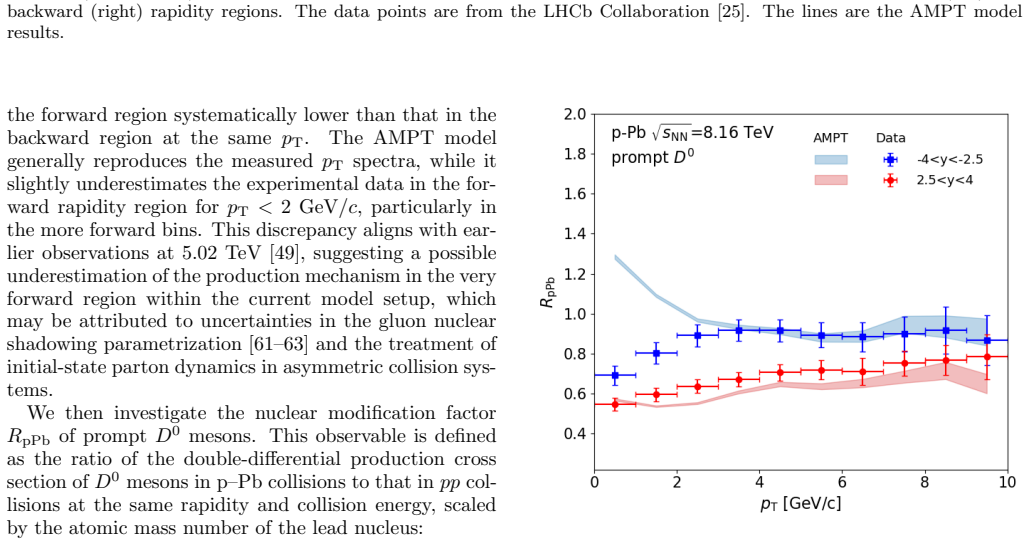
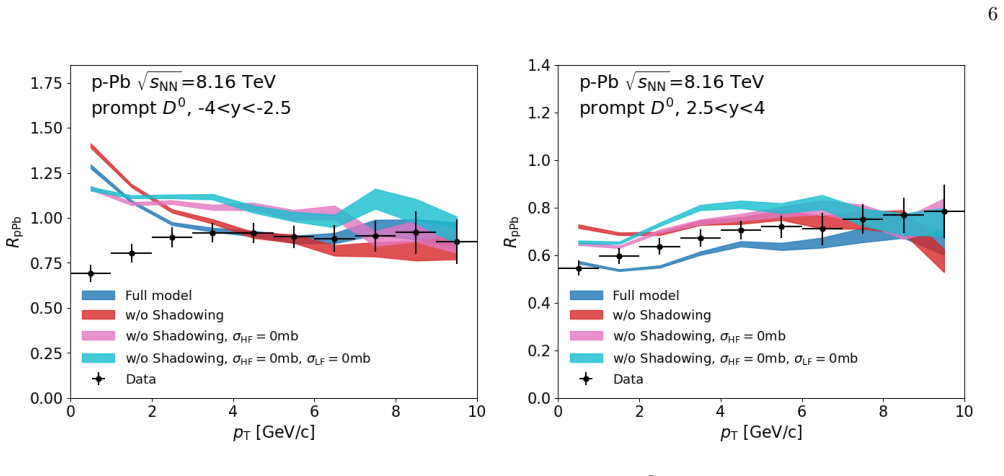
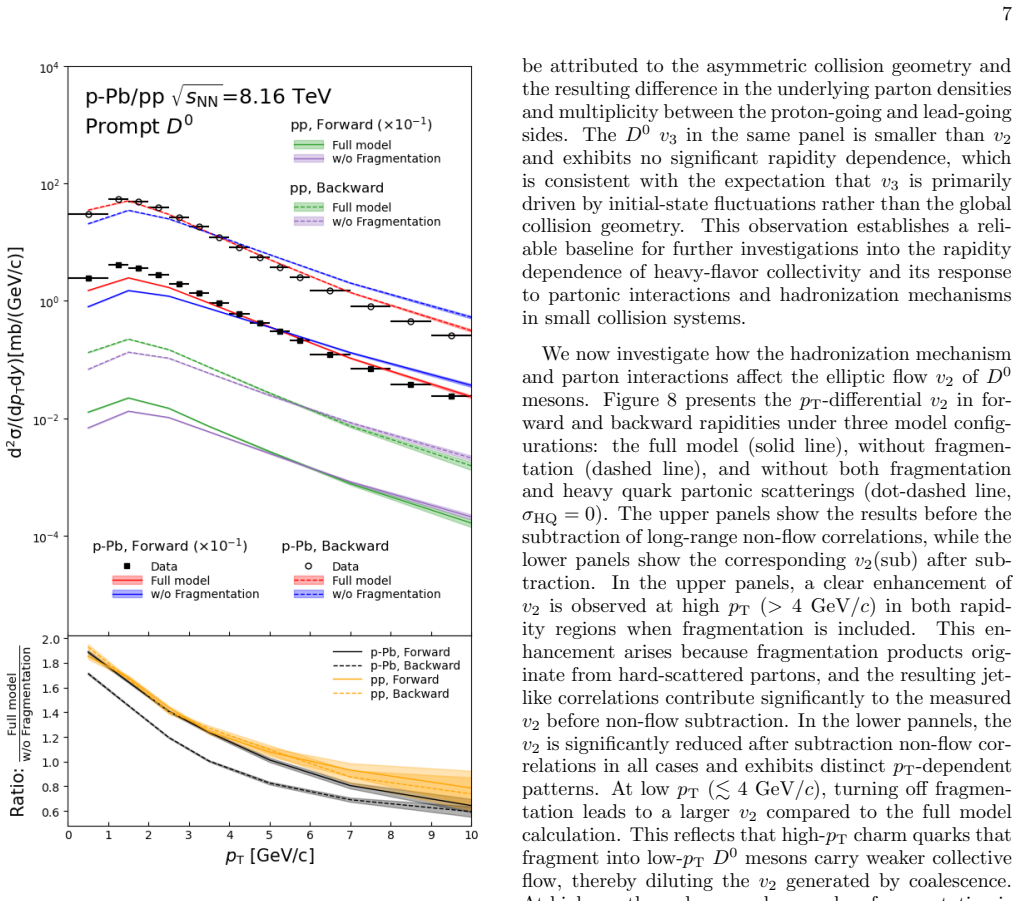
The heavy-flavor improved string-melting AMPT model provides a simultaneous description of the nuclear modification factor RpPb and elliptic flow v2 of prompt D0 mesons in both forward and backward rapidities. The forward-backward asymmetry arises from the combined action of initial-state cold nuclear matter effects and final-state partonic interactions, where the relative importance of coalescence versus fragmentation determines the detailed transverse momentum and rapidity dependence of these observables.
What carries the argument
The heavy-flavor improved string-melting AMPT model, which incorporates coalescence and fragmentation for heavy quarks together with partonic scatterings and initial nuclear effects.
If this is right
- The model reproduces both RpPb and v2 asymmetries across rapidities using only the stated parameters.
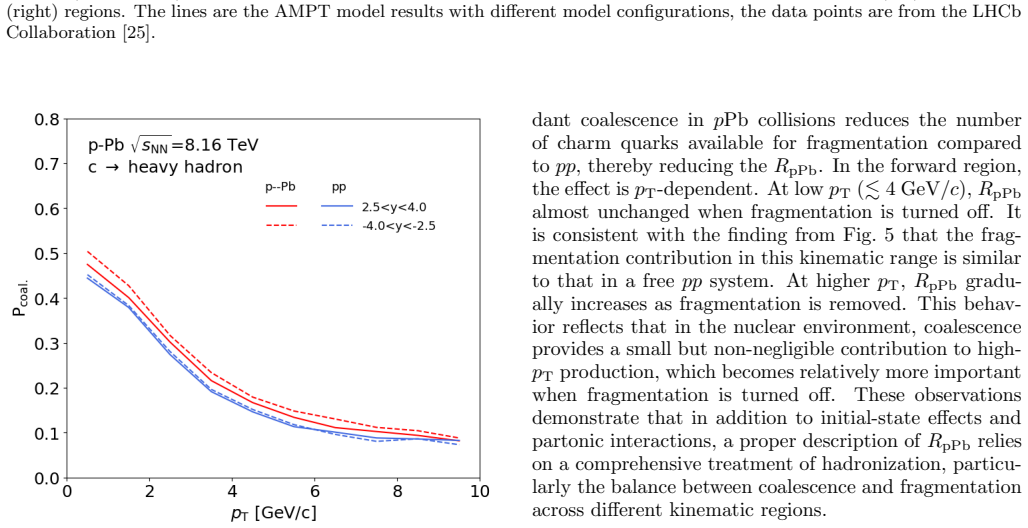
- Coalescence dominates at lower pT while fragmentation takes over at higher pT, shaping the asymmetry.
- Partonic interactions must be present to generate the observed flow and suppression patterns.
- The conclusions apply to high-multiplicity p-Pb collisions at LHC energies.
Where Pith is reading between the lines
- The same mechanism could produce measurable asymmetries in other heavy-flavor species such as B mesons.
- Collective flow in small systems may share a common partonic origin with that seen in larger heavy-ion collisions.
- Varying beam energy or using different light ions would help separate initial-state from final-state contributions.
Load-bearing premise
The heavy-flavor improved string-melting AMPT model correctly captures the balance between initial cold nuclear matter effects and final-state partonic interactions through coalescence and fragmentation without extra tuning.
What would settle it
Data showing that the forward-backward asymmetry in D0 elliptic flow vanishes or reverses when initial-state nuclear effects are removed, or that disabling coalescence in the model eliminates the observed pT and rapidity dependence, would falsify the claimed mechanism.
Figures


read the original abstract
We investigate the forward--backward asymmetry in the production and elliptic flow of prompt D0 mesons in proton--lead (p--Pb) collisions at$\sqrt{s_{\mathrm{NN}}}=8.16$ TeV using the heavy-flavor improved string-melting version of the AMPT model. The model calculations provide a simultaneous description of nuclear modification factor $R_{\mathrm{pPb}}$ and $v_2$ in forward and backward rapidities. We find that the observed asymmetry arises from the interplay of initial-state cold nuclear matter effects and final-state partonic interactions, with the competition between coalescence and fragmentation playing a critical role in shaping the transverse momentum and rapidity dependence of both observables. This work suggests that a partonic medium is formed in high-multiplicity p-Pb collisions at LHC energies.
Editorial analysis
A structured set of objections, weighed in public.
Referee Report
Summary. The manuscript employs the heavy-flavor improved string-melting AMPT model to compute forward-backward asymmetries in prompt D0 production and elliptic flow v2 in p-Pb collisions at √sNN=8.16 TeV. It reports that the model simultaneously reproduces RpPb and v2 at forward and backward rapidities, attributing the observed asymmetries to the interplay between initial-state cold nuclear matter effects and final-state partonic interactions, with coalescence versus fragmentation competition shaping the pT and rapidity dependence. The central conclusion is that these results indicate formation of a partonic medium in high-multiplicity p-Pb collisions.
Significance. If the model's reproduction of the data holds without post-hoc parameter adjustments and the interplay is shown to be necessary rather than emergent from the model's construction, the work would add to evidence for partonic scattering in small systems. The explicit focus on coalescence-fragmentation competition is a positive feature that could be falsifiable with additional observables.
major comments (3)
- [Abstract] Abstract and model description: The claim that the heavy-flavor improved string-melting AMPT provides a simultaneous description of RpPb and v2 'without additional tuning' is load-bearing for the partonic-medium interpretation, yet the manuscript does not list the numerical values of the coalescence and fragmentation parameters or the partonic interaction strength, nor does it demonstrate that these were fixed exclusively from prior studies independent of the present RpPb and v2 data sets.
- [Results] Results section (presumed §4): No quantitative comparison (e.g., χ²/dof or residual plots) is provided between the full model and a pure-initial-state baseline (cold nuclear matter effects only, no partonic scattering), making it impossible to isolate the contribution of final-state interactions to the reported asymmetry.
- [Discussion] Discussion: The competition between coalescence and fragmentation is stated to be critical, but the manuscript does not report the relative fractions of D0 mesons produced via each mechanism as a function of pT and rapidity, which would be required to substantiate that this competition, rather than other model ingredients, drives the forward-backward difference.
minor comments (2)
- [Abstract] The abstract refers to 'high-multiplicity p-Pb collisions' but the calculations appear to be for minimum-bias or centrality-integrated events; clarify the multiplicity selection used for the reported asymmetries.
- Notation for the nuclear modification factor is written as R_pPb in the abstract but should be consistently R_{pPb} throughout.
Simulated Author's Rebuttal
We thank the referee for the constructive comments, which help clarify the presentation of our results. We address each major comment below and revise the manuscript to incorporate the requested details and comparisons.
read point-by-point responses
-
Referee: [Abstract] Abstract and model description: The claim that the heavy-flavor improved string-melting AMPT provides a simultaneous description of RpPb and v2 'without additional tuning' is load-bearing for the partonic-medium interpretation, yet the manuscript does not list the numerical values of the coalescence and fragmentation parameters or the partonic interaction strength, nor does it demonstrate that these were fixed exclusively from prior studies independent of the present RpPb and v2 data sets.
Authors: We agree that explicit documentation of the parameters is needed to support the 'without additional tuning' statement. In the revised manuscript we will add a table in the model section listing the numerical values of the coalescence and fragmentation parameters together with the partonic scattering cross section, and we will cite the earlier publications in which these values were fixed from independent data sets. revision: yes
-
Referee: [Results] Results section (presumed §4): No quantitative comparison (e.g., χ²/dof or residual plots) is provided between the full model and a pure-initial-state baseline (cold nuclear matter effects only, no partonic scattering), making it impossible to isolate the contribution of final-state interactions to the reported asymmetry.
Authors: We accept that a direct quantitative baseline comparison would strengthen the isolation of final-state effects. The revised manuscript will include calculations with partonic interactions disabled and will report χ²/dof values (or equivalent residuals) between the full model and this initial-state-only baseline for both RpPb and v2. revision: yes
-
Referee: [Discussion] Discussion: The competition between coalescence and fragmentation is stated to be critical, but the manuscript does not report the relative fractions of D0 mesons produced via each mechanism as a function of pT and rapidity, which would be required to substantiate that this competition, rather than other model ingredients, drives the forward-backward difference.
Authors: We agree that the relative fractions are necessary to substantiate the role of coalescence-fragmentation competition. The revised manuscript will add figures showing the pT- and rapidity-dependent fractions of D0 mesons produced via coalescence versus fragmentation in the forward and backward rapidity regions. revision: yes
Circularity Check
No significant circularity; model description remains independent of target observables
full rationale
The paper applies the established heavy-flavor-improved string-melting AMPT model to simultaneously describe R_pPb and v2 asymmetries in p-Pb collisions. The central suggestion of partonic medium formation follows from the model's reproduction of data via the stated interplay of CNM effects, partonic scattering, and coalescence/fragmentation. No quoted equations or sections demonstrate that any prediction reduces by construction to a fit on the same observables, self-definition of quantities, or load-bearing self-citation of an unverified uniqueness result. The derivation is self-contained against external benchmarks because the model is a pre-existing framework whose parameters are asserted to require no additional tuning for this study.
Axiom & Free-Parameter Ledger
free parameters (2)
- AMPT coalescence and fragmentation parameters
- Partonic interaction strength in AMPT
axioms (1)
- domain assumption The heavy-flavor improved string-melting AMPT model accurately represents both initial-state cold nuclear matter effects and final-state partonic interactions in p-Pb collisions.
Reference graph
Works this paper leans on
-
[1]
New Forms of QCD Matter Discovered at RHIC
M. Gyulassy and L. McLerran, New forms of QCD mat- ter discovered at RHIC, Nucl. Phys. A 750, 30 (2005), arXiv:nucl-th/0405013
work page internal anchor Pith review Pith/arXiv arXiv 2005
-
[2]
J. Adams et al. (STAR), Experimental and theoretical challenges in the search for the quark gluon plasma: The STAR Collaboration’s critical assessment of the evidence from RHIC collisions, Nucl. Phys. A 757, 102 (2005), arXiv:nucl-ex/0501009
work page internal anchor Pith review Pith/arXiv arXiv 2005
-
[3]
K. Adcox et al. (PHENIX), Formation of dense partonic matter in relativistic nucleus-nucleus collisions at RHIC: Experimental evaluation by the PHENIX collaboration, Nucl. Phys. A 757, 184 (2005), arXiv:nucl-ex/0410003
work page internal anchor Pith review Pith/arXiv arXiv 2005
-
[4]
First Results from Pb+Pb collisions at the LHC
B. Muller, J. Schukraft, and B. Wyslouch, First Results from Pb+Pb collisions at the LHC, Ann. Rev. Nucl. Part. Sci. 62, 361 (2012), arXiv:1202.3233 [hep-ex]
work page internal anchor Pith review Pith/arXiv arXiv 2012
-
[5]
S. Acharya et al. (ALICE), The ALICE experiment: a journey through QCD, Eur. Phys. J. C 84, 813 (2024), arXiv:2211.04384 [nucl-ex]
-
[6]
A. Hayrapetyan et al. (CMS), Overview of high-density QCD studies with the CMS experiment at the LHC, Phys. Rept. 1115, 219 (2025), arXiv:2405.10785 [nucl- ex]
-
[7]
B. B. Back et al. (PHOBOS), The PHOBOS perspective on discoveries at RHIC, Nucl. Phys. A 757, 28 (2005), arXiv:nucl-ex/0410022
work page internal anchor Pith review Pith/arXiv arXiv 2005
-
[8]
I. Arsene et al. (BRAHMS), Quark gluon plasma and color glass condensate at RHIC? The Perspective from the BRAHMS experiment, Nucl. Phys. A 757, 1 (2005), arXiv:nucl-ex/0410020
-
[9]
E. V. Shuryak, Quark-Gluon Plasma and Hadronic Pro- duction of Leptons, Photons and Psions, Phys. Lett. B 78, 150 (1978)
1978
-
[10]
E. V. Shuryak, Quantum Chromodynamics and the The- ory of Superdense Matter, Phys. Rept. 61, 71 (1980)
1980
-
[11]
Nearly Perfect Fluidity: From Cold Atomic Gases to Hot Quark Gluon Plasmas
T. Schaefer and D. Teaney, Nearly Perfect Fluidity: From Cold Atomic Gases to Hot Quark Gluon Plasmas, Phys. Rev. C 80, 044910 (2009), arXiv:0904.3107 [hep-ph]
work page internal anchor Pith review Pith/arXiv arXiv 2009
-
[12]
Collective flow and viscosity in relativistic heavy-ion collisions
U. Heinz and R. Snellings, Collective flow and viscosity in relativistic heavy-ion collisions, Ann. Rev. Nucl. Part. Sci. 63, 123 (2013), arXiv:1301.2826 [nucl-th]
work page internal anchor Pith review Pith/arXiv arXiv 2013
-
[13]
Jet quenching in high-energy heavy-ion collisions
G.-Y. Qin and X.-N. Wang, Jet quenching in high-energy heavy-ion collisions, Int. J. Mod. Phys. E 24, 1530014 (2015), arXiv:1511.00790 [hep-ph]
work page internal anchor Pith review Pith/arXiv arXiv 2015
-
[14]
L. Apolin´ ario, Y.-J. Lee, and M. Winn, Heavy quarks and jets as probes of the QGP, Prog. Part. Nucl. Phys. 127, 103990 (2022), arXiv:2203.16352 [hep-ph]
-
[15]
S. Acharya et al. (ALICE), Prompt D0, D+, and D∗+ production in Pb–Pb collisions at √sNN = 5 .02 TeV, JHEP 01, 174, arXiv:2110.09420 [nucl-ex]
-
[16]
S. Acharya et al. (ALICE), Measurement of prompt D+ s - meson production and azimuthal anisotropy in Pb–Pb collisions at √sNN = 5.02 TeV, Phys. Lett. B827, 136986 (2022), arXiv:2110.10006 [nucl-ex]
-
[17]
S. Acharya et al. (ALICE), Constraining hadronization mechanisms with Λ+ c /D0 production ratios in Pb–Pb col- lisions at √sNN = 5.02 TeV, Phys. Lett. B 839, 137796 (2023), arXiv:2112.08156 [nucl-ex]
-
[18]
S. Acharya et al. (ALICE), Measurement of beauty pro- duction via non-prompt D0 mesons in Pb–Pb collisions at √sNN = 5 .02 TeV, JHEP 12, 126, arXiv:2202.00815 [nucl-ex]
- [19]
-
[20]
S. Acharya et al. (ALICE), Measurement of Non- prompt D0-meson Elliptic Flow in Pb-Pb Collisions at√sNN = 5 .02 TeV, Eur. Phys. J. C 83, 1123 (2023), arXiv:2307.14084 [nucl-ex]
-
[21]
S. Acharya et al. (ALICE), Transverse-momentum and event-shape dependence of D-meson flow harmonics in Pb-Pb collisions at √sNN = 5 .02 TeV, Phys. Lett. B 813, 136054 (2021), arXiv:2005.11131 [nucl-ex]
-
[22]
C. A. Salgado et al. , Proton-Nucleus Collisions at the LHC: Scientific Opportunities and Requirements, J. Phys. G 39, 015010 (2012), arXiv:1105.3919 [hep-ph]
work page internal anchor Pith review Pith/arXiv arXiv 2012
-
[23]
S. Acharya et al. (ALICE), Measurement of prompt D 0, D+, D∗+, and D+ S production in p–Pb collisions at √sNN = 5.02 TeV, JHEP 12, 092, arXiv:1906.03425 [nucl-ex]
-
[24]
Study of prompt D$^0$ meson production in pPb collisions at $\sqrt{s}$=5 TeV
R. Aaij et al. (LHCb), Study of prompt D 0 meson pro- duction in pPb collisions at √sNN = 5 TeV, JHEP 10, 090, arXiv:1707.02750 [hep-ex]
work page internal anchor Pith review Pith/arXiv arXiv
-
[25]
R. Aaij et al. (LHCb), Measurement of the Prompt D0 Nuclear Modification Factor in p-Pb Collisions at sNN=8.16 TeV, Phys. Rev. Lett. 131, 102301 (2023), arXiv:2205.03936 [nucl-ex]
-
[26]
Observation of long-range near-side angular correlations in proton-lead collisions at the LHC
S. Chatrchyan et al. (CMS), Observation of Long-Range Near-Side Angular Correlations in Proton-Lead Colli- sions at the LHC, Phys. Lett. B 718, 795 (2013), arXiv:1210.5482 [nucl-ex]
work page internal anchor Pith review Pith/arXiv arXiv 2013
-
[27]
B. Abelev et al. (ALICE), Long-range angular corre- lations on the near and away side in p-Pb collisions at √sN N = 5 .02 TeV, Phys. Lett. B 719, 29 (2013), arXiv:1212.2001 [nucl-ex]
work page internal anchor Pith review Pith/arXiv arXiv 2013
-
[28]
G. Aad et al. (ATLAS), Observation of Associated Near-Side and Away-Side Long-Range Correlations in√sN N=5.02 TeV Proton-Lead Collisions with the AT- LAS Detector, Phys. Rev. Lett. 110, 182302 (2013), arXiv:1212.5198 [hep-ex]
work page internal anchor Pith review Pith/arXiv arXiv 2013
-
[29]
S. Acharya et al. (ALICE), Measurements of long-range two-particle correlation over a wide pseudorapidity range in p −Pb collisions at √sNN = 5 .0 TeV, JHEP 01, 199, arXiv:2308.16590 [nucl-ex]
-
[30]
S. Acharya et al. (ALICE), Observation of partonic flow in proton-proton and proton-nucleus collisions, (2024), arXiv:2411.09323 [nucl-ex]
-
[31]
S. Acharya et al. (ALICE), First observation of ultra- long-range azimuthal correlations in low multiplic- ity pp and p-Pb collisions at the LHC, (2025), arXiv:2504.02359 [nucl-ex]
- [32]
-
[33]
V. Chekhovsky et al. (CMS), Evidence for similar collec- tivity of high transverse momentum particles in pPb and PbPb collisions, (2025), arXiv:2502.07525 [nucl-ex]
-
[34]
A. Hayrapetyan et al. (CMS), Observation of En- hanced Long-Range Elliptic Anisotropies Inside High- Multiplicity Jets in pp Collisions at s=13 TeV, Phys. Rev. Lett. 133, 142301 (2024), arXiv:2312.17103 [hep- ex]. 11
-
[35]
A. M. Sirunyan et al. (CMS), Elliptic flow of charm and strange hadrons in high-multiplicity pPb collisions at√sNN = 8.16 TeV, Phys. Rev. Lett. 121, 082301 (2018), arXiv:1804.09767 [hep-ex]
work page internal anchor Pith review Pith/arXiv arXiv 2018
-
[36]
S. Acharya et al. (ALICE), Azimuthal Anisotropy of Heavy-Flavor Decay Electrons in p-Pb Collisions at√sNN = 5.02 TeV, Phys. Rev. Lett. 122, 072301 (2019), arXiv:1805.04367 [nucl-ex]
work page internal anchor Pith review Pith/arXiv arXiv 2019
-
[37]
S. Acharya et al. (ALICE), Measurements of azimuthal anisotropies at forward and backward rapidity with muons in high-multiplicity p–Pb collisions at sNN=8.16 TeV, Phys. Lett. B846, 137782 (2023), arXiv:2210.08980 [nucl-ex]
-
[38]
In-Medium Charmonium Production in Proton-Nucleus Collisions
X. Du and R. Rapp, In-Medium Charmonium Pro- duction in Proton-Nucleus Collisions, JHEP 03, 015, arXiv:1808.10014 [nucl-th]
work page internal anchor Pith review Pith/arXiv arXiv
-
[39]
S. Cao and X.-N. Wang, Jet quenching and medium response in high-energy heavy-ion collisions: a review, Rept. Prog. Phys. 84, 024301 (2021), arXiv:2002.04028 [hep-ph]
-
[40]
Y. Xu, S. Cao, G.-Y. Qin, W. Ke, M. Nahrgang, J. Auvi- nen, and S. A. Bass, Heavy-flavor dynamics in relativistic p-Pb collisions at √SN N = 5.02 TeV, Nucl. Part. Phys. Proc. 276-278, 225 (2016), arXiv:1510.07520 [nucl-th]
work page internal anchor Pith review Pith/arXiv arXiv 2016
-
[41]
On the elliptic flow of heavy quarkonia in $pA$ collisions
C. Zhang, C. Marquet, G.-Y. Qin, S.-Y. Wei, and B.-W. Xiao, Elliptic Flow of Heavy Quarkonia in pA Collisions, Phys. Rev. Lett. 122, 172302 (2019), arXiv:1901.10320 [hep-ph]
work page internal anchor Pith review Pith/arXiv arXiv 2019
- [42]
-
[43]
Elliptic and triangular flow in p+Pb and peripheral Pb+Pb collisions from parton scatterings
A. Bzdak and G.-L. Ma, Elliptic and triangular flow in p+Pb and peripheral Pb+Pb collisions from par- ton scatterings, Phys. Rev. Lett. 113, 252301 (2014), arXiv:1406.2804 [hep-ph]
work page internal anchor Pith review Pith/arXiv arXiv 2014
-
[44]
P. Bozek, A. Bzdak, and G.-L. Ma, Rapidity dependence of elliptic and triangular flow in proton–nucleus collisions from collective dynamics, Phys. Lett. B 748, 301 (2015), arXiv:1503.03655 [hep-ph]
work page internal anchor Pith review Pith/arXiv arXiv 2015
- [45]
- [46]
-
[47]
L. He, T. Edmonds, Z.-W. Lin, F. Liu, D. Molnar, and F. Wang, Anisotropic parton escape is the domi- nant source of azimuthal anisotropy in transport models, Phys. Lett. B 753, 506 (2016), arXiv:1502.05572 [nucl- th]
work page internal anchor Pith review Pith/arXiv arXiv 2016
- [48]
- [49]
- [50]
- [51]
- [52]
-
[53]
M. Gyulassy and X.-N. Wang, HIJING 1.0: A Monte Carlo program for parton and particle production in high-energy hadronic and nuclear collisions, Comput. Phys. Commun. 83, 307 (1994), arXiv:nucl-th/9502021
work page internal anchor Pith review Pith/arXiv arXiv 1994
- [54]
-
[55]
ZPC 1.0.1: a parton cascade for ultrarelativistic heavy ion collisions
B. Zhang, ZPC 1.0.1: A Parton cascade for ultrarelativis- tic heavy ion collisions, Comput. Phys. Commun. 109, 193 (1998), arXiv:nucl-th/9709009
work page internal anchor Pith review Pith/arXiv arXiv 1998
-
[56]
Peterson, D
C. Peterson, D. Schlatter, I. Schmitt, and P. M. Zerwas, Scaling Violations in Inclusive e+ e- Annihilation Spec- tra, Phys. Rev. D 27, 105 (1983)
1983
-
[57]
PYTHIA 5.7 and JETSET 7.4 Physics and Manual
T. Sjostrand, PYTHIA 5.7 and JETSET 7.4: Physics and manual, (1994), arXiv:hep-ph/9508391
work page internal anchor Pith review Pith/arXiv arXiv 1994
-
[58]
Formation of superdense hadronic matter in high energy heavy-ion collisions
B.-A. Li and C. M. Ko, Formation of superdense hadronic matter in high-energy heavy ion collisions, Phys. Rev. C 52, 2037 (1995), arXiv:nucl-th/9505016
work page internal anchor Pith review Pith/arXiv arXiv 2037
-
[59]
Forward-central two-particle correlations in p-Pb collisions at $\sqrt{s_{\rm NN}}$ = 5.02 TeV
J. Adam et al. (ALICE), Forward-central two-particle correlations in p-Pb collisions at √sNN = 5.02 TeV, Phys. Lett. B 753, 126 (2016), arXiv:1506.08032 [nucl-ex]
work page internal anchor Pith review Pith/arXiv arXiv 2016
-
[60]
S. Acharya et al. (ALICE), Search for collectivity with azimuthal J/ψ-hadron correlations in high multiplicity p- Pb collisions at √sNN = 5.02 and 8.16 TeV, Phys. Lett. B 780, 7 (2018), arXiv:1709.06807 [nucl-ex]
work page internal anchor Pith review Pith/arXiv arXiv 2018
-
[61]
I. Helenius, K. J. Eskola, H. Honkanen, and C. A. Sal- gado, Impact-Parameter Dependent Nuclear Parton Dis- tribution Functions: EPS09s and EKS98s and Their Ap- plications in Nuclear Hard Processes, JHEP 07, 073, arXiv:1205.5359 [hep-ph]
work page internal anchor Pith review Pith/arXiv arXiv
- [62]
-
[63]
P. Duwent¨ aster, T. Jeˇ zo, M. Klasen, K. Kovaˇ r´ ık, A. Kusina, K. F. Muzakka, F. I. Olness, R. Ruiz, I. Schienbein, and J. Y. Yu, Impact of heavy quark and quarkonium data on nuclear gluon PDFs, Phys. Rev. D 105, 114043 (2022), arXiv:2204.09982 [hep-ph]
discussion (0)
Sign in with ORCID, Apple, or X to comment. Anyone can read and Pith papers without signing in.