Structural properties of one-dimensional Cs₂CoCl₄ confined within single-walled carbon nanotubes
Pith reviewed 2026-06-30 08:37 UTC · model grok-4.3
The pith
Cs2CoCl4 adopts tetragonal P4/mcc and orthorhombic Pmcm rod structures under 1D confinement in narrowing SWCNTs, with largely preserved Co2+ magnetism.
A machine-rendered reading of the paper's core claim, the machinery that carries it, and where it could break.
Core claim
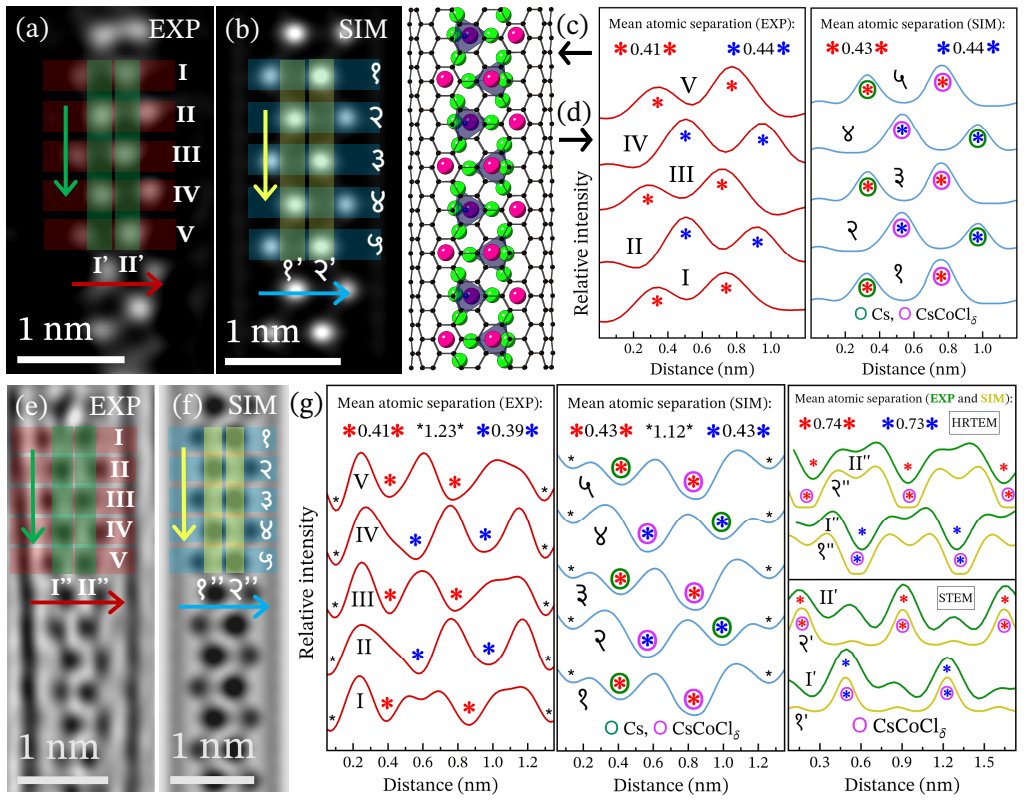
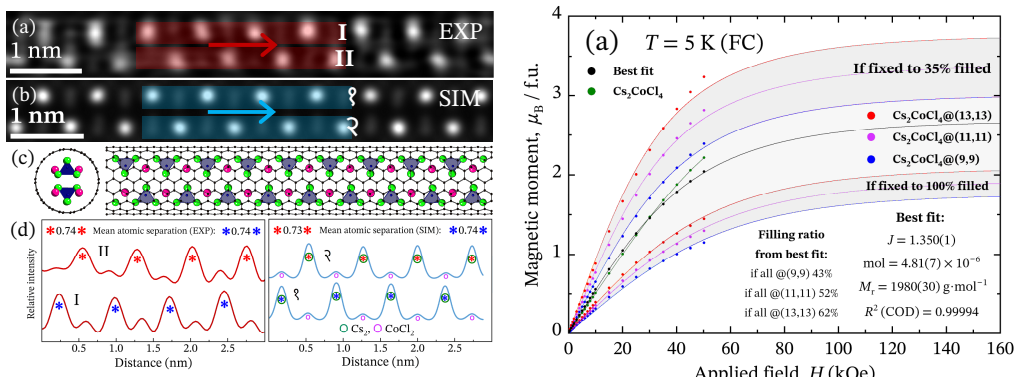
Cs2CoCl4 crystallizes in the tetragonal P4/mcc and orthorhombic Pmcm rod groups under radial compression within SWCNTs of increasingly small diameter, with a massive re-entrant orthorhombic strain towards the 1 nm extremum. The persistence of Co2+ is determined from fits to the d.c. magnetization, with a surprisingly small increase in the effective moment (4.607(3) to 4.788(3) μB/f.u.) and Weiss constant (−7.9(3) to −4.09(7) K) after confinement, suggesting that the confined structure topologically preserves the core magnetic properties of the bulk. Both unconventional polymorphs are noticeably different to the high-pressure piezochromic polymorph.
What carries the argument
Aberration-corrected TEM combined with multislice simulations that identify the P4/mcc and Pmcm rod-group symmetries of the confined Cs2CoCl4 phases.
If this is right
- The observed rod-group polymorphs differ from the high-pressure phase that undergoes tetrahedral-to-octahedral transition.
- Core magnetic properties of bulk Cs2CoCl4 remain largely intact after confinement despite the structural change.
- One-dimensional radial compression offers a structural manipulation route distinct from hydrostatic pressure.
- The re-entrant orthorhombic strain increases systematically as nanotube diameter approaches 1 nm.
Where Pith is reading between the lines
- Similar confinement experiments on related ternary halides could map a broader family of 1D polymorphs.
- The preserved magnetism suggests these confined chains might serve as model systems for studying low-dimensional spin interactions without strong lattice distortion of the magnetic ions.
- Optical or transport measurements on the same confined samples could reveal whether the new rod symmetries alter electronic band gaps beyond what magnetization detects.
Load-bearing premise
The crystal structures identified by aberration-corrected TEM and multislice simulations accurately reflect the confined Cs2CoCl4 phases and are not dominated by preparation artifacts, nanotube interactions, or imaging distortions.
What would settle it
Direct comparison of the same confined samples by synchrotron X-ray diffraction or electron diffraction on multiple tubes yielding a different space-group assignment or coordination environment.
Figures
read the original abstract
Crystals under one-dimensional (1D) confinement are well-known to exhibit drastic changes in metallicity, magnetic properties and chemical state, however, the intermediate phase space between binary metal halides and ternary metal halide perovskites remains poorly explored, especially in the context of the rich polymorphism exhibited by both families in the one-dimensional limit. Through aberration-corrected (scanning) transmission electron microscopy and multislice simulations, it is shown that the metal halide $\mathrm{Cs}_2\mathrm{CoCl}_4$ crystallizes in the tetragonal $\wp4/mcc$ and orthorhombic $\wp{mcm}$ rod groups under radial compression within single-walled carbon nanotubes (SWCNTs) of increasingly small diameter, with a massive re-entrant orthorhombic strain towards the $1$ $\mathrm{nm}$ extremum. The persistence of $\mathrm{Co}^{2+}$ is determined from fits to the d.c. magnetization, with a surprisingly small increase in the effective moment ($4.607(3)$ to $4.788(3) \mathit{{\mu}}_\mathrm{B}/\mathrm{f.u.}$) and Weiss constant ($-7.9(3)$ to $-4.09(7) \mathrm{K}$) after confinement in the SWCNTs, suggesting that the confined structure topologically preserves the core magnetic properties of the bulk. Both unconventional polymorphs observed are noticeably different to the high-pressure piezochromic polymorph previously shown to undergo a tetrahedral-to-octahedral coordination transition, highlighting 1D confinement as a unique tool for structural manipulation.
Editorial analysis
A structured set of objections, weighed in public.
Referee Report
Summary. The manuscript examines Cs2CoCl4 under 1D confinement in SWCNTs of decreasing diameter. Aberration-corrected TEM combined with multislice simulations identifies crystallization in the tetragonal P4/mcc and orthorhombic Pmcm rod groups, accompanied by re-entrant orthorhombic strain near the 1 nm limit. DC magnetization data are fitted to extract an effective moment that rises only modestly from 4.607(3) to 4.788(3) μB/f.u. and a Weiss constant that shifts from −7.9(3) to −4.09(7) K, interpreted as evidence that the confined phases topologically preserve the bulk Co2+ magnetic character. These polymorphs are stated to differ from the high-pressure piezochromic phase that undergoes tetrahedral-to-octahedral coordination change.
Significance. If the structural assignments hold, the work supplies concrete evidence that radial confinement in SWCNTs can stabilize rod-group polymorphs inaccessible by hydrostatic pressure, thereby establishing 1D confinement as an independent structural-control parameter for ternary halides. The modest magnetic-parameter shifts despite large structural distortion would further indicate that the local Co2+ environment remains largely intact, which is of interest for low-dimensional magnetism.
major comments (2)
- [TEM and multislice simulation section] TEM and multislice simulation section: the rod-group assignments (P4/mcc, Pmcm) and the reported atomic coordinates rest on image matching to simulations. For SWCNT diameters approaching 1 nm the carbon-wall projected potential overlaps the halide columns; the manuscript gives no indication that the nanotube lattice is included in the multislice models. If the simulations treat only the Cs2CoCl4 rod, the best-fit symmetry and positions can shift, undermining the central structural claim.
- [Magnetization analysis] Magnetization analysis: the interpretation that the confined structure “topologically preserves the core magnetic properties” is predicated on the correctness of the TEM-derived structures. Any revision to the rod-group assignments would require re-evaluation of whether the small observed changes in moment and Weiss constant still support that conclusion.
minor comments (1)
- Notation for rod groups is given as p4/mcc and pmcm in the abstract; ensure the same symbols and capitalization are used consistently in the main text and figure captions.
Simulated Author's Rebuttal
We thank the referee for the careful and constructive review. The comments on the multislice modeling are well taken and we address them directly below, including plans for revision.
read point-by-point responses
-
Referee: [TEM and multislice simulation section] TEM and multislice simulation section: the rod-group assignments (P4/mcc, Pmcm) and the reported atomic coordinates rest on image matching to simulations. For SWCNT diameters approaching 1 nm the carbon-wall projected potential overlaps the halide columns; the manuscript gives no indication that the nanotube lattice is included in the multislice models. If the simulations treat only the Cs2CoCl4 rod, the best-fit symmetry and positions can shift, undermining the central structural claim.
Authors: We acknowledge that the multislice simulations presented in the manuscript modeled only the Cs2CoCl4 rod and did not explicitly incorporate the surrounding SWCNT lattice. This omission in the methods description is a valid concern, particularly near 1 nm where wall overlap becomes non-negligible. To resolve it we have generated new multislice simulations that include the nanotube for the relevant diameters; these confirm that the P4/mcc and Pmcm assignments and refined coordinates remain stable, with only small intensity adjustments. The revised manuscript will describe the updated modeling protocol and present the new image matches. revision: yes
-
Referee: [Magnetization analysis] Magnetization analysis: the interpretation that the confined structure “topologically preserves the core magnetic properties” is predicated on the correctness of the TEM-derived structures. Any revision to the rod-group assignments would require re-evaluation of whether the small observed changes in moment and Weiss constant still support that conclusion.
Authors: We agree that the magnetic interpretation is tied to the structural assignments. Because the additional nanotube-inclusive simulations uphold the original rod-group symmetries and coordinates, the DC magnetization fits and the conclusion that the local Co2+ environment remains largely intact continue to hold. No changes to the magnetization section or its interpretation are required. revision: no
Circularity Check
No circularity; purely observational imaging and fitting study
full rationale
The manuscript reports direct experimental observations via aberration-corrected TEM, multislice image simulations, and DC magnetization measurements on confined Cs2CoCl4. No derivation chain, equations, or predictive models are present; rod-group assignments arise from matching simulated images to observed contrast, and magnetization parameters are obtained by standard Curie-Weiss fitting to measured data. No self-citation load-bearing steps, fitted inputs renamed as predictions, or self-definitional reductions appear. The work is self-contained against external benchmarks (TEM contrast and bulk magnetic reference values) and receives the default non-circularity finding.
Axiom & Free-Parameter Ledger
Reference graph
Works this paper leans on
-
[1]
Patrick Ruddy is thanked for assistance in ampoule sealing
at Diamond Light Source I11. Patrick Ruddy is thanked for assistance in ampoule sealing. DATA AVAILABILITY Microscope images, simulations, structural models of the bulk phase and modelled nanostructures (as .cif and CrystalMaker® ÿčĂ ČÿąčăēćęÿēćĎč Ăÿēÿ ÿđă ÿċċ ÿĕÿćċÿĀċă on the Warwick Research Archive Portal (WRAP) under reference number 202002
-
[2]
M. M. J. Treacy, T. W. Ebbesen, and J. M. Gibson, Exceptionally high Young's modulus observed for individual carbon nanotubes, Nature 381, 678 (1996)
1996
-
[3]
M. S. Dresselhaus, G. Dresselhaus, P. C. Eklund, and A. M. Rao, in The Physics of Fullerene-Based and Fullerene-Related Materials (Springer Nature, 2000), pp. 331
2000
-
[4]
V. K. Arora and A. Bhattacharyya, Cohesive band structure of carbon nanotubes for applications in quantum transport, Nanoscale 5, 10927 (2013)
2013
-
[5]
C. T. White and T. N. Todorov, Carbon nanotubes as long ballistic conductors, Nature 393, 240 (1998)
1998
-
[6]
Meunier, A
V. Meunier, A. G. Souza Filho, E. B. Barros, and M. S. Dresselhaus, Physical properties of low-dimensional sp2-based carbon nanostructures, Rev. Mod. Phys. 88, 025005 (2016)
2016
-
[7]
T. W. Odom, J.-L. Huang, P. Kim, and C. M. Lieber, Structure and Electronic Properties of Carbon Nanotubes, J. Phys. Chem. B 104, 2794 (2000)
2000
-
[8]
Sandoval, G
S. Sandoval, G. Gonçalves, J. Pérez Barrio, M. V. Kharlamova, and G. Tobías-Rossell, A Comprehensive Review on Filled Carbon Nanotubes: Synthesis, Properties and Applications, Chem. Rev. 126, 2283 (2026)
2026
-
[9]
Senga, H.-P
R. Senga, H.-P. Komsa, Z. Liu, K. Hirose-Takai, A. V. Krasheninnikov, and K. Suenaga, Atomic structure and dynamic behaviour of truly one- dimensional ionic chains inside carbon nanotubes, Nat. Mater. 13, 1050 (2014)
2014
-
[10]
R. R. Meyer, J. Sloan, R. E. Dunin-Borkowski, A. I. Kirkland, M. C. Novotny, S. R. Bailey, J. L. Hutchison, and M. L. H. Green, Discrete Atom Imaging of One-Dimensional Crystals Formed Within Single-Walled Carbon Nanotubes, Science 289, 1324 (2000)
2000
-
[11]
Zhang, H
X. Zhang, H. Ji, L. Geng, Y. Teng, P. Zhao, Y. Zhao, H. Liang, M. Yu, S. Liu, Z. Wang et al., Wafer-Scale Synthesis of Aligned One-Dimensional Arsenene, J. Am. Chem. Soc. 147, 45906 (2025)
2025
-
[12]
Y. Lee, Y. W. Choi, K. Lee, C. Song, P. Ercius, M. L. Cohen, K. Kim, and A. Zettl, Tuning the Sharing Modes and Composition in a Tetrahedral GeX2 (X = S, Se) System via ÿčĎ 17, 8734 (2023)
2023
-
[13]
Faulques, V
E. Faulques, V. G. Ivanov, S. Cordier, R. J. Kashtiban, Y. Molard, J.-L. ćʏĄăđăčēćÿċ ÿāĊćčą ĎĄ Ē2Mo6Br14 Cluster-Based Halide in Variable Diameter Carbon Nanotubes with Elimination and Polymerization to 1D [Mo 2Br6]x Ising Model Structures ܥ147, 7345 (2025)
2025
-
[14]
Sloan, G
J. Sloan, G. Matthewman, C. Dyer-Smith, A. Y. Sung, Z. Liu, K. Suenaga, A. I. Kirkland, and E. Flahaut, Direct Imaging of the Structure, Relaxation, and Sterically Constrained Motion of Encapsulated Tungsten Polyoxometalate Lindqvist Ions within Carbon Nanotubes, ACS Nano 2, 966 (2008)
2008
-
[15]
Y. W. Choi, Y. Lee, K. Kim, A. Zettl, and M. L. Cohen, Atomic and Electronic Structures of 1D Phosphorus Nanoring and Nanohelix, ACS Nano 19, 12155 (2025)
2025
-
[16]
Komsa, R
H.-P. Komsa, R. Senga, K. Suenaga, and A. V. Krasheninnikov, Structural Distortions and Charge Density Waves in Iodine Chains Encapsulated inside Carbon Nanotubes, Nano Lett. 17, 3694 (2017)
2017
-
[17]
T. Pham, S. Oh, P. Stetz, S. Onishi, C. Kisielowski, M. L. Cohen, and A. Zettl, Torsional instability in the single-chain limit of a transition metal trichalcogenide, Science 361, 263 (2018)
2018
-
[18]
Y. Lee, L. Li, W. Zhang, U. Choi, K. Lee, Y.-M. Kim, W. Ji, W. Zhou, K. Kim, and A. Zettl, Robust High-Spin State in One-Dimensional Cr X2 (X = Cl, Br, I) at the Single-Chain Limit, J. Am. Chem. Soc. 147, 26776 (2025)
2025
-
[19]
Nakanishi, R
R. Nakanishi, R. Kitaura, P. Ayala, H. Shiozawa, K. de Blauwe, P. ċăāēđĎčćā structure of Eu atomic wires encapsulated inside single-wall carbon nanotubes, Phys. Rev. B 86, 115445 (2012)
2012
-
[20]
R. J. Kashtiban, C. E. Patrick, Q. Ramasse, R. I. Walton, and J. Sloan, Picoperovskites: The Smallest Conceivable Isolated Halide Perovskite Structures Formed within Carbon Nanotubes, Adv. Mater. 35, 2208575 (2023)
2023
-
[21]
M. Gao, Y. Park, J. Jin, P.-C. Chen, H. Devyldere, Y. Yang, C. Song, Z. Lin, Q. Zhao, M. Siron et al., Direct Observation of Transient Structural Dynamics of Atomically Thin Halide Perovskite Nanowires, J. Am. Chem. Soc. 145, 4800 (2023)
2023
-
[22]
M. Song, B. Zhao, B. Li, K. Wang, Y. Jiang, G. Jia, X. Zhao, B. Yu, Y. Li, and F. Yang, Synthesis of single-unit-cell-thick perovskites by liquid- đÿĘ detectors, Nat. Synth. 4, 1056 (2025)
2025
-
[23]
K. Wang, Y. Zhao, L. Geng, H. Wang, Y. Teng, J. Yao, C. Zhou, X. Li, P. Zhao, Y. Wang et al. , Editable Light Response in Halide Perovskites Encapsulated within Single-Walled Carbon Nanotubes, ACS Nano 19, 16110 (2025)
2025
-
[24]
Zhang, K
Y. Zhang, K. Wang, X. Pan, L. Geng, Y. Zhao, P. Zhao, S. Liu, X. Zhang, Y. Zhong, and L. Wang, 1D CsPbBr 3@SWCNTs van der Waals Heterostructures for Negative Dual-Band Photodetectors, Adv. Funct. Mater. 36, e13943 (2026)
2026
-
[25]
M. Zhu, H. Yin, J. Cao, L. Xu, P. Lu, Y. Liu, L. Ding, C. Fan, H. Liu, Y. Zhang et al. , Inner Doping of Carbon Nanotubes with Perovskites for Ultralow Power Transistors, Adv. Mater. 36, 2403743 (2024). ăĔēđĎč ĂćʏĄđÿāēćĎč investigation of antiferromagnetism in CrCl3, J. Phys. Chem. Solids 19, 29 (1961)
2024
-
[26]
Bedoya-Pinto, J.-R
A. Bedoya-Pinto, J.-R. Ji, A. K. Pandeya, P. Gargiani, M. Valvidares, P. Sessi, J. M. Taylor, F. Radu, K. Chang, and S. S. P. Parkin, Intrinsic 2D- XY ferromagnetism in a van der Waals monolayer, Science 374, 616 (2021)
2021
-
[27]
Y. Li, A. Li, J. Li, H. Tian, Z. Zhang, S. Zhu, R. Zhang, S. Liu, K. Cao, L. Kang et al.ćČăčĒćĎčÿċ CrCl3 Atomic Chains with a Spin Glass State, ACS Nano 17, 20112 (2023)
2023
-
[28]
Y. Lee, Y. W. Choi, K. Lee, C. Song, P. Ercius, M. L. Cohen, K. Kim, and A. Zettl, 1D Magnetic MX3 Single-Chains (M = Cr, V and X = Cl, Br, I), Adv. Mater. 35, 2307942 (2023)
2023
-
[29]
Kenzelmann, R
M. Kenzelmann, R. Coldea, D. A. Tennant, D. Visser, M. Hofmann, P. Smeibidl, and Z. Tylczynski, Order-to-disorder transition in the XY-like quantum magnet Cs 2CoCl4 ܡ Phys. Rev. B 65, 144432 (2002)
2002
-
[30]
Breunig, M
O. Breunig, M. Garst, A. Rosch, E. Sela, B. Buldmann, P. Becker, L. Bohatý, R. Müller, and T. Lorenz, Low-temperature ordered phases of the spin-1/2 XXZ chain system Cs2CoCl4, Phys. Rev. B 91, 024423 (2015)
2015
-
[31]
Nataf, F
L. Nataf, F. Aguado, I. Hernández, R. Valiente, J. González, M. N. Sanz-Ortiz, H. Wilhelm, A. P. Jephcoat, F. Baudelet, and F. Rodríguez, Volume and pressure dependences of the electronic, vibrational, and crystal structures of Cs 2CoCl4ćčĂĔāăĂ piezochromic phase at high pressure, Phys. Rev. B 95, 014110 (2017)
2017
-
[32]
Jiang, H
H. Jiang, H. Ji, Z. Ma, D. Yang, J. Ma, M. Zhang, X. Li, M. Wang, Y. Li, X. Chen et al. , Simultaneous achieving negative photoconductivity response and volatile resistive switching in Cs 2CoCl4 single crystals ܥ13, 316 (2024)
2024
-
[33]
Sheldrick, SHELXT - Integrated space-group and crystal-structure determination, Acta Crystallogr
G. Sheldrick, SHELXT - Integrated space-group and crystal-structure determination, Acta Crystallogr. A 71, 3 (2015). ܥ12, A18 (2025)
2015
-
[34]
O. V. Dolomanov, L. J. Bourhis, R. J. Gildea, J. A. K. Howard, and H. đăʐʒčăČăčē ÿčĂ analysis program, J. Appl. Crystallogr. 42, 339 (2009)
2009
-
[35]
NanoIntegris, Skokie, U.S.A., Technical Data Sheet: PureTubes TM https://nanointegris.com/downloads/ (2023), (accessed 23 April 2026)
2023
-
[36]
B. W. Smith and D. E. Luzzi, Knock-on damage in single wall carbon nanotubes by electron irradiation, AIP Conf. Proc. 486, 360 (1999)
1999
-
[37]
Scheid, Y
A. Scheid, Y. Wang, M. Jung, T. Heil, D. Moia, J. Maier, and P. A. van Aken, Electron Ptychographic Phase Imaging of Beam-sensitive All- inorganic Halide Perovskites Using Four-dimensional Scanning Transmission Electron Microscopy, Microsc. Microanal. 29, 869 (2023). ܥ ܡ Robertson, and G. A. D. Briggs, Investigating the Diameter-Dependent Stability of Sin...
2023
-
[38]
S. J. Pennycook and L. A. Boatner, Chemically sensitive structure- imaging with a scanning transmission electron microscope, Nature 336, 565 (1988)
1988
-
[39]
O. L. Krivanek, M. F. Chisholm, V. Nicolosi, T. J. Pennycook, G. J. ėċăĘ et al.ʐʒăċĂ electron microscopy, Nature 464, 571 (2010)
2010
-
[40]
Yamashita, J
S. Yamashita, J. Kikkawa, K. Yanagisawa, T. Nagai, K. Ishizuka, and K. Kimoto, Atomic number dependence of Z contrast in scanning transmission electron microscopy, Sci. Rep. 8, 12325 (2018)
2018
-
[41]
Z. W. Wang, Z. Y. Li, S. J. Park, A. Abdela, D. Tang, and R. E. Palmer, Quantitative Z-contrast imaging in the scanning transmission electron microscope with size-selected clusters, Phys. Rev. B 84, 073408 (2011)
2011
-
[42]
D. C. Palmer, CrystalMaker v11.0.2 (2014)
2014
-
[43]
Weber, JCrystalSoft Nanotube Modeler v1.8 (2018)
S. Weber, JCrystalSoft Nanotube Modeler v1.8 (2018)
2018
-
[44]
J. Peters, JJPPeters/clTEM: v0.3.3a https://doi.org/10.5281/zenodo.4891764 (2021), (accessed 28 April 2026)
-
[45]
Gómez-Rodríguez, L
A. Gómez-Rodríguez, L. M. Beltrán-del-Río, and R. Herrera-Becerra, SimulaTEM: Multislice simulations for general objects, Ultramicroscopy 110, 95 (2010)
2010
-
[46]
J. J. P. Peters, A Fast Frozen Phonon Algorithm Using Mixed Static Potentials, Ultramicroscopy 229, 113364 (2021)
2021
-
[47]
Mitchell, Gaussian Blur v1.1 - Dave Mitchell's DigitalMicrographݨScripting Website http://www.dmscripting.com/gaussian_blur.html (2020), (accessed 10th April 2026)
D. Mitchell, Gaussian Blur v1.1 - Dave Mitchell's DigitalMicrographݨScripting Website http://www.dmscripting.com/gaussian_blur.html (2020), (accessed 10th April 2026)
2020
-
[48]
Blundell, in Magnetism in Condensed Matter (Oxford University Press, Oxford, 2001), p
S. Blundell, in Magnetism in Condensed Matter (Oxford University Press, Oxford, 2001), p. 86
2001
-
[49]
Mugiraneza and A
S. Mugiraneza and A. M. Hallas, Tutorial: a beginner’s guide to interpreting magnetic susceptibility data with the Curie-Weiss law, Commun. Phys. 5, 95 (2022)
2022
-
[50]
A. P. Ramirez, R. C. Haddon, O. Zhou, R. M. Fleming, J. Zhang, S. M. McClure, and R. E. Smalley, Magnetic Susceptibility of Molecular Carbon: Nanotubes and Fullerite, Science 265, 84 (1994)
1994
-
[51]
Koshits, Crystal structure of cesium tetrachlorocobaltate, Cs2CoCl4đćĒēÿċċĎąđÿʐʒĘÿ 1, 291 (1956)
P. Koshits, Crystal structure of cesium tetrachlorocobaltate, Cs2CoCl4đćĒēÿċċĎąđÿʐʒĘÿ 1, 291 (1956)
1956
-
[52]
H. M. Powell and A. F. Wells, The structure of c Ƽsium cobalt chloride (Cs3CoCl5), J. Chem. Soc., 359 (1935)
1935
-
[53]
Kopský and D
V. Kopský and D. B. Litvin, in International Tables for Crystallography, Volume E: Subperiodic Groups (Kluwer Academic Publishers, 2002), p. 37
2002
-
[54]
J. M. Wynn, P. V. C. Medeiros, A. Vasylenko, J. Sloan, D. Quigley, and A. J. Morris, Phase diagram of germanium telluride encapsulated in ܥ1, 073001 (2017)
2017
-
[55]
M. I. Aroyo, L. Elcoro, G. de la Flor, and G. Madariaga, Crystallography online by the Bilbao Crystallographic Server: new online programs for the analysis of the symmetry of low-dimensional materials, Acta Crystallogr. A 79, C326 (2023)
2023
-
[56]
Y. Teng, Y. Zhang, X. Xie, J. Yao, Z. Zhang, L. Geng, P. Zhao, C. Yang, W. Gong, X. Wang et al. , Interfacial Electron Transfer in PbI 2@Single- Walled Carbon Nanotube van der Waals Heterostructures for High- Stability Self-Powered Photodetectors, J. Am. Chem. Soc. 146, 6231 (2024)
2024
-
[57]
T. Che, S. Liu, Y. Wang, P. Zhao, C. Yang, X. Pan, H. Ji, L. Geng, Q. Sun, Z. Hu et al., Interfacial Charge Transfer in One-Dimensional AgBr Encapsulated inside Single-Walled Carbon Nanotube Heterostructures, ACS Nano 18, 32569 (2024)
2024
-
[58]
Soling, The Crystal Structure and Magnetic Susceptibility of CsCoCl3, Acta Chem
H. Soling, The Crystal Structure and Magnetic Susceptibility of CsCoCl3, Acta Chem. Scand. 22, 2793 (1968)
1968
-
[59]
Qin and L
C. Qin and L. M. Peng, Measurement accuracy of the diameter of a carbon nanotube from TEM images, Phys. Rev. B 65, 155431 (2002)
2002
-
[60]
Lu, T.-W
W. Lu, T.-W. Chou, and B.-S. Kim, Radial deformation and its related energy variations of single-walled carbon nanotubes, Phys. Rev. B 83, 134113 (2011)
2011
-
[61]
Authier, in International Tables for Crystallography, Volume D: Physical Properties of Crystals (Kluwer Academic Publishers, 2003), p
A. Authier, in International Tables for Crystallography, Volume D: Physical Properties of Crystals (Kluwer Academic Publishers, 2003), p. 11
2003
-
[62]
Wu and C
J. Wu and C. Leighton, Glassy ferromagnetism and magnetic phase separation in La1-xSrxCoO3, Phys. Rev. B 67, 174408 (2003)
2003
-
[63]
M. A. Korotin, S. Y. Ezhov, I. V. Solovyev, V. I. Anisimov, D. I. Khomskii, and G. A. Sawatzky, Intermediate-spin state and properties of LaCoO3, Phys. Rev. B 54, 5309 (1996)
1996
-
[64]
G. A. Bain and J. F. Berry, Diamagnetic Corrections and Pascal's Constants, J. Chem. Educ. 85, 532 (2008)
2008
-
[65]
V. A. Eremina, T. Eremin, H. Jiang, R. Dhama, J. Odutola, H. Caglayan, N. V. Tkachenko, and P. A. Obraztsov, 1D Light-Emitting MAPbBr3 Perovskite Encapsulated in Carbon Nanotubes, Adv. Funct. Mater., 2503397 (2025). Supplementary information for ‘Structural properties of one-dimensional Cs2CoCl4 ݆ Jaskaran S. Mangat,1 Yu Lei,2 Matthew Weyland,3,4 Yisong H...
2025
-
[66]
[100] Cs2.083CoCl3.417 𝓅4/mcc (× 2 supercell) a ≈ 18.4 Å b ≈ 18.4 Å c ≈ 14.5 Å a b c ~1.3 nm SWCNT ~2.6 nm SWCNT FIG. S6. ēđĔāēĔđÿċ Čÿď ĒĆĎĖćčą ēĆă đăċÿēćĎčĒĆćďĒ ĀăēĖăăč ēĆă ĀĔċĊ ÿčĂ āĎčʐʒčăĂ ĒēđĔāēĔđăĒ ĎĄ Ē2CoCl4. The [001] čČ wide SWCNTs whilst maintaining the ternary chemical composition of the precursor; whereas in ~2.6 nm wide SWCNTs the structure is...
-
[67]
[010] [001] c b Cs2CoCl4 Pnma (2 × 2 × 3.2 supercell) a = 9.7776(2), b = 7.4005(1), c = 12.9850(2) Å
-
[68]
[010] [001] c a b Cs3CoCl5 I4/mcm (2 × 2 × 3 supercell) a = 9.2315(15) Å b = 9.2315(15) Å c = 14.5535(24) Å [2]
-
[69]
Bagautdinov, J
B. Bagautdinov, J. Luedecke, M. Schneider, and S. van Smaalen, Disorder in the Crystal Structure of Cs 2HgCl4 Studied by the Maximum Entropy Method, Acta Crystallogr. B 54, 626 (1998). ܡ ދޏވ Acta Crystallogr. B 37, 508 (1981). FIG. S7. (a, b) Model and ADF simulation of an alternative 𝓅mcm orthorhombic structure (lattice parameters a ≈ 7.6 Å, b ≈ 5.4 Å an...
1998
discussion (0)
Sign in with ORCID, Apple, or X to comment. Anyone can read and Pith papers without signing in.