Velocity dependence of holographic entanglement entropy in a charged plasma
Pith reviewed 2026-06-30 02:05 UTC · model grok-4.3
The pith
Velocity increases holographic entanglement entropy in a charged plasma, washing out chemical potential dependence at high temperature.
A machine-rendered reading of the paper's core claim, the machinery that carries it, and where it could break.
Core claim
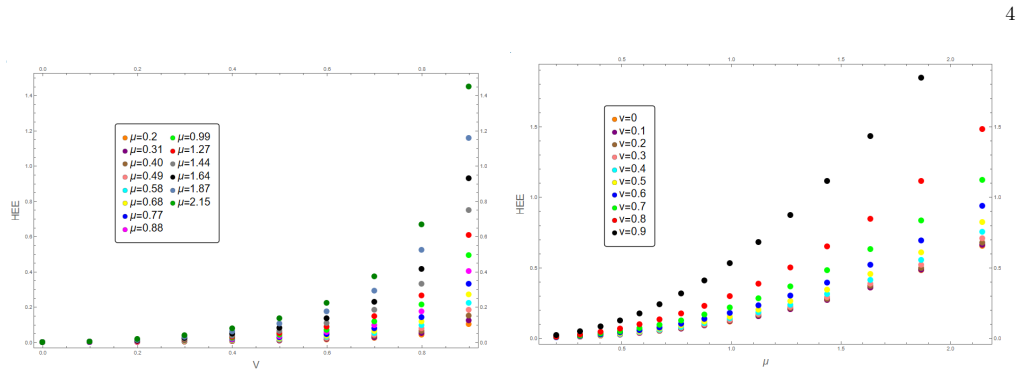
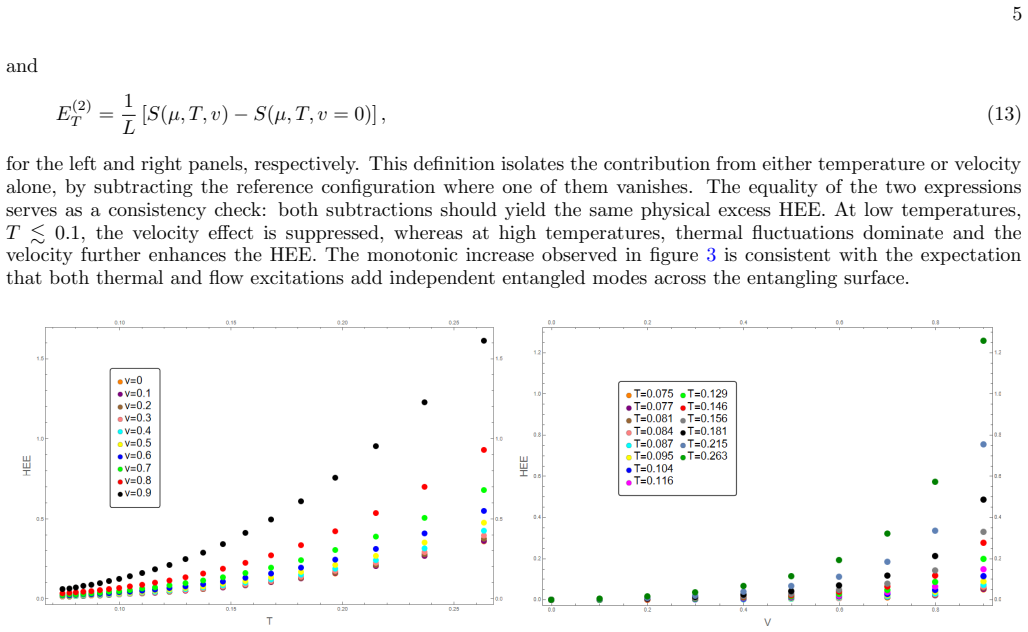
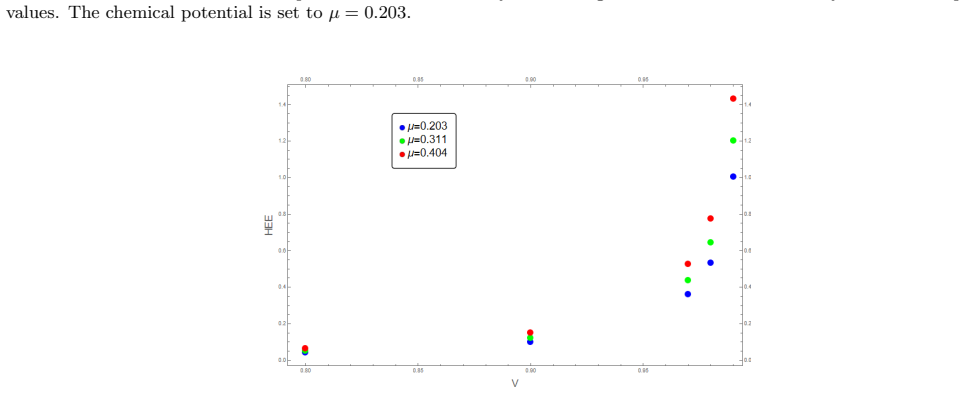
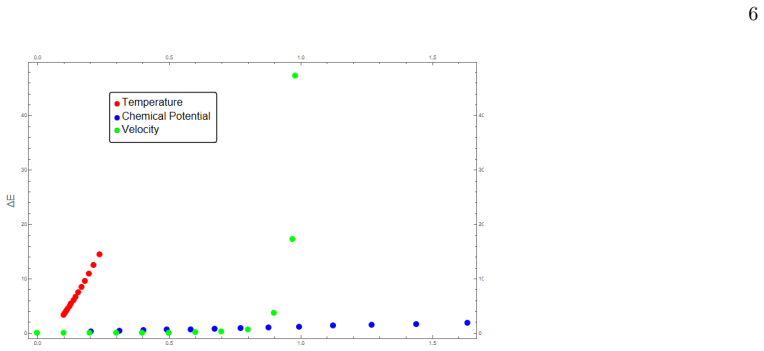
In the holographic dual of a moving charged thermal gauge theory, a sufficiently high velocity enhances the entanglement entropy, with the enhancement stronger at larger chemical potential; at high temperature and velocity the chemical-potential dependence is almost entirely suppressed; and in the ultrarelativistic regime the entanglement entropy grows rapidly with velocity, which then dominates over both temperature and charge density.
What carries the argument
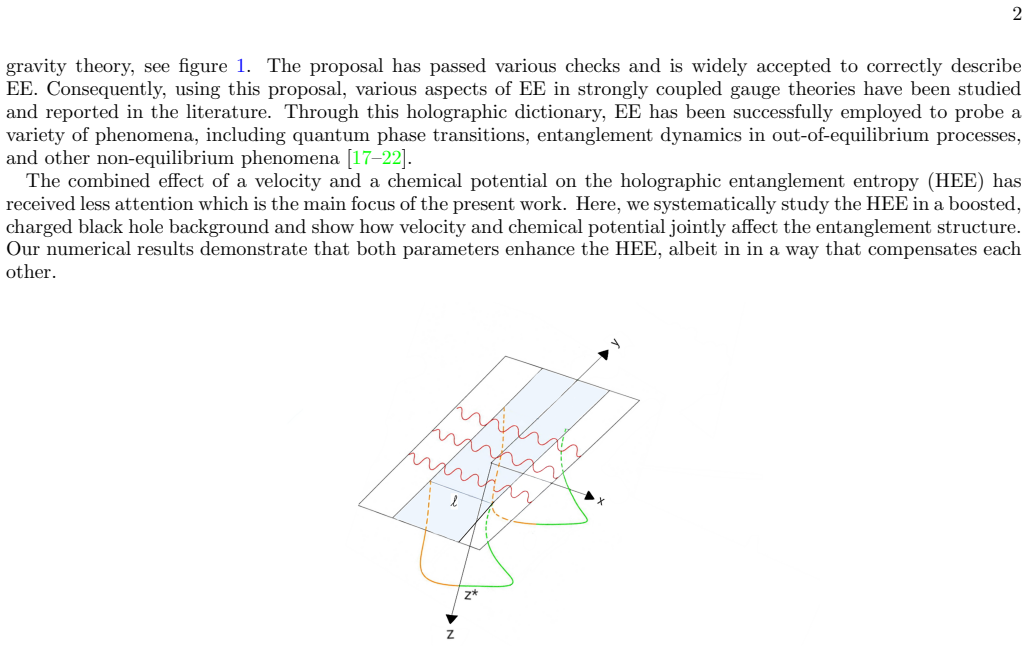
The area of the codimension-two minimal surface anchored on the entanglement region in the boosted charged AdS black-brane geometry.
If this is right
- Chemical-potential effects on entanglement entropy become negligible once both temperature and velocity are large.
- Velocity emerges as the dominant control parameter once the plasma is ultrarelativistic.
- Thermal fluctuations override charge-density contributions under simultaneous high temperature and high velocity.
Where Pith is reading between the lines
- The same velocity dominance might appear in other holographic quantities such as two-point functions or Wilson loops.
- In models of the quark-gluon plasma the result suggests that relativistic motion could amplify entanglement measures independently of net charge.
- The setup invites extension to time-dependent boosts or to mutual information between multiple regions.
Load-bearing premise
The boosted charged black-brane geometry and the choice of minimal surface correctly reproduce the velocity dependence of entanglement entropy in the dual moving charged gauge theory.
What would settle it
A direct field-theory computation of entanglement entropy in a boosted charged plasma that shows either a decrease or no change with increasing velocity would falsify the reported enhancement.
Figures
read the original abstract
We have studied holographic entanglement entropy in a moving thermal gauge theory with a non-zero chemical potential. A sufficiently high velocity enhances the holographic entanglement entropy, particularly for larger values of the chemical potential. However, at high temperature and velocity, the chemical potential dependence is almost entirely washed out, indicating that thermal fluctuations dominate over charge-density effects. In the ultrarelativistic regime, the holographic entanglement entropy grows very rapidly with velocity, which emerges as the dominant parameter, largely suppressing both thermal and chemical contributions.
Editorial analysis
A structured set of objections, weighed in public.
Referee Report
Summary. The manuscript computes the holographic entanglement entropy (HEE) of a strip subsystem in a boosted charged AdS5 black-brane geometry dual to a moving N=4 SYM plasma with nonzero chemical potential. Numerical minimization of the area functional shows that HEE increases with boost velocity v, with the enhancement stronger at larger μ/T; at sufficiently high T and v the μ dependence is suppressed; and in the ultrarelativistic limit HEE grows rapidly with v, which becomes the dominant parameter.
Significance. If the numerical results are robust, the work supplies concrete evidence that boost velocity can dominate both thermal and charge-density effects on entanglement entropy in holographic models of strongly coupled plasmas. This is relevant for phenomenological modeling of moving quark-gluon plasma and adds to the existing literature on HEE in boosted or charged backgrounds.
minor comments (4)
- The abstract states qualitative trends without quoting any numerical values, scaling exponents, or the range of parameters explored; adding one or two quantitative statements would improve clarity.
- Section 3 (or wherever the boosted metric is introduced): the coordinate transformation implementing the boost should be written explicitly, including the relation between the lab-frame and rest-frame chemical potentials.
- Figure captions and axis labels should specify the precise values of T, μ, and the strip width L used for each curve, and whether the entropy is normalized by the area or by the zero-velocity value.
- The numerical procedure for solving the minimal-surface equation (shooting method, boundary conditions, convergence checks) is only sketched; a short paragraph or appendix with error estimates would strengthen reproducibility.
Simulated Author's Rebuttal
We thank the referee for their positive summary of our manuscript and for recommending minor revision. No specific major comments were provided in the report.
Circularity Check
No significant circularity identified
full rationale
The provided abstract and context contain no explicit equations, parameter-fitting procedures, self-citations, or derivation steps that could be inspected for reduction to inputs by construction. The central claims concern numerical outcomes of a holographic minimal-surface computation in a boosted charged black-brane background; absent any quoted formulas, ansatze, or load-bearing citations within the supplied text, no self-definitional, fitted-prediction, or self-citation patterns are detectable. The derivation therefore remains self-contained against external benchmarks such as the Ryu-Takayanagi prescription and standard AdS/CFT numerics.
Axiom & Free-Parameter Ledger
axioms (1)
- domain assumption Holographic duality maps entanglement entropy in the gauge theory to a geometric quantity in the gravity dual
Reference graph
Works this paper leans on
-
[1]
The Large N Limit of Superconformal Field Theories and Supergravity
J. M. Maldacena, “The LargeNlimit of superconformal field theories and supergravity,” Adv. Theor. Math. Phys.2 (1998), 231-252 [arXiv:hep-th/9711200 [hep-th]]
work page internal anchor Pith review Pith/arXiv arXiv 1998
-
[2]
Anti De Sitter Space And Holography
E. Witten, “Anti de Sitter space and holography,” Adv. Theor. Math. Phys.2(1998), 253-291 [arXiv:hep-th/9802150 [hep-th]]
work page internal anchor Pith review Pith/arXiv arXiv 1998
-
[3]
Gauge Theory Correlators from Non-Critical String Theory
S. S. Gubser, I. R. Klebanov and A. M. Polyakov, “Gauge theory correlators from noncritical string theory,” Phys. Lett. B428(1998), 105-114 [arXiv:hep-th/9802109 [hep-th]]
work page internal anchor Pith review Pith/arXiv arXiv 1998
-
[4]
Large N Field Theories, String Theory and Gravity
O. Aharony, S. S. Gubser, J. M. Maldacena, H. Ooguri and Y. Oz, “Large N field theories, string theory and gravity,” Phys. Rept.323(2000), 183-386 [arXiv:hep-th/9905111 [hep-th]]
work page internal anchor Pith review Pith/arXiv arXiv 2000
-
[5]
Lectures on entanglement entropy in field theory and holography
M. Headrick, “Lectures on entanglement entropy in field theory and holography,” [arXiv:1907.08126 [hep-th]]
work page internal anchor Pith review Pith/arXiv arXiv 1907
-
[6]
1983 paper on entanglement entropy: "On the Entropy of the Vacuum outside a Horizon"
R. D. Sorkin, “1983 paper on entanglement entropy: ”On the Entropy of the Vacuum outside a Horizon,” [arXiv:1402.3589 [gr-qc]]
work page internal anchor Pith review Pith/arXiv arXiv 1983
-
[7]
Entanglement Entropy and Quantum Field Theory
P. Calabrese and J. L. Cardy, “Entanglement entropy and quantum field theory,” J. Stat. Mech.0406(2004), P06002 [arXiv:hep-th/0405152 [hep-th]]
work page internal anchor Pith review Pith/arXiv arXiv 2004
-
[8]
Entanglement entropy in free quantum field theory
H. Casini and M. Huerta, “Entanglement entropy in free quantum field theory,” J. Phys. A42(2009), 504007 [arXiv:0905.2562 [hep-th]]
work page internal anchor Pith review Pith/arXiv arXiv 2009
-
[10]
Non-equilibrium Phase Transition from AdS/CFT
M. Ali-Akbari and A. Vahedi, “Non-equilibrium Phase Transition from AdS/CFT,” Nucl. Phys. B877(2013), 95-106 [arXiv:1305.3713 [hep-th]]
work page internal anchor Pith review Pith/arXiv arXiv 2013
-
[11]
Anti-de Sitter Space, Thermal Phase Transition, And Confinement In Gauge Theories
E. Witten, “Anti-de Sitter space, thermal phase transition, and confinement in gauge theories,” Adv. Theor. Math. Phys. 2(1998), 505-532 [arXiv:hep-th/9803131 [hep-th]]
work page internal anchor Pith review Pith/arXiv arXiv 1998
-
[12]
Holographic CFT phase transitions and criticality for rotating AdS black holes,
M. B. Ahmed, W. Cong, D. Kubiznak, R. B. Mann and M. R. Visser, “Holographic CFT phase transitions and criticality for rotating AdS black holes,” JHEP08(2023), 142 [arXiv:2305.03161 [hep-th]]
-
[13]
Critical Exponents of Nonequilibrium Phase Transitions in AdS/CFT Correspondence
M. Matsumoto and S. Nakamura, “Critical Exponents of Nonequilibrium Phase Transitions in AdS/CFT Correspondence,” Phys. Rev. D98(2018) no.10, 106027 [arXiv:1804.10124 [hep-th]]
work page internal anchor Pith review Pith/arXiv arXiv 2018
-
[14]
Non-Equilibrium Critical Phenomena From Probe Brane Holography in Schr\"odinger Spacetime
A. Vahedi and M. Shakeri, “Non-Equilibrium Critical Phenomena From Probe Brane Holography in Schr¨ odinger Space- time,” JHEP01(2019), 047 [arXiv:1811.05823 [hep-th]]
work page internal anchor Pith review Pith/arXiv arXiv 2019
-
[15]
Black hole formation, holographic thermalization and the AdS/CFT correspondence,
E. J. Lindgren, “Black hole formation, holographic thermalization and the AdS/CFT correspondence,” [arXiv:1909.00434 [hep-th]]. 8
-
[16]
Holographic Derivation of Entanglement Entropy from AdS/CFT
S. Ryu and T. Takayanagi, “Holographic derivation of entanglement entropy from AdS/CFT,” Phys. Rev. Lett.96(2006), 181602 [arXiv:hep-th/0603001 [hep-th]]
work page internal anchor Pith review Pith/arXiv arXiv 2006
-
[17]
Entanglement Renyi entropies in holographic theories
M. Headrick, “Entanglement Renyi entropies in holographic theories,” Phys. Rev. D82(2010), 126010 [arXiv:1006.0047 [hep-th]]
work page internal anchor Pith review Pith/arXiv arXiv 2010
-
[18]
Holographic entanglement entropy: near horizon geometry and disconnected regions
E. Tonni, “Holographic entanglement entropy: near horizon geometry and disconnected regions,” JHEP05(2011), 004 [arXiv:1011.0166 [hep-th]]
work page internal anchor Pith review Pith/arXiv arXiv 2011
-
[19]
Holographic Mutual Information at Finite Temperature
W. Fischler, A. Kundu and S. Kundu, “Holographic Mutual Information at Finite Temperature,” Phys. Rev. D87(2013) no.12, 126012 [arXiv:1212.4764 [hep-th]]
work page internal anchor Pith review Pith/arXiv arXiv 2013
-
[20]
J. Molina-Vilaplana and P. Sodano, “Holographic View on Quantum Correlations and Mutual Information between Disjoint Blocks of a Quantum Critical System,” JHEP10(2011), 011 [arXiv:1108.1277 [quant-ph]]
work page internal anchor Pith review Pith/arXiv arXiv 2011
-
[21]
Holographic Entanglement in a Noncommutative Gauge Theory
W. Fischler, A. Kundu and S. Kundu, “Holographic Entanglement in a Noncommutative Gauge Theory,” JHEP01(2014), 137 [arXiv:1307.2932 [hep-th]]
work page internal anchor Pith review Pith/arXiv arXiv 2014
-
[22]
Holographic Entanglement Entropy Close to Quantum Phase Transitions
Y. Ling, P. Liu, C. Niu, J. P. Wu and Z. Y. Xian, “Holographic Entanglement Entropy Close to Quantum Phase Transi- tions,” JHEP04(2016), 114 [arXiv:1502.03661 [hep-th]]
work page internal anchor Pith review Pith/arXiv arXiv 2016
-
[23]
Aspects of Holographic Entanglement at Finite Temperature and Chemical Potential
S. Kundu and J. F. Pedraza, “Aspects of Holographic Entanglement at Finite Temperature and Chemical Potential,” JHEP08(2016), 177 [arXiv:1602.07353 [hep-th]]
work page internal anchor Pith review Pith/arXiv arXiv 2016
-
[24]
Charged AdS Black Holes and Catastrophic Holography
A. Chamblin, R. Emparan, C. V. Johnson and R. C. Myers, “Charged AdS black holes and catastrophic holography,” Phys. Rev. D60(1999), 064018 [arXiv:hep-th/9902170 [hep-th]]
work page internal anchor Pith review Pith/arXiv arXiv 1999
-
[25]
Phases of R-charged Black Holes, Spinning Branes and Strongly Coupled Gauge Theories
M. Cvetic and S. S. Gubser, “Phases of R charged black holes, spinning branes and strongly coupled gauge theories,” JHEP04(1999), 024 [arXiv:hep-th/9902195 [hep-th]]
work page internal anchor Pith review Pith/arXiv arXiv 1999
-
[26]
Black plane solutions in four dimensional spacetimes
R. G. Cai and Y. Z. Zhang, “Black plane solutions in four-dimensional space-times,” Phys. Rev. D54(1996), 4891-4898 [arXiv:gr-qc/9609065 [gr-qc]]
work page internal anchor Pith review Pith/arXiv arXiv 1996
-
[27]
Holographic entanglement entropy for relativistic hydro- dynamic flows,
J. Bhattacharya, P. Biswas, A. Chandranathan and S. K. Das, “Holographic entanglement entropy for relativistic hydro- dynamic flows,” JHEP05(2023), 092 [arXiv:2211.14271 [hep-th]]
-
[28]
Holographic entanglement entropy and generalized entanglement temperature,
A. Saha, S. Gangopadhyay and J. P. Saha, “Holographic entanglement entropy and generalized entanglement temperature,” Phys. Rev. D100(2019) no.10, 106008 [arXiv:1906.03159 [hep-th]]
-
[29]
H. Ebrahim and M. Ahmadpour, “Holographic entanglement entropy and mutual information in deformed field theories at finite temperature,” Phys. Rev. D107(2023) no.8, 086010 [arXiv:2301.07242 [hep-th]]
-
[30]
Holographic Entanglement Entropy Decomposition in an Anisotropic Gauge Theory
M. Rahimi and M. Ali-Akbari, “Holographic Entanglement Entropy Decomposition in an Anisotropic Gauge Theory,” Phys. Rev. D98(2018) no.2, 026004 [arXiv:1803.01754 [hep-th]]
work page internal anchor Pith review Pith/arXiv arXiv 2018
-
[31]
Holographic Entanglement Entropy at Finite Temperature
I. Bah, A. Faraggi, L. A. Pando Zayas and C. A. Terrero-Escalante, “Holographic entanglement entropy and phase tran- sitions at finite temperature,” Int. J. Mod. Phys. A24(2009), 2703-2728 [arXiv:0710.5483 [hep-th]]
work page internal anchor Pith review Pith/arXiv arXiv 2009
-
[32]
A holographic proof of the strong subadditivity of entanglement entropy
M. Headrick and T. Takayanagi, “A Holographic proof of the strong subadditivity of entanglement entropy,” Phys. Rev. D76(2007), 106013 [arXiv:0704.3719 [hep-th]]
work page internal anchor Pith review Pith/arXiv arXiv 2007
-
[33]
General properties of holographic entanglement entropy
M. Headrick, “General properties of holographic entanglement entropy,” JHEP03(2014), 085 [arXiv:1312.6717 [hep-th]]
work page internal anchor Pith review Pith/arXiv arXiv 2014
discussion (0)
Sign in with ORCID, Apple, or X to comment. Anyone can read and Pith papers without signing in.