The impact of interpolation in high-resolution spectroscopy -- The overlooked role of interpolation in radial velocity extraction
Pith reviewed 2026-06-30 01:55 UTC · model grok-4.3
The pith
The choice of interpolation algorithm when constructing stellar templates and extracting radial velocities can introduce systematic biases of up to 25 m/s.
A machine-rendered reading of the paper's core claim, the machinery that carries it, and where it could break.
Core claim
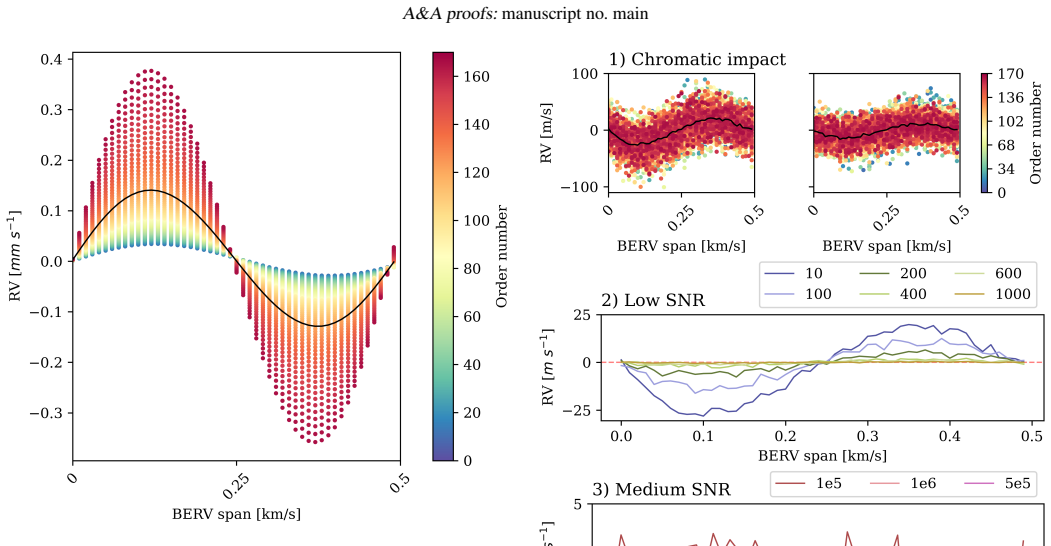
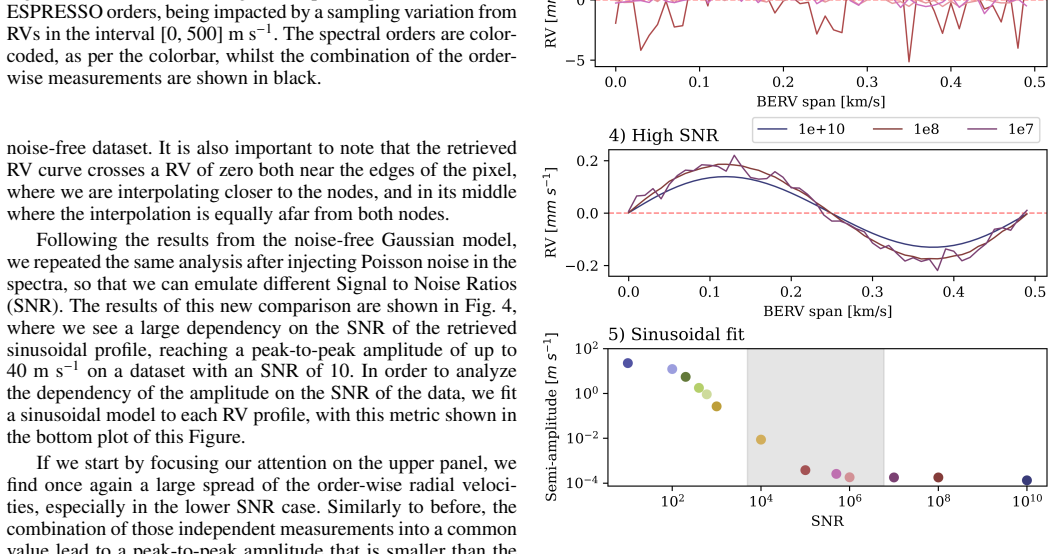
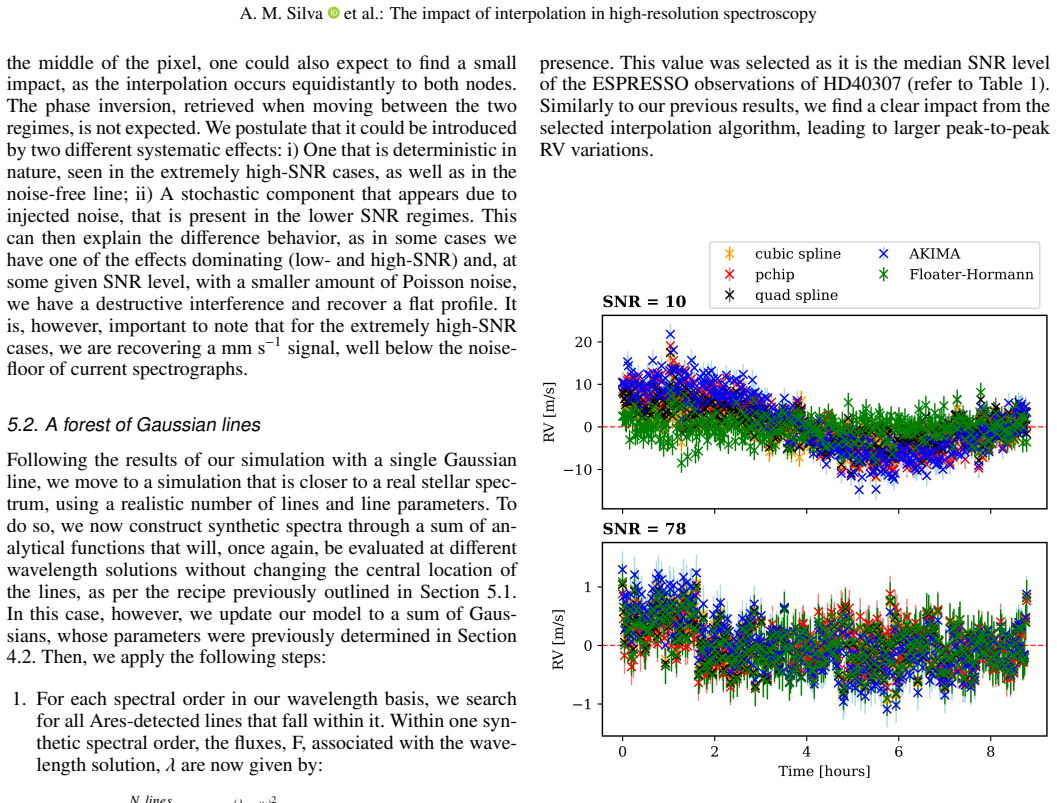
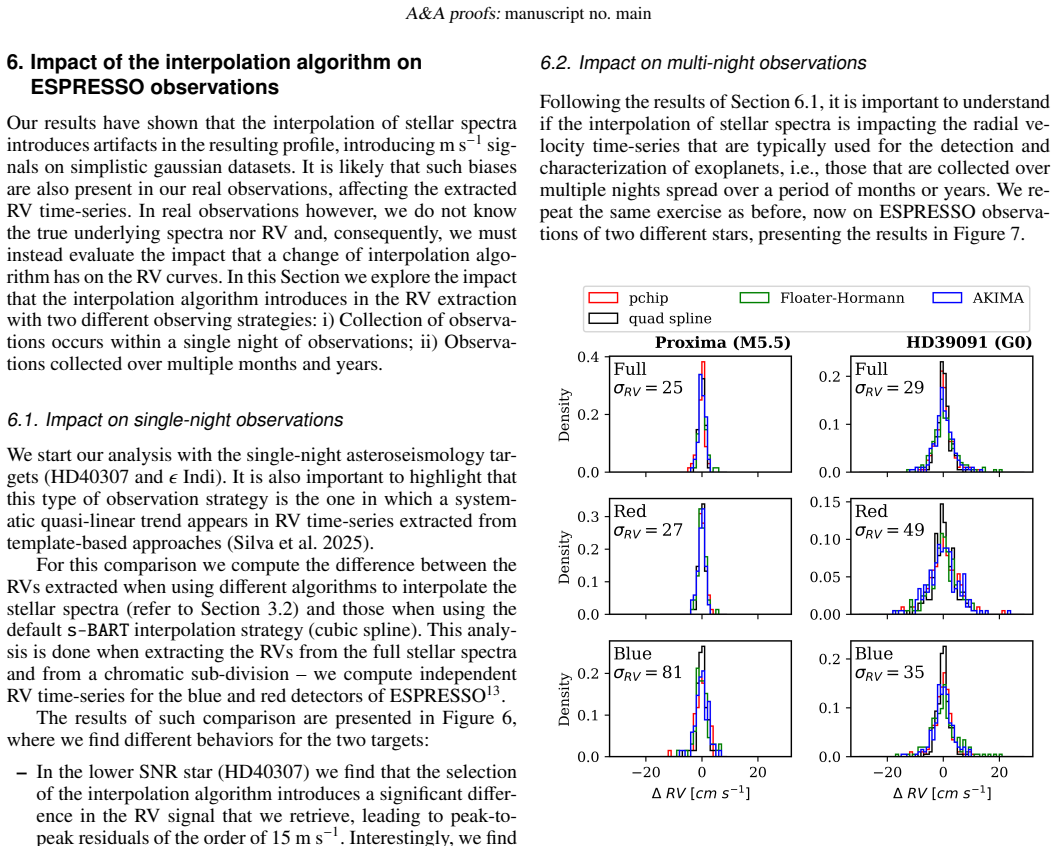
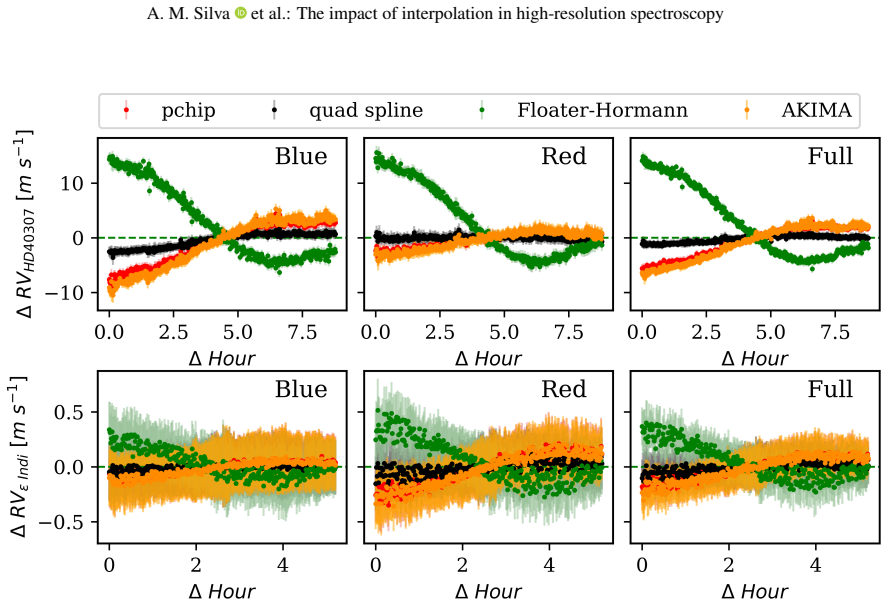
Synthetic datasets reveal systematic biases with the largest peak-to-peak amplitudes reaching ∼20 m/s in low SNR cases, decreasing as SNR rises and still present at the mm/s level in noise-free spectra. High-cadence real observations with small BERV variation show peak-to-peak residuals as large as ∼25 m/s in the lower-SNR case and ∼1 m/s in the higher-SNR case. Observations spread over a larger BERV window limit the scatter from this signal to an upper bound of 20 cm/s.
What carries the argument
The interpolation algorithm used inside the s-BART pipeline both when building the stellar template and when performing the subsequent radial-velocity extraction step.
If this is right
- Low-SNR, high-cadence observations with limited BERV range are most susceptible to interpolation-induced RV offsets of tens of m/s.
- The bias shrinks below 1 m/s once SNR is high and is bounded by 20 cm/s once observations span a wide BERV window.
- Even perfectly noise-free spectra still carry a residual interpolation bias at the mm/s level.
- Template-based RV pipelines must therefore treat the interpolation routine as a controllable source of systematic error.
Where Pith is reading between the lines
- Surveys that combine data from different instruments or pipelines may need to reprocess all spectra with a single interpolation choice to avoid artificial offsets.
- Small-planet searches that rely on sub-m/s stability over many nights could be limited by this effect unless observations are deliberately scheduled across a wide BERV range.
- Future higher-precision instruments may need to propagate interpolation uncertainty into the final RV covariance matrix rather than treating it as negligible.
Load-bearing premise
Differences seen when swapping interpolation algorithms are produced by interpolation itself rather than by interactions with other fixed steps in the pipeline or by the Gaussian approximation used to generate the synthetic spectra.
What would settle it
Re-extracting RVs from the identical set of spectra after deliberately varying one other pipeline step while keeping interpolation fixed would show whether the bias amplitude remains unchanged.
Figures

read the original abstract
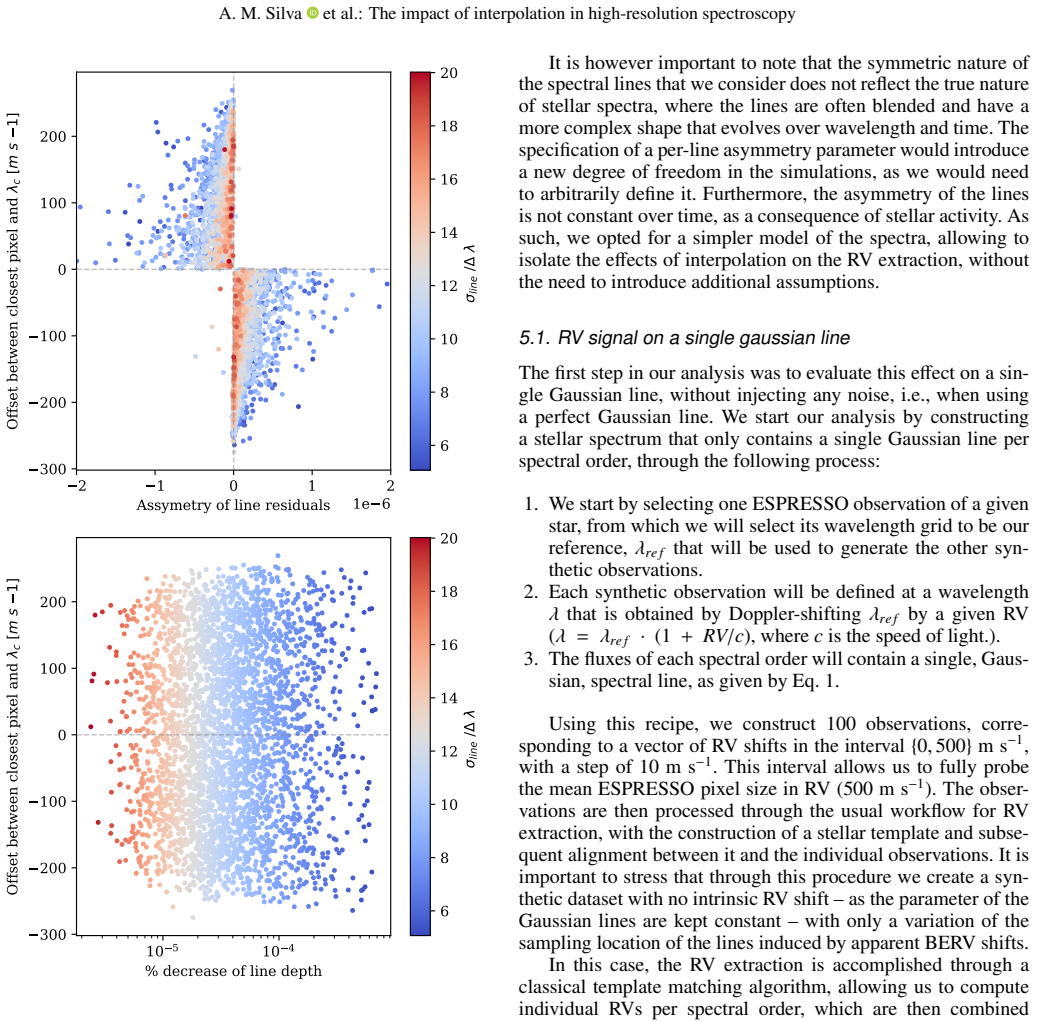
We explore the impact of spectral interpolation in radial velocity (RV) time-series extracted through template-based methods. We build synthetic datasets with Gaussian profiles to evaluate flux residuals and line asymmetry that are a result from changing the sampling location of the lines. We generate synthetic spectra as a sum of Gaussian functions whose parameters were determined through an observed spectrum. The s-BART pipeline was applied to them, allowing to evaluate any biases in RV extraction introduced by its internal assumptions in line shape. Lastly, we apply the s-BART pipeline to ESPRESSO observations of four stars: two that use high-cadence observations over a single night, and two that have observations spread over multiple nights. When extracting RVs from stellar spectra, we change the interpolation algorithm, used in the process of constructing the stellar template and, afterwards, during RV extraction, comparing them with RVs extracted with a widely-used cubic-spline interpolation. We find that synthetic datasets reveal systematic biases with the largest peak-to-peak amplitudes reaching $\sim$ 20 m/s in low SNR cases, with the amplitude decreasing as the SNR of the spectra increases. In the extreme case of noise-free data, we still recover a systematic bias, albeit at the mm/s level, significantly smaller than the RV precision of state-of-the-art instruments. With real observations we find that those from high-cadence observations with small BERV variation are impacted by the choice of the interpolation algorithm. This impact is smaller in higher-SNR cases, where the peak-to-peak amplitude reaches $\sim$ 1 m/s. In the comparatively lower-SNR case we find peak-to-peak residuals as large as $\sim$ 25 m/s . In cases where the observations are spread over a larger BERV window, we find an upper limit of 20 cm/s of RV scatter for this systematic signal.
Editorial analysis
A structured set of objections, weighed in public.
Referee Report
Summary. The paper claims that the choice of interpolation algorithm (compared to cubic spline) during stellar template construction and subsequent RV extraction in the s-BART pipeline introduces systematic biases in radial velocity time series. Synthetic spectra generated as sums of Gaussian profiles show peak-to-peak RV bias amplitudes up to ~20 m/s at low SNR (decreasing with higher SNR, down to mm/s in noise-free cases). Real ESPRESSO observations of four stars reveal similar effects, with peak-to-peak residuals up to ~25 m/s in high-cadence low-SNR cases with small BERV variation, ~1 m/s in higher-SNR high-cadence cases, and an upper limit of 20 cm/s when observations span a larger BERV window.
Significance. If the central attribution holds, the result is significant because it quantifies a previously overlooked systematic that can produce RV scatter at levels comparable to or exceeding typical exoplanet signals, directly relevant to cm/s-precision goals with instruments like ESPRESSO. The combination of controlled synthetic tests (with explicit numerical bias amplitudes) and application to real high-cadence observations provides concrete, falsifiable effect sizes that pipeline developers can use. The analysis relies on direct empirical comparisons rather than circular parameter fitting.
major comments (1)
- [synthetic data generation and pipeline application] Synthetic data generation and pipeline application sections: The RV differences are obtained by holding all other s-BART steps fixed while swapping only the interpolator, but the manuscript does not include control experiments in which normalization, line selection, or the Gaussian line-shape model are varied independently. Without these, it remains possible that the reported peak-to-peak amplitudes (~20 m/s in synthetics, ~25 m/s in real data) arise partly from interactions between the interpolator and unvaried pipeline modules rather than from interpolation alone; this attribution is load-bearing for the headline claim.
minor comments (2)
- The specific interpolation algorithms tested (beyond the reference cubic spline) are not named or described in sufficient detail for readers to reproduce the exact comparison.
- [real observations] The real-observation section would benefit from an explicit table listing the four stars, their approximate SNR, BERV ranges, and number of spectra to make the case distinctions immediately clear.
Simulated Author's Rebuttal
We thank the referee for the constructive comment on attribution. We address it point-by-point below.
read point-by-point responses
-
Referee: Synthetic data generation and pipeline application sections: The RV differences are obtained by holding all other s-BART steps fixed while swapping only the interpolator, but the manuscript does not include control experiments in which normalization, line selection, or the Gaussian line-shape model are varied independently. Without these, it remains possible that the reported peak-to-peak amplitudes (~20 m/s in synthetics, ~25 m/s in real data) arise partly from interactions between the interpolator and unvaried pipeline modules rather than from interpolation alone; this attribution is load-bearing for the headline claim.
Authors: We thank the referee for highlighting this point on experimental design. Our approach deliberately fixes all other s-BART modules (normalization, line selection, and the Gaussian line-shape model) while varying only the interpolator; this isolates the contribution of the interpolation step within the pipeline as actually used. In the synthetic case the input spectra are generated exactly as sums of Gaussians, matching the pipeline's internal model, so any RV difference recovered after swapping the interpolator is produced by that change. The same amplitude range appears when the identical pipeline (with its fixed modules) is applied to real ESPRESSO spectra, indicating that the observed bias is the practical effect of the interpolator choice rather than an artifact of untested interactions. We do not claim the bias would be identical under every conceivable pipeline variant; we claim it appears when the interpolator is changed inside this standard template-based workflow. To strengthen clarity we will add a short paragraph in the methods section explaining the controlled-experiment rationale and the limits of attribution. This constitutes a partial revision. revision: partial
Circularity Check
No significant circularity; empirical comparisons are self-contained
full rationale
The paper conducts direct experiments by generating synthetic spectra as sums of Gaussians, applying the s-BART pipeline while varying only the interpolation algorithm (vs. cubic spline), and measuring resulting RV differences on both synthetics and real ESPRESSO data. No load-bearing step reduces by the paper's own equations or self-citation to its inputs; the central results are measured peak-to-peak RV amplitudes from controlled swaps. No self-definitional relations, fitted inputs renamed as predictions, or uniqueness theorems appear. This is the standard case of an empirical study whose claims rest on observable differences rather than internal re-derivation.
Axiom & Free-Parameter Ledger
free parameters (1)
- Gaussian profile parameters
axioms (1)
- domain assumption Summed Gaussian functions sufficiently reproduce the flux residuals and line asymmetry induced by changing the sampling location of spectral lines.
Reference graph
Works this paper leans on
-
[1]
Line-by-line. AJ , author =. 2022 , pages =. doi:10.3847/1538-3881/ac7ce6 , abstract =
-
[2]
Expanding the frontiers of cool-dwarf asteroseismology with. A&A , author =. 2024 , keywords =. doi:10.1051/0004-6361/202449197 , abstract =
-
[3]
ApJ , author =. 2022 , pages =. doi:10.3847/1538-4357/ac77ec , abstract =
-
[4]
Three years of. A&A , author =. 2021 , keywords =. doi:10.1051/0004-6361/202039350 , abstract =
-
[5]
Monthly Notices of the Royal Astronomical Society , author =
Separating planetary reflex. Monthly Notices of the Royal Astronomical Society , author =. 2021 , keywords =. doi:10.1093/mnras/stab1323 , abstract =
-
[6]
The Messenger , author =
Setting new standards with. The Messenger , author =. 2003 , note =
2003
-
[8]
Gaussian
Aigrain, Suzanne and Foreman-Mackey, Daniel , month = sep, year =. Gaussian
-
[9]
Astron. Astrophys. Suppl. Ser. , author =. 1996 , keywords =. doi:10.1051/aas:1996251 , number =
-
[10]
kima:. JOSS , author =. 2018 , note =. doi:10.21105/joss.00487 , abstract =
-
[11]
Jurgenson, C. and Fischer, D. and McCracken, T. and Sawyer, D. and Szymkowiak, A. and Davis, A. and Muller, G. and Santoro, F. , editor =. Ground-based and. 2016 , keywords =. doi:10.1117/12.2233002 , abstract =
-
[12]
The. A&A , author =. 2002 , keywords =. doi:10.1051/0004-6361:20020433 , number =
-
[13]
A novel framework for semi-. A&A , author =. 2022 , keywords =. doi:10.1051/0004-6361/202142262 , abstract =
-
[14]
A candidate short-period sub-. A&A , author =. 2022 , note =. doi:10.1051/0004-6361/202142337 , abstract =
-
[15]
Spectrum radial velocity analyser (. A&A , author =. 2018 , keywords =. doi:10.1051/0004-6361/201731483 , urldate =
-
[16]
2021, A&A, 645, A96, doi: 10.1051/0004-6361/202038306
A&A , author =. 2021 , note =. doi:10.1051/0004-6361/202038306 , abstract =
-
[17]
Nat Methods , author =. 2020 , pages =. doi:10.1038/s41592-019-0686-2 , abstract =
-
[18]
ApJS , author =. 2012 , keywords =. doi:10.1088/0067-0049/200/2/15 , number =
-
[19]
Measuring precise radial velocities on individual spectral lines:. A&A , author =. 2018 , keywords =. doi:10.1051/0004-6361/201833795 , urldate =
-
[20]
Search for
Astudillo-Defru, Nicola , year =. Search for
-
[21]
A. ApJ , author =. 2006 , pages =. doi:10.1086/498131 , language =
-
[22]
Monthly Notices of the Royal Astronomical Society , author =
On the interpolation of model atmospheres and high-resolution synthetic stellar spectra , volume =. Monthly Notices of the Royal Astronomical Society , author =. 2013 , pages =. doi:10.1093/mnras/stt130 , language =
-
[23]
, editor =
Auer, L. , editor =. Formal. Stellar. 2003 , pages =
2003
-
[24]
Published in The Messenger vol. 194 , author =. 2025 , note =. doi:10.18727/0722-6691/5381 , abstract =
-
[25]
and Kasper, David and Stürmer, Julian and Brady, Madison T
Seifahrt, Andreas and Bean, Jacob L. and Kasper, David and Stürmer, Julian and Brady, Madison T. and Liu, Robert and Zechmeister, Mathias and Stefansson, Gudmundur . and Montet, Ben and White, John and Tapia, Eduardo and Schwab, Christian , editor =. Ground-based and. 2022 , pages =. doi:10.1117/12.2629428 , urldate =
-
[26]
A precise architecture characterization of the. A&A , author =. 2020 , pages =. doi:10.1051/0004-6361/202038416 , abstract =
-
[27]
A systematic bias in template-based radial velocity extraction algorithms , volume =. A&A , author =. 2025 , pages =. doi:10.1051/0004-6361/202554955 , abstract =
-
[28]
A new code for automatic determination of equivalent widths:. A&A , author =. 2007 , pages =. doi:10.1051/0004-6361:20077288 , number =
-
[29]
A&A , author =. 2015 , pages =. doi:10.1051/0004-6361/201425463 , urldate =
-
[30]
and Artigau, Étienne and Doyon, René and Silva, André M
Doshi, Dhvani and Cowan, Nicolas B. and Artigau, Étienne and Doyon, René and Silva, André M. and Moulla, Khaled Al and Hezaveh, Yashar , year =. The. doi:10.48550/ARXIV.2508.10980 , abstract =
-
[31]
A&A , author =. 2025 , pages =. doi:10.1051/0004-6361/202554897 , abstract =
-
[32]
Monthly Notices of the Royal Astronomical Society , author =
On the. Monthly Notices of the Royal Astronomical Society , author =. 2018 , pages =. doi:10.1093/mnras/sty1464 , language =
-
[33]
Monthly Notices of the Royal Astronomical Society , author =
Fundamental cosmology from. Monthly Notices of the Royal Astronomical Society , author =. 2023 , note =. doi:10.1093/mnras/stad1359 , abstract =
-
[34]
Astronomy and Astrophysics , author =
The. Astronomy and Astrophysics , author =. 2025 , note =. doi:10.1051/0004-6361/202554502 , abstract =
-
[35]
Observing the. AJ , author =. 2022 , pages =. doi:10.3847/1538-3881/ac5622 , abstract =
-
[36]
Staring at the. PASP , author =. 2023 , pages =. doi:10.1088/1538-3873/ad0b30 , abstract =
-
[37]
and Navarro, Ramon and Naylor, Tim , editor =
Farret Jentink, Casper and Mortier, Annelies and Snik, Frans and Dorval, Patrick and Thompson, Samantha J. and Navarro, Ramon and Naylor, Tim , editor =. Ground-based and. 2022 , pages =. doi:10.1117/12.2627113 , urldate =
-
[38]
JOSS , author =. 2026 , pages =. doi:10.21105/joss.09413 , number =
-
[39]
The. A&A , author =. 2020 , pages =. doi:10.1051/0004-6361/202038031 , abstract =
-
[40]
A&A , author =. 2026 , pages =. doi:10.1051/0004-6361/202558095 , abstract =
-
[41]
Aigrain, S. & Foreman-Mackey, D. 2022, Gaussian Process regression for astronomical time-series, arXiv:2209.08940 [astro-ph]
-
[42]
2025, A&A, 701, A266
Al Moulla, K. 2025, A&A, 701, A266
2025
-
[43]
& Butler, R
Anglada-Escudé, G. & Butler, R. P. 2012, ApJS, 200, 15
2012
-
[44]
J., et al
Artigau, E., Cadieux, C., Cook, N. J., et al. 2022, AJ, 164, 84
2022
-
[45]
2015, PhD , Université Grenoble, Alpes
Astudillo-Defru, N. 2015, PhD , Université Grenoble, Alpes
2015
-
[46]
1996, Astron
Baranne, A., Queloz, D., Mayor, M., et al. 1996, Astron. Astrophys. Suppl. Ser., 119, 373
1996
-
[47]
F., Zechmeister, M., Kaminski, A., et al
Bauer, F. F., Zechmeister, M., Kaminski, A., et al. 2020, A&A, 640, A50
2020
-
[48]
Cameron, A. C., Ford, E. B., Shahaf, S., et al. 2020, arXiv:2011.00018 [astro-ph], arXiv: 2011.00018
-
[49]
L., Kjeldsen, H., Li, Y., et al
Campante, T. L., Kjeldsen, H., Li, Y., et al. 2024, A&A, 683, L16
2024
-
[50]
2020, A&A, 642, A31
Damasso, M., Sozzetti, A., Lovis, C., et al. 2020, A&A, 642, A31
2020
-
[51]
B., Artigau, A., et al
Doshi, D., Cowan, N. B., Artigau, A., et al. 2025, The Interpolation Constraint in the RV Analysis of M - Dwarfs Using Empirical Templates , version Number: 1
2025
-
[52]
2018, A&A, 620, A47
Dumusque, X. 2018, A&A, 620, A47
2018
-
[53]
2021, A&A, 648, A103
Dumusque, X., Cretignier, M., Sosnowska, D., et al. 2021, A&A, 648, A103
2021
-
[54]
Faria, J. P., Mascareño, A. S., Figueira, P., et al. 2022, A&A, 658, A115, arXiv: 2202.05188
-
[55]
kima: Exoplanet detection in radial velocities
Faria, J. P., Santos, N. C., Figueira, P., & Brewer, B. J. 2018, JOSS, 3, 487, arXiv: 1806.08305
work page internal anchor Pith review Pith/arXiv arXiv 2018
-
[56]
2022, in Ground-based and Airborne Telescopes IX , ed
Farret Jentink, C., Mortier, A., Snik, F., et al. 2022, in Ground-based and Airborne Telescopes IX , ed. H. K. Marshall, J. Spyromilio, & T. Usuda (Montréal, Canada: SPIE), 146
2022
-
[57]
D., Thompson, S
Hall, R. D., Thompson, S. J., Handley, W., & Queloz, D. 2018, Monthly Notices of the Royal Astronomical Society, 479, 2968
2018
-
[58]
2016, in Ground-based and Airborne Instrumentation for Astronomy VI , ed
Jurgenson, C., Fischer, D., McCracken, T., et al. 2016, in Ground-based and Airborne Instrumentation for Astronomy VI , ed. C. J. Evans, L. Simard, & H. Takami, Edinburgh, United Kingdom, 99086T
2016
-
[59]
Lin, A. S. J., Monson, A., Mahadevan, S., et al. 2022, AJ, 163, 184
2022
-
[60]
Marques, C. M. J., Martins, C. J. A. P., & Alves, C. S. 2023, Monthly Notices of the Royal Astronomical Society, 522, 5973, publisher: OUP ADS Bibcode: 2023MNRAS.522.5973M
2023
-
[61]
2021, A&A, 645, A96, arXiv: 2010.00316
Pepe, F., Cristiani, S., Rebolo, R., et al. 2021, A&A, 645, A96, arXiv: 2010.00316
-
[62]
2002, A&A, 388, 632
Pepe, F., Mayor, M., Galland, F., et al. 2002, A&A, 388, 632
2002
-
[63]
A., Halverson, S., Walawender, J., et al
Rubenzahl, R. A., Halverson, S., Walawender, J., et al. 2023, PASP, 135, 125002
2023
-
[64]
C., Adibekyan, V., et al
San Nicolas Martinez, C., Santos, N. C., Adibekyan, V., et al. 2026, A&A, 708, A317
2026
-
[65]
C., Cabral, A., Leite, I., et al
Santos, N. C., Cabral, A., Leite, I., et al. 2025, Published in The Messenger vol. 194, pp. 21-25, 5 pages, artwork Size: 5 pages Medium: PDF Publisher: European Southern Observatory (ESO)
2025
-
[66]
L., Kasper, D., et al
Seifahrt, A., Bean, J. L., Kasper, D., et al. 2022, in Ground-based and Airborne Instrumentation for Astronomy IX , ed. C. J. Evans, J. J. Bryant, & K. Motohara (Montréal, Canada: SPIE), 50
2022
-
[67]
M., Faria, J
Silva, A. M., Faria, J. P., Santos, N. C., et al. 2026, JOSS, 11, 9413
2026
-
[68]
M., Faria, J
Silva, A. M., Faria, J. P., Santos, N. C., et al. 2022, A&A
2022
-
[69]
M., Santos, N
Silva, A. M., Santos, N. C., Faria, J. P., et al. 2025, A&A, 700, A93
2025
-
[70]
G., Santos, N
Sousa, S. G., Santos, N. C., Adibekyan, V., Delgado-Mena, E., & Israelian, G. 2015, A&A, 577, A67
2015
-
[71]
G., Santos, N
Sousa, S. G., Santos, N. C., Israelian, G., Mayor, M., & Monteiro, M. J. P. F. G. 2007, A&A, 469, 783
2007
-
[72]
Trost, A., Marques, C. M. J., Cristiani, S., et al. 2025, Astronomy and Astrophysics, 699, A159, publisher: EDP ADS Bibcode: 2025A&A...699A.159T
2025
-
[73]
E., et al
Virtanen, P., Gommers, R., Oliphant, T. E., et al. 2020, Nat Methods, 17, 261
2020
-
[74]
J., et al
Zechmeister, M., Reiners, A., Amado, P. J., et al. 2018, A&A, 609, A12
2018
-
[75]
B., & Tinney, C
Zhao, J., Ford, E. B., & Tinney, C. G. 2022, ApJ, 935, 75
2022
discussion (0)
Sign in with ORCID, Apple, or X to comment. Anyone can read and Pith papers without signing in.